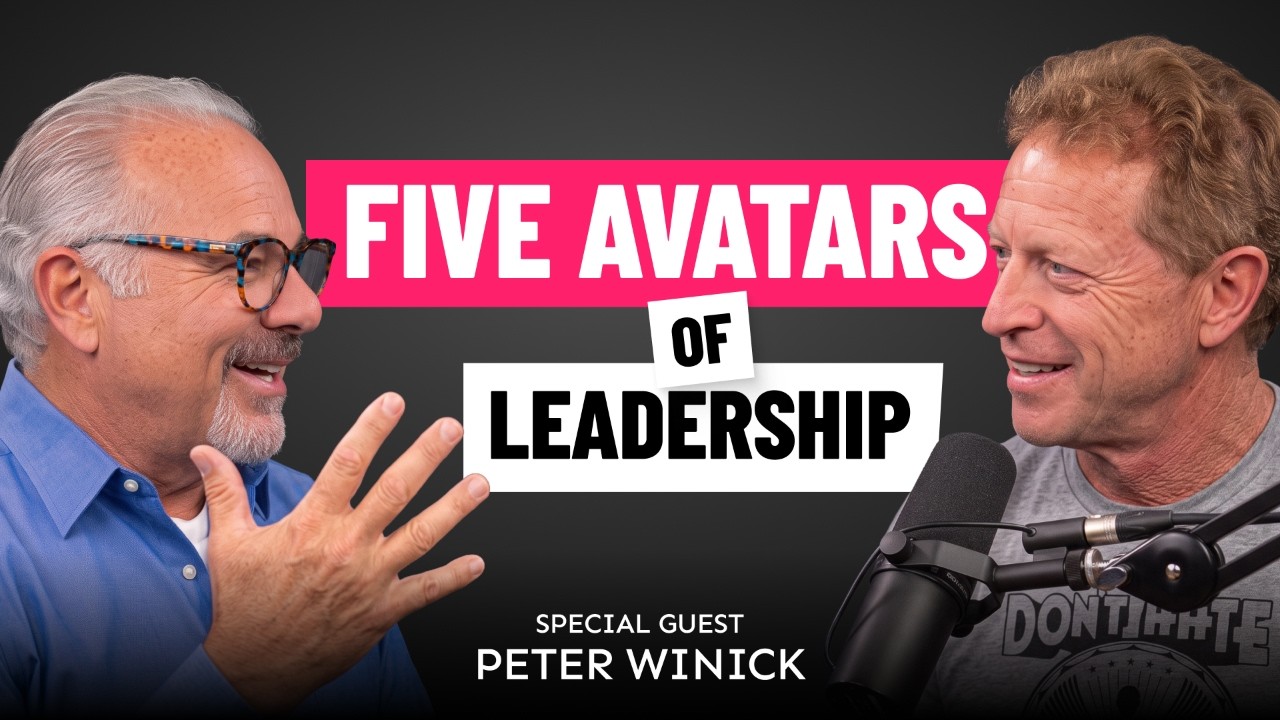
Donnie Tuttle left his sales career to travel for 2.5 years with his eight children, an experiment that led him to develop the "Joyful Farmer" selling approach. He discusses his Genius Effect framework for unlocking individual and team performance, and Fuel's AI coaching platform that offers 24/7 avatar coaches and micro-learning courses.
Chapters
All right. Hello, everyone, and welcome to Fearless. Fearless is a production of Fuel. If you're not familiar with Fuel, I highly recommend you check out myfuel.io. Donnie Tuttle, our guest today, and I are both instructors for Fuel. It's the fastest-growing e-learning platform in the world right now, over 50 countries being served with AI bots, if you want to call it that, speaking multiple languages. I've actually had conversations with my own bot in Japanese and in German. It's quite fascinating. And Donnie, just before this interview, I actually interviewed Donnie's bot to just to get a feel for his answers to some of the questions we're gonna discuss. Fuel is a performance acceleration company. What does that mean? It means it's not just about getting better slowly, but getting better immediately with results after the first session. So we've got a phenomenal faculty. Some of those faculty have been on this show. We now have a number of those faculty with AI. avatars, if you will. What does that mean? It means that in my case, it's 38 years of work experience and wisdom, if you want to call it that, loaded into this avatar available 24/7 that you can interact, role-playing with. Donnie will tell us a little bit more about his as well, because Donnie specializes and he has a coachbook AI, which he'll talk about just a little bit. But Donnie is an executive coach. He's an author, and he's He's really all about bringing out the genius in people. So we're going to talk a lot about the activator of genius, the Genius Effect, which is what he's created, and a little bit more about his coach book, AI. So Donny, welcome to the show. And thank you for being a guest here. Donny also hosts Leadership Live, which I think you've changed now.
Changed names. It's now the Genius Effect. Yeah.
Perfect. And bringing on a number of guests. So I highly recommend through Fuel that you check out Leadership Live as well. So Donnie, give us a couple of soundbites about yourself and where we're going with this.
Oh, by the way, give us some soundbites here. Press the button. And you're thinking of AI Donnie. This real Donnie has to be wound up with With questions. Uh, John, thanks for, thanks for having me, man. Uh, super excited to be fearless together with you. And, um, initially we, we talked, you know, like, tell me about your, your 2 and a half year vacation. And that was, I think that was what you and I kind of, uh, uh, rolled around and came up with. But dude, um, I just love, I love creating experiences for people to help them to connect with these unique God-given gifts that they have. that I think we all have. Um, we just need to find the opportunity, what those are, and find the opportunity to connect those with the people that need them. So happy to serve and, and happy to, happy to take you anywhere in the journey, man. You lead, I'll follow.
Oh, absolutely. We're going to get to that 2.5-year vacation, uh, and what you learned from it. Donnie's got 8 children, and so you can imagine taking 8 kids, uh, and his wife, so 10 people out, out on a vacation for 2.5 years and just the You know, the lessons learned as it relates to not just fearlessness, but just creativity and adventure. So we're going to get to that. But in my conversation with your AI, Donny, I asked you to tell me about the genius effect. And how do you activate that? How do you go about in your coaching to get people to tap into that inner genius? So tell us a little bit more about that.
There are 8 components that we have to that. And we can rattle through a few of those. But the core of it, John, is that all of us have almost inert, inactive gifts in our lives, or maybe gifts that have been activated at one point, but it doesn't really match opportunities. We haven't been able to match those to the opportunities that are being presented in in front of us right now. A genius is, is someone that actually is able to— I even love the word. It has like hints of genetic, has hints of generosity, has hints of generate. These are people that have something input into them, like we're taking from the code that was input into them, and, and creating a way of expressing it outwards. And so one of those keys is personality.
Yeah.
Knowing who it is that you are. And yes, I understand some of the studies say that personality can change, but a lot of them say that it can't. I'm not here to debate whether or not your personality can change, but I just like to look at the history of, of how you succeed. And John, it would be like if you, uh, you, you were a quarterback at, uh, at Notre Dame. Did you throw right-handed or left-handed? What was your— what's your dominant hand?
Right-handed.
Right-handed. So can you imagine if we asked you to run the same playbook back then, but with your left hand?
I can imagine it. I can imagine myself throwing a lot of interceptions.
So that's what I think is happening in real life is that a lot of us have a dominant way of doing things. And what happens is we enter into the professional world, and there, and we're given the playbook, and we're told to throw left-handed. And so when you align, when you know your personality, There are actual ways of expressing that verbally. There are ways of setting goals. There are ways of managing time that are in alignment with, with who that is. So that's a part of the genius effect. It's really just freeing people to the dominant way of how they were designed to operate, so that they can kind of get a lot of this extra stuff out of the way and just, just simplify the path to success. So throwing from their dominant hand. Does that make sense?
Yeah, it makes a lot of sense, Donnie. But I also bring out this for people to consider because I teach Myers-Briggs Type Indicator, which is the most researched personality profile tool in the world. And the MBTI, you've got different, you'd say, polar opposites almost. Right-handed, left-handed is a good metaphor for that. And so when I teach it, I'll ask people, write your name, just write your first name down on a piece of paper with your dominant hand. And They do it without even thinking about it. It's habitual, right? And now say, try it with your other hand. And it takes longer, more concentration, and the quality is not quite as good. But here's the point that I challenge them with is you did it. So if you asked me to throw, you know, play left-handed football, I wouldn't do it very well. Okay. But if I practiced long enough, I think of basketball as an example. You have a dom— you know, players have a dominant hand, but in, in, in the, you know, professional basketball, college, even high school, uh, the best players play with both hands. They can go either way, so to speak, right? They can shoot with either hand. They can dribble with either hand. So my point there is that, uh, I caution people to be too dependent on their dominant side and to exercise that auxiliary. But now, how do you do that? You do that with people who are really good at the opposite. That's teamwork, right? So if I'm highly intuitive, which is part of my profile, creative, looking at the options, looking at the patterns, looking at the abstract, you know, thinking that way, the visionary, I need people to help me with the facts and the specifics and the details and the data. Because this is like absent-minded professor can't find his keys, right? But he's got his mind out there thinking about how to solve world problems. So, you know, I think— And I talked to your AI before this. And I said, and with the AI, when, to anyone listening, when you have this conversation with these AIs, they'll give you some suggestions and some ideas on how to, they'll coach you. But then they'll turn around and say to you, now, how does that resonate with you? And how do you feel about what I just suggested? So it really is a dialogue. And so we talked about the Genius Effect. And I was asked back about, how do I bring out the genius in a team where I'm running a Kaizen event, a rapid change event? And I said to your bot, Donnie, I said, well, I tell people that no one on the team has to be a genius, but we're going to tap the genius of the team. And your AI came back to me and said, well, that's really clever because it takes the pressure off of people. Here's the other thing is that when we start to pull together and synergistically come up with more creative answers because of the diversity that we start to get richer, a richer experience. And I think, talk about this, I think that that process activates the genius in everyone. What do you think of that?
For sure. Listen, I do think that Genius is something to be orchestrated. And I think, I think when you're working with a team, there is something, there's a whole different scenario than let's just say a solopreneur, right? The reality is, is, is though, John, I feel like that we, we step into a situation, we've been given a playbook, and success typically, like what's the, what's one of the biggest laws of success? It's momentum, right? And so we know that if you can start to feel momentum quicker, success begets success, momentum begets momentum. Momentum is made up of what? Moments. And so if we can give someone a moment, a glimpse into what is like their, their optimum experience for them to experience momentum, it's usually still within the purview of their gifts and talents. Now, Gifts and talents. The one thing that we, we all see, we normally see these like in this, like this mono lens. I would say it probably looks more like a, like a diamond cut, right? There's, I don't know how many cuts there are in this fake diamond. I wish it was real. But, but it's like there are, there are 10,000 ways, there are 10,000 applications of what it is that you're bringing. And any of those still within, within your zone, you're going to find more ease. And I'm definitely for being like the—
Yeah.
I like being the utility player. Like, I love and I respect people that can do all of the things, but also the more and more that we are together as teams with AI, and there's just so many opportunities to outsource for momentum. Now, that being said, I still feel like I do agree with you. Like, go practice your left-handed layups. Like, go get good at these things. Like, I think learning is a part of what keeps us young and alive, right? So we both know this. We're both 119 years old. Look at us. We look great. We look great.
Yeah. Well, collectively, we are. We got to, yeah. Well, that's exactly right. But going back to the idea of balance, and all I bring up here is that, and the research shows that when you look at a highly effective leader, it's very difficult to Pinpoint whether they're introverted or extroverted or sensing and intuitive. Because why? They're like the basketball player that can just go both ways. And if they do it well enough, you can't tell whether they're right or left-handed to begin with. Here's another metaphor. In baseball, you throw with one hand and you catch with the other. Have you ever tried reversing that? No. You know, throwing is one thing, but it's awkward to catch with your dominant hand when Why? Because it's not, it's not practiced. So the idea of momentum is, yeah, keep taking steps forward to develop yourself. And you can use personality as part of that. But there's— it goes way, way, way down.
You know that. I 100% agree.
Yeah, absolutely.
There was, um, there's a documentary out, and it's like a few years old now. Um, and I think Doc Rivers was coaching a team that he doesn't coach anymore. But one of the things that he said on there, John, and you would appreciate this, he said, that his job as a coach is to remove the layers in between them and the play, whatever's on the court. And he says, if I can make it to where you're not thinking anymore, you're better. And I would, I would say that in terms of the, the, to the leader that's learned to function one way, Right. that could be like, it could be like a lot, there are a lot of people who have learned, they've succeeded through a persona. And a persona is when we lift up something that we think we ought to be to get the things that we think we want. And it's— I don't want to say it's an act, but it is definitely a filter. And it could be an alter ego, it could be— you could name it. And these are, these are effective in some ways, but it's also de-energizing in others. So like anytime there is a filter or a number of filters, it, it requires higher output from the individual.
Yeah.
And for diminishing returns. And so I'd like, I'm about, I think if we can remove the filter, and it is, John, it is, personality is a part of it. I also feel like, what's your pursuit? Your, whatever your, whatever your vision is, you could be completely, like, you could have all of this talent, but if you don't have a real reason to go do it, a mission or a pursuit, it's just sitting there untapped. But when you have a mission, It's like the moms that can lift a car off of their baby. Like, how do they tap into the strength? Well, a mission does that. What else? Knowing who your people are, knowing these people that you love, and understanding what it is that you were— what problem you were designed to serve, to solve. And because we're not, we're not supposed to be on an island doing nothing. We're here to solve problems, all of us. And what's the process that we go about these? But it's like, I think all of us have—
Hmm.
a unique structure of doing that, that we can align with opportunities that are all around us, that if we can see ourselves and not have to pretend, we end up serving to our highest capacity, and everyone wins. That's kind of the genius effect.
Yeah, well, I hear you. And I think for our listeners, I, No. 1, I'm a huge believer in a clear mission and purpose. Like, why are we here to begin with? And if we're a team, why are we What's our mission as a team? And why is that important? What's the reason for this, the purpose? But then the vision of the mission is what does that look like at some point in the future, right? Now, the real— and you mentioned removing layers, and I love that, Donnie, because great coaches remove layers. So we're clear on our mission. We know we want to get there. But what's in our way? And it's not just tangible things. In most cases, I find it's intangible things like fear. Okay. And if a team is somehow doubtful about achieving the mission, if there's fear, uh, in individuals, a lot of people have great dreams, but they don't get started. They don't do anything because they think they have to know how before they start. And I've said this, Donnie, I love your thoughts on this, is that the how shows up along the way.
Mm-hmm.
Once you're clear about what it is you're trying to accomplish. And you just start moving to build that momentum you're talking about. And the more you get through the different hows and the hurdles that come up, the more confident you become. And by the way, that challenges the genius in all of us. I mean, when I started my practice 38 years ago, I didn't know how to do any of the stuff I've been doing. But the fact that I figured it out along the way with help from people, by the way, I didn't do this all by myself. It, it, it built moment— momentum, but it also tapped the, the creativity, if you will, to the genius in me. What are your thoughts on that? Removing those, the layer like fear.
So, oh, bro. So I feel like that what you just described is, first off, it actually describes the 2.5-year vacation that I wrote about in the book Sell Anywhere, which we'll give away for free. to anyone who's here if they enter the code fearless. But, um, I'm going to tell you the story. I don't know if you know all of— like, I— yeah, we painted it like it was a 2 and a half year vacation. But this is, this is how I do think that when a hero steps across the line, it's called stepping across the threshold, that totally unpredictable things will appear. Some feel like they're not in your favor. Other things, they're very much in your favor. And so, in 2015 or 2016, I can't remember the year, and even if I told you, I'm going to get it wrong and my wife's just going to yell at me when she hears this because I always get the years wrong. Okay? But we asked our kids, we have 8, as you mentioned, we said, hey, do you guys want for this Christmas, do you want presents or do you want to go see snow? We live in Florida. None of our kids have ever seen snow. So they said, snow, everyone together, right? And so we went up to Michigan, um, as far as we could go, Upper Peninsula Michigan. We were looking at the Canadian border, no snow, but we had a beautiful Christmas and we were in a log cabin for a week. And on the way back home, we started— my wife and I had this, you know, you have a lot of time to talk on the way back. And we said, well, what if we could, what if we could do this more? What if we could travel more with the family and do these things? How would that be? And we started just relishing in it and imagining it. And, um, and then we somehow in our mind, we said, John, look, we said, oh, we're gonna do it, we're gonna find a way. And the first thing that— you're gonna, you're gonna laugh so hard at this— the first, my first brainiac way of doing it. So I was a sales trainer back in Gainesville, Florida, making $70,000 to $90,000 a year. It wasn't like, you know, like And it was, it was very like we couldn't go anywhere. We had to be there. And, um, it was, uh, my brain came up with the idea. This is what— this is why I said I'm gonna start a podcast. I'm gonna get famous, and then we can do it from anywhere. And, um, so as soon as we got back, I bought this little— I still have a piece of equipment called a Zoom H2 Handycam recorder. It's like a— it's a voice recorder. You can plug microphones in. You plug microphones into it. And I listed out, and I listed out 12. Getting a bad echo. Listed out 12. Getting a lot of feedback echo here. If there we go. All right. So listed out 12 of the 12 12 people that were people that were that would be interesting, and I reached out to them and asked them for if they would do an interview. And so I started the Sales Heroes Podcast. Back in 2015, and people came on. I can tell you I never got rich or famous, but after the fifth episode, a coach heard the woman I interviewed. I interviewed a woman named Vicki Sherman, and a coach heard Vicki Sherman and tried to recruit Vicki Sherman, or she tried to book a workshop with our organization through Vicki. And Vicki's like, "No, I don't think so." But you need to talk to Donnie. And that turned into from a her trying to book a workshop to her recruiting me. And what I did, John, was I said, you know, she she asked me if basically I took the job. I I ended up it ended up being off the podcast. It didn't make us rich or famous, but it did provide the opportunity to begin the journey. And so, you said when you make a decision, the stuff shows up along the way. Well, it gets even better than this. So, we make this plan for like the next year. We decide not to re-enroll our kids in school. Like, there's all of our brain is just going in that direction. And in 2016, we end up, we sell everything or we give most of it away. We didn't have really a lot worth selling. And we, um, we didn't have— we didn't have a lot of money. So none of this was fiscally responsible. None of this is like, oh, you're so successful. This is what— this was like, we didn't really have anything. But John, we said, well, we have this— we were deciding to buy the house or not. We have this money we pay for rent, and we have this money we pay for electricity, and we have this money we pay for the internet. We can use this as our Airbnb fund. And that's what we did. And We left Gainesville, Florida, and, um, and we didn't even have trailers. We had to like— we had a trailer and somehow the lights didn't work, so we had to leave behind the kids' bikes and all kinds of stuff. 2 vehicles, Chevy Suburban up front, the Honda Odyssey in the back, all 8 of our kids and all of our possessions loaded into these things. And, um, getting out was pure hell. It was hilarious. But, uh, but we leave and we go to the first place we go to, John, was a place called Charlestown, Rhode Island. And coaching business had picked up, had done decently for me, and I was selling and coaching and it was doing great. And in here we are, and we're in Charlestown, Rhode Island, and all the appointments I used to be able to book, I couldn't book. Nobody would meet with me, and I was, I was upset. And this was like the theme of the first 6 months. I was walking the beach, um, in Charlestown, Rhode Island And John, there were so many pebbles in that beach that whenever, whenever the ocean would, would, would roll in, it was just click, click, click, click, click, click, click, click, click. And I'm just like kicking the ground. And I'm a, I'm a Christian, so I'm praying to God. I'm kind of like, man, God, why am I— you know, I'm like having like a pity party conversation with me and God. And my kids are somewhere nearby. And I look down, and this is the craziest thing. I look down at this antique brick. I'm gonna get it for you right now because I still have it. And I'm going to tell you, like, all of the fears, all of the thoughts of how stupid and idiotic I was to do the thing that I'm doing, all of like the dark night was there, and it, and it sucked. And I, but I looked down in the midst of everything being so sucky, um, I pick up this brick, I'm like, oh, what's Interesting and curious and odd. Looks like it's 100 years old. Turns out it was 100 years old. Do you know how I found out? The name that was printed on the other side. It has my name like listed. I'm walking complaining, man, God, where— like, it's like I'm in the middle of fear and anger and all of the things that come with that. Fear turns into anger for me a lot of times. And, um, and I find this brick with my name on it, and the rest of the journey would, would go along with that. A few months later, I figured it out, turned the corner, and learned how to sell in a way that was genuine to— actually, this is the beginning of The Genius Effect. I learned how to sell like myself. And, um, but that was, uh, you know, that's, that's a, that's a part of it. That's like one of the darker parts of the, um, Yeah. darkness and brightness of that journey.
Well, yeah, and it's an amazing synchronicity, Donnie. I, I, I believe deeply in synchronicity, that there are messages being sent to us from, you know, wherever. Um, but they are— it's important to pay attention to those. Uh, the other thing is, obviously, you— it took a great deal of courage to just leave everything behind, take your kids on this amazing adventure. I didn't do anything quite that extreme. But when I— after I wrote my first couple of books, I bought a motorhome and I was going to do, you know, a national book tour, which I did. And I lined up some speaking engagements, things like that. But my kids to this day, Donnie, I have 4, they talk about that motorhome trip. They've been to all but Alaska, all of the states except Alaska, all of the national parks, everything. They remember that more than anything. And I remember people saying, well, do you know how to drive a motorhome? No, I'll figure it out.
Figure it out. Um, it's like the Richard Branson, how he said, he said, screw it, let's do it. And that's like my favorite, like, why not? And that's always been my approach with this. It's like, why not? Like, it's not that hard. It's figureoutable.
Yeah, we can do this. Yeah, exactly. And this was only like a 30-day, 40-day, uh, excursion, nothing like 2 and a half years. Uh, it was during the summer, the kids were out of school, things like that. But, uh, then we ended up doing that every summer. Not quite a month, but a couple of weeks, 2, 3 weeks. And we just explored and figured out the how along the way. By the way, this is before GPS. You know this. And this is before you got—
I couldn't have done it then.
Yeah. We're looking at atlas maps and finding KOA camps and things like that, parking in Walmart parking lots overnight if we needed to, things like that. But yeah, it's that whole sense of adventure, clearly. Now, you know, Sell Anywhere, I know you said you're gonna get a free copy of that. I think Scott's got the barcode on it. You've got the book. And how do people, there it is, how do people other than just taking a picture of that, how do they get the book?
Yeah, great question. So this is actually built into my proprietary CoachBook. And a CoachBook is an audiobook that you can talk to. So in between chapters, you actually, so it's narrated by, this version is narrated by me. If you get an Audible, it's narrated by Michael, I forget his last name. He's awesome, but he's a famous narrator. But this one is narrated by me. In between chapters, you get coached by me, so we calibrate it to where you're at. It is free, but all you have to do is you go to sellanywhere.coachbook.ai. So if you go to sell any—it's sellanywhere.coachbook.ai. There's a code they'll have to put in. And John, it's Fearless, all capital, Fearless. If you put— if you input Fearless, you will get it for free. Um, it's literally— it would, it would be like having sales coaching with me for a couple of, you know, couple 2 or 3 hours. And, um, enjoy my, my gift to you. If you're an author and you want your book to do that, you need to find me. We'll, we'll talk about how to do that. But for right now, this is just how I I serve people with this book who are looking to find their voice and how to sell like themselves. One of the things I talk about is I used to, I used to approach things, I used to approach things, I called myself the sales warrior. Okay. And I, John says, I'll do whatever no one else will do so I can have the things that no one else will have. And In the middle of my journey, um, like it says, like a few months after I found the brick and I was at my breaking point because, and my kids noticed, they kept noticing how sucky I was at the end of every day. And, uh, I would, um, essentially they, they helped me to realize that I loved what I did. I just didn't like who I thought I had to be when I was selling. And I learned, I went almost overnight. I'm like, you know what? I'm not really doing great anyway. Yeah. And this isn't like, I don't like that. I don't like being that guy. So I'm at least going to be the me that I like to be, and I'm just going to try that, and we'll bring that to the marketplace and see how it does. And it did awesome. So I called myself the Joyful Farmer, and I decided I was just going to serve, serve and love and give and like have fun along the way and not care about if I close people correctly or if I did this technique or that technique. It worked great. It was a part of my big evolution as a like becoming a fearless salesperson because now I didn't have to pretend anymore and hold that persona. I helped a bunch of other clients to do it. But, but that's all in that book, Sell Anywhere, and it will help other people to have that moment for themselves as well. That's what it's designed for.
Oh, Donnie, you're breaking new ground. So, and I, and by the way, I think of that brick, it isn't just that your name's on it, it's that it's a brick. It's foundational. It's as hard as a rock, right? So you're the rock in the family. My kids refer to me sometimes as the rock. You're my rock, Dad, things like that. But it's— so that's, that's, that's, to me, that's another very powerful metaphor, if you will. And, uh, but this, but, but this, uh, Sell Anywhere and the audiobook, I think that's genius, uh, Donnie. I think that's brilliant. I think about all of the books I've read over the last 4 decades professionally, uh, to help figure out the how, you know, the how I say shows up, but you have to look for it. You know, you have to surround yourself with brilliant people if you want to have a brilliant career. So I would do that. But I never had the chance to actually have a conversation with any of the authors in depth. You know, I did spend a day with General Schwarzkopf, the late Schwarzkopf, Sorman Norman.
Wow.
We were speaking at an event together, and we're on a— we're actually on a private jet flying across the country. And he goes, you know, there's a death threat out on me, right? I'm like, oh, no. But, but To spend time.
There's no death threat on me, so don't worry about it. Like, this isn't gonna threaten you in any way.
But to read a chapter, and this is for the audience, I really recommend this, to be able to read a chapter on Sell Anywhere and then have a coaching session on that chapter, you know, where it's really interactive. Donnie, I think that's brilliant. And so I can't recommend enough that people do that. I also wanna recommend to our audience that you check out Donnie's podcast 'cause he's got some great guests coming on every week. It's every week, right, Donnie? Every Wednesday?
I mean, I'm having, um, we're starting to do— yeah, it was live. It used to be called Leadership Live. Then for a little bit, it was like some of my stuff wasn't live because people were like booking times. So I'll— I have a couple, 2 or 3 a week, and we're, we're backed up. And so it'll probably be a couple of times a week just so I can start to clear some of the, the chambers. But, uh, yeah, it's now called The Genius Effect. We haven't let anyone really officially know that yet, but But The Genius Effect, yeah, it is how we help people to connect with that unique and powerful person that they are and bring it to serve others. So it's all, it's leaders, authors, and speakers that we're working with there.
Yeah, well, Adani, thank you so much for being a guest here on Fearless. You know, you and I could talk on and on and on about some of the courageous, if you will, almost fearless things that we've done to learn and to grow. And I've always said this to people. If you make a mistake, which some people might call a failure, but you learn something from it, Murphy doesn't see that as a mistake. Murphy sees that as a, you know what, a positive move. And you make— I can't even tell you how many mistakes I've made over the years, but it got me where I am now. Okay? Every single one of them. And But I also want to say one of the tips that helped me so much over the years is to surround myself with very genius, bright people.
Yeah.
And if you don't know them, you can buy their books, you can buy their audios, you can listen to their podcasts. But just, I recommend to anybody who's really serious about their career, feed yourself, feed your mind with creative genius ideas. Then, you got to do something about it. That is why Fuel is such a powerful platform because it is performance acceleration. It is 15 times more powerful in impact than traditional education training, 15 times. So, you get immediate results after 1 session. You go to myfuel.io. There are the instructors like Donni and myself and a number of Hall of Famers and New York Times #1 bestsellers, people like that, and you are learning from brilliant people. Through microcourses. What's a microcourse? It might be an hour long broken down into 10 6-minute lessons. I have 2 of those on creative problem solving and on beyond doubt, essentially fearless leadership. And you go through a 6-minute lesson and then you have to actually apply it. It's like golf. You got to swing the club, not just sit there and intellectualize it. And so, Check it out. It's, it's amazing. Uh, next week on Fearless, we've got Colonel Brian Cook. Donnie, I know you've had Colonel Brian Cook on your show.
Yeah, he's great.
Um, 5, 5 combat missions, uh, the Army. He's a colonel, um, uh, author of Set the Table. Well, that's gonna be our, our theme next week. What does that mean to set the table? And just, uh, amazing stories from Brian Cook. So Donnie, uh, give us a, a one-liner, if you will, or a couple of lines on Brian Cook and your experience with Brian Cook, cuz you introduced me to Brian Cook.
I did. I would, I would say, um, Brian Cook is intentional and strategic. And, uh, when you hear the story of how he, um— this guy's died a few times. He's died a few times. And, uh, how he was able to come back better, but also not just better like as though he got better results, but just as a better human being and learning to have permission to create the life that he wanted to have. His story is remarkable. You're going to love him.
Yeah, absolutely. What was he? He was managing an $18 billion training budget.
All of our armored tank strategy that we operate with now all came from him. So he built how that works. Yeah.
He's remarkable. So tune in, please, everybody, to Fearless every Friday. Subscribe and share, if you will, on YouTube. And then also check out Donnie's Leadership Lab. Well, actually, The Genius Effect, right?
The Genius Effect. Yeah.
Genius Effect. And get, yeah, and get your copy of Sell Anywhere and really play and play with the AI bots or avatars, if you will, including my own on Fearless and a number of the other instructors. It's truly remarkable real-time coaching, 24/7, multiple languages. It's fascinating. And I think a very positive use of AI where a lot of people are afraid that it's going to be dangerous. It's all about how you use the tool. It's not the tool itself. So with that, thank you everybody for tuning in to Fearless this week. Thank you, Donnie. I love you, brother. And we will see everybody next week on Fearless.
Thanks, John.