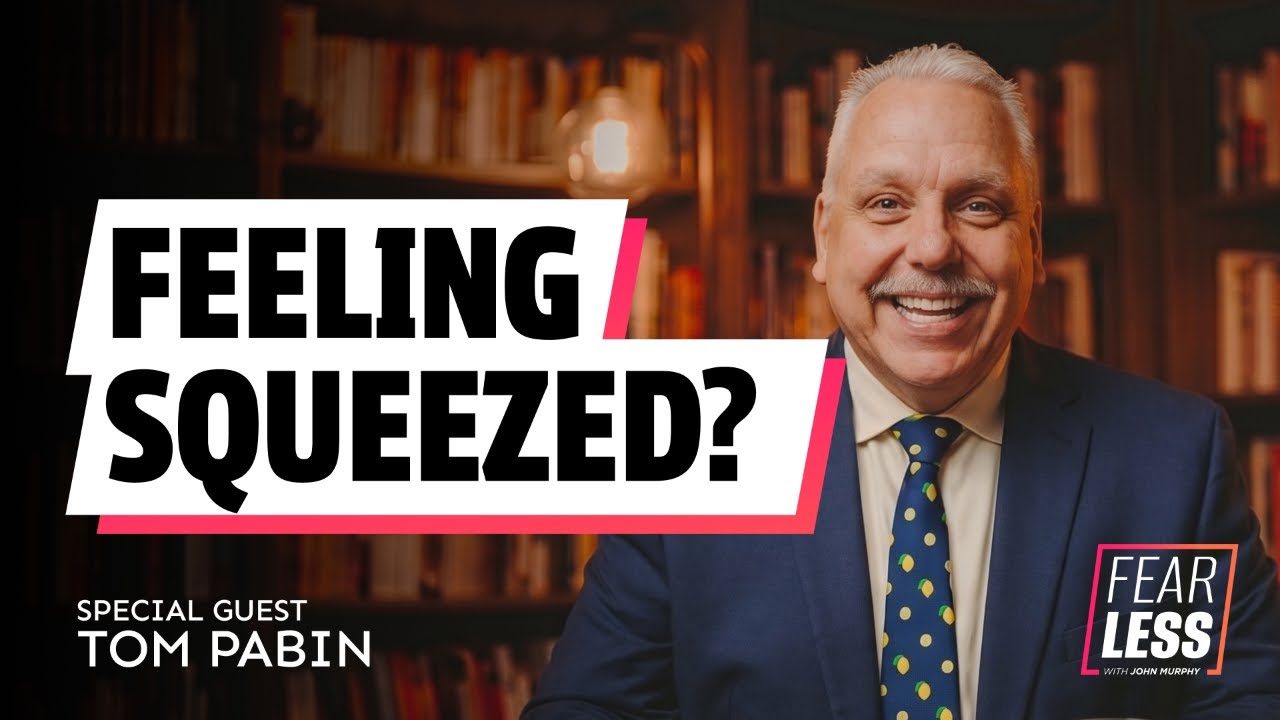
Tom Paben, founder of Class 101, talks with John Murphy about turning pressure into purpose. He shares practical strategies like micro-steps and FMEA to overcome limiting beliefs, and explains how competence builds into confidence and conviction.
Chapters
Well, hello everybody and welcome to Fearless. This is our 22nd episode now, and Fearless is a production of Fuel. Now, if you haven't checked out Fuel, I highly recommend it. It's one of the fastest growing e-learning platforms on the planet. It's, uh, it's like becoming the, the Netflix, if you will, of applied learning. So not memorization learning where you go to school and take notes. Imagine trying to play basketball learning from a textbook in a classroom. No, you'll learn how to play basketball or any sport or any instrument or essentially any skill in life By doing it, not by thinking about it and planning it for another day and studying it and theoretically getting it. No, FUEL is about immediate applied learning so that you actually finish quickly with the skill being developed, whether it's selling, closing deals, leading people, speaking, whatever, meditation. It's a broad platform. I'm privileged to be one of the FUEL instructors. along with some just fantastic New York Times bestselling authors, Hall of Fame speakers, top TEDx talkers, things like that. You have access to a phenomenal learning platform at an incredibly good deal, if you will. I, 40 years ago when I was getting started, I was looking, you know, at reading books, going to the library essentially, no internet, no Google, no YouTube. But I highly recommend, if you've heard me before say this, lifelong learning. And so today, Tom Pavan and I are going to talk a lot about that and just what does it take to get through fear, to get through anxiety, to deal with adversity, things like that. And you've got an excellent group of instructors ready to help you, coaches, if you will. And Tom is a business coach, also a keynote speaker, the author of the book Squeezed. So if you're ever feeling He's got me a signed autographed copy here and I'm just loving it. He'll tell you more about his story with that. And so check out myfuel.io and you get a 7-day free trial and you can actually interact if you like with my twin, my AI twin. Now my AI twin is downloaded with essentially 40 years of my work. What does that mean? It means I have 20 books published, hundreds of articles, hundreds of YouTube clips, hundreds of interviews, all loaded into my bot, so to speak, my AI twin, where you can ask me questions, anything within my body of work, and get immediate 24/7 responses in multiple languages. Essentially, the bot, the AI twin, has Better recall than I do, and that's my entire body of work. Incidentally, anything you ask any one of the Fuel instructors, AI twins, they're not going to the internet to get you an answer. It's not like Googling something. You're you're you're communicating directly with the coach. It's a phenomenal use of AI, and it's a tool you can check it out again free for seven days as part of the Fuel platform. I'm super excited about. Delivering to the world what we have to offer, especially around dealing with fear and doubt and anxiety, leadership strategies, team building tips, just phenomenal stuff. So that's Fuel. And then each week, as you know, on Fridays, I bring in a special guest. Not always, sometimes I do the show solo, but guests who've been there, done that, and really have something powerful to offer. Not theory, but actual practice. Wisdom. I always say wisdom comes from experience. You don't gain wisdom in a classroom. It comes from the school of hard knocks, if you will, in some cases. Really getting knocked down, having to improvise, having to figure things out. One of my courses at Fuel is called Creative Problem Solving. Sometimes it just means I got to get creative here. I'm not quite sure what to do. But doing it with courage, doing it with tenacity, doing it with inner peace and strength. So that's what we're going to be getting into today. So Tom is going to talk to us about this whole idea of being squeezed under pressure. And he may talk a little bit about his athletic background. I can certainly relate to that, where the pressure actually helps you perform at a higher level. peak level, if you will, where you actually thrive on it because you know it's helping you elevate your game. And Tom will also talk about how it helps people find their purpose and what they can do to give. So with that introduction, Tom, give us a couple of opening words. Tell us who Tom Paben is and where you— how you ended up here.
What— Yeah, right now, honored to be here today, John, and be part of um, the, the whole fuel process, right? Because, um, everybody has within them, you know, certain, certain gifts, um, and most of us don't have, right? Most of us are not 7'2, right? So our gifts are not so easy to say, hey, you should be playing basketball, right? Most of our gifts are hidden, and, and unless we try to, unless we try to experience— I mean, think about it, you could be walking around today Being lucky and you wouldn't even know it.
Right.
You played the lottery or went to the track or did something, right? I mean, you wouldn't even know it. So think about the gifts that you have in your life that you don't even know it. So what happened for me is I got involved in some opportunities that those gifts, they become alive within me, right? Because it was exactly where I needed to be. So originally from Youngstown, Ohio. So grew up in a steel mill town. My dad was a steel mill worker. So that means, right, what? Consistency, right? So that was my model. That was great, right? Just kind of get up and do your thing every day. Nothing fancy, nothing too sexy about that, John, but it sure was a great model for me, right? Get up and go to work and be able to do that and do your chores, right? And, and continue to do that every day. And so there was some value in that sense of accomplishment and just being consistent.
That's right.
That's where I got it. So my mom passed away when I was young. I was 10 years old. And what happened was, is 29 years ago, when I was in my mid-20s, my father got ill. I was living in Kentucky. I was a youth minister and, and I was a financial advisor. And so I took some time off from doing those 2 things and went up to help take care of my dad in Ohio, Youngstown. And so what happened is I spent the best 5 months of my life with my dad, and my dad passed away. So here are my parents, my godparents, and my grandparents had all passed away. I'm in my mid-20s, and I said what anybody would say, life is short, right? So that's when I decided to give my life to teenagers. And what happened was, is that was in, uh, I thought that was going to be at my church. I thought it was going to be this youth minister extraordinaire and, and, and do that. And I did that for 9 and a half years, but I did it volunteer. I didn't do it for pay. And so what happened was, along the way, I realized I wasn't going to be able to make a living, right? Be able to have a family and have a dog and all the normal things. So we had a young lady in our youth ministry program that said, hey, I need help on my college planning. Right. And so I said, oh, and her mom said, well, you're her youth minister. She'll listen to you. Right. So Um, so we would go to this restaurant here in town that was formed here in town called Fazoli's, and we would go to Fazoli's and, uh, have breadsticks and talk about college. And that's kind of how it all got started. So believe it or not, from one person at Fazoli's restaurant, right, uh, meeting at her house, um, um, I actually started that day, um, August 27th, 1997. Be almost 30 years Started a college planning firm, and that ended up launching, and it was just an adventure from there.
Yeah, that's Class 101, right?
Yes, that is correct. Yeah, the name of the company is called Class 101. Originally, the first 10 years, it was called College Finance and Planning. A lot of people don't really know that, but And it was going so well, I didn't really know what to do. So, you know, because I mean, think about this is 25, 26, 27 years ago. So, it didn't have, you know, I was asked to go to Nashville and Cincinnati and ride 2, 3, 4, 5 hours. And I didn't know what to do. So, I started, somebody said, you got to franchise this. And I was like, I don't know anything about franchising. Of course, I didn't know anything about college planning. So, but I was willing to learn. I was determined to learn. And so that was my key. So part of being, I guess, fearless, right, is, is, is finding the things in your life that, that you enjoy so much that when those hard days come, it doesn't matter, right? Because you're so, right, you're, you're so into whatever it is, you enjoy it so much. Most people quit because they don't really love what they're doing, right?
Yeah.
And so then they, they toss it aside and it's, it's not worth anything. So I started So, I built a 10-year model. Who knew that that was going to be one of the best things that happened is I had a 10-year model. And so, at my year 10 is when I started franchising. So, I had all my systems in place, right? AKA franchise, right? And so, then it took me 5 years to open up the first 5 locations. So, now I have a 15-year-old company and then we opened up 3 in year 16, 3 in year 17. We got crazy in our 18th year and opened up 4, and then it was 7 and then 13 and 8 and 3 during COVID and 8 after COVID and bing, bam, boom. Next thing you know, we have 50 locations in 30 different states.
Yeah.
Wow.
Yeah. I've got a number of questions for you, Tom.
Yeah.
And around the whole topic of fear and, you know, so that our audience can really get some deep insight into just, you know, what you teach, what you speak and write about. So first of all, like, what do you think, you know, fear can do to a leader? What can, you know, what is, what impact does fear have on a business leader? Oh, boy.
It freezes you. Right? I mean, it causes you to have hesitation, right? So that's what happens with fear, right? And so fear is, fear is noisy. That's what fear is. Right? And so when I feel the most comfortable with myself and the most confident with myself is when I'm competent in what I'm doing, and then that's peaceful, right? So for me, I knew for my business to become limitless, I had to become fearless. And so I did some things. When I first— my first business adventure, I started by living out of my car. That will create some courage and some bravery. And malnutrition, by the way, is a motivator also, right? I mean, that will make you do certain things. So When you have no choice to do it, typically us as humans, we'll do it. It's just most of us are living in this world in between. So because we don't wanna live fear, we don't wanna go outside that comfort zone. But that's really, right, like my book, right? Where's the fruit? The fruit is out on the limb, right? And so that's where you gotta put yourself, out on that limb to grab the fruit. So really for me, fearless is in being conquering fear because anything worthwhile is gonna have fear, right? You buy a car, you might have some fear. You get married, Oh my gosh, am I doing the right thing? Right? People have cold feet, right? Because that fear starts to come into your mind. So I break it down. That's what I do. I break things down to the ridiculous, right? You've heard all the acronyms, false evidence appearing real. I just, I was a big guy. I've always been tall. I've been 6'2, 6'3, right? My life, 200, 200, now 250 pounds. And I used to be deathly afraid of roller coasters. I mean, I would get in a roller coaster. I used to say, I can't fit in those things, right? I'm gonna fall out. And for years, I didn't get the enjoyment of riding a roller coaster until I said, gosh, how many people have fallen out of that thing? I never hear people— 10,000 people ride that a day at Cedar Point, Ohio, right? And nobody's fallen out of that roller coaster, right? And so I broke it down and I ended up getting on the roller coaster for the first time.
And Right.
And my life became limitless.
Yeah. You know, I know you grew up in Ohio and Cedar Point is just one of the top amusement parks and fast— some of the fastest roller coasters in the world. I've been there with my kids a number of times. And I was going to ask you about Cedar Point. That's hilarious. But same thing with people who are afraid to get on an airplane.
Right.
You know, statistically, it's safer than crossing the street. It actually is. And statistically, it's a lot safer than You know, get— getting in your car and driving somewhere, but people are terrified of it, you know. And I speak a lot, Tom, about how fear is just a projection from the mind. It isn't that thing out there that scares people. It's what you think of that thing out there that scares you.
Wow.
So change your mind, it changes everything. It's all, it's all in the mind. So what scares you might, might not scare me at all, and, and it's because of what's going on in our minds. Some people are terrified to give up and get give a keynote. You know, it's one of the top fears supposedly, you know, getting upstage. And, uh, but they can talk openly and comfortably with, with a family or a group of friends anytime, which is public speaking. You know, as Jim Cathcart says, it's just you're, you're having a conversation with a few people. That's public speaking. So what's the big deal about getting up on stage? That kind of a thing. So one of the things I wanted to ask you is, from your perspective, because you write about and talk about this, is how do you conquer— how does one conquer How does one actually get through that barrier, that obstacle?
Yeah, you're exactly right. It's the things that we're telling ourselves in our minds, right? So, believe it or not, I stopped believing my mind because a lot of times we hold back, right? You know, you're getting ready to go into surgery. A lot of times you think of the bad stuff that's going to happen more so than the good stuff, right? It's late night and you're walking outside your office and you think, you know, somebody's out there, right? And because you start building this stuff up, you know, in your mind. So what I do is I just, you know, I just stop believing myself and I go with facts.
Believing myself.
I go with data, right? And so the data is where it's at. So I do data-making decisions. So I am going to say, you know, what's the odds or what's the chances or— and try to just not talk it down with facts. And so that's how I do it, right? I mean, if I want to lose 40, 50 pounds, it's easy to say, gosh, there's been tens of thousands of people in the world that have, right, lost 50 pounds. So why can't I do it? It's not like only one person's done it, right? And so, so that's what I started to do. So I tackle fear with, with the other F words, facts.
Yeah.
And faith, right? Because faith is really where it's at.
Precisely. And I've often said this, I even have a t-shirt that says faith over fear. You can't have one and the other at the same time. It's, it's when you really boil it down, you either have true faith, which is fearlessness, or you have fear, which is the absence of true faith. So which one are you going to choose? Now, we're both former athletes, and I've used this metaphor so many times, but I use it because it speaks not just to me but to a lot of people. If you approach the day, you wake up in the morning and the day is full of uncertainty, do you wake up afraid? And the metaphor is, if you were a quarterback walking up to the line of scrimmage, You've been practicing, you're skilled, you're playing as a team, you have a strategy and a game plan, and everybody knows what to do. But when that ball is snapped, it's uncertain, right? And you might be running for your life, you might, you know, you might get hurt, or you might score a touchdown. The point is, is when— what's in your mind when you approach the day or the line of scrimmage? Are you nervous and anxious and afraid? Because, you know, as an athlete, That ain't gonna work. You know, you're— the defense is going to read you like a, like a dog reads a person. You know, they're going to sense that fear and it's game over. And your own team is going to sense it, which means you're not going to get a lot of playing time. So that's, that's critical, that to find your way through the fear. I use a tool called the FMEA, and I've talked— I teach this in one of my Fuel courses, the Failure Mode Effect Analysis. A simple version of it is saying, well, what could go wrong Right. And how serious is it if it goes wrong? 'Cause it might not be serious at all. So I say something and I trip over a few words or I stumble up the stairs to get on stage. So what? You know, people can see past that. You know, it's kind of a so what attitude that, you know, it's not that serious. And if it is, the key to the FMEA is what can I do now to mitigate that risk? To, to, to change it. And then I always reverse it and say, what's the risk of not doing it? So it's not just the risk of doing it and evaluating that, look at facts and data and statistics like you talk about, but the risk of not doing it. And to use your, you know, your metaphor of, of it's paralyzing or it freezes you, the, the risk of being frozen and not doing something you're capable of. And not really stretching to your true potential. Now what? Well, the risk of that is you're living with regret. You're living with almost a sense of deep guilt, like, I shoulda, I coulda, I didn't, and I'm just replaying the past. So, another question for you is, how do people identify what it is they're afraid of? How do you uncover that? Because a lot of it's subconscious, right?
Yeah.
We're downloaded with— most of our downloading, most of our subconscious mind is by the age of 6 years old. Again, and this is science. So we're downloaded with all these programs like, I'm not worthy, and I'm, you know, that's wrong, and that's wrong, and don't go near the pool, don't go near the water, things like that. We're downloaded with fear essentially as human beings. So now how do you identify What you're afraid of? And at a deeper level, why are you afraid of it? Because you got to get to root cause to delete it, right? To really solve it from a root cause level, not a symptoms level. So, how do you help people as a coach identify what is it you're really afraid of?
Yeah. Well, I mean, some things I don't have to be afraid of, right? I'm not worried about jumping out of a plane. That doesn't interest me, right? So, that fear I don't have to worry about, right? So, I don't worry about any of the fears that really don't apply to my life. And like you said, right, I mean, certain people are afraid of certain things, whether it's public speaking or whatever it might be. So it depends on what avenue you're going down, right? Some people are afraid of, of, of being leaders, right? Some people are afraid of putting themselves out there, right? And so, so it depends on what avenue. So the first thing I would say is, what's preventing you from being the, you know, you always hear the best version of yourself. Right. Because you're right. I mean, there's a, there's a certain part of everybody that's probably better than what we are, right? I mean, if we started exercising today, you'd run faster in a month than you do now, right? So, and, and so now you have the big thing that comes up. It's mental health, right? Is mental health an offshoot of this fear thing, right? It's just kind of a little bit of an easy way. And mental health is a real thing. So I'm no psychologist, but it is another one of those easier types of things to say I got a mental health issue, or maybe it's a fear issue, right? You know, as far as that goes. So sometimes those can cross over. People have to believe, right? And so I surround myself with people that help me to believe, right?
Right.
I share a vision and then we do it together because Typically, nobody does anything alone. So you're going to do it with others. So how do you overcome that? You do it with other people. If I know I got to show up and do my part with the team, I'm going to go ahead and do that because I got to. Again, absence of option gives you power. When you don't have an option, you will do it. That's from the book. That's a chapter in my book. I mean, so many times. So here's what I would say to anybody. Um, so we have had— I sold the company in 2022, my, uh, college planning business. Um, I still have a local franchise with my business partner, but right, we built the country's largest college planning firm. And I have— John, I've never been to college, right? I did franchising, and, and I don't know, I didn't know anything about franchising. Uh, and I wrote a book, and I consider writing, writing to be my 79th best gift. Right? Meaning, I wouldn't say I have a talent towards that. So what I'm trying to say is I consider myself a pretty average type of fella. Now, maybe my determination's above average, and maybe my enthusiasm or my energy's above average, but I wouldn't say I'm super fast or super smart or whatever, right? But what I am, what I have gotten down, is I do the things that I'm passionate about, and I just learn how to, how to do those. And I do that by modeling examples and doing it with other people. So I hope I answered your question there. But if you surround yourself with people that lift you higher, and if you're doing it together with some, some putting yourself out there a little bit, right? Because that's, again, that's where the fruit is, out on the limb. So you put yourself out there a little bit, small by small by small, you'll gain more competence, and the competence gives you confidence, and then you live life with conviction, and then that conviction allows you to have more confidence, and that opens up a new capacity in your world, right? And so that's the 4C chapter in my book, right, um, as far as that goes. So nice segues, John, to help me, uh, publicize my book here. But, uh, but yeah, I mean, so, so fear is, um, really the things that an individual is preventing them From something they want to do, right? And so, right, you tackle that by help by others and by putting yourself out there with one small step and that next logical step in that, and that will get you to where you want to go.
Absolutely. And I like the idea of those micro goals, those baby steps, if you will. You just, you know, use the example earlier of losing 50 pounds. You know, a lot of people in their mind, they get on a treadmill, they start exercising, and what's going on in their mind is, I'm overweight, I'm, I'm, I'm fat, I'm, I'm out of shape, I'm getting old. That's what's going to happen when you believe that. I'm getting old and I'm going to stay this overweight weight because that's what I'm telling myself. And so I advise people to say no, because when you go to bed at night, you still weigh 50 pounds more than you want to.
Right.
So in other words, you failed the day in your mind. But no, what you wanna do is you wanna tell yourself that I'm on my way to a target weight, whatever that happens to be. I'm on my way. So when I'm working out, I'm walking, I'm doing anything, that mentality is taking you there. Dr. Bruce Lipton did an amazing study, you know, quoted an amazing study. I mean, his book, The Biology of Belief. Essentially, what we believe influences our DNA. I mean, it's incredible. So if I— one of the examples was a group of hotel room attendants, or people that come in and clean up the rooms.
Right.
One group, the control group, was told, just keep cleaning the rooms. Okay? And the experimental group was told, think about exercising while you're cleaning the room. You're bending over, you're lifting up, you're moving around, you're making beds, you're exercising. And they did this study for a while and the control group, no change essentially. The experimental group with the change in belief, the change in thinking, had much better health metrics, lost weight, felt more energy, just had a better attitude, better mindset. Again, just by changing their belief. So when people think in their minds, and a thought that you think long enough becomes a belief. And then when you do root cause analysis and you get to the belief level and you start to question the programs that you're running on, that inner story, and I could never do that, you know, that's just, I don't have the skills, things like that. Wrong. We don't even come close to our true potential in life. You know, when you look at the psychological studies on people and things like that, we don't use— A fraction really of our brain capacity. This is science, not philosophy. So you start thinking about, like you said, you never took a college course or whatever, and you started this amazing Class 101 business and franchise. You know, when I started 38 years ago now, I, I didn't know a thing about consulting. I didn't know a thing about writing books. I didn't— there was again no internet, no Google, no YouTube. How do you do this? It was like you figured it out. Right? And at 28 years old, who was going to take me seriously? You know, I'm— but if I always say this too, Tom, and I would love your comments on it, if you're what you want and your why it's important to you is powerful enough, the how and the who show up. And otherwise, I'm going on this mission and I'm open to the who. I— who can help me? Who's already been there and done it that I can learn from? This is why I'm a big believer in Fuel is because you've got instructors available to you to coach you. And so back in my day, I'm reading books, you know, I'm going to conferences and stuff. I'm trying, like, I'm hungry for this stuff just like you were. And then I read a book about how to write a book before I actually wrote my first book. And it was actually a great book, How to Get Happily Published by Judith Applebaum. 38 years later, I can still tell you about this book. It's That's how important it was. I went to a train-the-trainer to learn how to train seminar or workshop. It is that attitude, like you said, of I'm passionate about this. Of course, you're feeling squeezed along the way. And I wanted you to talk just a little bit more about the idea of being squeezed, the pressure helping you find purpose. Okay? And you open your book with a quote from Wayne Dyer. I love Wayne Dyer's work. It was something like—
I love Wayne.
The juice is inside the orange or the lemon. So when you squeeze it, what comes out? The juice. And so when we're squeezed, what comes out? It's whatever's inside us.
That's right.
And it's that— I talk about that inner story. It's— if, if it's, if it's confidence and passion and positivity, you get squeezed, you come out, you're inspiring to the world. If it's fear, okay, and toxic thinking, negative thinking, everything becomes toxic. Your relationships become toxic. Your body becomes toxic. Your brain may become toxic. And then you start suffering from all kinds of dis-ease because internally you're not at ease. It's a powerful combination. So as we start to finish up here a little bit, Tom, talk to me about— to the audience, really, about The whole idea of squeezed, how you came up with that, and how do you use that to find your purpose in life?
We all have it, right? Well, first of all, let me say there's never been a better time than right now, right, to, to succeed in our world, right? With AI, with what's going to happen in the next 5, 10, 20 years, it's just going to be amazing opportunity. So there's never been a better time. This is, this is an amazing market environment that we live in that anybody can become successful or rich or whatever you, whatever your your term is, you know, for success. In the meantime, there's, there's going to be some struggles. I had a focus group that would meet every Wednesday. I found myself not hitting my timelines on my book. So I created a Wednesday at 11:00 in the morning timeline. And it was amazing how those Tuesday nights, so many of those Tuesday nights, right, I stayed up till midnight or slept at the office writing to get my to get my stuff done. So if you're going to get to this— I mean, 85% of the people live in a normal circle. Everybody's trying to bust out of it. But the world and sometimes other people bring us back into that circle. It's the 15% that live outside that circle that are really, truly right. They're coming alive. They're not living. They're alive, right, as far as that goes. Right. And so what happens is you got to bust through that. So it's going to take being, right? I love the fearless. You got to be relentless. There's got to be something that you're going to have to be relentless. It's just part of it. I mean, these kids that take these to become, you know, a doctor, what they got to do to study for 3, 4, 5 months, 40 hours a week, right? There's going to be something that you're going to have to have some type of incredible effort relentlessly. That is going in. So you feel that pressure, right? Because you got to take that exam. If you don't pass that— when I was a financial advisor, when I first became a financial advisor, I had 30 days, right? Excuse me, 90 days to study for the test. If I didn't pass, I got fired. That was, that was the, that was the rule, right? So I had to pass. You needed a 70. I got a 76, right? Thankfully. Um, so, but the pressure.
Sure.
So if you know that That's there, right? I mean, think about getting up in the morning before work and working out, right? Maybe there should be a Fearless podcast on New Year's resolutions, fearlessly, right? Lose weight, better finances, quit smoking, right? You could just do that podcast, John, and you'd do great, right? So, I mean, but think about that, right? So, but we have to put ourselves— it's going to be some kind of effort. And if you're feeling that, Then you've got to know that it's coming. It will come. So most people will quit, right? You hear all this, never quit, and Jimmy Valvano, right? Never ever quit. You hear all these different types of things, right? But when you're living it, nobody wants it, right? That's the first chapter of my book. Nobody wants to feel pressure or have to risk a bunch of money or do that. But that is where you get to that 15% level outside the circle and you really start to really develop unbelievable fulfillment, not regular fulfillment, just a thankfulness and a gratitude.
Thankfulness.
It also could be money, right? You can make a large sum of money. Yeah, there's different ways of success. Some people like titles and being in positions of being able to deliver podcasts like this, right? Or to write your own book. Everybody's got a story to tell. I just happened to tell mine in a book, and I wanted to do that for partially my legacy, but it was tough just even writing the book. So if you're experiencing pressure right now, hopefully you're finding your purpose and your passion more than ever. It's okay. I'm not saying enjoy it, right? Because nobody's gonna enjoy it. I get it, right? But also know that there is something on the other end coming that's going to get you outside that 85% circle.
Yeah, and you know, I liken it to discipline, you know, again, using a sports metaphor. Well, you could use music, you could use any, any skill set. You, you either— you have self-discipline and discipline. And if your self-discipline's weak, you're going to end up disciplined one way or another. The same thing with pressure. Self-pressure, which I happen to believe in— putting pressure on yourself to perform at a higher level, to learn more every day, to do something productive that moves you in the direction that you want to go. That self-pressure, that self-squeeze, if you want to call it that, reduces actually the societal squeeze, the environmental squeeze, the boss squeeze. If you're getting squeezed a lot from the outside, you might want to ask yourself, am I squeezing myself on the inside? And Wayne Dyer also said, don't die with the song still in you. We all have a song to sing. We have a great gift to give the world. And if we don't give it because we're afraid, we've just butchered our own life, so to speak. We've really just— and the thing is, is if we have a gift to give the world, we haven't just hurt ourselves.
Yeah.
Okay. We've, we've neglected the world. We're here to give. And if we don't, we're, we're, we're not only hurting ourselves, we're actually hurting the world. So with that, I mean, Tom Paben, please check out his book. Check out the video here, the full recording if you miss it on YouTube. I would love it if you would follow us on YouTube, Fearless with John, and check out Fuel. It's just a phenomenal platform for you. If it existed many years ago, I'd probably be far more along than I am now, but because it took a long time to find the right books and find the right people and learn what you could. But I encourage you to commit to lifelong learning. You got it. You got resources all around you. Check out our YouTube channel and share it with your social media. Check out Tom's book, check out Tom's coaching and the things that he offers, his whole body of work, if you will. Next Friday, we're taking the holiday off. So no show on July 3rd, the day before 4th of July. But the following week on July 10th, I'll be leading a show solo. Called 9 Questions to Awaken the Zentrepreneur in You. The one of the title of one of my books is Zentrepreneur, combining Zen, which is harmony and balance and rhythm and inner peace and, and flow, with action and taking risks and getting things done. So essentially translates into how do I get really good bright ideas manifested and done? And these 9 questions are a guide to do that. Tom and I just talked about some of them, if you will, without mentioning that. So check out the next show. Again, follow Fuel, follow Fearless, follow Tom, if you will. And of course, you can check out my website at johnjmurphy.org. With that, Tom, any just last quick closing comment?
No, we're bigger and better than what we probably are living. So why not go for it and experience, right, what life is is all about. And that's the best version, you know, of yourself. Don't worry about being part of the division. Just be part of the vision of what our world is all about.
There you go. Follow your vision, define your vision, and then let go of— take your foot off the brakes, I like to say. You know, take your foot off the brakes and go for it and then pivot along the way. So with that, thank you for joining us on Fearless. And we will see you on July 10th.








