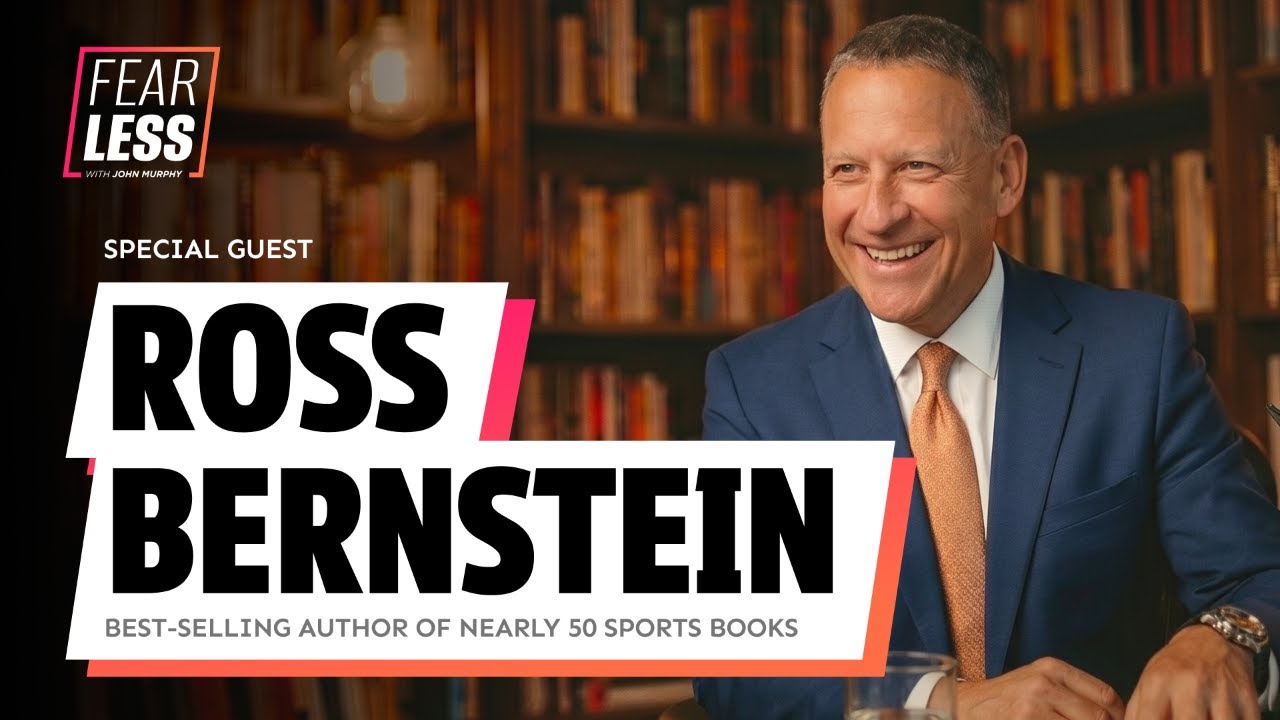
Ross Bernstein, a Hall-of-Fame speaker and author, discusses his "Champions Code" framework of integrity and disciplined teamwork drawn from sports. He and host John Murphy share how they've handled serious health challenges like stage-IV cancer through mindset and detachment, and debate whether relationship-building should stay personal or embrace AI tools.
Chapters
All right, good morning everyone. Happy Friday and welcome to Fearless. We've got an amazing guest today, Ross Bernstein, and, uh, a Hall of Fame speaker. Ross has spoken on all 7 continents, over 2,000 talks. on what does it really take to play like a champion, so to speak. And he's a sports— he's written nearly 50 sports books. He's the kind of guy that can blend a lot that we can learn from sports into modern-day practices in businesses, things like discipline and accountability and strategy and teamwork, of course. But Like any athlete, you're never done practicing. You never think you get to that point where you're like, you know, I don't need a trainer anymore. I don't need a coach. You know, you're constantly seeking ways to improve, which is— which I've been a lifelong learner my entire career. I've talked about that before, just hungry to surround myself with bright people, inspiring people. And we got one with us today, Ross Bernstein. He's, again, Hall of Fame speaker. He's going to talk a little bit about I, I, we were just talking, he's got like 5 different cities coming up and, and I know he's in Miami Beach today. He's got some fascinating stories to share. But in particular, he's also had, like all of us, some, some adversity in his life, some real challenges. And, you know, if you're ever gonna get anywhere in life, you've gotta be willing to step up and, and with courage and work through those challenges that, that come along. And so, Yeah, you know, Ross has been featured on CNN, CBC, uh, yeah, CBS, excuse me, um, ESPN, New York Times, Wall Street Journal, uh, Bloomberg. I mean, he's— Ross is the real deal. So I'm super excited to have him on board today. Uh, so Ross, welcome. Do you have a couple of words just to open up with?
Well, it's great to be with you. Our mutual friend Brian Byro connected us, so I love that guy. So Big, big morning cheers to him. But great to be with you, and, and I'm just excited to be able to hopefully share some wisdom with your, with your, uh, loyal viewers and followers. So thanks for having me.
Hi, Ross. Well, you know, you, you speak a lot about the Champions Code, you know, the Champions Code, what— and, and the, the Old School. Well, I want to talk in particular about these, these themes, if you will. So why don't we start with Old School, the title of the show? might just be the new school. What— take it from there. What are you about here?
Yeah, I'm, you know, I, I just, I run my business from my phone. I, I kind of have an old-school business. I, I've learned early on, I just, I really like speaking. Early on, I was a sports author and I wrote almost 50 books, but then I could see that Amazon was coming and Borders was going and Barnes Noble was going and Crown Books was going and Waldenbooks was going and Barnes Noble was selling more caramel macchiatos and board games and tchotchkes and greeting cards and music than they were books. So I could see that disruption coming, just like Airbnb and Uber and other— and AI, certainly in other industries. So speaking has been great, and I just learned early on that I wanted to kind of run my own business as an outlier, I guess, to do it differently. There's a lot of, you know, I do this and I do that, and there's a lot of keeping up with the Joneses and whatever business you're in, but I just For me, old school is just kind of just relationships. Like, I don't, you know, AI is never going to take my job because I, I do some weird stuff. So it's just, you know, when you're connecting with people like, like you do, John, it's, it's, you know, that's, that's not a, a bot-living world. So, um, you know, I, I don't use a CRM. I'm, I, I, I've, you know, I, my contract is 2 sentences. I just try and I make phone calls. You know, it's a lot of old school stuff, but I still believe that if you're willing to build relationships and help people and kind of by the laws of karma, you can still really grow a successful business and you don't have to always be up on all the latest technologies and do those things. So I'm— I don't know if I'm resisting. I'm just— I've just found a way that works and I've become very laser focused on saying no to things I really don't want to do. Um, like, I enjoy being a guest on a podcast, but I don't want to have a podcast. And I should have a podcast. I've interviewed thousands of professional athletes. I'm in the media. I know all these coaches. I could have an incredible podcast, but it's so much work that I don't want to do it. So it just— I've learned, I'm just like, just pick your— pick the things that you really think you're good at that you want to do. And I've kind of created a lifestyle business where my wife and I get to travel. I do over 100 keynotes a year, so we go all over the world and we just pick and choose different great cities and see friends, and we just kind of live that lifestyle. And that's kind of at the stage right now where I want to enjoy this ride but still really be— try and be a top producer. So old school.
Yeah, I hear you, Rod. I just connect with you so deeply. You know, my company turns 38 next month, and, uh, congratulations. I got started writing my first books You know, Amazon was just getting started as a bookseller. And like you said, Borders was on their way out and didn't even— couldn't adjust fast enough. Barnes Noble adjusted to the idea behind Amazon to stay alive. But like you said, there's only more coffees now, it seems like, than books. And, you know, so one thing you've obviously done is pivoted throughout, you know, your career and adapted to certain changes. But by holding on to just some fundamental principles, which I think are so important. And as you know, I was an athlete. I played football at Notre Dame and it was a little ahead of your time. And I know you're—
But the name like Murphy, where else do you play football, right?
That's right. That's right. Go Irish. But, you know, you learn just some fundamentals that have helped me throughout my entire career. Just those things like just self-discipline, self-management, and teamwork. Clearly, you know, we don't do anything alone. We've always got teammates in one form or another. Like you, I run my business very simply. Having said that, I obviously have a podcast, but I have to tell you, I said just exactly what you just said for years. Like, I didn't— I was a guest on hundreds of interviews and podcasts, but I never wanted one. Until Fuel came along and this, this idea came along. And just the fact that I can now host people like you for an audience that's hungry for inspiration. You know, there's a lot of worry and doubt these days, as you know. And, um, the thing is, is I teach that adding more is usually not the answer. Adding more complexity to your life, adding more technology, add, add, add. You know, I've in the past Podcasts, and I've taught that about the closet syndrome. We keep filling up closets with stuff just like we fill up our time with stuff, and then we think we don't have enough space. We don't have enough closet space, so we need more. And human nature seems to be just keep adding. And what I love about your theme is that we don't need to add anymore. You know, I could do business. I could run a global business with a phone. And with relationships. So you're very, you're very key on relationships, and I know that's one of those fundamentals, just learning to, to be authentic and be real. So tell me a little more about how you run your business. You talk about your media strategy a little bit. How's that work?
Yeah, thank you. Well, I think relationships is It's your terrestrial profile and your your online profile, certainly. So for me, I would say you know relationship building. I mean, I'm very purposeful to really reach out and see my friends when I'm in cities to really try and be a cheerleader on social media to to support people. I really focus on LinkedIn. That's my only social platform. I don't waste my time on Facebook or Instagram or Snapchat or any of those other platforms. I just wanted to be good at one thing. And I really, I use it for, for 3 reasons: to honor, acknowledge, and thank others. So every time I'm giving a keynote, I'll— it's all about my client. There'll be a great picture of, you know, not me, but like the, the room, the audience, and just me bragging on what that business does, what they do for the community, tagging the planners, the, the senior VPs, the C-suite, thanking them for, for bringing me and bragging on them. And really by the laws of karma, that winds up growing my business because people see this and they see those good comments and they grow more and more and more. And you wind up, if you use social the right way, it can really be a positive thing. Most people use it for a lot of weird different reasons. And I don't profess to be any sort of social media expert whatsoever, but I find that relationship building kind of starts there on a micro level. But then I'm very purposeful to reach out on the phone. I'm a runner. I run, I try and run every day. I'm always calling people. How are you? How's your family? You know, can I can I do anything for you? I don't monetize it. It's just I'm always taking people to lunch and just catching up. I grew up in a real small town in southern Minnesota. I'm that's just kind of how I grew up. I don't you know I don't really know any differently, so I'm not gonna change now. So I'm just kind of enjoying this ride. It's a it's like you said, it's weird turbulent crazy times. But I think if you can Support people, be that cheerleader, not just for your clients, but for your friends and family and colleagues. I think it really goes a long way. People see those things, it means a lot to them. And I think having a mix too, a little bit of—
Oh, no question.
A mix of personal and business on your, on your LinkedIn is important. People want to know who you are. And the, the, you look at analytics of posts, certainly when you make a comment about your family or you do things, I think that really does help build a relationship beyond business. And I think that's important too, to be a little bit vulnerable and share some of those things about yourself sometime.
Yeah, in fact, especially when it's adversity and when you're sharing something, you know, a lot of people think, oh, you know, you've been so successful and you're at the sweet spot in life, but they don't realize just what maybe you had to go through to get there. I was listening to John Maxwell speak recently and I I love this because John said he told the story about how a young person came up to one time and said, "I want to do what you do." And John looked at me and said, "Well, if you want to do what I do, are you willing to do what I did? Because to do what I do, you got to do the did." And I just kind of love that line because it resonated with me. I've gone through a whole lot of bumps in the road to get to get where I am today, and I still feel like I'm. I'm on my way up, not down, and, you know, in a good way. So, what about some of the bumps you've run into?
Yeah, I mean, I think adversity is really the— as a speaker, I mean, dealing with failures, and, you know, being as a Division I athlete, I mean, that's the hallmark of success. That's where we learn, right, is not through the successes, but through those failures and things that we need to try. My first big failure was I was a walk-on to play hockey at the University of Minnesota. And I got cut and wound up becoming the team mascot. This is actually my, my head, my Gopher head. It's funny, I was just with my good buddy, a good buddy of mine, a fellow speaker who was the leprechaun at Notre Dame. Uh, and, and, uh, so we're—
oh, no kidding.
But everybody knew him because he didn't have a costume. He just wore an orange beard and walked around campus and everyone knew who he was. But, um, I wound up writing a book about it as a senior in college. It was called Gopher Hockey by the Hockey Gopher, and it launched my career. My 2 brothers getting Ivy League MBAs on Wall Street, and my parents thought this was just the worst idea ever that I wanted to write a book about hockey. But I want— I was passionate about sports. I want to make a career, and I just— everyone said you're going to fail, and I just said, okay, bring it. And I, and I did it. And, uh, so I learned a lot from that failure of, of that, and then just going through all the trials and tribulations of learning. And it never ends. Like, I, you know, I, I book over 100 keynote speeches a year, and I probably lose 500, right? If you, if you're not gonna deal— if you can't deal with failure, uh, you're— I have job interviews every single day, you know. Every day you get hired and people go, you're great, we love you, and then 3 other people go, you're horrible, why would we hire you? We found 10 people prettier, smarter, more qualified than you. And it's, it's a lot that you're dealing with, a lot of rejection. So you have to be able to process that in sales and in life. And, and things happen. I, you know, I, I earlier this year I was diagnosed with stage 4 cancer, so I'm I've been on chemotherapy for 10 months. It's brutal. It breaks you down. It's like napalm, but I'm finally through it. I'm on my last cycle right now. I'm on the path. I had my last treatment last week and I made a LinkedIn post just to give people a little bit of an update every few months so I don't get inundated so much, but I just said I'm I'm not ringing any bells. I'm not taking any victory laps. Give me 5 years of clean scans, and when you get in remission, I'll ring the hell out of that bell. But until that point, I'm just going to focus on what I can control, right? Like my diet, my eating healthy, running, having a great attitude. Certainly my work. I love it. I love traveling. My wife and I are together, which brings me great joy and purpose. And helping people. I mean, that's John. That's what you and I get to do. We get to help people through different platforms, right? Whether it's through fuel or speaking or books or just consulting, whatever that looks like. So I all those things matter, and there's you know there's people way worse off than me. So I'm I want to be real careful and respectful of that. But you know, I'm I'm dealing with some crazy shit right now, and it's it's pretty wild. You You know, everything changes when the doctor says you need to get your affairs in order before you go under surgery because there's a good chance you're not going to come out. So you better make sure your wife has all your passwords. That's a conversation most people aren't really prepared for.
Yeah, yeah. And, you know, it's— I'm a different story than you are in that case. And, you know, I keep you in my prayers, of course. But, you know, I've had over 10 skin surgeries, 7 melanomas in the last 3 years. And You know, you hear that news from a doctor and it's like, yep, here we go again. But, you know, I think one of the things that keeps me moving forward, and this is what I hear you saying, is that positive mindset.
Yeah.
Because if you start taking the victim mindset and you start worrying and stressing out, you're actually asking for more to worry and stress about because that's karma. That's the law of attraction. The energy, the vibration we put out into the world is precisely what we get back. And I often give this exercise to people and it freaks them out sometimes a little bit. I'll say, how do you see the world today? In one or two words, how do you see the world today? And whatever their answer is, it's a reflection of what they have going on inside them.
Mm-hmm.
So if you see a conflicted world, you're conflicted. You see an angry world, You're angry. If you see a world of harmony and balance, yin yang, what goes up has to come down. There's always a perfect match. That's karma. And when people start to realize, you know, it's two sides of the same coin, and I have the choice to choose which side to look at, the solution side or the problem side, and you start to think, you know, uh, I'm gonna keep the positive side going. I'm gonna like you get get on the road and get out there and help as many people as I can. And again, with karmic law, the more people I help, the more I get help. The more put out, the more joy I feel. The more love I put out, the more loved I feel. Just universal law. Once people start to understand that, they start to learn why am I afraid and what good is that doing? Because if I'm I'm putting out a fear vibration, and this is these are measurable frequencies. I love the work of Dr. David Hawkins. Major influence on my life, the late David Hawkins. And but he measured these frequencies scientifically. And if I'm putting out a fear frequency, I'm just asking for more to be afraid of. And so I have my hand on the dial, the radio dial, so I can change those frequencies. That's true empowerment. But it all begins with the mindset. You know, I was told I could never play football again after running my foot through a lawnmower in high school. And and I was a captain of a of the state championship team in Michigan, and I decided that that's not true. I'm going to play again, and I I walked on Notre Dame. I didn't get the scholarship. Oh, I could never play again. The interesting thing is being told by a doctor. Yeah, right. Well, yeah, exactly. Here here I can't. Supposedly walk again without, you know, limping. And, and, uh, I literally walk on the football team. I'm one of 2 guys that makes it. And, uh, and I lettered in 2 years. So, uh, but that's— if I'd have believed the, the negative.
Yeah.
Um, and gone through life with that victim mentality, you know, and the woulda, shoulda, coulda, you know, regret. I just don't think that's any way to live. So, I mean, God bless you for just stepping up, dealing with it, and moving forward and not stressing out over it too much.
Likewise. You realize everyone's got stuff. So we've all got stuff.
Yeah, precisely. You know, when it comes to Always happening, and I again two sides of the same coin. I'll say to people, well, you can either ride the wave of change, or you can resist it and fight the wave, and that's just going to exhaust you. It's going to age you faster. It's going to you know overwhelm you, or you can learn to surf like a skilled surfer. Ride those waves of change because they're not going to stop. I mean, think about it. Just in the last hundred years, the advancements we've made as humankind, you know, moving through civil rights, moving. I mean, through just, I mean, all kinds of technologies. And I remember people were freaking out about the internet, right? Oh my God, the internet's ruined everything. Now AI is gonna, you know, ruin everything. Well, you know what? And Fuel has AI bots now coming out. I think I'm one of about 15 instructors that have an AI twin. And what that means essentially is that this AI twin avatar, whatever you want to call it, has been downloaded with 40 years of my body of work. It does not work with the internet, things like that, doesn't Google stuff. So if you asked my bot, John, I've got this thing that's stressing me out a little bit, or I'm trying to adopt Lean Six Sigma and operational excellence into my business, or I'm struggling with culture change, things that I work with. What do you— where do you suggest I start? And my bot has better recall than I do. It's got hundreds of articles and interviews and things that I've done for over the decades. And it's fascinating, you know, Ross, because I've actually had conversations and I've challenged my bot with things and it comes back with better answers than I do sometimes. It's like, whoa. Now, to your point, old school, it's not going to get up on stage. And give speeches that I, that I, I don't think so, or go into clients and run Kaizen events and some of the things that I do. And that's where that old school, the relationships, the live interaction, the exchange of energy is so important. But as a keynote speaker, one of the things these bots could do for you, and I know Brian Byro's got a bot now, is that when you leave the stage and you leave the speech, if 1,000 people have 1,000 different questions for you, In the old days, they'd have to wait in line for an awful, awful long time to get to you to ask their question and get an answer. Now, 1,000 people can ask 1,000 different questions at once and all get instantaneous answers. So it's like your bot follows you off the stage and is available to the world 24/7. That's pretty cool. So anybody listening to, uh, to this, uh, I, I can't recommend Fuel enough as a learning platform. It's one of the— it's the fastest growing e-learning platform on the planet. And, uh, like, like Ross has talked about, you know, you don't learn to play hockey well, uh, watching TV and watching the, the NHL players and, and studying the rules and flipping through textbooks. It's not how you learn how to play hockey. You learn how to play hockey by playing hockey, right? Get out on the rink and, you know, you learn— you have to You know, learn strategy and learn techniques and learn plays and things like that, like in football. But when you get out on the field, that's where the real action is. And, uh, you know, Ross, you're out on the field every week, you know, doing your, doing your performances, doing your games, if you will. I don't, I don't know that you wear your golfer, um, hat out on stage a whole lot anymore. Maybe you do. Maybe you do. So, you know, offer, offer everybody a couple of thoughts on that. You know, we've, we've, um, How do you deal with AI these days? What do you suggest to people?
I've always said the only people making money in AI right now are AI speakers, right? Consultant speakers telling people how do you— I mean, I bet you in a competitive world, I've lost 50 gigs when I sell speaking engagements to AI speakers. There's only a couple that are good. I mean, I'll say that very critically. There's a lot of really bad AI speakers because they're just jumping on the bandwagon because companies are so terrified that they're gonna— you know, I've had many clients say, hey, I've been contracted, we need to cancel because we got to bring in an AI speaker. We're all worried we're going to lose our jobs running a hotel chain, right? This is going to be outsourced. Any industry, pick, pick your platform, and they're, they're all kind of terrified of what's, what's going to happen. So I don't know the answer. Uh, I don't— I didn't jump on that bandwagon. When my clients ask me to talk about it, I can tell them, you know, I just keynoted a huge conference for Best Buy. Here's how they're using AI. I just keynoted a huge procurement conference for 3M. Here's how they're using Best Buy. Um, here's what, uh, Prudential's doing on some of their platforms. So I'm more or less being a purveyor of information and wisdom that I'm learning from my clients. To share what other people are doing, which I feel is a responsible way of using it. I don't care much about AI. I care that my clients care, but I'm not jumping on that bandwagon. No disrespect, I have zero interest in having a bot. I'll be entertained by you and Brian and your bots, but I— I just don't have any interest in it. And I just Maybe that's the old school in me, but I have a lot of friends, dear friends who are brilliant, who code generative AI. And I'm, I'm always fascinated. I need to stay up on it to learn about it, to be informed. Oh, I love that. But when you talk about fearless, I don't know. I think there's a lot of fearmongering going on in technology right now. And I think it starts with whether you're at home watching Fox News or CNN or what, what your social platform is. And it's, you know, everything's polarized today and it sort of dictates more fear, right? And, and do this, do that, if there's a consequence. So I really— I'm just— I'm at a stage, and maybe it's because when you go through a near-death experience, you just— you're like, screw it. I don't— I'm gonna pick and choose what make— what brings me joy, what makes me happy, what I feel like I can control. Um, it's, it's the wild, wild west with this stuff right now, and poly markets and tariffs and politics, and, you know, it's just— it's, it's, it's so overwhelming. You know, you and I grew up, John, in an era where, you know, I grew up my dad's— we, we read the newspaper, right? We get the Wall Street Journal and the New York Times and the Minneapolis Star Tribune, the St. Paul Pioneer Press, the Fairmont Sentinel, local, national, and you'd watch the news. And back then, if Walter Cronkite said something and it was wrong, they'd make a retraction, or there'd be an op-ed in the New York Times, and there was sort of an accountability. And now With so much news and fake news and news outlets and anyone— everyone's a prognosticator and an expert. It's so hard to disseminate what's true. How do you fearlessly believe anymore, right? So you have to make your own opinions. And during elections, it's like, yeah, I don't like you anymore, I can't be your friend. And it's just a really overwhelming time in society, I think.
It's incredible.
And it causes a lot of fear. So people just tune out. They're like, I don't want to listen to the news anymore. And they're, and they're uninformed. And the louder you bang your drum, they say, well, no, this is what's happening. And we're seeing it on both sides. It's— you can't, you can't really be partisan. You're just— it's hard. Half my clients watch, you know, the left, half watch the right. So I'm Switzerland. I don't have opinions like that publicly.
Yeah, I think we're losing some sound here a little bit, uh, Ross. But, you know, you're talking about the news. I, uh, I turned the news off 30 years ago and, uh, I'm still here. Because I basically turned off negative 30 years ago. It's like, I'm not going to listen to it anymore. I'm going to focus on what I can control. I can't control what's going on halfway around the world. I can't control what's going on in my own family. Honestly, the only thing we can actually control is our own mind. So I'm going to control that to the best that I can. You know, yeah, with AI, I hear you. I was giving a talk out in San Diego, and I was the closing keynote. But the audience was predominantly customer service reps, and they were all worried about losing their jobs to AI. So it was the— it was like, you know, so important to them. You know, my topic was more on, you know, karmic law and leadership. And I lose my job every year. I mean, you lose your job. Essentially frequently, because I don't know about you, but I'm not on a salary. You know, I, I go in and I teach a client what I, I do typically on retainer for a year or two. I teach them how to take over and do it and then, and really can, uh, continue the, the cultural changes we've made, the operational changes. And then, then I'm looking for another job, so to speak. Right. And, you know, you're, you're constantly looking for— Opportunities to get out and relate with people and speak. So once you get through that idea of locking on to a job, and in the Zen teachings, it's attachment. Once you attach to something—a job, a person, a house, a car, anything, a title—once you attach to that, you live in perpetual fear of losing it because you're attached. And so the principle is detachment. What that means is. I love it. I love you. I love my job. I love where I live. I love my lifestyle, but I'm okay with or without it. I'm going to land on my feet. I'm going to, you know, I'm not going to attach my identity to something I have no control over. So once you get past that, which takes courage and a sense of fearlessness, then you get into a world of true inspiration. In-spirited means fearless. Once we're in that spiritual realm and we realize that so much of what we've worried about is an illusion, because when we get over it, we're like, what was I afraid of, right? So how about a few just closing remarks here, Ross, for the audience? Just, you know, when you talk about the Champions Code, what's a real nugget people can run with here?
Well, the Champions Code, it's about winning with integrity. It's based on a 2 series of books I wrote about why winning teams win and, and about that fine line between cheating and gamesmanship in sports, in life, in business, in sales. So to be a champion, it's metaphorically— I study what it is that makes the great ones great, and I try and apply that to business, to leadership. And, and, uh, so for me, you know, being a winner just— it means doing things the right way, taking care of people, um, not cheating, being honest. Um, we're all tempted to find shortcuts. And we know in football and every sport, there's what's cheating, what's gamesmanship. It's the flop, it's the dive, it's steroids if you can get away with it. It's right, there's, there's always that edge you're willing to go beyond. You know, if, if, if LeBron can sell that flop and they win by 1 point in overtime, was that gamesmanship or was he cheating? It's really a, it's really a, an ethical conundrum. So I talk a lot about integrity and doing the right thing even when no one's looking. And that's really the kind of the hallmark of my speaking and writing is just trying to celebrate the good stuff, the men and women who do good. And a lot of companies I work with, they love hiring athletes, right? They're coachable, they're great listeners, they want to win, they're competitive, they can take constructive criticism. Everything is gamified, especially dealing with Gen Z and millennials trying to acquire and retain talent today. So there's just a lot of things you can learn. And that's why, you know, I'm lucky I've been able to keynote at all 7 continents. Because my topic of sports is just universally relatable, whether I'm talking football in Texas or basketball in Indiana or hockey in Minnesota or cricket in South Africa or rugby in New Zealand. People speak that language, so I've just been lucky to tie into all those things.
Yeah, that's it. I'm all about integrity with you too. You know, we— some— sometimes you hear things like fake it till you make it. I have a real I struggle with that, you know, faking it. You can't fool the truth, capital T truth. So, you know, all you're really doing is fooling yourself. And the idea of the athlete taking constructive criticism, or criticism at all, if you will, reminds me of my coach back in high school. And he said, Murphy, the day I stop yelling at you is the day I've given up on you.
Yeah.
And right there, that struck me. Here I am, like 50 years later, basically, I'm constantly going, quoting him. He's long passed now, but it was a lesson. Criticism can be quite valuable if you can open your mind up enough to listen and to hear it and adjust with it. Ross, you're an amazing guy. I got to ask you one more question. All 7 continents. What in the world were you doing in Antarctica?
Well, I had to make that one happen, but I had a couple gigs in South America, so we decided we're gonna, uh, make that happen. So I was speaking in Chile, and then we wound up reaching out to a company that does business in Antarctica, and I was able to get on a, a research vessel and work with the cast and crew. So that was, that was pretty cool to be able to do that. But I will tell you, the penguin poop was so overwhelming. I, I even thinking about it, I get a little PTSD. We We spent a day on Ernest Shackleton's island, and there's like a million penguins on an island the size of like a golf hole. You know, like, and it's it just stunk so bad. I'm like, these people lived here for two years eating penguins. I don't know how they did it, but it was a pretty cool experience.
Yeah. Wow. Well, Ross, it's been here. I thank you. Wish you the very best in terms of health and wellness and life. Thank you. You and I will stay in touch for sure. Next week, I've got James Maloney. James was a very successful Chief Human Resources Officer who's got quite a story to tell. His title is Walking Into the Fire. We've been trained since we were little kids, don't get near too close to the fire. What in the world is that all about, walking into the fire?
Yeah.
He will talk about that and courage and what he's had to deal with and what he's seen in terms of change happening throughout organizations. for the last 40 years that he's witnessed. So next week's James Maloney. I mentioned we got Brian Byro coming back up in a couple of weeks and some other top, just beautiful people, wonderful people with great messages. So with that, I guess, John Murphy, thank you for joining us here on Fearless on Fuel through the Fuel platform. And if you will, and you've got some great value out of this like I did, I learned from every one of my guests. Please like it, share it, and invite people to join us on Fearless as well. With that, happy Friday, happy weekend, everybody. Enjoy Miami and your travels next week, Ross, and thank you. God bless you.
Thank you so much.








