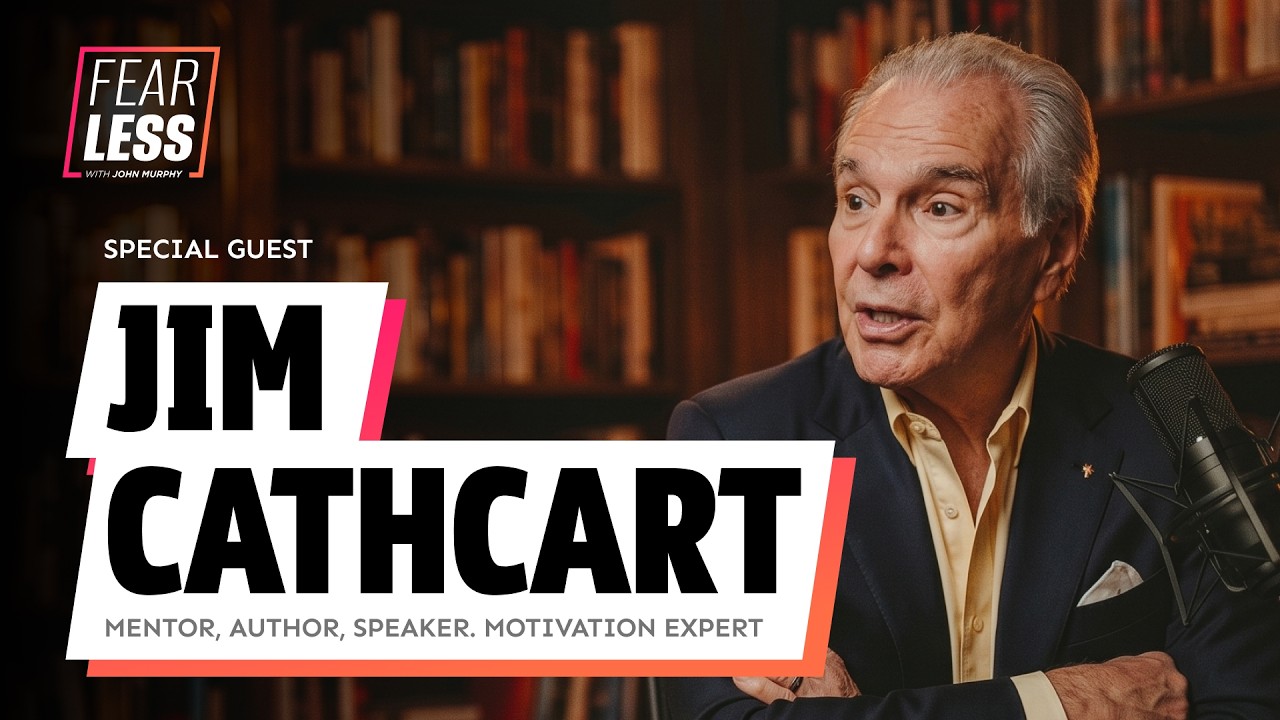
Jim Cathcart explains fear as a perceived illusion rooted in ego and self-preservation. He shares how preparation, mental rehearsal, and realistic risk assessment shrink fear, and introduces FMEA for evaluating what could go wrong. Reframing anxiety as eagerness and using simple exercises like a quarter-jar for negative self-talk can rewire your response to fear.
Chapters
All right.
Good morning, everybody, and happy Friday the 13th. I'm John Murphy, host of Fearless, and I am very excited today to bring in Jim Cathcart, the legendary Hall of Fame speaker, bestselling author, strategist, founder of the Cathcart Institute. I could go on and on about Jim, but he's got some wonderful insights on the topic of fear, which is what this show is all about. And courage and conviction. And what does it really take to break through that veil? I like to think of it as a veil of fear. So, a lot of people are afraid to bust through and lean into it. And as a result, it limits our growth. It limits our success in life. And so, just exactly how do we confront fear? How do we recognize it and let it go? So, Jim is going to offer some insights on that. And I'm going to ask Jim also to share his contact information so that you can reach out to him. But Jim's also a fellow FUEL instructor. And if you're not familiar with— or you are familiar with FUEL, hopefully by now, but share it with your friends and family and team members and businesses and organizations. FUEL is rapidly growing, and we've got just a phenomenal faculty. And so, Jim is a member of that. And so, let's get into this. All right? Again, it's Friday the 13th. And fear, by the way, can be as paralyzing as you just feel like there's no way you could do something. You have this vision, but you're getting in your own way. You just don't subconsciously believe you're worthy of that. Or it could be something as simple as a superstition. My name is Murphy, as in Murphy's Law. If anything can go wrong, it will. I've run into that countless times in my life. I was born on Friday the 13th, believe it or not. And just for fun, I threw in a black cat. And, you know, people have these jinxes. If you say something to somebody about what you want to happen, you just jinxed it. It's not going to happen. I mean, fear shows up in all kinds of ways, right? So, Jim, welcome and thank you for being a guest on Fearless. So give us a little bit about yourself and how, you know, how is fear entered your life and, uh, just with such an incredible career. How'd you get past a lot of it?
Thank you. It's so poetic to be on this podcast on Friday the 13th. johnmurphy13@gmail.com. I mean, how poetic is that? The fear of the number 13 is called triskaidekaphobia. So the fear of the number 13, and that's a very real fear for some people. And it's like you said, it's superstition. I was looking that up, and Otis Elevators says that 85% of their elevators don't have a 13th floor by request of the customer. In New York City, only 5% of the apartment buildings have a 13th floor designated as such. Of course, they've all got 13th floors, So you know it's a ridiculous fear. You say, "Oh, I'm you know I'm staying on on 12A." No, not. You're on the 13th floor. You just did not. In China, they say, "What's the problem with 13?" Four is the scary one. What's scary about four? Well, four is xue, and that sounds like the word for death. So the sound of the word 4 and the sound of the word death are similar. And so the superstition over there is you're staying on the 3 and a half floor. Well, I was talking with my son about this this morning. And I said, fearless— fearlessness is not the removal of fear. He said, excuse me, Dad. That's exactly what it is. I said, no, it is being— it is fearing less. See, when I— I've bungee jumped a couple times. I have gone skydiving. I've done a lot of things like that. If I were to do it again, I would still be afraid, but I would fear less.
Mm-hmm.
Because I understood that the danger was not as great as my natural instincts would perceive it to be. So I think the way to deal with fear is to look at it as a natural reaction. It's self-preservation. It's your mind and body saying, mm-mm, danger, danger, right? Everybody experiences that. We have fears that appear in categories, you know, physical fears. I'm afraid to touch that hot stove. I'm glad you are because you're not going to get injured. I was afraid when Tony Robbins led me to do the firewalk barefoot on the coals, but I did it because he spent 3 hours in a seminar teaching me and the other people what we were dealing with, how to deal with it, and how to stay in the right frame of mind and, and the right physical movement. to be able to walk across a bed of hot burning coals and not be injured. And 298 of us did it without injury. And 2 of the people, 2 or maybe 3, had minor injuries where they had stepped on a burning coal that was gray, that was not part of the stack. So in other words, they walked over a bed of hot coals uninjured And then stepped onto a coal afterwards in a different frame of mind and ended up with a burn. So I don't want to explore the physics of that. I want to explore the emotions connected to that. He spent 3 hours teaching us not to be afraid. And if we don't do something to manage fear, to learn to recognize it, deal with it, objectively instead of only subjectively, emotionally, then it's always going to limit us. And I think of fears that I've faced, like you had said, you know, I've faced fears, interpersonal fears, afraid to talk to somebody about a hard subject or afraid to see somebody for fear that they would bring up something that was going to be embarrassing or terrifying for me or disastrous or whatever. I was a bill collector. At 22 years old, imagine that. Now, this is me in my 70s. At 22 years old, I looked about 4, and what I was doing for a living was repossessing log trucks in the Ozark Mountains. Talk about fear, and it was real fear. You know, people would meet me with shotguns and pistols, and, and, uh, they didn't, they didn't want to see me. And I hated that aspect of the job. So, a lot of things there. Yeah.
And I think what's important, Jim, talk to me about this a little bit, is that it really depends what you look at and what you project. So, we all have to look forward into the future. And as humans, we can do that.
You focus on—
Right. And I love something that Einstein once said. He said, is a preview of what's to come. So, what if you imagine failure? All right? If you imagine you're going to hurt yourself or screw up on something.
There you go.
That imagination, that projection triggers hormones in your body, stress hormones. It triggers things in your body that then your body tells you that's real because you feel it. So, what if you think differently? And you don't feel it, so you fear less, to your point, or perhaps not at all. Like I, you know, you speak all over the world, Jim, and when you get up on stage, I'm I'm guessing you're not afraid at all.
I'm I'm more eager to be on stage than I am to remain in the audience.
That is the start that way. But that's the key. You know, I I grew up an athlete, and and I was a quarterback, and I use this metaphor for life. When you walk up to the line of scrimmage. You really don't know what's going to happen. You have a play called, you have a game plan and a strategy like you might have for life. I've got goals set for today and this week and next week. It's all part of a strategy and things like that. And I know what I want to happen. But when I approach the line of scrimmage and I wake up in the morning and that ball is snapped or that alarm goes off, how do I feel? Yeah. Do I feel eager and enthusiastic like you do getting up on stage? Or am I nervous and anxious like, uh-oh, something could go wrong. get hurt.
Yeah.
You know, and in sports, you lose with that mentality.
Yeah.
You, you, you're— it's game over. And it's the same thing in life, you know. Whatever you're approaching, if you're projecting something negative and you have the option to project something positive, it's a choice. And at the end of the day, it's all in the mind. Fear comes from the mind. It doesn't come from anything out there.
Right.
It comes from the mind, right? And so talk to me a little bit about—
People that aren't afraid to do things that are absolutely foolish and dangerous. They're not afraid. And so that's clearly the physical threat is there, but they're not perceiving it to be a threat. And like a little child, they're not afraid of anything. And they learn from pain and other things. You know, they learn what to be afraid of. Trouble is, as people grow, they don't shed those old learnings and replace them with new ones. And so—
That's right.
Fear of the dark or fear of high places or fear of flying or fear of, you know, I mean, when you look at reality, flying in an airplane, a commercial airplane, is safer than walking across a grocery store parking lot.
Yeah.
And that— and yeah, but if you crash, you die. Well, not always, you know. And it's statistically— it is literally safer than walking across a grocery store parking lot. You know what else is safer? Riding motorcycles.
Yeah, I know you ride.
Yeah, I've ridden 150,000 miles all over the world. I've taken a couple of spills, but, but I haven't been injured, you know, except for abrasions, that kind of injury. Um, and I, I know people that are just absolutely terrified of motorcycles, and they say it's a rational fear. I've got a great uncle who once lost 4 arms in a motorcycle accident. 4? Yeah, he lost 2 and then had them put back on and lost them again the same day. You know, I mean, they make up stupid stuff.
Yeah, yeah.
Of course we know people who have been injured when they're riding a bicycle, a motorcycle, or whatever, you know. But if you look at the numbers, the odds of you getting a severe injury on a bicycle are like 10 times greater than getting a severe injury on a motorcycle.
What?
Yeah.
Yeah. In fact, I referenced—
That's not just because there are more bicycles. That's per hours ridden. So it's actually one-to-one comparison.
Yeah. Well, you know, one of the tools I talked about and I use in businesses is the FMEA, the failure mode and effect analysis. And it's a measure of risk really. And so the questions that really it asks are what could go wrong? You're riding a motorcycle. You're flying a plane. What could go wrong? Well, I could crash. And then another measure is, well, how serious is that? And it could be anything from it's minor to I could die. But one of the measures, and you just referenced this, is likeliness. How likely is that to happen? And when you look at statistics, like you said, it's not likely a plane's going to crash statistically, right?
No.
So, we're going through life every day with uncertainty, unpredictability. A woman actually died by getting hit by a car a couple of years ago right here in front of my home in Palm Beach walking her dog. So, like your point, walking across the street, the parking lot. So, the question now is, and I may precede this with what has worked for me a little bit, is it is preparation. It is planning and preparation. So, before I am going to do something that has risk, significant risk, how do I approach it? I do not wing it. I think carefully about FMEA. What could go wrong? What can I do? Because the big tool, the FMEA, is about countermeasures. What can I do to ensure it doesn't go wrong?
Yeah.
To ensure success. So, it's just simple framework like that. And then practice, practice, practice. You've given thousands of speeches. So, now it's just probably second nature. You know, for a Tom Brady or—
Now, I just say, hey, is there a guitar nearby? Yeah, I'll add that to my speech. And I just love it.
So speak to the audience just a little bit now about just some simple, uh, tools that you use to plan, to prepare, to, to get through that veil.
All right, item 1 is to recognize that your fear is not a real thing. It is a perceived thing. So it's, it's your interpretation of the reality. No, no, you know, I, if I blow this speech, I could lose my job. Well, then don't blow the speech. Well, you know, they say the greatest fear is the fear of public speaking. That's absurd. Nobody's afraid of public speaking. I mean, the people who say they're terrified of public speaking have no problem turning to their friends and saying, hey guys, the door's open now, we can go in. That's public speaking. Yeah, afraid of is not public speaking, it's being judged.
Exactly.
See, you're sitting at a dinner table and your family says, hey, how was the trip to Disneyland? And you tell them. That's public speaking. They say, hey, stand up and give us a speech, and you, you go into freeze mode. Why? Because now you're afraid of being judged. A moment ago, you just wanted to tell your story, right? So it's all perception. And when you recognize that, then you recognize that what John was saying, folks, is absolutely certain. Preparation, a little bit of mental rehearsal, diminishes the fear profoundly. When I chose to become an active motorcyclist again as an adult— I'd been a motorcyclist as a teenager, And then got married. I sold my motorcycle and went many years without one. Back in 1992, I bought another one, and I've had 18 since then and ridden all over the world. But when I first bought a motorcycle as an adult, knowing I'd ridden hundreds, maybe a few thousand miles already, I didn't assume I was good at this. People say, no, I can ride. I'm fine. Can you stop in the middle of a curve? What do you mean? If you're leaned over and you're going too fast in a curve, can you get the bike upright and stop before you run off the road? Well, I don't know. Can you handle a loose surface when you're going through a big sweeper and all of a sudden you encounter gravel or sand? Can you handle? No, no, I'm a good motorist. No. You're a good aimer, not a good stopper.
Yeah.
You know, that's, that's like, I can drive a sports car at high speeds. Yeah, but can you get back home safely in one piece? So the practice matters. And one thing they teach you, this relates to all kinds of fear, in motorcycle safety training, they teach you when you see an obstacle in the road, Force yourself to look beside it instead of at it. At it, you look at it, you will hit it.
Isn't that interesting? Yeah.
That's amazing. I mean, even if you're looking at it to avoid it, you're somehow— your body is going to orient yourself to hit that target. And so you can end up with the problem. But look at, look at what you fear and then look beside it, you know, get your eye off of it. And focus on the goal that you're you're trying to achieve. When I first started speaking, I was foolish enough to get up and give speeches or lead a meeting without knowing what I was doing, and I did an embarrassing job. I mean, literally. And I had a guy David Hale came to me. He said, "He said, 'Hey Jim, I appreciate you having me at your meeting today.'" It was a JC's, Junior Chamber of Commerce meeting, and I was running it. And he said, you've never been through an officer's orientation, have you? I said, uh. And he said, there are better ways to run a meeting. Let me show you. And so I did that. My son and I were talking about a problem one time that was just a lack of experience in leading group discussions or meetings. And I said, join Toastmasters. It's easy. It's a no-brainer. It's, you know, it's an effective process that causes you at every Toastmasters meeting to get up in front of your friends. You're in a safe environment and speak, introduce yourself, whatever, until you gain the confidence you need.
Absolutely. Say, Jim, we've got something in the chat here. Let me read it to you. And I have a response as well, but I'd love to hear it from you. So, Mike is asking, what do you say to entrepreneurs and business owners facing real financial challenges, some close to risking everything? I've talked to others saying they've lost it all and gained it back and more. That state isn't resourceful, but the threats can be real. For example, the AI threat to business or jobs. Yes, it will create both, but others will go away. I hear that come up more and more. That's from Mike.
Yep. Well, good question, Mike. Thank you. And I'll take a shot at that. The fear of AI is a fabricated fear. You know, it's based on what you've read online or heard in the news in 99% of the cases. In 1% of the cases, it's actually eliminating some jobs. Well, cool. So did the steam drill, and John Henry had to retrain, you know, as a spike driver on the railroad. So this goes back to the beginning of time.
Mm-hmm.
I'm sure, you know, when somebody invented fire, the other people in the cave said, oh, you know, that'll never work. So whatever it is. Entrepreneurs definitely pay— face the real threat of going bankrupt or losing everything. And I've been an entrepreneur for 50-plus years. I've had partnerships and other types of small businesses with 10 employees, 2 employees, no employees. I've been in joint ventures and collaborations and so forth. And I've lost a ton of money, but I've gained 100 tons of money by comparing, by in contrast, you know, through the things that worked. So the number of times that I lost money were just times when it hurt to learn a lesson. And I think that's the thing is, you know, if you're, if you're afraid of pain, get over it. Pain has to be experienced from time to time. It's like I took a spill one time and I scraped up my backside. And, um, so I had— I'd been sliding across pavement on my butt and had some pavement embedded in there. So a friend of mine took me to the ER, and the ER nurse was a guy named Larry, and he said, ooh, he said, that's a pretty mean scrape. He said, look, I'm going to have to get in there and pick out this asphalt. And I said, okay. He said, well, I'm going to give you an anesthetic. And I said, no, I don't want to go under. And he said, well, it's going to hurt. I said, well, how much is it going to hurt? He said, I don't know. I said, well, let me make a deal with you. If I say wait, will you stop?
Yeah.
Okay, so I'll take the hurt up to the point of tolerance, and it starts going beyond that, I'll say, wait, and I'll regain control, and then maybe you can proceed, or maybe we take a different approach. He said, okay. And so we did it, and I ended up with still some asphalt embedded in my backside, which I call my ass fault.
That's good.
But I got over, you know, I dealt with the physical pain. I was afraid of the pain until he reassured me. But once he reassured me and I saw that I could trust him, then I was able to just deal with it that way.
I got to ask you, did you have a knife between your teeth? Like—
No.
The old days, put this knife between your teeth while we pull the bullets out. So I'll give you a quick story for Mike, too. You know, when I started When I first started my practice, by the way, Jim, when you said 50-plus years as an entrepreneur, between the two of us, we have 100 years-plus as entrepreneurs. And I just, I had that mentality since I was a kid. You make a lot of mistakes, but if you learn from those mistakes, they just educate you more and more and more. And wisdom doesn't come from a classroom. It comes from experience, right?
Yeah.
So, you gain wisdom through experience. And when I first started my practice in 1988, I mortgaged, I took everything out I could on my house, which wasn't all that much. And you know what I did with it? This is FMEA. What could go wrong? I could go broke. How likely is that? There's a high risk of this happening. It's serious. I've got a wife and a child and a child on the way. A lot of people say, John, you're insane. You're going to start a business with very little capital and you don't even really know what you're doing. I mean, you're 28 years old, like, what kind of a consultant are you going to be? Long story short, I took money out of the house and bought a duplex.
Hmm.
What in the world are you going to do with a duplex? Well, I'm going to rent out both sides of it, which more than pays for the mortgage. So, I get a little positive cash flow. And if I lose my house, I have a place to live with my— because it was a nice duplex. It wasn't a dumpy place or anything like that. So, that's a countermeasure. to that what could go wrong question. And I think for anybody listening, if you just stop and you recognize that fear is an illusion, it's projection from the mind, the only thing you can actually control in life is your mind.
Yeah.
That's what mindfulness is really all about, is controlling the only thing you can control, which is your mind and what you project onto other people, onto situations, things that could go wrong, because perception and judgment always go together. And neither one of them understands knowledge or truth. We perceive and judge every day, and we usually get it wrong. People look at the horizon and the ocean, and they think the world's flat and we're not moving. How long? How many millennia did we get that perception wrong?
Yeah.
But if people are afraid to be judged, which is true, perception and judgment come from ego, and ego is the root cause to fear. It's fear-based. It cannot understand faith. with a capital F. It's one or the other. So, when you start to realize root cause because that's what I teach is root cause analysis and you start to realize when you get drilled right down to it, it's a thought system. It's what Eckhart Tolle calls the mind.
Yeah.
And, people confuse who they really are. You'll hear people say things like, I changed my mind. And, I will say, Who said that? Who's the I?
Exactly.
Said they'll change their mind. Because that's your real self, your capital S self. But the mind is fear-based because it's ego. So if I'm going to control anything, I can control my mind. And I can say, fear, I hear you. I recognize you. Now it's time for you to go sit down because I'm going to do this.
Duly noted.
Yeah, you're taking over because most people aren't controlling their mind. Their mind is controlling them.
And once their mind focuses on their fear, then it goes from mental, from rational to emotional. And we can't control our emotions. We can influence our emotions, but we cannot control our emotions. We can limit them, we can influence them, but the emotions have their kind of their own energy force. And that's why it's so important to learn to control the inputs. For example, your language opens that door or closes that door. For example, one instance, if I say, hey, I'm anxious to meet you. My response to that would be, why? Well, it's it's a good thing, Jim. I'm anxious to meet you. No, anxiety is based in fear. Anxious is anxiety-based. It's fear-based. Well, but I want to meet you. Oh, in other words, you're eager to meet me. Well, yeah. What's the difference? The difference is huge.
Yeah.
Is a positive anticipation. Put me in, coach, right? And, and anxious is apprehensive and fearful. Uh, okay, hi, hello, you know, everything tentative, question mark at the end, stand back, yeah, link to protect yourself. So we need to We need to get sensitive to the difference between saying we're anxious and saying we're eager, and mean whichever one we're saying at the time we're saying it. And another thing is, like in sales, people talk about making cold calls. Well, that's— that came from a very limited mindset, probably 70 years ago, in the earliest days of sales training. Oh, maybe even more than that. Maybe it's close to 100 years ago because of the early 1900s. Cold calling. What does it mean? Well, it means calling on somebody who doesn't know you're going to call on them and you don't know them yet and they don't expect you. So you're an interruption to what they were doing. Well, why does it have to be cold? Well, okay, we'll make it warm calling. No, that's just juvenile. That's silly. What it is is one thing that has no spin whatsoever. It's a first call or a new call if you want to call it that. New calling. Okay. Yeah, but it's cold call. No, there's nothing cold or warm about it. It's just a call that hasn't been made before. So don't poison it before you get into it. by pre-characterizing it as being cold.
Exactly.
You know, something like that. And then closing the sale. You're not closing the sale, you're confirming the sale. You're beginning the relationship. So if anything, you're opening the sale. But confirming is what we're talking about. Closing is what we've learned to use. And then we say, well, why don't our salespeople follow up? It's closed. Of course they're not going to follow up. In their mind—
They're on to the next one.
Yeah. You know, I got your money. Go, you know, next, right? It's just the language we use colors the fears we embrace, and we don't even realize it many times. I had a guy, I was staying at his home one time. He, he was incapable He was psychologically incapable of making a positive observation. His name was Bruce. He lived in Anchorage, Alaska— no, Juneau, Alaska. And I was staying at his home while doing some training in that area. And I just said to him, Bruce, my God, man, you know, you're the most negative person I've ever met. Stop saying it can't. I they won't. You know, it's impossible. There's no way. I said, for heaven's sakes, just limit that. And he said, I can't. And I said, of course you would say that. Will you do me a favor and put a quarter in a jar every time you say can't or won't or whatever for the next for the rest of this evening? Yes. Four and a half dollars later, I said, never mind. It's not going to work. It was too deep-seated.
Yeah, well, that's a measurement. Our time's about up here. Before some closing thoughts from you, Jim, let me just make a couple quick comments. One of the things you said is that we can't control our emotions. I think real quickly, a lot of people, a lot of people can.
I just want to take issue with the word can't. I'm sure I said that way. What I meant is We don't have control over our emotions, but we do have influence on our emotions. So I guess you could argue that that's a form of control, but it's not direct control.
Yeah, well, that's, that's what the, that's what the mind and the ego believes, but I'm going to challenge that because we actually, if we can control the mind, we can control the emotions. It's as simple as that. How do we do that? by the thoughts we choose to think. Imagine this, you're watching a scary, really scary movie on TV. How does your body and your emotions respond to that? Your feelings and your body gets you— your mental nervous system doesn't know the difference between reality and fantasy. It doesn't know the difference.
Right.
So, if you're watching something scary or you're projecting something scary, something could go wrong, your body will prove you're right. when you're not. You'll have evidence that you're right when you're not. So, somebody who says, I can't do something, will prove it.
Yeah.
Because they made that choice. So, I want the listeners to realize that you have far more power than you know you do, than you think you do. And that's a great example. If you put a quarter in a jar every time you think something negative, Or make a critical judgment. You'll probably fill that thing up by the end of the day. And it's telling you something about what's going on internally. And if you really want to become more fearless, you need to take charge, take control. Think of it like a king over a kingdom or a queen over a queendom. You're letting your mind govern you when you have the power to govern the mind. And when you govern the mind, And you choose the choices you make, which are tens of thousands per day, those choices shift, you will feel very different emotionally. Your body will heal faster and age slower because it's neutral. It responds to what you're thinking. And that's absolutely essential to To take ownership for that. The last thing, and Mike said, I spent a lot of time regulating the leader before moving them forward because they already went there. I'll just leave Mike and everybody with this thought. I teach pull over push. Rather than trying to push and use the word, you should change, you should or shouldn't do something, stop using those words should and shouldn't and ask questions. Questions are pulling. It's Socratic. And so, if you said to your boss, why are you afraid? What is it that scares you? Help me understand.
Yeah.
And I know it's a projection. And then I could ask FMEA questions like, so, what's the big deal if that goes wrong? And what could you do to prepare better and get, you know, move through it with more confidence? Questioning is a critical leadership skill. And I'll just leave it with that. But our time is up. I want to A couple closing remarks from Jim. I also want to invite listeners to Mindset Matters. I'll be hosting on Monday around the topic of assumptions, the assumptions we make. Assuming something could go wrong will trigger a lot of fear. So, join me on that. And then, next Friday, I've got Brian Byro, another FUEL instructor, well-known for his breakthrough strategies, coming. So, continue to stay tuned and please tell your friends about FUEL. And your teammates and bring them in. So, Jim, how about just a quick couple of closing comments? And how do we— how do people reach you?
People reach me with my name, Jim Cathcart. jim@cathcart.com is my email. cathcart.com is my website. But the idea I want to leave you with is when someone says, what if, and then they project some dark scenario, you know, what if we get stuck in traffic? What if people don't know? What if we can't? What if I did? But what if it rains? Answer the question because that's the doomsayers never answer their own question. Then we'll, if it rains, we'll go indoors. If we'll call ahead, if we run out of gas, we'll bum a ride, you know, we'll live.
Yep.
Okay. Let your fears have their little moment and say, okay, thank you, you're off duty now. And then get on focusing on what you want, because what you want will pull from you the things that are needed in order to make it a reality. Thank you.
Absolutely. Absolutely. Thank you so much, Jim. Let me leave everybody with this little Zen teaching too, and because I love this, it's when something's knocking on your door. Let's say in this case, fear, it's knocking on your door. Let it in the front door and let it out the back door, but don't invite it for tea. So, by the way, that means don't lock the front door and not let it in because it will compound and it'll blow your house down. Let it in. Have a conversation with it. Fear, it's like talking to your ego. So, why are you afraid? Have that conversation and say, all right, now it's time to leave because I got a job to do. I got to get up on stage and give a talk, or I got to go into an interview for a new job, or I got to do whatever it is. So, Listeners, I hope you got a lot of benefit out of this. I gotta say again, thank you, Jim, for joining me, and we'll get you back on here one day if you'd like to.
I'd love to. Thanks.
All right, everybody, thank you. Join us, join me on Monday and then again on Friday on Fearless. Bye-bye.








