Joining AIG When Everyone Else Was Leaving | James Maloney
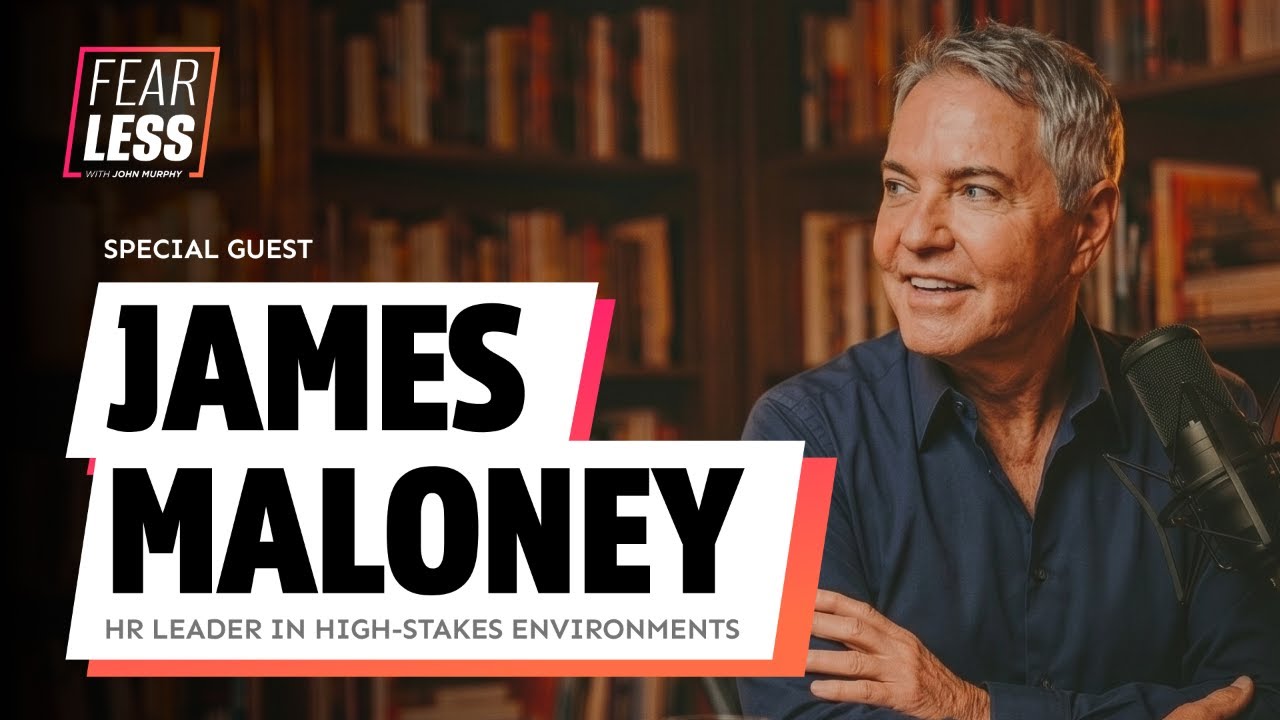
James Maloney joined AIG as an HR executive during the 2008 financial crisis when most people were leaving. He used change-management tools like Kaizen events and DMAIC to drive transformation, stressing the need to align strategy, culture, and incentives while building psychological safety for dissent.
Chapters
Good morning, everybody, and welcome to Fearless. Happy Friday. As we prepare for the weekend, let's, let's open up a conversation around stepping toward the fire, stepping into the fire rather than running from it. We've got an amazing guest today, James Maloney, 40-plus-year career in executive roles in human resource management, senior VP at companies like Paramount, CBS stations, 17 markets and a $1.6 billion revenue, 3,400 employees. big-time challenges with people. The idea of challenges today, the uncertainty that we're surrounded with, it seems like an accelerating pace of change. AI changing everything and people feeling threatened. How do we handle that in terms of an organizational culture? James is a specialist in strategy and employee and leadership development and strategic alignment. really aligning an organizational culture around a clear purpose, a clear mission, a clear strategy, pulling together, so to speak, which is something I write about and teach. Before we get into our conversation, just a quick promo for Fuel, one of the fastest-growing e-learning platforms on the planet, where we are specializing in what we've referred to as mastery learning, over memory learning. If you think about learning, and James can comment on this, our current paradigm going through the school systems up through the graduate programs, etc., is all about memory, learning from memory. Often people, including myself, step out of a major university into a company and have to relearn almost everything. It's not applied learning, it's more theoretical. Fuel specializes in applied learning. And I use the metaphor of golf. You can study golf by watching videos and reading books and textbooks, and you can think you know how to play golf and not know how to hit the ball at all. And so what we do with Fuel is we teach you a 9-iron or a club, so to speak, and then you practice that club, and then we teach you more clubs in the deck. And so you're immediately applying what you learn. And so that's the name of the game. with Fuel. I'm one of a number of esteemed instructors for Fuel. I've got 3 courses myself: Beyond Doubt, Creative Problem Solving, and Leading with Wisdom. I also have an AI twin, so you can get coaching and mentoring from me 24/7 all over the world. Simultaneously, this bot has been downloaded with 40 years of my work, books I've written, hundreds of interviews, hundreds of, uh, Audios, hundreds of articles I've written. So it's got pretty good re— it's got excellent recall, better than I do. And it's perfectly honest. These twins do not go to the internet for answers. They give you specific answers based on what I have learned over the last 40 years professionally. So it's a pretty amazing use of AI. And I have to tell you, I was a little nervous about AI changing everything up for me. Actually, I was concerned when COVID hit. I was traveling all over the world running live events and things like that, and that came to a shutdown. How do we adapt in these crazy times? I had to learn to do online stuff. I'm still learning. Now this AI bot. Another thing I'll tell you this is when I wrote my business plan 38 years ago to start my company, I didn't imagine any of this. And we've talked about in prior episodes, if you wait until you have full certainty, and James and I will talk about full certainty, if you wait until you have everything figured out, your plans figured out, you never leave the starting gate. It paralyzes you. And I've often said to a number of people that if your what and your why are important enough, what it is you want and why it's important, not just to you, but to the world, the how shows up. The how shows up. So when I started going into consulting, I didn't know how to do it, but I knew what I wanted and I knew why it was important. And the how just continues to show up when you're clear on that. And you've heard me use the metaphor of a GPS system. If you know where you're going, you're gonna get sidetracked. That's life. There's gonna, you know, it's gonna be uncertainty. If you know where you're going, you're going to get rerouted and you're going to correct and you're going to keep moving forward. And everything that looks like a mistake is just adding to your bucket of wisdom. You don't learn wisdom from a textbook or in a classroom. You learn wisdom from experience. And so we've got James Maloney today with all kinds of experience. Welcome, James. Thank you for sharing your wisdom with us. our audience.
Thank you, John. It's, uh, it's really great to be here. It's an honor to be here, especially with someone as accomplished as you— author, keynote speaker, consultant, change agent. I don't know where to stop. I think I want to add one thing though— salesman— since, uh, you convinced me to jump on this podcast with you, and it's my first, so I hope it goes well.
Yeah, I'll talk about stepping into the fire, walking into the fire, or walking into the podcast. By the way, that's another thing for me. I I mean, I've been a guest on hundreds of interviews and podcasts, but I've never actually hosted one until late last year. And now I have 3 different podcasts, including this Fearless on Fridays. And again, that's the how showing up. I'm learning as we speak. And that's another critical success factor for anyone listening is lifelong learning. No matter how great you are, and you can see this in the music industry, the sports industry, of course, In the business world, every great leader has a great coach. It's just as simple as that. And nothing is ever accomplished alone. Even sports that seem like it's a solo thing, a singles tennis match, a swimming race that isn't a relay, doesn't matter. Everyone's got a coach, everyone's got teammates of some sort, and there's a collective nature to it. So I call it a constituency for change. When I go into an organization to lead a change event, I never think that I'm going to do anything alone. And so we pull together, we get aligned strategically— we'll talk more about that— and we get things done. So running Kaizen events all over the world without knowing the language that I'm— the country I'm in, without knowing the people I start with, it can be a little intimidating. But so how does that work? Well, I step into it with trust in the process and the methodology, the change methodology that I use and teach, and the fact that we've got really bright people that want to make good change. And so we just, we do it. We make it happen. And the more we practice that, it's like getting on stage to give a speech. It terrifies a lot of people, but the more you do it, the more experienced you are. Uh, you know, some of the Hall of Fame speakers we've had on this show, They don't blink. They don't blink. It's like they can speak in their sleep. Now, James can pretty much tell you all you need to know about strategy and aligning executive teams and human resources teams and really building a culture of performance. But he's made some changes in his career. James, I wanted you to comment that a defining moment for you and what you learned from it, and what did you see that other people didn't see? Can you comment on that just a little bit?
Sure. And you're right, there have been a few defining moments, but I'll focus on one that I think is very relevant. I guess one of the most defining decisions I made in my career was to leave a very stable AAA-rated insurance company back during the financial crisis. It was one that really came through that without having to lay off a single employee. We had no exposure to the mortgage-backed securities, and it was really a great place to be to join AIG when it was 92% owned by the US government. In the public conversation at the time, it was widely seen as the symbol of everything that had gone wrong during the crisis. I'm not sure that's an appropriate designation, But clearly in the public view, that's how it was seen. When I think about it on paper, it probably didn't make much sense. I was leaving stability to walk into an organization that was under enormous scrutiny, that was still trying to rebuild trust, trust with employees, clients, regulators, the American public. I mean, the American public was funding the company and saved them from bankruptcy. People around me thought I was crazy. My boss at the time, who I have the greatest respect for and still talk to, when I walked into his office to resign and tell him where, he sat down with that look of like, what's the punchline? I had colleagues and, you know, people that I've worked with for many years that were supportive but questioned me in a good way. And even family members. I mean, my mother told me she was a didn't want to tell her girlfriends at coffee that I was going to work for AIG. They were seen as the enemy. And look, there was definitely some hesitation. And honestly, even for me, a little bit of embarrassment attached to AIG in that moment because it was so public. The company employees were being accosted on the streets and the subways. We had to take AIG branding off of our security badges that allow people access into the building. But I would say in part that's what really drew me to it. I saw it as an opportunity to rebuild something that really mattered, not just maintain something that was working. I was bored in my job. This was a challenge that I hadn't experienced before. I, I think I said to someone, I'm going to have an opportunity to make an impact in an organization. And when they— when the stories are told at the end of the day about the success, and I believed it would be successful, I can say I was part of that. And sort of despite all the noise around the company, there were truly incredibly talented people there. I mean, what I would say as rock stars of the industry and truly some of the best people that I've had an opportunity to work with. When I got there, one of the first things I tried to focus on besides getting to know people and whatnot was really trying to understand what were the disconnects between what the business needed and how the company was operating. Because we all know that in situations like this, the issue isn't usually that people don't know there's a problem. It's that the organization isn't necessarily aligned around how to solve it. And that experience really shaped how I think about leadership and organizational work today. I'm usually drawn to situations that are a little messy. Some would say a lot messy or unclear. I always say I'm not a maintenance HR guy. If that's what you need, don't call me because I believe in the messy and in the unclear. That's where the opportunity for real impact exists. You know, you asked me to, to talk a little bit about, you know, what I saw that others didn't. And honestly, Yes. I don't, I don't think I saw anything that other people didn't. Um, I think I probably interpret— interpreted the situation differently. And sometimes that's easier when you're an outsider, right? I was working with people that had lived through the crisis. They were living it every day. I was coming in with a fresh perspective. and it's an outsider's point of view. A lot of people, I would say everybody, saw the reputational risk, the instability, the uncertainty. Are we really too big to fail? And all of that was real. But I also saw an organization that was under so much scrutiny that it was actually more open to change than most companies usually are. I mean, we all know change is hard. And you have to really make a strong business case for it. In the situation that they were in, 92% owned by the Treasury, and you're sort of trying to come out of that crisis successfully, the case for change was pretty obvious. And, you know, in moments like that, when the case is obvious, there's usually less patience for politics. There's less ability to hide problems because they're visible to the world. and more willingness or openness to rethink how things operate. I mean, it really creates permission to do the real work. And so for me, it wasn't about ignoring the risk because I knew it was there. It was recognizing that the conditions were so meaningful that we could have real impact.
Yeah, you used the word risk, and of course that's a huge component to whether we make a move or not. And so how do you distinguish— how do you see risk in terms of making a change versus not making the change? How do you look at that?
It's a good question. I usually— I still go back to the old yellow pad with the line down the middle and the pluses on one side and the negatives on the other. But I would probably boil it down to a couple of things. First, I ask, is the problem actually real? and consequential? Or is it one of those things that's perception, noise, a short-term panic? Because sometimes organizations look messy from the outside, but underneath that, there's still a really strong business or a strong group of people. And so I try to get my head around that. Second, I ask, can the core issues actually be influenced? Like things like leadership. Are they aligned? What are the incentives? Are the decision-making rights clear and are they open to considering changes there? How is accountability? What's the culture like? I mean, those things are really hard to adjust and to take on, but they're workable. So if the problem is real and solvable, it's usually worth taking the risk, in my opinion. If it's fundamentally broken or outside my ability to influence in a meaningful way, Then that becomes a very different decision.
Yeah, you know, I love the idea of, you know, the line down the middle and the pros and the cons. You know, in my line of work, we call that force field analysis. What are the forces for making the change and what are the forces against making the change? And let's weigh that. But I also teach in one of my courses the FMEA, the Failure Mode Effect Analysis, which is a tool I use in every kaizen event, every change event. And the FMEA, in a simple way, is just what could— we're at, as a team, we're saying we make this change, what could go wrong? What could go wrong? How serious would that be? How likely is that to happen? So that we can basically calculate it in a comprehensive way. There's a numeric system to calculate what's called a risk priority number, an RPN. But you basically, for every potential failure mode, you're identifying How serious is it? What's the risk? Then what I also do is we'll come up with countermeasures for everything that we think can go wrong. We'll come up with what can we do to make sure it doesn't go wrong, what we just simply call countermeasures. But then we'll also say, what's the risk of not making the change? Let's look at both sides like you do. Often what happens, We're as a team pitching this to senior leadership about making some pretty radical changes in policy and organization design and things like that. Almost always we can convince the senior leadership that the risk of not making the change is higher than making the change. But it brings comfort to the team. It's like, oh, if we don't— what if we screw it up? What if we get it wrong? Well, what if we don't?
Well, it creates buy-in. For people to go through the change process, which we all know is hard, you've got to have some buy-in to accept what is that case for change.
Oh yeah. In all of this, James, walking into that fire, people saying, yeah, but, yeah, but. We've talked about the yeah, buts before. Almost looks like you're making a foolish decision to some people. What's that whole experience taught you? Would you, if you could summarize that?
Oh, well, there's a few things. I guess for me personally, when I think about it, it's trust your gut. So do the analysis, do the old school cost-benefit analysis, but at the end of the day, trust your gut. I was fortunate that I have been able to work with some really great leaders and have learned a lot from them. And I'm a pretty good read on people. And I felt very comfortable that the individuals I met that I was going to be working with at AIG were the real deal. And I could learn a lot from them. And I could also bring a lot to the table. So, you know, part of it is just trust your gut. When I think about, you know, what I learned around organizations, I mean, I would say that organizations don't struggle because they don't know what the problem is. Usually there's a very high level of awareness about what the problems are. But what usually, at least in my experience, tends to break down are things like alignment. Are the leaders aligned on where you're headed? How do decisions get made in the organization? Does everything get pushed up? Are people clear on what they can decide and what they need to inform people of or what they need to push through? What gets reinforced every day? We talked a bit about culture. The stories that leaders tell, the things that they reward you for, those matter. Those drive behavior. And whether all of that stuff actually supports the strategy. I mean, at the end of the day, it's a business, right? So you have to make sure these things are aligned to support your strategy and that the strategy actually drives the business forward. And I think a lot of organizations are working really hard, but not always in the same direction. And I guess what I learned from that is that once those things start to align, change can happen a lot faster than people expect it to. The alignment is one of those things that if you don't start there, it's going to take you a long time to achieve your strategy.
Yeah. Oh, I hear you. Well, what about you? Do you have any questions for me, James? I mean, we've gone back and forth on a lot of this stuff and alignment and strategy and things like that.
Yeah, I guess maybe what's the decision? Because we talked a bit about, you know, I think you opened with a statement about not having complete clarity when we make decisions, and I think that is the reality today. So maybe share with us a decision that, that you've made before that you didn't have full certainty about and what you learned from it.
Yeah, well, I, I guess I could give like 100,000 of those examples because I don't think we have full certainty Yeah, I mean, seriously, I don't know if we have full certainty about anything anymore. And I mean, we can pretty much predict that the sun's going to set tonight and rise tomorrow, things like that. But probably the biggest example is when I started my company in 1988. I'd left an executive HR position and made the national newspapers with some pretty significant changes back then in terms of labor relations and organizational change. I wanted to teach it, but I had no idea how to do that. I've told this story before. Somebody said, you got to write a book if you're going to make it in consulting. I didn't know how to write a book, so I read a book about how to write a book and then wrote a book. That's the application. Then somebody said, we need to write an allegory because you tell interesting stories in your first book. Write an allegory. I didn't know what an allegory was, which is like a story, a novel for teaching. I read a couple of allegories and then wrote my first, which went on to national newspapers. That followed with more. What I'm saying is the how just kept showing up because I was very clear on what I wanted to do in terms of benefiting the world. And I always say this too, James, it's not about me, it's about what I have to offer. And so as long as I'm clear on the gifts I've been given to give to the world, then the— and the why is important because I'm here to help, which is why I believe we're all here spiritually, is we're here to help and make things better. And so we live in— you made the comment change is hard. I, I challenge that paradigm quite a bit, and I used to think that— I used to think people resisted change too, but that's an illusion because you can't. Your body is changing every split second of every day. 50 trillion cells somehow getting along inside those cells, molecules inside the molecule. We're energy beings, ever-changing. The world's not still, it's revolving. You know, everything, when you start to look at The world, the universe is, is in perpetual change. So that leaves us with a choice in terms of mindset. We can either try to resist it, which is a huge mistake, because there's no such thing as a bad choice. Now that blows people's minds. But if you're afraid to make the wrong decision, you're paralyzed. You're living in fear. And fearless is about— no. you can't screw it up. You're going to learn from it and you're going to pivot. Now, that doesn't mean you do stupid things. I don't think it was stupid for me to leave a safe position and salary to do what I'm doing. But like you said, it was a gut call. It was intuition. We've both worked with senior teams in some pretty major corporations. In terms of culture and change and strategy and alignment, you've brought that up. I think one of the most significant things I see is where a team is aligned, often they're aligned around the wrong thing. It's a bunch of people saying yes, yep, yep, yep, let's do it, and it's not a good idea. Then culturally, people are like, what are we doing? And in many cases, those businesses are gone. I see it all the time.
And sometimes on that point, they're saying they're aligned and they're all sort of claiming to be rowing in the same direction. And it might be that there are people that actually see a different path or have a different point of view, but they're— because of the culture or the hierarchy or whatnot, they're afraid to speak up, so they go along. And even though they might have a view that there's a different path forward, they're They're paralyzed, I guess, to some degree.
Yeah, and one of the things that really makes senior leadership look stupid, quite honestly, is operating without good data and good facts. So I use the DMAIC model, D-M-A-I-C. So we define current state. What exactly is going on right now? And by the way, we can use this on our personal lives. Let's define our life right now. How do we feel? What do we think? What do we look like? What are we doing? How much money are we making? Things like that. Are we in a happy career? Are we aligned with our core values? M is measure. Let's populate that with facts and data, not opinions. Forget opinions. Then let's analyze what's wrong. You mentioned earlier in the conversation, we know we have problems, And I'll come in and say, define a problem for me. Well, customers are calling us up and they're not happy with our service. And I will say, that's not the problem. And they look at me like, what do you mean that's not the problem? It's costing us X number of dollars. Our customer service people are going out of their minds. So you're— that's a symptom. You don't know what the problem is. And that's the problem. You don't know what the real problem is. So you're reacting. You're reacting to symptoms. It's like taking a bunch of aspirin for a headache. If the headache's not going away, you need to go deeper dive. And that's the A in DMAIC. We need to analyze the symptoms to get down to—
Absolutely.
Brilliance, to genius, and the genius of teamwork. Nobody on the team has to be a genius, but it's a good team aligned and focused on the core problem, the root cause, it comes up with ingenious things. So, you know, that's where we go. And then the I in DMAIC historically has been improve. Let's make things better, better, better. But what I've also identified is there are organizations making things better that should be eliminated. Why are we making this process better? It's obsolete. Let's get rid of it. Why would we optimize a meeting that we shouldn't even be having? Why should we optimize a report that we should delete? We don't need this report anymore. Just really, really archaic things. So I use innovate for the I more than anything. Let's eliminate everything we can. Let's optimize what's left that we need to do. And let's ask who's in the best position to do this. Because a lot of managers are getting in their own way. By not delegating effectively. A lot of that's ego and control issues. That's what I see. I go deep dive and then the C in DMAIC is control. Once we've come up with a brilliant solution, let's lock it in with measurement, with alignment on incentives, with standardized work, with things like that. That's where I've been able to make a huge difference in my career with Executive teams. By the way, if the executive team doesn't understand this and buy in, I don't waste my time with the company. You know that, right? So, you know, you've— how do— how have you seen executive teams really pull together in a good way? And what have you seen where they just— they're all going different ways? Because I'll also add this, without a real understanding of a methodology like DMAIC, a lot of people go right to the I. There's a problem, which is really a symptom, and they say, here's what we should do. Somebody else says, I don't agree with that. I think we should do this. Somebody else says, I don't agree. I think we should do this. You're immediately in conflict. You're not aligned and you don't even know what the problem is. I see that as just a major issue going on these days with organizations that are, in many cases, on their way out.
Well, I think to that point, you know, what do I see? People may call themselves a leadership team, but are they really a team, right? So you played sports, you understand what it's like to be on a team. And, you know, what team do you play for? They might say, I'm part of the executive team. I also lead the finance function, so I'm part of that team. But at the end of the day, what team are you really on? And it goes back to that sort of form, storm, norm, perform, right? You have to make sure that you're in the trenches. You trust the person next to you has your back, you have their back. You're all heading in the same direction. You're going to talk about the ugly stuff. You're going to be transparent with it. And you're going to win together or you're going to lose together. And I think often when teams aren't effective, it's because they aren't really a team as we would define it, a healthy team. They haven't fought with each other. I can remember some of the most effective teams I've been on. I would be on a Zoom call and Philip would say to me, what was that? It's like, no, it's just a team meeting. It's like violent disagreement, but with respect. It was you felt free to be able to voice your point. And then once a decision was taken, whether it was a unanimous decision, consensus, the boss made it, you all aligned around it and you headed forward. And I think that's lacking often.
Yeah. And I mentioned the FMEA earlier. I think it's a critical tool, the failure mode and effect analysis, because in a leadership role, it's simply saying to a team of people or a group of people that you're leading, Push back. Tell me what's wrong with this idea. Push back. You're asking for conflict, so to speak, rather than a bunch of yes people going, okay, let's do it, without really giving it serious thought and analysis. That's—
and you need to have a safe environment for people to do that, right? I mean, you have— I have to be able to tell my team, push back. You know, I, I don't know all the answers. Like, we're heading down a path and you think I'm wrong and you have a different perspective. If you don't share it, we're all in trouble. But I have to create the kind of culture environment that people can say that and not feel that they're going to lose their job or not get their bonus or whatever that happens to be. It has to be a safe place.
Yeah. You know, when I'm running Kaizen events and I've got these teams and I'm saying, you're about to tell the C-suite of a multibillion-dollar global company that their baby's ugly. Because you've done the analysis. I use that metaphor. I'll say, here's what's important to remember. Do not say the baby's ugly, even if it is, which we know it is with facts. You can't say that because now you just created a whole new problem.
Right.
How do we do that? Here's how we do it. I'll just use this little metaphor. I'll say, okay, and I don't speak. I'm the director behind the scenes, so to speak, but the team takes turns, the team members, presenting to the senior leadership on the current state, the DMAIC model, the analysis, the root cause, things like that. But when we're talking about things that are factually wrong, we've got, you know, we're taking 10 days to do something that should take 10 minutes. Okay, we've got a defect rate of 25%. We're not even close to 3 Sigma versus 6 Sigma, things like that. We speak like we're reporting live From Palm Beach, Florida. Here are the facts. It's taken us 14.2 miles to make a vitamin tablet. That's a fact. And that's a client— that was a former client of mine. It's taken us 184 days from start to finish to make a vitamin tablet. That's a fact. We've got $300 million of raw material in our warehouse that's— that does— it turns twice a year. That's cash tied up. Fact, fact, fact, fact. And if the leadership team says, that's not possible, I can't believe that. I said, well, prove us wrong.
Right.
And I had one guy say one time, well, I will. There's just no way that can be accurate. And he came back the next day and he goes, you're right. And we knew we were right because we got the data from his people. You know, so that's strategy right there. And when you think about change, And it makes no sense to not change and a lot of sense to make change, to make things better. You ride the wave of change rather than fight it. And so that's my whole, my whole job, uh, James, and I know it's been your job over the years, is let's figure out ways to, to use the power of change. I think of it like a wave. Let's learn how to surf the wave, not try to Fight our way through it, which is exhausting. And if you have right a good tool set to do that, you got a team that comes together. And you mentioned you know the form storm norm perform. I had a fifth, which I call transform. Because if we form a team, and I have people on Mondays of kaizen events going, I don't know how we're going to make changes by Friday. I mean, this is I'm talking about rocket scientists in the military, the Department of. defense and people, very smart people telling me, Murphy, you're out of your mind. And then by Wednesday, we've done the deep dive analysis. And instead of trying to solve 100 different symptoms with 100 different projects, we've identified a way to solve 100 different symptoms with 3 projects because we got right down to the leverage point. And, and that's, I mean, that's powerful. And then by the time of Friday, these people who were nervous and skeptical on Monday are high-fiving each other, just going, wow. That's a change of mind. That's a change in mindset. So when I talk about Kaizen events, which are change— rapid change events, I'm not talking just about changing design, changing policy, changing procedures, changing the way we do things around here, which is synonymous with culture. How do you change culture? The way we do things around here? You change the way we do things around here. You standardize work, you redesign flow, things like that. And when we do that, and they come together and align around it and they change their minds. We didn't just change the process, we changed people's minds. That's powerful stuff. I know you've done well with that, James. Any final closing comments, James?
Yeah. Sure. At the beginning, you made some reference to the uncertainty that we're facing today and how we deal with that. I know AI is something that's on all of our minds and For many, it's a big scary thing and people worry that it's going to significantly change their job, take their job. And how do we walk through the fire today with something like AI? And I guess for me, I think it looks a lot less dramatic than we imagine. And I think it's just human nature for us to make it scarier than it really is. For me, I say that I have to get more comfortable probably making decisions earlier than will feel comfortable. It's probably being very clear about what I'm prioritizing and as importantly, what I'm not prioritizing, that we can't wait for certainty. And you touched on this before. I mean, AI is moving so quickly that you got to take some action, right? Clarity usually doesn't come first. It comes from movement. And we're going to learn by doing, much like As you were referencing into your first job out of college. So I guess I would, I would finalize it by saying, you know, walking toward the fire today is less about one big bold move and more about, I guess, consistently choosing action over perfection and then align the organization behind those decisions so that people are all headed in the same direction.
Yeah, I love it. In fact, one of the mantras we use in the Kaizen events is better, not best. That takes a little pressure off people because we got to make it perfect. I'm like, no, we don't. It's not perfect.
You worry about all the things that could go wrong. Let's get it even.
It won't be perfect by Friday.
Absolutely right.
It's not perfect now, it won't be perfect by Friday. Let's just be sure it's better than it is today and part of that whole continuous improvement journey and build momentum. Because once we start getting momentum, because we've been making positive changes and people are pulling together and they're excited, one of the measures I have is, at the end of a Kaizen event, how many people want to do another one? Incidentally, I think in over 30 years, I've never done a Kaizen event where we didn't come out of the Kaizen event with 3 more in mind. Here are several other areas we should look at because we're tripping all over ourselves. That momentum is powerful stuff culturally. Yeah, it's just great stuff. Well, James, thank you so much for sharing your insights and your wisdom.
Thank you.
I mean, you and I could talk probably for days on a lot of this stuff. So maybe we'll get you back on the show. Um, next week I've got Brian Byro coming back, Hall of Fame speaker. Brian's just an amazing guy, and he was on the show actually earlier in February, and, and he's in, in, in hundreds of, hundreds of views, uh, from his interviews. He's just a wonderful guy and a great motivational, inspirational speaker, particularly around the The topic of change and dealing and working your way through fear. And like James, while walking toward the fire, I'll just leave you with this thought. Fire is not a bad thing. It's, it's, it's neutral like any other tool. It's like a hammer. You can use it destructively. You can use it constructively. Fire can be dangerous. We had Mark Tabet on the show just a couple of weeks ago where everything he owned went up in flames in the Palisades fire. He rebounded from that in the most inspiring way. But I'm the guy that likes to sit around a campfire at night. There's a lot we can do with fire. Whether it's AI or anything else, I advise people, let's figure out the best way to use it intelligently, which is the very thing I'm trying to do. If you'd like, you get a 7-day free trial with my AI twin. Go to myfuel.io and and click on me as an instructor and play with it. Just click live and ask my bot anything you want and see what I have to tell you. It's got better recall than I do and it's perfectly honest. I try to be as honest as I can too. But what I mean by that is the bot's gonna, if you ask a question that's outside my body of work, I'm gonna tell you, I can't answer that. I'm not gonna give you—
Right.
An unauthentic answer. The bot's very authentic. So with that, hope to see you next Friday with Brian Byers. And, uh, again, James, thank you so much. What a great— what a great show.
Thank you.








