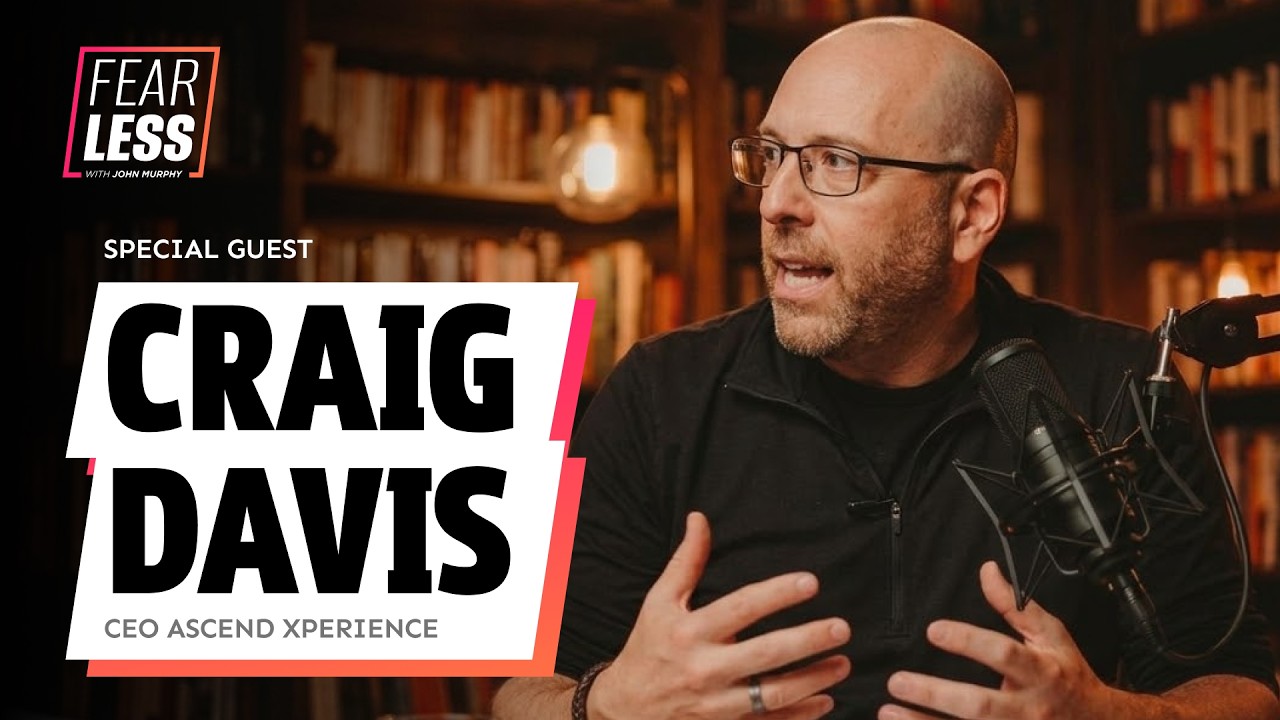
Craig Davis, founder of Ascension Experience, talks with John Murphy about making intentional shifts in mindset and leadership. Davis shares how he overcame cancer and job loss to become a coach, and offers practical strategies like specific "I am" statements and balancing fear with faith.
Chapters
All right, good morning everyone and happy Friday. Today we've got an awesome guest, Craig Davis, and we'll tell you a little bit more about that. But this is a production of Fuel and we've put the— in the chat, myfuel.io, the website. And you click on that and you can check out a whole number of different courses that are offered. The faculty members, Craig and I are members of the faculty. And some of us now even have AI bots, which means you can interact with us infinitely, if you will, within the scope of our work. So, for example, in my case, over 30 years of articles I've written, speeches I've given, interviews, 20 books, things like that loaded into these bots, allowing you to ask any question within the scope of my work and get immediate answers. And so, follow-up type things. So, play with that. Go to myfuel.io. Look at the different courses. Check out the instructors. We're talking world-class instructors here. And I'll tell you what, if there's one tip I'd give anybody after 38 years as an entrepreneur and running my business, it's surround yourself with brilliance. Find people who know what they're doing, people who have accomplished what it is you want to accomplish. And learn from them. I mean, I'm learning to this day and I always will. It's so important to keep that open mind and grow. It's about continuous growth. You don't reach a point in life and then start going downhill unless you choose to. So, today, we're going to talk about shift. Shift happens. Craig's got a podcast himself called Talking Shift. So, what's that all about, the shift we're talking about here? There it is. And so, with that, let me welcome Craig. He is the founder and CEO of Ascension Experience. And he could tell you a little bit more about that. He's an executive coach. He's somebody who's been in a leadership role for over 20 years and run into some bumps as we all have. And, well, how do we respond to those bumps, that adversity? Is it with fear or is it with faith? So, Craig, welcome to Fearless and tell us a little bit more about you.
Yeah. Thanks for inviting me. It's a pleasure being here. I love this conversation. You were just on my podcast recently as well and I just thoroughly enjoy and learn from you. And so, I love as you were talking about surround yourself with brilliance. I mean, right? Like Jim Rohn says, we are the sum of or the average of the 5 people around us. And so, never better advice. So, yeah. I mean, my background, just, I guess, the real quick, I mean, I was 20 years in the mortgage business. And those who know the mortgage business, it is a very emotionally charged, up and down, volatile business. And from the 2000s going through the 2008 timeframe and from the sales trenches into management, into leadership, and helped take a company public. And so, that's my technical background. But There was a few more little twists and turns there that sort of led me to where I'm at now, which is sort of what has fed into really my brand that has developed about Shift Happens. And shift's either going to happen to you or we're going to make shift happen for you. So, happy to dig in wherever you want to go with this.
Yeah, Craig, that's a great way to put it. Is it making shift happen to you? Or we making shift happen in the most positive way. It's almost like, do we go downhill or uphill from here, wherever here happens to be? So, before we get into some of your personal story and your applications, if you will, in making shift happen, what exactly do you mean by shift happening? I know we're talking about mindset and the shift in mindset, but talk a little bit more about— What do you mean by shift in this case?
Well, I mean, throughout my tenure, my life, all of our lives, right? I mean, we don't have to coin it down into our careers or business, but just in general, there's sort of 3 fundamental rules that I call them your 3 truths. And I'll go back to shift happens, opportunities change, and success is a choice. So, I frame that because, look, we can't control everything out here. Now, we can control what's in here. And so, when our world might shift, society is currently shifting right now, AI is shifting everybody right now, companies are shifting. I mean, again, not to abuse the word, but it is. And not everything is this big dramatic, like we're waiting for this sign and like this is going to happen. It's not like that. Sometimes it's drift.
Yeah.
Sometimes, it's drift happens, right? And that's where we have to have this conscious awareness because it can get us into these positions. And I talk about the big, nasty, ugly obstacles we face when shift happens: fear, getting stuck, or just dealing with change. And so, really, the fundamental core underneath that is, okay, no problem. Shift happens like we talked about. Opportunities change. Okay. Maybe your boss has left and you have a new incoming boss and everything just changed, right? Maybe just a new project landed on your plate and like, we don't like it. I don't like who I'm working with. I mean, there's so many things that can affect us. Again, everything has to be this big monumental event. It can be little things. But like we just said, drift also happens. So, those things can creep in. So, we have to be in control. We have to have a strong mindset. And we have to look through the lens As a leader, and look, leadership is a behavior, not a title. I don't care what job titles are. So if we look through the lens as a leader, okay, great. What is happening? How do I respond, not just react? And then whether it's a big issue or really a non-issue, we know, I mean, how many times throughout everybody listening, you know, yourself, John, like we've encountered something, it might've felt like the biggest thing in the world. Or not. It's just how we interpret it and then how do we move forward with it, right?
So, yeah. I think about it this way. I call it minding the gap in these situations. So, there's a gap. This is the psychology of stimulus and response. There's a gap between stimulus and response. So, if somebody pokes you, for example, you can respond instantly by poking them back or reacting in a— not very positive way, or you can mind the gap and say, you know, it doesn't have to be a physical poke. It could be, you know, an insult or something like that. But how do you respond? Is it habitual? Is it your automatic response? And a lot of that's just subconscious programming we've grown up with. So, you know, an eye for an eye, you know, that kind of a thing. Or a more Wise and sagacious choice where it's just like, well, let me mind the gap here a minute and think about alternatives. I could respond any number of different ways. What's the wisest thing to do in this situation? Which translates into shut up to a lot of people. Just stop talking. Just stop talking. Listen, contemplate without judgment. And respond in a more responsible way. And like you said, shift happens, drift happens. And when I hear the word drift, I think immediately of true north, like a ship at sea. Of course, we're going to drift. That's life. That's variation. But do you know where you're going or where you want to land?
Yeah.
You adjust. I saw an interesting metaphor recently about GPS. If you take a wrong turn and your GPS goes, hey, beep, beep, beep, we got to readjust here. It does as long as you know where you're going, right? So, as drift happens and shift happens, I mean, we've experienced lots of shifts in life. What's the response, right? So, give me an example of Let's call it because I know it's a major shift for you. Let's hear your story about how you made shift happen in your career and really in your life.
Well, so, there was something I was dealing with throughout my career, and I just call it my biggest fear, right? And my biggest fear, especially as I grew and rose in my career, like the more success I had, The more fear I had. And I just was developing so much fear. Like I just had this fear of losing my job. And certainly, and it's true because as I got out of sales and into management and I kept getting promoted into leadership, you know, I was making sure I always stayed on the ground. I always stayed, you know, with my crew because I had to stay in production, right? That was important to me. But I just, this growing fear of losing my job. So here it is. It's a Sunday. We just come back from President's Club.
Wow.
3 years ago, 3 and a half years ago. And I've got an amazing group of leaders around me. I've been cultivating leadership around me. We're running record volumes. I mean, life is great. What could go wrong, right? That's a Sunday. Guess what happened on a Monday? I was diagnosed with stage 3 cancer. So, when we talk about shift happens, I did not see that coming. That one came right out of left field. This was not a Oh, I think there could be something. So, as I got that information, right? I mean, I come home and my wife and I are holding onto that. I mean, I think I'm going to die. Like for 2 days, all I could think about. So, you want to talk about everything became one? And I remember sitting in the kitchen looking at my wife and daughter, and I couldn't tell my daughter, who then was in 5th grade, like, I can't leave you. That was my only thought. I'm going to die, but I can't leave you. I cannot leave you. It's not an option. It will not happen. And then 2 days later, I talked to a friend. I got a little information. He was the first person I told before I even told my parents. He said, listen, we have a family history of that same colorectal cancer, and I believe it's treatable, and I believe it's slow-growing. Now, the doctors never told me that, but as soon as he told me that, my belief system changed. My belief system changed from I'm going to die.
Wow.
To, I just have to get through treatment. And so, there's something important here that I realized in the moment. It was, I don't have cancer. There is cancer. I shifted outside of it. I don't have cancer. There is cancer. And then I put my leadership brain on it.
Okay.
How would I manage this situation? Okay, cool. Cancer treatment just became another project, so to speak.
Okay.
Let's get my head wrapped around it. What is treatment? What do I have to go through? What's my timeline? Yada, yada, yada. Who's on my team, my doctors, my nurses, all the stuff. And then I had a very specific mindset. And I want to make this point because this is going to go down a lot of different tentacles, but I just want to make this one quick point for anybody dealing with this, but just in life in general. Have a specific mindset, not a general mindset. It wasn't just, I'm going to be positive. Life is good. You know, fuzzy bunnies and namaste and unicorns and rainbows was not good enough. My specific mindset in this moment was, I will endure. Endurance became my one word. Endurance became my identity. And that's really important. We'll kind of hold on to that for a second because this translates and transcends throughout our life. Like, what is your one word? My theme, my one word, my identity became, okay, every single day, every single moment, I will endure. I will endure. So, enough days went by, made it through chemo, made it through radiation, made it through all the glory that comes around all of that, about 8, 9 months of treatment there. It eradicated the tumor. I didn't have to go in for surgery. I'm back. I never stopped working, but I'm back. Okay, let's go. Hell yeah. We did it.
We made it.
And then 6 weeks later, I faced my biggest fear and lost my job because they shut down the company. And this is what was even worse. Losing my job was harder for me than fighting cancer because my identity, I felt, was lost. I felt like I lost my identity. Everything I had wrapped myself into— I am a leader, I'm an executive, I am a part of this company, I've been there for 14 years, I helped take it public— and it just broke, and it was completely out of my control. It was an investor decision. We took the company public. Oh, we don't want to be in the forward mortgage space anymore. We just want to be in the reverse space. They tried, you know, they tried doing things, selling off parts. It was the mortgage industry was disintegrating around us.
Poof.
Now, I could have gone and chased another job. I could have easily gone and gotten other jobs. But my stomach was screaming. It was upside down. It was like, don't do that. Everything, my wife, including my wife, and I'm the sole breadwinner. My wife's like, "I think you're meant for something different." I said, "I think I want to be a coach." This was always my life after mortgage plan. I just thought that'd be later, not now. And and so once I got again, once I got my head wrapped around that, I said, "Okay, I declare April 12th, 2023, 8 a.m., pen on paper. I declare I." I am a coach and I stepped into my future identity. And I say, faith plus grit, faith in myself, faith in this is what I'm meant to do, plus grit. And I never looked back. And that was 3 years ago. And launching my coaching, consulting, speaking, podcasting, all the stuff, business.
So, that's— I mean, it's an amazing story, Craig. And a couple of things you said that just align beautifully with what I teach. I teach beyond just business consulting. Operational excellence, that kind of strategy. I teach energy shift, energy transfer. So, there are a couple of things that you said I want to comment on.
Yeah.
One is you attached your identity to something you had no control over, your job in this case. Anyone who attaches to anything they don't control or can't control lives in fear. They live in fear of losing what they've attached to, which is why one of the key universal principles in life is called detachment. It's letting go of that as an identity. It doesn't mean you don't love your family, your house, your car, your job, your title. It doesn't mean you don't love it and appreciate it and honor it. It just means you're not attaching your joy in life to something you can't control. That's true mindset shift, mindfulness. The other thing you said I thought was really interesting is you became very specific and you used I ams in a positive way. A lot of people don't do that. And in fact, I have a show coming up on Monday on Mindset Matters through Fuel, and it's called What Follows Your I Am. So, if you want to hear more about that, audience—
I will.
Check it out on Monday. But here's the point. Is if you follow the I am, you said, I am enduring, and you were very specific. I'll often teach clients, you cannot fix vague. You can't fix vague. You need to be very specific about what it is that you're going after or where you want to be. And that specificity is what allows you then to bring the energy in to solve the problem. There's no problem on the planet without a solution.
Right.
At least one solution. And there's no problem on the planet that isn't, in the long run, a good thing. That blows people's minds. Like, wait a minute, we should be giving thanks for our problems?
Yes.
And the answer is, yeah, because it's a lesson in disguise. You're going to learn from this one way or another. And in fact, we invite problems into our lives. I like solving crossword puzzles. I mean, I like challenges like that. That's a problem.
Yeah.
You know, solve this math problem, solve this problem. And it's exciting. What if we had no problems, right? So, as we face— now, some problems are a lot larger to— harder to solve than smaller ones. But I love what you said about faith, you know, faith over fear. And you said, I don't have cancer. All right? I don't— I'm not attached to it.
Yeah.
And in an energy way, you let go of it, whereas other people will say, I have cancer, I have this illness, I'm anxious, I'm really worried, I'm afraid. And that's attracting more of the same. Like energy attracts like energy. So, wow. I mean, what a story. So, you reinvented— I know you like that term, reinvented yourself. You more or less reinvented yourself. And what was that like? Did you hit some bumps in the road? Did you ever get to a point where you're like, maybe this wasn't the right decision, maybe I should bail?
I mean, do I hit bumps in the road? Of course, every day, right? I mean, every day, right? But what's interesting is, and I talk about this, where I actually have less fear now as an entrepreneur, right? Because you wake up every day like I have to go out and hunt and kill. But I have less fear than I ever did before when I was gainfully employed. There's an interesting irony there. But it comes back into everything that you were just talking about. And going back to the identity piece, what got me up when I was knocked down from losing my job and got me here because it didn't just happen overnight. Okay. Poof. Let's go do this. Life will be wonderful. Again, life ain't unicorns, rainbows, and fuzzy bunnies, right?
Yeah.
I mean what got me up is When I felt like I lost my identity, like who am I? I literally, like in the immortal words of my 15-year-old daughter, I literally had to ask myself, who am I? And it's a funny question because I had a very, very important job. Like I didn't get there by accident. And I had to ask myself, who am I? And what stood me back up, as I said, I am a leader. I am a leader. That's who I am. That is always what has made me successful throughout my entire career. My ability to lead others, my ability to help you be successful helps me be successful. And that, that is my mission. That is my purpose, to help you be successful on purpose, but in your design, not just my design. And it's one of my talents. It's what I love doing. It's what I get out of bed doing. If I could win the lottery, I would do this for free. And that is what got me up. I had to remember that. I had to reattach my identity to me. Nobody can take that away from me. I am a leader, and I love— no one can take away what I love doing. I love barbecuing too, but I'm not going to go up and open up a barbecue joint. I could, but I'm not going to. I love leading. This is what I want to do. And that is what led me to this decision. So when I do face fear all the time, when I do face obstacles all the time— and by the way, I love what you're talking about with problems. And I love Wordle. I do it every morning. You know, it eases the brain. And I just ask people, is it a problem or is it a challenge? And if it's a challenge, what's the opportunity? I can wake up every day and say, cool. What are my challenges and what are the opportunities for those challenges? I'll get after that every day. Do you want to wake up every day and go, okay, what problems do I have today? Right? I mean, a little, these simple mindset shifts can change everything, can change everything.
Yep, yep.
Because, you know, here's the simple math. Attitude plus action equals you. And your attitude is the output. It's the output. That's how the world sees you. That's how you interact with the world. The input, like you're talking about, mindfulness, awareness, what information are you allowing in? And all your mindset is is how you interpret that information, good or bad. How you interpret that information, your output is attitude. Attitude plus action equals you. So, is it a problem or a challenge? Yeah.
I would just add attitude plus action translates into results.
Exactly.
And so, here's a tip for everybody is if the results you're getting in life aren't optimal, whether it's physical results with your body, it's emotional results, you're stressed out, you're anxious, it's relationship results, you're in a Relationships that aren't positive and happy and healthy, financial results, whatever results. And this is how I teach business and strategy and operational excellence. We work backwards. So, we start with results, customer complaints, defects, quality issues, employee issues, morale, things like that. And we take it upstream doing root cause analysis to just what you said, which takes us— Through attitude, which is an output, into perception, into how we're looking at things. So, for an individual, how do I see myself in any situation translating into my attitude, the way I think and feel, which then propagates into results? So, we take it all the way upstream. And this is where I think the most important tip is, is it's what's in your mind.
Yeah.
Okay. And I'll often say this to people, is your mind controlling you or are you controlling your mind? There's a big shift there. Like, what do you mean? Well, my mind is telling me I should be anxious in this situation. Things could go wrong. Why don't you tell your mind it's wrong?
Yeah.
Mind, because the mind's the ego, and the ego wants you to be afraid. It doesn't know anything but fear. So, if I recognize that's actually not who I am, you use the term who I am. I teach what am I, not who am I, because who is an ego term and my name is such and such, I'm the president of some company, I'm a father, I'm a husband. Those are all more or less who identifies, personas.
Mm-hmm.
But you go deeper than that to what am I? You get into spirit, you get into energy. Because when we even the human body, which has 50 trillion plus cells, and every cell in the body is doing 6 trillion things per second, and every cell is predominantly empty space, if you take it right down to the quantum atom level, right?
Right.
We're basically just energy beings, and we've lost control of that awareness by giving control to a mind that says, you should, you shouldn't, you're sick, you should be challenged and stressing out in this situation. So, I think when you get to a point of true awakening, true enlightenment, and you realize there's no reason for me to be afraid, it doesn't mean I'm going to do something stupid.
Yeah.
So, what I'll often do, Craig, I love your comments on this, is I'll actually recognize that the fear is coming from the ego. It's not coming from my true self. So, I'll say, ego, what are you trying to tell me? Is there something I should be cautious with here that I could risk, do a little mitigation on, a little risk? Because it may actually have something to say, but I'm not going to give it control.
Yeah.
And so, in your case, whether it's a loss of— I lost my job in 1988, started my my consulting practice. So, 38 years later, all kinds of drifting, all kinds of shifts going on. I basically, I'm in the problem-solving business, you could put it. So, I look forward to these challenges, as you like to put it. God, I can't imagine life without having some challenges. What would you do? Peace is boring.
Yeah.
So, what are your thoughts on that to get to that point where you know things are going to shift, And you keep your true north. You just, you persevere.
Well, and again, I like what you're saying because, and I wholeheartedly, and I'm going to start thinking about what, not who in this as well. Because again, you're talking about detachment. You know, our mind is not always working in our best interest. I always talk about, and our brain and our mind are 2 different things. And I always talk about our brain and our mind in third person. You know, that way. Right? Because I make it third person when I'm talking about this stuff. Because again, your mind's not always working. And all your brain, your mind is trying to be is safe and warm by the fire. If you think about the caveman days, right? We just want to be safe and warm by the fire. Your brain wants to generally predict an outcome. If I'm safe and warm by the fire, I can generally predict that I'm going to be safe and not die. But I got to go out and hunt. I got to go down that trail. But there's saber-toothed tigers down that trail. What if they kill me? So, now enter fear and enter anxiety and a whole cocktail of worry and all the stuff, right? Fight or flight, lizard brain, whatever, you know, limbic system, you know, all the stuff. But that's how we have to go out and survive and live in this world. And I think more and more saber-toothed tigers out in our lives, certainly as society has developed over the last 150-plus years and all— I mean, our brains weren't wired for chronic Stress, right? So I really think about this. Our brain is a muscle, right? We go to the gym and we work out. Our brain has to be worked out as well. It's a muscle. We have to be purposeful about what information we allow in. There's our reticular activating system, right? Like I want to go buy an orange car. I've never seen orange cars. I think orange cars are cool. As soon as I make the decision I want to buy an orange car and I get an orange car, what happens? I see orange cars everywhere. That's our reticular activating system. It's a filtration system to pay attention to what we deem as important. Well, if I deem that leadership is important, if I deem that mindset is important, if I deem that bringing healthy information into my world, I'm listening to Leadership Live, I'm participating in Fuel, I'm doing the courses, I'm reading John's books, I'm going to Talk and Shift, right? I mean, all the things. If that is healthy for me, then good. That's my neural net. I'm going to grab that information. It's going to come in. It's going to influence the mindset. The mindset is just interpreting information.
Cool.
I like that. Attitude is different now. Attitude is better. Now I see challenges, not problems. I mean, it's— so think about your brain. It's just, it's a muscle. Let's work it out. We don't have to do 1,000 sit-ups over it. Just read one thing. What are your— and I talk to people about what's your code? What are your magnets to your compass? What are your core values? What are your favorite isms? What are your favorite quotes? What are those things that kind of center you, that ground you?
Yeah.
And these are just little things that help just kind of reduce the noise and create signal versus noise. I know, Jon, that you and I talked a lot about this because I believe in our energy. We have great signal, like we're on the same frequency. And it's things like that that people, if you're just sort of, we're stressed out and we're worried and we have anxiety and all these different things, it's all natural. It's all real. It's not necessarily going away out in the world. It's competing for your attention. But we can choose to interpret these things a little different, for you, not to you, for example.
Yeah. Love what you say about the brain. And I don't even refer to it as my brain. I love what the late The late, great Dr. David Hawkins would teach with the Map of Consciousness, which I've spoken on before. But he'd always refer to his body as the body, his brain as the brain, recognizing that it's a tool. Basically, the body's a tool while we're here on the planet. The brain is a tool to use to solve problems and to survive in physical form. And when you start to think it that way, you say, well, what could I do to exercise the tool, the brain? And it's not about going to the gym and pumping weights with your brain, but I do neurofeedback, which is brain training. I mean, it's one of the latest, greatest discoveries in brain health. Things I just took up, I'm in my mid to late 60s and I just took up piano lessons. You mentioned Wordle. I love Wordle. There are so many things we can do to exercise the brain and the neurons and the neuroplasticity. But yeah, one of the simplest things to do is hang out with smart people. Listen to smart podcasts, read smart books, especially as they relate to the direction you want to go. A little entertainment here and there is great, but I always separate activity from productivity. Activity is just a bunch of busy stuff. I'm super busy. I don't have time to do some of the things I really want to do. Doing the things you need to do to be healthy, to be happy, to be prosperous, to grow, Those are the productive actions. So, know the difference and choose productivity, and maybe you'll go a little drift along the side. So, we got to wrap up here, Craig. Give us a final takeaway. What's a one-liner? What's something you could just give the audience to say, here's something, a golden nugget to take with you to really open up the doors in front of you?
I mean, there's so many. I would maybe leave the audience with this. I mean, your mindset is your greatest asset. It is your greatest asset because it's in your control and it can determine everything. So, if we just understand, I'll go back to the 3 simple truths. Hey, shift happens, right? Opportunities change, but success is a choice. And either shift's going to happen to you or you can make shift happen for you. And that lens that we look through, so when things happen around us, okay, cool. I'm just going to respond. I know how to respond. I've been here before, right? I've seen these saber-toothed tigers before, but I'm prepared now. And your brain gives you confidence.
Yeah.
Your brain gives you fear when it's uncertain. So, you know, this one— I love that.
And I'll just— I'll add something I've said before. It's a great Henry Ford quote. He said, whether you think you can or you think you can't, you're right. Yeah. So, you know, Think you can. That's important.
Yeah.
Thank you, Craig, so much. You guys can check out Craig's podcast, Talking Shift. Check out Fuel. Craig is an instructor there, as am I. Play around with the A-Bots a little bit. We've got some great faculty with some great tips, brilliant minds. Bring it into your life and learn and grow with it and pass it on. Of course, when you pass things on, that's when you shift from memory learning to mastery learning. And that's a fundamental pillar With, with fuel. Learning from memory, you forget stuff. You, you don't really know. You, you think you get it, but you don't. Where mastery is when you actually live it and you apply it and you embody it and you teach it. And people just go, wow, this Craig gets it. You know, he gets it. Not because he memorized it or took notes in class, but because he applied it. He, he took the attitude to action like he likes to put it. So do that. Monday, I've got Mindset Matters, more on mindset and What follows your I am? And why is that so important? It's absolutely important energetically. That's because we draw what we feel we are. And so if we feel anxious, we're asking for more anxiety. If we feel afraid, we're asking to be more afraid. If we see the world as conflicted, we're conflicted. We're projecting what we are onto the canvas that we live in. And we can see the entire— we can see the exact same thing entirely differently. We could see it as a mess, as something negative, as something to be afraid of, or we could see it as an opportunity, a challenge, something exciting. It's one of the— it's two sides to the same coin. And then next Friday, I've got Meredith Elliott Powell, another Fuel instructor who's got a real compelling story to to share. We're calling it From Secrets to Strengths. She grew up in a very struggling family. I'll let her give you more details, but learned to let go of the shame and trying to hide those secrets to using them to improve things around the world and help people struggling with the same issues. So, tune into that next week. The last thing I'll say quickly is if you get value out of these videos, they're streamed live on YouTube and recorded. Share them. Share them with family and friends and people who might be struggling with an illness or a job loss or any number of things. We've all had our ups and downs and our drifts and our shifts. So, share it. With that, Craig, thank you so much, and we'll talk again soon.
Thanks for having me. Enjoyed the conversation as always.
You got it. Bye, everyone.








