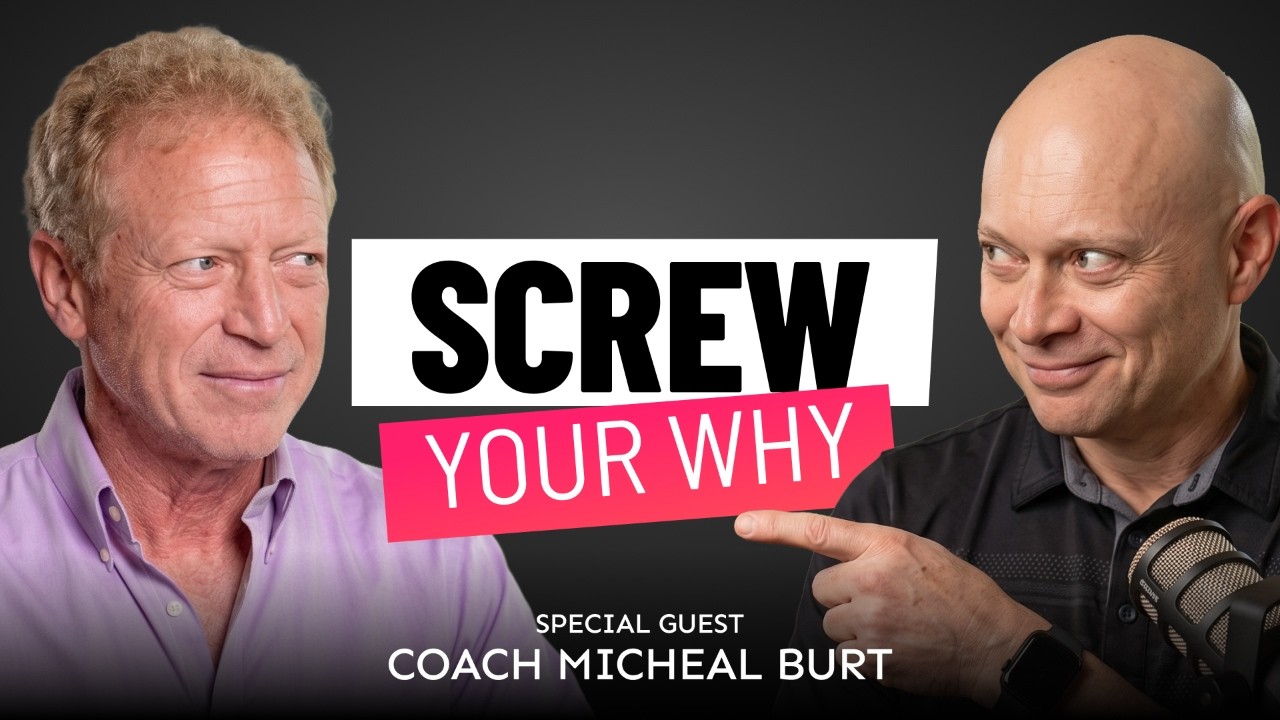
Coach Michael Burt argues your "why" is too vague. Instead, identify a skill, pair it with a problem only you can solve, and pick a distribution channel. He's raised over $20 million with this framework and built the Greatness Factory around it.
Chapters
All right, greetings everyone and, uh, welcome to Fearless. Uh, this is our 25th episode and I've got a phenomenal guest today, Coach Michael Burt. And, uh, just a quick thing about Fearless, you know, we started this podcast in January of this year. Again, this is our 25th episode now. We've had some wonderful guests, and the whole podcast exists to help people essentially get out of their own way and to get through fear and find the courage and the will and the passion to pursue their dreams and really elevate.
Coach Burt started the Greatness Factory. He's a Wall Street Journal bestseller of Flip the Switch. His new book, Screw Your Why, is going to be a lot of fun to talk about on this show and really about developing and understanding your skills, packaging those. He'll talk about skills versus why, how they interact. He'll talk about a vehicle, if you will, for delivering value, essentially. So, Fearless is a production of Fuel. If you've not checked out Fuel, I urge you to. Coach Burt's partnering with Fuel. I'm one of the original instructors at Fuel, fastest growing e-learning platform in the world with micro courses. Courses essentially where you learn a skill in 10 minutes and immediately apply it.
So Fuel produces this podcast along with a couple of others. I'm a co-host on Mindset Matters, and they've got Leadership Live. Coach Burt's been on Leadership Live with Todd Duncan. So, Fuel is just a phenomenal organization. Go to myfuel.io to learn more. And you can take these micro courses on anything from how to close deals, how to, you know, approach people, how to meditate, how to get through fear, all, I mean, all kinds of stuff. And some of the instructors now have an AI twin, if you will. So, I've got John AI. What does that mean? It means my AI has been downloaded with 40 years of my body of work, hundreds of articles I've written, hundreds of videos and interviews I've done, 20 books, things like that. It has perfect recall. So you can interact, do role plays with these AI twins. And so think about this. You see Coach Burt delivering a keynote and you have some follow-up questions, or myself or Todd Duncan or a number of instructors. If you see that and you have follow-up questions, Let's say 1,000 people have 1,000 different questions and they want to get an answer. Without these AIs, they'd have to wait an awful long time to get to Coach Burke or get to John Murphy to get an answer. With AI, they can get an instant answer. 1,000 people, 1,000 different questions instantaneously and in multiple languages. It's just a phenomenal use of AI and as a complement, if you will, to the real thing. So, with that, wow, Coach Burt, welcome to Fearless. Thank you so much for joining me. And how about just a couple of words to start with on how'd you get into this business, The Greatness Factor? You've got your own podcast. How'd you get started? What motivated you to do what you do?
I got started as a women's basketball coach. I spent the first 16 years of my professional career building a national championship team and program that would go on to win 8 state championships in a 10-year cycle. I was a deep disciple of Covey. That's who I studied under from 18 to 25. I was using a lot of unorthodox mindsets, body, mind, heart, and spirit, whole person theory, building competitive intelligence in the players. And pretty soon, everybody was asking me, what are you doing with these kids? Right? It's like, and so, I said, I don't have time to explain it because I'm working 80 hours a week. And so, I wrote my first of 24 books. And the books got me in front of corporate America. The next thing you know, I'm speaking to big companies like Dell and State Farm and National Healthcare. And those companies very quickly started saying, what would it take for you to coach our people? And so, I retired at 31 years old from athletic coaching and started up a high-performance coaching business that has now turned into more of an intellectual property company that specializes in creating people of interest. And that's really what the Greatness Factory does.
Yeah, I love that—
people of interest.
And, uh, you know, I— like I said, this, this podcast exists to help people get out of their own way.
And I, I use that simply as a way of saying, you know, fear is a barrier.
And, uh, if, if it's a projection that something's going to go wrong, it's, it's It's a creation of our own mind. So if we think something's going to go wrong, we're going to lose, we're going to do something stupid, we're going to hurt ourselves, it's an assumption. But that triggers the whole fear, if you will, the emotional and the hormonal system of the body. So all of a sudden now we actually think maybe we shouldn't do something that we want to do, right?
Right.
So tell me now about why it's important for a person to first identify their skills versus their why, if you will?
Well, I think studies show 88% of people live their entire lives, they never locate their purpose. Okay? If we go all the way back to The Purpose Driven Life, that book sold 50 million copies. It was selling a million copies a month. Simon Sinek came out with you know, start with why, only to figure out people couldn't start with why because they didn't know their why. I actually believe you can know your purpose and still not be motivated. I think you can know your purpose and not want to go into battle that day. I think you can know your purpose and struggle financially. So I started saying what you should really find is your skill. And then you should find the problem that you are uniquely qualified to solve. And then you should Choose the vehicle that is the best distribution channel to get you to your goals. And in the process of this, finding your skill and finding your problem, I actually believe your purpose finds you. So, my teachings to a lot of my students is to really help them find that primary skill. Now, I know they have secondary skills and latent and undeveloped skills. But once they find the skill and they find the problem, they get what I call purpose tokens. in the book Screw Your Why, which is a little sense of purpose, right? You were an athlete, so it's like we have a little sense of purpose. It feels good. And it's like, okay, that was a little purpose token. Thank you. I owe you. So that's really what the book Screw Your Why is about. It's about really— it's a book on purpose, but an unconventional way to get there.
Yeah, well, that's just it.
I've even said this, if your what and your why are important enough, the how shows up.
But to your point, you got to have skill set. And in fact, I think it's important. I like to use the term connect the dots because you have, I mean, use me as a case study. I've got a variety of different skills that you might say don't necessarily connect.
You know, what does being a quarterback have to do with solving problems in the corporate world, with giving a speech, to writing a book?
Like different skills like that.
But what I had to do Is to your point, find a vehicle. Like, how do I— first of all, how do I really understand my skills? I mean, I, I think a person could be really good at something and not even necessarily know what to do with it. Is that, is that your experience?
Yeah, I think of it like this, because I was such a disciple of Covey, uh, when I was in my very primitive years of growing, growing my skill set. I think you were born with certain birthday gifts. Those gifts have to be opened. They have to be found. They have to be refined. That gift then turns into an ability. That ability over a period of time is then converted to a skill. And that skill is then used to solve a problem. Okay, now if we look at, if we look at when our skill meets the right challenge, that could be the equivalent to a flow state, right? So I figured out very early in life, I was just lucky to be honest with you, that that I had a skill of activating people. I had a skill of inner engineering people. I had a skill, you know, we would maybe people would put it in a general broad sense of leadership. But I try to get people to go much deeper than that. Like, okay, you may have a skill of leadership, but what's the real skill that you have? Right? Like activating something, creating something, deconstructing something. So I think we can recognize our skill when we're aware and hypersensitive to, okay, I think I have a skill of this. I'm good at it. I kind of extend out, do things, I circle back and Yeah.
It makes me think, Coach Burt, about in my own case, when I graduated from Notre Dame with a degree in finance and went into corporate finance in Chicago, great big company, I actually discovered I was good at it.
I was actually really good at numbers and math and things like that. But I got into this job and honestly, I just didn't like it. So it's possible, I think, to have a skill that you don't necessarily want to package and sell. Something else might be better.
But having said that, my financial background and my mathematical skills, if you will, have helped me in all kinds of ways. I just didn't want to be a corporate finance guy.
I had to make a shift, if you will. It's the same thing, like, you know, athletically, I didn't make it into the pros. So I had to use skills like, how do I lead a team to lead something else? Is that pretty— because I think of myself, I know your teachings and I've studied Covey for probably 20-plus years. And, but I had to figure out, like, to find a vehicle, what's the best way and what problem am I trying to solve? And I'll give you a real quick illustration of that. I saw an absence of real true teamwork when I came into corporate America, first at this company in Chicago, then with a company in Michigan. Starting right at the executive level, I just didn't see clear alignment, clear focus. I really didn't see synergy and the power of teamwork. And it befuddled me because I thought, we're a team. What's going on here?
And that's what motivated me to start going, hmm, maybe I can package some of the skills that I think I have, develop them to your point. And then, and I think you develop them by applying them, right?
You got to apply your creativity to get more creative, right? So, what, you know, and I'm thinking about just everything you teach and trying to understand it. And I hope the audience is doing this.
Like, okay, what skills do I have?
What gifts have I been born with to cultivate, if you will, and to refine into skills? And then what problem can I use to solve them?
And if I'm not mistaken, Coach, we're perfectly aligned here because the problem I found was organization dysfunction, misalignment, just chaos almost culturally. Yeah.
Yeah, so that's what I set out to do. In fact, that's what I first did in my corporate role before I went into consulting. And then by going into consulting, I took it from one company to hundreds. And am I on the right path here?
Yeah, just because you could solve a problem does not mean that's the problem you're supposed to be solving. Okay, and you know, just like I started as a women's basketball coach, I got into corporate coaching. I was coaching multi-billion-dollar companies. They would give me a division. I would try to maximize that division towards some goal, which is perfectly aligned with what a coach does, right? And then I used various skills to do that. But then I kind of figured out as I kept going in life that I somehow developed the skill of packaging intellectual property and really helping people package and monetize their intellectual property. And I found that to be a big problem. And when I wrote the book Person of Interest, I found that most people I coached, whether they were just getting started all the way up to top leaders, had a desire to be known in the world. They had a desire to bring their skills to the world, but they didn't know how to package it. So, most of the work I do today and most of the work we do at the Greatness Factory is a unique curriculum that helps people work through this kind of formula: find, package, market, monetize. Okay, so, so I've actually got a high-performance coach coming in this afternoon that I'm coaching, and he's done everything you could do, right? Except he doesn't know how to package his intellectual property for monetization. So basically, we've created a lot of formulas, 10-step processes. This is how I will be using Fuel as well. And that's actually my role with Fuel, is helping people monetize their intellectual property at a very high level. And I try to figure out where I developed that skill from. And so we're talking about Covey. It's like I thought what I was studying under Covey was philosophy and the 7 Habits and finding your voice. But, but Covey was a master at packaging his intellectual property. And I think that's where I got turned on to it. And then I went through Strategic Coach with Dan Sullivan, who was another master at packaging intellectual property. And it's like somewhere along the way, that was a dormant gift that I had. And I go, I really enjoy teaching people how to bring their skills to the world. And then we kind of structured our company around that, around that specific skill set.
Yeah, that, I mean, that's such a beautiful example. And you built an 8-figure business. You raised over $20 million in capital. I know you've grown your own business significantly, not to mention helping so many other people.
grow theirs.
But I love that, just packaging intellectual property. I mean, could you imagine 20 years ago knowing that's what you wanted to do? Or maybe it was 25 years ago.
Yeah, if you would have told me at 25 years old, Coach, this is going to be your path— my trajectory was to win championships at the high school level. And I was at the largest high school in Tennessee, one of the second largest high schools in Tennessee. It was going to be a major Division I coach in college. You know, like a Gino Aoyama or one of those people. Like, that was my life's path. If you would have told me that I would be doing this, it's like, no, I'm not gonna be doing that. I'm a coach. Like, this is what I'm going to be doing. And I just found that I, I did have skills and I did enjoy that, and I did have other things that I could do. I wanted to raise capital, so I said I'll give it a shot. And then the first year we raised, you know, $20 to $30 million. I wanted to build greatness factories, so we started building greatness factories, which is kind of like these really cool performance centers. Kind of takes you back to being in a locker room, a very nice locker room.
Yeah.
And then people from all over the world come here weekly to tour. I really have a vision of having 50+ of these, so we're licensing this concept. So it's really, it's really been a lot of fun, to be honest with you, and it's been life-changing for me. Uh, now we talk about the vehicle. You, you mentioned the vehicle and Nobody sat me down at 30 years old, 31 when I retired and said, let's think about the vehicle. Now, let me give you an example. I have a— I'm partners in a company called the Financial Lab, excuse me, the Greatness Lab, which is a financial services company. And I partnered with a gentleman who built a company to about 800 people. He sold a percentage of that company for $123 million in just 9 years. He did that. And when we have talks, he's like, Coach, if you would have chosen a different vehicle at 31 years old, you would have probably already had a $100 million exit or $200 million exit. And he likes to remind me of that. He likes to remind me that. And I go, well, this is the reason that I'm so big on the vehicle. Because if you wake up and you are in a vehicle, which is the distribution channel that you've chosen, like I chose a high-performance coaching business. If you've chosen a business that's harder to scale or harder to exit, or you wake up one day at 50 years old and go, man, I could have already exited for $200 million. There's one of 3 things we can do with that vehicle. We can torch the vehicle. We can tweak the vehicle or we can use the vehicle. Now, I have used the platform of coaching and becoming a person of interest to now do big strategic partnerships, take equity in companies that I think have real exit potential, partner with some of the best people in the world and bring my skill set to their problem.
Okay.
And what that does is instead of getting a transaction of just coaching, that allows for exits where you get big checks, right? Of $15 million, $20 million, $25 million. And it took me a while to figure that out, to not just trade my intellectual property to help a person for a fee, but to actually participate in the growth of those companies and then have big exit potential.
Yeah, and I love that you use the term figure it out because this is what I mean when I say if you're what, you know what you want to do and you've got the skills and you know why it's important, what problem you're solving for the world and the how you figure out along the way.
And I mean, I couldn't imagine, you know, 1988, Coach Burt, when I wrote my original business plan, I didn't have access to the internet.
There was no wireless.
I had a phone with a cord and an answering machine. No Google, no YouTube. I mean, you had to read a book to learn how to write a book, which is precisely what I did when I got started. And I had no concept back then of AI bots and, you know, some of the things that we have going on today. So how have I Figured that— you used the term figure it out. I want the audience to think about this. If you're going to wait to have a perfect path to follow on the road, you're going to wait an awful long time because the path's ever-changing. So sooner or later, you got to just step up and move and get moving forward.
And then I like to use the metaphor of a GPS system. If you know where you're going and you get a wrong turn or you get a You run into a traffic jam or something like that, you are going to get rerouted, right?
So tell me a little bit about how you have been rerouted maybe a few times, Coach Burt. And then I want to also hear you talk about your because goals.
Yeah.
Well, I think there has been a number of times that I have been rerouted in life. I think as I have spent time with some of the best people in the world who have Reorienting my thinking, right? They tell us that an airplane that has a flight path, you know, 80-something percent of the time doesn't follow that flight path exactly because, because of tailwinds and turbulence and whatever the case may be. And I'm pretty psychologically flexible in my thoughts. I have a high tolerance for ambiguity, which means I can move toward a target, fail. I look at the greatness factory. We actually tried to build the greatness factory in Nashville. I tell people it took me Uh, 4 tries and $8 million to actually pull this off. I got kicked out of one building. We, we built it out. I was renting or subleasing in one building. We spent $250,000 on the furniture. This was right after COVID happened. We did one event and the landlord basically kicked me out of the building and said, the other tenants don't want you here. And I said, well, I've got $250,000 worth of furniture. I've already told the world this is where the Greatest Factory is. And And it was— at the moment it seemed devastating, but it actually taught me a valuable lesson. And the lesson was that I wouldn't kick myself out of my own building if I owned it.
Yeah.
So I finally said, renting, it's not a good idea. I should just own it. So when I built this, the one that we're in today— but at the time I thought, this is terrible. So reorienting, I think, is just part of the cycle. And I spent a year with Dr. Price Pritchett last year. studying Quantum Leaps and the U² Method. And he and I have become really good friends. And just the concept of Quantum Leaps, failing your way toward a quantum leap, not trying harder, but trying differently. Now, you know, like, like really, really asking yourself, what is a quantum leap and how do I move toward that? And that was very valuable for me. Now, a because goal I learned actually from Dr. Kevin Elko. And I spent a lot of time with Elko, who was Nick Saban's psychologist at the University of Alabama. And he talked about because goals. These are big reasons you do something when you don't feel like it. So, instead of finding your why, you find your because goals. I do this because this is what the top 1% of performers do. I do this because I didn't have a great dad. So, I decided I'd be a great dad to my kids. I do this because of these reasons. So, I like because goals better than finding your why. Because if you, if you know your because goals, you can, you can, you can click those because goals in when you're not feeling like doing something.
Oh, absolutely. In fact, I like to use the term, in addition to because goals, but micro goals.
And what I mean by that, you know, sometimes people set these goals.
So for my, you know, year 2026, or for the next 2 years, I'm going to have these huge goals.
And at the end of the day, They haven't accomplished it.
Yeah.
So, but what if you have daily goals?
So today I'm gonna go to the gym.
Yeah.
Because, you know, bring the cause, 'cause it's gonna help me grow stronger or be more fit. Today I'm gonna do something I don't really wanna do because it's gonna be helpful in some way. I'm gonna read an article, I'm gonna attend a conference, I'm gonna listen to a podcast. I may like it, may not, but I'm going to do it because I'm going to learn something. So I like the idea of having a longer vision.
Yeah.
Okay.
A meaningful vision and then breaking it right down. So at the end of the day, I can say I did 3 things today that helped me in my career, and I did 1 or 2 or 3 things that helped me in my personal life. It doesn't have to be a huge number. But if it's something you can, at the end of the day, say, I accomplished something important today in line with the direction I want to go in life. And one of my big goals, well, big visions, if you will, Coach, is I want to help 100 million people around the world improve their own lives.
Okay?
So that's a pretty big goal. The vehicle, how in the world is that going to be accomplished? Well, each day I'm broadcasting podcasts. I've got books out in circulation like you, delivering talks and speeches. Whether I ever hit 100 million or not, you know, I don't know. I might hit 100 million 100 years after I've passed, you know, but I want to— that's part of my legacy. So talk to me a little bit about legacy. What do you want to leave behind?
You know, when you study some of the great people and, and, and, you know, you see what they left behind, whether it be universities or, or intellectual property, or— I think, I really do think the Greatness Factory is going to be part of my legacy. Uh, it's one of the reasons we're excited about it. We have another concept called the Confidence Factory for young people because, you know, God kept telling me to use my intellectual property for young kids. I kept saying no. I worked with young kids for years, right? But I finally packaged up all my intellectual property that I'm trying to decide what I want to do with young people specifically around confidence. So I think I'm in that stage where I'm thinking, how do we package it? This is one of the reasons I really like Fuel is because you can package that intellectual property and people can interact with you as if they were right there with you. I mean, on Sunday night, I sat down with my 3-year-old daughter. We have a 3-year-old, a 6-year-old son, and a 13. And we were on Fuel and I told my daughter, Emmaline Rose, I said, you know, there's Daddy on, on the screen. Ask Daddy some questions. And she was like, what do you mean? Like, you're Daddy. And I'm like, yeah, but he's right there too. And she would just talk to it and it would say, hi, Emmeline Rose, here's what you need to do to prepare for your week. And it was just all of my content. It was just the coolest thing in the world, uh, that she could interact with me like that. So, you know, that— I think, I think that fuel plays a role in the, the, the legacy and the packaging of the intellectual property and the distribution. Listen, I only got to spend a few minutes with Covey. Yeah, when I was 25 years old. I imagine if I would have left there and I could go back and forth with him and ask him questions, right, from his body of work.
Yeah.
Pour into me. I just think, gosh, what would that have done for my career if I could have truly tapped into his thought patterns and thought processes? And at that time, you couldn't other than listen to VHS tapes and going to workshops and being certified and all the things you do. But now imagine just sitting there going back and forth with that and thinking like that. It's fascinating.
Yeah. And it's, it's just, it's so, it's, it's truly amazing. I had a conversation with my AI twin just over the weekend in German and Japanese, and I don't speak either one really at all. But I could, I could say, put that, you know, answer the same question you just answered in, in another language. And, you know, and I, I'd even ask my AI, how many languages do you speak? And it's dozens. It's quite fascinating. And Like you said, if I could interact with Stephen Covey, or I could interact with Earl Nightingale, I mean, you know, anybody who's left a real legacy behind, W. Edwards Deming, I mean, I've heard him speak back long before he passed, but I quote him to this day, because he's such an influence in corporate worldwide total quality management, and his teachings on Six Sigma, things like that. Yeah.
So I'm always, you know, Peter Drucker, you could, you could pick, pick your favorites, but to interact with them is quite amazing. And, uh, it's cool that you had your, your daughter, uh, interacting with you that way. Um, wow. So, uh, we're running out of time here. Just how about just a couple of quick 1, 2, 3 kind of takeaways, uh, Coach, just for, for our listeners?
Well, I think if you pick up the new book, Screw Your Why, you can get that at Amazon. It's on Audible, and I read it. Uh, you can go to my website there, screwyourwhy.com, and get that. Um, I do think it would be to your benefit for— to really think about your skills. I went to college for 9 years to, you know, pursue 3 degrees. I never had one course in finding a primary skill, how to package the skill, how to market the skill, how to monetize the skill. So when you really, when you really, really do the lifting, and this book kind of guides you through— one of the interesting things I show 40 different ways in that book that I have actually used one skill to generate income. 40. Okay, I talk about how Navy SEALs go into the Navy, and I make the question is, did they have these skills that were latent and undeveloped? And, and the process of going through the Navy SEAL training, does it refine the skills, or did they not go with the skills and leave with the skills? I show how teachers who say, what would I ever do besides being a teacher, all the ways that they could monetize So, I really go deep into very practical things that people have come back and told me, man, it's really helped me. I was working with a lawyer the other day who practiced law for 38 years, retired. He's 63 years old. And he's like, you know, this book has helped me to really figure out what my skill was and what the next chapter of my life will be. So, I think find your skill, find the problem you're supposed to solve, but really think about the vehicle.
Yeah.
Can the vehicle get you to where you would like to go? And if it can't, it's okay. Tweak it, torch it, utilize it. Like I said, now I use my coaching platform to meet some of the best people in the world. And if I look at some of the biggest relationships I have today, they came because I was first a coach and a thought leader. And that's where those relationships came from. So I don't want to get rid of that business. I just want to utilize that business to continue to play even a bigger game.
Yeah, I think that's so important. And I've often said this, when, you know, we're all blessed with gifts. You talked about that earlier in the show.
I find that when we give away the gifts we've been given, we feel great. Yeah.
It's the best feeling in the world. So, and I also spoke on emotional intelligence in the last couple of episodes, and EI, the first competency is self-awareness. You got to really look inside. And in this case, really identify the skills that you have.
Yeah.
I mean, what—
and then what do I really enjoy? I think that's important. It's important to have that because— those because goals.
But for me, I think that one of the highest success feelings, if you will, is joy.
I mean, you can have all the money in the world and not be very happy. You could have all the money in the world and not be in very good physical shape, you know.
You could have all the money in the world and be in a lousy relationship with people.
Yes.
So to me, I mean, money is an important factor, and because it can do a lot for you, but at the end of the day, do you love what you're doing? And so I, I'm asking the audience now to really think about that. Do you love what you're doing? And what skills are you using to improve yourself further?
What can you do to go to the next level? Whatever it is you're doing, if you're teaching, you've got a variety of different skills, including whatever subjects you're teaching. If you're coaching, same thing. What would that look like 5 years from now if I really took these skills, refined them to Coach Burch's point, and then found maybe a different vehicle? Or I, like you said, I could jump the vehicle you're in now and come up with something new, but really pursue that. And I really want the audience to hear that. And you talked about confidence, building confidence. It's one of the quickest ways to get through fear is to practice and build confidence. So when you get up on stage to give a keynote, you know, you're going into a job interview, you know, you're taking an exam in school, whatever it is, you're confident because you're prepared.
And you've worked at it and you've got your because goals and you've broken those things down into practical steps, which, which is what I love about Coach Burt's Greatness Factory and his whole business, his models, if you will, for driving growth and performance is that they're practical.
So check out Coach Burt and the Greatness Factory and Screw Your Why. Definitely go there.
And with this channel, please subscribe, comment, and share it. Uh, we're growing Fearless to, to reach more and more people around the world and help them get through that, that major barrier called fear and doubt and worry and stress. Uh, next week I've got Brian Byro. All right, this will be Brian's 3rd time on the show. He's known as, uh, America's breakthrough speaker. Yeah, Hall of Fame speaker. He's, he's spoken all over the world and, and touched I don't know, hundreds of thousands of lives. He'll be speaking on the 6 beliefs that change everything. He touched on the first 2 a few, a couple of months ago.
We're going to continue that discussion. So tune in next Friday on Fearless for Brian Byro. Also check out myfuel.io and check out my AI twin, if you will, on Fuel. And I've got 3 courses on Fuel, Beyond Doubt, Creative Problem Solving and Leading with Wisdom. Take—
check those out as well.
With that, we are finished for the day. And again, thank you so much, Coach Burt. I will see you on Fuel in future sessions.
Absolutely. Thank you for having me, man. I loved it.
You got it. Keep it up.
All right. Have a great day.
Thank you.








