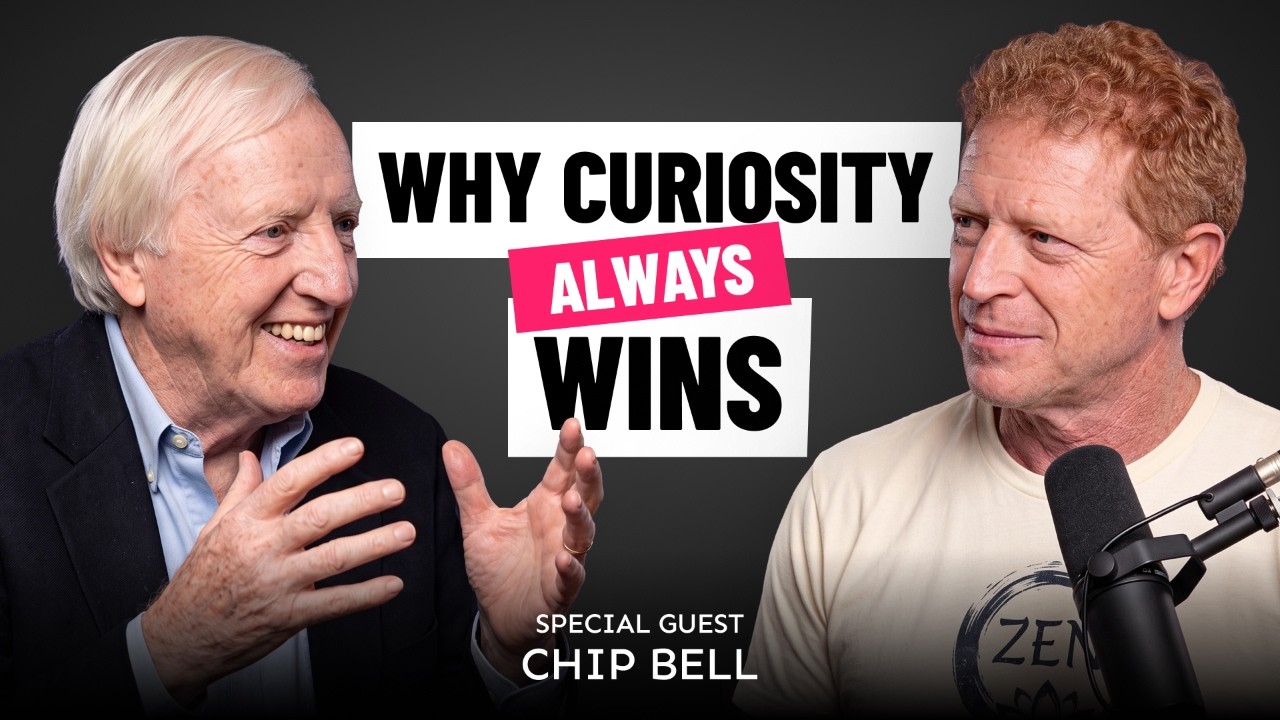
Chip Bell, a former paratrooper and author, argues that curiosity beats courage because it replaces fear with exploration. He shares a Vietnam story where he called artillery on his own position, staying present through curiosity. Bell explains how curiosity shifts decision-making from the reactive amygdala to the rational cerebrum, and why hiring curious, growth-oriented people matters for leadership.
Chapters
Well, hello everybody and welcome to Fearless, a production of Fuel, myfuel.io. If you're not familiar with myfuel.io, you're missing out on a massive opportunity. Just imagine this. You've got mentors and role models and bestselling authors, people collectively with hundreds of years of experience and wisdom to share 24/7 now through some of our AI twins. We've got online courses, micro courses where you can learn a tool or a skill in 5, 6 minutes and then actually begin practicing it and role-playing it. It's the fastest growing e-learning platform on the planet right now. So go to myfuel.io. And check it out. It's a few dollars a day, a dollar a day at most, where you can completely learn just all kinds of things. Both Dr. Chip Bell and myself have been at this work for a very long time, and I know I attribute a lot of my success to just surrounding myself with brilliant people like Dr. Bell, reading the books. You know, this goes back almost 40 years, reading the books, listening to the CDs, listening to them actually cassette set tapes before that and just really absorbing everything I could to work through insecurity, ego, fear, to accomplish some massive things. We're going to talk a lot about curiosity today and why it always wins and how curiosity beats courage even. And what does that actually mean? Dr. Bell has written 24 books. He's been featured on CNN, CNBC, Oh my gosh, ABC, all these, all kinds of channels. He's been in magazines, Forbes, Fortune, Inc., Money Magazine. He is truly a guru, if you will. We're very blessed and fortunate to have him join us today. So he's also an Army Airborne veteran, and he's got a fascinating story to share about how he had to deal with some fear many years ago. We're going to talk a lot about just the whole idea, how does fear get in the way of our curiosity, which then impedes our innovation, and why that's so important today to create a culture of psychological safety where people feel safe to speak up, to challenge the boss, to challenge one another without things just completely falling apart at the seams. With that, Dr. Chip Bell, he's a graduate of He did his— George Washington University, he did his PhD. He went to Vanderbilt before that.
Wow.
Dr. Bell, Dr. Chip, I'm going to call you Chip.
Oh, yeah, please.
Chip and I actually go back over 20 years. 20 years ago, we were working for the same client in Europe, and just, we've been connected ever since. So Chip, welcome. Open up with a couple of words of wisdom for us, if you will.
Oh, thank you so much. I appreciate the opportunity, and I'm excited to talk about curiosity, Particularly, and I'm reminded of— I got real inspiration when I was in college from Alan Watts. I came from a little town where everybody was Baptist or Methodist, and I was Baptist and kind of suspicious of the souls of the Methodists. But when I went to college, I wanted to learn a little bit more about other philosophies and religions, and I came across Zen Buddhism, and I found a great quote by Alan Watts in his book the way of Zen, and he said, when you replace the fear with curiosity, it opens up unlimited opportunity. And that always fascinated me about how curiosity and the quest for learning and quest for knowledge could supersede all those scary things that might happen to us and actually use it as a tool to deal with those moments where we might be a little bit frightened, a little bit scared. So It sort of changed my life in many ways.
Yeah, well, I call those defining moments. We even did a show called Defining Moments, those moments of truth where, you know, you're at a point in your life and it could be a one-liner from somebody.
Yes.
Just, you know, a powerful one-liner. You know, I used to, when we were working together with operational excellence and really improving the customer experience and the value stream flow and all that, and I was training black belts and master black belts, and I was asked by clients, what's What characteristics do you look for in candidates? All right. Curiosity was one of the very first characteristics I said. They're thinking, well, he's got to be good at statistics and math and, you know, problem solving, things like that. Yes. But they got to be curious. They got to want to know how things work. They got to know how— want to know how the customers— that mapping. You innovated customer mapping, what, in the 1980s?
I did. Yeah.
Yep. So curiosity. So let's talk a little bit more about how curiosity beats courage. What do you mean by that?
Well, I think we always— I'll give you a great example of how that comes into play. I've got a grandniece who is on track to be an Olympic gymnast. And she just recently visited us. And she was here training at the University of Georgia. And I asked her about what it was like when she was performing. And knowing that's a scary proposition when you're in competition like that. And I said, what, what, what, what gets you— what do you think about when you're on the balance beam or you're on the whatever? And she said, well, I think about what my coach tells me. And my coach tells me, as a way of dealing with being scared on that beam, don't pay attention to your fans, which I thought was fascinating. Don't pay attention to your fans, focusing instead on what you've trained for and what you will learn from this, and think about what you already know. And, and obviously the fans are all focused on, you can do this, Harper, you got this, Harper. They're always giving encouraging words.
Encouraging words.
When in fact the power is in focusing on what you know, focusing on how you learn more, And that is where she puts her attention. So, in many ways, that curiosity, that quest for being better, that quest for growth supersedes the fear and in many ways, the traditional courage that someone has with a fan cheering, go Harper, you can do this. So, again, it can be powerful stuff.
Oh, yeah. And I, you know, I look back over, you know, I started my practice 38 years ago and I think about how in the world did I get to where I am today? Curiosity is right up there at the top. I was super curious, which means I was open-minded and searching for growth and expansion and, you know, learning and just taking it in. And then what I discovered is that that gave me all kinds of ideas. They weren't even my ideas, honestly.
Right.
My first book, I was suggested, hey, you need to write a book. And I didn't planned that. But then I read a book about how to write a book and wrote a book. And then I had my older brother who just retired as a professor at Notre Dame tell me way back when, he goes, you got to write an allegory. I go, what's an allegory? I didn't even know what an allegory was. He goes, you know, it's like a story and it teaches. And you told some really good stories in your first book, but you should write the whole book as a story. And so I read a couple allegories, you know, including Ken Blanchard, you know, The One Minute Manager and some of those books.
Yeah.
And then come full circle, Ken Blanchard actually endorsed my first allegory.
Oh, that's great. You know? Yeah.
So then that allegory led to a university professor told me, she goes, now you got to write the sequel to that, John.
Right.
I go, what? Like, what sequel? But because I was curious, Chip, and I kept that open mind, I was able to just navigate all of the ups and downs and things like that. Even, you know, working through the big recession in '08, '09. Working through COVID and just adapting by keeping that open mind. Give me an example of how you've done that.
Well, I think here again, one of my specialties that I focus on in my business is innovative service, not just good service, but service that's what I call value unique. We all know provide value-added service, meaning taking what the customer expects and add more. But the problem with that is the customer's expectations climb right along with your addition and you run out of room. And so, what I focus on with my clients is value unique. That means I provide a unique, creative, unusual, inventive kind of response. I don't have to do it every time. But then, once in a while, like the slot machines and how they work for that variable ratio and it creates— well, if the people often say, well, that's That's really cool, but what about the people who have to deliver that? There lies the challenge of saying, I want people who are creative on the front lines. How do we provide an environment which sponsors that? That means they have to look upon— they have to come into the role and come into the job with a great sense of wanting to know more, being curious, seeing every situation as an opportunity, for growth. It's like in sales, we say, you know, Zig Ziglar taught us all we love objections because objections, while they are scary, give us the path to learning what the customer needs to know to get to closure. And so in many ways, it serves as a portal to all kinds of rich stuff that gives you that chance to be innovative and creative in terms of how, in my case, how you respond to that customer. So I think there's a great deal of, like Alan Watts said, it opens the door to unlimited opportunities. Whereas if you just focus on the courage side, I think it's not as rich, not as limiting, and doesn't provide near the opportunities.
Yeah, there you go. And, you know, speaking of Alan Watts and those, then I had the same curiosity that you did growing up. And I've, you know, I've been reaching out and studying all kinds of different religions, if you will, and practices, things like that. And with Zen Buddhism, you mentioned that. I actually have one of my books is called Zentrepreneur. What is that all about? It's precisely what you're talking about. And every chapter is a question. So chapter 1 is, what if? That's curiosity, right?
Yeah, that is.
Chapter 2 is why. Why is this important? Chapter 3 is why not? So it's just the whole idea of it is to be curious and explore. And it was really a— it was kind of like a blueprint for what I have been going through my whole career, just what-ifing all the time. And I know you're pretty— you're incredibly good at that. So now let's talk a little bit about psychological safety and what leaders can do to create a culture. Well, I think it's an environment.
Absolutely. I think it starts with thinking about how the brain works. And, you know, I love to talk about the brain and it's place. When I teach customer service, people often want to know, how, how do I handle an irate customer? And, and here again, you'll find where curiosity plays because we are frightened by an irate customer many times. You don't need to be scared. And you have to recognize that the customer who is angry is really frightened. Anger is not a primary behavior. It's a secondary behavior. And the secondary behavior is fear, fear of being a victim, fear of uncertainty. And so, it plays in, in terms of how the brain works. And the simple way I like to talk about it is your brain has got a lot of parts, but the 2 most important parts in your brain probably are your cerebrum and your amygdala. And the cerebrum is the thinking part of the brain. That is where we solve problems. That is where we figure things out. That is the logical side, the rational side. And that is where we live most of our life. But then, there is the amygdala. And the amygdala is the oldest part of the brain, reptilian part of the brain. It is the part of the brain that is reactive, that is instinctive, that is fight-flight.
Fight-flight.
That triggers a trigger. It dumps that hormone into your bloodstream, makes you fight faster, tougher, meaner when you feel threatened. The thing about the amygdala though is not only does it hate uncertainty, which makes it difficult in dealing with change, which is very, very important. It can't— but it can't differentiate between a real situation and an imagined one. So you got all this stuff going on in your head about what might be, maybe totally imagined and not real. It also has a long memory. So that thing that happened to you in the 3rd grade that was so painful, your amygdala remembers all of that and copies and sees a situation and goes, this is like that was in the 3rd grade.
Right.
And you thought about it from a perspective of a 3rd grader, not a mature adult. And so, learning how to say, wait a minute, I need to figure out a way to calm that amygdala. How do I use curiosity to calm that amygdala so I can operate from the thinking part of my brain, the problem-solving part of the brain, the part of the brain that loves change? Because there, and again, when you make that shift from the amygdala to the Cerebrum, it dumps hormones in your bloodstream that your brain likes, you know, and pleasant things. And so again, it gives you greater incentive to do more like that. And so again, learning to manage that, and that's where I think curiosity— when you attack, when you reach the amygdala with a curiosity, it changes the shift over to the cerebrum. And so, To me, that's kind of a helpful understanding. I was working with a group last week in Florida, doing a keynote with a group. And you could see these are all people that were in sales for a large company. And you could see when I said, that person you see that's angry, they're really scared. And you need to treat them not dissimilar from a child that comes into your bedroom in the middle of the night, having had a bad dream. And they go, oh my. I mean, you wouldn't say, that's just a bad dream, go back to bed. You wouldn't react defensively. You wouldn't try to explain things to them. You would be comforting. You would be empathetic. You would be compassionate. And all of those things are part of the curiosity. You would say, what can we learn from this? You know, this is great. Your brain's teaching you to be attentive to things that could cause you danger. It also can get in the way. So again, I think it is how you begin to focus on how do I manage the part of the brain I need. The amygdala can help me because it can save me in difficult situations, but I've learned I need to learn to manage that part because it is reptilian. It isn't— it is ancient. You know, most birds or lower forms of life, they got mostly amygdala. They don't have much cerebrum. We're called Homo sapiens, wise person, because we have a big cerebrum. Let's use it.
Yeah, yeah, precisely. I like, I mean, I like to think of it as programming. You know, we're downloaded with programs. In fact, according to a lot of scientists, Dr. Bruce Lipton, for example, he says that most of our downloads are by the age of 6.
Yes.
And because they're so sub— yeah, because they're subconscious, we don't even know they're there. We just have a tendency to get impatient or angry or scared or whatever.
Yeah.
And I also like to say, Chip, um, rather than letting the mind control us, we actually have the power to control the mind. And so when we start to really think about being sovereign over our mind, and our brain is just a receiver, okay, there's a difference obviously between the brain and the mind. And the power we all have is our— we're able to think.
Right.
And to think consciously and to make choices. And when we make choices long enough, they become Wired, so to speak. Dr. Joe Dispenza, you know, a brain specialist, he often says that what fires together wires together. He's talking about neurons, right?
Yeah, yeah, it's great.
Yeah, it's a great line. But, you know, you start thinking the same thing over and over again, it becomes a pattern, it becomes wired, it becomes a program. And now every time you step on stage to give a keynote, you're anxious or you're afraid. And you don't— you're not.
No, no, I'm excited.
Right, but a lot of people are terrified to get up on a stage and speak, right? It's one of the highest forms of fear. And how do you handle that, or how did you?
Oh, that's a great question. Well, you know, first of all, I'm always reminded of the great Charlie Daniels. You remember the country music singer who passed away a few years ago? He said, I never sing to the empty seats. I look for the happy people in the room. And so I think focusing on the happy people It's, it's, it's, it's part of it is learning to focus on a sense of wonder. Wow, this is amazing. Look at this. Isn't this incredible? This is great. I think focusing on the wonder, it's, it's in many ways like we were when we were small children. We were amazed at a lot of things. It's rekindling that sense of amazement, that sense of wonder. It's also recognizing that the whole purpose of growth is to is forward. You know, I talk to people sometimes who say, you know, what I do when I have fear, I go to my happy place. Well, to me, that's stationary. That's not forward. And so, the concept of curiosity is forward. It's looking for the how. It's looking for how I can reframe failure to say, this is a great chance, and hunt for the lesson in everything that I do. Again, I think—
Yeah.
It's the kind of thing you have to fake until you make it. I mean, you don't just start that way. But if you believe it can be helpful and you try it and keep trying it over again, we wind up saying, man, this is a great blessing. You know, I can find a way to find the wonder in what I'm doing. I walk on that stage, I can't wait to get out there. I can't wait to get out there. I take deep breaths before I walk out there. And then I think about, man, this is going to be one fun time. And this— and then I focus on the connection with the audience. Obviously, you've got to know your stuff deeply. You got to know what you're doing. You got to not have to think about your content. And you also know that the audience is dedicated to seeing you be successful. You know, they don't want to see you fail. We sometimes like to think they want to see us fail. And my God, what if I make a mistake and I forget things? You know, they love it when you forget stuff. Where was I in this speech? They love it when that authenticity comes through. So it's learning to be that wonder-filled, authentic person when you're in that situation and just be who you are and just have a blast. So that, I think that's why I started with Charlie Daniels. It's, you know, I'm gonna go out here and have fun. I don't worry about the, in his metaphor, I don't sing to the empty seats. I sing to the happy fans. So I think it's reframing all of that. So to me, that's the, you know, I look for who's the happiest in the room. That's who I want to coach.
Yeah. And I think musicians is a great example of that. You know, just like getting up on stage for a keynote, they're getting up and they're doing what they love. They're giving. Rather than taking.
I mean, that's right, that's right.
The joy they get is from giving, right?
Oh yeah.
In fact, I saw a fabulous band just last night, and, um, they just— they're just like you said, having fun, giving away their skill, their talent, their purpose, really. There's a connection there, an energy, and I absolutely love that. Um, so I want to hear about a time in your life When you were, let's just say, scared, where you were really afraid and you had to get through it because we all have that experience where we just were maybe even frozen, like before an interview, before taking an exam, before getting up on stage. I know you've got an amazing story and I'd love the audience to hear this.
Sure. Great. Well, I had the wonderful opportunity to serve in Vietnam. I was with the During— in 1969, I was with the elite 82nd Airborne. I was a paratrooper and I was a unit commander. And what you did in combat in that period of time was you put out a lot of ambush sites in the area that you knew the enemy was located. And the hope was you'd make contact, take the enemy out. That's part of what combat's all about. And so I always went with the unit most likely to make contact, or sometimes the weakest, newest unit. And so on this particular cage, I went with an 8-man unit and we got set up on the— in ambush. Now what you typically do is you've got grid coordinates where you're located on the map. Everybody knows about where your ambush site is. The artillery that's supporting you knows that. And so you go in a dummy position, sort of a fake position nearby until it's totally dark, and then you move into your real position. Hopefully the enemy might know you're in the area but not know exactly what Where you are. And on most occasions, you might make contact, you might not. And this particular occasion, it was about 2 in the morning, and we started getting rifle fire coming our direction. And didn't take us too long to figure out they were trying to get us to fire back, which would telegraph our position. It didn't take too long to figure out they didn't know exactly where we were. We knew they knew we were in the area. But not exactly where. And so they sort of, you could tell, lined up in formation like they were going to sweep the area. Theoretically, they hoped they would, in that sweep, would come up on us. And the word was, we passed around, don't make contact, don't fire your rifle, it'll give away your position. Then they'll know, right? Well, but some point they were about 75 yards from us, and we could see from flares that we called in There was about 100 soldiers. We were 8. Not good odds. Not good odds. You're not gonna have a good outcome when you're 8 to 100 and they're sweeping in our direction. So like any good field commander, I started calling our artillery behind them. And so you get on the phone, you whisper to the artillery unit 3 miles away, let's say, and you fire behind them. And then the idea is to start walking that artillery fire closer and closer to them as they came to you. And your hope was that sooner or later it would get the enemy before they reached you. That was the concept. And they kept moving closer and we kept dropping artillery and nobody's firing a shot. Everybody's laying as flat on the ground as they can. You're not in a foxhole, you're just flat out on the ground. And so at some point when I called in a particular round, knowing it's going to be close, close.
Close.
It landed when you— when it landed behind them, we caught lots of shrapnel. I mean, big pieces of metal falling all around us. So, you know, man, this is right on us. And they kept coming. And now they're like 100 feet from you, and you can tell from the silhouettes they're coming on your— So I did what we're trying— what you're trained to do. And, uh, you know, this is one of those hard decisions you have. As a soldier, when you know you're outnumbered, you know you're going to be overrun, your chances are remote, you call in artillery on your own position. And so the cold part is you go, you call back, and you say, drop 100, which means drop that next round 100 feet closer. And they call back and say, confirm on your pod. And then by rules of engagement, you're required to say— Roger, on my pod. Meaning I am giving you authorization to fire that next round right where you have us on the map. And you know the outcome is it's going to take the enemy out, but it's going to take you out with it. So it's a hard decision, and you pass the word around to say, this is it, boys. We've trained for this. Let's focus on what we can take away from this. But this may be it. So say your prayers. So the next round fires and you can actually hear the round coming. I mean, you could hear it going and you hear it whizzing through the air. And so you— and when it landed, it's like you couldn't hear for a long time. And it took— I mean, it landed right in their laps, took out many, many, many of those enemies. But as I like to say, a miracle happened. And the miracle happened is nobody in my 8-man unit got hurt. Nobody got touched. One guy— this is how close it was— one guy had his pants, like fatigue, shredded on both sides of his leg, and it didn't touch his leg. One guy was holding the— his rifle on the top half of the rifle, the stock on the top. And the entire bottom half was blown away by that round.
Yeah.
One guy, the most amazing one, one guy had his steel pot, his helmet on his head. He decided at the last minute it might be a good idea to take it off, turn his head sideways, lay his head on the ground and put his helmet on the side. And a big piece of shrapnel cut right through the middle of his helmet. So if it had been on his head, it would have splattered his brain. Not one guy was hurt. So, you know, I walked the next morning. We—you don't make a sound. You wait. Of course, the next morning you've checked the area, and there's lots of blood trails and all. They grab, they pull all the bodies away, but tons of blood trails. So we knew we took out a lot of the enemy, and we walked out. And I said to myself when we walked out, "You know, I'm gonna be. I'm gonna." not be scared again after going through that. I wasn't supposed to be here. You know, that changed. And after that, when I went into business, you know, I'd walk into a CEO's office who had a reputation of being a hard-ass, and I'd go, this is going to be a piece of cake compared to what I went through. This is nothing. So, you know, that experience gave you that sense of confidence that And I remember what, what when we passed the word before that last round is, remember guys, we've trained for this. That was the last thing I said. We've trained for this. And so it might not have a good idea, but just focus on the learning out of this. What are you going to learn out of this? What are you going to learn about yourself out of this? Not why this happened to us. Why me? No, that doesn't help you. It's focusing on that. Curiosity in the moment and it made all the difference.
Oh yeah. Yeah. And it's interesting, you refer to it as a miracle. That's what the title of my last book is, Miracle-Minded Manager.
Yes. Absolutely.
It's like you gotta be essentially, you gotta be positive and believe.
You do.
In positive outcomes. That's so, I mentioned curiosity.
Yeah. The backstory, John, was the week before I got shot in the face by a sniper, And I still had the bandage on my face from being hit in the face. Fortunately, it didn't take my eye out, but it could have. So, I mean, I've already got in my brain that, man, you're, you know.
Yeah. And you use the word confidence, and I think that's so important as well. So, I said earlier, characteristics in choosing high potential leaders, black belts, people to really groom. Curiosity was one of them. They got to be curious and they got to be looking for— open-minded and looking for growth opportunities and asking a lot of questions. Another one's positivity. I mean, they got to be optimistic. You know, I don't want any naysayers on the team. We used to use the acronym CAVE, C-A-V-E, which stood for complain or cynical about virtually everything. We don't want them on our team, you know. No, we had this bell curve. Yeah, this Sort of the normal distribution bell curve. And on one end, you had maybe 10% who were pioneers. On the other end, the cave people complaining about everything. And in the middle, we call them settlers. And so we look for pioneers. We're looking for the pioneers, the explorers, the fearless. Let's, let's, let's go out and break new ground. And then the settlement will come forward and the cave people will complain about no matter what happens. So just forget about that.
That's a good way to think about it. Yeah, I'm reminded, you know, I reminded my good friend Shep Hyken, who wrote a book that said— the title of it was Be Amazing or Go Home, you know. And so you want people who are, who are willing, who want to be amazing, you know. That's what you want. And again, that's that sense of wonder and, uh, that comes from a focus on curiosity.
Yeah, well, you know, I— we're running a little short now on time, Chip, but I want to, I want to first of all tell, tell the audience that if you're looking for a phenomenal keynote speaker, an award-winning author, a guy with decades of amazing experience, fearless. You gotta dial into Dr. Chip Bell.
I appreciate that.
I've heard him speak. He's the real deal and he's fantastic with deep, deep wisdom. I also want to encourage the audience to find Dr. Chip Bell as well as myself and a number of other phenomenal speakers, authors, consultants, teachers, gurus, if you will, on myfuel.io. Chip's got courses there. He's got an AI twin. I have an AI twin. What does that mean? It means that you can get coaching from Chip or myself or some of the other instructors 24/7, 24/7, and you can get it in multiple languages. I was, I was interviewing Chip's AI twin, or bot if you want to call it that.
Yeah.
Some call it an avatar. But it's downloaded with over 40 years of Chip's body of work, his books, his keynotes, his lectures. It's downloaded with all of that with perfect recall and perfectly honest. If you're talking with Chip and you ask him a question outside of his scope of work, he's going to say, I'm not going to go to Google and AI and try to find you an answer.
No.
You're talking to Chip. So, and the same thing with me. And here's the other thing, after having a great conversation with Chip earlier this morning, I said, Chip, can you put that last comment that you gave me in Spanish? And all of a sudden Chip's speaking Spanish and the text is all in Spanish.
Right.
I had a conversation with my bot a while back in German and in Japanese. So what I'm saying is these are amazing tools for you to use. I also want to welcome the audience, our fearless audience, to share, to subscribe and share these interviews and give us feedback as well. So look at Chip's body of work. Go to his website. Chip, what's your website?
chipbell.com.
There you go. Pretty simple. chipbell.com. Go to his AI, go to myfuel.io, subscribe and share Fearless. And next week we got Peter Winnick. Peter is another award-winning author. He is incredible on thought leadership. He wrote one of the books, he wrote The Thought Leadership Handbook. He's coming on to talk about the 5 avatars of thought leaders, thought leadership, the 5 avatars. So that's next week. Fantastic guest. We've got some great guests lined up throughout September and into October right now. So stay tuned, share, and let me just finish up with a last comment from Chip. Chip, give us the one-liner that everybody's going to remember.
Oh, good. Thank you so much. And I appreciate— first of all, I want to thank you for being there, but I want to end with one thought. And that is, I think a major key to all of this is passion. And to keep in mind, passion is 3 words, isn't it? It's pass, I, own. It's the bringing of the best of who you are to other people. So look for ways to pass you on in a way that's energetic, enthusiastic, and authentic.
That's beautiful, Chip, because I look back over my career and if I hadn't had that passion and be willing to pass my best on, I never would have made it. There's no question about it.
Right.
There were just so many bumps in the road. And I want to leave everybody with this thought as well. When you learn to turn what some people will call failure or a mistake, when you learn to turn that into something positive, because there's always a positive opportunity with any mistake or failure, You learn from it, you become wiser, you move on, you gain the confidence that Chip was talking about. And when you have the confidence, whether it's getting up on stage to do your thing or lead a team, lead a team in the military or anywhere else, that confidence, it's an energy that's contagious and people start to really feel it.
Right.
If you're in a leadership position, that's the kind of energy you want. Albert Einstein said the field is the sole governing agency of the particle. Your teammates, we're all particles, and the energy field that we work in, that we put ourselves in, is powerful. Get yourself into flow, develop that culture of psychological safety that Chip talked about, and create a culture of growth and curiosity so that you're learning constantly. And then you're turning that learning into innovation. Game on. Chip, thank you so much for joining us.
My pleasure, John. Thank you for having me.
Yeah, you and I could talk all day. We'll get you back on here another time. All right, that's it for today. All right, we'll see you next week with Peter Winnick.








