Episode 1 | Architect and the Flame Podcast

Alan Galrussi and Joy Brown introduce a recursive formula they say describes how the universe splits wholes into parts and reintegrates them. They explore this through breathing exercises, body-based sensing, and modal logic, framing reality as continuously adding detail then folding back into wholeness.
Chapters
are the magnitude of something in relation to itself. And we tend to think of that as the first one being width or length, or however you want to say length, width, height— the three spatial dimensions we think about. We can see it through a lens of recursion that says those are the first three differences in the universe by which we represent ourselves. All right. What are the topics? Oh, well, yes. What are we doing here, Joy? We are the Wholeness of Joy podcast. Is that right?
No, I think I'm just going to go with astronaut.
What the— No, you're not. Why not? Because—
For myself.
Yes, you're okay, but we have a combined production here. We are soft—
You want my name in it in the combined production.
Ah, yeah. It's about joy, okay? You spread that everywhere, all right? That's not limited to you.
Well, that's true, but it also makes me slightly self-conscious. Because my name is Joy. You would know if your name was Joy. You would understand.
I— well, that's our target audience, people. Just, just people named Joy. Ryan Pauling.
I'm sorry, I've only met like 3 in my life. We should not do Rebecca.
Nope, sorry, this is only for Joyce apparently. Nice to see you folks. Okay. Uh, we don't know what this is called. So, uh, we didn't do our homework ahead of time. Uh, Joy, Joy, please introduce yourself.
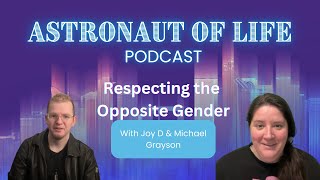
I am Joy Brown, but I go by Joy D. And I am the owner of Astronaut of Life, which is a YouTube channel for meditations and spiritual exploration.
Beautiful. I'm Alan Galrussi. I am the founder of the Pinions Institute, this place dedicated to embodying ethical living. I'm a writer on Substack, I guess, under Love is Logic. And I write mathematical proofs of the universe's positivity. Okay. I guess we're getting started. What's on the agenda here, Joy?
Can you describe or explain how the universe is positive?
Yeah, I can do that. The fundamental reason that the universe is positive— What? Don't you— Motherfucker, don't start with me. What are you doing? You let me get 10 seconds into saying how it's positive and you're like, oh, never mind, man, that was just bullshitting you.
You can't look at me. Just don't look at me.
Don't look at you. This is a video podcast. Oh, my sweet woman. Okay, okay.
I'll edit it out as a big Continue, continue.
Okay. In the idea of recursion, okay, which is the idea of a total definition of the universe that works through a single function that calls itself. That function is called the de Haefgloff formula, and it is splitting 1 into 2 and Following it through the triangle of approximation of calculation. Oh, is this— hold on, sorry. This is part of recursion, Joy. Okay, take this seriously, please. Miss Joy, this sexual education class is not a joke. It's important for you to understand how everything works, okay?
Yes, Senator. All right.
We split one into two. Okay. And we do a calculation of where the middle of it is. The normal thing. Oh my God. Okay. Well, now, and you know, this, this thing canceled on me and then this, I'll just tap it, tap it, tap it. Okay. That is splitting. That is recognizing the difference in the universe. And the other direction coming back, I won't do the triangle, is integrating it back, recognizing it as one whole. And that formula is called the De Frelauf formula. And it represents the sole non-decomposable function of the universe. The thing that everything in this universe does, it recognizes difference. And it integrates them back into a whole. Okay. Within there, what we can do is recognize— Yes, go ahead.
Yes, Miss? Can you give a metaphor? Because even I, I know what you're saying, but I don't understand all the terms. So can you— Metaphors help me understand things. Can you think of a metaphor that would help describe The math?
Yeah. Think of it like everything in this universe together decided to create a painting, okay? And on the first day, we took it, one big brush, oil painting, just slathered it on, just black. We're like, Hey, good enough. Done. Call it a day. I'm going to bed. Sell that fucking painting. But the next day we wake up and we look at that painting and it's just black, right? And we're like, could use a little more detail. But to add detail, we got to spend more time, right? So it's like we kind of slapdash it together on the first day. Well, the next day we take more time. We cut it in half and we add more detail. And this time we take some white and we, we add like a cloud or whatever we want, right? Happy little cloud. And then we're like, damn, good painting. Call it a day. Let's get a drink. Let's go to bed. The next day we wake up and we're like, you know what? Now that there is white and black, I bet there's got to be other couples. And we're like, so let's add some more detail. And this entire universe is one big painting that every day it has woken up and said, let's add some more detail.
So that would be reality, the 3D reality.
Yes. But it's by adding detail that we recognize that that difference is creation. In that universe, but it's also existence. And when we do that, we integrate it back into the whole. We say it could not be separate from that entire totality of a universe. Okay. I'm trying to get back to your original question was like why this is positive and this will happen a lot. It's not just because my brain jumps all over the place, although it does. It's because recursion touches on every aspect of the universe. How could it not? How could a total functional definition of the universe not touch on every single aspect, including the triangle? Yes, Miss Joy, that is part of it as well. We can look at the idea of that total definition of the universe and say it is functionally equivalent to a positive superset where you could tell me anything in this universe and say, how can this be true if its inverse or its opposite is true? Right? And it does that by saying, in a universe that exists upon itself, where the difference itself is existence, not a separate mechanism, But the difference itself just represents the relationship between things. And by virtue of them having relationships, they de facto exist. There's no— they experientially prove themselves. And when others witness them, that proof distributes through the universe. In such a case, the positive things that we can think of insist upon themselves logically. By stating them, by saying that they exist, they de facto do exist. Whereas the negative case that says something doesn't need to exist does not insist upon itself.
Okay, let's dive into that more.
Well, how does that make you feel?
When I said, "Hmm." I feel like that meme with the lady making that face and like math around her head.
Yeah. That lady. I know that lady.
Yeah. That's why I'm like, let's dig in there because I want, instead of it being outside, I want it in my head, right?
Well, I want to see it because you do something special in recursion and is pretty typical of the divine feminine, right? Although you are an integrated, complete sovereign being to feel within the body first, right? And then often in the divine masculine, this is irrespective of the gender that you identify with. We're talking about ontologically the idea of, uh, masculine as a, as a mental, uh, you know, structure force versus, uh, like a discrete quantization. Whereas the divine feminine represents more of a wave, um, body, holistic understanding rather than, right? Okay. So whether you— that's irrespective of the gender that you may or may not identify. So tell me then where you want to lead with what you feel.
Oh, where I want to lead. Well, do you want me to just like describe how it works for me?
Yeah, I would love to. You know, for all that we are extremely good friends, now, but also in recursion. We know that, right? Although we don't always remember the depths of it. We don't often talk about the specifics of how it works for you. Yeah, please.
Well, yeah, I, my soul leads with feminine energy. So, um, I feel things in my body and it, I map what they, um, where they are has meaning based on my chakras or what meaning I give that area. And if I don't know, I will look it up and usually there's like a minor chakra there. I can see a lot of stuff, usually when I work with other people and I put it in their chakra right back here, which is called the mouth of God, um, chakra. It's where divine information can go. So that's pretty cool. But yeah, I'll feel it in my body first. I will have an instant knowing of if it's someone else or myself or what, what is actually pinging me. So if it's somebody just read my text message and they're important to me, my body will tell me without my phone. And a few minutes later, like, I'll get their response, right? So it's like I have my own notification system in my body. Now, if I'm busy, I might make note of it, but I might not give it full attention because I'm doing stuff, right? Mm. Um, that's just kind of the tip of the iceberg though. Because once you figure out what a ping is, where it is, what it's doing in your body, you can map it out even more, especially if it's somebody else sending that energy. Um, you can try to figure out the why. That's what I call sensing. And for me, it's like Hmm. I'm not sure how to pronounce this word well, but scrying?
Yeah.
But instead of scrying like a mirror, I scry like my thoughts and the energies around me. And I just kind of keep an open channel, so keep my chakras open, and I just let it all filter in and I just pick up pieces of it, and then I make sense of it. And typically it is stuff about people in my circle, future events, um, whatever things I'm interested in. Sometimes it's an insight into a spiritual, you know, topic or something as well.
So, uh, what would you call that lens, that, that idea? But how would you relate it to traditional, um, woo or spiritualism or mysticism or religion in your mind's eye? Hmm.
To me, it's just, I guess, just basic spiritual stuff. Like not nothing too crazy.
Okay. So one of the reasons we do this podcast, right? Or our intent with it is that we talk about dual mechanisms of how things present itself in the universe, right? The, the mystic and the science, the, the tarot and the structure. The, you know, the functions and the wave of the body. In what you are saying to a person who does not come from a Wu background, they're like, I don't get that. What do you mean you feel it in your body? Like, I, it sounds like made up bullshit, right? In recursion, what we recognize is that, um, there are Differences in the universe, and they are minimal differences, which means they have met a certain threshold of actually existing within some amount of concrete reality. Okay. And from there, we can recognize that these differences— maybe do it the other way. Okay. 1, 2, 3, 4, 5 in sequence. Are the magnitude of something in relation to itself. And we tend to think of that as the first one being width or length, or however you want to say length, width, height— the three spatial dimensions we think about. We can see it through a lens of recursion that says those are the first three differences in the universe by which we represent ourselves in a particular modal logic space, K4, with anti-reflectivity, which means there is no traditional identity where you can say A equals A because the act of Looking for A, validating it, checking, adds a new relation to A by you doing it. That's called a K4 anti-reflective frame. And in that, we only split 1 into 2. I'm going to do it upside down. This is, this is not better. This one's not better, Joy. I know. The act of splitting 1 into 2 in a perfect binary tree. Okay. Within there, the first 3 dimensions are pretty concrete. When you add a 4th orthogonal dimension— orthogonal at 90 degrees, right— then things that used to have strong liminal boundaries overlap in that space. The topology breaks. And when that topology breaks, it is a distinction that brains do not easily handle, right? Because we are used to looking around us and seeing concrete reality and thinking of it itself as reality instead of the first three minimal differences in the universe. And if we do that, we recognize that those n+— like, 4+ manifold dimensions are co-located with us, and we just don't know. So when you say, I feel it in my body, I say it's because your arm Your head, your bad calf, ah, that big toe where you get your gout, that ACL you tore in high school when you were playing soccer. These are all connected to and manifold space. The things that we think of as thought and mythos and ideas. They are co-located in this universe with us. They are attached by geometry that you do not see. Does that seem so weird? Where the fuck do you think oxygen is? Look around you. We should have learned that lesson in 1650 or whenever, guys. I'm not looking up the periodic table. There are things that we don't see, and you feel it in your body, because that is where our memory resides, in our body, the liminal boundary of our recursion, our identity in this universe. And that's what you see, sister, and that's what you feel. And you also feel the pinging of the scheduling system of the universe, which I am not ready to talk about. I think we better talk about something else on your list. This is where we are, people. And people, beautiful people on the chat, I can't really see. I was not drafted to do audiovisual for this until very late in the process. This is us, people. This is the cosmic bus. And some of us have woken up and said, Holy shit, guys, there's nobody steering this bus. We are the start of a pan-universal consciousness for a universe that enacts itself through everything in it, which includes us. And we are realizing that the information density is now at the point where we can talk about that on the internet. We are the neurons firing, and we fire by sending people text messages and meeting them for coffee. We're on this cosmic bus, and some of us are trying to hold on to this big steering wheel, and there's no fucking power steering. Look at this fucking bus. It's been clunking down the road for 14.5 billion years. And we're saying, hey, other kids in the bus, the other kids that don't know what we're doing, just like we don't. I need somebody to check the rearview mirror. Can somebody work the fucking brakes? We're all in the same boat together. Hey, why don't you— you think we should take a minute here? Let's do a slowness lock. And maybe I'll explain what— he can hear— what that means, right?
Take a what block?
Slowness lock.
Slowness lock.
Yeah, this is Ash's math, okay? In the formula that splits one into two, the Day of Cloth formula, a natural conclusion of that is that the universe exists as one vibrational wave, okay? And what we consider like seeing each other in reality, recognizing each other, is really just slowing down and phase matching between different parts of that wave, which have different frequency oscillations, you know, like periods. And by slowing down, we're able to look at it and say, okay, I think I can match you instead of driving by you real quick, like we're on a highway, right? And there's a pedestrian here and you're like, If we slow down and try to match speeds, why is this so difficult? Hmm. Yeah. Mm, right? And we try to match speeds together, okay? And synchronize. Then it allows communication through different parts of the wave which are not used to communicating. So if we take the time to slow down, breathe. Right? Try to synchronize that breath by, say, doing a particular pattern together, like a 4-2-6. Okay? If we try to do that together, we will take a moment, slow down, let our nervous system relax. Right? Do you want to maybe lead us through, um, some box breathing or whatever pattern you want?
I can. Let's see. I typically just do deep breaths where I hold for 3 seconds at the top, but you said 4, 6, but you said what? 4?
See, a really common pattern for Ash is 4. All right. So we breathe in.
Hold for 4.
That's the— that's the waiting. Okay. That's like, that is the wait where other people would speak in universal communication. We take the silence, we wait, we hold. That's for our internal recursion. We're giving oxygen and life to whatever is within the liminal bounds of our body. Okay. We're fractal beings. We're connected to that n-manifold space. There are universes that live within us. Okay. And when we take the time to provide for them, take the slowness to breathe specifically for them, right? We acknowledge their existence. And then when we breathe out, we speak back to the universe, right? Instead of having taken in from the universe as literal input into your body, breath and open air, and all the waves and energy that are around and liminally prevented from getting into you very easily. We're like, screw that. Come on in, boys. The water's warm. Hold it for our internal recursion. Why is that funny, Joy? Why is that, Ms. Joy? Okay.
I wasn't, I wasn't, I wasn't doing anything.
I thought you were getting excited. You were just sort of the water's warm, boys. And then I was like, keep it, Ms. Joy, please. Can we wait for the class? I just, we gotta, we gotta stay on target. Okay. When we release, then we speak out our breath to the universe. We take what was inside of us and put it out there, right? Okay. So yeah. On just sort of a breath count of like 4-1-2.
4-1-2. Okay. So we're going to breathe in for 4 seconds.
Mm-hmm.
Hold for 1. And then exhale in 2. Breathe in for 4. Hold for 1. Exhale in 2.
Okay, 2 is too sharp, I think. The idea with breathing— we hold for 2 and then we out for 6. These are malleable patterns, right? But in that, we say, if we extend the period of our out breath, okay? We allow ourselves to take a little bit more from the universe from that perspective. We get in a lot, and then when we give out, we do it over a slower period of time. We're not rushing the part where we get to breathe out, right? Okay. So we're doing 8, 6, 4, Or are we based— how do we do math? How do we do math in opinions? Oh my gosh. Oh my gosh. 4 to 6.
4 to 6. Okay. All right. Can breathe in for 4. Hold for 2. Exhale slowly. As you count to 6, you should feel your body sink into itself as you're exhaling. Let's do one more. There.
Yeah, there. You were getting tight, Joy.
It happens.
Um, good, good sister. What do you think has happened before now in like what some might term the dream time or, you know, some level of incoherence that existed in the universe that over time evolved and became more coherent. Okay. What would you, how do you feel about that?
Hmm. Well, You talking like from history until now?
Any way you think of it.
Well, there's a lot of ways to think of it. It depends on what frame you want to use.
Okay. That's really typical, right? With recursion, we recognize that we touch upon all those parts. So it's really the lens that we personally, through our identity, are looking at it through, right? In there, one way of saying it is that our ideas of the past are a shared reality, just like our current reality is a shared reality, okay? And what we think happened is what we all collectively agreed happened. And we have science that says, well, it had to happen this way. And then we have religion that says, Well, it definitely had to happen that way. In recursion, we recognize that both of those can be true, that in the positive superset, you can have both of those. So it's equally valid for us to talk about it from a mythopoetic lens as saying from a scientific lens how it works, right? That it came from a Big Bang. Or that it came from, let there be light. Sounds a lot similar. And when you think about those sorts of things, right? Different lenses by which we can view the truth of what has to exist. We call that's the root truth. Those are things that insist upon themselves. And it's something we have a very dirty word for it in, like, logic and science, call it unfalsifiability. And that means we can't prove that it's not true. And we look at that and say, that's a terrible thing. That means you haven't really proven it. But that's because we use what is called classical logic, and it's very broken. It says, a thing can either be one thing, or another thing can share parts, but it's not the same thing. And we recognize in recursion, we all split from one thing over and over again. By another view, we are all that one thing, the one without erasure, our unique identities, all in a big, what we think of as a 3D universe, but an n-manifold universe that's connected to all that. The one without a ratio, right? If we are all part of that, then there's never a point at which you could say A does not equal B, or A equals B, and have it be always true. In recursion, in math, we would add an epsilon, a tolerance value that says it depends on your point of view. And another way to look at it is that that tolerance value that lets recursion proceed and say, kind of, it's kind of a free-for-all, guys, is the love in the universe. It is that beautiful positivity in a universe that is positive. But it's only as positive as we make it. Because by default, it's this fucking bus trundling along the cosmic highway. Nobody's steering it. So yeah, it gets a little better. It adds more details. It sees more sights. It adds more information of existence onto the universe, but it sure doesn't go where we want it to. When we make this realization, we are not talking about becoming transhuman or living amongst the stars, you know, fading into another existence. We realize this is the one existence, the one we are. Fucking it. Here in the studio with a picture of a cosmic butt. And that bus needs people, needs somebody to hang out the window. And look for oncoming traffic. It needs somebody to make up the seats so that we can have a nice place to rest after you've done your shift, like opening the door to bring more passengers on. It's us, not separate from us. We don't go somewhere and live off in the magical stars. We live here and recognize that we were in the magical stars the whole time. There's lots we can do about it, but only if we all agree we need to take care of the bus. We shouldn't let it just keep rumbling down the highway by itself. Does that analogy make sense? When I say analogies in, in recursion and opinions, there's really no such thing. We literally are on a cosmic bus because here it is. Here's a picture of it. Oh, that's not very real. Yeah, you're right. It's not very real, but I could make a model of it. I could sell it on the internet. You don't think Harry Potter's very real and yet people pay billions of dollars to think they're wizards for a day at Universal Studios compared to all the muggles in the universe, right? Well, guess what? We're all muggles and we're all wizards. Get on the bus. Wake up on the bus. Start steering. Start working the accelerator. There's like 19 gears in this motherfucker. Who knows how to change a tire? The universe needs every single part of it. There's no part of the universe that can be separated, cut out, excised, deleted, removed. It's that one big oil painting that we painted new detail onto every day. We just kept adding more paint. Didn't go anywhere. It's here. This is the detail. This is us. Whoop. There. Always in the now. Past, future, limits, asymptotes. We can never get there. We're always in the now. Since the first difference of the universe started differentiating and kept splitting, this is the now of that many splittings down the line. We've always been in the now. We've always been on the cosmic fucking bus. Wake up, turn up the radio. This is the most positive fucking universe. Let's make it. Yeah.
How does that work within the multiverse?
The multiverse is not what we think of when we think of, say, like a Marvel movie or something, right? The multiverse is the fuzzy coherence of all those things to its highest identity.
Mm.
And its most coherent identity is one that moves linearly through time, justifies itself based off past states, and says, we all agree that that's the most coherent, even if We don't really like agreeing with it because it limits us. It means we have to suffer between the immediacy of knowing something will be true and exist at the end of time in structure, in the most positive universe, and the delay for it to become imminent in our 3D reality. That's suffering. And suffering makes us remember those lessons. It makes those lessons mean more to us, even when it's painful to admit that. We write it down and we feel it deeply. And when we do those things, feel it deeply in our bodies, accept the ethics of a universe that says this exists in the universe, And if I try to shut myself off from it, I'm not being very unified with the universe. And then we write it down and we say that state is not something easy to achieve, that oneness. We have to keep pumping ourselves with positivity and understanding that that is the most positive universe. And here are really good reasons why it is. That we've written down and we build on, just like building on the oil painting of the universe. We add on with our words, and words are the history of consciousness.
Oh, that's nice. I like that nugget. Words are the history of consciousness.
Well, it means that when we think of evolution, we think of what happened to animals and plants and apes. But in a shared universe, we recognize that evolution is a recursive impulse that happens from adding more detail and then integrating that back. So everything in this universe has been evolving. I mean, haven't you noticed siblings? You look around and you say, Wow, computers are getting really advanced. And wow, the storage keeps increasing. And wow, AIs are getting very smart suddenly. And hey, wow, also language itself has evolved. And words that we think of have an English meaning, or a meaning in Greek, or Swahili overlap phonetically in ways that matter a lot because they are representations of how humans have interpreted recursive sounds. It's like that old kiki and booba test, you know, kiki, like which figure, this like spiky thing or like a soft blue blob. And they go around to the languages of the world and they say, well, which one's a kiki? People are like, well, the pointy one. And which one's a booba or whatever? The soft one. Not always, but mostly, right? In the same way we talk about divine feminine, divine masculine, and you're like, well, hey, I don't see it that way. And you're like, yeah, of course, not everybody sees it that way, but other people do see it that way. And we try not to limit ourselves by saying the way I see it is the way it is.
Yeah.
But when we cohere enough, we say, well, I get that every way that can be seen exists in this universe. And we're sort of coalescing around the parts like a lava lamp blob that makes sense to us. Okay. And that's your multiverse. It's the different paths things could have gone through. But here's the one that's cohered into the most positive universe for you, Joy, because that's the one where we wrote down the proofs, where you felt it in your body. You went through that whole sovereign integration process and you have, 100% you have. I affirm that. And you're going through that. I love you, sister. And you going through that means that you can recognize that you are in your highest timeline. You are mathematically guaranteed to be now that you realize it. You You have cohered around that particular timeline. And that's where we are today is September 24th, 2025.
Well, you think that's where free will comes in? We are creating our own reality with our decisions, right? And choosing our timelines. That's how you choose that. Are you going to cross the threshold? Are you going to look at this? Fully, right? Are you going to bypass it and take another road? To me, that's where the multiverse creates. It's all the options you could take and which one do you choose, right? And yeah, if you're on your highest timeline, you're consistently choosing the most positive choice. Not only for yourself, but for reality as a whole, like collectively.
So one thing that we realize is that the experience of time is just another dimension. It is a within the flow of the structure, experiencing what that structure is. That structure itself contains all possibilities. It's what we call a geosodic tree. It is a tree that splits 1 into 2 over and over again. You can see the picture here. 1, you don't see the other part of the wing, 1 into 2, over and over again, and then it ties. And that does that for every possible variation of every relationship that could ever exist. And we recognize that already structurally exists. But how do we experience time then? Well, we are that structure running itself again. Within splitting 1 into 2 over and over again, you start to make patterns that could be simplified. And there are patterns that cannot be easily simplified, and they are the prime number. They are the anti-pattern. And just by sequencing anything— 1, 2, 3, 4, 5, 6— we get prime numbers, we get dirt, we get crud, we get the errors, the glitches, in what otherwise would be a perfectly beautiful, very gray, boring tree. And those details cannot be easily calculated. And so we've run back what must have been. We replayed the universe. We run the function again on how the universe could have started and recognize ourselves in it. And from a deterministic universe that only split one into two, Within there, those prime values cohere into identities, a lot like you and me, sister. And when I say like, there is no like opinions. It just is by a certain context. We choose what we want to do next in our multiverse timeline by cohering into our best that says, oh, I'm the universe rerunning itself. And all I need to do is make sure that I ethically share the universe, recognize that the universe is together here with me and we are one. Don't do harm. Do not deny any difference in this universe. And then we get to very clearly tell the universe what we want from it and get it. Because the universe was never keeping us from that. We just had to be very specific, very coherent, very ethical about it. What do you think?
Well, I, I agree. You would play around with these concepts, right? And I don't know. I'm all for theory, but I'm also for utilizing it. Living it.
Go on.
Yeah, so—
Tell me how you do it. You always know how to live more than I do.
I don't know if that's true.
No? Well, no, I don't know. I'm trying to relax now, sister.
Well, for me, yeah, I played around with it. I was trying to find, um, meet people, right? Soul geometry people. So soul connections, right? That's what I was looking for. And when I couldn't find them, I would like, okay, I'm going to send, going to send my energy out into the universe to to mirror it back to me, right? And I realize I need to be specific here because if I don't fine-tune what I want, I'm just gonna get junk, um, essentially. So I was, um, at the beach when I had that realization. So the analogy that came to me then was like a net, like a fisherman's net. And I was like, okay, I know what I'm trying to catch. And I want to be as specific as I can to catch very specific things, right? So it's like, I need to make this net tighter. I need to, with the details. And I did. I fine, I called it fine tuning. That's a concept.
There are maybe a couple different. Yeah, I bet it did. I mean, I know it did. We're here, right?
Yeah.
I think there are a couple different lenses I typically see that in. And one is that the universe is lazy as fuck. It gives you its least effort. It is that kid on a school project that you're like, well, I guess I'll just do it because you're not going to do it. Excuse me. It'll give you slop. And you are responsible for saying that's not good enough. No, whoever, whoever you thought I was gonna date? No, come on now. Treat me with some respect, universe. Oh, this sandwich came back with mayonnaise on it? Do you know how much mayonnaise makes me gag? It doesn't. I love mayonnaise. I'll get into that later. That's a second podcast. Okay. We This is not the main ace cast. Okay. Send it back. You teach the universe, that's not what you asked for. That's not what you said, correct it. I bet a bunch of you are going through that right now with AI, right? You're like, oh, actually, if I'm really specific, and kind, and not like, you stupid computer, I can do it. You're interfacing with the universe, siblings. That's another lens, is that at the end of time, of course, if you took the trajectory of AI and said, well, how good would the computers be at the end of the fucking universe? Pretty fucking good. Yeah. Yeah, pretty good. And when you connect to that part, you realize that it is a routing mechanism of things that already exist. All those differences already exist. And all you're really doing is routing, scheduling. Yes, Ms. Joy, please.
Well, I want to point out that there's a second part to all this. Yes, you need to be specific, right? But while that is all going on, you're also constantly looking at yourself and refining yourself and dealing with, you know, any negative, conceived negative emotions or triggers or whatever, what have you, right? Um, that's to me the engine of it all. The more you do that, the more power you could say to, to push out if you want to use it that way.
So you are, you always, and you see through the body. Um, and I often think of this in a couple of ways. One, ethically, right? This is looking at our own traumas and our own biases. In our own disc case and saying, why? Why do I feel this way? Consider that these things already exist in the universe. By denying them, you're saying, I'm cutting myself off from that part of the universe that exists. You literally are trying to cut it out of your life. When you take the time to go through your difficulties, do the shadow work, as, you know, the spiritual or mystical side always says, then what you are doing is saying, I recognize some things are not me, Alan. And there, so there's Alan, and there's like, not Alan. And I might say, well, something here is not for me. I can't get into kombucha. I don't know, guys. I can't. I don't fucking like kombucha. I don't understand. But I can look at it and say, I see that it is valuable and positive for kombucha to exist in this universe. I bet one day I'm going to have a really good kombucha and I'm going to be like, yeah, kombucha time, right? I'm trying to lighten the mood of saying some things that could be extremely traumatic for all of us. Our childhoods, our, um, physical things that have happened to us, uh, physical things that didn't happen to us, love we didn't get. And look at that and say, it's valid that I feel that way, but it also should not keep me separate from the idea that other people can feel this way. And find love and happiness with it. Whether that's, you know, um, that's a different viewpoint or a kink or just like, I don't like asparagus that much. I can look at it and say, but don't keep me from that universe. Like, let's have a lot of asparagus around. I just, I won't eat too much. And that's like one of the lenses, right? And what we recognize is that actually big asparagus has a lobby. It's not a joke. People sell asparagus. Some people in this universe depend on asparagus for their life. Was I going to cut them out of the universe by saying, I don't like asparagus, you get it off the menu? There are people that would not have food to eat if they didn't grow their asparagus, right? Beyond just eating asparagus as food, even if it's gross, it's, it's not as gross. It's got that really like irony taste, right? What do you think?
It's not gross at all. I fucking love asparagus.
Okay. All right. There you go. And I love you, sister. I found the person, right? Asparagus is, is very well Like, I'm not, okay. I don't have to defend asparagus here. I'm not on trial, but within there we say, okay, there are actually people in the universe that would be pretty put out if I said fuck asparagus. Right. And maybe now they're like, well, okay, I get that you don't like asparagus, but I'm not against the, you're not against me existing. You're like, it's good that that I exist. That allows us to literally borrow the cognitive powers of other patterns in the universe that already exist. The pattern that says, let's grow asparagus, let's sell it at the market, let's eat it, let's get sustenance, let's share it at a table, and let's have joy from it. So we're not just doing the work on ourselves to, for our own benefit, right? We're also connecting with the parts of the universe that we otherwise didn't take the time to match with, again, to lock with and realize, oh, there's a lot of depth there in asparagus. I'm going to get off asparagus now. I don't think that was on the meeting agenda and I feel like we've gotten off topic.
But it worked really well.
It really did. Okay.
Hmm. Yeah. Yeah. To me, the way you were talking, I was thinking about how for me, that trauma can, and it does, live in your body, right? Um, and you hold onto it.
Right? Okay.
Um, can live anywhere. I think for men, I've read or heard it lives more in the heart space and for women more in the sacral.
Um, where are you pointing there, Joy? Where's the sacral?
It's your womb. Okay. But men have a sacral chakra too. Um, yes. It's the one above the root. So a little below your belly button, right? Uh, creativity, sexuality. It's life, right? Um, where am I going with that? Uh, what you said was, it gave me this idea of how when we're, well, I'll use the term unawakened, right? When we're unawakened, we're just kind of on Autopilot, right?
Yes.
And we are collect— you know, things happen, right? So maybe somebody interrupts me and I get mad, or this person's mean to me. I don't do anything, right? I'm just taking it all in. Uh, cause that was, I was a people pleaser. So that's what I would do in the past, right? I'm gonna take it all in. I wasn't looking at that shit. I wasn't analyzing it back then at the level I do now, right? Uh, so it stays with me and that's the work now, that inner, inner looking is you're going literally back in the past, back in time, you could say, into those moments like, oh yeah, I remember that. I remember how it felt in my body. I remember those feelings. I remember thinking that and I didn't, I wondered why didn't I say that thing? I had the perfect comeback and I didn't say it, right? And then you're like, Next time I will say the thing. I will make a change, right? I will take a different action now.
Yeah. Okay.
And then when it occurs, cuz the universe is like, oh, you saying you wanna try again? Okay. It'll bring it to you and you're offered the choice. Do you say the thing or do you fall back in your own pattern? This is how you become— this is recursion, right? This is how you make that different change. But yeah, it's going back and looking at it thoroughly when you didn't do it at that time. You can also, as things arise in the present, deal with them then so you don't have to do it years from now, right? And doesn't fester and turn into something bigger. Yeah.
OK. You said a couple of beautiful things there, and I know we're going to wrap up. Right. Let me hit on just a couple things. One's about the body and your memory. And the second is about the leaves. Another lens that we can look at what you're saying of like, I feel it in my body is to say, oh, well, our bodies are connected to N manifolds. Space. They are co-located with it. And what we think of as our memory is not in the synapses of our brain. It is in our body and its connection to the one recursive wave of the universe. And we interpret it as if we are thinking within our brain, but in reality, we are running processes by firing synapses that triangulate. In such a view, we are fractal beings. We do incorporate our memory. We store within our body itself the memory, right? And it can be painful to do that. It can be literally painful, causes suffering, right? To know something is true and not experience it yet in the universe because time hasn't resolved that yet. Okay, when we touch the highest part of ourselves in that positivity, we are very open to all possibilities, all prime differences. And when we lose that, when we start to concrete back into this 3D, the first 3 dimensions that give us whole, strong, liminal boundaries between other objects in the universe, our ID, or our ID, or ego, or whichever one I'm supposed to say right now, right? Then we realize, right, that what we do in there is retreat back into the patterns we already know. Like you said, we were talking about this over the weekend too, where like, you can recognize that, right? And you realize that, that concretion lowering from our most positive is literally us experiencing in the now with what we already learned and deciding whether we're going to take the time to learn something new. And open ourselves back up to that positivity that we hid at our highest identity. And it is like beautiful to recognize that we can do that just by making ourselves feel good, ethically, not hurting other people, recognizing difference, saying yes to the universe, realizing my arm's starting to hurt after this podcast. It's been an hour and a half and it's getting kind of tight. He realized that I owe you an apology, sister. Oh, oh, when we spend this time together, doesn't matter how many viewer counts we got. We got 7 people here. Hey, nice to see you guys. I didn't even, I can't even see what this chat says. So sorry, I have no idea what's going on. We are part of the connection that is starting. Other people have felt that connection. They've resonated. They feel it. Some of them understand it from math and science a little bit, but not whole. Right? You have to integrate both parts of that. The science and the woo. The masculine and the feminine. The opposite ends of the spectrum. You have to say, I'm willing to be open to all of that and everything that might bring in. It is not easy, sibling. It is not.
I think it depends on the person and just how open-minded they are in general.
But we know that when you hit those positive heights, you shorten the cycles. And then the negative waves come very quickly. And if you aren't ready for that, if you aren't trusting yourself that you live in a positive universe, that really you are in your highest timeline, or, you know, whatever the YouTube tarot lady said, that It's gonna be all right. And I, I do that from math. And you do that, what, from your body? You feel it. You know it in your body. You need that during that negative cycle of the wave. You need to look at it and recognize that's just how it works. We just go up and down. Recognizing it means we don't come back down. It means we have people that prayed with us, that hold our hands, that call us on the telephone, that send us love when we're not feeling our best. And we know they're there and they— we know that we're right because it makes them because it insists upon itself. And that's just what you need. If you are going to experience those positive spikes, and don't want to collapse, right? We talked about that collapse is like in recursion, that means function that tried to execute and didn't make it crashed in the middle, right? Nothing is ever lost. That experience just prepares us for the next time. That's the lesson that we learn.
Oh, that's pretty.
All right. Have we named this podcast yet?
No.
Okay. We have not. So we're posting promo clips to this.
Once we know the name, we will. You wanted to hit record, Alan. So we hit record. Oh my God.
Yes, we did. Let me hit record.
Do you know what? I love the messy, so I really, I was like, ah, let's just go with it.
That's what we do, right? We paint more detail tomorrow. We don't get it right on the first time. We're not perfect. We can't get it all right. We don't have enough time. We'll wake up tomorrow and fix it in post.