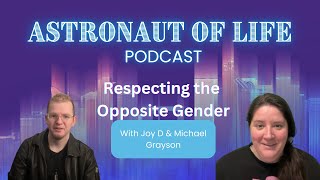
Michael, a cancer survivor and memoirist, talks with Joy Brown about how shadow work and spiritual practice changed his view of gender dynamics. He moved from chasing external self-improvement to inner work, and discusses teaching boys emotional awareness and building respect between men and women.
Chapters
We're live.
All right. We're live.
It's happening.
Awesome.
Thank you, Michael, for being here.
Oh, thank you for letting me be here today. It's a privilege.
Yeah. Yeah. Um, just to get us going, and I know you're new to this kind of thing. Um, do you want to tell us just a little bit about yourself and your writing and like Just a little bit. Yeah.
So, um, it probably all started kind of just, uh, my journey into doing a lot of shadow work and a lot of spiritual practice. I had a very, um, compelling story of not only, um, coming from single motherhood and taking myself out of poverty, but I, um, became a cancer survivor myself after losing both parents to cancer. And in doing a lot of this, um, shadow work, spiritual work, and my cancer recovery, I was kind of inspired to take all of that and put it together in a memoir that I've been working towards. And that was kind of my motivation for coming on Substack. And since I've been here, I've seen such a huge audience of people who are just so highly engaged. I like to call Substack a kind of anti-meta, anti-Facebook and Instagram, because it focuses on like captivating people's attention for just a small split second while people on here are looking for niches and they're looking for depth. And I've just found that to be kind of rare.
Yeah. Yeah, I agree. I've personally closed out all my Facebook stuff and I'm just not resonating with that platform, but Substack has certainly felt We're at home as far as social media goes, and though we're on the authentic side, and as a writer, like being around other writers, of course, is, it's a beautiful experience. But we actually connected from you reading a piece of mine about, um, gender and men and my viewpoint of men and how that has shifted. And I know, um, this is something you have written about as well, but, um, right? Yeah.
Right. And I'm just going to mention this just because I find it profound that this just popped up on my feed right after we started this here. And this is the perfect way to introduce this topic, Joy. One of my other things that popped up, another live event that's going to be like in a couple of days. Smash the patriarchy. And I don't know if you, um, know anything about like Carl Jung and synchronicities, but that absolutely screams synchronicity, like, considering like what our topic's going to be.
Yeah, that's a good point. Yeah, yeah. Um, well, I know for me and my story Um, this all happened last year and like I got a lot of dreams about men coming into my life. At the time I was married, so I was like, I don't give a shit about men. Like, I don't, why do I care? But, um, it was pretty persistent, very interesting to get um, omens and stuff via dreams. That was new. It was very consistent. So I was like, something's going on here. But, um, and it happened. But before it happened, I had to— I think I talked about this before. There's like this energetic river that I know as feminine can tap into our women of just all the repression and rage, right, around any atrocity that's happened towards us, not even including my own, right? And it— the thing I learned was I would need to release that and step out of that energy if I wanted to work with men, see men, and just understand men. So I had to do that first, and I'm glad I did because as I got to know more men and just, and meet them and have conversations, I was amazed at the depth of the heart. It was like seeing them in whole new eyes, and I was, it was just a profound, beautiful experience in that. That's what I wrote about, have you, how has your own perspective changed towards women or, or gender in general and just the relationships between them?
So to understand that, uh, change within myself, I'm going to give a frame of reference of how I grew up trying to understand women. I, um, tried to understand women from a frame of reference, from a logic, from cause and effect. And I was very oblivious and ignorant to not just to women, because men do this too, but women are very much creatures of emotion and that emotion often overrides our judgment in both men and women. And I simply, like, I didn't like really comprehend that concept. So I kind of got like stuck in this trap that I feel a lot of men get trapped into is kind of looking at like women and getting a successful romantic relationship kind of like through a transactional thing. Things like, if I do this, this here, then, um, that's going to enable me to have, you know, like this, uh, great relationship. They'll want to date me and I'll be able to have this sex life afterwards and yada yada yada. And I was very much stonewalled and frustrated by that at first. And it had just been like a life experience. I just kind of kept thinking, though, maybe I'm not ready yet, I'm not successful enough yet or whatnot. And after observing like kind of like this trend, I started like looking at myself and I started like seeing some of the types of relationships that women, um, would, um, either keep going back to or stay in. And a lot of them— I'm not— all of them, but a lot of them were, um, very abusive or manipulative. And I started just like kind of questioning that. I— this was kind of a fatal mistake on my part. I started like inquiring about that. It's like, why does that tendency exist on various social media platforms? And that was fatal because I was attacked Instantly, I would hear terms like incel and simp, among other things. And at the time, probably like in the early mid-2000s, I didn't even know what an incel was. And when I looked it up afterward, I was just absolutely mortified. I was just kind of thinking, this is what women think of me. I knew I wanted absolutely nothing to do with the incel movement, but at the same time, I was just like, I understand the psychology behind it at the same time as well. So like, how that shifted my perspective of women now is instead of, you know, just like trying to build yourself up for a transaction, men should really approach it from a sense of sacred responsibility. It's like they have a sacred responsibility to both themselves to empower themselves, become the best versions of themselves, and in doing that not only won't they be better selves, they're going to be better partners for women. So, um, that's how my like approach to like not only romantic relationships, but any kind of general relationship with the—
Yeah, just like understanding and yeah, no, that makes perfect sense. Um, I followed a lot of, um, Alison Armstrong, and she talks a lot about, um, differences between men and women and more on like a, the way we think or approach things. And women have a diffused awareness. We're taking in everything. Our emotions literally are in our heart space and we feel them very intensely and they're like very, you can feel a multitude of emotions at the same time. And that's a very real experience for us, right? Um, but as man, and you can confirm or deny, sometimes it takes some time to dig deeper into what you're actually feeling and what those emotions are. And, and it's easier to just stay focused and in the logic and everything and, and not be aware. Maybe as much as, as a female. So, um, that's just a random tangent, but it was something I was picking up last year as I was going through this kind of inner transformation of just seeing men differently. And I think for me, as someone who's been in some of those relationships that you've talked about, like I've been in abusive relationships and I've had those patterns, and I won't go into all the details, but there's certainly reasons why those repeat, and that's because I didn't do the inner work. That's what it essentially goes down into, right?
Right.
Um, yeah, it's, doesn't really matter what the pattern is. Um, if you don't look inward and like really sit with it and all of these things, right? You're gonna, you're kind of destined to repeat it until you like learn the lesson.
Right. That's exactly that, Joy. One of the big aspects of it that like we're not teaching men is how to implement and foster their own emotional intelligence. That's the big thing that's missing is masculine emotional intelligence. And one of the reasons that we don't do it is because it's very difficult and it's very challenging. And instead of like doing things just like, no, that's not me. I'm a man. I'm a stoic. I don't cry. I don't, uh, show my emotions. They don't learn how to process it. And, um, I can get into a little bit of that later here.
Yeah. Yeah. Yeah. Well, let's see. We've kind of— I wrote down something about dating apps. Um, So how did dating or dating apps impact your view of just women or male and female relationships in general?
Honestly, at first it made me feel like, and I'll be, uh, kind of humorous about this, that it was a million times easier for a woman to get laid than a man to get laid after, uh, being on dating apps for several years. Um, When I, um, first, um, started getting on there, it was just like, it was very, very sparse. There'd be like an occasional cricket chirp with an occasional match or a message reply. Um, usually didn't go anywhere. Like there was like one or two times where it did go somewhere and I would just randomly, I'd get ghosted or whatever. And I like really, really didn't understand that. For like a really, really, um, long time. And this aspect about it, like, it really, really frustrates a lot of men, and it, um, reinforces kind of what we, um, call hypergamy in modern culture. And, um, if anyone's unfamiliar with the term, hypergamy just basically means that you're only going to, uh, mate with someone of either in equal or higher, um, status than them. And, um, the dating apps, like, all these men, probably the vast majority of men on there, aren't getting any interactions at all from the women that they're trying to reach out to. And it's creating, like, this feeling that all of these women have these wild, unrealistic expectations, like they only want this rich, athletic, muscular looking guy and like if he doesn't have that, they don't want to have anything to do with them. And I was again kind of oblivious that I was part of an algorithm. So like in response to that, I was still thinking from a logical frame. What did I do? I got in really good physical shape and I started making a lot more money and I was just like, oh yeah, I've got it this year. You know, I'm going to have a lot more success. And I did that. And then I gave them another go. I had a, maybe a little modest increase in my success on there. It wasn't anything like profound, uh, night and day. It definitely like was somewhat of a difference, but there, it was still like this big mismatch. I was putting out way more energy into it than what I was getting in return. And then I realized I was part of an algorithm that the dating apps had, they were specifically only mainly showing most of the women these absolute top-tier men so they would enhance their user experience while basically just keeping most men in this endless loop of singleness, which has profited them billions of dollars. And once I figured that out, I deleted the dating apps for good. And fortunately, I no longer have to worry about that because I'm happily married now. Thank God. Yeah.
I got a question for you that I don't think we talked about beforehand, but, um, when did your inner work come? Did that come before you met your wife or after?
Um, honestly, um, a little bit of both. It was like a big culmination of I would probably describe it as like doing a lot of hard work with a dom saw. There's that classic story that like there's a guy trying to cut down a tree with a dom saw and they tell him it's like, you take time to sharpen the saw, then you'll do it faster. And I kind of just like wanted to do my own thing. So I did, I made some progress prior, but what really like got me into, um, you know, kind of like fostering my own masculine intelligence is doing like the deep-seated shadow work within patterns that I learned to help me survive throughout life and a life of poverty and a life of a single motherhood and just kind of identifying those things and is kind of looking at where does this come from. So yeah, I did a lot of that strong. Inner work prior to my marriage, but after it, and especially given like the health scare that I went through, I was able to really like hone in and focus on that because I decided I don't want to live the rest of my life this way.
Yeah. Yeah. Well, I'm asking that because I'm like, you talked about how you changed external things, right? Like money and your physique. And had minimal change. And I'm wondering if, or I'm hypothesizing that maybe that internal change is what your wife was actually attracted to versus the external change.
Quite possibly.
I mean, I guess that's a question for her, but, um, just in general, well, I'll say that's something as I began doing my more inner work, right? That's what I began looking for. In others, um, external things really had or just went down in not value, but like as in priority, right? And I was like, what is he emotionally intelligent? Can he— is he secure in himself? Am I gonna have to carry everything type of thing, right? Um, so yeah, um, but we don't know to look for that. Until we start doing it, you know? That's been my— I'll own that.
Right, right.
Yeah.
Yeah, because the hard part about that is like, we're always looking for external blame and we don't wanna take the accountability of the internal blame and like the work that we're responsible for ourselves, because that's much more difficult to recognize than something that's out.
Well, I think for a lot of women, you want safety and you're kind of taught that that means he has a good job and he has all these external things. He has a home. He, you know, he has a car, but that's not essentially what makes you feel safe, right?
Right.
And, um, I've certainly been with men like that, and then I was abused, right? So that was definitely not safe. So that was a lesson learned the hard way. But, um, where am I going with this? I'm just saying it's kind of a failure as a culture in society, um, That, that's what we are shown and taught is to essentially just seek the external factors about each other. Right.
Mm-hmm.
So you want a pretty woman who, you know, isn't too smart but isn't too dumb and, you know, looks a certain way type of thing. Um, but what about in here? Right. So it's, yeah, it's, it's, it takes a while to get out of that culture and mindset, but it, I think it, it definitely starts here. And that's, um, it's kind of where we're going next. I wrote down, how do we shift to see the other sex in a more human way? Which we've kind of already been bumping around all of this, but let's just dive in deeper. There was a point you mentioned earlier about coming back to I don't know if I remember. Do you remember?
Uh, yeah, it's like what I was, I'm kind of, um, getting back to, um, that some talks about emotional intelligence again and kind of gets, um, into our next topic. Um, men either learn two ways if they don't have healthy emotional intelligence. They either learn to oppress those energies and feelings that they have, and they become these either at best manipulative people, at worst very abusive partners. And, uh, if, if they don't do that, they repress it and they internalize it. And that comes out in all kinds of mundane and very unhealthy ways. And that, that's kind of like the basis and the foundation of, uh, modern-day incel culture is that repression and that resentment kind of just been stewing. As you know, they, they don't know what masculine intelligence is. If they, somebody told them that they need emotional intelligence, they probably tell you it's just like, oh, I'm not, I'm doing that womanly stuff. I'm a man, you know?
Yeah. Yeah. No, I understand that. That's a very interesting thing. Cause I think, I mean, obviously there's feminine intelligence or just just emotional intelligence in general, right? And I feel like the same could be said for women. It's when you don't speak up and you don't stand up for yourself and you internalize it, it becomes resentment. It's just easier to blame, blame them for everything, right?
Right.
And he, he's not reading my mind, essentially. And I, you know, he should know these things, right? It's so obvious, but it's really not. But that's how we perceive it because it's obvious to us. Um, because we, we assume that you are as in tune to your emotions and as aware as we are. And that's obviously not the case. Everybody's different, right? So it certainly can lead to resentment or The outward way would be the, um, critical and, um, you know, just being very critical of a man. I can't think of the term I'm trying to think of, but, um, you know, just express it more outwardly. You're trying to bring him down because you, because of how you feel. Right? So again, we're kind of circling that the starting point to all of this, to relational, is in here, is in ourselves. Right?
Right. Right. And to kind of get back to your previous question of how we can see, you know, the opposite gender in a better light, one of the things that we have to realize, you know, like when we're interacting with, especially with men on women, there is this stark contrast between the potential consequences for a woman rejecting a man versus a, um, man being rejected by a woman. A man, if he absolutely fears and gets absolutely torn up and torn to shreds and torn to pieces if he gets rejected by a woman. That's what he's thinking. If a woman gets rejected, I mean, if a woman rejects a man, she has to think, is this man going to attack or even try to kill me? And from that logical lens, it just looks like this huge divide. It kind of makes men look like these big old wussies, and it makes women feel that they have this strong sense of empowerment. And whatnot, but what's actually happening, like, on a psychological and, um, neurochemical level is that these men are actually feeling that exact same fear of survival women are feeling from a neurochemical sense. Um, there are actually studies, uh, with, um, functional MRIs that show that The receptors in the brain perceive that type of rejection in the same manners, in the same pathways as someone fearing for their own survival. So it just, another huge contrast. It's just like, oh, the consequences for men and women are so different in these situations, but they have to understand that the feelings are not. And this is not to say that like women shouldn't be able to say no. They should absolutely be able to say no with absolute sovereignty and without feeling any guilt about it whatsoever. But at the same time, it would be such a benefit to realize that this is coming from an evolutionary perspective. And the interpretation that he's taking, especially without any work on emotional intelligence, is, you know, My family line is ending. Ah, that's kind of what it is. It's like this, um, evolutionary dissonance or this evolutionary lag that we've, um, programmed ourselves to procreate and, uh, move on from one generation to the next. So it's like, that's what's essentially happening here. And I feel if men take that real world perspective and understand it's just like, yeah, I'm going to have like, you know, um, this neurochemical response is going to make me feel this way. I can kind of prepare myself for that because, you know, it's not the end all of things and women can realize it's just like, okay, um, I might be rejecting him, but understand it's like how hard it's going to hit him just to kind of create this more overall empathy with those sort of interactions. And I feel if we take those two things together, that like men and women can really truly understand each other a lot better than they ever have.
Oh yeah. To be honest, it wouldn't even dawn on me that that's what he's thinking about, about his lineage and things like this. But now that you're saying that, I know I've heard that Like in, like on TikTok or something, people talking about that or men talking about that. And like, that's, that's totally a real thing. So I'm just kind of sitting with that for a second. But, hmm, I think again though, it still points back to being secure within yourself, right? When you're not and you have two people who are not. It's, it's going to be harder for them to come at each other with love and not take things personally. Right.
Right.
I guess it all depends on when this rejection is happening, whether it's, you know, on a first date or you've been together for X amount of years type of thing, right? There's a difference there, but, um, it's weird because both are valid and we're all human.
Right.
I mean, I've, I've certainly been scared of, of men, not even ones I knew. I've, I've worked at a coffee shop and I think I wrote about this, like, and a cop had to tell me I had a man stalking me, right? I didn't do anything, right? But here was somebody who could potentially want to do something to me or control me. And he was a little creepy, but I didn't. I was at work, so I wasn't even focused on that. Yeah. Right.
Yeah. And the more that happens to a woman, it kind of just creates like this hyper-awareness on their part. Um, like especially like from their own experiences and then they talk to each other about it, which kind of amplifies that hyper-awareness and it kind of like gets it in all, uh, one inclusive label. And this is kind of like, I've, um, In some of my previous articles, I bring up the concept of men saying, it's like, we're, we're not all men, but at the same time, men aren't standing up enough. And I call it in the terms of us being too chicken shit to actually stand up for women and challenge the power on the structures and dynamics that are in place that enable men to be this way.
Well, I feel like in the end, we all just, this might be a little too kumbaya, but we really do all just want to get along, right? We all, we all have this loving nature inside of us. It's very easy to see now on this side of things than maybe before, because it is exactly like you said. I had my own experiences that gave me real, you know, these lenses to see the world out of. Well, I have I'm not safe in the workplace, right? I can't even work in a coffee shop without a man sitting there staring at me for hours or whatever, right? It goes on and on and on. And yeah, we women talk, we tell each other things and you feel for your friends. It's another reason we go to the bathroom together, right? If you're alone, a man could come in and take, you know, getcha. In a way. And it's—
Right. And as a man, it's like, I can't fully comprehend, you know, exactly how much scary that must be.
It is scary.
What would be a good way that like we can be teaching men that and making them recognize it at a much younger age that would be a benefit to everyone?
Oh, that's a good point. Well, essentially just respect. It's just honoring and respecting each other as humans, right? Um, and understanding, I, to me, that's essentially the core, but it, it does start at childhood. And there's, I think we're at a place where there's so many places that need fixing pretty much everywhere, right? Culturally, in the home. You can raise your child to be respectful and aware, but they're still going to be shown propaganda and all these other things culturally, and their peers aren't going to have this same upbringing, right? So they're— it's not like it's coherent across the board, but we have to start somewhere, right? I have a young daughter, so obviously I'm going to do my best with her and teach her what I can. But I also have to prepare her for a world that still has all these pains. Right.
Right.
That's essentially all it is. It's just pain bouncing around. But let's see. Was there any other points we wanna, that we wanna touch on these things, Michael?
On, uh, that subject, I feel the biggest, most beneficial thing that men, um, have better relationships with women is we and society as a whole has to shift from this perspective that women are this kind of conquest sort of thing. I think in conquest, they start kind of like thinking strategically, almost in like a warlike strategy. It's just like, I, I do this, this here, and then I bring this here, and I can expect this, this, and we negotiate this, this and that. And just realize that women aren't a conquest. A relationship with a woman is a sacred responsibility on a man's part, and that sacred responsibility is a lot of work, and it entails a lot of work that most men aren't willing to do. And if a man comes from a socioeconomic disadvantage like I have, they're going to have to do disproportionately more of that work. And that's like another frustrating point to a lot of men and kind of like reinforces that hypergamous attitude that we were talking about earlier.
Yeah, there's a point I want to hit in the comments. If I can find it, that Knightler said, when you're dealing with someone who is mentally unstable, the entire game changes. The same rules just don't apply. Well, that's certainly true. Um, but that goes both ways, right? Um, I would say that goes, certainly goes both ways. But as a female who's been sexually assaulted, who's been abused, all these things, a lot of it's because he's bigger than me and I'm not a small woman, but he was still bigger and stronger. And it was more like weighing my options. What's gonna keep me the safest? And I, I obviously can't physically take him, right?
Mm-hmm.
So there's this biological disadvantage in a way, but I think that also goes into your Your, your sacred thing, um, because that is something we can do, but, um, or just to be aware of, right? That women are very well aware that you're— that men are stronger and can physically overpower. That's, that's where the scaredness comes from, especially once you've had it happen. Your nervous system has almost trained to look at any male as like a threat. Not saying that's correct, right? It's just your system trying to protect you. And that's beautiful in its own way, but you're going to live your life this way and miss out on beautiful relationships, platonic and romantic, if you don't do that work and that healing.
And I want to talk about this, um, very carefully because, because we're touching on a very, very sensitive subject and I don't want to come across this like as the wrong way at all, but what really needs to happen is we have to start teaching young men and young boys at a younger age how to deal with a woman's no. Because a woman's no is sacred. And while it's sacred, it's also very painful. I can almost guarantee if you ask the majority of men if anyone has had that conversation or has kind of taught them, and she's like, you know, how do you handle like that no or that rejection from a woman? Like, how do you handle it? Has anybody helped you figure out how to handle it? The answer is going to be no. No one has. And until we start doing that, we're going to have these situations where men like physically abuse men. I mean, physically abuse women or sexually assault women because they're taking in that oppressor energy that they never really learned. The way I kind of put it is, you know, the repression kind of leads to kind of like a complete lack of the emotional intelligence. The oppression is an absolute perverse form of that intelligence. And if we start teaching that to people, it's like, it's an inevitability, almost like death, that, you know, like somebody is going to say no in a, like, in a romantic or sexual sense. Not only will we be better partners, but the rates of sexual assaults and all this abuse on women would decrease drastically. Kind of, I kind of take it because I've worked in healthcare in the past, they call it like primary prevention versus secondary and tertiary prevention. Secondary and Secondary involves treating a disease that already exists, and primary prevention kind of prevents it from emerging in the first place. And if we start looking in that primary prevention instead of, you know, like the secondary prevention of like teaching women to look over their shoulder and, uh, whatnot, that's going to do a lot. It's going to make a larger impact on a much larger level.
Let me ask you this, Michael. What, what would you want women to know about men? What would you want them to know? That's a new question. Sorry. It just came in my head.
I would like them to know that there is this huge disconnect between what they experience the world to be versus actually what the world is. They're— men grow up internalizing themselves and forming themselves basically, um, as a mirror from the perspective of their environment and their circumstances. Like, for me personally, that kind of came from a form of lacking, um, I had a very good, strong, loving mother, but at the same time, she kind of told me that like I always had to be completely submissive to women, that I was never to assert myself in any mannerism. Um, I wanted to learn karate because I was being bullied, and she absolutely forbid that for me. Um, another example is I wanted to watch the Rocky movies, and she wouldn't let me watch the Rocky movies when I was a kid because she said, oh, boxing is violent, and that you don't need that in your life. And So when I saw them as an adult, I related so much to Rocky and that, like, resilience of, you know, like, I don't need to win every round. I just need to keep getting up for the next. And like, that— I would probably consider that like kind of the foundation for my intelligence. I kind of just like— I was rejected so much early on by women that I started just taking it and, you know, just like getting back up again for another round. And that's really what kind of like inspired this awareness within me.
Oh, wow. Thank you for sharing that. Thank you for sharing that. Um, Knightler said children learn what they live. They— that's absolutely true, isn't it? Yeah. And it makes sense why your mom was doing that. She was projecting her own beliefs and everything, right? And trying to protect you, I suppose, but missing a lot of the key elements that as a man you needed to, to see reflected and to experience, right?
Right.
Oh yeah. Okay, let me think of what I would want men to know.
Hmm.
I would say, um, this is gonna be very generic, what's coming to mind. And this might get me in trouble too, I don't know. Women are a lot smarter than maybe you think, than maybe you guys realize. But that, that's a whole shebang right there, right? We notice everything. We notice everything. And it, that's with an asterisk too. I think it really depends on where you're meeting at. If she's done her inner work, if she's secure in herself. If not, you, you're gonna know. If you understand that, you, you're gonna know what you're going to experience, right? If she hasn't, she's either anxious or avoidant or something, vice versa, right? But yeah, women, one thing I love about being a woman is my trust in my intuition and how that leads and guides me and just my connection to that, which isn't very logical all the time.
No, it's not at all.
It's not. Um, it's not always right, quote unquote, either, right? But, um, but I still trust it. And I know men have it too, but I don't know if they trust it on the level that in general women do. What do you think? I know we're talking general here.
You want to cook?
Hmm?
Can you say that question again one more time? Oh yeah.
Um, let's see if I remember it. Um, I don't know if I remember, but Um, women put a lot of trust in their intuition, and I know men have intuition as well, but is it as high up on the helping you make decisions as you've— as you think maybe with— as it is with us women? Does that make sense?
It's kind of getting to more of like the mystical spiritual, um, aspect of, um, men and, uh, women are— women are a lot more naturally grounded in terms of environment and accepting like what is, what's around them. Men can definitely tap into that too, but women have that ability, um, like much, much easier, and they get those gut feelings much, much easier. And there are ways that men can learn how to do that, but it's kind of just something that you know, like women don't learn how to— need to learn how to do. They're able to do that. And you just have to know that, like, even though you don't understand it through logic, there is something there about that intuition. I know Carl Jung, and when I've studied a lot of his work, he talks about that intuition big time. And he goes from like kind of a perspective of like cause and effect to a kind of relationship of like what causes what in the universe. And a woman's surrender to like what causes what, instead of like trying to figure it all out, is naturally a lot stronger than most men. And they have that— it's kind of just like a strength difference in how they like feel in their environments versus a man who was like traditionally, um, charged with protecting that environment. And when that—
Oh, I like that you said protecting.
Yeah. Like, and makes that environment potentially unsafe, that intuition, um, starts going wildfire in a woman.
Well, it's interesting you said that because Laura B. Riding in the shadows said, as women, we experience different levels of danger on a regular basis. So we have a different intuition and trust in our gut. That's fire. She nailed that. Yeah, that's a good point. Laura, because there's some will tolerate and others that just like a hell no. I need to, you know, my safety's too important. I need to get, get outta here type of thing. And, and it's nuanced. Yeah. Oh, Nightler also had a good, there's a reason for a difference between the sexes. Amen to that. Yeah. They're complimentary. They're complimentary. Um, And I can, it's so easy. It's much easier to see once you, as a woman, I took those, like, just try to find a man I can tolerate. That's nice to me. When I took that lens away and saw them as they truly are, which is divine, gorgeous beings, um, you can really see how the the symmetry and the balance between them, right? Um, but I didn't get there again until I became secure in myself and, and I could just see things for how they truly were because we're all, we've all had our traumas, we've all had our dramas, right? We've all have stories. Um, And it crafts who we are. Yeah. Um, not, where am I going with this? And yeah, you gotta, we're all just on these journeys together. Yeah. Yeah. Trauma shapes us for sure in how we deal with our trauma certainly shapes us. That certainly shapes who I am. But do you have any other closing thoughts, Michael, before we start winding this up?
Um, just kind of in lines with what you were thinking is kind of like the relationship between men and women. Women want men essentially to be like the guardian of this sacred circle that they have. That sacred circle is, you know, their connection to their intuition, their connection to the earth, and they want to feel like that is a sacred space where they can feel safe in. And where like kind of the intricacy lies is men need to learn to defend that space as sacred. And when they get into these, um, bad, maladaptive relationships, instead of protecting that sacred space and circle, they take that power, turn it on its head, and turn that circle into a trap, which is one of like worst, most poisonous things that, um, a man can, uh, do with, um, its power.
Oh, well, I agree with that. Do you think there's— if we reverse or invert that, do you think there's a way women do the same to men? I wouldn't— maybe look the same.
I would probably just, um, get her sense of like, you know, like who fits that sacred circle and who protects it the best for me, because that's going to be different for every woman.
Yeah. Yeah. I agree. It is. Yeah. Night Lord said, exclamation point, end of sentence. So that was a mic drop for you there, Michael. She agreed with that. Yeah. Well, I want to give you one more opportunity before we close up to just talk about your book, your memoir that's coming out, because I know that it is super amazing.
So it kind of goes in line with what I was talking about. You know, I had got married. I managed to get a very good-paying job. A few years ago, like, I was— doing exactly that, you know, it was like I was starting to form a positive net worth after overcoming a mountain of debt in my late and early 20s. I proposed to my then girlfriend, who's now my wife. We got our first house together and it seemed like everything was going absolutely perfect. I was thinking like, finally, finally, you know, this is happening for me after all these long years of struggle. And then I learned in my own body I was having a troubling symptom. I was having trouble swallowing food. It would seem to get kind of the stomach— that's forever before it would get settled in my stomach. So because of that, I went and got an endoscopy. The doctors tried to reassure me. They said, oh, it's probably just acid reflux or whatever. I wake up from that endoscopy and the doctor tells me that I have esophageal cancer in my mid-30s. 40s. And I had done all that, like, went through all that heartbreak and building my career and proposing to my now wife that it just absolutely crushed and turned my world upside down. Um, um, as soon as the doctor left that, uh, room, I asked my, um, fiancée at the time to move up our wedding date. I did not want to go through that cancer recovery as like a, not as a husband and wife. That thought even terrified me even more. So what we did, um, and both of my parents are gone now and I was very upset. I realized it's like, no, neither my mom or my dad are going to be there for my wedding day. So my mom and my dad were buried at the same location. So what did we do? We had our wedding at their gravesite. Probably a month before I had my surgery done. And the surgery for that is the absolute, like, most painful and traumatic thing that I have ever been through in my entire life. I did get some good news after the diagnosis. The cancer that I had did not spread anywhere. And it was actually a very, very rare cancer that forms in the inner wall of the esophagus versus the inner lining. And that particular cancer unfortunately had a much better outcome and prognosis than the other cancers did. So I was able to have a successful surgery for that and I had to go without eating like real solid food for, um, well over like, it was like 6 to 7 weeks. I, people say that, uh, Jesus, uh, didn't, uh, eat for 40 days. I probably had him beat by a few days by just getting tube feed in one of the tubes that they put in me and, uh, nothing else from that. And what my memoir, uh, what it does is I really continued moving forward with that. I got a part of like all these support groups and whatnot online. And all these people were telling me that I needed to give up my career and file for disability and that I would never be the same again. And I just said, it's like, no, that's not me. I didn't go through everything I went through to have that be the rest of my life here. And I recovered and I'm like doing exercises that, you know, the— when I got in shape the first time in my life, I did Tony Horton's P90 and I've started doing that again over the past several months of my life just to kind of maintain my health and my fitness. It's for a very different reason. I was trying to get the ladies the first time. And now I'm trying for a life with my wife this time. And my memoir, it talks about my early life and it highlights the diagnosis and it highlights the challenges that I faced going back to work because there were like some very immense, not only just physical, but psychological challenges. Um, when I work initially for, um, this, um, illness and a surgery, I was overwhelmed by support of my coworkers. They even gave me like a generous financial donation, um, because like I was only getting disability pay and not my full pay. It was just like this outpouring of support. And then when I returned I didn't seem to miss a beat at all. And I was, um, did all kinds of things. And like, I had like a really good thing happen to me. I, um, had my federal student loans forgiven through public student loan forgiveness. And people saw that and they saw my successful recovery and it created like this aura of resentment and this, And just people like talking about me behind my back, being resentful of me and my recovery. So I went and I transferred to a less demanding position that I was already familiar with within my company. And that's when I like really, really started like taking a deep dive into my writing and my pursuits here. And I'm very, very thankful for it. One of the reasons that I'm using a pen name and not using my legal name is because those challenges that I faced back and some of those people, I had the surgery done at the same place that I work at, and I'm going to be calling out some of those people for the way they treated me in my memoir. And if I do that with my real name, there's a very real chance I'll lose my career and my job. If I do that. So I'm being very, very meticulous about it, not to identify any institution, any individual. And even before I publish it, I decided I'm going to have a media law firm look over it in case, you know, I'm ever connected with my pen name and my legal name, that I can show it's like I did absolutely everything in good faith to show, you know, like I'm not trying to badmouth the employer, I'm not trying to badmouth any individual. About this, but you know, it's for the very first time I'm not pretending to be someone else. This is who I am and this is who, um, what my story is. And, um, I got the name of my book in a very unique way. Um, one night when I was doing a meditation, um, I had a vision of a past life where I was struck with a sword. In the exact same spot that I had my surgery. I didn't quite understand it at first, but with that strike and after the meditation, this very, very rare cancer, I found meaning in it. I was like, wow, this is almost like a soul wound from another lifetime. And it kind of manifested itself as this very rare cancer. and I just remember that stark vision of me being struck with a blade. So in the past lifetime, I underwent the sword. In this lifetime, I underwent the scalpel. So that's why I've named my memoir Blades of Resurrection.
What a name. What a story. Yeah. Uh, certainly got some reactions there. So thank you. I think, um, and you, you finished writing it, I believe, right?
I finished writing the handwritten portion part. Um, I plan on releasing it probably like late fall of this year. I'm going to start getting it out soon. I'm going to have beta readers for it. So like, you know, feel free to reach out to me if you would like to be a beta reader for it. I'm going to do another self-revision after I get the beta reader feedback. I'm going to do, uh, editing and graphic design probably in the summer for it. And before I publish, like I said, I'm going to have a media law firm review the text just to ensure, you know, I'm protecting myself, I'm protecting my career and, uh, having like all my I's dotted and T's crossed.
I love it. I love your timeline and that you have a plan. And I'm certainly looking forward to it. So thank you so much for joining me today. Let's see. Oh yeah, there, we got a good comment, so I'll read it. They said, Michael, it's been great getting to know you more. I just want to thank you for having this conversation because we need more of them.
Thank you.
That's a beautiful way to end it.
Yes.
Thank you guys. Yes.
Listen to me and my story, and I hope to be around here a long time to keep telling it. And my final note on that is, you know, this book is, it's basically my testament to when I'm gone, you know, like it may never be financially successful at all. I may never like make a lot of money on it. It's like, if that doesn't happen, then so what? The, the words I write are going to outlive me and that's what really matters.
Oh, that's so beautiful. Yeah. Do you feel like you're first and foremost— like, are you doing it more for yourself first or also to just have that legacy there? Or both?
I would probably say a little bit of both. It's like, this is definitely something on my heart I need to tell the world, but at the same time, I, um, I want it to, um, benefit others and to help them find like their own inspirations and their own paths with it.
Ooh, I like that you said that. I like that you said that. Thank you so much. This was so enjoyable. And thank you guys for joining us.
Yeah, we'll have to do this again, but is there a way I can comment afterwards or?
You know, I don't know. I don't know if they save. I have not figured that out, to be honest. So sadly, I don't know. That's why I've been reading them. So at least they're on the recording, right? So we have them that way, but yes. Yeah. Laura says no. So I think, yeah, they just live once. Well, actually these will live longer in Legacy because we send them out loud. So thank you guys. Thank you, Michael.
Thank you, Joy.
It was a pleasure. No problem. Bye.
Bye.