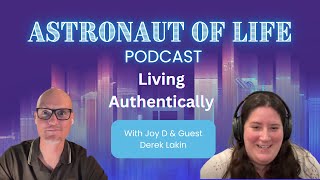
Joy Brown and Derek discuss authenticity as aligning your inner feelings with outer actions. Derek overcame decades of depression through major life changes; Joy used meditation and therapy to manage anxiety and became a certified teacher. They share how small choices like saying no and setting boundaries, plus practices like journaling and meditation, strengthen what they call your authenticity muscle.
Chapters
And we're talking about authenticity today, which is fairly broad, right? So how would you define authenticity?
Um, again, I think it's really broad and I think authenticity ultimately means something different to everybody, but, uh, from my perspective, through my lens, I would just say it's, it's largely not living through a lens of comparison or of constantly seeking external validation. It's owning my uniqueness, flaws and all, warts and all, and then just living through that truth.
Oh, that's so beautiful.
What about you?
For me, it's about how I present. Yeah. And what I say and my actions, are they aligned? And are they matching? Is what I'm saying actually what I'm feeling? Am I skewing it to fit the other person or scenario, right? So, so I'm always mindful of that. And I'm like, how do I want to navigate this? Because it's essentially how I'm presenting myself. But also internally, I also want to be— I don't want to lie to myself either, right? And really just kind of like, I'm thinking of like Orange Clockwork eyes. Into myself. Like, I wanna see it. I wanna see what's there and I, I don't wanna look away anymore. Like, let's see what's there and, and express that outward, right?
Yeah, absolutely. Aligning your internal with the external.
So how has authenticity played out in your life?
Yeah, I think that's, I think that's a really good question and, and probably something good to start with just so that kind of everyone that's watching knows why we're even talking about authenticity in the first place. And as far as my personal story, as we've discussed before, you know, I, and I discuss a lot on my, through my newsletter, is dealt with decades of depression, probably my entire life. Didn't really know what life was like without looking through the lens of depression. And as I stopped running from myself, gained the courage to face my emotions, especially the negative emotions, asked them what they could teach, you know, sit with them, ask them what they could teach me, and then ultimately release my clinging to them, I found that I really didn't know who I was underneath. You know, if I wasn't labeling myself as depressed Derek, or, you know, if I wasn't constantly using all of my energy to run from myself, I didn't know what Derek actually, who Derek actually was. So over the past couple of years, as I've consciously tried to emerge from my depressed state, it's just been a journey of self-realization and self-actualization. And it's been, as we talked about, it's been beautifully challenging. You know, it's messy, it's not linear. There are lots of ups and downs. We, when we become our authentic selves, we often lose people whose relationships we built on inauthenticity, and that's something we can maybe talk about in a moment. But just, um, despite all of those challenges, it feels beautiful. It feels wonderful. It feels freeing. I feel like I've, I've unlocked my own prison door, you know, and walked out of it. And I definitely would never go back to that inauthenticity.
Oh, I love that prison door analogy. Oh yeah. Well, Cause like you, you talked about depression and we talked about it before. I had anxiety really bad. It started around 20 and I, it, I finally moved out of that type of thinking in my late 30s. Like it took a long time to really work through that and it, it was all encompassing for me. I mean, panic attacks and stuff felt out of my control. It just. I didn't really, everything was focused inside and it was like bouncing around in my head and that was all I could really consider for years. Right. And yeah, it finally, I had to get fed up enough with it to be like, I need help. Like I need like real help and I don't want to be on any medication. I want to like really learn how to do this myself. And so that's, I went to therapy, they introduced me to meditation, which I'm now a certified teacher, right? So it's like, I, it was a process. It wasn't, like you said, it wasn't linear. It was messy as fuck. But I, I freed myself from that. I don't really have anxious thoughts anymore, or if I, I can catch them so quick now, right?
That's exactly it. Yeah.
Yeah. Yeah. So now that you're living authentically, how does it play out in your daily life?
Um, you know, I think just like meditation and I think meditation and authenticity kind of go hand in hand and I'm sure you can talk more about that, but, you know, meditation is a practice and becoming our authentic self is maybe a sub-practice of that. You know, it, it takes concerted effort. It's like, it's like exercising a muscle, you know, your authenticity emerges more as you work more of it out. The more you flex that muscle, the stronger that muscle gets. And, and what I've found is that it's, it's often, you know, what, whatever habit we're trying to build, it's often about, it doesn't have to be about big grand gestures. It's often about making the small choices throughout the day. Exactly like you were just talking about. You know, catching our thoughts before they have the ability, before we react in some way that doesn't reflect our authenticity based on those thoughts. So it's just, you know, small moments throughout the day when you allow your true self to shine through. So just, you know, being real whenever it seems risky, choosing things that reflect your preferences and not those that you think you should choose is a big one. Another big one for me was just becoming comfortable saying no. Phrase that I've heard a lot lately is that, you know, if it's not an emphatic yes, it's a no. So just listening to that and having the courage and the wherewithal to say no when you want to say no. And really talking about the process of being nonlinear and messy, it's allowing yourself to be seen as less than perfect. Because a lot of the times, you know, perfection is just us covering up some other aspect of ourselves that we don't like and that we don't want to show to others. So then when we, when we try to always seek that perfection, it's really a surefire recipe for dissatisfaction and continuing to wear masks, which can deepen our anxiety or deepen our depression, which then deepens our inauthenticity. Like we were talking about earlier, it becomes a feedback loop that really just spirals out of control eventually. What about you? How do you practice it in everyday moments?
Well, it's funny that you picked meditation. To me, I, I connected to mindfulness. So, um, but they all go hand in hand, right? Right. Um, because for me it's catching it. Right. Um, before I follow into my own, my own patterns, right? And doing that enough that I create a new pattern. In myself where I don't have to worry about catching every little thing, cuz I know I'm just gonna act that way now. And also embracing vulnerability and like, like how you said, no, I had to do that with speaking up and just saying what I actually want. Um, cuz for me, I was very much a people pleaser, always trying to just keep other people happy and not voicing my own. Experiences or intentions or desires, right? So it's like, no, I can have a voice too. I can say what I want to say. And, um, one fun way I've done that, oh, how I'm going to share this memory because it felt really badass in the moment. I'm sure everybody's had like a moment where you thought of a cool thing to say, but you didn't actually say it. Oh, I hate those moments because I'm like, man, what would it be like to actually say it? And hmm, trying to think, this was maybe back in like late April or early May. I can't remember. I was living in Alaska on the Kenai Peninsula and I had one week left in Alaska and I went to Homer, which is at the bottom of the peninsula. It's a beautiful city, totally worth it if you're in Alaska. But, um, went to a weed shop and it was just me in there and I was talking to the two employees and I bought something, right? And I was going to Australia the next week. Those employees assumed I was a tourist because Homer is a very touristy place and I didn't really correct them. Um, and so they were like, oh, what are you doing here in Alaska? Right? Because it was off season and all this. And like I said, they assumed I was a tourist and I was like, well, next week I'm going to Australia. And they were like, oh wow, what are you going to do there? And I was standing right by the door. Like, this was like a freaking movie moment. And I, I had the cool little thing to say, like it popped in my head and I just said, I'm going to fuck shit up. And I left. Did I actually fuck shit up? No, not really. I didn't do anything besides You know, normal stuff in Australia, but to embrace that moment and just say it in their faces, they were like, it was pure joy on their face. Like, whoa, she just said that. And then I left like a badass, right? And I was like, whoa, I literally just did that. That was so authentic. I thought it, I said it, I acted it out. It didn't have any meaning besides really what it did for me, right? To really own that voice and own that. Like, I'm on an adventure. I'm going on an adventure kind of an attitude. So when you, when I had a moment like that and I felt the way it felt inside to like do that was like, oh, this, this is what I like. This, I haven't had a moment like that since where I've had like some cool ass thing to say as I leave, but I know now I could do that and that what it feels like. And it felt really good.
Yeah. To both say what you meant and to be seen for saying what you meant.
Yeah. Well, and it was embracing the attitude I was in. It was embracing what I was feeling in the moment and not shying away just to seem less than, right? No, I'm on an adventure in Homer. I live, you know, like 100 miles north. That's it. Not that exciting. I could have said that, right? Like, no, I'm from Kenai. I, you know, I'm just here visiting. I could have said that, right? But no, I was like, no, I'm going to be mysterious here. I'm going to say this weird-ass thing to these people. Yeah. Okay. Let's see. Um, well, we kind of already talked about this, but let's expand on it. Is it a conscious, mindful thing or something you just are now?
Right?
Like there's a progress and a journey to it. So how did that play out for you, Derek?
Well, I think to kind of piggyback on your story, I mean, you, you automatically recognized when you were being authentic, right? You, you felt good. You made other people feel good. The energy was great. The other parties responded to your energy. You know, I mean, it's, when we're authentic, we know we're being authentic. But, you know, I think, I think it's both something that we need to consciously cultivate, but it's also second nature because we often, so for example, in instances where we feel safe, let's say with loved ones or what have you, or close, you know, friends that we've known for years or really connect with, I think our authenticity flows naturally, but out in the real world, we often feel like we have to wear masks because we seek, you know, external approval, whether it's from a boss, a coworker, a new acquaintance, you know, the list goes on. So in order to wear that mask, we limit ourselves in some way. So it's about consciously allowing ourself to Maybe bit by bit, and sometimes it might not be as big of a moment where you say, I'm going to fuck shit up or whatever it is. It can be much smaller little micro moments of authenticity and where we consciously remove our masks bit by bit and then we consciously reclaim our true nature. But, you know, in my instance, I really didn't know who I was. Without my masks. I had, I don't think that I had ever really lived who I was. And that's where a lot of meditation on my, in my end came in. You know, meditation is obviously just the formal practice of mindfulness, you know, taking the time and effort to create a space at a specific time and practice getting into that mental space. And then I found that the more I entered into that mental space, the more I was able to transition that mindful state from on the cushion out into the real world, quote unquote, the real world. And kind of like Viktor Frankl says, to kind of piggyback on his quote, you know, in between stimulus and response lies all our power, learning to sit in between in that space. And I think in between that stimulus and the response is really where our authenticity lives. And, and as we, or as I, in my instance, transition the mindful state from on the cushion to out in the real world, that those moments of authenticity just naturally shine through. Our, our, our authentic selves, once we remove the mask, once we remove the weights that kept them underwater for so long, you know, that, that authentic self just naturally kind of bubbles to the surface and, and reaches for air, reaches for oxygen. And as we do that more and more, as we consciously do it more and more, it becomes more and more unconscious. We just naturally express our authenticity instead of having to consciously live in that space between stimulus and response. What about you? What would you say?
Well, what's coming to mind is big actions I took. So it started after therapy and everything. I wanted to move. I was in Indiana where I'm at now, but I wanted to move back to Oregon because I just, if you've been there, you know, kind of a thing, right? And I, nobody around me really gave a shit about Oregon. They didn't understand why I wanted to live so far away, but it was owning that like, no, I want to live in Oregon. I'm going to go. And I did, and I lived there for like 3 years, and then I found myself in another like tower moment, like rock bottom-ish, not quite a full rock bottom, but I was like, okay, where do I wanna point myself? What is my fullest expression? I, I can create this reality, right? And I was like, you know what? I love traveling. I'm just gonna, I got a job teaching English online to Chinese kids, and it paid the bills. So I was like, I'm just gonna travel. I'm just gonna go. And it freaked my mom out. It freaked my family out to be like mid-30s and single and traveling by myself. And I went to South America, and this was in 2020, right? So we all know what happened in 2020. Um, I got put in lockdowns in Colombia. For a year. Um, but that's kind of a side story, but living the, that the real part is taking that action and just like, no, this is what I want my reality to look like. This is where I'm going to point myself. Was I nervous? Yes. Was it always easy? No. Right. It was actually really hard. I don't, I hated Spanish class in college and high school. I didn't pay attention to anything. I was like, I just wanna get my grade and get outta here. So of course I picked South America, right? Where I, I don't wanna learn the language, but, um, no, it was embrace it. I think that actually helped me, um, to be in a foreign language country by myself and like nobody knew me. I'm the freaking gringa, right? So it's like, let's just, let's just experiment, right? I'm already standing out cuz I'm almost 6 feet tall and I'm white and I don't look You know, Latino. So I don't speak any Spanish. I have to act things out to get myself across. It was a beautiful, like, playground for me to play with this and, like, be seen because everybody wants to talk to me or try to talk to me in English, right? And, um, no, it was a cool, cool experience. Um, and now, now that's just a part of my life. I can easily go travel or or talk to people or being in a foreign country isn't, isn't scary or anything. Now that's a very big extreme example. Not everybody's going to want to go travel the world, right? I get that, especially by themselves. But for me, that was authentic to me. Um, and not hiding that away and trying to be like, no, I guess I have to live in the same place for X amount of years. Like everybody else, that doesn't feel authentic to me. And that's my truth, right? I'm not a, pushing that on other people, but that's what was true for me. And I was like, I'm going to own this. And it's, for me, it was like owning things little by little. And, and that was also the process of learning who I was. And like, like you said, like, actually, who is Joy? What does Joy want? Well, Joy doesn't like staying in the same place for 10 years. No, I really don't. I like to see new places. I want to get new experiences. I want to have new smells. I'm, I'm actually very picky about my food. So that one, I'm a little, not as I explore it, like I don't explore food too much, but anyway, um, no, that was, that was really big for me in my life to do that and to own it and, and to live it out. And it, I don't regret it at all. Right. Even being in a lockdown in a foreign country. It was terrifying, but I would still do it again. I would totally do it again. Let's see.
And I think there's, there's so much value in, um, making ourselves uncomfortable as far as discerning who we are as individuals, because you're forced to face who you actually are when you're in uncomfortable situations. Uh, you know, I think we've talked about it before, but you know, I, I haven't moved out of the country, but I've moved around within the United States quite a bit. Grew up in the Deep South and moved to the East Coast to Boston soon after high school and lived on the West Coast, live in Denver now. And living in all of those places, it forces you to— you're not, you're not stuck in old patterns, people that you grew up with and the same social circles and the same social mores and, you know, all of these things that are just baked in if you've never left the environment in which you were raised. So absolutely. I, I wanted to ask in, in your instance, what did the small moments of figuring out who you are, your, your authenticity come kind of in a gradual step-by-step fashion and then you decided to move, or was it only after you moved that the smaller pieces of who you are started to fall into place?
Well, in Portland before I left, I was really, I was trying to make friends. And so I, um, it was happening then in small ways. I joined, I love writing, right? That's why I'm on Substack for one reason. And so, and I have an English degree to boot, right? So I joined Write Around Portland, which is a nonprofit that does creative writing workshops for low and underclass people all over the city. It's gorgeous. Um, and I joined it. I did that for 2 years. As an attempt to get social because I was such an introvert, I knew I needed to talk to people. It was a skill due to some trauma in my life that I had lost. And so I was like, I need to rebuild this and figure it out. And it was uncomfortable. It was uncomfortable. I still, eventually I became a facilitator and I led a whole group of people, you know, um, in this writing workshop. And that was uncomfortable too, right? I was in like a leadership position and, um, and it, it took a little bit to navigate, but that's part of my authenticity is to actually put myself in those situations where I am hyper uncomfortable. I actually, in a weird way, enjoy that. Um, and I leaned into that and I'm like, I didn't make any friends at Ride Around Portland. I mean, they were nice to me. If you live in Portland, check them out, right? But, um, I didn't, I didn't gain those skills, but before I went to Columbia, I was in Mexico City and it was still going on. And I was like, I'm going to, I went to a meditation circle and I started meeting people. I joined a Spanish class and I remember, um, in my Spanish class, there was only like 2 other students, like an Irish guy and a British girl, and I was, I had in my mind, I was like, I want to ask him to lunch because our class was like around 11:00 AM and we got done around noon or something or somewhere around there, like brunch, lunch, whatever. Oh, it felt monumental. It felt like, it felt so big. And I'm like, I don't know if I can do this. And my anxiety was, and I'm like, Joy, you're just asking them to lunch. This is, they like, you're not going to die if they say no. Right. So we have class and we're just sitting there and we're, and I'm just, my heart's pumping cuz I know what I wanna ask. And I'm like, you guys wanna go to lunch? And they're like, yeah, let's do it. Where do you wanna go? And it was just like, whoa, was it really that easy? Was it really that easy? It was that easy. I said those words and they responded and it wa— it literally rewired my brain in that moment to just do it. I'm. Probably was not visibly sweating, but it felt like it, you know, because it was such a big thing in my head. And then I made friends and we had a freaking blast in Mexico City. Uh, or I did anyway, because I was like reteaching myself. I spent 2 years in Portland trying and it wasn't working right. But I was still, I still went to the meetings. I still went, I at least put myself in the situation. I didn't really talk to anybody. I was still at that level. But I, you know, I only had one month in Mexico City, so I was like, I think I can handle it if they say no. I know I'll be okay. I know I'll feel good that I at least did it. And even though it was scary, I did it. And, um, yeah, that one little question really turned the corner for me. Like, ah, uh, people do respond to me. I actually can speak up. It really isn't as scary as my anxious mind made it out to be. I actually enjoy their company. I'm actually having fun with these foreigners in this foreign city doing— well, I was vegan at the time, so we were going to a bunch of vegan restaurants. It was, it was beautiful. And I'm freaking proud of myself for it. You know, I mean, it's something so small, but when you have an anxiety disorder, it really can feel huge. And I think just right now, like owning that, right? Like, uh, what about you? Uh-huh. When you were depressed and like moving out of it, was there anything like that that was really big and that you like tackled that really gave you that 90-degree turn?
Um, well, you know, in my instance, and I think this kind of goes along with, you know, what, what ultimately awakens us to the realization that we've been living inauthentically. Uh, in my instance, it was a complete shattering of my life. Um, uh, I mean, from the ending of a nearly 30-year relationship, 22-year marriage, relationships with lifelong friends, uh, even, even my, uh, relationship with my children, having to move away from my children and, and the, and how that impacted the relationship. I mean, it was. All of the pillars that my depression had built. I mean, my entire life was built around depression, not just the masks that I wore, but literally every relationship in my life. And once all of that crumbled, it was kind of like just a series of dominoes really, you know, and everything just kind of fell from there. And, and, you know, and that's certainly not the case for all of us. In a lot of instances, it can be just, you know, an accumulation of small compromises over the years or decades. We can be, you know, just reaching a point of absolute exhaustion because we're tired of wearing these masks. We're tired of performing for others. Could be, you know, maybe achieving a big goal that ultimately feels empty, something we've worked on for years or decades. We can maybe see someone else succeed and seeing how empty that might feel to them. You know, there's a lot of different ways I think that inauthenticity can ultimately build to a critical mass, so to speak, in our life. And for me, it was, you know, just basically the crumbling of my life. And I've spent the past couple of years really rebuilding from square one. And, you know, that's ultimately what brought me to Substack is talking about my journey and specifically how meditation and the mindfulness I earn from meditation has helped me remember who I am and then how to express that and, you know, how to form relationships based on authenticity and kindness and compassion and empathy instead of, instead of building relationship on wounds. Really, I think that was a lot of what my previous relationships were built on. And when, especially when we start healing those wounds, all of those pillars kind of crumble away. Um, so for me it was, it was definitely a catastrophic event. It wasn't, it wasn't a small series of events. But how about you? How, how, how did it show up for you? What, what made you realize it?
Hmm. Well, those, I call those tower moments, which comes from the tarot, but, or rock bottom, whatever, soup, whatever you wanna call it, right? The destruction of your reality. Oh, I used to hate them, but they are magic if, if you let them be, right? Um, and they can be as big as yours was, or you lose your job, right? And maybe everything else is there, but your job's gone, but it feels big, right? Because that is a big thing. Um, or you lose a friend, right? And that same thing. It doesn't have to be everything. Is gone. But when those things happen, if you can learn to lean into them a little bit, just a little bit, you can, um, it gives you kind of a clean slate. Well, it does, not kind of, it does give you a clean slate. And that is magic in my opinion. But I think for me, if I go back to like maybe like 2015, 2016, when I was in therapy working through anxiety, what even got me to go to therapy was like, I just felt really bad inside. I felt like I was like in a— I would call— I called it the darkness. I just, in my mind, it was just dark and it was not a fun place to be. And it was just like, I don't like this. I can admit now that I don't like this. I don't like living inside my own mind, which for me was everything when I'm happy, right? And it was like, I can either live like this and just keep spiraling. Like, it just was so negative. I was, I couldn't even, I was working at an Amazon facility center trying to finish college and I couldn't even finish my shift sometimes because I would just break down crying from like this darkness in my head. And it was like, I need a change. I, something needs to change and I don't know how to do it. So I was like, but I know how to, I know how to get a therapist that can maybe give me the answer, right? Or point me in the right direction. I was actually an atheist at the time, so like spiritual stuff wasn't even on my radar. I obviously was kind of rejecting that. Um, But it was like, I, there, for me, it, I don't even remember the exact moment, but I know I ha— I was just like, okay, let's not lie to myself anymore.
Mm-hmm.
I'm unhappy and I'm, I'm tired of pretending I am. I know my name's Joy, but it's, it's not what I'm living right now. It's the opposite. And I don't like the way any of this looks. Right. And that was the big turning point. And then it was just little steps the whole way till it led to, you know, you know, 5 years later, I'm living in a foreign country, learning to make friends. Like it literally took that long to just say, hey, you want to go to lunch? Right. It took 5 years out of the darkness. I got out of the darkness. I did all these other things and then, oh, okay, I can do it. And it just kept building. It kept building and building. Now I can totally ask somebody for lunch and it doesn't even faze me, right? I don't have any anxiety around it. Well, it's been 5 years since 2020, so 10 years in this, just into all of this journey. Yeah. But, um, now that you're kind of on the other side of depression, the other side of all of this, I know for me, I'm not in the darkness in my mind. I'm in the light. My mind is a beautiful place to explore and play and everything. I love it, right? And I'm in a tower moment right now in my life. I'm going through a divorce myself, right? And I'm working out things, but I'm leaning into it and like, what do I want to create? Where do I want to go? I'm a little Miss Nomad. Where do I want to point myself, right? I'm having fun with it. Even though bad things are still occurring, right? Or I don't, a lot is still unknown. I'm like, I'm just gonna lean into it now versus viewing it with fear and, you know, scarcity or whatever. Right. Um, but how for you now that you're on the other side, what are the benefits that, that you're experiencing?
Oh gosh. I mean, there, in every way. I mean, physically, emotionally, psychologically, spiritually. You know, I think when, when we're, when we're living inauthentically and we're performing, it's exhausting and we might not even realize how exhausting it is until we just let go. And, you know, a big thing for me through therapy and meditation and practicing mindfulness in the real world is no longer clinging is the big thing. And you know, when, when we live inauthentically and we constantly don different masks for different situations and different people, we're clinging to other people's expectations of us and we're clinging to what we want them to perceive us as and how we want to show up in the world. And it's just when we start living inauthentically, we're able to just release that iron tight grip and all of the energy that we expend in holding onto that, that those, those, that clinging so much and So, I mean, it's, you know, it's my body is much more relaxed. I no longer seek external relief, you know, whether that's, you know, through drugs or alcohol or shopping or, you know, whatever it is. I mean, pick your poison. We no longer need those things when we're living from a place of authenticity. At least I'll talk from my experience, I don't, you know, I feel more peaceful. I'm better able to show up for myself. I'm able to, better able to have difficult conversations, not just with others, but with myself. You know, I'm able to set and maintain, I think is the bigger thing, personal boundaries that speak to my authenticity. I'm more accountable to myself. I'm more accountable to others. I show up better for the people who still remain in, in my life. And I think, you know, it can be a double-edged sword with, with the boundaries. You know, um, I was talking earlier about when we build relationships on pillars of wounds, when those wounds are healed, the pillars collapse. It can be a lot the same with boundaries. You know, a lot of relationships can be built on violated boundaries and feeling like we're not We're not living authentically and we're not maintaining where we're comfortable with others. We're letting others trample on us or whatever else. And when we begin to set and maintain those boundaries, a lot of those relationships will fall. That goes kind of back to the beginning where we're talking about, you know, the messiness or the nonlinearity of, if that's even a word, of healing and of moving into authenticity. But the good thing is, is I've found is that, and I'd love to know what you found as well, is the people that fall away are often replaced by others who are more aligned with our authenticity or whatever version, you know, we're living at that time. And, uh, you know, another big thing for me, especially talking about writing newsletters on Substack is, is creativity. Over the past couple of years, my creativity has absolutely exploded. Because again, I'm turning all of the energy that I was using to take on and put on different masks for different people in different situations and clinging to expectations and clinging to how I wanted people to perceive me. All of that's now energy that has been freed up to express who I am. And, and it's fun to express who we are. You know, it's a blast to be who we are and, and figure out our weirdnesses and not be afraid to Show those weirdnesses and show those imperfections. It's just, it's just a beautiful process that, you know, again, isn't always linear, isn't always pretty, isn't always neat and tidy, but it's just, I would never go back. And, and I, I certainly urge others that, you know, if they're in a position where they're, they feel that they're living inauthentically and they're ready to kind of step in. Just do it. Yeah. And it's, it's worth it. It's worth every second. What about you?
Well, writing is a beautiful modality for that to get your own thoughts on paper, um, via journaling or, or Substack, right? Where you, where you share it publicly. Um, if it's too intimidating to share it publicly, I would suggest obviously journaling, just be real with yourself. Oh man. We'll put writing aside for a minute, but I think authenticity is, it's double-edged, right? It's just as much internal as it is external, and they reflect with each other. And to me, you're only externally authentic as much as you are internally. They, they literally coincide. You, I don't. I don't know enough psychology, but I would think they kind of got to go together, right? Um, so when you do that inner work and you are real with yourself, honest, like I said, those Clockwork Orange eyes, right? You are literally like, I'm gonna make myself look at it even though it's hard. You're gonna cry, you're gonna scream, you're gonna go through all of that. Mm-hmm. Um, and then you come out the other side and you're lighter. Right? And you're not carrying that heaviness. And then you're like, oh, that was so worth it, man. And it becomes the new habit or pattern, right? Yeah. Um, but now back to writing. Yeah, I, I have a long history with writing. I won't go into that whole story, but for a while it stuck with creative writing was what I would do. Writing. I love writing fiction. I love everything about fiction, man. Especially freaking sci-fi. I've read sci-fi novels, I've read sci-fi short stories, but on Substack, though, I, I'm thinking about, and now I probably will because we're saying it, I will share some of my sci-fi stories on there, but writing about, I'm doing more poetry. I don't know shit about poetry. It just flows out of me and I'm like, I don't care what it sounds like. There it is. I'm putting it on there. It's more from— I'm sharing it, but it's actually for me to keep, like, this is me putting my voice out there authentically, right? I—
Yeah.
If anybody reads it, fine. If they get something, fine. But no, it's for me. It's totally for me. Right. And because it's those steps, right? And even my non-poetry stuff, it's still— it's my voice and I can As an English major, it's all about your voice in writing and, you know, how you're shaping that as a writer, right? It's a huge— oh my God, you took a whole series of lectures on that. But when you read back your own words and you can feel your energy in them, that is— that is nice. That's really nice. That is beautiful feedback. And because if you don't, then you're lying to yourself, in my opinion. There's something you're saying, you're trying to fit a mold, maybe with what you're writing, right? Um, trying to hit, hit a certain audience, right? Yeah. And it, I've totally fallen in that, but it's, it's finding that balance. And like, mm, you know, I, that's one reason I am like, no, I will share my sci-fi stories. It, my page is all over the place. That's okay. I literally say I'm messy on it, but it's like, this is me exploring my voice. This is exploration. And to, mm, I think that's for me, the part, one of the most cool things about authenticity is it's you exploring yourself. Both internally and externally and, and sharing it. And when you meet somebody else who's authentic, you just know whether you are in that state or not. You can tell when somebody else is right. And it, for me, that every time when I was in my anxious state, I remember when I first moved to Portland, one of my coworkers, she just, She was like 10 years younger than me, younger than me. She was like 22 at the time or something. She just exuded that. And I was just like, what are you smoking? Like, what is going on? This is so cool. I don't know why, but I love your energy. I want more of it. And eventually she smoked a lot of thades, but eventually I realized it's not, obviously that was a joke, but it was like, ah, she's owning her shit. She knows who she is at 22. Fucking awesome. But it's like, that's what it is. How do I get that? Oh, I have to do the work. Right? I have to do the work. I have to put myself out there and everything, right? But, oh yeah, it's, oh, I'm looking at my questions. Do you think it becomes like a skill after a while that you just it's just something you live out. Like you don't have to think about it as much. Yeah.
I think that's kind of goes back to what we were talking about earlier is authenticity is a muscle that gets stronger the more you work it out. Right. And at first it might be, you know, it's a practice just like mindfulness or meditation or learning to do artwork or learning to write. I mean, whatever, it's all a practice that it, you know, it might take it's going to take more conscious effort to express your authenticity on day 1 than it is on day 365. You know, it just becomes, it just becomes automatic. And it's the same thing with, you know, mindfulness. It's, you know, it's going to take conscious effort when you're out in the world and you're trying to create that, that space between the stimulus and the response. But the more you do it, you just automatically react or, or respond from that place. And then I think it's the exact same with authenticity. And I think, you know, as far as practicing authenticity out in the real world, I think what you were just talking about is a great way to know that you're being authentic is when your body responds accordingly. Because, you know, you were talking about just, you know, just boom. It's like, you know it. It's, and I think that's a big thing. Regardless of if it's authenticity or trying to live with depression or trying to become less reactive or trying to deal with anger or grief or any of the big emotions, big or small emotions, it's really checking in with yourself. You know, if you're in a specific circumstance or just out and about, I mean, whatever the situation is, check in with yourself. You know, what am I physically feeling right now? Are, you know, are the feelings good or bad? However you define good or bad, you know, the not going to be, no two people are going to define those the exact same way. You know, is, is what I'm feeling right now because I'm being inauthentic or I'm wearing a mask, or am I just uncomfortable because I'm scared of showing my authenticity? It's, you know, I, I very much believe that in today's society, we've lost touch with our body as a feedback mechanism. And I believe that, you know, our body absolutely knows things before our mind has had the opportunity to rationalize it and contain it, you know, put it in nice, neat little boxes. Our body is already speaking to us. And I think if we learn to just naturally tune into what our body is telling us, then we can, uh, from authenticity or whatever it is.
Oh yeah. Well, when you, it's such a good barometer because when you aren't, you know it, your body will tell you, right? And then, yeah, like you said, when you do, it lights, you just, you feel it light up and you, you get that excitement. And cause you're like, ah, this, and then eventually that's just pretty much your baseline, right? Which is pretty fucking cool. Yeah.
And then life is beautiful, you know? I mean, life is always beautiful, but you're able to appreciate, feel that beauty, let that beauty flow through you. And yeah, no better way to live. Mm-hmm.
Yeah. Well, I mean, that's a good gauge and it is, it's, you gotta lean into the hard stuff when you're moving through this. Like it's gonna be awkward. It's gonna not feel comfortable. It really isn't. It's not gonna be comfortable. And you just, you kind of have to just do it anyway. And whatever step that looks like for you, like just baby steps, right? Until you're ready to take bigger steps and then leaps and then jumps and then whatever. You got to build on it. And it does take consistency. One and done is not, not the game here. No, it's continual work towards it. And I also say if that feels too intimidating, that's okay. That's your authentic, that's being authentic, right? And so it's like, maybe your steps are a little too big. Maybe you need to baby them down a little bit to where it doesn't feel overwhelmingly intimidating. And just think about the next step, not 20 steps ahead. Like today I'm gonna do my one thing. I'm gonna do this one thing. And I'm gonna do it and that's all I'm gonna focus on and I'm not gonna get in my head about it with my anxiety or whatever. I'm just gonna do it or I'm not. And, and then yeah, listen to your body cuz once you do that one thing and you feel that light up, it's gonna make it easier to do it again and again and you're gonna kind of chase it, you know, especially in the beginning and it's, and then you're gonna wanna find other avenues like. Well, it feels good in this, but what if I try it over here? What if I tell the freaking shop owners that I'm gonna go fuck shit up and wow, okay, right? Like, um, yeah, you just build it all around you until that's what it is now. Like we said, it took me 10 years. That's a long time. I'm still on this journey. I don't think it really ends.
Never ends.
No. Right? Um, because I'm still learning about myself and I, we change and grow. So it's all exploration again. For me, it's all exploration.
But, well, I think we were talking about journaling earlier. I just wanna quickly mention that because I think that is a very powerful tool for reflection and insight and learning to let your authenticity flow onto the page without worrying about someone else seeing it or without allowing your internal editor to dictate what you put on the page and what you don't. And, you know, very much resonate with your mentioning, you know, the small steps. I love the quote, you know, small steps repeated daily lead to big change. And it's like, you know, training for a marathon. It's like you don't just automatically walk out your door and run 20 miles or something like that. You know, oftentimes it's just, taking your running shoes out of the closet and putting them at the foot of your bed one night, and then the next night putting it in front of the couch, and then the next night putting them outside your front door. And then the day after that, it's, you know, walking to your mailbox in those shoes. And then, you know, it's, it's very small repeated steps. And I think when we journal, that it's such a small step that anyone can do, literally just pick up a pen and find a piece of paper and just write whatever you feel. And as you become more comfortable not editing yourself and allowing whatever you're feeling to just naturally flow onto the page, then it's easier to transition that over to other parts of your life. You know, just repeating those small steps every day until, you know, like you're talking about, you look 5 or 10 years down the road and you're literally a different person.
Oh yeah. Yeah. Well, I know with journaling, sometimes We can be like, I don't know what to say, right? Or I don't know what to write. Literally write that. You can literally write like, I don't know what to say. And you just keep writing it. And then I'm thinking about The Artist's Way and how those 3 pages, the 3 morning pages and stuff.
Morning pages, yeah.
And yeah, it kind of, you kind of have to get out of your own comfort zone if you're not used to doing it. Or even if you are, sometimes I'm like, I don't know what to say? Everything is pretty good. What am I supposed to— do I need to complain? No. Why don't I just talk about how good shit is right now?
Yeah, just start there.
But also not judging it. Um, you don't— if you think you're going to judge it, I would say don't read it. Just write it and put it away. Don't even read it because you'll forget.
Or even burn it. I've heard that's a real thing. Just burn it.
You won't even remember what you— you won't even remember what you wrote, right?
Mm-hmm.
But at least gets it out of your body. It gets it out of you and you still feel that release and it's like pressure releasing. Mm-hmm. And oh yeah, it's beautiful. That's really beautiful. Is there any other, I know we're both mindful and meditation. Is there any other modalities you think that help with authenticity that people that you've used or that you know of that I think a good prompt, and this can be a meditation prompt, this can be a journaling prompt.
I mean, it can be, you know, or a mindfulness prompt in the middle of the day. Just asking yourself, what do I know that I'm pretending not to know? And I think the phrasing of that question really shakes it instead of just saying, what do I not know? Or what am I pretending to know? The, that's a, that very specific phrasing of the question helps us bring to the surface things that we probably already recognize, but we might be like, we were just talking about, you might, the internal editor might come in and we might be ashamed to admit it, or we might be grieving over the loss or whatever it is. You know, maybe we're unhappy in a relationship, bored in a career, dimming ourselves around certain people. We know these things fundamentally. And if we're, if we're just honest with ourselves, we have the bravery to just ask ourselves that question. Um, I, at least in my instance, the, the answers naturally flow.
Mm. Yeah. Ooh. Can you say that prompt again? Cause that was like really good.
What do I know that I'm pretending not to know?
Yeah. Oh, I love that. That was real. That's real. I really liked that one. Cause it, oh yeah, that's one to sit with and think about for sure. But yeah, well, we're pretty much at time. Is there any other little tidbits you want to add, Derek, before we hop off?
No, I think we covered it really well. I very much enjoyed this conversation. It was a great energy flow back and forth. And I think we talked about some important issues around authenticity, and I think we provided some good tips and tricks and ways that, that others might be able to explore their own authenticity.
Yeah, me too. I'm very happy. And this was a very authentic conversation, so there you go. Yeah, that's freaking nailed it.
Yeah, go fuck shit up.
That's right, we're gonna fuck shit up. Oh, I love it. Well, thank you for joining me. Thank you for having this conversation. Uh, yeah, thank you, live viewers. Thank you guys for being here.
Yes, thank you all.
We will see you guys later.
Bye-bye.