Meditation Stories with Empath Coach Clare Liza. How Meditation Helped Her Healing Journey.
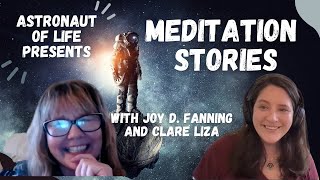
In this episode of the Meditation Stories series, host Joy Brown interviews empath coach Clare Liza (also spelled Claire). Clare explains her 25‑year background training vulnerable populations and her recent focus on empowering empathic people through coaching, a Facebook group (Are You an Empath?) and her website. She recounts her rare salivary‑gland cancer diagnosis five years ago, the severe physical decline she endured, and how guided meditations—first for healing the cancer and later for gratitude and love—sustained her mentally during hospitalization. Clare describes deep meditative states where she felt detached from her body, including a vivid “light” experience and a profound “Life Between Life” meditation that took her beyond the physical realm and clarified her spiritual relationships. After recovery she rebuilt her body through a cancer‑rehabilitation exercise program, began listening to bodily signals, and now balances meditation, movement, hydration, and rest. She runs a cancer support group and a community for empaths, sharing advice about body‑mind listening, the challenges of being an empath in work and relationships, and the importance of accepting one’s sensitivity. The conversation highlights the interplay of empathy, meditation, illness, and holistic healing.
Chapters
Hello.
My name is Joy D. Fanning, an astronaut of life, and I help people go inward to explore. This video is part of a series called Meditation Stories where you might hear me share some of my own stories, but the main part is to share other people's experiences because there are so many ways to meditate and so many things that come to us when we meditate. So without further ado, Here's the video.
Hi, Claire.
Hi. Hello, Joy.
Welcome, welcome. I'm so glad to have you here today.
Thank you.
Claire, can you tell me and the audience a little bit about yourself? I know you're an empath coach, so I'd like to hear some more about that.
Sure. Yeah, of course. I'd love to. Oh, I'd love to. Yeah. So thanks so much for having me on.
It's—
yeah, I've been really looking forward to it. So I am— yes, I'm an empath coach. So it's really about sort of empath empowerment. I've been a trainer and a coach for probably about 25 years now, and I've worked in a lot of places where a lot of vulnerable people have been. So in terms of, I've been into prisons and domestic violence, ex-offenders, drugs and alcohol communities, etc. And yeah, so I, and I've really sort of started my own business the last couple of years focusing on, on the empowerment of empathic people because I have realized that there are a lot of us around sort of being intuitive and empathic and sensitive. And I'm realizing more and more that actually it's not us because we're told all of the time that it's us, that we're being too sensitive or too caring or too loving or too, you know, whatever. So, yeah, so that's kind of where my training and coaching goes now. So, um, yeah, so I've got a group on Facebook called Are You an Empath? So, um, yeah, if you want to find out any more, it's a free group, just, you know, go along, you're more than welcome. Um, I've got some documentation videos and bits and pieces on that.
So yeah, that is awesome. Yeah, I'm an empath, and I went— I probably didn't learn that until my late 20s, early 30s. So I went the first part of adulthood just thinking I was weird, or yeah, I got called too sensitive to everything.
Yeah, too caring. And the other thing— confusing, it is. I know the one thing that is really sort of coming up to me a lot at the moment is that people are being told in the workplace particularly, or in business as an entrepreneur, that they are too, you know, they think too much of the other person, or they think there's too much care going on, there's too much brought too much love, and the person cannot be a manager or cannot be in a leadership role because they're too soft, which is completely wrong because empaths are actually super strong because they have to be. Yes, exactly. We have to be super strong and we have to have that power within us to be able to deal with everything that we have to deal with because what we're doing is picking up on everyone else's energies. So, you know, it's all about protection and understanding that actually we're not weird, and there's a lot more out there of us. I think it's 2% of the population are empathic.
Wow, I didn't know it was 2%, but that's— I'm an INFJ, apparently that's just 1%, so let's double that.
There you go.
Wow. Yeah, I ran into that myself, like especially with my voice. Everybody just thinks I'm weak and sweet, but it's like, nah, there's a warrior in here.
Absolutely, absolutely, exactly right. Yeah.
Well, did your meditation journey kind of go along with your empath journey too?
Do you know? No. It's interesting because the, the meditation, um, I mean, I've always been sort of quite a spiritual person, and I've done a lot of spiritual things in terms of getting into a sort of a connection of my inner self and my, my personal development journey. So I've had a lot of things that have really sort of taken me down the personal development pathway. But the meditation— and I, and I have done meditation a lot before, but it really, really kicked off and kind of came out for me was when I got physically ill. 5 years ago now. And as I said, I did do sort of a low-level amount of meditation, but it was— I never really sort of had committed to doing any form of sort of regular practice. And I did it more about my sort of— for my spiritual connection as opposed to anything else. So then I became— and I became incredibly poorly I was diagnosed 5 years ago with cancer of my salivary gland in my throat, which is quite rare. And they took it out, and the treatment that I had was not good at all on any level. And I actually became really poorly and ended up back sort of in hospital for a number of weeks. And I was on I don't, you know, looking back on it now, I don't actually know how I got through the days because I know that at nighttime I was going to sleep thinking I do not want to wake up tomorrow morning because I was in a place I hadn't— there's no— the treatment meant that I couldn't drink, I couldn't eat, I couldn't speak, I had no voice. It had just taken everything away from me and I almost felt like a shell of a person. Because I wasn't, you know, I talk for a living. So somebody to take my voice away is huge. So yes, and I ended up back in hospital on drips and all sorts of things, being very, very weak and very poorly. And I remember getting my son, I was in hospital and I asked my son to bring me some recordings and some things that I could put on my phone. From meditations because I was, I was so ill. I thought, there's nothing more I can do. I had no energy physically to do anything. So he brought me some into the hospital and I, and I sat and just started to do these meditations. And actually, I think that if I hadn't have got those, I don't know where mentally I would be now. Because I spent the majority of my life, or the majority of that time of my life in meditative state. I put my guided meditations on, I plugged my earphones in, and I was gone for hours. And it actually, you know, from that moment, it sort of, it got me through the worst time. And then what I realized, which was really interesting, that I was starting to build, I was starting to build quite a lot of meditations that were focused on healing, that were focused on cancer, you know, it was really specific to my journey at the time. And, and as I was starting to get better and starting to get more energy and start to go out— not that I walked anywhere, but I started to go out a little bit more to the end of the path and back. And I started to realize that actually, what happens if I now start changing this focus from the negative in terms of the healing of the cancer, which was really important at the time, but I felt like I'd moved on from that journey. So I then started to find meditations that were more about gratitude and love and support and heal, you know, um, that type of healing as opposed to really specific, you know, sort of coming down. So, so I started to really explore this meditative state and go really deep. I mean, for hours I was, I was off, and it was just beautiful. I just loved every second of it, and I think it got me through. I really, really do. I think it got me through that state.
Wow, that is a powerful story. Yeah, yeah, I had a similar moment in my journey. Not quite, not cancer, but I broke my back and I couldn't— I was 30, what, 4, and using a walker and I had to have surgery. So I totally know what you mean by like, it's literally like taking it minute by minute, hour by hour. Even an hour sometimes felt like too much, too much. Yeah, and it, it makes you go into this deep inner place where that strength is because it's intense, right? Especially because you're like, it brings up, yeah, a lot of these why is it happening, you know, why me. And I love how you mentioned how you got past focusing on the healing, which is a positive thing, but then took it into gratitude, which is even higher. That's important, important part of it, right? To just— I had it. I don't— meditation wasn't my thing at that time. But a similar thing, I had to go in and just be like, you know what, I'm alive. And that's, that's something to be thankful for. You know, if I'm in a wheelchair, I'm in a wheelchair. This is, you know, you kind of have to get to that place where you just accept that this is happening and find the positive.
You absolutely do. And I think when It's interesting, actually, you say that, because when it happened, I was very angry. I was very cross, and I was very, very just angry at everything. You know, I used to sort of say, haven't I not been good enough? Have I not helped enough people? Have I not— what, you know, all of those questions that we ask ourselves. And actually, I was in a place of being really, really, um, I don't know, it just, it was, I mean, it was almost, I want to say self-pity, but I'm not, I'm not I'm not sort of saying that that's wrong because I think it was a place I needed to be in. Um, but it was certainly— I was very angry. And, and I had a friend say to me, I remember she said she was doing some Reiki with me, and she said to me, you know, there is a reason why you're, why you're going through this. And I was so cross because I thought, what reason on this earth can I possibly be going through this? And of course, the journey of meditation took me through that process to, to the point now where you know, where we're 5 years on, but probably about 3 years, I would think, took me to that place of gratitude where I could actually say, no, I'm actually really grateful for being awake this morning and opening my eyes and looking at the sunshine coming through the window. And, but, you know, that was a real soul-searching journey. It was a real development of my own soul and my own spirit and where I wanted to be and where, you know, where I wanted to connect to. So it wasn't easy by any stretch, but it It was definitely a meditation that helped me get there.
That's awesome. Yeah, like, no, it was similar for me. That anger, the why me, yeah, the pity almost. And then you sit in that a while and then you're like, well, this isn't getting me anywhere. I'm still— my leg still hurts. I still can't walk, you know, like every— I still can't talk or whatever. And you're like, I have to change, I have to change this mindset. And just—
that's right, it's, it's pretty cool.
So could you— did you have any, um, unique experiences that you remember, either from that meditation time or another time in meditation?
Um, I, I think, I think yes. I mean, for probably from that time, I remember There were a couple of particular meditations that just took me to a place of complete relaxation. I mean, I'm very good at relaxing now because obviously I've practiced the art of it, but, but at the time I remember these— there was a couple of, of really deep level meditations that just took me to a place where I wasn't, I wasn't in my physical body anymore. I wasn't in the bed. I was just completely connected to whatever else is out there. And, you know, this connection was really— it was so strong. And I remember when I came back to the room, it was almost like I still wasn't in my body because my body was so physically relaxed. And just being able to get to that place at the time was exactly what I needed because I— now I'm better and life has moved on, and obviously I'm speaking again and, you know, I'm doing my training and coaching and there's things that are changing. I very rarely get back to that, to that deep level state. Very rarely. I mean, I can do it, but it, but it does take quite a long time. Whereas it was much easier, and I think it's because it was the only thing I was focusing on. There was nothing else that was in my space or my energy or my day that was taking up my, my thoughts. So it was just, that was the only thing I was thinking about. But that, that journey for me, I remember one of them, I I moved towards. It was just amazing because it was— there wasn't a particular picture in my mind, there wasn't a particular place that I went to, but it was just the most beautiful feeling. Um, and, uh, it was almost like a light. And I don't mean a light for when you cross over, but I just like a light that was sort of in it around me. And I remember kind of moving into this light and just feeling so loved and so cared for, um, that nothing else seemed to matter. And yeah, so that was, that was quite profound. I remember that it was almost like I was connecting to my own self in terms of my own spirit self. Does that make sense?
My own soul, like your higher self?
Yeah, yeah, yeah, absolutely. Yeah, so that, and that connection was really So deep, um, so deep. Um, there was one other time that I have had experience that was— that has changed me, um, and it was called— and I don't know if you know about it— is the meditation that, that is called A Life Between Life.
I haven't heard of that one, but I'm writing it down.
Yeah, Life Between Life, it's great. Yeah, LBL, A Life Between Life, and it's And it's about the meditation takes you to, to basically to a place that, I mean, I call spirit. You can call it whatever, whatever it is your belief is, but I call it spirit. But, but it takes you to a place where you are no longer in a physical body. It's quite mind-blowing, but I did that.
That's up my alley.
I did that and that was just phenomenal, phenomenal. And it was— I did it with a lady. Lady took me through it and she, she talked me through everything. And I didn't know at the time, but she was sort of checking off her checklist and there's certain things I had to see and certain things I had to say that made her know that I was in the right place, you know, those things. But I didn't know that. But, um, yeah, so it was literally just a meditation that took me back to, to, to this time and space where I didn't have a physical body and I was experiencing it. And everything suddenly made sense, you know, why my parents were my parents, why my sister was my sister, what happened with relationships, where, you know, everything just completely made sense. And I came out of that completely different. I know I did because, because of that experience. That was amazing.
I was just saying that these experiences sounds like they had a big impact, like, on your spiritual journey too, right?
Completely, completely. Yeah. And the first, the first one that I was just talking about, the life between life, was, was more about the spiritual journey. And definitely I'd done a lot of work on that to that point, but when I became ill, I suddenly realized that I hadn't— I'd spent so much time thinking about my spiritual journey and my, my mindset and my getting my confidence up and my empath side and all that, that actually I've forgotten about my physical body.
That's a, that's a good point. Yeah, it's finding that balance, right?
Yeah, yeah, yeah.
I'm— that's something my guides have been talking to me, because obviously I love to do the astral stuff and go, but it's like, Joy, you still have this body you need to take care of and, and, you know, like, honor, right? So That's a great point.
Yeah.
And yeah, because you had the life between life experience. I've often wondered what that was like. So I'm gonna, yeah, check that out, for sure. But, and then yeah, when you had the cancer, doing more of the body, and how did it feel to connect with your body? Did that bring up new things to you to do that?
Yes, lots of things, you know, a lot of, a lot of real issues because obviously I had never thought about it. And all of a sudden I had to, you know, all of a sudden I was sort of facing it head on because I wasn't anything as I was before, you know, I would become so poorly and so ill and so weak. And as I said, I was a shell of my person. So it was as if somebody had not only taken my physical away, but they sort of sucked my— me out of my shell. So it was about rebuilding both. So it was rebuilding my physical body. And I was very lucky because I found a program. And I have actually done— I've just put the speech on my group, actually. But I did a talk. I found an exercise program that was rehabilitating people with cancer. And they helped me to build up my strength again properly for my physical body. So that was really, you know, that was really beneficial. And I, and I went to their sort of gathering, it was the YMCA, um, and they, um, they did a staff and volunteer day and there was about 250 people there and they asked me to go and talk. So I went and did a talk there and I recorded it, so I've just put that in my group. It's about 10 minutes long, but it's, it's just about, you know, everything that I experienced really and how I then started to build myself back up physically, um, in terms of, you know, that, that place of— I don't know, it was just because I'd never really thought about it, and, and all of a sudden I was really aware of everything. I, I couldn't eat and drink, so there was nothing going in, but, but it— I suddenly sort of went, I spent my whole life not, not looking after my physical body, but actually thinking about my physical body and thinking 'Oh, I'm too big to do that,' or 'I'm too fat to do that,' or 'I'm too this to do that,' or 'I'm too that to do that,' and thinking, 'I'm never ever going to be obsessed like that ever again,' because it doesn't matter as long as you're looking after it. It doesn't matter, you know. Oh, that's awesome.
Yeah, yeah, that's so empowering too, once you come to that realization, like, 'Oh yeah, I don't have to be skinny to, to climb the mountain or whatever, right? Or to go on a mile-long hike. No, no, I have— same for me, it was because mine was my legs. Like, it's like, oh, I put off all these things because same reasons, like some kind of excuse. Now I'm looking at the possibility of never doing it again. Like, oh, I probably should have took advantage of that, right?
Absolutely.
You see the falseness in those statements, and it, it does change things a lot. Yeah. So how is the— how do you balance like the mind and the body now since you've learned both?
Well, meditation is still a huge part of what I do, absolutely. Um, but there's a lot of— I do exercising, uh, walking, and just being aware of myself physically. Which is something I've never had in my awareness before. So it's just being about, you know, being aware of what my body needs. Water, a lot, drinking water. And just resting if I'm tired. Just, yeah, listening, probably listening to my body is probably what I would say. That's what I've discovered most, is I actually now listen. I've always listened to my mind, But now I'm listening to my body as well. So it's about, you know, doing the meditation, doing the exercise, doing the— and actually just knowing that whatever, whatever— I was going to say state, but whatever I am, however I am, and whatever I'm feeling is okay. So if one day I'm not able to go out for my walk or I'm not able to do so, that's okay because I'm just listening and honoring my body.
So you're like in the flow. That's how I view that. Like you're just going with the flow with soul, spirit, and body, right? Like I think I'd say for me, like that experience at the least taught me how to listen to my body. Yeah. So now going forward, I'm like, oh, there's this, you know, this pain here. Maybe I need to do some stretching or some yoga or Oh, you know what, I just— today feels like I need a rest. My body's telling me to rest. I need to be in that flow and allow myself to do it, even though there's work to do. If my body says rest, rest.
And rest.
Yeah.
And it— and that— yeah, that's interesting because I, I run a cancer support group because there wasn't much support around when I, when I was diagnosed. So I started up my own group with a friend of mine. And so, so we ran this cancer support group, still do. And I listened to some of the ladies that are going through the treatment now, and they've got such a high expectation of what they should be doing. And I, every time I'm just like, my favorite saying of all time is, just be, just be, you know, whatever's happening, your body is going through hell. Your physical body is going through hell because you're because you're dealing with cancer, you're dealing with treatment, you're dealing with all the other things. Just let it rest. You know, let— just listen. Listen to what it needs. Because our mind is so strong that our mind kind of heads off in a direction that we'll just follow. And actually, we need to just listen to our body and stop and kind of go, right, what do you need? It's like check in with your body.
That makes me want to write like a meditation where you just check in with your body, like literally call it—
Perfect.
Yeah, thank you for inspiring me.
Yeah, welcome.
Because it's so needed. Yeah, I wish I could have learned that lesson without having to break my back.
Oh, bless you. Yeah, you know, right?
Like, it is what it is, and I take that blessing, you know, anyway, because yeah, learning It's such a— it just enhances life and, and being in that flow. And yeah, it, it takes it to another level, I think, for sure.
Definitely, definitely.
Thank you so much, Claire, for sharing those experiences and your story. That was—
thank you—
really amazing.
Yeah.
And can you say the name of your Facebook group again?
And yeah, sure. So I've got a website called Claire Liza Coaching. Is my website, and my Facebook page is Are You an Empath? It's actually Are You an Empath by Clare Lyser Coaching, but it's, it's Are You an Empath is the group.
Gotcha. Okay, thank you. Yeah, and I'll put links below for everybody too.
Fabulous. Thank you.
I feel like there's probably going to be several empaths watching this.
Oh, come on over. You know, it's right— I have, I have comments daily from people saying 'I never realized this about myself. I feel so much stronger just knowing that I'm a part of a group of other people that are feeling the same way.' Um, and the majority of people that are empathic— it's interesting, there's a lot of people that are empathic are married to somebody who is non-empathic. And so I've done a couple of videos on the group talking to my partner, who is, who is non-empathic, and I'm empathic. And we've had lots of conversations on there about you know, what it's like to live with a non-empath and what it's like to live with an empath and how, how to get the balance right.
Oh, I'm gonna check those out.
Yeah, yeah.
Well, yeah, I don't think my husband is— he's very caring, but about— I'm not sure about the empath part. No, no, it has a big heart, but yeah, yeah, yeah, it's different.
Yeah, it's not wrong, it's not right, it's just different. That's so true. Thank you, Joy, so much.
Well, thank you. This is fun for sure.