Why Selfridges Said Yes | Megan Tan on Supermarket Listings & Retail Strategy
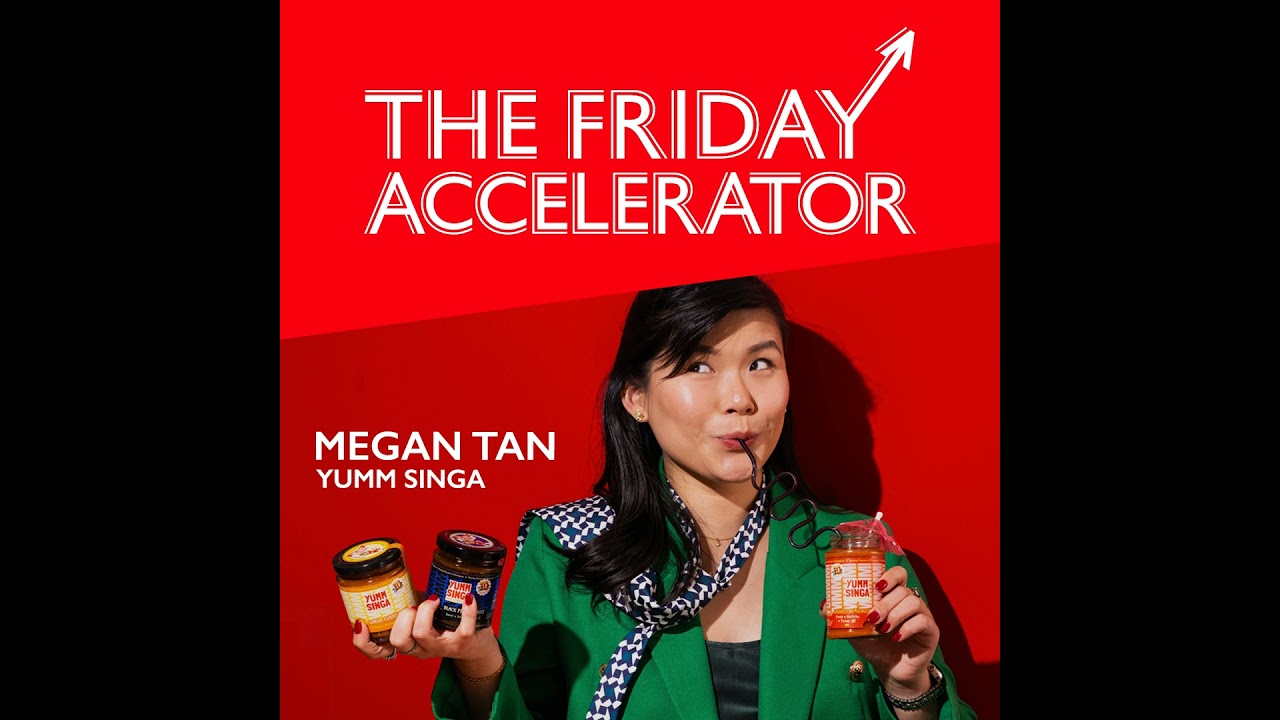
Megan Tan built Yumsinger to fill a gap: Singaporean flavours barely existed on British shelves. She got into Selfridges within two months of launch through the Bread & Jam summit, then expanded via independent delis and farm shops with heavy in-store sampling.
Chapters
Singapore is one of the world's great food cultures. It has a UNESCO-recognized hawker tradition and a food scene built on flavor, heritage, and communal eating. And yet, on British shelves, Singaporean food is almost invisible. And that's what Megan Tan has set out to change. She launched her first product in March 2025, and within 2 months had secured a listing in Selfridges. But the journey didn't start smoothly. Megan's original branding had already been trademarked when she received a legal notice from Warner Brothers. Imagine launching your first business thinking you've done everything right and then getting hit with that.
What would you do next?
This is the Friday Accelerator. I'm Karen Green, and here's Megan Tan.
Probably the best thing to start with is introducing the brand and let me know what's, what's the elevator pitch, if you, if you ever do such a thing.
Yes, of course. Thank you so much for having me as well. I'm really excited to be speaking with you and to share a little more about what we're doing here at Yumsinger. I'm Megan. I'm the founder of Yumsinger. We're a very young Singaporean food brand here based in the UK. And our elevator pitch, you know, it begins by examining the landscape, the current landscape in world foods. We have 92% of Brits eating world foods at home. We have 78% wanting more regional authentic cuisines. And the world foods market in the UK is set to double in the next 5 years to be worth almost £3 billion with compound annual growth rates in excess of 8%. Yet, as a Singaporean living in London, I couldn't help but notice that Singapore remained underrepresented on the shelves. Despite increased awareness of Singapore, especially in the past decade. When I first moved here as a student, people didn't really know that well where Singapore was, much about the country. A lot of people thought we were in China. But nowadays, you know, there is a lot of increased awareness of Singapore, but yet, you know, we're not on the shelves yet in a very big way. So our mission is to fill that gap. It is to make it easy and fun for everyone to enjoy big, bold, authentic Singaporean flavours in the UK. And we're doing that through premium, versatile, and accessible products that bring distinctive Singaporean adventure to everyday meals. So yeah, that's the sum.
So what are the products for the audience who want to go out and have a new Singapore experience?
The first product that we launched with was the signature ginger chili from Hainanese chicken rice. And then the next product we launched was a black pepper sauce from Singapore black pepper crab. And last but not least, most recently, we have launched a laksa curry sauce. So that comes— is inspired by Singapore Katong laksa, because of course there's a lot of different laksa. in Southeast Asia, but we have made it in a form, in a very interesting, exciting form. It's a curry sauce, which you can use for curry, or you add some stock and it becomes a curry noodle soup, or you can even use it as a marinade. So the idea is that each of these sauces, they come from iconic hawker dishes in Singapore, but all of them are made to be very versatile.
I have been to Singapore and I've been to Malaysia. And I didn't really know a lot about the, the, the 2 countries, but it, for me, it was a fusion between Chinese, India.
Absolutely. Yeah, absolutely. No, that's right.
And there's a 3rd bit, isn't there?
And I can't think of what it is.
Malay.
Yeah.
So what would be on a typical Singaporean menu?
You're absolutely right. I think something that makes Singaporean and Malaysian cuisine very special is how, you know, the cuisine is very multicultural. So Singapore especially, it is, I like to say, very much an immigrant country. Even someone like me, you know, born and raised, and I've had, you know, a few generations of my family in Singapore, and we'd be considered, you know, very much local. But even then, you know, it was my great-grandparents who first moved from southern China to Singapore. So As a result, the cuisine is really a reflection of the people, like the heritage that we have inherited from all these different areas. So, and that's actually, you know, a little tidbit. It's something that's reflected in our logo as well, which has the word yummy in the 4 languages of Singapore. So English, Mandarin, Malay, and Tamil. Where Singaporean cuisine is really most intensely experienced is in the hawker centres of Singapore. So these food courts where you have lots of different stalls, each one specialises in something a little different. And so our star dishes, Hainanese chicken rice, so the one that our chilli sauce is from. We've got roti prata, which in other regions is also called roti canai. So that's like a fluffy Indian flatbread, which we have with curry sauce. We have nasi briyani, which would be like biryani that we know of in the UK from India, but it's got a distinctive Singaporean, Malaysian twist with Malay influences. For example, it's often served with acar, like pickles, which are very Peranakan, which are done in a very Peranakan style in Singapore and Malaysia. So honestly, I would say there's the typical Singaporean menu is a mix of All these things. You will do— every family, you know, wherever we're from, you know, whichever our own ethnic cultures, our ethnicities. For example, me growing up, I felt like roti prata was like my cuisine as well. You know, it was something that felt like home to me just as much as a Chinese meal would.
And is it spicy? Is it spicy hot? Is it like make me cry like Thai food does?
I think some dishes can be, but I, and you know, maybe I am, biased or my barometer for what's spicy is maybe already high, but I think that maybe contrasted against, for example, Sichuan chili oils, Sichuan spices, which are like, you know, tingly, literally like tingling on the tongue. I feel like Singaporean cuisine, a lot of dishes are spicy, but it's not necessarily— there's a lot more that maybe as a Singaporean, we see as the primary ingredient. So for example, laksa.
Laksa.
Although it is a spicy dish and you can see literally a layer of chili oil on top, you know, it's really also about that coconut flavor and, you know, the richness of the broth with all the other spices as well. Yeah.
Right now you can grab a free copy of my book, Birology, at my website, birology.co.uk/free-resources.
You said you're at an early stage. If people wanted to buy your products, where are you?
We are available on our website for nationwide delivery in the UK, but right now our biggest retailer is Selfridges, which we're very excited to be working with them on. And we're also in a range of independent delis and farm shops, mostly right now in England, but we have just onboarded with our first distributor, Mahalo, and Yeah, which we're really happy about. And so, you know, hopefully it won't be long before you can find us in many more farm shops and delis around the country.
So Yum Singapore wasn't the first name for your brand, I believe.
Yeah, absolutely. So, um, I began this journey, this part of this journey with food in 2024 when I was still working as a corporate lawyer. And so I was just trying to test this idea and see if it had legs. You know, my gut said yes, but I wanted to test it. So I started running monthly supper clubs. And then, you know, I was just like, let's just, let's just get going. So I named it Homie Kitchen because I wanted it to feel homely. People were coming to my home. It was about sharing food from my original home in Singapore. And so that's what gave rise to that name. When I launched the first product, the chili sauce, in March 2025, after I decided to take the leap and leave my corporate legal career, I just saw it as an extension of the supper clubs. And so I didn't really want to change, I suppose, the original branding of the supper club. And I decided to just continue in the same vein. And that's sort of how it happened that the name of the product's brand was also called Homey Kitchen. But I like to say that 2025 for me was really my year of learning, starting, researching, learning, validating the product in the market, understanding the industry. So eventually I realized that the name had to change. The whole branding had to change because fundamentally, I think it— It's a happy problem to have, I like to say, but I feel like our ambition and where the brand was going with the traction it was receiving, it had outgrown what Homey Kitchen did for the business. So that's why I began my search for a new brand name and a new brand that could really represent what we're trying to do. A lot better.
And so what was yum singah, or the background to that?
In English, we say cheers. And in Singapore, when we do the Cantonese toast, yum sing, drink to victory, we do it in a very distinct way. In a big celebration, we scream like the whole room. It can be 200 people all at once. It goes yum for like as long as you can hold it.
Yum.
And then Amazing. So I love that practice. You know, we could all be in our finest, you know, pearls and suits, but when we do that cheer, we're all screaming at the top of our lungs. And I think that actually represents like a very big part of the energy of Singapore, you know, people coming together wherever you're from and, you know, celebrating together in a very playful way. But always also comes back to food. So that's what made me gravitate in, made me gravitate towards that practice and the yum sing. But I think again, because one, and for me it was really important when I was doing the rebranding that I shaped the brand to be uniquely Singaporean. You know, I kept asking, you know, myself, my designers, I don't want to just have another Asian brand. You know, I don't want to represent Asia or even just Chinese people, because I'm always very like conscious of the fact that I am ethnically Chinese, but not all Singaporeans are Chinese. So I wanted a practice that felt a little more inclusive. And so that's why we also did include the other 3, so the 3 other official languages. So Mandarin, Malay, and Tamil. And yeah, I added, so that's why we have a double M in the name. It's to reference this The Yell, the Loud Long Yell, and then Singa for Singapore.
I understand you had an issue with Warner Brothers, which is a major, major thing for a baby brand. Tell me about it.
Absolutely. So that was quite the roller coaster. So what happened was early on in, I think it was late 2024, we applied for the trademark Crazy Rich Flavours in Our category, so food. Yes, and in February 2025, that was when it was like fully registered. You know, meaning it passed the objection period and it was fully registered with the IP office because we were using the phrase "Crazy Rich Flavors" as our tagline. So that was on all our jars. You know, the crazy rich flavors of Singapore. But in October last year, when I had begun my search for a new brand name before Yum Singer. was going to be Crazy Rich Flavours just because at all my samplings at retailers, at little markets that I did, people responded really well to that phrase. I think they enjoyed the energy of it and it does what it says, you know, it was Crazy Rich Flavour. But when I then applied for further trademark coverage, because now I was going to use it as my brand name, that was when Warner Brothers lawyers sent me a notice through the IP office to say that they were going to oppose the trademark. And I remember that day very distinctly. It's hard not to. It was, I think the first reaction was definitely like panic and fear. Just, oh my God, you know, they're going to take me for everything I have, you know, my bank account.
Like, that's it. That's the end.
You know, it's very— Just the idea of like a giant— Big ball of gas.
Yeah, yeah.
I just suddenly felt very small, I think, for a moment. And I think I cycled through all the stages of grief within 24 hours.
That would be stressful.
Yeah, yeah, it was very intense. But, you know, I used to be a lawyer, so I sort of went straight into that mode very quickly. I immediately started looking for help, legal advice. I was surprised it took me that long to remember, but actually one of my top, my top customer on my website is a trademark lawyer, and I had met him at an event, and he very kindly, you know, sat down with me for half an hour. He looked at the documents and sort of gave me his view, and that really helped me to figure out how I wanted to proceed. I decided that for various reasons, mainly commercial, it wasn't really worth the fight. I didn't have the same resources, but also I think most importantly, the time costs would have been too high for the business. And when I say that, I mean that, you know, I was— this came at a very specific time when I already knew I needed a rebrand. I didn't want to continue selling under the old branding. Like, I wanted to begin the next chapter. And if I held on to this, and went through the whole legal process, that would have been however many more months of being in this limbo. And so that was really it for me, why I decided that, like, in this very young business, when time does matter, it wasn't worth that fight. And so I, yeah, spent all of December last year, yeah, brainstorming for a new name. Like, I was like a zombie. I'd walk into a supermarket, I just, I'd be on a walk with the dogs, and then suddenly I'd be like, how about this?
How about that?
I'd just be like mumbling like all kinds of names. I must have looked crazy, anyone watching. But yeah, so that's, that's how, you know, my, my lawyer advised that we had an arguable case, you know, because obviously we're different categories. So really what's the risk?
And you'd already got the, the IP registered. So really, but like you say, I mean, I think one of the things when, with a lot of founders of food and drink businesses, you are all of it, you know, Warner Brothers have people to do the sales. They have people to make the things they have and they have lawyers, whereas you are 360 managing a business. And I think. It's really important for everybody to prioritize what's important to the business. And I think it's, sometimes we can get too emotionally involved with things. And to be fair, a brand name is pretty critical actually. And it would have been nice to have, but well done you for just moving on and getting on with making this business work, which is, which is far more important.
Yeah, absolutely. You know, I, I, I will say that, I mean, yes, absolutely. Firstly, number one, I thought to myself, what's the most important thing here? The business needs to work. The mission, like I need to go back to the mission. Does this— do I need to have this to serve that mission? But then secondly, I will say that I— the reason it took me a whole month was because I refused to settle on anything that wasn't miles better than Crazy Rich Flavours. You know, that was my way of taking back control to be like, Actually, you didn't take it from me, right? I came up with something better.
Have you changed the products themselves? And I mean, we've obviously talked about the branding and the design, but have the products changed in the last year or 2?
The flavours themselves haven't changed in that it's still the same chilli sauce from Hanae's Chicken Rice, the black pepper sauce, but we have definitely refined the recipes for feedback that I've collated over time from, yeah. everyone through the samplings that I've done at retailers, through markets as well. But the tweaks I would say are just to improve and refine upon that flavour. So something, so stuff, for example, like, oh, the black pepper sauce is just a bit too sweet. And the pepper sauce over time, I realised because we weren't using any thickeners, it was separating and it didn't look good on the shelf. Like after, after it was set for like any more than, you know, a week. And for the chili sauce, you reduce the amount of water. So it's really small things like that. And I think that it's important when it comes to products. I think maybe founders may find it difficult to let go of what was their original idea, their baby, right? And what they think is delicious or perfect or great. But for me, again, you know, I think the way I think, number one, it just has to be authentic. And because in Singapore, like, you know, there are so many hawker centers, there are so many different hawkers who do chicken rice very slightly differently. I think as with all things in life, there is like an essence as to like what's, you know, the thing. And then we have slight variations, da da da. But, and so that's important to me to keep that essence very clear, still very recognizably Singaporean, but I do think that also has to be balanced with, you know, what do customers, real customers, paying customers actually want? And yeah, and that's where, you know, we have to take ourselves as founders a little bit out of the equation as the customer. Yeah.
When we, when we look at products and, you know, you are the expert in Singaporean and, and other of my clients are the expert in their cuisine. And, and I'm kind of like, well, your perception of the cuisine might be different to, to a British market or especially French actually, because the French don't like heat. So anything you have is in terms of Thai curry, what have you, Indian, it will not have heat at all. And they'll say, oh, do you want it spicy? In the UK, I'd never say spicy for an Indian, whereas in France you say spicy and you might get a slight nuance. of chili, but you don't get it. So I think you do need to understand the customer that you're selling to, which kind of moves on to the second point of who's your audience. But I think also for you, are you going for real connoisseurs or are you going for a broader marketplace?
Oh, that's a really interesting question. And I think my view is perhaps slightly coloured by my own personal experience and understanding of— back to your first original question of like, what is Singaporean cuisine? One special thing that I really love about Singaporean hawker centres is that, you know, it's a very democratising, equalising sort of setting, you know. Whether you're rich, you're poor, like the hawker centre has a space for everyone like that. And, you know, everyone feels equally at home. Like it's such an important part of our culture. And I don't think, and I really don't think that any, how to say, and the idea of being a connoisseur, you know, and having a perfect standard for the cuisine.
Mm-hmm.
Like, of course, you know, we all know like where is our favourite chicken rice, where's our favourite, you know, Hokkien prawn noodles. But it is such a ubiquitous part of Singaporean life that in many ways it's just about good flavour. It's not about perfection. It's about feeding people. It's about nourishment. It's about connection and culture and community. For example, I'm thinking of other cuisines or other dishes like perhaps a Beef Wellington. You know, where there is a right way of doing things and there is a specific or certain key indicators of a really good one. The nature of Singaporean cuisine, hawker cuisine, is that there are many shapes and forms and ultimately it's just about being delicious.
So for the brand in the UK, who is your target customer?
Initially, I struggled with this question when I started out, and I think that probably is slightly reflected in the original name, Homie Kitchen. I had some ideas of personas. But, you know, I was too hung up on characteristics like, you know, standard characteristics of how you categorize a demographic of people, like gender, race, age, right? And I was like, I don't think I'm for any particular one. So that was very difficult at first for me to understand. And which is why I think with Homey Kitchen, I was hedging a little bit in terms of, you know, wanting to be for everyone. I didn't wanna exclude anyone. I didn't want to sound too, like, for example, Chinese or Malay, and to make a European person feel excluded. And of course, to some element that still remains, but I think eventually I realized that who my target audience was, I think over 2025 for me, I wouldn't say that the target audience changed, but I think it became a lot more clear. It crystallized for me that my audience was simply someone who loved world foods, someone who loved adventure, someone who loved Asian cuisine. But also, I think at the start, in order for this to sort of, you know, grow its own legs, it had to be someone who had an interest in Singaporean/Southeast Asian cuisine. And so that could be, you know, any shape or form. It could be the working professional who likes to go on holiday every now and then. It could be the creative who loves, you know, travel and culture. And it could also be, yeah, someone like me, someone who moved from East or Southeast Asia, who's grown up familiar with such flavors and just wants it for a taste of home.
Yeah, no, I think, I think you're right. I think demographics is the old way of defining a customer and it is much more about psychographics in terms of, well, what are they really wanting? What, what do they buy at the moment? Where do they shop? How do they buy? All of those questions are much more important than, you know, I remember seeing, I've quoted this a few times, but sadly Ozzy Osbourne's no longer with us, but there was a piece that had Ozzy Osbourne and King Charles, same age, same amount of money. And there were a couple of other similarities, same number of children also. Anyway, and it kind of like, hmm, are they? be buying the same thing, right? Not. And I think, yeah, getting clarity on it is really important because it underpins your marketing, it underpins your branding and underpins where you're going to sell. So if we move on from audience, the third part of what I look at is the commercials, which of course is the most important to me because, you know, I'm in the business of helping people make money. What do you retail for, just out of interest?
Yeah, of course. So it's £6.49 for the cooking sauces and then it's £6.95 for the chili sauce.
Okay, cool. And are you, are you making it yourself or is it, is it being—
Yeah, we do have a co-manufacturer who helps us with production.
Is it something that formed the basis of what you put together when you first started or did Did thinking about costings come later? Hmm.
I would say it was very much a big part of the decision-making in setting up the business into what it was, right next to, again, that product-market fit, the mission. Actually, the first thing I really wanted to do was ready meals, Singaporean ready meals, because again, for me, I was trying to fill that gap between You know, Singapore, in Singapore, if you wanna eat good for cheap, you absolutely can in the hawker centers. And here I feel like to eat good, like a piping hot, nice fresh meal, you know, you'd have to spend, you know, you have to go to a restaurant and it's probably at least £15, £20. And in the UK, I feel like the in-between from making it from scratch for yourself to that was the ready meals category. So actually that was where I was quite interested to go in first. But the reason why I have started off with sauces is absolutely because of the commercials behind it. I know, I think I understood that to, you know, the chilled logistics that are involved with ready meals and also the rate of sale I needed to hit from the start to make it viable was not going to be easily achievable with limited capital. And I always say that actually I assume as a first-time founder that I'm going to make a lot of mistakes, you know, despite my best efforts. So I wanted—
Even people who have been doing it for 20 years are still making mistakes.
Yeah, there we go. You know, so I assumed I'd do it even more. You know, so I wanted to find a category. I chose the category resources to begin with because I think it does just give a little more margin for error. And because it's a bit more like shelf-stable. And there are other reasons for it as well, of course, you know, it being more versatile and—
How did you find your initial listings like Selfridges and Mahalo? What was— tell us, inspire us with how you got there.
Yeah, so Selfridges, I must say, I think I often go back to the Selfridges listing when I need a boost of confidence because we got the yes from Selfridges 2 months after I launched in May 2025. So we launched the chili sauce in March, and then we got the yes from Selfridges in May. And it was through Bread and Jam. Yeah, like the— yeah, food.
Bread and Jam's coming up soon.
Yes, exactly. Get your tickets if you haven't. I'll be there. I'll be there again. But yeah, so that was a great opportunity. It was the Startup Summit. So like a slightly smaller version of Bread and Jam that I attended, and I got the opportunity to pitch to Selfridges. And honestly, especially now, because I'm so proud of the brand that we've created, Yum Singapore, I look back at the Homie Kitchen brand and I'm like, oh, cringe. But even then, that got the yes, I think because the buyer saw my vision, like that there is this gap on the world food shelf and this product was a good product and deserved that space. And I, I, and now with even stronger branding, I, you know, that helps me. Like I say, it keeps me positive and optimistic and confident on the days when I just need a little, you know, little boost.
Turnaround as well, to turn it in 2 months from, yeah, from, from meet to launch, which, which does show that, you know, it can be done. So when you got the listing, just kind of thinking, because Because the last component that I always look at is execution. So when Selfridges went, yep, we want you, how did you get it to sell?
Just a lot of samplings, that's for sure. Retailer samplings. Yeah. I think with a lot of my more like local independent stores. So for example, Eat 17 and Walthamstow, Riot Grocery and Borough Market, because those tend to attract more local crowds. So the individual samplings compound a lot quicker because if you've won over someone who lives 5 minutes down the road, it's very easy for them to keep going back for more. And Selfridges absolutely to a degree has that as well because, you know, it's a department store that people like to go to, you know, on the weekends every now and then. But I think the— I've tried to do as like more samplings for Selfridges. I think it needs a bit more because a lot of the crowd there may also be passing through from elsewhere in the UK or, you know, even from abroad. But I think, you know, each brings something a bit different to the table. I think Selfridges has definitely helped us to spread brand awareness a lot. And, but yeah, that's how we sort of keep the rate of sale up. Absolutely. I think with retailers, samplings are super important, but we also try in all of our other touchpoints, whether it's like WhatsApp, Singaporean WhatsApp community groups that I'm a part of, or, you know, our mailing list. We try to, and of course on our social media, we try to spotlight our retailers whenever we can, when we're doing a sampling and just to remind people that we're there. If you're interested, if you're in the area, you know, you can always pick us up on these shelves.
So Mahalo, obviously going into more independent stores. What next?
I think our go-to-market strategy right now is very much, you know, building in independent retailers, you know, premium retailers. for a start. Also because I think that fits where Singaporean cuisine currently sits in the market in terms of it being something that, you know, if you're a foodie, if you enjoy culture and travel, you are very likely to be interested in Singaporean cuisine or be open to learning and experiencing it. And you're also quite likely to be the kind of person who likes to go to like more specialist and premium stores. And so I think that's where there's a very strong fit at the moment. Of course, a big part of what I'm doing actually, which I think makes us a bit different from other brands in more established categories, like I say ketchup, right, is that there is that education piece, which I think is really exciting to do, to hopefully be part of cultural change within supermarkets. But yeah, the next step from there would be when we can penetrate mainstream consciousness and be in mainstream supermarkets. And which, you know, I think I'm cautiously optimistic for, or like optimistic but in a balanced and realistic way about, because all the statistics support it, like those that I rattled off earlier, you know. And especially when we just look from a very anecdotal sort of perspective, you know, 5, 10 years ago, I wouldn't even have dreamed of seeing kimchi on the shelves. That's what I like to say. And so I think we are heading in that direction and I'm hoping that it will be sooner than expected. But, you know, in the meantime, yeah, the farm shops, delis, independent retailer space, I think that's, yeah, a really good space to be at and we're building very strong relationships there.
So it must be pretty fraught because you're juggling all these different things. How do you prioritize? How do you plan your week?
That is such a good question because it is, you're absolutely right. So many times I open my inbox. or I open my to-do list and I'm just like, boom, it just feels like a mountain of messily stacked papers. But how I— when I need to sort of calm the chaos and reset a bit, what I do is my framework, so to speak, is to first pick out anything that is time sensitive because, well, it's time sensitive, whether big or small. If I don't do it, I miss the opportunity. And then the next thing is, What are the tasks which have a rollover effect? If I don't do this, it's blocking this next task, which eventually has a time— since everything has a time limit to it. So that's the next one. But then after that, after those first 2 bits, it's then, okay, the next mode of categorization is what's the easiest? What's the easiest? Send a quick email or whatever. The next thing I do is the hardest thing. So yeah, the thing that's causing me either the most anxiety or fear because yeah, exactly like you say, sometimes the easiest thing, it just gives you a little boost, you know, of like, oh yay, you know, I've got this, you know, the confidence boost. But then the next thing, I think it is very important to just go and do that hardest thing because the longer it procrastinates, the more it builds. I mean, I'm absolutely so guilty of that all the time. That is why I even get that Messy stack of papers in my mind, you know.
Trust in it.
Yeah, yeah, yeah, exactly. But that's it, basically.
What's the hardest thing you've got to do in the next 30 days?
Sales. Converting sales, absolutely. I had a beautiful, you know, 3 to 4 months when I had the luxury of being fully focused again on like the exciting building phase. You know, what's the brand name? What are our colors? What are we trying to do? What's our messaging? And then Now we're like, okay, now you just need to go and sell. So that's, I suppose, the hardest thing. But I am learning to treat— again, it's always a balance. You want to make sure— I have a very deep fear of deluding myself, of hiding from the truth. So I always have my eyes wide open. Like, in these sales conversations, if something's not converting, why, why, why, why? the numbers are just not working out, like what's going on there? And I think that is such a crucial part of the whole process of business building in every single respect. And so even as I chase the outcome of sales, revenue, numbers, I am also simultaneously trying to keep that because I think it is a very emotionally draining, it can be an emotionally draining process for someone like me who's not really been trained in this sort of skill just yet. I'm absolutely learning. And so one thing that helps me to keep fuel in the tank is to use this whole experience, whether I achieve an outcome or not, to learn as much as possible, again, about the business, the industry, the customer, to keep improving on that process. And I do believe that that method will and has Over time, borne fruit.
I think sales, that's my focus for a lot of my clients is how do we get the sales? And I think you have to kind of get past the fact that you're selling and you have to say, well, actually I'm, I'm serving more people and educating more people, but I'm delivering something that they really want. When I was working with the sushi company at Choban, I used to say I was saving the world from a shortage of sushi. And it was kind of a bit of a joke, but it was sort of, that was what I was, my mantra in my head was, well, you know, we are delivering this product and people love it. And so we're actually doing, you are actually doing something that's great and delivering. And I think if you can start to think that, and then when you're thinking about retailers, you're delivering sales opportunities for them because you're filling a gap they had before. And now you're actually filling that gap and it's giving them an opportunity to sell more, then sales isn't so hard, is it? The difficulty is, and we all go through this in sales, is rejection. Because that's the hard bit. Because when somebody says no, you go, but that's my baby.
Yeah.
But yeah, sales is a hard one. I love that.
I will take it. I'm going to take that with me.
I was thinking about Friday being the day when you can start to plan For next week. How do you feel on a Friday? Do you have the Friday feeling or do you go, oh my God, there's so much I didn't do this week, or?
There's absolutely a bit of that, but I've begun to realize it's because I sometimes have unrealistic to-do lists. But, you know, I think the primary feeling I get on a Friday, and which I'm trying to encourage more of, is just to feel proud. Proud that I showed up in the week, proud that I did my best, proud that I've Put myself in a position where I, like, the work I get to do is what I really care about and proud that I'm gonna do the same next week. So like Fridays to Sundays really are like my period of a bit more introspection and reflection.
Have you got any productivity hacks, tools, things you use that you can recommend?
Yeah. For me, the one that's made the most difference is time blocking, which is just putting everything in a diary. So I use Notion calendar. And so, yeah, literally every single task, whether it's 5 minutes, 10 minutes, 15 minutes, especially on those days where it's all just a bit jumbled in my head, once I've laid it out and I even give time for like half an hour lunch, 15 minutes to find the cat, you know, bring the cat back in, right? It just makes everything feel a lot more doable.
So if you could get rid of one distraction, what would it be in your week?
It would absolutely be the doom scrolling. Like, it's really frustrating because I actually never used to do any of that, but it's because now I have to do my own marketing and I Like I said, I don't— I in the past didn't even consume TikTok much at all. But now, I mean, I have friends who are content creators and I asked them like, how do I even begin this? Their advice was you need to go and consume first to understand like what are other people doing and what's working. And so I began consuming and now it feels like part of work, but also like, let's be real, the algorithm is learning what's Keeping my attention, and and there's a lot of stuff that yeah, I feel like um it's it's really dangerous.
It certainly taken takes a little bit of time where I would have probably read a book, and I'm like oh we don't have time to read books anymore, and it's like well you spent half an hour just do do do do do and then do you read listen to podcasts have where else do you get your inspiration?
I do like to listen to a lot of business podcasts. So, you know, I love what you're doing and I sort of hop between a few, but the one that I've most recently discovered is Aspire by Emma Greed. That one I've really enjoyed. Actually, I would say that a lot of my foundational thinking in business, especially as someone who used to come from a very technical, you know, corporate background, a lot of my business education has come from books, and one that I love, but which is not strictly a business book, it's called Never Split the Difference.
Everyone should read it.
I have a little, on the front page, I have a physical copy, and on the front page, whenever I actively apply the principles and I win something, I write down, this book has earned me like this or that, you know? And it's It's so cool. My friend has criticized the book or the concept as like, oh, it feels a bit like manipulation. I was like, no, it's just understanding how people think, you know, how everyone thinks. Yeah.
We'll put the, in the show notes, the link to the book, because I think it's, it's a great book.
Absolutely. Absolutely.
Fantastic. Thank you so much, Megan, for your time. It's been really great, really interesting. And where can people find your business if they want to, which I'm sure they will, they're going to want to order some products.
Yeah, so our website is www.yumsinger.com, so Y-U-M-M-S-I-N-G-A, and you can find us on Instagram as well and TikTok. Our handle is Yumsinger, Y-U-M-M-S-I-N-G-A.
Thank you so much.
Good luck with the brand.
Thank you so much, Karen.
It was very lovely to talk to you.
Meghan talked today about the moment she stopped trying to define customer by age or income and started to think much more deeply about what actually drives them. Because when a brand feels stuck, it's not usually just one thing. Sometimes it's the product, sometimes it's the customer understanding, sometimes it's the commercial model, and sometimes it's poor execution. If you're listening to this and thinking something's not quite working but I can't put my finger on what it is, I've built a free 3-minute diagnostic that will help you to work out which part of your business needs the most attention, and you'll find it at fridayaccelerator.scoreapp.com. Let me give you that again, it's fridayaccelerator.scoreapp.com. And if you've enjoyed this episode, do subscribe wherever you get your podcasts for more honest conversations about what really drives growth in the food and drink industry.