Why Taste Isn't King for Food Businesses | with Chris Lukehurst
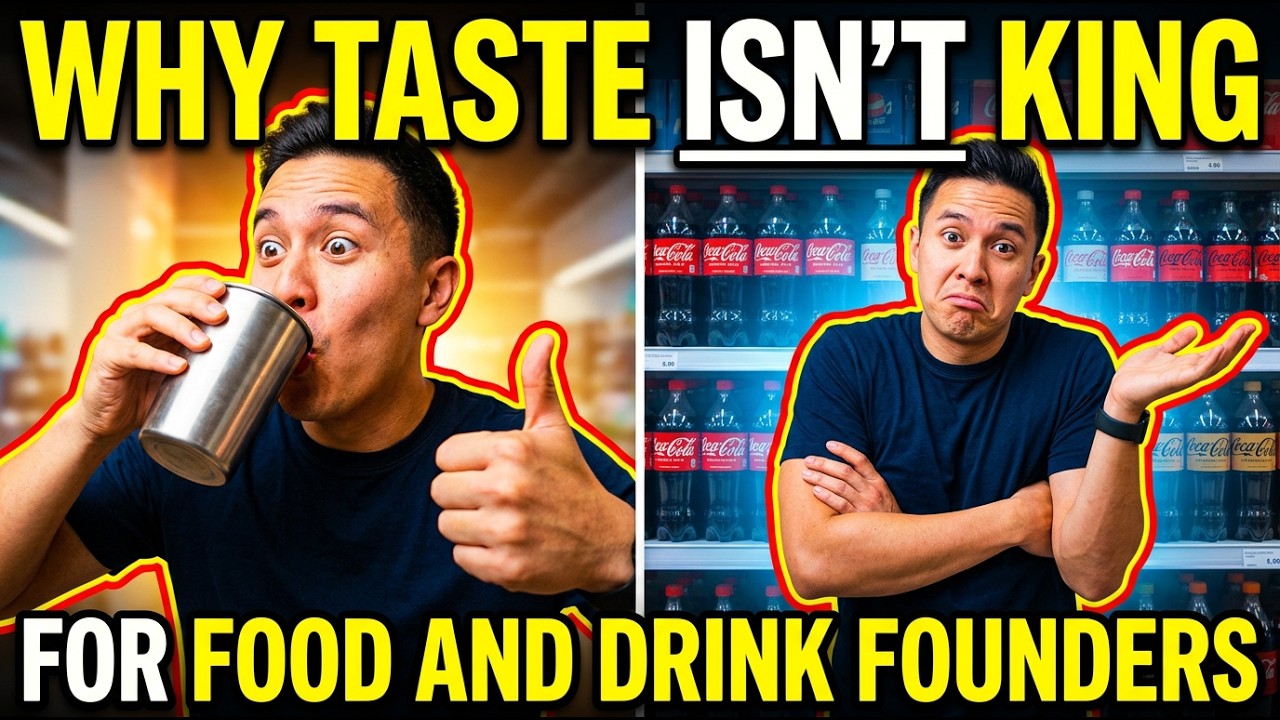
Chris Lukehurst argues that 95% of food buying decisions are emotional, not taste-driven. His Shape of Taste method traces consumers' earliest memories and maps sensory experience to uncover what actually moves people. Blind tests show own-label colas often beat famous brands when taste alone is tested.
Chapters
If you've ever assumed that make the product taste better should be your North Star, then this conversation is probably going to unsettle you a bit. That's not me being provocative. That's the considered and experienced view of my guest. But here's the proof that he points to. When own-label colas go head to head with the market leaders in a blind taste, people prefer them. So if it's not the taste that gets the sale, what is it? I'm talking to Chris Lukhurst, author of The Shape of Taste. A book about the psychology behind why we buy what we buy. Let's get into it. So welcome, Chris. Thanks for coming along for a chat.
Hi, Karen. Thanks very much for asking me.
I think the first thing to do is for you to introduce yourself. I know you've got this amazing book called The Shape of Taste and Why Consumers Buy with Emotion, but I have been looking at your LinkedIn profile actually, and you have an interesting life trajectory or career trajectory. So I'd really like to just start there and then we'll come on and talk about the book in a bit.
Fine. I, I'm kind of sitting here. What's so interesting about my career trajectory?
When I first came across you and I was really interested in the subject of, of, of food and taste, and I've kind of studied it myself, and then when I looked went back to have a look at you and I was like, well, okay, that's— and then you started as a marketing— well, I don't know where you started, but your LinkedIn starts as a marketing manager for Hush Puppies and then you're head of new product development for Barclays. And I was like, oh, that's a bit different.
So very food and drink related.
Was it?
Okay, tell me. I mean, I did 20 years on the client side as a marketeer. That was where I started. So like you say, I did. I actually started at Marks and Spencer, actually. That was a graduate trainee disaster for me. Disaster.
Was your degree in psychology?
No, my degree was in geography.
Now, now we're all interested. Geography to shape of taste. That's a trajectory.
And, and so, yes, so I was, like you've already said, marketing manager for Hush Puppies, head of new product development at Barclays Bank. Now, it was interestingly at Barclays Bank, I was introduced to a guy by the name of Thornton Mustard.
Right.
Real name. And he did all this research understanding consumer psychology.
Right.
And the reasons that people bought into stuff and how about how it made them feel and how in this case, the bank's behavior affected their behavior, the way we dealt with people. And I remember I actually went to a presentation by Thornton and my boss sent me along. And I said, look, he's talking, what he's talking about in the way of understanding psychology is fascinating, brilliant, would be great, but I don't believe he could do that. I don't believe he can deliver what he says he can deliver. Being Barclays Bank, he said, well, why don't we give it a go? So I was sent down to, to work with him and give it a go. What he delivered was brilliant. Absolutely brilliant. The understanding of how our behavior affects consumers and, and, and how we can position products and position things, talk about them in a way that becomes emotionally attractive to consumers.
Uh-huh.
Rather than just, right, because banking's all about rational, we think.
Yes. But then you think buying is rational as well. And the parallels, I'm gonna kind of bring it up a few times, I think, as we talk. But the parallels are quite similar because you assume that a retail buyer in a grocery store is gonna be going, what's your price? But actually they buy on emotion as well. So it's consumers and B2B is similar.
Well, in this conversation, it was gonna come up at some point, so I'll bring it up now. Kahneman, System 1, System 2 thinking. Kahneman himself said about 95%. Most commentators have heard somewhere around 95% of our decisions are System 1, emotional, instinctive decisions.
Yes. And I've seen that actually. And I use that number. I read it in Harvard Business Review about, again, business buyers, 95% of decisions are based on emotion. And it's one of my You know, if I'm doing a talk, I put that up first and go, and everyone goes, oh, I don't think so.
Because we're all such rational beings.
And they go, well, you know, we have a checklist and we, we, we analyze it. And I'm like, yeah. And you know what? You, you, you have an objective checklist and you subjectively judge against it.
Absolutely.
Yeah.
And so I'll quickly go back to why, how did I— I left Barclays Bank. And I joined the Meat and Livestock Commission where we were responsible for the marketing of all British meat. I joined just after foot and mouth disease.
Right.
Both while they're sitting watching this stuff, but also when they're in the shop and when they're writing their meal lists and when they're understanding what they're doing. So I worked with Thornton throughout foot and mouth disease. And in fact, you know, we were, we recovered the center of the play pretty quickly after that, partly because we kind of knew what people were thinking and we could work out the ways to communicate with them. So that was that. But at that point, Thornton said to me, oh, I'm retiring now. He said, I've had enough. You know, far more interesting than what I do. I just think what you do is great. So instead of retiring, he spent 3 years training me.
Oh wow.
Gosh. He was, he, he had a psychology background. Quite a fascinating background, but that's another story. And he spent 3 years training me in psychology and in how to understand psychology. His kind of start point had been that people, we talk about emotions for food and drink. So we all talk about, oh, this is relaxing, this is calming, this is— but no one really knows why does the product, why is your product relaxing, calming? Why is your product indulgent, whatever. It's kind of a black box, but he understood that black box. He said, I can, I get that and I can explain that to clients. And so that's what he spent 3 years training me doing. He retired, I set up the new version of the Marketing Clinic, 2005.
Okay.
Yes, you know, we, as we learn, we constantly have been moving that on, but it's really understanding because when we talk about Emotions in food and drink. We tend to talk about how the consumer feels at the end of the consumption. So it's relaxing, it's calming. But actually, the consumer has gone on an emotional journey to that point. So they didn't just bite it and then relax. They actually kind of— there was a sensorial journey that they went on, and everyone can describe that sensorial journey to me, or every manufacturer can say, yes, we It starts off, you know, crispy, and then it gets quite sweet, and then there's a bit of a sour note. And they can all describe—
Exactly the science bit.
And my question to them is always then, so what's the emotional journey? And they go, oh, it's relaxing. I say, no. What is the journey that they have gone through to get to that point?
Mhmm.
What is different about Coke or Pepsi or 7-Up. It's the journey that it takes you on to get to that endpoint that actually differentiates these products. And that's to do with taste, it's to do with texture, it's even to do with communications. But they all take you on an individual, quite unique journey. And it's that emotional DNA of products that I just find fascinating and work with consumers.
That is absolutely fascinating. And I've got about 20 different questions coming into my head. So I'm going to try and keep to some structure if I can. I'm going to come come back to something that's been bothering me for— in fact, I'm going to ask it now, actually. It's bothering me because we've had this debate over the years, probably for 10 years. I used to work for a sushi company, and then I went back to work at sushi, and we got into a debate with one of the product developers about whether you can have healthy indulgence.
Hmm.
And that's a question I'm, I'm really— you know, when you were talking about, you know, is a product indulgent, is it calming? Are the 2 things mutually exclusive?
No, they're not. I, I would argue they're absolutely not because, you know, that, and that comes down to if you start to say indulgence is about chocolate and about the taste and all of those things, then you, it starts to become quite difficult to combine them. But as soon as you start to concentrate on the emotion, so what is indulgence? It's that relaxing, calming, slowing me down, really kind of in the moment. How can we deliver that through the sensory journey of our product? I mean, a lot, a huge part of indulgence is melt. So you have a melt.
Which is your chocolate, obviously, which melts at body temperature.
Chocolate, fat, But, but you can also deliver that perhaps through— I mean, particularly when you talk about sushi, you know, through a fish.
Mm-hmm.
A raw fish can melt in the mouth, or, or it can give that impression, that feeling, that slow cooling of the mouth. How can we deliver that slow cooling and that slowing down? That's a really important part of indulgence, is slowing down. So how can we deliver that through healthy ingredients?
I mean, you're very visual, obviously.
Yeah, it's always— yeah, so we can draw— this is the emotional journey we want someone to go on. These are the sensory attributes that can deliver that emotional journey.
Okay.
And all of a sudden you go, oh, that's interesting. Coffee's quite indulgent, or can be.
I did see in your book you talk about coffee, and I think Yeah, it's, it's, it's a, it's an interesting piece what you're saying about the, the melt. For you, when you talk about the shape of taste, define for, for us what taste means to you to start with.
That's a really good question because when I talk about taste, I am talking about the sensory experience of consumption. Now, that's not necessarily what a scientist would be talking about taste, but that's what the consumer is talking about when they talk about taste.
Okay.
So it is a whole sensory experience. So that is, you know, the heat, the flavor, the aroma, the texture— incredibly important. And all of those things have to work together. You could even include The colour and the appearance, you know, it's that classic, if I give you a straw— a blue-coloured strawberry-flavoured sweet, you probably won't guess the flavour.
Yes. No, it's—
Because you'll have been misled by the colour.
And I'm the— which was a product developer from, I think she was from Tesco, and she stood up and she got us to try a red wine and a white wine and write the notes about each of them. And everyone wrote the notes. And then, of course, she said, well, they're both the same, we've just coloured the red one, and everybody had written different notes. like you say, it's that expectation. So a product has to have, deliver what you're expecting, otherwise it's incongruent.
I'll—
You can put it, correct me, it's fine.
It sets up your expectations.
Yes, it does. Yes.
And then, and I actually, if it doesn't deliver what you expect, we'll probably come back to that point because I think that's a really important point.
So how does a product take people on a journey? So you draw your journey, but talk me through, because part of me when I was looking at the book and I was reading it, and of course I come from the more commercial side and the marketing side, and I'm like, well, you know, you mentioned Coca-Cola. Coca-Cola, I mean, I've done quite a lot of development work. A long time ago on own label cola. And actually Coca-Cola is really hard to imitate because I spent a lot of time trying, in fact, not trying to imitate Coca-Cola, but the cola that M&S had because we were pitching for M&S's business. And I didn't realize, you know, I'd come from, from a food background where, you know, it's like, can we match this fish pie? And it's like, yeah, we can because you just put more cheese, the cheese and all the rest of it. Whereas cola is, is really, really complex. But if you blind taste, and I don't know if you remember when the blind tastes happened, Sainsbury's, it was Sainsbury's, the own label cola was launched into Sainsbury's and you did the blind taste and everyone went, oh, we prefer the own label cola, but nobody bought it.
Yeah.
So talk me through, because for me, that's kind of like the taste actually isn't that relevant. So are you saying the emotion is delivered by the branding or is it more complex?
But I wrote an article on LinkedIn just the other day basically saying taste is not king. Taste is not king. And read the comments, they're hilarious because, you know, what I actually got is lots of agencies coming in and saying, oh no, taste is really important. How can you say taste isn't king? Well, read the article, but taste is important. Clearly no one is going to eat or drink something that is just disgusting. Well, Red Bull might be an exception, which we can come back to.
Red Bull's an interesting topic.
But yeah, so taste, you know, yes, of course it's got to taste good, but to pick up on what you said earlier, it's got to deliver the consumer expectation.
Uh-huh.
Now, we're talking about that in the context of color. But we could also be talking about that in the context of marketing, in the context of situation, etc. So the consumer enters into the product with some expectations, whatever those expectations are. And, you know, now when we do the shape of taste, it generally, probably 80% of the time, we start with appearance of the product, and then aroma of the product, then first in mouth. But quite often, other times we'll start with appearance of the packaging.
Yes.
Feel of the packaging, opening of the packaging. What does it look like on the shelf? So it depends on where the client wants to start that experience, because what we're really looking at is the consumer experience of the product. And they'll enter that with some expectations, and then they will expect those expectations to be delivered. So if I'm expecting, if I'm expecting a high protein product, yeah, I've bought it because it says 25, 30 grams of protein on there, on the packaging.
Many things are saying at the moment.
It said that, so that's why I've bought it, because I want the protein. And then when I eat it, there needs to be something in that experience that tells me it's Got more protein in it. Now, I could give you two bars, one of which tastes fantastic, and another of which tastes a little bit dry. Now, you're in a taste test. You're going to say, "I'm going to buy the first one because that tastes so much better." If you bought it wanting extra protein, that dryness might be, and I'm not saying it is, but it might be the indicator to you. that says this has got more protein. And so that is the second one that has delivered your expectations.
So, so they're all, they're, they're not necessarily on a par, but they're, they're in the acceptable range. And what you're doing is you're saying it's, it's, it's how you, how people deliver expectations. And it's interesting you talk about a bar because I'm, I'm working with someone at the moment called Get Feasted and she's got a, it's 18 grams of protein, 9 grams of fiber, chocolate coated, tastes amazing. I haven't tried it yet, but I take her word for it. But then I'm kind of like, well, that's interesting because what you're saying is what's the cut? Because, you know, people buy Grenade and they buy all sorts of other products. But are they buying it because actually it tastes what Like what you expect that sort of bar to taste like. And therefore, if it does, you know, deliver all these, the protein and the fiber, is it actually delivering what I was expecting if it tastes like, like a lint ball?
That's right.
I'm not saying it does, but I mean, I'm just—
Yeah, it doesn't feel right. People don't buy the best product. They buy the one that makes them feel good.
Which is exactly what I was saying about Coca-Cola versus own label. Own label cola generally tastes better. Pepsi, as we know, because they've always done the taste tests, tastes better than Coke. Yeah.
The reason that Pepsi wins all the taste tests is because it's slightly sweeter. And if you taste a small amount of it, you know, just a sample, Pepsi tastes sweeter. It's also less carbonated or less aggressively carbonated.
A little bit more citrus as Well, I see.
A little bit more citrus. And so it tends to win on a small taste test.
Okay.
Whereas quite often if you do a full can, Coke might win.
That's interesting.
I mean, yeah, I'm a Pepsi fan. I work with Pepsi. I don't work with Coke. So, yeah. And that's why I think taste tests are fascinating. You know, how much did they eat? What was the context in which they ate it? What was the communication before they ate it? What were they expecting? And it's—
That's a really interesting point for those of us who've worked in the food industry a long time. And, you know, where I've presented, and I mean literally 30 ready meals on a Tuesday morning, and you've presented 30 ready meals. You can't eat 30 ready meals. So you take a mouthful, you spit it out, you go, yeah, that's, that's okay. That's not okay. But you don't actually sit there. And eat the whole thing. No.
And that's the other thing is, yeah, you said yourself you spit it out.
Yeah, no, because you haven't swallowed it, it hasn't gone to the back of the throat, you haven't got all the taste buds in there. I don't know whether retailers have changed that, but it does make it very difficult otherwise to do taste testing other than giving people 10 lasagnas to take home and say you need to eat one a day.
I remember turning up to a client, it was Ben Jerry's. The work was in Japan, so I had to fly into Japan. The first thing I had to do on the first day was taste 20 ice creams. That's tiring.
I think they, they say you should only taste 11 things.
You've lost it, dear. You're already really struggling by the time you get through that. I just needed to at least have tasted them so that as I go in and talk to consumers about them, I kind of knew what they were talking about. But, you know, it's, it's just impossible.
By the subject. But if we go back to your trajectory of taste, just so we start, it, it can start anywhere. I mean, it could almost start in your mind. So, you know, like when you're very hungry and, or you're very thirsty and anything appeals like a drink, a juicy fruit, a melon, something. Your brain goes, get me one of those, get me one of those. So it can start there or it can start, you've seen an advert or it can start in the shop. What, where, where do you put a pin in?
Well, we put the pin in where the client asked us to, to be quite frank. If they, you know, if they're looking at packaging development as well as product development, we need to start there. If they're looking at presentation in store, we probably need to start there. But the most important thing is appearance, aroma, and then the consumption experience, because they will then feed back into wherever you are starting.
Right.
And you also need to understand what are, what are the expectations as they come into that. So we need to get that context right and understand that. But once you really understand that shape of taste, you can see how that's starting to deliver. And because of the way we do it, and perhaps we might come back to that, but we are really analyzing the consumer's emotional response and we're cross-questioning, oh, that's interesting. Why? What? Why? How? And so you start to understand the whole context. They'll say, oh, it's disappointing. Oh, why is it disappointing? you know, you dig into why is it disappointing, all of a sudden you are, you're going all the way back to, well, my— they won't say this exactly, but their expectations were, and then it was this.
Right.
It becomes a loop. The whole thing becomes a loop. And once you start to understand that loop between expectations, product experience feeding back into expectations, that's when you really start to understand the whole shape of taste.
Right. So it is, it's quite circular. And what emotions are there?
Well, so many agencies that talk about emotions and I, I get given a piece of someone else's work before we go into a project just so that we can build on it, you know, et cetera. Yeah. Oh, that's interesting. They went into emotional research with a list of half a dozen emotions. Where did they come from?
Right.
They've, so they probably had a workshop or they've had a discussion. Oh, what emotions are important around this product? These are the emotions that are important. And then, and then they've classified anything that the consumer said into those half dozen emotions. And then they said, and so this is how your product is responding. You know, this is how people respond to your product emotionally. I mean, well, first of all, those predetermined emotions tend to be really quite high level. So, you know, I mean, it's easy when we start talking about calming, you know, refreshing. They're really high level. They're also category broad. You know, all sodas are refreshing.
Yes.
All chocolate is indulgent in some way or another.
Yes.
And, and so, so when you get that research and, and you get a lot of it, what you end up with is a load of everyone in the category is delivering products that are delivering a fairly narrow set of functional benefits.
Right.
So, but if you really understand the consumer's response, and it's not just about, oh, they were relaxed here, or they were a bit disappointed here. It's actually that whole journey because you could have a negative emotion followed by a positive emotion and the negative one then emphasizes the positive one. They actually, because they've moved through that, they've forgotten the negative one. The positive one has been emphasized and that's really important to them.
Okay.
And that journey, that's really interesting. And each product will have a different journey. And so yes, all sodas are refreshing, but Coke or Pepsi or whatever delivers that in a very specific way.
So you alluded to it a moment ago, but how do you extract this from people? So what's the process?
We start with what we call regression.
Okay. Is that like hypno— hypnotherapy?
It's not like hypnotherapy, but it is like psychoanalysis. It's not that deep, but that's where it comes from. So we start with, we're talking about sodas, doesn't matter. We'll start with, I'll start with the consumer and say, I want you to start talking to me about your earliest memories of what you had to drink as a child.
Okay. So you are regressing back.
Your very earliest memories.
So this is a one-to-one conversation?
Well, it is, but we actually do it in a group environment.
Okay.
So I have 5 people in a session and I'll start with one person and I say, I want you to start telling me about your very earliest memories. Now the chances are they'll start, well, I can remember, you know, when I was 6 or 7 drinking so-and-so. Hmm. Is that really your earliest memory? Well, I can't actually remember. I know I drank milk as a baby, but I don't remember that. No, of course you don't. But what do you remember, even if you can't remember what you were drinking when you first started school or before you started school, what did you remember about drinking? And there'll be some stuff they remember. And anyway, we have that conversation, we go, and we go from their very earliest memories, and we'll just track them through time. So early childhood, childhood, teenage years. And I'll talk to one person for about 5, 3 to 5 minutes. Then I'll say, brilliant, thank you very much. Next one, same question. Start your earliest memories. Now, this is what happens. The reason to do it in that environment is it's like when you get a group of friends, of old university friends together, you know, 20 years, 40 years since we were at university, you know. Oh, do you remember so-and-so?
Oh yes, yeah.
And this is what happens in the group because they're all cultural. They come in, they grew up in the same culture, you know, we've recruited them in the same city or whatever.
Yeah.
They won't be the same, but they'll be similar and they'll bounce off each other in that sense. So, and by the time I go back to the first person and say, brilliant, we got to the end of your teenage years, Let's go on. When did he, you know, university or leaving home or whatever? And they'll go, hang on a minute, can I just go back to so-and-so? Because so-and-so said this, and, and, and for me it was like this. That, and we'll get great stuff. Now, they won't remember exactly what, well, they won't remember the milk. They won't remember what Coke tasted to them when they—
I remember what milk tasted like as a, at school, 'cause I didn't like it.
They'll remem— what they'll really remember is how it made them feel.
Yes.
So you're catching, what you're actually catching is loads of emotional phrases, words and phrases.
Right.
All around the category that you're talking about. And they'll talk about, oh, this happened to me and this happened. And so after I've done that, we take them from their earliest memories all the way to adulthood. And that's interesting because we'll see how the category has evolved for them over that time. But most importantly, I'll catch all this emotional language.
Right.
And then I'll get them to taste some products. And again, I'll go around one at a time tasting different products and I'll get them to describe that process to me. If they're really, really good, they'll give you 4 words, one of which will be nice.
Okay.
And that's no good to anyone. But if you start, if you break it down, say, what does it look like? Describe how, what does it look like to you? What does it smell like? What's it like when you first bite into it? What's it like as you chew it? What's it like just before and as you swallow it? And also watch them because there are stages to consumption for every product.
Right.
The stages of consumption of a cup of coffee are very different to the stages of consumption of Häagen-Dazs ice cream. Which is different again to the stages of consumption to Ben and Jerry's.
Right. Yeah, no, that makes sense.
So observe what's going on and break it down by those stages and get that vocabulary. So we then, having done that, we only do 10 people, you know, 2 groups of 5 people.
2 groups of 5.
Probably enough because we'll collect huge amount of language. We'll then sit down and it'll be 2 of our psychologists will sit down And go through all of that and we'll create what we call a psychometric circle, which will be 50 to 70 emotional terms that consumers have used. And also we'll do probably about 120 words to describe from consumer words, describe the consumption experience. Now that's slightly different from a sensory expert's set of words because if a sensory expert says dry, they know exactly what they mean by dry. The consumer doesn't.
We've Brix measured it. We know what the sweetness is.
Yes. It's slightly different from that, but it looks a bit similar.
Okay.
So then we'll go into, that's kind of stage 2. Stage 3 is when we'll then sit with the consumer and we'll work through their experience. But what we'll now do is I'll give them the product. Let's assume we're just doing tasting. I'll give them the 120-odd words and say, read out to me which of these words for you seem right as you consume that product.
And will you give them the product in the packaging or do you just give them the product?
That depends on the project. It just depends on where we're coming from, where our start point is. Now, in terms of branded and non-branded, because brand makes a big difference, it will depend on the, again, that will depend on the product. But we, I like to start unbranded and then move into branded. So I've got a really good picture of it unbranded, and then we'll see how branded affects it. But, you know, if you're doing chocolate, you put a lump of Cadbury or something, you know, you can't do that unbranded.
Oh, it's not recognizable.
Because you've changed the shape.
Yes.
Shape's really important.
Yes.
No, no, the shape.
Yeah. I mean, I've studied chocolate, and I know that the shape makes a difference to the way it melts and It makes a difference to the way it feels in the mouth.
It makes a difference to the way that you eat it.
So, 2 people, will 2 people experience a product differently? So if 2 people are eating Cadbury's, for example, maybe would they, I mean, I don't really like Cadbury's. It's too sweet for me. It's too sickly. So therefore, does that mean I experience it differently to my friend who loves Cadbury's?
Interestingly, if I give someone a product that they don't like, I'll probably get much better, clearer responses.
Okay.
Because it's much easier to articulate what you don't like about something than it is to—
Because you're going, it's nice.
Right.
Yeah, super.
Cadbury's always is.
That's how it should be.
Exactly. Now, what would— well, I give them those 120 words to taste it. We then, after we've gone around and got them all to taste the product and I've got their responses to that, I then give them the emotional circle and say, pick out from here all the emotions that feel relevant for the product you've just eaten. And they'll pick them out. They'll pick out a dozen, maybe 2 dozen. We'll then cross-question them in quite some detail about those ones that they picked out and they'll talk about that. And I'll say, that's interesting. And at what part of the consumption experience did you start to feel that? And they go, what? I'll say, well, was it on the appearance, the aroma, the first bite, the chew? Have another bite, think about it, and then have another bite. And they'll go, it's as I chew it, then I start to— it's so-and-so happens, and that makes me think of so-and-so and so. And you, you get it, and it's great, you know, it's lovely when you start going into this. Now, but I've also got what they said originally on that 120 words. So now they're justifying how it made them respond. So they'll give me a slightly different response to what prompted it. Now that's interesting and it's not, it's not wrong, but I can also compare it to what they said originally.
Okay.
So what we're doing in these groups, because we did the regression work, we start to understand why they're responding like that. Because they talked about, oh, when they were 5 or when they first found this, and all of a sudden we're starting to make those connections.
Okay.
So, and that's where we start to really understand, oh, that's interesting. When the sensorial experience goes from there to there, this is the way most people respond emotionally to that, and this is why.
Okay. So how do you convert that then into which means Cadbury's, you need to do this?
So we do that for half a dozen products. So whether that be different examples, you know, different production samples or whether that be competitive samples, you know, or a mix, probably a mix. Having done that, we'll start to get a very clear picture of what the ideal emotional journey would be. for the product that we're looking to develop or where we're going with this, right? This would be the ideal emotional journey, and this is how you can deliver that ideal emotional journey. And also, this is why this ideal emotional journey is important and how it will positively differentiate you from your competition.
Okay, so you can convert that research into Whatever the product brief would be.
Yes.
I've come across recently, and I'm sure you have as well, I won't mention them, one of the companies, the research companies, the big research companies who get the EPOS data and do the panels, and they say, well, we can now research your product using AI. So we can create an AI person. for your target audience and we can show AI the product and it will give the response. Yeah. Can your methodology use AI or not? It doesn't sound like it.
No, not at the moment. Who knows where AI is going and I'm no AI expert. But the thing with AI, of course, is it only is drawing on that whole body of human knowledge or rather what it can find in the internet, what it's been fed. So it's always drawing on the past. It's not drawing on what's happening now or where we're going. It's making assumptions as to that. Of course, someone has programmed those assumptions in. And so I think it's brilliant for background research, but if you really want to move forward, you need to really understand where we are now. It's AI. It's all too logical. In that sense, it's not really understanding what is it about this that's driving, what are the real details here. It's not getting to the bottom of that.
So it's going back to that, you know, when we were saying 95% emotion, 5% logic. AI is more in the 5% logic camp and saying, well, you know, you've done your research and our research shows that this is the shape for a soda, therefore this is the shape for the soda. And this is how, and therefore if you're targeting that one, they have that shape and therefore this is what you should be developing. But what you are saying is it's more subtle.
Even where AI is supposedly talking about emotions, it's dealing with those emotions in a very logical way.
Yes.
It's a bit like they're saying it'll, great, it'll get you so far. It'll also get all of your competitors to the same point because they're all working on the same information.
Right.
If you wanna break out of that, then you need to do some real research.
So if we, we've talked a lot about how consumers consume, is your work applicable to the retail buyer? So the person who's buying the product, or is your research, is it more present like one would present category data? Is it you present the data to say, look, this is why these products will be successful? Or does, how do you take the buyer, commercial buyer, onto an emotional journey as well?
Our research is consumer targeted. How is that relevant to the buyer? I think it's about, you know, we said earlier, buyers like to believe that they're very logical. They've got their checklist so that they know what they're doing. It will probably, this is about trying to take the buyer that next step on and saying, actually, this is why our product is differentiated.
Yeah.
From the other ones that you've also got on the shelf. This is why it's different and we can show you. So you start to show the shape of taste and you start to show the emotional journey behind it. And maybe you get the buyer to taste the product and talk through that shape of taste. If they understand that, I mean, if they kind of buy into that argument, it's a really strong one. By which they start to understand why you, what is the unique DNA of this product? Why is it different to everything else that's on offer?
So when I help people pitch, we obviously look at each retailer differently and they have a different customer profile. So when you're saying this is the DNA of the product, does it vary whether it's a Waitrose shopper, a Tesco shopper, or a Sainsbury's shopper, or are they not that Obviously, I would argue that they're not that obviously different. Okay, that's interesting.
Now, there's gonna be some examples where you can say, well, actually, that's, you know, there's a big difference between a Waitrose and a Sainsbury's buyer here and here. But in most cases, when it comes to what they're looking for, because they're culturally coming from the same place, and so the emotion, their emotional response to a lot of the products will be very similar. Now, you know, you could arguably, you know, let's go down the, the Sainsbury's route. We'll work with Sainsbury's consumers, we'll compare them. We can find a difference if you want us to find it. But I suspect it won't really be that significant. At the end of the day, Coke sells across all of the retailers perfectly well.
Own label. So if you are developing own label products and you're thinking about recipe, product delivery, price comes into it, is a fish pie which has stayed, stayed with me for many years selling fish pie, is that fish pie that I'm selling, how do you then differentiate Between an Asda fish pie and a Sainsbury's fish pie. And then actually within Tesco's, and this has been a very interesting debate, especially for sushi, actually. How do you say, here's a finest sushi, here's a standard sushi, and we don't have, we don't have basic sushi. We don't do that.
So what is it when the consumer tastes the finest sushi? What is it in that experience that confirms to them that this is a better sushi than the standard? There's something in that eat. Now, you know, you could argue, oh, it's got better quality ingredients, it's got this, it's got more of this, it's got— there's something in the eat. It's like probably the reverse, but it's like the dryness in the protein.
Yeah.
Something in the eat that prompts them to believe that this is better. Believe is really important here because it's not, doesn't have to be better, but the consumer has to believe that it's better.
But if the only difference, for example, is a, is a, I don't know, I'm trying to think of an example. The salmon is Scottish, salmon is Scottish, and then another one isn't Scottish. You're actually, you're not gonna taste A lot.
So why would the consumer buy it then? Why would the consumer spend more on it if it's not any different?
This is a genuine debate that I've had in terms of, is there a place for, for a premium sushi within sushi? Because it's, and that's partly why I'm asking the question, how do you add value to something that's already perceived as, as, as value anyway?
How do you add value to chocolate? You know, that we're getting more and more premium with chocolate. And, and, and at the end of the day, you can go too far because it can become too sweet, too sickly, or— but, but actually what you start to do is introduce bitter notes to make it more premium. The logic doesn't quite hold, but the emotion absolutely does.
For me, for chocolate, the difference is If you're buying a mass market brand, and I do have Lindt in there as a mass market brand, it's using a broad brush of beans and they, they normalize the flavor, balance them out a bit like tea tasting, and then they'll balance it out again with vanilla or vanillin and sugar and milk. Whereas if you go to a more expensive bar, you're buying Often a craft chocolate. So you are getting lots more notes within the chocolate. So it's not just a, a one hit. And that's, that's where my training has come in on chocolate, that, that the, you are getting more complexity. So that's where I think the premiumness is.
You've just described that from a, a someone that really knows about taste and you understand the different notes and that you are getting, et cetera. And, and you're right. From the consumer point of view, they wouldn't be able to describe it as well as you've described it.
But— I couldn't until I was trained.
Exactly.
I've been through training for that.
Exactly. But they will notice that there's something about that craft chocolate that's more, more complex, that's, that's got something else going on, and they recognize that as being more quality. Be the same with sushi. If we understand what the consumer is looking for, we could introduce that. I'm gonna use the word complexity. I don't know what it would be. It might be complexity, it might be, you know, texture, it might be something, you know, but we can introduce that complexity and make it feel more premium.
What's your favorite ta-da where you've done the research, the products have gone out, and it's, and it's flown?
Well, yeah, that's an interesting, because I, I, there's lots of great products out there that—
Aren't you gonna choose one of your babies?
You must choose one. The one that had the biggest impact on me and that I always remember was Nescafé.
Okay.
And it was Nescafé in the Philippines. Now, Philippines is 7,000 islands. You know, we divided it into 5 regions. They were suffering. They had in some regions, they had competitors that were coming in with a much stronger coffee, a much sharper, harder taste. And in other regions, they were losing to a much gentler, easier coffee. For their own production reasons, they had to have the same recipe across the archipelago.
Yeah.
So the brief to us was, how do we, how do we manage this? We know how to take that one on, we know how to take that one on, but how do we manage the whole thing? So we actually came up with a shape of taste that was going to deliver what each of those markets wanted.
Wow.
So it was gonna deliver the strong and it was gonna deliver the calm and relax.
Wow.
So this was what we did in the Philippines. Of course, the development work was being done in Germany. They came back and they said, oh yeah, well, we don't really believe that. So we will test what you've done, but we are also gonna put this one in because we think we'll do better with this. So they went out and tested it and they decided to launch an R1, not only one, It won in every region and it beat the existing recipe, it beat all of the competition and it beat their new recipe.
Incredible actually, where you've got, like you say, you've got cultural variations and you've managed to meet both of those.
Yeah, and that's why I love it. I mean, we've done a huge amount of work with Nescafé since, you know, kind of from that.
Yeah, no, I can imagine. But we need to wrap it up. You've obviously got the book which we've sort of talked around, I suppose. But if someone was going to go and read the book, what's the one thing you'd want them to take away that's key?
I think when I talk about taste, of course, I'm talking about the whole consumer experience. But taste is an emotional experience. It's not just a sensorial one.
Yes. And I think, I think we've, we've really understood from your, from your finger waving that it isn't just Like you say, it's not, it's not what I learned taste to be when I've been through wine. I've done wine and chocolate tasting. And you do think about that. It's more like, I mean, I work with Quality Food Awards. It is more like the 10 criteria that we work with, but even then it's, it's more complex than that. So it's, it's, it's absolutely fascinating. So where can people find you? Where's the book? Where are you? How can people connect?
The book, it's on Amazon. It's, it's available through any, I'm not going to kid myself. It's probably not stocked by all the booksellers, but they can all get it. So you can ask for it in any bookseller. But it's sitting on Amazon. It's immediately there.
Put it in the show notes, obviously.
Well, I'm based in Leamington Spa in the UK, but I'm on LinkedIn. That's the best way to find me. Chris Lukhurst on LinkedIn.
Thank you so much. I've really enjoyed it. We'll put all the details in the show notes. And yeah, thank you very much. I've really had a really fascinating time talking to you.
It's been wonderful. Thank you very much, Karen.
More from karen


Why Selfridges Said Yes | Megan Tan on Supermarket Listings & Retail Strategy