Why Do I Keep Going Back to Someone Who Hurts Me? | Dr. Karol Darsa
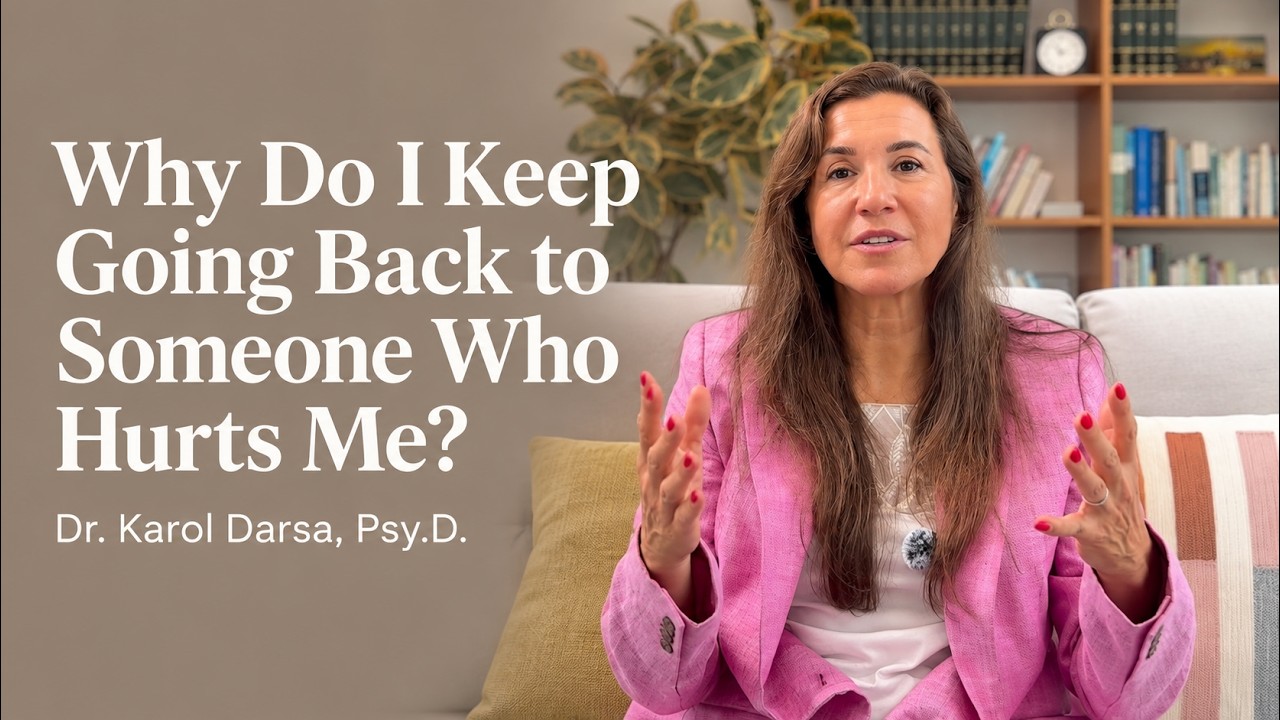
In this psycho‑educational YouTube talk, Dr. Karol Darsa explains why people repeatedly return to relationships that cause them pain. He frames the issue as an internal conflict between the rational “mind” and the emotional “heart,” describing how self‑abandonment and disconnection from one’s own thoughts, body, and feelings can keep a person stuck. Using two anonymized client case studies—Rodney, who oscillates between distrust and longing, and Colleen, whose love‑addiction masks unresolved childhood grief—Dr. Darsa illustrates how fantasies, love‑addiction, and emotional avoidance function as coping mechanisms that obscure underlying needs. He introduces a practical writing exercise that gives voice to the mind and heart, helping clients externalize the dialogue, recognize self‑neglect, and shift attention back to self‑care. The talk emphasizes the importance of acknowledging all emotions without judgment, challenging negative self‑talk, and rebuilding the primary relationship with oneself. Finally, Dr. Darsa offers concrete steps for recovery: seeking therapy, connecting with supportive community, re‑engaging in valued activities, and using resources such as his books “The Trauma Map” and “The Trauma Bridge” and his Reconnect Integrative Trauma Treatment Center.
Chapters
You know this person has hurt you. You remember why you left. So why do you still want to go back? Hi, I'm Dr. Karol Darsa. I'm a psychologist, author, and the founder of Reconnect Integrative Trauma Treatment Center. Today I'm going to talk to you about why you may feel pulled back towards someone who hurts you, even when part of you knows how how painful the relationship has been. We'll look at the conflict between your mind and your heart and how you can lose connection with yourself while trying to hold on to someone else, and how to begin reconnecting with your own feelings and needs. That conflict can, can be a very painful one. One part of you remembers the betrayal, the disappointment, and how much the relationship was costing you, and another part remembers the closeness, and you miss the person you could laugh with. You miss having someone there. You may still love them. Then on top of everything else, you judge yourself. You ask, how can I possibly be going back to that person? I know what happened already, right? Those are the typical judgments. So I want to help you understand this conflict so that way you can begin reconnecting with yourself. And when you're so focused on another person, you may not really realize how disconnected you have become from your mind, from your body, and from your feelings. Becoming aware of that disconnection is a first step towards making that change. There's not really a single reason why people stay in, in these relationships or why did they even return, but there may be some practical barriers like children, financial dependence, fear of being alone, or pressure from the other person. So I'm going to today focus on emotional conflict. I describe that in my book, Trauma Map. Understanding that conflict doesn't make you responsible for another person's harmful behavior, however, so that's an important part. In the book, I talk about a client, let's call him Rodney. He had an on-and-off relationship with his girlfriend. The girlfriend had been unfaithful. Although they separated, he had a history of returning, hoping of course that each time the things would be different. He was constantly arguing with himself about the relationship, right? Inside, he could recognize the reason why he didn't trust her, but he also felt love and enjoyed their time together and didn't want to be alone. So I encouraged him to do a writing exercise instead of thinking about it over and over. So we called these 2 voices mind and heart. So he gave it a voice. His mind asked in, in the writings, Do you honestly think you can trust her now? And his heart said, I need her. I enjoy my time with her. He didn't like really being alone. They enjoyed the same thing and he believed she really loved him. He also explained her behavior by saying that she was just insecure and was working on herself in therapy. So he had these 2 opposing feelings about the same relationship. One part recognized the hurt and the other part really wanted the connection. Writing this dialogue helped him hear the conflict instead of continuing to argue with himself inside of his head. Knowing a relationship is hurting you doesn't automatically remove the feelings that you keep connected to it. You could still feel affection, grief, anger, and longing all towards the same person. That can be very confusing, upsetting, especially if you believe that recognizing the hurt should make the love disappear and you should move on. So you also could misinterpret missing someone as a reason why you should return, right? Missing them tells you, oh, the connection really is important, but it doesn't really answer whether the relationship can offer the trust and the care that you need. This is why it helps to slow down and distinguish a feeling from a decision. You can acknowledge that you miss someone while also remembering what it is like being in a relationship with them. You can feel lonely and give that loneliness attention without immediately deciding that returning is the only way to address it. That's kind of just to get rid of that pain, actually. So if you attack yourself for having these feelings, you add shame to an already painful situation and makes it worse. Then you may become more focused on trying to stop the feelings rather than understanding what they're telling you, and it can become even more complicated. We need to feel our feelings without judging them. It's not good or bad. You can feel love and sadness at the same time. You can feel you love them and hate them at the same time. You can be angry at them, understand them, and wanting to push them away. So when Rodney did this writing exercise, the second part had something important to say. As his mind and heart continued the conversation, the attention began to shift from the girlfriend's behavior to what was happening inside of him. Actually, at one point his mind said to his heart, you're so focused on her and so worried about her behavior, what she's doing, that you don't even realize how much you abandoned me. And he described not making time to meditate even though he knew it helped him. He was so focused on the detail of her cheating, where is she, what she's doing, he couldn't concentrate on his work. And of course this was very draining for him. He was thinking so much about how she felt that he wasn't even asking how he was feeling, right? And that's the disconnection I want you to notice. You can spend so much time worrying about the relationship that you stop recognizing what's happening to you. You can become occupied with another person's feeling that you don't even recognize yours. You stop asking about yourself. That's a self-abandonment. You think about Why that person behave this way? Why they're upset and obsessing? What can I say to make things better? And you can explain even their childhood, their insecurities, and all of that. But in the meantime, your own experience really becomes secondary. Next thing you know, you're exhausted, you're hurt, you want them to understand you, but you're anxious and you tell yourself, okay, okay, I'm gonna feel better once they reassure me. In The Trauma Map, my first book, I talk about how easily we can abandon ourselves while worrying about another person who loves us, right? Whether they love us or not, actually. We could be physically present in the relationship but really increasingly disconnected from our thoughts, our bodies, and our feelings. Of course, understanding another person is valuable, but that understanding needs to include the impact that their behavior has on you, and their pain does not make your pain less important. You could actually understand the other person very well, but how are you treating yourself in the meantime? Are you paying attention to your feelings? Are you making time for the things that help you feel good and grounded? Or has your attention become so focused on the other person that you don't even listen to yourself anymore? The most important relationship, as cliché as it sounds, is to honor the one with yourself. Reconnecting means bringing your attention back to your own thoughts, feelings, and to your well-being. So for my client Rodney, writing helped bring that experience into much more focus. He talked about the relationship before, and this dialogue gave him a different way to hear his own feelings. As he became more aware of how he was treating himself within the relationship, he decided to make a change. He He already talked about the relationship with his friends and with his therapist, but talking about it is different than writing. It gives you a different kind of access to your feelings. So he really became aware of what he was doing to himself. Another way we can also disconnect from our feelings sometimes is just through fantasy. Well, in childhood, fantasy is a way that helps us to get away from painful feelings, but as adults, if we continue imagining that, then we can really create more problems. So sometimes you're holding on to the person and to the life that you hope you will have finally with them, like the fantasy of it, right? I'm gonna have a family, I'm gonna be understood, I'm chosen and I belong somewhere. And of course those wishes are very important, and when they're connected to the needs that have gone unmet for a long time, it can be especially difficult to separate what you hope for from what's really happening now. In the trauma map, I describe another client. Let's call her Colleen. She experienced an abusive childhood and an abusive marriage. So after her divorce, she became intensely hopeful about another man she met. She just met him for coffee once or twice. She believed he could be the person she's been waiting for. So that excitement took up so much of her attention that she had difficulty sleeping, couldn't concentrate on her work. On her work. So of course, as we talked about her history, her longing for love was definitely connected to the grief about her childhood and of course the loss of her first marriage. For Colleen, the feeling of being in love was just a way to avoid past grief. She was trying to really feel the emptiness that she felt as a young person. She wanted to reconnect to her heart, but she She know how to do that. This is when we call this love addiction. It's like a compulsive search for the feeling of being in love. It's not really a label for everyone who misses someone or has difficulty ending a relationship, but what mattered in Colling's work was to understand the function that the pursuit of love had in her life. And this is what I mean by emotional avoidance. Sometimes the excitement about a relationship takes our attention away from really. Feelings we have not been able to deal with. So in this example with Colin, understanding the grief underneath that excitement was really, really important for her to break the pattern. Our feelings provide very important information about ourselves. Sadness could tell us that maybe we need to do something else, we need to take care of ourselves, maybe we need comfort. So if you keep getting away from a sadness, you really miss an opportunity to understand what you're really needing. So that kind of honesty may bring sadness. You may be grieving the person, the shared experiences, and the future you imagined. The grief can be very significant even when there were clear reasons that the relationship was painful. So this is one reason a decision about a relationship may not bring immediate emotional relief, but understanding that something was hurting you does not erase everything you wanted from it. You can't simply just get rid of feelings by deciding, I'm not going to have them, right? Avoiding feelings takes effort and it can leave you with less energy for other parts. We need to reconnect with those feelings gently without overwhelming ourselves and of course without judging ourselves for being hurt. You may hear yourself saying you were stupid or you should have known better. Those are very common judgments. I want to ask you to write those down and see if you would say those to a friend who was hurt, who were hurting. Would you let someone else to speak to you this way, the way that you're speaking to yourself? So to reconnect to your mind, it's very important to notice your self-talk and challenge that negative self-talk because you deserve support. Even you're trying to make sense of this relationship, you don't have to present like a perfectly clear explanation of why you stayed in this relationship and why you returned to someone who wasn't really nice to you. But to support yourself is especially important if the relationship includes threats, control, or violence. Reflection alone doesn't address this circumstance, of course. A person like a therapist can really understand you if you're in an abusive relationship and help you to get out of it safely. You don't need to really confront the person or make sudden change to prove yourself that You are strong. For the emotional conflict that we've been discussing, one place to begin is to read the internal dialogue that I use with Rodney, writing it for both parts. If this is manageable and you have a private place to write, just give a voice to each side of the conflict and begin with the part that wants to return maybe. Let that part describe what it's missing, what it's hoping, why it wants to return, and give that part that feels hurt a chance to respond. So have them have a good dialogue without judging each other, and eventually you'll have a really good understanding. So at first, what you really write may resemble a conversation between your mind and your heart. Let each side respond. Notice where you feel judged, where you're afraid, what you have difficulty accepting. The purpose for this kind of writing is to become more aware of your feelings and the conflict inside of you by giving it a voice. If it's too much though while you're writing, please stop for a second and do something that helps you feel good, connected, and then either bring this work into therapy or then do it another day. As you listen and pay attention to whether the conversation keeps returning to the other person's intention, It may be familiar to explain what they meant or why they did something. Try also to describe why, what you experienced and how it affected you. And this is part of rebuilding the relationship with yourself, the most important relationship. You are learning to include your feelings in, in the relationship rather than dismissing them, putting them under the rug, and hopefully you will understand more what's happening for you. This process needs support outside of the relationship. In the trauma map, I talk about finding your community, identifying resources, finding trusted people, and of course doing activities that make you feel good. When one relationship occupies most of your emotional life, it may take time really to reconnect with other source because your energy is drained. So start with Someone that you trust first, an activity maybe you didn't do for a long time, start doing that, or of course seek a therapist, seek a professional, a place where you wouldn't be judged. You definitely need to surround yourself with people that make you feel comfortable. You can also return to activities that help you feel connected. Could be sports, could be art. This way your attention is less focused on that other person. You could still miss this person, You may still have moments of wanting to return, and those moments, see them as opportunities to notice what's happening inside of you, what support you need, rather than evidence that's it, I failed, or I have to go back. When you notice yourself becoming preoccupied whether they love you or they— what do they— what will they do next, just bring your attention back to the present moment and to the activities that you like to do. Notice how it feels How it feels now, how in your body. See if you can manage it this way. Learn to listen to yourself again. Your need for love is understandable, like any other human being. Your need for trust and safety matters too. So you deserve relationships where there's room for your feelings and where caring for another person doesn't require you continually abandoning yourself or dismissing yourself. Healing can help you recognize these patterns with much more compassion and make choices with a clearer connection to yourself. You don't have to figure it out all alone. Ask for support. To learn more about my books, The Trauma Map and The Trauma Bridge, and about my treatment center Reconnect, I invite you to visit karoldarsa.com. You can have a loving life and build a more caring relationship with yourself. Remember, healing takes Time commitment, and you're worthy of that time and that attention. You deserve to feel connected to yourself and to the people in your life.
More from Dr.
Betrayal Trauma: They Cheated, So Why Are You Falling Apart? | Dr. Karol Darsa




58 - HOW DOES TRAUMA AFFECT CHILDREN - IT MIGHT BE MORE THAN YOU THINK - HOW TO SEE SIGNS
57 - GAMING ADDICTION AMONG ADOLESCENTS - WHAT ARE THE SIGNS AND HOW TO DEAL WITH IT AS A PARENT?