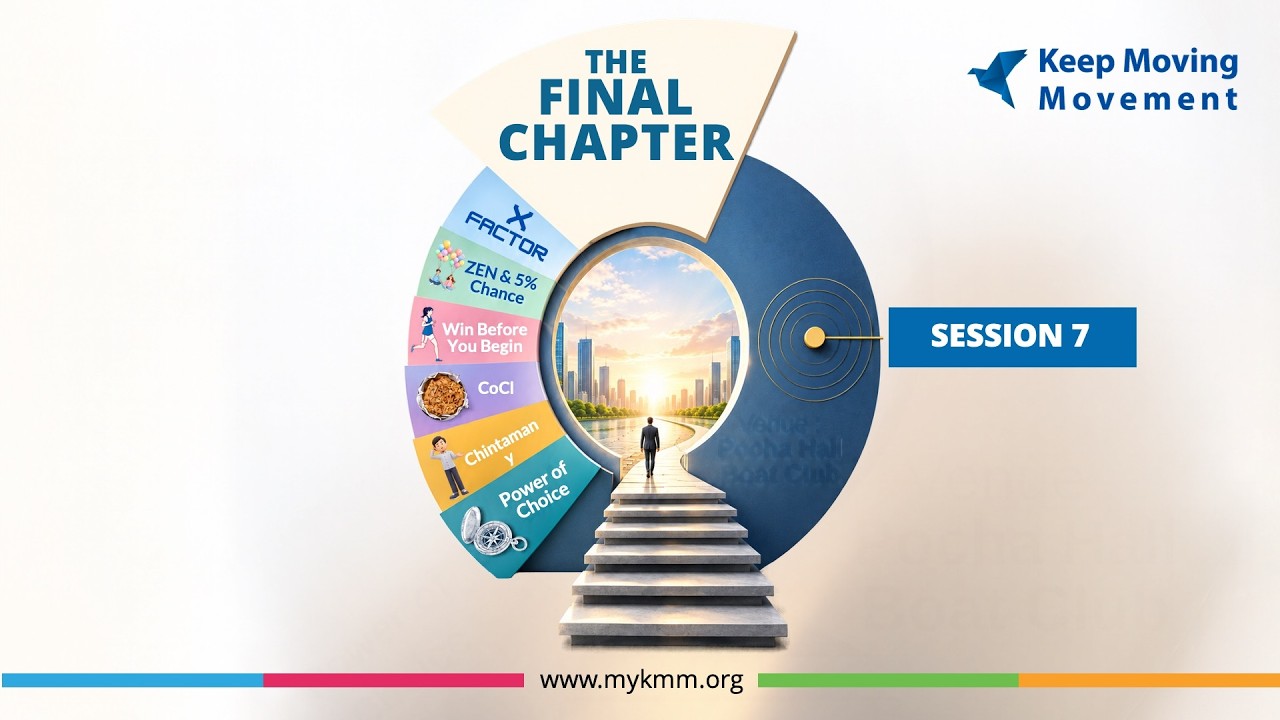
KMM 2026 Session 2 - #CHINTAMANY | Naren | Life School |

Naren leads a KMM Life School session on managing anxiety through the Chintamany framework. Volunteers learn the Shoulder Test (does it lighten burdens?) and Companion Test (are you a non-judging presence?), then practice box breathing and single-point focus to calm worry. The core idea: ambition starts the journey, but responsibility sustains it.
Chapters
Happy morning!
Happy morning, sir! Happy morning! Happy morning!
Happy morning!
Happy morning! Happy morning!
Happy morning! Now, I have been traveling quite a bit in the last 2 weeks, and, uh, I was in Rajasthan last Sunday, and I saw that it is so hot. The moment I step outside my AC room, I start sweating. And I realize how blessed we are when we stay in a place like Pune, and of course places like Hyderabad, Bangalore. But the climate is so cooperative. Um, we were— we should be very, very grateful. We should be very grateful for we have something like Keep Moving Movement in our lives. A few weeks ago, I was sharing in, uh, one of the life lessons about Kabir. And Kabir is definitely one of the most, most, most favorite characters out of the entirety of history. Kabir very beautifully says, and this is also there in Guru Granth Sahib, in Ang 1366, uh, shloka 38, about ego. And I think what he writes over there about ego is so profound. Kabira garb na kijiye, uchha dek aavaas, kaal pare bhui letna, I think that's just like Kabir. What he says is, do not be proud. Do not be proud of your achievements. Do not be proud of your tall mansions, because today or tomorrow we will lie beneath the ground and the smallest of grass will grow above us. You know, that's just like Kabir. The image is so stark, it skips moral lecture and goes straight to the point that don't get ego involved. Why am I mentioning this? You know, as you learn certain insights in some sessions And as we go to schools, it is very easy to get ego involved with the teachers, with some of the speakers, and definitely with some children inside the classroom. I'll tell you one approach that I take which helps me to stay on the ground. There is an Ivy League school called the Kellogg School of Management, and the theme, the credo of Kellogg School of Management is low ego, high impact. Essentially what they say is your ego and your impact will always be inversely proportional to each other. If my ego is high, then my positive impact is low. When my ego is low, my positive impact is high. And I believe that is exactly what Kabir was also saying on ego. And Kellogg School of Management, the Ivy League management school in the school— in the world, is also telling all its students, just because you have come to Kellogg's, don't get ego involved. Don't think you're the best in the world, you're better than others, others have not got through to a great college. If you have come here, come here to learn how to make an impact. And the beginning of making an impact is always low ego. High ego will always lead to low impact. I was discussing this with, uh, somebody day before yesterday, and they said, Naren, if you have to speak about the philosophy of Keep Moving Movement, what would be the philosophy? Uh, would it be, uh, we are doing social work? Would it be that children are off track and your job is to bring them back on track? Would it be it's a community of people who want to lift the nation, what would be the philosophy? And spontaneously, what I said, I also liked after I said it. I said, we don't have a philosophy, but we have a few tests. The way the Litmus paper does not have a philosophy, it has just— its work is to test. Similarly, we have a couple of tests. And every speaker, every AC, every leader of Keep Moving Movement aspires to pass these two tests. Those who are able to pass these two tests well— and Joe will be able to, you know, always be a role model in these things— those who aspire to pass these two tests will always be great volunteers. And those who fail these two tests, they may be a part of Keep Moving Movement, but they are not great volunteers. So when you look at Joe, you will realize that test number one is called shoulder test. What is a shoulder test? I enter inside a classroom. I have some ideas in my mind. I think about the effort that I have put to create the session. I also think about the effort I have taken to come to deliver this session. I think about the sacrifices I have made to prepare for the session. And I enter the classroom wanting to be seen as a hero, and that is when I want to make statements which I think will be so powerful that they will see me and remember me. So that is one approach. The other approach is Everybody is carrying some burden on their shoulders. Some have people who have unrealistic expectations from them. Some are not as gifted as somebody else is, and they are always a victim of comparison. Some are in broken families or families where there is a lot of struggle. Some have low self-esteem. Some work very hard, but they are not able to grasp. Some have a crisis of identity, and therefore they might disturb a class a little, because when they disturb, people look at them. And when people look at them, they become the center of attraction, and that becomes their identity. To sum it, everybody is carrying some kind of a burden on their shoulders. And now let me stop about the children and let me talk about you. All of us are carrying some burden on our shoulders. KMM is successful. If at the end of the session you feel some lightness on your shoulders, you delivered a session brilliantly well. When at the end of the session children inside the classroom feel some burden has been taken off from their shoulders, we call this as the shoulder test. At the end of the class, it is not about what kind of a hero we were. It is not about did you remember all the points. It is not about did you speak fluently. It is not about the efforts you took to take the session. The test of the session is very simple. Some, many, or all should have felt that the burden on their shoulders is a little less. So if some of them were struggling to make a choice in their life, and if the choice that they were making was more to please someone rather than to choose progress And the way you delivered the session, they realized that I will make some progressive choices, some bold choices. I will do what is right irrespective of what happens. Now you've lifted some burden off their shoulders. The burden and need to please someone, a burden to belong, a burden to feel that others approve of them. If they felt that then the session was successful. If they felt that you are great, you speak beautifully well, but at the end of the session they feel the same burden on their shoulder, then we could have taken the session much better. So in KMM, we call it as the shoulder test. At the completion of the session, would some, would most, or would in a miracle session, would all of them feel a little less burden on their shoulders? The second test is called the Companion Test. Would they believe here is one person in the world who will not judge us, who will understand us? Is this person who's standing there, who looks like a didi or a dada or an uncle or an aunt or a granny or a grandfather, is this somebody who gets me? And in a very gentle way, they are nudging me in a direction. And if my neck is stiff and I'm taking some time, they are patient. They don't want things to happen at their speed. They understand my struggles. They're not giving me sympathy, but they are saying there is a better way to live life. And when they look at me, I see somebody who believes in me. You know, a companion is a person with whom you enjoy a journey. A companion is a person who does not judge you. A companion is a person in whose presence you feel strong. A companion is a person in whose presence you never ever feel alone. So the second test for every speaker in KMM is, as you take the sessions, as you go deeper and deeper from session 1 to 2 to 3, are their shoulders getting lighter and lighter? And is their heart and mind believing, here is one person who understands, one person I can depend on? And this institution where they come from, Keep Moving Movement, is a place I would like to be in my future. So when I was discussing with this lady what is the philosophy of KMM, these two tests emerged: the shoulder test and a companion test. So the philosophy of KMM, if you have to take it at a deeper level, is not just about making a difference. It is not about teaching life skills. That is the process. It is not about thoughtful sessions. Again, that's a content process. End result ke Ultimately, how do you and me know that you and me did a good job? So only two tests: shoulder test and companion test. And that lady was very sweet. She looked at me and said, that is exactly what I feel when I meet you and I talk to you. At the end of a conversation, I feel I'm more capable and I can handle it. And I also believe I have someone with whom I can be myself, who will guide me, hold my hands, and nudge me in the right direction. So I wish and pray that each one of us In every session of KMM, as you look at the children and deliver, this is a conscious guiding principle. The shoulder test and the companion test. So every time you lift your shoulders, move your shoulders, remember about the shoulder test. And every time you see a shadow, remember the companion. Silent, the shadow doesn't make sound, but it's always there with you. So I wish you great success inside the classroom. Today is an astounding session. You will love the simplicity of today's session. You will love the thoughtfulness behind today's session, as is Jo's forte. She makes things super simple, beautiful stories, lovely insights, and 100% implementable. So the objective of ACs for the speakers inside their group is not only to remember to deliver the content properly, but the tone at which we deliver, uh, the way we handle certain disturbances inside the classroom. Sometimes the fight for time inside the classroom, because some schools might delay by 5 minutes, 10 minutes. The core of every opportunity that we get is passing the shoulder test. Companion Test, and keeping in mind, low ego will lead to high impact. High ego will lead to low impact. Now, to take us through session number 2, let me invite our darling, Betu. Vidhu, over to you!
Happy morning! Happy morning! Good morning! Morning! Good morning! Good morning!
Good morning!
Good morning! Good morning! Good morning! Happy morning! So 3 rounds of when you're happy and you know it— clap your hands before we get into the mode of taking the session. And the moment we complete, pen and paper. If you don't have it, run and take it and come back after the jingle, and then we'll start the session. 3, 2, 1, pay. At 1, we go. 3, 2, 1, go. When you're happy and you know it, clap your hands. I want you to sing also. Let's start again. 3, 2, 1, go. When you're happy and you know it, clap your hands. Clap your hands. When you're happy and you know it, clap your hands. When you're happy and you know it, clap your hands. When you're happy and you know it, and you really want to do it, clap your hands. Thank you, thank you. Milind bolega, ye char screen mein jaha pe dooso log dikhte, mera hi cheera kaise dikhaun. Boh hain na, this is the beauty of KMF. Jitter aak jaani hoti hai na, chale date. So welcome to session number 2. Pen, paper, hands up. Darian said the session is very simple. Why should I suffer all alone? And how I have suffered for this session, I'll tell you as the time goes by. Some schools have had their sessions. Some got postponed because of Palki. Uh, don't worry, in the coming weeks we'll have the sessions. Those who have taken the session, Choice Wala, have given good responses. So I think those who are pending to take the session will definitely have a good time inside the class. Smile, all of us, 360°, all set. Session number 2 is called Chinta many. Okay, mind you, it's not Chinta money, it is Chinta many. It has taken me about 48 hours to pronounce this properly. So whenever we are talking in the class, we'll have to very specifically say many, many at the end of it. So both practice. Part 1, we start with the recap. And for the recap, I have a very beautiful anecdote. Uh, in one small village, there used to live a father, a grandfather, and a grandson together. And every evening, the child would see his grandfather light the lantern. So he, he used to add oil in that lamp, light the lamp, and this child was very observant, you know. So he used to see that this grandfather will light the matchstick. The matchstick glows very bright. But when that goes to the lamp and the lamp is lit, the lamp is not that bright. So one fine evening, he gathered the guts and asked his grandfather, "Keh, the matchstick is much, much brighter than the lamp, so why don't we use the matchstick all the time?" So the grandfather told him, "See, the lamp in— and the oil in the lamp, na, the oil is very important. It makes the light last throughout the night." The matchstick, even if it is very bright, it will go off in a few seconds. The process of learning is that when we go through a session, we understand the power of choice. It sparks, you know, one bright light within our mind and says, wow, this is wonderful, I'm going to practice it. But for it to become sustained as a learning for my lifetime, I have to keep adding that oil in my lantern every evening. So the lantern over here in this session and the oil is the recap of the last session. So let's quickly learn or revise what we have covered in the last session, and then let's go on with the session today. So anybody, 5 sharings, fat fat, raise your hands. Let's remember what we have done in the session of Power of Choice. Anyone? Yes, so we started off with the— hi, happy morning! Happy morning! We started off with the Sun and Cave story, which basically intended to tell the students and ourselves as well that we have our own light and we have our own versions of light, and KMM is also here to help us become leaders through conversations of our own choices, etc. That's, that's it. Power of choice. Yes, Vijay.
So happy morning.
Happy morning.
So it was very, very beautiful session for me. But one thing came in the session that when sharing the 4 great people there about their story, so when everything looks at the end, it is a choice to bring a new beginning.
Correct.
So that was it. This way, when something looks end, it is a choice.
Very nice, very nice. Hanji, Janta, Uh, I'll listen to Hinal and then, Aushmalee, we will revise the session together. Hinal? Yes, so after that, maybe move further ahead with the choice compass, wherein it was beautifully explained with the words. So the C stands for consequences, H for the help, O for others, I for identity, C for character, and the last one, E goes for excellence, wherein we spoke about Ishaan Krishan. Very nice, very nice. Chat box, maybe coffee messages. We've summarized it in a sheet together. Can we please have that on the screen? Okay, so life gives us situations, we give responses. The Choice Compass: consequence, health, others, identity, character, excellence. My Pledge: I choose to become better today. Thank you, Ashu. So probably it will be a nice thing for us to note these pointers down when we revise the recap, so that in the class, like today, if some are a little preoccupied with what's coming ahead, we should be able to give the pointers ourselves. So the first part, or the first part of the session, is recap, and the second part is a beautiful, uh, person that I want to introduce to all of you. Uh, you know about, uh, His Excellency Akbar the Great, all of you, okay? And in Akbar's court, there was a gentleman I'm not talking about Birbal, there were other ministers also in the court, and this minister was called Chinta Mani. Okay, one fine morning, Chinta Mani was getting ready for the court, and you know, he put on his best dress, and he is putting that perfume, his wife is helping him get ready, and then he's also getting this khushboo of freshly made aloo parathas from the kitchen. So, you know, wo kush bu aatiya aloo paratha ki, and as he's putting the perfume on him, he is visualizing himself taking that paratha ka one bite, putting it in the dahi, eating it, enjoying himself. And as he is in that dream, there is a knock on the door. So, you know, these people rush the door, open the door, and there is one guard from the palace who just come. The guard comes in— some faces, now they are serious for lifetime with that kind of a face. And he says, 'Chinta Mani, Akbar has summoned you immediately. You are supposed to report to the court as soon as possible.' And before Chinta Mani could ask him anything, this guy bows and goes back. For 30 seconds, Chinta Mani is frozen in his feet, and then something happens. His mind starts working and he starts asking questions to himself. Why has the emperor called me? That also urgently? I'm going to the court anyways. Did I make a mistake or something? I mean, did he complain about me? And what if the bacha punishes me today? How will my family survive? What will I do? And all that, he puts his hand to his head and he sits down. His wife comes running to him. Says, immediately, I don't know anything. The lady sits down and she starts wailing, 'Aba, mara kya hoga? Mere husband toh nahi raha hai.' He's standing in front of her. 'Mere husband toh nahi raha hai, hamlo barbad hoga hai.' The two children come running. The two children see this, they also start crying. And everybody is discussing about these things. After some time, Chinta Mani realizes he has to go to the court. So, you know, he is walking towards the court. And sometimes, now, just before an exam, how we walk, now, one, one steps looks like we're climbing one towards Mount Everest. Finally reached the court. Aghbar ke jab saamne ata haina, toh Aghbar woh tha, what has happened to you, Chinta Mini? You're looking as if you've seen a ghost in front of you. So he falls down on his knees and he says, jaapana mujhe maaf kardo, jaapana maine jo bhi kiya hoga mujhe jada punishment mad dina. I mean, I'm very sorry, very sorry, very sorry. So Aghbar is like, Chinta Mini, get up. Akbar says, he stands up and he says, what happened? Which mistake are you talking about? Saying I must have done something, so you called me a midget. There is pin drop silence in the court. Everybody is silent. And then everybody starts laughing. Akbar says, Chinta Mani, aaj aap ka birthday hai. I thought I'll reward you with something special in front of everybody, that's why I had called you. The whole entire court bursts out into laughter. Chinta Mani realizes his folly, and all is well that ends well. So that is my dear Chinta Mani for all of you. What I would like to know from you is As you were listening to the story, are there any insights you gathered? You can raise your hand, I'll ask you. Are there any insights you gathered? This is question number 1, you can note it down. And second question, have you ever worried about something that turned out very different? Ah, don't jump to conclusion. Chat box is good, but you can raise your hand. And you, hands up. Uh, Mamta, happy morning. Happy morning. Accident. So many, so many. Wonderful, wonderful. Thanks, Mamta. It always takes courage to raise the first hand, so thanks for being the trendsetter. Thank you. Yes, Bharti. I can easily relate with the way how Mamta and you're telling. When Naren goes for run in the morning at 4. Okay, you're clapping and then Naren is listening. Okay, anyway, everybody is listening. When he goes for the run at 4, he's not home back. What has happened? Why is he not touched home by 8? And the heartbeat goes up and down. So So it is not that— and I can relate to the story what you just shared— before, something has not actually in practicality, in reality, it has happened, but, uh, the mind, no, it goes everywhere. Very nice, very nice. Anu, hello. Yesterday only I had to fill up some form for the school and some, uh, related to, you know, police clearance form which all the employees have to fill. And I was trying, I've been trying like from past 1 week. Yesterday also I was trying and kahina kahina, because we are staying in Haryana. So correct, I just lost my cool and I started crying like first time, and my mother was I'm so worried she saw me. Then finally I called my friends and I talked to them, and my daughter also was telling me, as if there must be other people also, and you just ask help. But sometimes that block is there in your mind. Yes, yes. Or I got worked up or stressed out, whatever it was. But my mother is sitting here and she's laughing. Namaste, Auntie. Sorry, I'm not in a proper attire. No, no worries, Auntie. But yes, this is what happened. Nice talking to all of you, and I keep listening because I was very much interested in psychology during my younger days. So nice. I keep listening to every, all those gems which are spoken by you, all of you. Thank you. So kind of interesting story, by the way. Thank you. Thank you. Thank you. Thank you. So we'll listen to Anil, Amit, Sameer, Ananya, Siddharth, and we'll move on then. Yes, Amit. Sorry, Anil.
For me, I was saying, Mostly negative thought, once it comes to the mind, that negative thought is— you go on, continuation goes on till you settle with a positive thought. So unless you come up with a positive thought, that line doesn't stop till you get the end result, and that is time you are going through all the stress. Correct. So what you are feeding your mind, it is going towards that direction.
Absolutely.
That is the time you need to stop.
Stop. Stop. Correct. Amit?
Yeah, I think on the similar lines, we basically over-index on the potential negative things that we have done and kind of like completely overshadow some of the good deeds that we have done. So that's number one. And the second insight is, jaise ki chinta mein hi jab gaya toh, when he starts stressing out, his wife stressed out, his kids stressed out. So I think that is the biggest takeaway for me, is like once we are in that position, we basically pull everyone down who are around us.
How lovely! And can you see the top-class engineer over-indexed? I love that word, Amit. Superb! Abhi main hai, with your permission, kahin kahein marungi zarooru? Chalega na? Main recording tere liye sunne wali hobi, woh sentence I am going to etch it. Thanks, Amit. Thank you, Shamil.
Hey, hi, hi. Firstly, I feel this story is very simple yet very impactful. Ji, Akbar feels like life for us, and when life calls out a situation, our mind is an organ which always wants to predict something. That's where our anxiety comes in and we start feeling a lot vulnerable. And rather than remediating those kind of vulnerabilities, that is what I get out of this, that when life gives you a situation, you have the power of choice. Should you try to think negative things, or would you want to take the positive things, or rather just wait? The situation will come, and then you pause, decide, and respond.
Absolutely. How lovely, how well put.
Thank you.
Ananya, happy morning. Happy morning. The same situation, especially My Micah is not with me here, so sometimes That is it. Wow, lovely. Sidhu, happy morning. Happy morning.
See, when, when we have some important meeting and we are waiting for someone, the person is not coming and he's not picking up the phone after calling couple of times. So then mind starts calculating what's happening, what's going wrong, whether I should wait or move ahead. So it's kind of tricky situation. And if the person doesn't call in 10-15 minutes and we have to move ahead, so then that's a really big chinta. What happened means there are so many situations can happen.
Yeah. But I have never seen you in chinta, Sidhu, ever. That's such a nice thing. He's been one of the sweetest people I've related to over so many years in life too. And just to tell you from my sharing what this Chinta gets to me like every day, every time I have a session in the morning. One previous evening, if you ask Tyra, I'm on the edge at office and for smallest thing I will be like, "Ye kyu ki aah hai?" But itna, itna overdramatization, meh, sa nahi kartu, but hirata hai andar. And then, you know, I sleep at 1 o'clock, I'll get up 3 times in the morning, Picnic, wherever you are, I'm very, very sorry for this. This has happened today morning. I got up at 4 o'clock. The moment my eyes opened, you know, the first thing that I did was open the phone, see the session PDF, go through it. 4:30, I completed seeing the PDF. Then I said, 'Abhi aur time hai, ek das minute ka nap le le.' I took that das minute nap, and this is what Chinta does, you know. The moment I closed my eyes, I fell into deep sleep. Jo yeh toh achi baat hai, iske baad mein suniya zara. And I see Swapnil Shah. He has never spoken to me in a loud voice ever. He is holding my arm tightly and pulling me through the corridor of my floor. Towards the lift, and I am shouting, can you imagine? And I got up with a start in 10 minutes. I am still feeling Swapnil's hold on my arm right now. The dream was so true, it took me 5-7 minutes to come out of things to realize where the reality is I am inside my house, my dress is ready, I'm supposed to get ready and go back. Sometimes Chinta gets us into hallucination. This time though it was good. I was being dragged because I'm getting aushmalin married. Imagine Naren dragging me to the mandap to get remarried. That will be death call for me because I don't want to get married ever. And I don't think I'm going to give Naren the pleasure of getting me married. So at Subhanika, one of my subconscious chintas just came out because I'm going to take this session. So sometimes chinta becomes very funny also with ourselves. This is the first part of the session, first 10 minutes. Easy? Absolutely. Yes, we'll be, uh, we'll have to practice to get their sharings from them. Cajole a few students, say a little funny things about our life, then get the sharings out of them. If we get the first 10 minutes right, then the entire session sets in right. Because this session I'm not going to take, you all are taking. You all are going to share, and as much as you share, the session will go brilliantly well. So the first part is the recap with the lamb, the grandfather, and the grandchild story. Akbar's story— uh, no, sorry, Chinta Mani's story. And then the two questions: what are the insights that you get from this? And have you ever thought of something, worried of something that didn't turn out? All good so far? Give me a show of hands, a happy clap. Good, good. Movement, at least second part of the session. Second part of the session is into 4 subparts. Part number A, okay, this is called as Meet Your Chintamani. Many. Chinta many. Meet your chinta many. In this part, I'm going to give you a situation. I'll take 3 sharings per situation. We go down to the shoes of a 9th and 10th year old and then answer. So I'll tell a situation, you think about the responses, and you raise your hands and we will take the responses. So let's imagine we have become Chinta Mani at the moment, and if this situation comes, what is it that you're going to think, or how is it that you're going to act? The situation number 1: the principal says, meet me after the school. You're walking in the corridor, you see the principal walking towards you, put your head down, you don't want to have eye-to-eye contact with the principal. And just when you are looking up to see whether he's gone or not, he's bang there standing in front of you, looking straight into your eyes, and says, meet me after the school. What is going to be in your mind, the thought that moment? What will Chinta Mani think that time? New hands, huh? Mamta, new hand. Sorry, Mamta. Ritesh, Yogeshwar, and Aditya. These 3 people. Yes, Ritesh. Ritesh, you were like that or what in school? That's why we get along well. Same to you, Yogeshwar. Happy morning. Happy morning.
Who knows better than we people, you know? If we get such kind of a call, then we are like— suppose we get a message in the morning, the day, so many things are going on in our mind and whatnot. Absolutely. We meet the principal, ma'am.
The things are, you know, and so rightly coming, Yogeshwar is a teacher in Pavar Public School, Nanded City, Pune. And I, I can understand when Naren also gives me a message, betu, we need to talk today. I know what palpitations I go through. Sometimes we are in the same boat. Yes, Aditya.
Yes, happy morning everyone.
Happy morning.
Yes, when, uh, even not just principal or headmistress calls that need me We also have the same, uh, thought in our mind. Absolutely. Correct, correct.
Already I can understand that totally. Let's move to the next situation. Um, I message a friend, but my friend has seen my message, blue tick, but not replied back. And it's about 5 hours, 32 minutes, and 20 seconds since I have sent the message, yet there is no reply. So a friend— I have messaged a friend and there is no reply. Why is he behaving like that? Correct, Shweta? Happy morning everyone, and this reminds me of my last year's session where we gave activity to children. So that was the same thing, like, uh, is my friendship over? Or I always think like positive, that is always there in mind. Brilliant, brilliant. Anil?
Yeah, happy morning everyone.
Happy morning.
Are you calling Anil Bardo or Anil Kalraji?
Anil Bardoji. Ah, sorry, sorry.
So it's situation positively, negatively, depending upon type of message. Uh, but Very true.
We'll listen to Sudhir and then move on to the next.
Yeah, like many times it happens, like, why only me?
Yeah, who is writing this, Simran or Gursharan? My God, we need to talk, Gourmael. I'll call you after the session. Guys, uh, let's, let's move on to the next. Um, the exam result is supposed to be announced and it is at 3:00 and I'm at 10:00 right now. Namrata, Siyana, you've already answered. I'm going to take— everybody should answer in today's class because there are innumerable situations. So I listen to Namrata. Shamir, is it you? Or ma'am? Okay. And Padmani, three of you. Namrata. Yeah. So, result Okay, fair enough. Yes, Padmini. Happy morning, Joe. Happy morning, uh, Joe. If it is a result day and the result is to be announced by 3 and it's 10 in the morning, Option. Correct, correct. What are the mistakes we did? Because we recheck the papers and answer later on, so we know where we went wrong. So is it gonna hamper the result badly? And the whole day we are like this. Correct, correct. Absolutely. Yes. Yeah, so first thing, correct, till the time you see the result, and, uh, your result, you somewhere, you know where, what it's, it's going to be, you know. So your anxiety level will be measured on that level that If it is good, of course, tumhara result acha bana. So you are excited. If your exam was not good, then you know it's going to be not that great result, so you're anxious about it. Absolutely. Brilliant, brilliant. We'll listen to Ajit and then move on. Actually, I raised my hand. Malika, sorry, sorry, stand corrected. Yeah, so I always used to be worried that will my parents be super disappointed if my marks get less? Correct. If I gave a good paper, I never had the confidence that, you know, my marks will be okay. So I was always worried that my parents would be very disappointed. Absolutely, absolutely. Yeah. So wow, wonderful, wonderful. I remember my 10th standard when I had gone for the results. I was only crying, but till the time I got the exam result in my hand I stood 4th in my school that time with merit. So that is another thing. I'll come to you with the next sharing, huh? So last one for the day, um, my friends have thrown a party, maybe a birthday party, and I'm not invited. Friends is a very, very crucial topic for all of us. And more so for students because that's their entire life. Uh, Asmita, Pritesh. So first Asmita. I'll be disheartened and I'll be wondering what did I do wrong to hurt her or hurt him that I'm not invited. And out of frustration, have you broken a few things in the past? When you're not invited. Yeah, I— no, no, not broken. Not broken. Pritish, hello, happy morning. Absolutely, absolutely. And, uh, to all of us, since Pritesh is sharing, we must, uh, appreciate him. For the past few years, he's been taking a single school in Ahmednagar, right?
Or Aurangabad?
Aurangabad. There are 4 divisions there. He goes alone, takes all the 4 divisions, and in spite of being alone, The only one to take, then we don't have to remind him to reach school on time or post the selfie or give the mock. I mean, Pritesh, it's lovely to have you, Rupesh, the entire family as a part of KMM. Thank you. Face-to-face session, we would love to see you in Pune. We are not that far. Yeah, yeah, definitely. Yeah, lovely. Uh, we listen to Mukul, Swati, and then move on. Yes, Mukul. Mukul, sorry. So I will think, correct, correct, absolutely. Swati, the first thought will be, this is not fair, correct. Yeah, yes, good, good, good. Hey, thank you for sharing, guys. So this is part A of the second part, simple and neat. One, uh, situation, few sharings, and move on. Class feels, you know, like when, uh We sit with our grandparents or uncle, auntie along the fireside or in the family hall, and then they're telling a story, or kaise ham log cheez-e gupshap karte hain. That should be the mahol inside the classroom. It should not feel like a classroom. They should feel they're sitting at home with some elderly relative and they're just chit-chatting. That's when the best things will come out and their deepest of fears will surface. Does the entire objective of the first part of the second part, part A of the second part of the session. So though it seems very, very seemingly simple, the mental preparation of the volunteers is going to be very, very thorough and required in this session. Class backup should be ready with us to get them back to the class. Part B of second part of session. Okay, this is a question I want to ask each one of you. When does your Chintamani wake up? Question is, my Chintamani wakes up when? Fill in the blanks. You have to now take 2 minutes and write down the answer, and then I will take 5 new hands for sharings. So the sharing is: My Chinta Mini wakes up when— I have just shifted to a new apartment. We are on the 7th floor. Earlier I used to be on the 4th floor, and coming down of the building was so easy. Get out, bang the door, run towards the car. I will want to listen today an exact situation like I'm telling you. So every time I have to come to the session at 6:00, 7:00, 6:30, I reach office. I'm standing outside the lift at 6:10, and you know what's going on in my mind? This new house is giving me anxiety even while I'm coming for the session. So I have gone through it right in the morning today. It wakes up when I have to come to the session and reach here on time. Bharti ji, I'm very sorry, but new hands, so I will wait for somebody else. We'll listen to Ritesh Prince. Yes, Ritesh, house help doesn't come. Very good. And it's interesting, Rajiv is answering this. Rajiv, it's you or Hira saying that? How's that? Doesn't come, definitely my Chinta Mani wakes up.
Yes, am I audible?
Yes, yes.
Okay, so, uh, basically when we are expecting something, we have planned and we are expecting the results and the results are not coming, correct? Suppose we have a plan to meet somebody, we have called somebody at some time and he is not coming. So whenever we have planned, not getting the results, then Chinta Mini is there.
Wakes up. Very nice, very nice. Prince?
Yeah, it usually wakes up when I get a call from HR.
Ah, when I get a call from HR, my Chinta Mini wakes up. Absolutely, absolutely. Padmini? Yeah, thank you, Jo, for the second opportunity today. My Chinta Bani makes: in any situation, expected result or response is not received within the expected lead time. Absolutely, absolutely. Madhu? Happy morning, Jo, and everybody. Happy morning. For me, Chinta Mani wakes up when I realize that I probably was not correct in doing something, and so many things pops up, like what I could have done differently and how it could have been done in a different way. Absolutely. Lovely, lovely. Suraj?
Happy morning, all. My Chinta Mani gets up when I get a call from someone whom I have not spoken for a long time, and if I get the call in message call back. That is the moment when it starts thinking, 'Hey, what has happened?' Uh, it didn't block me, and now he's calling and asking.
So listen to Jasvinder, Ravi, Rashida, and Abhijit, and move on. These are the hands that I saw the first, and then we'll give the others a chance a little later to answer as well. Yes, happy morning everyone. Happy morning. My Chintamani wakes up whenever, you know, my son and daughter They basically live in Goa. So when they have to travel by air, so I know that the flight will reach Chandigarh Airport by this time, and I don't get their message. Correct. So that's when immediately your negative thoughts start coming. Absolutely. How true. Ravi?
My Chintamani wakes up. Like my daughter, she studies in Mumbai. So while going, she normally calls, 'I'm going to the college,' and when she comes, she calls. So someday she doesn't call, and then, you know, that family starts questioning.
Absolutely, absolutely. Rashida, we are not able to hear you, dear. Abhijit? Yes, Abhijit.
Yeah, my Chinta Mani wakes up when I get a simple message from my boss, "Do it now." So it's a simple message, "Do it now," but it's like, "Do it now!" So I put it in my head and everything starts happening. It really is frightening at times.
Wonderful, wonderful! I really love that expression. Thank you. Thank you. Sangeeta, happy morning, you. Happy morning. Correct, correct, correct. Wonderful, very nice, very nice. So Ananya, we'll come to you later, huh? Totally session ke baad. And Preeti is writing, mom in local call. You should know Preeti's husband is so devoted to KMM, every session he'll get her to office, wait down in Irani Cafe, she completes the session and then takes her back. So Preeti, one chai from your Mr. Sunil ji, okay? So session, the second part, simple, all of you simple smile. When Papa calls, when sound is not clear, my sound is not clear, all well, okay, okay. When sound is not clear, correct, correct, correct. True, true, true. You know, last year, this is honestly sharing with you, again, peace. So Harsha, thank you so much. Your encouragement means a lot to me. So, you don't have to worry. Okay, let's move to Part C. What happens when Chintamani becomes powerful? I want you to write down 3 points very specifically. Like, you know, my heartbeat starts going faster, I feel unwell. What happens when Chintamani becomes powerful? Not theory, not philosophy. When your Chintamani wakes up, what happens to you? Or when it becomes powerful, what do you go through? Like, I go through palpitations from the 7th floor underground, upper ground floor. Through the night, you know, I'll keep waking up multiple times. Ready, Sunita? Okay, pull it. Insomnia, correct. Yeah, hi, happy morning. Happy morning. Yeah, first thing is, of course, I lose sleep. Second, my head starts paining. And as we said earlier, hallucinating— all the images come in front of me. Correct. So power of imagination goes in full gear. Absolutely, absolutely. Sangeeta? My stomach starts rumbling and I have to use the washroom again and again. Correct, correct. How true, how true. Manju? I start blabbering and then I'll talk to everyone saying, you know, I'm getting a bit nervous. I mean, it recently happened with my first session, so I was saying it to all of them that I am nervous, I am nervous, my heart is pumping. Like, you know, I was standing right outside the class and thought, thought, I'm like, oh my God, what will happen? Will I be? Won't I be? So yes, that is what happens. Outro, outro. Guys, symptoms only, girls are answering. Anyways, I'll come to that. Happy morning. Happy morning. Yeah, so when the Chintamani wakes up, I mean, you know, I immediately go in a fight and flight mode and all the defensive mechanism in my brain sharpens and then you start thinking of the worst scenarios and also thinking how you're going to fight them. If this happens, I will do this. If this happens, I'm trying to keep myself prepared for all kinds of scenarios. And then finally, I blast at the person who's nearest to me, and then I tell them sorry also. But then that is what happens. Absolutely, absolutely. Manjusha? Yeah. Happy morning. So my first response is an anger, you know, immediate anger. Then there will be blank. I will feel, and then slowly it will come back. Then next thought. Absolutely. Because while writing, I start speaking faster, correct? Correct. When I speak faster in the session, now, now realize what is happening. Tell me, Trupti. Happy morning. Happy morning. I become anxious or I get angry on others, uh, and my breathing gets higher, my hand gets sweating. So, and at the same time I'm thinking about what could be the options to solve any situation. Absolutely, absolutely. How true. Or, yeah, though, uh, guys have put their hands up, so I have to listen to them. Thank you for saving me today. For sharing. Yeah, I was just thinking she's more fond of— No, no, no, I'm fond of both of You just joking. So actually different chintaon ke liye different reactions hai. Correct, correct. For example, for session, so school mein session nahi hota hai, especially one day before itni, there is so much nervousness. Correct. And I know session is going to happen good. Once we step in the class, we sab goom, but Very nervous, very tensed. Correct, correct. How true. Rupesh, and then we move on.
Uh, correct, correct.
Absolutely, absolutely. Kalyani is writing right leg is shaking. Correct. I agree to that. So if I have to summarize from all our sharings, uh, you know, small problems look very huge when my Chintamani becomes very, very powerful. Small problems look very huge. I start overthinking. Point number 1, small problems look very huge. Point number 2, I start overthinking. Point number 3, I become restless. I'm sure most of us become restless. So I become restless and filled with self-doubt. Even if I know I've been taking sessions for 20-odd years today, even if I know my session will go well, I have not missed on my preparation, still I start doubting myself a little bit. Hooga kenne. And this is a practice that I follow. I go to Narayan and tell before every session, if I do it, great. If I miss out on something, make out that number, please. And please have my back. So ritualistic, please, please have my back. So I start self-doubting and then I go through all these crazy rituals. Sometimes, sometimes, you know, we carry that one flower somebody has given us. 'Sometimes carry a lucky charm.' 'Sometimes, you know, do some—' 'Konsa asane wo, sir? Ek pair upar leke se karte ho, tada sunya parvata sun.' Something like that. For 20 minutes before going, because it's a good omen. I said, 'Do self-doubt,' and then I go through all these funny responses. Sometimes we create misunderstandings within the relationships and friendships. And that hurts us the most. Anxiety. So in the Part C, I ask these questions, I ask them to share, and then we summarize. This is Part B, right? Part B. Okay. So Part A was what? Me giving the situations. Let's meet our everyday Chintamani. Part 2 is when does your Chintamani wake up. Part C is what happens when Chintamani becomes power. Part D, again pointers, 2 points each person. I'll take 3 sharings or 4 sharings. Why is it important to be Chintamani free? Why is it important to be Chinta Mani free? F-R-E-E. Free of this person called Chinta Mani from our lives. Why is it important? New hands. Harshad. Mental health. Mental health and physical health also deteriorates without we becoming aware to it. So for a short duration, uh, chinta maini is okay, but for a prolonged duration, we should be aware of what is happening with us and try to come out of that situation as early as possible. Absolutely, how true. Saurabh? Happy morning, Ju. Happy morning.
I understand all the expressions and the feelings which have been shared because it goes through in my life too. I think being Chinda money free is important because if I continue to have that feeling for a very long time, the end results are always going to be disastrous or problematic. If we are free, we can convert it into a positive end, otherwise we cannot end.
End it with positive. Absolutely, absolutely.
Vijayji, uh, the situation is not in your control and you can do nothing about it, so be positive and do what you can do.
Absolutely, absolutely. Gunjan, Satish, Pallavi, and then we move on. Gunjan. I think she'll take a little time. Pallavi? Oh, you can't hear me. Happy morning. Happy morning. Absolutely, absolutely. Satishji? Mute. Yeah, same like Pallavi, it's not going to help me to find any solution. Absolutely. So it's of no use to me. Absolutely. Gunjan? I hope you can hear me now. Yes, yes. Oh, great. Okay, happy morning everybody. Happy morning. Aagar zindah hai toh fir mar mar ke kyu ji? Now why should I die every day? So for me, chinta many makes my problem-solving ability— it inhibits my problem-solving ability. It further constricts me from reaching good solutions, and it also creates mental and physical ill health. So I think it's best to get rid of it. It's not helping me solve a problem. Absolutely. Dr. Somani, sir, mute peh hai.
Uh, I'll think this will also pass off.
Correct, this will also go away. Very nice, very nice. I cannot be the best version of myself. I'll just read out some chats because it's so beautiful. We lose out on focus. We can think clearly if we are free of Chinta Mani. So if I have to summarize, I get these points. Point number 1: I think clearly when I'm not in Chinta. I sleep better. I perform better. I enjoy friendships and people around me. Most importantly, I make clear choices. So this is a part where we connected back to the last session. I think clearly, I sleep better, I perform better, I enjoy friendships, and I make better choices. With this We wind up the second part of the session. So the second part of the session has 4 parts. Each part asks for some interaction. It's about 10 to 12 minutes, very light, very easy questions, and that can create all the fun inside the classroom. So far so good. Give me your hands, hands up, thumbs up. Let's move to the solution part, part number 3. So we realize even as adults, Chinta Mani, Chinta Meni becomes a part of our life so often, doesn't he? And we have to find an antidote for it. So the next two parts are going to be the antidotes to Chinta Mani. Part number 3 is called as Chatur Asra Pranayam. Difficult to pronounce, I'm going to, I'm going to spell it fully. C-H-A-T-U-R-A-S-R-A. Chatur Asra Pranayam. Pranayam, I think, is simple. Session pronunciation practice. So much anxiety. See, it, it— we are so bound to look at what's not going to happen. Okay, we get into that anxious mode. What is it all about? Something that we have done last time— box breathing, four-sided or square breathing. This technique involves breathing with equal counts and in a box-like fashion. So we will practice and introduce the students to box breathing in part number 3. Last year, those who have been with us, most of us know how to explain the entire process. I will just have, uh, the pointers slide through and, uh, then we will practice box breathing today. So, Aushmaal and Paya, can we have that slide? When we are explaining box breathing, part 1 of box breathing is inhale through your nose for 4 seconds. Part 2 is hold your breath for 4 seconds. Part 3 is exhale through your nose for 4 seconds. And part 4 is hold for 4 seconds again. So box breathing is nothing but regulated breathing in a systematic fashion. How do we get prepared for it? All of us, can we sit straight please? Spine erect, feet flat on the ground. Now inside the classrooms, we should be able to do this with the students to prepare them for this entire process. Feet flat on the ground, not crossed. Your palms, your palms resting on your thighs. Aram se. Shoulders relaxed, forehead relaxed, and please close your eyes. One of the simplest ways to calm our anxiety down is through balancing our breath. Most of us would have experienced, when I'm anxious, my breathing becomes faster. If anxiety can make my breathing faster, so is true for the opposite. My breathing can make my anxiety slower. So the slower my breathing, the regulated my breathing, lesser will be my anxiety. Hence box breathing, Chatur Asana Pranayama, helps us fight anxiety almost instantly when we practice it. So now let's practice it. When I say inhale, we'll inhale for 4 counts, then we'll hold for 4 counts, exhale for 4 counts and hold for 4 counts. We will do 5 rounds of this. Let's breathe in, 2, 3, 4, hold, 2, 3, 4. Exhale, 2, 3, 4, hold, 2, 3 4. Inhale, 2, 3, 4. Hold, 2, 3, 4. Exhale, 2, 3, 4. Hold, 2, 3, 4. Inhale, 2, 3 4. Hold. 2, 3, 4. Exhale. 2, 3, 4. Hold. 2, 3, 4. Inhale. 2, 3, 4. Hold. 2, 3 4. Exhale, 2, 3, 4. And hold, 2, 3, 4. For the last time, inhale, 2, 3, 4. Hold, 2, 3, 4. Exhale, 2, 3 4, and hold. 2, 3, 4. Keeping your eyes closed, let's allow our breathing to come back to normal. Take in a deep inhalation. Exhale. One more time, deep inhalation. Exhale. And now very gently, as I count 5 to 1— 5, your eyes being totally closed. Gradually, as I go to 1, your eyes open very, very slowly. 5, 4, 3, 2, and 1. Smile, please. So the third part of the session is box breathing, chaturasra pranayam. What happens to me when I do this? That can be the summarization of the part. This we will take from the student's perspective. So if I can practice 5 rounds of box breathing every morning, then what happens to me over a period of time? I become a person who can stay calm before exams. Point number 1, I will have doubts. What if I forget? What if I go blank? So I'll be able to be calm before my exams if I can practice box breathing on a daily basis. Especially before going to the exam. Point number 2, it helps me increase my concentration. Point number 3, it reduces my overthinking. Point number 4: Controls my nervousness. Point number 5: Helps me respond instead of reacting. And point number 6: I sleep better. Those of you who have a little courage like me and who enjoy taking potty jokes inside the class can also add another point When I breathe well, I can also do potty very well. It won't take me long time. Go into the bathroom, sit, douche, dash, douche, flush, and come out. So the 5 pointers have been taken very, very specifically to what it will help the students to do. They are not going into the science of how it happens. We just explaining these are the benefits that are going to be there. Because of box breathing. That— let's now move to the final part of the session, part 4. Session simple or clean? There are too many parts, that's why I'm asking. Simple, simple. Good, good. To be, uh, prepared to drive the engagement and conversations. So more than the content, I think our performance will need a little bit effort this time in the session. Part number 4 again has 2 small points in it. Point number 1— now before I say the point, let me explain to you one of the stories which we are very well aware of. You know, when we were young and when we used to do drama practice in school, there was a very famous sentence. I mean, those who have studied in Pune will understand this. Arjuna utthal to baan and Marta pakshala. And all of us in the lunch hall, we used to be doing Arjuna utthal to baan and Marta pakshala, and we kind of aim to the guy or the girl whom we don't like and attempt to throw paper balls at them. So this is the story of our famous Arjun. So it so happened, you all must be aware of it, uh, I would love to reiterate it, uh, it, it so happened that one fine morning Dronacharya put a wooden bird on top of a branch and then decided to test the princes, the Pandava princes and the Kaurava princes. And everybody is gathered there in the courtyard and there is that wooden bird on the branch high up there And since Yudhishthira is the eldest, Dronacharya calls Yudhishthira. Yudhishthira takes his bow and, you know, kind of aims it at the bird. And then Dronacharya asks him, 'Yudhishthira, what do you see?' So he says, 'I see the branch, I see the leaves, I see the trees around, I can see my brothers and sisters standing around me, I can see you, and I can see the bird.' Dronacharya is very disgusted. He says, 'Get out of my sight.' Then he calls Bhim. Bhim comes, you know, nice bulky, and Bhim, this irritates Dronacharya even more. You can only see arm Get out! And one by one all the princes come, but they are not able to satisfy with what they see to Dronacharya. Then comes Arjun. Arjun takes that bow, aims it at the bird, and then Dronacharya asks him, Arjun, what do you see? He says, I see the bird's eye. He says I see the bird's eye. Dronacharya asks, can you see the branches around? Arjun says, no. Can you see the trees around? No. Can you see your cousins around? No. Can you see the mangoes around? No. What do you see, Arjun? I see the bird's eye. Dronacharya says, then shoot. Arjun takes his shot and never misses to take the right shot ever. The question is, what is your bird's eye? What is our bird's eye? Why was Arjun so successful? Was he the strongest? No, he Was he the smartest? Maybe. But in that moment when he had to see the bird, he gave his attention to all that mattered the most. He focused on what mattered the most. When I am into a situation when my anxiety is high, I cannot control my feelings, I need to focus on what matters the most. Anxiety plays the opposite role. It takes us all over the place. What will the principal say? Have I done something wrong? Has somebody complained about me? But the bird's eye makes us focus on a simple thing. Anxiety becomes a roller coaster ride, dissipates my energy. Bird's eye helps me focus my energy, and that's when I can perform the best. When my mind looks everywhere, it becomes powerless. When my mind focuses on only one thing, it becomes powerful. So say there is an exam tomorrow. I can look at— there's so much of a syllabus to be covered, this is my board exam, what if my future gets spoiled if I don't do well, what if my percentage goes down, will I get the right college? My bird's eye is, can I complete the next chapter properly? One bird's eye, one focus, one attention. Whenever Chintamani wakes up, I need to ask myself this question: what is my bird's eye? What is the bird's eye just before an exam? The revision that has to be completed. If my friend hasn't replied to my message, I'll talk to them tomorrow and clear out things. If my parents are angry with them, my bird's eye is first to listen to them calmly and understand why they are angry. If I am on stage and I have stage fear, my bird's eye is speaking the first sentence and then carrying on. In any situation, the most important thing is what has to get my focus. Focus on what really matters. When, as Naren said, we go inside the classroom to take the session, our bird's eye is, can we stand the shoulder test and can we become the right companion for the students? That's our bird's eye. And if our focus is that bird's eye, every performance, Every session in the classroom will leave an impact in the hearts of the students. There will be a sparkle in the eyes. So the first thing that we do to fight anxiety is Chaturasra Pranayam. The second is ask myself this question: what is my bird's eye? You know, like Mamta said, what's your bird's eye? What's my 'Right now I need to be calm.' Because last session we discussed, 'Yad Bhava Tadabhavati'— what I am full of, I will attract. If I am full of calmness, that's what I will attract in my life. If I'm full of being positive, that's what I attract in my life. And that leads to the third thing that we do when we are going through anxiety, and that is what you and me check every day multiple times. You know this word called OTP? OTP, in this context, OTP is observe the positive. Observe the positive, and that's going to change everything. You know, our Chintamani is very, very smart. It notices the problem properly. But it ignores the 10 good things that are happening around us. Our mind is tuned to focus on danger. That's why a one negative comment from somebody and yours together we will carry it. I need to focus on what is positive right now. It doesn't mean ignore our problems, but also see what is the positive, because that opens our minds to possibilities. So say my exam is there and I have to complete a lot of things. Instead of saying, I have 3 more chapters left and the whole tomorrow morning is my exam, What can be positive? I've completed 5 chapters. I still have one night to prepare. I have improved my marks from before. There will be enough positive things. I need to just shift my focus, observe the positives. You know, in the age of 9th and 10th standard, we often go through times when we believe, yeah, I can either look at my parents getting upset with me that way, or I can say they care about my future, they are supporting me in everything I'm doing, they are educating me, giving me a house to live, they're correcting my behavior, they're not rejecting me, my parents are not against, they're just correcting my behavior. If I focus on this I will never have this doubt. And especially then, you know, I had a bua who used to tell me, I don't know why, but that time, you know, maybe every time we'll see that, no, she'll tell me And that kind of stuck in my mind. 10th, 11th standard, when I used to have fights with my mother— I have fought with my mother— when I used to have that, now I should really think, can I shift my focus to the positives? With my friends, other friends are caring for me, other friends are loving me. Why not focus on that? You know, in my 11th and 12th, my mommy never gave me dabba. I used to eat 2 vada pav and 11th and 12th, that time my mother was going through some illness, but dabba system was not there in our house. G used to come at ₹11 a liter. Can you imagine? Kinetic Honda I had. From Vanuri to go to FC College and come back to Vanuri, I should need 1 liter petrol. ₹11 petrol I'll fill and I'll have ₹9. In that I can eat only 2 vada pav. If I want chai, I have paid 1 vada pav and 1 chai. That's how I went through my 11th and 12th. And when I joined Life School and I used to do marketing and I used to be on the field from 9 in the morning to 10, 11, sometimes 2 in the night. I remember a lady called Gunvanti Shah, the whole family was Life Schooler. I mean, that way people have cared for. So when one thing is missing in life, there are 100 positive more things there. Can I shift my focus? And that's how I am blessed to say Every life school or family I've interacted with, I have a family there. Can you imagine, you deal with one mother, how many mothers I deal with? I mean, can never imagine. And there are times when Taira will bring aloo paratha made from our mother, and mother will say, 'Madam, I don't know why she calls me Madam, but Madam.' So I need to shift my focus to what is positive. Public speaking— there was this one event where I finished my speech 2 seconds before the time. 2 seconds before, and I got the second place. I think that's the only time in my life for a public speaking competition I've got the second place. And I was a wreck after that. I went behind the stage, I'm crying, I'm wailing. Narain came and said, simple senseless drama, senseless drama. And then when I came back, we had lovely human being called Valentine Shipley. He's no more with us, but those of you who experience his singing will remember him as one of the sweetest, most lovable human beings. He's got us all singing so well. And he told me this one sentence, 'Jo, when you were on the stage, you owned it. You were living what you were saying, and that's the most important thing.' I am thinking, 'I missed out on 2 seconds.' He is thinking, 'She's definitely going to do what she's saying.' Just a shift in perspective. Observe the positive. What I observe influences what I feel. When I observe my positives, I discover possibilities instead of problems. When I observe the positives, my mind discovers possibilities instead of problems. Every situation in life is a circumstance. When it enters these 4 inches, it's my choice. Do I— does it enter into my 4 inches as a master which controls my emotions, or does it enter my 4 inches as a teacher who teaches me something? Does it control me over my negativities, or does it teach me something. I was very regular at Life School. I believed a parent can be very, very proud of a child who wants to be focused, growth-oriented, focused on developing a mindset, having no vices, not going out for parties, no friend circles, just focused on growth. And my father thought otherwise. And for almost 10 years, I didn't have a decent conversation with my father. It used to be only, "Acha, TK, okay," and many a times, "Rebuke, hostel mein ratiya hai kya, hum kyu teko khila hai, hamare liye khaana karte hi hai kya." One, I could have processed it as my father also doesn't understand, but fortunately for this platform, called life school. I could observe the care that is behind, and hence when required, I could give my 100% to take care of my father. And then I look back, I see that he's developed me, helped me develop my patience so much. It wasn't his neglect for me, but his love for me and wanting me to be very safe. That was wanting him to protect me. You know, he was this— you shouldn't be taken advantage of. I can look back at that relationship with so much fondness and gratitude just because I could observe the positive, go beyond all the bad that has happened. I mean, it was traumatic, but I can look beyond it because my focus is on observe what is positive. Don't let any situation come into this 4 inches to control my negativities. I'll always look at positivity, and probably that's why I like to tea too much, you know, positivity. So with these two points, we complete the fourth part and then come to the conclusion. Today, in the entire session, we met a new gentleman called Chintamani We understood when Chintamani wakes up in us, and we also understood how to take care of Chintamani. First point is Sut Chatur Asra Pranayam. I would really love to listen to your voice clips, you know, on my personal DM, how you pronounce it. So many pronunciations of this word. Maza aega mujhe. Chatur Asra Pranayam, box breathing, to Find your bird's eye. I think that's the most, most crucial and powerful thing after this session. Focus on only what matters the most right now. Right now what matters is my health. People ill-treating me is not my focus. I'll focus on my health. Observe the positives. Training our minds to see possibilities from situations, not just the problems. You know, we make Chinta Mani, but in Sanskrit there is another word called Chinta Mani. Okay, ek kaha hai Chinta Mani, M-A-N-Y, aur dusra hai Chinta Mani, M-A-N-I. And you know what is Chinta Mani ka real meaning? It is supposed to be a precious wish fulfilling jewel, wish-fulfilling jewel. It can touch anything and transform it into gold. That kind of a money. Isn't it beautiful that from Chinta Mani to Chinta Mani, it's just one alphabet difference? One step that I take in my life to get out of my anxiety, I can become that Chinta Mani and not remain as Chinta Many. And this entire journey from Chinta Many to Chinta Mani starts with a choice. Let's go back to the last session. If I make a choice, I will be able to become Chinta Mani, from that many. You know, every time I choose to remain calm over panic, I've become stronger than my fear. Every time I choose focus over confusion, I have become greater than my distractions. Every time I choose hope over helplessness, I remind myself that my future is not decided by circumstances, but the quality of thoughts, actions, and choices I will take. For the truth is, I can never stop challenges from coming in front of me, but my choice is whether it enters my mind as a master to control me, or it enters my mind as a teacher to teach me something. One breath, One right thought, one wise choice, again and again. One breath, one thought, one right choice, again and again. That's how Chinta many becomes Chinta money. You know, the greatest wish-fulfilling jewel is not in some pyramid hid somewhere or in some Khazana. It is in each one of us waiting to shine bright. And with this session, I wish and pray each one of us discovers the Chintamani within each one of us. Wishing you all the best for the session. Thank you so much. Thank you, Jyoti. Thank you, ma'am. Pleasure is all mine. Thank you so much. Thank you, Jyoti. Thank you. Thank you so much. Thank you, Joe. Lovely session. Thank you, Joe. Thank you, Joe. Wonderful session. Thank you. Lovely session, Joe. Thank you. Thank you. Thank you. I think we've covered the session entirely well. The PDF will have the timings. All 4 parts are equally timed, with the last part just having 2 minutes more. Very simple, very beautiful, absolutely will have results in the classroom when I practice it in day-to-day life. So test and challenge for all of us is, before we go and stand in front of the class, can we live by this session? Or magic, imagine what can happen in the classroom if you practice this and go I would say that I know what it feels like. I have experienced what it feels like, and I really wish all of you have the same. We have about 10 minutes of the class to go. I would love to hand over this to Naren now and listen for his thoughts and ideas on the session. So thank you so much. Love you all. All the best with your sessions.
Thank you, Jo. Uh, Bidhu, exceptionally well-created session and extremely well delivered. Thank you. So you're speaking about anxiety. Before I go there, Bidhu, your pronunciation about the pranayam came out really right, but the pronunciation of pronunciation is pronunciation.
I said— I said corrected. Thank you, sir. Pronunciation it shall be from now on.
Since we are talking about, uh, anxiety, chinta mani, let me introduce something very beautiful to all of you. Happiness is unbelievable. If you go around, you, you look at people and you will start to feel that it's difficult for a man to be happy. You talk about depression, sadness, misery, everybody believes it. It seems almost natural. But if you talk about your happiness, people ask you, yeah, okay. Really, is it practical? A happy person actually needs no religion. A happy person needs no temple, no church, no mosque. You know why? Because for a happy person, the whole universe is a temple, whole existence is a church, and the whole of creation is a mosque. Now, a human being can be tremendously happy or tremendously unhappy. They are free to make that choice. Now, this freedom is hazardous. This freedom is very dangerous because when you want to execute this freedom, you become responsible. You know what is responsibility? Whatever happens, I know how to respond. And you will find only a person who believes that they have the capacity to respond will be able to choose happiness in their life. Like when people ask me, Naren, how is it that we have never seen you worried? Aap chinta maini nahi hota hai. And I say, for me it's very, very simple. My thinking is I can handle every setback of my life. I have chosen to feel responsible. I will, I will be able to handle every setback of my life. And therefore there's no anxiety over here. This freedom that I will be responsible is what enables me to defeat all the possible anxieties of my life, all the emotional misunderstandings of my life, and stay focused on happiness. Now if you ask people, are you ambitious about being happy? Everybody will say, yes, I'm ambitious. Now listen to this, it's very beautiful and very solid. Ambition is a very powerful spark, but it is not always a lasting fuel. It burns brightly in the beginning when everything feels exciting and full of possibility. Then comes a long ordinary middle where progress is slow, setbacks are frequent, and applause disappears. What did I say? Then comes a long ordinary middle where progress is slow, setbacks are frequent, and applause disappears. This is where ambition begins to fade. Yesterday morning I went for a long run. I had a schedule of a 3-hour run. I began at 4:45 in the morning and I was doing really well. 1 hour 2 minutes in, I was not feeling tired at all. I had done about 7.5 km. Then I saw a group of workaries in the left who were singing bhajans beautifully well. I started looking at them, and as I was jogging, I missed seeing a small, uh, a kind of an uprise in the road, and I stumbled and I fell full body directly down. Thanks for all the push-ups I have done in my life, I could protect myself and not actually get myself completely cut. And I started bleeding from my hand and from my legs. So it teaches me two things. One, when I'm running, I should not lose focus. I should be like that Arjun. And like Bhim, there would be mangoes. In my case, it was the varkaris. And I lost that focus. And I fell. Now, this is the classic ordinary middle where progress is slow, where setbacks are frequent. And obviously, when I fall, nobody applauds. And this is where ambition starts to fade. The ambition which was beginning, which was super exciting and full of possibility now starts to fade. Bharti and me have done Everest base camp. So this is what I believe: ambition gets you to the base camp, it does not take you to the peak. Ambition rarely takes you to the summit. Now, who does not have the ambition to be happy? Who does not have the ambition to be successful? Who does not have the ambition to get along well with people? But what carries you ahead in that ordinary middle where progress is slow and setbacks are frequent and applause disappears— what carries you ahead in those situations is not ambition but responsibility. When there is a— that ordinary middle, when progress is slow, when setbacks are frequent, the first thing that happens to the mind is, I am not responsible. For example, I wanted to run. These corporation people don't have the roads properly, that is why I'm not running. So what did I immediately do? I shifted responsibility. Whether it is success, whether it is happiness, in both the cases you will get whatever you feel responsible for. So prepare for a life of setbacks, prepare for a life of differences, prepare for a life of misunderstandings. Between the children and the teacher, between we and the schools, between husband and wife, between other people in your life, between friends, between relatives. Prepare for a phase when there is no applause. And in all these situations, don't choose Chinta Mani. When you feel responsible, you feel the presence of the Chinta Mani inside. When you feel responsible— I am responsible to bring things back on track. I am responsible to go through this tough phase. I am responsible to ensure that I watch the road properly. Even if the corporation has made ordinary, less than ordinary, poor roads, I will still learn to run and I will run beautifully well. The more responsible you feel about your life, your relationships, your peace of mind, your happiness, the more you will feel the presence of that Chinta Mani. So the gap between Chinta Mani and Chinta Mani will be bridged in the beginning with ambition, because if you're not ambitious about it, that's not going to happen. If you're not ambitious about it, you will give up. Like, if we are not ambitious about KMM in 2020 when COVID happened, we would have given up. So that middle where progress is slow, setback has happened, there is nobody who's uploading, and now ambition seems to be your And that is when you feel responsible. You begin to feel that inside me is that power which can make things happen. Ambition will get you to start. Ambition burns brightly in the beginning. In the beginning, everything feels exciting and full of possibilities. But you want to create something stupendous, and I'm talking about not only success, I am talking more about happiness to you. The choice between anxiety and happiness, the choice between chinta money and chinta many, will be what do you feel completely responsible for. Ambition will help you to make a solid beginning, but what will take you till the summit is going to be responsibility. And responsibilities are never tested in comfort. A sense of responsibility is tested in tough times. Like Beto was sharing, uh, her father had an approach towards the children which is a little pressure, little negative, little I don't believe you. Now that was the normal approach of that person, but when her father's health was not okay, Jo felt completely responsible as an elder daughter to take over irrespective of how the treatment, how the doubts, how the negatives have been. As a result of which, in the last phase of his life, Joe and her father had a beautiful relationship together. Now visualize if Joe had waited for the father to realize and take the responsibility of saying sorry or changing himself, and then the relationship will become wait, he would have passed away and she would still be waiting. So responsibilities are not tested when things are going right. Responsibilities are not tested when we are at comfort. Responsibilities are tested when progress is slow, setbacks are frequent, and applause disappears. I really want all of us to live a life of progress and happiness, of purpose and impact. And therefore, I'm saying it again: ambition burns brightly in the beginning when everything is exciting and full of possibilities. Then comes the long ordinary middle where progress is slow, fake bats are frequent, and applause disappears. This is when ambition begins to fade. But what takes you to the summit is I am responsible for my happiness, my progress, my relationships. What takes you to the peak, what makes you feel that chinta money inside and not end as a chinta money outside is this beautiful combination between ambition and responsibility. Without ambition, you won't begin. With ambition, you will not end. So this combination called ambition and responsibility is another formula with which you can defeat all the anxieties of your life. Stay composed, stay focused, and be progressive and happy. As you prepare for this session, be very responsible. As you go inside the classroom, remember the shoulder test and the companion test. And may this session of KMN be the best session you have ever taken in your life. Thank you so much for being a part of Keep Moving Movement. It means the world to all of us here. Wish you a great life and we'll see you again in 2 weeks' time. Thank you. Love you. Have a great day. Thank you. Thank you. Thank you. Thank you. Thank you. Thank you. Thank you.