Better Futures Summit 2026 | The Business of Leadership and Innovation

In a fireside chat at the Better Futures Summit 2026, moderator Allison Frances interviews Ken Denman, managing partner at Sway Capital and board member of Quantinuum, Motorola Solutions, and Costco. Denman shares his personal background—growing up as an Army brat, early leadership roles, and a career that spanned finance, telecom, and multiple CEO positions. He explains how a series of executive roles, an exit to Apple, and an entrepreneur‑in‑residence stint at Crosspoint led him into venture capital. He recounts his first Sway investment, Bento, a technology platform tackling food‑insecurity, and a failed 1999 cloud‑telephony startup that collapsed during the dot‑com bust, highlighting lessons about timing and resilience. Denman outlines Sway’s investment criteria: strong interdisciplinary founding teams, demonstrated sweat equity or prototype, and clear technology risk mitigation, while de‑emphasizing early financials. He discusses board priorities—company culture and customer feedback—and his excitement about quantum computing, describing Quantinuum’s spin‑out from Honeywell, its IPO, and the strategic importance of quantum as a power‑efficient AI enabler. The conversation closes with Denman’s personal legacy goal: to support as many people as possible, spend time with family, and leave a positive societal impact.
Chapters
TranscriptAuto-generated · 43 min
Today, I am very pleased to introduce our moderator of the last panel of the day for Better Futures. She's a beautiful soul inside and out. I've had the pleasure of knowing her for many years now as she's led the charge at Costco supporting our work at HBCUFI. She's an Oakwood alum, and one thing I really want to commend about her is that she ensures that she not only pours into HBCUFI, but she always reaches back and pulls amazing folks from Costco into the mix as well. support into our founders, mentor them, and of course, be here today. So without further ado, it is my honor to introduce you to Allison Frances.
Hello, everyone. I hope you all are doing well. And we are the only thing standing in between you and lunch. So we're gonna get started. But it is my pleasure to introduce Ken Denman, who is the managing partner at Sway Capital. where he brings decades of experience as a CEO, operator, and board leader to investing in enterprise technology companies. He recently joined the board of Quantinuum as chairman upon its spin-out from Honeywell, and they just executed a successful IPO on June 4th. He also serves on the boards of Motorola Solutions, where he's lead independent director, and chair of the Nominating and Governance Committee, and he also serves on Costco Wholesale's board where he chairs the Audit Committee. Additionally, he's an active board member for earlier-stage Sway portfolio companies, so ProprioVision, Noble.ai, Bento, and Tiffin. Ken is widely recognized for his leadership in both operating and governance roles and was ranked number 14 on the Wall Street Journal's inaugural list of the top 250 S&P 500 corporate board directors in 2025. So super impressive. But what I love about Ken is that he is just a servant leader, super humble, engaged, loves people. So let's welcome Ken.
Thank you.
Man, you had a lot on your bio. It's very— and I've read it a few times.
It was too long.
No, it was excellent. I learned something new every time and This isn't the first time that we've had a chance to do a fireside chat, but I always think it's important when you're talking about just business and leadership and even investing, you know, it's always good to kind of get to know who the person is who we're talking to. So if you would, maybe just give us a little bit about like who really is Ken Denman. I think there were a lot of things in your bio, but it's nice to know where you started.
Okay. Well, first of all, I'd say husband and a father. I've been married to my wife, we were 39 years in May. Aww. I'm the oldest of 5 boys and I grew up in a military family. My dad was a sergeant in the Army. That gives you a lot of background around, first of all, being the oldest where your father is often gone, whether it's Vietnam or Korea or whatever, and yet that imposes a leadership requirement on you, you know, to support mom and all of that. And so, you know, and my dad was a sergeant in the Army, to be clear, so not a lot of money. My parents were born in Mississippi. They were raised largely in Memphis. A lot of my people are still in Memphis. Some of them went north to Chicago. But the ability— because I was an Army brat, we had the opportunity to live in Germany, 2 different tours across 8 years, 8 of my first 12 years. That was an imprint on me. If I'd grown up and spent all of my time in Memphis, I think I would be a very different person. The fact that I went to great schools in Europe and most of the time all around the country, I'd say the exception maybe was like Fort Polk, Louisiana, which was A tough place to go to school, especially when you're coming back from Germany. A little bit of an accent, funny clothes, almost dangerous sometimes. You have to learn to assimilate. That was one of the benefits of being a military kid was you— my high school was my 14th school. You learn to make friends. You learn to assimilate. You learn to get by. You learn to survive. It's helpful when you have 4 brothers because there's probably a coach somewhere who wants to invite you into the community. But I would say that was a major part of my growing up. It was just, you know, and then that took that into sports and other things, you know, a wannabe basketball player, more of a nerd than a basketball player. But if I played basketball, you know, if you're a nerd but you're a captain of the basketball team, you can get a date. Okay. So that balance was also part of me walking that fine line and living in different communities and moving very fastly across whatever I ran into. So, that's a little bit.
Could you tell us, you know, what was your first, like, leadership role in business and then how you kind of transitioned into venture capital?
You know, when I came out of my undergrad program, I joined a contract research and development company as a financial analyst. In terms of a leadership role, I kind of, over a course of 3 years, I got to a department controller role, and I had a couple of people working for me. That was probably my earliest example. of having to lead people. After business school, again, I came out of business school, I wanted to be in computer— I wanted to be in either computing or telecom back in the day. I knew that those were technical areas that were going to continue to grow. When I came out of school, my goal was to find a job in a place that was going to represent go-forward growth, that was going to impact the country and the world because If you are in growth directions, growth verticals, good things were going to happen. You were going to have a lot of opportunity. That was my analysis. To be honest with you, I just kept walking into doors that were opening up. I tried really hard to do what I'd always done, which was listen to coaches, listen to mentors, try to be as authentic and hardworking as I could. When they gave me an opportunity, my goal was to crush the ball. I didn't want to just do a good job. If somebody bet on me, if they gave me an opportunity, my goal was to make them a hero. I wanted them to be so thankful that they'd given me that opportunity. The way that you do that was you execute. In terms of leadership, I didn't really do the next leadership job until after I had a stint as a I had a big title, Executive Director and Assistant to the President and CEO. I'd been picked by this particular CEO who I'd met when he got the job. He came to me and said, hey, I don't believe in big entrepreneurs. I want a staff person. I'd like you to come do this for me. It was great. He said, look, I want you to help me organize my leadership team. 8 people that report to me. You'll help me with the agenda. You'll help me with governance. And he said, but I want you to understand one thing. This is a really great opportunity for you, but you don't have any power. I have power. You need to be really humble because you're going to have to work. You're going to have to come behind me and tell these people what Gary meant was no. And so, So later on, when you get ready to go to the job, you're going to work for one of them. So be really thoughtful about how you comport yourself. I don't know that I needed to hear that, but it was good that I did. And so a year and a half into that role, I ended up in a job where suddenly, after a series of staff jobs, I had 5,000 people in 3 states, union issues, and And that was a sink or swim thing. That was where you get dropped into the water and you have to figure out how to survive. And I'll tell you part of how I was able to survive through good advice from my dad at some other point, but I want to keep us moving here.
So I just wanted to key in on 2 things that Ken talked about as he's just dropping nuggets of wisdom. And hopefully, I hope you all are picking up what he's putting down. But one, when you're thinking about your business and when he was thinking about what to do for work, what was a growth— what were growth businesses? What was gonna be growing and expanding? And I think that's really relevant to when you're founding your own business. Like, what is the next wave of things that's gonna be important? And so you wanna make sure that you're in that growth mindset. But then two, just the leadership example of he was supporting a leader and his role at one time was to say no. And I think that's just a good message for all of us. You want to support— you want to surround yourself with a team. As founders, it's easy to do or want to do everything for yourself, but you're going to eventually have to add people, and you need to have different ones who can play different roles. I thank you for bringing those points out there. Why don't you tell us about venture capital? You worked in different telecom business, and then what got you into— Doing venture capital?
Well, you know, I, I always aspired to be in venture capital. I always aspired to be an entrepreneur. I grew up as a sci-fi kid reading, you know, sci-fi forever and always thinking about what was next, what was around the corner. But candidly, you know, as I came out of school, it was all about getting a job. My parents were really clear, you got to get a job. So you can have All the aspiration you want, but you got to get a job. I didn't really have the financial wherewithal to take the risk to go into entrepreneurship. It just wasn't a reality. I knew I was going to be the backstop for my family and eventually for my wife's family as well. We're the backstop for both families. Financial risk-taking wasn't a thing early. I did some intrapreneur things. in the companies that I worked for trying to get that muscle going. But it wasn't until I had an exit. I was Chief Operating Officer at Media One, Chief Operating Officer of Wireless. I was building GSM companies and cellular companies in Central and Eastern Europe. Great job. Came back to the U.S., ran about a third of Media One's cable business. And then— and I had just moved into the Chief Operating Officer role for Media One, when Comcast made an offer, AT&T did the bear hug, and I knew I didn't want to work for another big company, so I answered a call. I had been getting some pings from Silicon Valley. I joined Crosspoint Venture Partners as an entrepreneur in residence, and that was my path into— finally into venture capital, where— What was your first venture? They were paying me a lot of money to help them look at companies with the thought that if we saw one that they liked, their commitment was, if we see something we really like and you like it, we'll tell them, we'll fund, but only if Ken can be the CEO. That was how I got into venture capital. Look, to be clear, I understand my privilege. Do not, please do not think that I don't understand that I kind of backed into, you know, entrepreneurism and a lot of other things because of the road that I traveled on and the people that I knew. And so it's, but I have a lot of respect for entrepreneurism 'cause I know how hard it is. And I would just tell you that my first venture, again, I walked into a— I walked in, I had a whiteboard session with one of the partners who today is still one of my best friends. And he said, you know, you ought to write this up. This is interesting. And so I literally wrote a business plan, walked into a partner meeting. They said, this is interesting. How much do you need? I asked for $10 million. By the time I got out of the room, I had $15 million. That was my first company. That is not normal. Okay. I wanna be— that is not normal. That was after a lot of years, couple of decades of work in a lot of different things and being in proximity to people that had seen me do other things and said, you know, he has some potential. So, you know, I hesitate in forums like this to give people the wrong impression. Being an entrepreneur is one of the hardest things. I think being a founding CEO is the single hardest job in the world, to be clear.
Can you tell us the very first company that you invested in, and was it successful? How did that go? If it wasn't successful, what did you learn from it?
As a venture capitalist?
Yes, as a venture capitalist.
The very first company that I invested in was a very non-obvious opportunity. I had met a founder. He was speaking at an event. Again, I just started spending a lot of time with Sway. I had sold my last company. I sold my last company to Apple in 2016. And that I ran, the last company I ran. And so I had pitched Sway when I was raising money for them, and then I went dark because I signed some NDAs. And when they saw the news, they called me up and said, hey, we thought you didn't like us, et cetera, et cetera. And I began hanging out with them, going to partner meetings and stuff like this. I met a founder that I really thought had an interesting view, a non-obvious view, On— and this goes to how you can— how you should think about the kinds of companies that you can start, run, and model, because things are changing right now between nonprofits and profits. There are a lot of people who are attacking what's thought of as nonprofit issues or hard issues, intransigent issues, with a for-profit motive. Right. The challenge with nonprofits is well-meaning, mission-driven, and all of that, but they can't pay their people a living wage. Okay? So the turnover is high. They can't invest in technology. And if you can't invest in technology today, it's very, very difficult to play the game, any game, successfully. So the particular issue that they wanted to focus on, or they were focusing on, was food insecurity. but drawing a real direct tie to the impact on health. So how does food insecurity impact communities on the health side? And that, I was really, really intrigued by that. And so it's actually, it's a company called, the name of the company is Bento, B-E-N-T-O. The website's GoBento. And I just, yeah, I went to my partners after spending a lot of time with these guys. I went to our partnership and I said, you know, This makes sense to me because the myriad of organizations that are trying to do really good work supporting these communities, Boys and Girls Club, United Way, you name it, myriad of health and insurance organizations, really well-meaning, but it's the Byzantine structure. None of them have scale and they're constantly trying to raise capital to do good. But what if you could actually build, use technology, to provide scale, but also pay the people that are driving the business a living wage, also invest in technology to get that scale, and really build something that could go across the country potentially. The numbers, if you could actually address this massive problem, as was discussed, Naseer talked about the TAM. The TAM is huge. It's huge. So that got me excited. Thank you. That's the company, my first investment, still going strong. They had $26 million of revenue last year with a strong growth rate and more work to do. Don't get me wrong. There's more competition out there with some big companies like a TPG-backed company, but that should also tell you something. When TPG is investing in companies, the private equity investing in companies to go do this, you're probably down the right lane. There's probably some scale here. There's some opportunity here.
Can you share any examples of any projects you funded that maybe didn't go as well as Bento?
Oh yeah. I'll tell that, that very— I'm going to go back to my— I told you that story about walking into a room, asking for $10 million, getting $15 million. Well, that company didn't make it. That was my first company. So this was 1999. Okay. This was basically an early version of 8x8 or RingCentral, basically cloud-based telephone systems. And it was really voice over ATM. Voice over IP wasn't really a thing, and I apologize for being technical, but just, we were bleeding edge, but still doing well. We had 53 deployments. We had 73 in the pipeline. We were crushing our business plan. And then the light switch went off. Many of you, most of you are probably old enough to remember the internet bubble. Well, the internet bubble kicked my ass. Ooh. And I could— people were banging on my door trying to put money into our company, and within the span of 60 days, everything changed. I could not raise another dime for love nor money. I had 95 employees. I had all these systems. in place. We were doing great, and all of a sudden, silence. 73— the VCs gave me a private jet. I flew around, 73 pitches. They were gonna match dollar for dollar. I could not raise another dime. Oh. So I called them up and I said, look, Seth, I think I've got like $1.2 million left. I've got 55 front doors that I own. If we go dark, they go dark. I said, I think I gotta wind this down. I have just enough money maybe to do this, move everybody to other platforms. And he said, okay, I hear you. I think you're right. What do you need? I said, I might be a couple hundred thousand short to do this really well, to wrap it up. They wired the money the next day. No VC does that. Okay. I stood in front of the employees and told them we were winding the business down. It's the first time I've ever cried publicly. Aww. Then my senior staff team members, we worked for 4 months to wind the company down at no pay, just to make sure that we did it in a way that our name was attached to it. Yeah. And put a padlock on the building and took the family to a Disney cruise. So it was an incredibly painful time. The last piece of this, though, I called Seth and said, okay, we're about done. I said, Seth, I just want to apologize. I can't believe I let this happen. mortified. I don't know what to tell you. I'm embarrassed. I'm crushed. I'm so sorry, Nan. And he said— he paused for— it was like silence on the phone for a few minutes. And I thought, okay, here it comes. And he said, Ken, get over yourself. He said, Cisco's trading at $11. This is way bigger than you. You know, and it was a great lesson. conversation, but it was— he was teaching me about timing. Every single entrepreneur has one thing they cannot overcome, and that's timing. You're either on time or out of time. And so you gotta know that. You gotta have those lessons and take them to your heart, because if you don't understand that, you're gonna make big mistakes. And that was a seminal education for me, which I think serves me well today. day, because the reality is that most startups don't work. You need to understand that. You need to have the resilience and the ability to understand what learnings to take away and what learnings to take to heart because they are things that you can impact, and what learnings you need to let go because they're not things you can impact.
I think that's great. I love the fact that you really shared so vulnerably just your relationship with your employees and a good leader saying, like, you know, I apologize. And just, I mean, because your people are depending on you, but to step up in that moment and take responsibility. And I think it also says a lot about the leadership team that stayed for 4 months without pay to make sure that things were wrapped up in a good business manner. And so As you all just think about your businesses, I mean, yes, there's all kinds of things as far as technology, and everybody's talking about AI, but don't forget, people still make businesses go around. People is what make things effective. I think you can never lose sight of that, whether that's connections with your consumer that you're selling a service to, or your team, or just even your mentors. I thought it was great that you You had somebody who could just be real and say, get over yourself. Just a learning lesson. Don't forget all the different groups of people that are important as you're going on your journey with business. When you're today, when you all at Sway are looking at companies, they're coming to you for funding, what do you look for?
First and foremost, I look at the founding team. job one. And my— I have a bias. I'm nervous. I'm always nervous about Lone Ranger founders. I, you know, if it's just one person who, you know, I can look at the cap table and tell, are these people employees or are there other co-founders? I prefer teams. I prefer interdisciplinary, cross-functional teams because, first of all, that means that the leader has been able to recruit other people to the idea. And if those people are true co-founders, then that means that they're all on mission and they're all contributing their skills, their heart to the mission. And that right there, that nucleus, that core team is my initial, that's the first gate. Does this team have the skillset, the experience, Everything that I need to believe that they can go do what they say they're gonna do. So that's job one. Job two is, ideally they have put in sweat equity and they've got something to show for it which they can demonstrate to me, a prototype or some aspect of the capability. Now again, remember, we at Sway, we tend to be Series Seed and A. So typically for us, and we're a technology investor, software forward and AI native, so we tend to focus fintech, proptech, supply chain, but always with a software technology underpinning to go attack that market. So what I wanna— what ideally I'd like to see that they've pretty much nailed the technology risk. They can show me something that says, What we say— here's how we're going to do what we said we're going to do. And so we've done the basic work on the technology risk. And it might be early. It might be a prototype. It may not be completely nailed. But they know what they need to do to get to the next step. And then from there, then I can assess, can I fund the market— the rest of the technology risk and the market risk? Seed stage is, you know, that's even early. That's before the technology risk. Maybe they got a concept they want to go do. We don't do much of that, but I have a lot of respect for some of my friends in the VC community that have really good insight to seed stage investing. And for that, for seed stage investors, really, really will vet the technology chops of the team because, again, that's all about the technology risk to Me, we're at Sway, we are a group of people who have— we founded companies, we built companies, we've exited companies, we've skinned our knees and bumped our heads. We have a lot of pattern recognition on sort of the early productization and the go-to-market. That's where we can be helpful. And if you don't— you give me a sense that you don't really need my help, you just want my money, then I'm probably not going down that lane.
So you talked a lot about what you're looking at initially, but like when it comes to financial statements of people who are looking for funding, what are you looking at?
You know, the financials are not the highest priority for me because nobody really knows. I mean, you know, I have to assess the model, the people, the model, and the plan, but I discount the financials pretty heavily. Because it's just so early. I mean, you've got to be able to have basic acumen to put a plan in front of me, a plan that hangs together, you know, the financials, the use of funds, and all of that. But I know, you know, Mike Tyson said, you know, you all get punched in the face pretty quickly after you go out and do it. So the plan— I think that's a good point. The plans are— it's almost a formulaic process to just so that you have the basic modicum, you understand how numbers come together in a business. But we don't make decisions purely on the plan because we have our own plans. We go through diligence. We're going to do our own models in the background. Yeah. You have to do it. It's an expectation. You have to have a basic data room and all that stuff. But the honest truth is we are discounting those plans significantly and we're making our own call our own decisions about the efficacy of the overall model. So that's just the inside baseball on VC.
What emphasis do you place on what the company's initial plans are versus, like, what their growth is going to be?
Well, I think the— I go back to my last comment. We expect to see milestones that show, if I can be crass, that the dogs are eating the dog food. Okay? We want to know, we want signal. We want to know that there are people out there that see value in the product. There are partners who want to be adjacent. You know, we really want to understand that our— the bet that we're making on the market and the opportunity in the market is real. And that's why the— obviously the best signal is revenue, but there may be other milestones that might be more important than revenue. Early customer adoption. If you're doing POCs, proof of concepts, and you're getting a lot of uptake on the proof of concepts, if the model is such that you need to have deployments, the revenue to come later, we're going to watch the deployments and how quickly do you actually get signal on deployments, that is, into customers? One of the hard things about some businesses that I've learned over and over again is if your go-to-market model is such that you give your product away and you think you're making progress because people are taking it up, supposedly taking it up, but if they don't have any skin in the game, they're not actually pushing it. So you're spending a lot of money deploying all of these proof of concepts, but they aren't actually moving forward within their organization to do adoption. So that's one of those situations where you're getting logos, but you're not getting traction, and ultimately you're not gonna get revenue.
I think that's so important. You know, earlier we were having a little bit of a conversation Ken and I, and then a couple of— I have some colleagues from Costco here. We were just talking about how with small businesses or founders or entrepreneurs, how it's important to have an idea of what's next. I will say, especially in the consumer product goods space, an item has a life cycle. You may have one great idea. If you do get a meeting with a buyer at Costco and your item does well, If you don't have something else to go to, it's going to sunset, and then that impacts what investors are going to do or if they're going to give you more money. It's probably the same thing in fintech and service industry.
Yeah. I think that overall, that's a broader concept that speaks to what are you learning? When you get into a market, you're getting traction. The question is, what are you learning? There's great data. You've worked hard. You've got an opportunity, and it was discussed earlier on stage, but there's a lot of data in those early connections with customers. It's an amazing opportunity to spend time with your customers and understand how is your product meeting their need, how is your service meeting their need or not, or is there something, the next thing that they might want to deliver? That's gold. It is absolutely gold. It's a privileged position to be able to listen to customers and pull that information out and think about how do you develop the next thing. Then sometimes you're completely surprised. I'm just going to share this one though. I mentioned that I think I've run 5 companies. The last one, I kind of went back to my roots after running a couple public companies and did a startup with 6 research professors from University of California, San Diego to chase something that me and my investment partner, by the way, the same guy. who told me to get over myself. He was my investment partner for this deal. We were chasing something called facial expression measurement. We thought, okay, what's going to happen now? This is 2012, 2014. We watched what was beginning to happen in AI and we said, hey, since the beginning of the machine age, people have been adopting to— have been adapting to machines. So, what's going to happen now? Well, with all this enabling technology, machines, platforms, systems are going to adapt to us. Well, how is that going to work? Well, there needs to be a signal, and we adopted the face, facial expression measurement. There needs to be sensors, cameras everywhere. Long story short, we go down the road, we pull these professors out of school, I do the deal with the university for the prior art, we start down the down the road. Intel takes a little bit because they invested with me like 4 times. Anyway, we start building something. We hire 6 more of their students when they did their— when they got their PhDs, they did their defenses. And we're building really cool technology. We're getting notoriety in facial— in atomy testing and some cool stuff in healthcare. I start getting all these pings from Apple, Google, Samsung, Qualcomm, et cetera, who want to play with our SDK, with our software development toolkit. And I'm thinking, what's going on here? Well, eventually figured out they've got a lot of phones in the market. So long story short, after a short bidding process between Google and Apple, Apple buys us. They had a product problem with Face ID. We had the answer. So the Face ID thing under the covers was our stuff. And that's what they bought us for. Completely unrelated to what we were building and what we were building for. And by the way, I had to convince our scientists. They were like, oh, that's so easy. What? You know, we could do this and we could do that. And I was sort of saying, well, you know, guys, we could, but Apple just did the gangster move on me. They basically said, after asking 4 times, well, look, if we don't buy you, we're going to buy one of your competitors and put a few hundred million dollars behind them. You've got to compete with that. So that was— so that's why we sold the company to Apple. You have to pick the time to get off the field. That was the exit ramp. But my point here is that what you're building, sometimes others may value for a different reason. Okay? So do your thing, build what you're building, your mission, but be open to understanding who else may see value in what you're building, if that makes sense.
So you've had several different roles from, you know, doing venture capital to being a CEO, running companies, and now you have a lot of board service. How important as a board member is the consumer's feedback?
I think it's critical. There's 2 things that boards Of the many things, there's 2 important things the board should focus on. What's the culture in the company? And what's the feedback from the marketplace? So those are the, you know, those are 2 top-line. Obviously, we have a governance responsibility to do all the things that we need to do to make sure that the company is meeting regulatory and ethical and moral, you know, issues. But in terms of the future of the company and where the company is going, the long the longevity of the company, those are the 2 most important things: company culture and customer feedback. Because one way or another, those will show up in your financial results over time, period.
Thank you for that feedback. I mean, like, you just have so much that I can ask from, because I could ask you about venture capital or board service or running a company.
That's just because I'm an old guy.
You're not old. You look young. So I know we're kind of coming to a close. I did want to just ask you just a couple of more questions. One, really, you know, you just got on a new board. And so I'm sure there was a reason why you chose Quantinuum. And so maybe you could talk a little bit about, you know, that company, why you joined that, and why we should be paying attention to that.
Well, As I said, I've always been about— I've had a strong interest in technology and what's next and where things are going. That focus at Emotions was that company we sold to Apple. That was on the very beginning of the AI push. And in fact, my team came to me and said, we need more compute. This is 2012, 2013. So I went to NVIDIA to try to get discounted gaming chips so that I could give these folks GPUs to fit under their desk. And I didn't get much traction there, so I went to AMD and was able to get to the CTO, and they gave us a deal on chips. And so we were, you know, we were ahead of the game. We knew that in order to move from machine learning to deep learning, neural nets, we needed more compute. And Mark Papermaster, who was the CTO, still is at AMD, did us a solid. And it still was kind of a bet the company, based on the money we had to do that, but it really broke the code for us. And we got from like 86% accuracy to like 97%, which got everybody's attention. And we started getting a lot more notoriety. That team, that youngest, my youngest PhD was a guy named Josh Suskind. And Josh studied under Hinton at University of Toronto. Really sharp guy. But he had kind of a complex because his father was Dr. Suskind at Stanford who was the father of string theory. String theory, quantum entanglement, you know. And Josh was back then trying to tell me a little bit about this the new big thing. So fast forward, I get a call from— and I've been kind of reading about quantum, which I believe is the next big thing. It's not instead of AI, but it's the next thing that's gonna embolden AI. And I get a call from Honeywell, hey, we're spinning off this company, we're looking for a board member. So would you be on the board? Would you be chair? And for me, this was like a kid in candy. I mean, this is like right down my lane. Frontier technology, next big thing. So it wasn't really difficult for them. And the fact that this company, Quantinium— actually, that's how it's pronounced, Quantinium— was hidden within Honeywell, you know, kind of means that not a lot of people knew about it. And after my diligence, it became clear to me that they had done— they were really, really way down the lane. Thank you. So I agreed to sign on and they came back and said, hey, we want to go public in 45 days because we want to get out ahead of SpaceX. So that was the sprint for my last 60 days and we had a very successful IPO on the 4th of June. Why am I interested in this? I'm always interested in things that have great growth potential, things that represent the next big technology. We will see— one of the big challenges right now for classic computing is that it has a massive power problem, and power and water and all these other things that impact our environment. The thing that is going to come next that can solve that problem is quantum computing, in my view. And, you know, I won't get into the technology of it other than to say that Quantum will be like 10,000 times faster, more powerful than any of the compute that we have now, which will make AI even more powerful, but with so much greater efficiency. And this is a really big deal, 'cause if you can have quantum computers in the data centers, you're not gonna be raping and pillaging the environment and communities. for their power and their water. But fundamentally, I believe that, you know, we have to, as a country, we have to lead in quantum. We probably don't have the lead in fusion. I think it's Chinese that probably have, as they're probably pari passu with us or even better in fusion. Quantum is a space that we can lead. The other pure plays in quantum technology all went public via SPAC. which I think is a big mistake. We were able to go public the classic way with an IPO. We come out with a $17 billion market cap and we raised, they raised $850 million in the fall before I got there. And then we just raised $1.7 billion in the IPO. So we are really well funded. IBM, Google, Microsoft all have quantum pushes. But I tend to typically believe that those companies also have trillion-dollar product lines that they have to pay attention to. I love dancing with the pure plays. It's kind of a burn the boats. We got, you know, we don't have other product lines. We got to, we got to make this work. And so that's the kind of stuff I like to sign up for. So I apologize for geeking out a little bit, but I'm pretty excited about this space.
And for those who are wondering how you can Go and get some stock, QNT.
Be really careful. Be really careful, okay? Yeah, I always tell people, you know, I shouldn't get— I'm not giving investment advice, but I look at stock like SpaceX and other stuff with, you know, and just do your homework on every— anything that you invest in. Do your homework, please.
Ken, I thank you so much for your time today. I have one final question before we wrap up. When you retire from business, board service included, what do you want your legacy to be?
I'd like my legacy to be that I supported as many people as I could. in accomplishing their dreams. I'd like it to be that my— that I spent— I don't want to have regrets about spending time with my family. I got to tell you that I do have those regrets right now. That's something I got to continue to address because I've been— I'm a workaholic. I love what I'm doing. My siblings and my in-laws are all retiring. They're looking at me like, what are you doing? I'm like, well, I love what I'm doing. It's all between my ears. I'm not digging ditches. It's fun and I get to make an impact. I'm hoping that I can make an impact by helping people accomplish their dreams and goals and helping society be better than it is today. So that's it.
That's perfect. Thank you so much. Thank you.
More from Ken
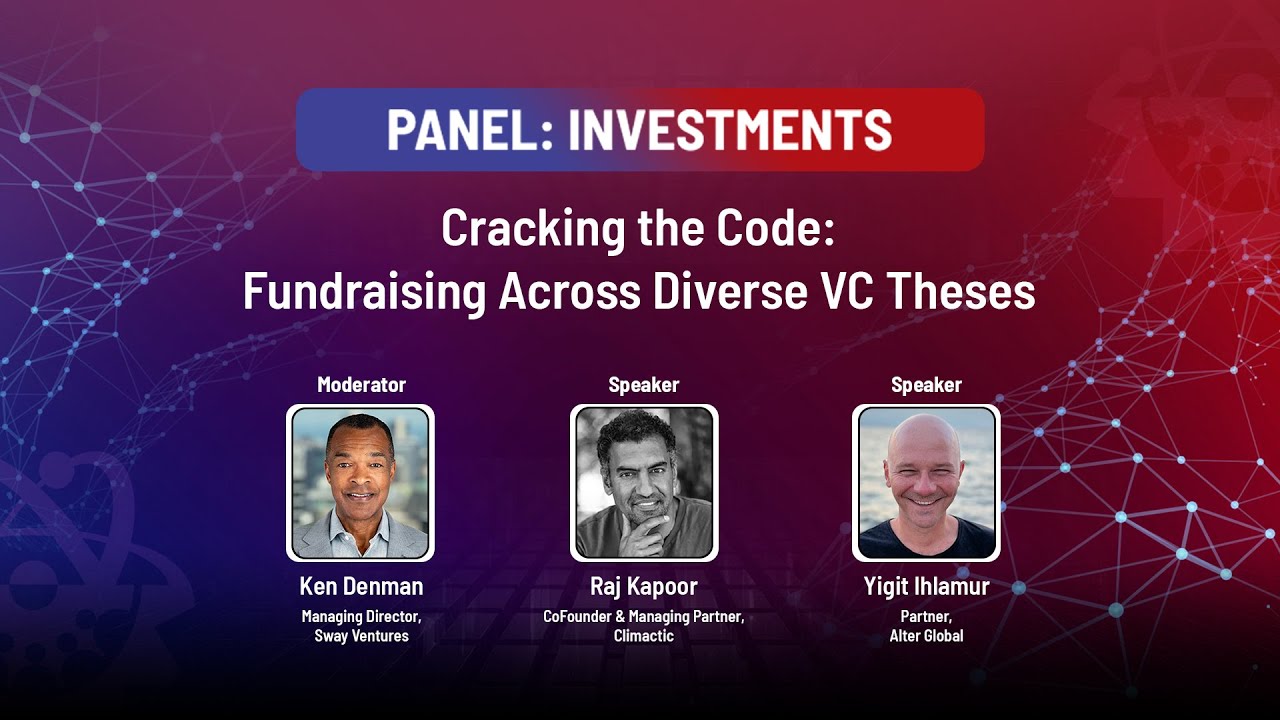
How Top VCs Evaluate Startups in 2025 | Fundraising Secrets & Investment Theses | TechCon SoCal

Growth Stage Investing: What VCs Look For After Product-Market Fit | Real Advice From Top Firms

The Secret to Success in Venture: Ken Denman on Timing, Strategy, and Resilience


Innovation Panel Discussion at TechCon Socal 2020: How AI is impacting our future


TiEcon2015 TiE50 Finalist, Ken Denman CEO of Emotient, Interviews with Prashant Shah at TiETV

