Frank Discussions: Ken Denman, Venture Partner, Sway Ventures
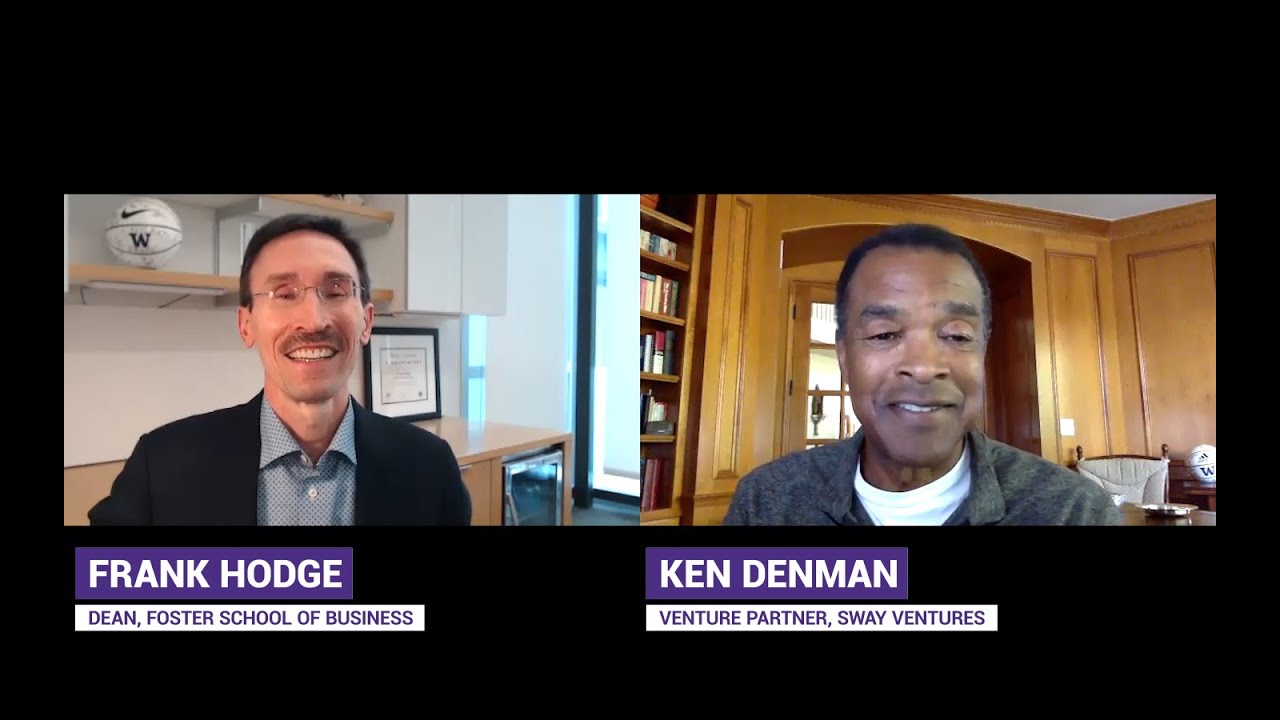
In this interview, host Frank talks with Ken Denman, a venture partner at Sway Ventures and board member at Costco and Motorola Solutions, about his perspectives on leadership, talent development, failure, personal loss, and social equity. Denman emphasizes the importance of interdisciplinary breadth—"wide range, broad shoulders"—as a key trait for future leaders and suggests that business schools like Foster can serve as a glue for cross‑disciplinary collaboration. He recounts a pivotal failure of his early telecom startup during the dot‑com bubble, highlighting the lesson of focusing on timing and broader market forces rather than personal disappointment. He shares the influence of mentors such as Gary Ames and John Thompson, whose consistent values shaped his own leadership style. Denman reveals his deepest personal crisis: the tragic death of his daughter Kelly, describing how family support, purpose, and faith helped him navigate grief. He discusses practical routines that keep him effective, from travel packing systems to building common language and gratitude within teams. On decision‑making, he notes reliance on trusted mentors and intuition. The conversation turns to equity and social justice, where Denman reflects on his experiences as a Black man in predominantly white spaces, the challenges his daughters face, and his optimism drawn from diverse protest participation. Finally, he looks ahead, envisioning success for early‑stage ventures he backs and the diffusion of technology into traditional industries. The interview weaves personal anecdotes with actionable insights for leaders, educators, and investors.
Chapters
TranscriptAuto-generated · 23 min
Greetings, everyone. Today, my guest is Ken Denman, partner at Sway Ventures and board member at Costco and Motorola Solutions, as well as a member of the Foster Schools Advisory Board. Welcome, Ken.
Hi, Frank. Thanks a lot. It's great to be here.
Yeah, I appreciate you being here. I wanted to start it, Ken, you've been a senior leader in large multinational corporations and have also worked in small startups. So you've had a chance to assess talent at many levels. What one or two characteristics cause you to say, I need to keep my eye on that person, they're a future leader?
One of the things I generally look towards, or the things that sort of attract me to people, is I see folks that have wide range, broad shoulders. By that I mean they're, you know, they're not narrow. They tend to be more, you know, maybe, you know, a few inches deep, but mile wide in terms of their capabilities. And what I would observe is they've often sort of spent time in interdisciplinary either academics and/or roles and/or jobs. That is, they've touched a number of things. They may have a particular functional area that they're deep in, that's kind of their anchor in a storm, what they're best at, but they also are well-rounded.
So that, that talented but well-rounded characteristic, if we want to try to develop that in our students, can you give us some advice on how we might enrich that in the Foster School?
Well, Frank, you've probably heard and seen me on this soapbox before. I'm a huge fan of interdisciplinary academic training. And frankly, you know, I think the business school, the Foster School, is in a really good position to be sort of that glue between a number of other academic areas within the university. There's just something about working on projects across disciplines that helps people grow exponentially, in my view.
Yeah, that's great. We've, we've tried to do that both at the undergraduate and graduate level through things like the Burke Center for Entrepreneurship and the competitions where you compete with engineering students and computer science and medicine and things like that to get that collaborative cross-discipline environment here in the Foster School.
I just think it's the real world. You know, if you get into business, you get in whether they're large corporates or small startups. In fact, you know, the best early-stage companies are typically a very diverse team that comes together to solve a big problem.
Ken, is there a success or a failure that fundamentally changed you and helped you become the leader that you are today?
Yeah, there is, in fact, probably a couple, but the one I think was the most impactful You know, I've been fortunate. I've had many lives, so to speak. I've had a lot of— I've touched a lot of different roles and responsibilities in my various careers. And as you mentioned, I've been at big companies and small companies. Well, after the big company career where, you know, I was looking to thinking I was going to run one of the big companies that I was working within, it was Media One. We ended up selling the company and it was a great You know, it was a great exit, you know, top of the market. Our chairman was really smart. But it was, you know, I was a little bit depressed because I thought, oh gosh, you know, I thought I was going to run that company. Having said that, I got engaged with Silicon Valley and ultimately was able to raise $15 million to found a company that was, I thought, was a big idea. And so that was my first startup. And, you know, we launched the business and hired a team and we were going great guns. I was making a lot of progress and we ran into a buzzsaw, which was the first internet bubble.
Uh-huh.
And, um, and this was a company that was basically an early version of 8x8 or RingCentral, the kind of hosted, um, uh, cloud-based, uh, telecom services. And you may remember at that time telecom service providers were not very popular in that window, and I could not raise another dime for love nor money. And we worked really hard, ran all over the country, if not the world, And it occurred to me when I— with about $1 million left, that I was the front door to many of our customers, all of our customers. We were basically their front door, and if we went dark, they would go dark. So I talked to my lead investor, very great, great people, I'm still best friends with them, and said, you know, we probably should wind this down so that we don't hit the wall at 10,000 miles an hour and, you know, not be proud that our names are attached to this. And so it was a really hard decision. You know, we had 80+ employees and And that was very, very disappointing. It was devastating at some level personally. You know, I looked at it as, you know, you know, tried to keep my chin up and do all the right things, but I really felt that I had failed, personally had failed. And anyway, we, you know, we started, we moved customers to alternate solutions and wound the company down. We didn't file for bankruptcy. We did it in a way that we could still be proud to have our names attached to it. But as I was doing sort of the triage right at the end, uh, with, with, with my lead investor and venture capitalist, um, Seth Nyman, and, and I, and I just said in a moment, I go, gosh, Seth, I can't believe I let this happen. I just can't believe that I allowed this to happen. I'm, I, I mean, I just— And he, he said, Ken, wake the heck up. He said, Cisco's trading at $10. You know, this is a worldwide event, this, you know, this, this internet bubble followed by 9/11. He goes, we're in a deep, dark time here. And, and he goes, you got to get over yourself. This is way bigger than you. And it was a, it was really kind of slap in the face. I just went, oh, you know, you know, I was so focused on my own personal dreams, my own personal desire to accomplish that I was taking this particular situation very, very personally in my own heart and head, not sort of focusing on what's so important in venture— timing. Timing is a huge thing, you know, and so if I didn't learn that lesson, you know, I would be so personally motivated and not sort of looking at— rationally looking at the world around me and understanding all the dynamics. That was a huge lesson for me.
And I think, Ken, what I hear you saying is sometimes when we're really down, sometimes you don't realize that when one door closes, another door may open, right? And so there may be an opportunity that you're waiting to take advantage of, but you don't see it because you're coming out of something that is impacting you strongly in a negative way. Ken, who is someone you admire, and in what way has that person inspired you?
One of my mentors and bosses when I worked at U.S. Western Media and then Media One was a guy named Gary Ames. And Gary Gary was, you know, he was a consummate leader in that his value set was so strong. I was his assistant when he became the president and CEO of US West Communications. He brought me into that role to be his sort of mighty staff of one. And then subsequently, when, you know, he lost the battle to be the— or the race to be the chairman of Media One. And, um, and he went to the guy that, that won that race, Chuck Lillis, and said, hey, you know, did the proverbial thing that you do in corporate, you know, hey, you know, congratulations, you won. I'm happy to leave, you know, uh, here's my head, basically. And, um, and, you know, Chuck being the great honorable guy he is said, well, gosh, Gary, you know, is there something you'd like to do? You know, is there another role? Is there a role that you would— you be willing to stay? And And Gary said, I'd love to, I'd love to run international, run the international business. And Chuck said, well, it's yours. And so Gary moved to London to run Media One International and brought me over to be Chief Operating Officer for wireless. And I had a really romantic time building cellular companies in Central and Eastern Europe and around the world. But what I witnessed out of Gary Ames in that time was he never— his value set and the way he comported himself and how he led never changed. in very, very stressful times, very, very happy times, you know, he was the same person. I learned that you have to be able to keep balance, manage the stress, not, not put the stress on other people. The other person is John Thompson, who rose up from a historically Black college to have a career in IBM. Mm-hmm. Became one of the first and highest performing, first leaders of IBM sales organization, um, uh, out of the Boston office, which had some of its own challenges from the standpoint of an African American leading that company back in the, uh, leading that group back in the early '80s. And, and he was, John was just a consummate professional. He never allowed anything to, um, you know, distract him from his goals and from his role as a, as a leader. And ultimately he left IBM to run Symantec and took Symantec from $500 million to $5 billion before he retired and left, and is now, as you may know, the chairman of Microsoft. So I've known John for a long time. He sought me out when I first took iPass public, and so we were just a couple of the very few, we may have been the only 2 African American CEOs of public companies in Silicon Valley back at that time. He sought me out and basically sort of put his arm around me and has helped me, and we're very close friends to this day. And I've just appreciated the way that he has always been not only a leader, but a balanced and a fair person, and a person who's continued to learn. So those are a couple of guys that I have immense respect for.
Yeah, those are great examples, Ken, and both of them remind me just how important it is to have rock-solid values and to not only live by those values, but remind yourself on a regular basis what those values are, because when things are not going well, sometimes it's hard to live by those values, but you've given 2 great examples. I wanted to follow up. So you mentioned tough times in describing one of your examples, and we're in the middle of a pandemic which has caused many people to have to deal with a crisis of one sort or another. Can you share a personal or professional crisis you've experienced and how you worked through it?
Well, you know, the biggest personal crisis that I experienced that I think probably anybody can experience is I lost a daughter, you know, and my daughter Kelly was finishing her junior year— her sophomore year, headed into her junior year, and she was She had a tragic accident and passed away while she was in Italy. That was a, you know, it's something that you can't explain. It's something that's so impactful that you, it just stops you in your tracks and you, you know, you don't know which way is up. And so I resigned from my job as, at the time, the CEO of OpenWave and, you know, just tried to gather myself and gather my family and, and figure out a way forward. And we, we were fortunate to have support from friends and family. And, but that was, that was the— I mean, I mean, to this day, it's, it's one of those things that I struggle with. I think that the thing that helps you get through times like that are the people around you. You know, obviously, whatever your faith is, some kind of Centering some kind of value set, some kinds of spirituality that allows you to try to make reason.
Mm-hmm.
But ultimately, it's about finding a purpose that, you know, the thing that digs you out is, you know, you find purpose. You, you, you grieve and you, you, you want to remember and be thankful for the 20 years that you had with your daughter. And you have to figure out how to go forward to to continue to support and be part of your base of friends and family. But it's a tough one. That's the toughest.
Yeah, Ken, I have 2 daughters, and I cannot imagine the trauma you must have experienced, especially losing your daughter overseas. That must have been— gosh.
It's the worst phone call you could ever imagine, when the State Department calls you early, early one morning, and you just— it's— yeah. But thank you for that.
Ken, sometimes during difficult times, routines can be important, and I'm a routine person. Do you establish routines in your life and feel that they're important to your success?
Yes, and I'm going to give you one that doesn't sound very sophisticated, but, you know, I've been a person that has traveled a lot in my life, in my career, you know, as much as 250,000 air miles a year, you know, with international operations and running global companies. And one of the most basic things that I had to figure out how to do was just how to pack and how to, and how to plan travel and how to move around. I just had to routinize everything because when I didn't, I started losing things or I got off track. So I had to find a way to, you know, to consistently manage myself. Now, if I get a little bit more sort of serious, I would say I've always looked for surrounding myself with people that I can quickly get to a common language with. And so, you know, that, that, that means, you know, bonding with people, spending the time to build relationship, to build fellowship, to build community, and create that common language for your team so that you can work quickly together. You know, the other thing I would say is Remembering to say thank you a lot, because at the end of the day, you know, when you're really busy and you're running hard, you rely on others to catch the balls and/or to just, you know, keep you informed. So you can't do the kinds of things that I have been able to do and am doing without great staff.
What important decision, Ken, in your professional life did you base on intuition or a gut feeling?
You know, a couple of times when I was— have been unsure about opportunities that have come my way, and I really had a hard time parsing between the opportunities, and I've talked to advisors, friends, supporters, mentors, and there have been a couple of times where— You know, I wasn't really sure which way to go, and I literally trusted, you know, a trusted mentor who said, you know, Ken, here's my advice, you know, here's, here's what I think you should do and here's why. And even I can remember one of those times I really wasn't sure that that was the right advice, but I trusted that person.
Uh-huh.
I believed that they had my best interests at heart, and I thought they had more perspective than I had.
Yeah, you're speaking to one of my core values, which is that trust component. It just, it's so valuable to create, nurture, and grow trust, and it just makes the job so much easier than worrying about what other people are going to do or what they might say. That trust is just critically important to having an effective team. Ken, as a business leader and a father, can you share a bit about your experience with equity and social justice in America?
I struggled a little bit with this at times because I have often found myself to be, you know, one of the few, one of, one of the few in the room, or one of the few in a role, or one of the first. And, and that has been a real challenge for me at times in terms of struggling with this quote unquote imposter syndrome, wondering, you know, like, well, why me? And, you know, what's, what's, you know, why? If they really knew me, would they really think I was as good as they think I am, you know? And I have, I have sort of had to work with that, that concept personally. I have seen my daughters struggle with that because of the way we live. You know, we, you know, we're certainly upper middle class, if not more, family. They go to school and school— have gone to school and schools where they're You know, there aren't a lot of people that look like them.
Mm-hmm.
But where they, as they got older, they became clear that people began to sort of treat them as, even though they're mixed race, my wife Mary is white, they were treated as African American predominantly. It was almost like they weren't, they didn't have a white side of the family. And one of the things I've had to do is talk to my daughters about that phenomenon. Because oftentimes as they got older, you know, it surprised them. They didn't even realize that, you know, they were going to be looked at one way versus the other. And it's humbling, you know, it's, it's deeply humbling to try to explain to them something that they, they, they run into, but they haven't seen at the depth that I've seen it. You know, I'm the oldest of 5 boys. My parents were born in Mississippi. They met in Memphis, Tennessee. I was born in Memphis. I spent some time, not a lot, because my dad was in the Army, in the Deep South. I understand what it is for somebody to look at you who you've never seen, to have somebody look at you and you know they hate you. Now you can't figure out why they could hate you because they don't know you.
Yeah.
But, you know, it's a thing. I know my parents were, you know, they had 5 boys. They were terrified. The odds of my parents, if you think about the timeframes that I've lived in, and, you know, to have 5 boys get, you know, grow up, go to college, not get killed, not go to prison, the odds were against them. You know, if we were late coming home, they were terrified. We had that conversation about how to deal with the police or how to, you know, I've, you know, I've been pulled over in my very nice neighborhoods in my nice car and had that situation where, you know, I'm asked to get out of my car because, you know, why am I here and, you know, what am I doing. And it's long before the idea showed. And actually had a situation where a neighbor pulled up and kind of said, hey, Ken, you know, what's— oh no, he lives over there, that's his house, you know. So those are anecdotes. So I am always thoughtful about if that can happen to me, you know, I'm clear. I mean, once I'm out in the world, I'm just another person for sure, and another African American person. And, you know, I could— I can be treated and abused just like anybody else can. But those that have the least amongst us, those people who you know, who don't have the privilege that I have, and I make no mistake about it, I have, I certainly am, have privilege.
Mm-hmm.
But the people that don't have the privilege I am, are, you know, those incidences can inform them, their life, in a way that is different than me. I can, I can brush some things off, I can go forward, but for some people it just says, I'm never going to have opportunity. I am going to be disrespected. I'm troubled by how controversial some of this stuff has become, but it's— these are complicated issues from the standpoint of we have never really dealt with racial injustice in a way that we can begin to fully put it behind us. Yes, we've made progress. We have a long way to go still, and there's a lot of good work being done. by a lot of people, but we can't ever say, ah, you know, that's not a big issue, that's— we've made progress. We have a ways to go. And, and I think, you know, talking about it and working on it is the only— I am so encouraged. If you ask me where my— where some optimism comes from, if you look at the crowds that were protesting in these most recent protests around racial injustice and George Floyd— George Floyd. The great majority of the people in those crowds were white people. That gives me great optimism for this country and for this issue.
Yeah, that perspective piece, Ken, has been so meaningful for me because I realized when the social unrest exploded in the spring that I needed to further educate myself. I have strong beliefs in the EI space and had a lot of initiatives started, but I have expedited those and then on a weekly basis tried to educate myself because I realized that white male lens that I see things through allows me to perceive things very differently than someone that is Black or a different underrepresented minority group. And so when I talk about the foster community being a safe space, that's from my perception.
Yeah.
It doesn't necessarily mean from someone else. And I've tried to be very careful to take those other perceptions or perspectives into account as I've learned more and more. Question, Ken. So if you had a crystal ball, what would it show about Ken Denman's activities and achievements over the next 5 years?
I think it would show, you know, hopefully a lot of nice results with a number of early-stage teams, early-stage ventures that I'm working with, where some of those teams achieve their goals and go on to build really good businesses. And so that's one of the things I'm very focused on. I would hope it would be that Ken is continuing to learn about how to diffuse— how technology diffuses into traditional industries and businesses, because as you know, the saying goes, every company is or will be a software company. So, you know, it's not just the new companies that are coming up, and I do think we're going to see a lot of new companies, formative companies that step into the fore in leadership, but we're going to see some traditional companies, you know, pivot and change and figure out how to continue to compete.
Well, thank you for joining me today, Ken. I greatly appreciate the conversation. I've enjoyed it and appreciate you.
Thank you, Frank. Thanks, and I'm so happy to have you in the seat. You know, we made a great decision collectively to get Greg Hodge into the role. I'm thrilled to come behind Jim and, and carry the flag to take the next couple of hills. So it's great to be on your team.
I appreciate your support. Be safe.
Take care. Bye-bye.
More from Ken

How Top VCs Evaluate Startups in 2025 | Fundraising Secrets & Investment Theses | TechCon SoCal

Growth Stage Investing: What VCs Look For After Product-Market Fit | Real Advice From Top Firms

The Secret to Success in Venture: Ken Denman on Timing, Strategy, and Resilience


Innovation Panel Discussion at TechCon Socal 2020: How AI is impacting our future


TiEcon2015 TiE50 Finalist, Ken Denman CEO of Emotient, Interviews with Prashant Shah at TiETV

