How Top VCs Evaluate Startups in 2025 | Fundraising Secrets & Investment Theses | TechCon SoCal
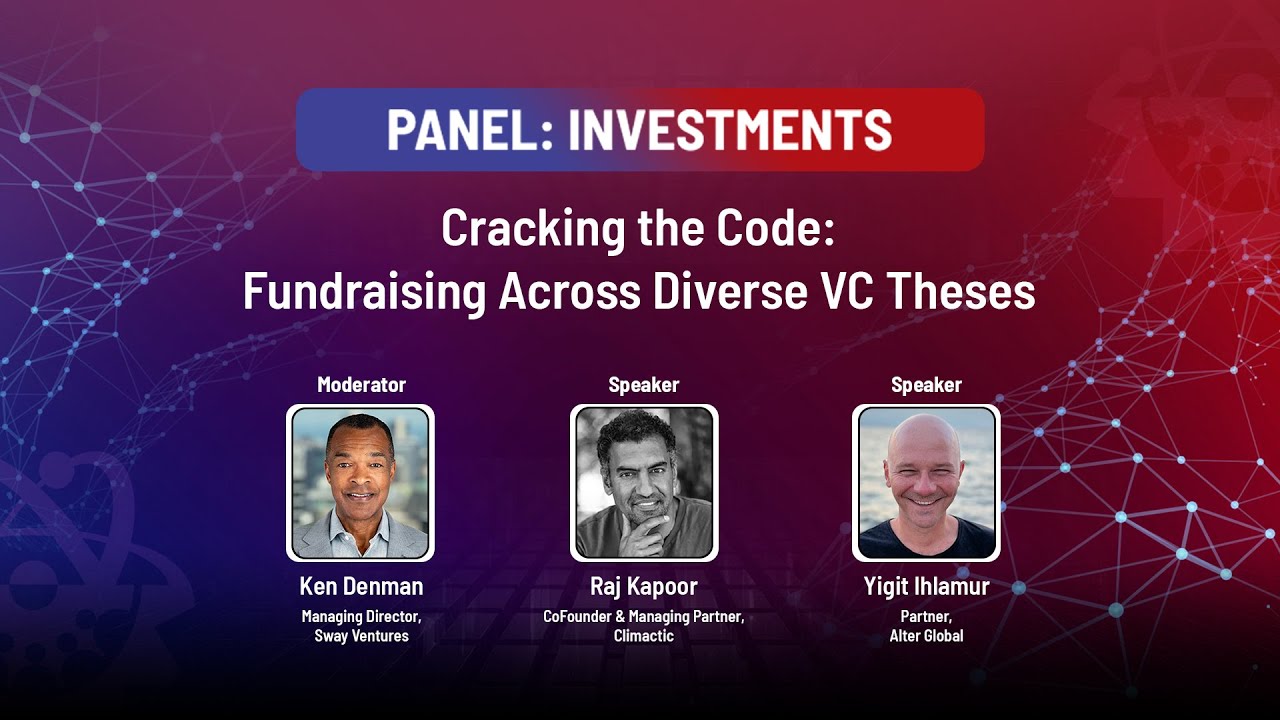
In a TechCon SoCal panel moderated by Ken Denman, investors Yit (Vela Partners) and Raj Kapoor (Climactic) discuss how leading venture capital firms evaluate early‑stage startups in 2025. They begin by describing the current macro environment – a post‑crash market where public‑market liquidity affects LP capital, but a surge of Generative AI (GenAI) is creating new opportunities. The conversation moves to the core criteria VCs use when reviewing a deal: founder story and super‑power, team dynamics, market sizing (TAM/SOM/SAM), go‑to‑market strategy, capital timing, and the ability to retire key risks with each financing round. They stress that non‑obvious or “disruptive” ideas must be framed as pain‑killers rather than incremental vitamins, and that founders need to craft a compelling narrative, especially when the market is nascent. Practical pitching advice includes warm introductions, ultra‑concise decks (3‑4 sentences in the email), third‑party research, and providing trusted industry contacts. Raj highlights climate‑tech challenges – policy‑dependent business models, the “valley of death” funding gap, and the need to re‑frame messaging (e.g., “energy dominance” vs. “clean energy”). Yit explains Vela’s quant‑VC approach, using AI‑driven models to predict founder success, but notes that ultimately founder characteristics (mastery, perseverance, personal backstory) dominate decisions. The panel also touches on AI open‑source vs. closed‑source dynamics, the importance of proprietary data, and the looming impact of future AI models on software startups. Throughout, the speakers emphasize interdisciplinary teams, founder resilience, and the necessity of clear, data‑backed storytelling to capture investor attention.
Chapters
TranscriptAuto-generated · 46 min
Thank you all for joining us this afternoon. Thank you. My name is Ken Denman. I'm your moderator for this session. And I'm really, really very happy to have a sort of a varied group of investors up here with us. We're missing one. Hopefully he'll show up. But nevertheless, we're well armed. We have a quorum. So we're going to get started. Why don't we start with letting Raj and— it's always— I'm always nervous. With pronunciation. But let's—
Yeah,
thank you. Okay, well, why don't I let you start, please, introducing yourself to the group?
Hi guys, welcome. I'm Yit, co-founder and GP of Vela Partners. We are a quant VC fund. If you guys are familiar with like quant hedge funds that actually model out like the public markets, That's what we do for the private markets. So we built a bunch of quant math, you know, AI models to be able to predict the success of startups or founders in their earliest stage, basically. Because of that, like, it's— we rely a lot on the models, but the main focus for us is inception to Series A. But mainly, like, in the earliest stages as possible, developer tools, infrastructure tools, B2B, frontier tech are the areas that, like, we focus on.
Thank you.
Great. Raj Kapoor coming up from Silicon Valley as well. Been a repeat entrepreneur, started a company called Snapfish, didn't work, had to sell it for pennies on the dollar, bought it back, sold it again to HP for, like, $300 million, and then Did another company called FitMob, which merged into ClassPass, which is now ClassPass Mindbody. Mm-hm. And then I was a VC for 7 years at Mayfield, and that's where I got involved and interested in climate, led the first deal into Lyft, and a few other companies, and went to Lyft and was the Chief Strategy Officer for 4 years, trying to make us into an electric, self-driving shared fleet. My background was actually in robotics from Carnegie Mellon, so it's like now it's back in favor. I don't know where it was for 25 years. And so I started a fund at the end of 2020 after leaving Lyft, and it's called Climactic. And we are an early-stage fund, pre-seed, seed, and A, and we focus on climate tech, and very specifically focused around companies that can help the 9,000 businesses who've made a net-zero pledge actually do it. And so we look at efficiency, we look at resilience, a lot of overlap with what you do as well.
Great. And my name is Ken Denman. I'm a— I've had a lot of lives, so I'll try to be really brief. Big company career, you know, in telecom, wireless broadband, et cetera. The company I thought I was going to run was sold to Comcast, so I headed to Silicon Valley probably 10 years too late, but that led to a series of 4 companies, the second of which I took public. I ran another public company, then went back to my roots and did a startup in an interesting area called facial expression measurement, from which we— you can infer emotion. We sold that company to Apple after a 4-year sprint. I had 6 great PhDs from UCSD that were the core of the business. We ended up hiring another 5 as soon as those students did their defense. My props were their advisors. So I'd go to the celebration, you know, when they did their defense with a job offer in my coat. And we picked up 5. Anyway, we sold that company to Apple. That Face ID thing under the covers was the first thing they used it on. And there's some other stuff. And then from there, I joined Sway Ventures, LP, advisor, venture partner, and about 4 years ago as a GP. I do some public board work. On the side, I'm on the board of Costco, I'm on the board of Motorola Solutions, and I was on the board of VMware before we sold to Broadcom. So again, ne'er-do-well. So I can't really figure out what I'm doing, but I've been able to touch a lot of different things. And that leads to this conversation, which I think is really an important one these days, because just listening to the two— the things that we've heard here, these gentlemen have actually been about looking for those spaces between theses, if you will. I mean, from my perspective, it's a really interesting thing. The question is, do you disrupt current interesting spaces, or are you going to go revolutionize something and really create some significant value? Oftentimes it takes interdisciplinary skill sets and interdisciplinary teams and sort of multifaceted founders. For me, that's always the most interesting things. You know, can you get a sort of a diverse group of talent skill sets to come together and kill something? So as I said, I think that the macro— I don't think we can avoid coming into this conversation without acknowledging the macro. On the one hand, we're coming out of a very ugly macro in venture, but we've gotten a stimulant from GenAI, and that's beginning to touch a whole bunch of things. Gentlemen, I'd love for you to talk a little bit about how you think about this current macro and what GenAI in particular can do to help founders find interesting spaces between the sort of obvious theses.
So I think like From the macroeconomic standpoint, in the last, you know, 2 years or so, it's been really rough for the founders, as well as like VCs as well, to raise capital because of, you know, how the public markets are. Because at the end of the day, like, Ken, you're an LP, like, you know it as well, like, LPs actually need to make money to invest in the VCs, and then VCs need to get that capital to invest in the startup. So, there's like a trickle effect. from the public markets that go into the private markets. So there's some sort of a delay that comes in. So now the public markets have been like, you know, up and going. I think there will be some trickle effects if the companies go for IPO more, like the LPs that have actually stakes in the VC funds will start making some DPI, like real cash coming in. This kind of reflects back into the VC ecosystem. reflect back into the startups. But at the end of the day, like, you know, if you are, you know, if someone is building like a great, you know, interesting, you know, company, they are always able to like raise money. So macro has like, I think, a gigantic impact on the startup, you know, ecosystem. What the founders can do is like, I think, it's, It's basically like the problem that they are gonna solve is like, you know, really, it really depends on the area that is growing really fast. So having like that focus on specific areas such as like infrastructure, developer tools, robotics, where like the things are rapidly changing is really important. So there's like markets that are like really, rapidly growing and there are markets that are like really big and changing as well. So large markets versus like small and fast-growing markets. So identifying those areas of opportunities is very important.
What if you're— what about the scenario where you have a thought or where a founder has a thought or a team has a thought where it's actually non-obvious? They're bringing technology to bear, they have a story to tell, down a lane where the size of the market is, you know, it's not provable yet. But once you get there and once you develop, you have to actually— so how do you think about telling those stories to investors? Raj, you want to?
Yeah. Just before going ahead, raise hands who's founders in the room and raise your hand if you're an investor. Okay, great. So this is mostly about founders. focus the conversation around that. Going back to what you were saying, and let me make sure I repeat the question, is around the non-obvious areas that are not there. Because like if you're a GenAI company, it's clear there's a market there. Yeah. Although it may be overcrowded. So I think what, when we are looking, so I do climate tech and it seems like it's getting less obvious with the political environment that's there that we should be doing this. But the reality is you have to create and craft your own story if the story's not out there. Like AI, the story's out there. So, I'll tell you an example of the story that we have crafted, which is that digitization of the world is what made venture in the last 25, 30 years. Most LPs and GPs have made money off of digitization, which includes the internet. And Marc Andreessen said famously, software's gonna eat every single industry, and he's right, and it's happened. Digitization is now maybe a 10% growth business. It's not disruptive. Venture makes money on disruption. So, if you're going to get venture capital, it has to be something that you can show is disruptive, not incremental. If you're going to something non-obvious, you have to show a significant massive alteration, altering of what's there in doing it. So like I just was with a founder upstairs. He started BlueNalu, which you may be familiar with. It's in San Diego. It is creating cell-based toro sushi, so cell-based tuna. And it is not obvious that an entrepreneur should jump into selling fish, right? But what he showed is the macros that are out there, which is that there's mercury poisoning, there's parasites, the seafood supply chain's off. And people are willing to pay $70 a pound, so that the price point works, it's not a commodity. And he put all those things together, and then there was an interesting technology. So without that storytelling that it's like so disruptive to do cell-based, and it gets to animal rights, like there's so many different things he's impacting, that was really powerful. So the short of it is, don't be incremental. It's really difficult. And another point that we always look at when we look at companies, Is, is the buyer of the product— we mostly do B2B stuff— is vitamin or painkiller? Realize that the buyer is getting 600 pitches of how they can make their business better from software or whatever, and it's not going to stand out. They don't have time to do 600 things. They're going to do the first thing on their list. So how do you prove that you're a painkiller versus a vitamin to your customer? And that's what I think is so important, especially when it's not obvious.
Yeah, I think it's great. I actually heard the medicine versus vitamin like 3 times in the last 2 days. But I do think that there were several important points there, and I hope you guys wrote down those first 2 that Raj just made. And I'm thoughtful about, okay, if it's a non-obvious space, it's not incremental, then You know, you really have to, as you founders go to look for somebody to pitch, I think it's really important to decide who to pitch. Yeah. Because, you know, I get a lot of inbound, as all investors do, and I'm amazed at how little homework is done before they come to me and say, hey, do you want to invest in my idea? And it's something completely unrelated to anything we've ever done. Nothing in our portfolio says that. We have no sort of nexus to the thought. And so you want to give us a view? What do you expect from an investor coming to you in terms of their preparation?
Yeah, I think that's a great question. And also to Roger's point, like, you know, we look into stuff that like if it works big, if it works, it's big. Like, you know, it's kind of like Yeah, teleporting is something that I really want to do, but like I know that it's not feasible at this time, but like if it is, if it was feasible and if it works, like everyone wants to teleport. Like if someone makes that work, it's incredible. So those are the things that like VCs mainly look for, like super disruptive stuff, like, and other businesses that are incremental, exactly Raju, you said, like, it's kind of like difficult for VCs to rationalize because of the business model that the VCs have been built on, because most of the portfolio will likely fail or return like small multiples of the companies that they invest, but only a few like Lyft that you invested, right? Like, you know, it's, it just brings like the gigantic returns for the fund. So, that's what investors are looking for. And regarding like the preparation and how founders could come in and like pitch, I think it's about like the, you know, mainly building the right team first. Because like investors at least like, you know, I'm gonna talk about from the inception stage or like early stage, maybe the seed stage. Maybe I'll ask a question to understand the audience. You know, how many people are like in the inception seed stage like in the audience? Like, okay, good amount of people, I think. So, it's about like basically the team that you have built up and like the industry and the expertise that you have. That's like, you know, mainly like at least us and like many VCs evaluate to understand like, is this the right team that, you know, is attacking the right, you know, problem? Is there a founder idea, founder market fit? in that sense. And if you are like the right team, then how do you actually, you know, approach to the VCs and what are like the validation points like in your business? So, to your point, like, Ken, I think it's that like personalized touch, getting the introductions when you reach out, like it's, you know, short and understandable and talking about the main stuff. why the team is like really fit to build that business basically. So, that's sort of like how I think, like how do you think about that, Rush?
Yeah, I think that's absolutely right. And what I would, I would take it, a couple tips there that I've learned over the years. One is when you present your team slide, you're usually gonna put your university and you're gonna put the companies you work. That doesn't really tell me a lot. I mean, in a rare instance like, I worked at Google and I did exactly what I'm doing now. Great, I should know that. But really, what's the personal story on why there's a founder market fit? There's gotta be something personal there. Like, and the question that I ask founders, and I wish they would just tell me upfront, is what's your superpower? Because you, you must have a superpower, and it's not everything. Like, I'm a great seller. I'm really good at marketing. I'm an incredible technical genius. Like, whatever it is. Don't be afraid to brag, and something that obviously when we talk to people, it'll be backed up. So it can't be bullshit in doing it. The second thing that I would say is around your point around in non-obvious areas that, for example, that I'm not familiar with. I'm experiencing this all the time. So climate tech is actually 60 subsectors. Like, I don't know anything about tuna and seafood, and all of a sudden I got to learn about it. And this is a fundamental problem because I can get excited in the meeting like I was upstairs with this guy, And I'm gonna go back home and I know nothing about tuna and I know nothing about seafood. If he does a good job, what he would actually be doing is send me a number of things. Number one, a set of contacts in the industry that are not affiliated with him because they're— that's biased, not the advisors of the company, that understand the space that I can talk to, that are ready to go because that takes me weeks just to figure out who to talk to. And it's someone that I trust. So, one is having that. Two is having any sort of research or anything that's done, and again, best is all third party so that they're doing the homework for me, and especially in a non-obvious industry because it's hard to find that information. Where we get tripped up, I see so many great opportunities and I'm so excited by it, but then I have to go and speak to customers and I may not know a whole new customer segment like all the CPU distributors in the world. So, if you, if you just let me go do it, it'll take me like a month and a half. And then, by the way, another deal's gonna come that I'm familiar with, and I'm just gonna jump on that. And it actually could have been that that should have— the other deal I should have done. But you just did not arm me with the amount of information. And you're doing it once, and you're giving it to the 100 VCs. And that's how many, by the way, you're gonna need to talk to, is 100. Whereas, why should each of them do it each time? It just doesn't make any sense.
Several key thoughts there. First of all, Efficiency. A warm intro of some kind is always best. The number of cold intros that I take a look at is minuscule. I mean, I just don't really look at them, to be quite honest with you. But it also is about, as Roger was saying, a little adjacency. It may not be directly down the lane, but an adjacency. Climate, as an example. There is some relationship to the tuna opportunity. Yeah. There's enough there for you to go, oh, wait a minute, this is interesting. There's a little tidbit here of something I could learn. Yeah. But then you've got to make it easy for Raj to learn. I mean, because he's going to get, as he said, he's going to probably get 5 or 6 or 7 more deals in front of him from the window that you spoke to him to what happens in the next week. And if he doesn't have some independent data that begins to support the thesis that there's something big here, you're done. And it's probably days, not a week, to be quite honest. So,
I mean, people think it's like, oh, my deal didn't work because they rejected me. I actually think the number of true rejections are very low. It's just that there's just better things to look at. There's— it's just, it's great, but I have something else rise up and someone I know sent me another deal and I'm just gonna go look at that. So.
Yeah, I just wanna add that like this exactly like what I feel as well as like in the models that we build up, it's about like, you know, comparable opportunities that we have like in the pipeline, like it's all the stuff that most of the time that like I personally hear is like, you know, great opportunities, like I think they are like real businesses, but most of the time VCs, investors are presented with many, it's just like an opportunity cost among like different basically companies that are out there, so that's kind of like the, you know— Yeah. the mindset of like, you know, how the VCs are thinking about
it. One other thing that came up is, so I'm in climate, and I'm amazed that now climate is a polarized view in this world. Up the street, you know, they're suffering a lot, and we forget the cause of that. But in any case, what I'm now showing, or what I'm actually coaching entrepreneurs on is that It's a polarized world even in the venture capital community. And if you're just going to come in and have green, green, you know, emission savings and that's it, and I want to save the world, it's going to fall on deaf ears. So you may have to have a different pitch. Like we're changing words from clean and green energy to energy dominance. You know, all of a sudden we have all this masculine that we have to deal with in the White House in the next couple of days. And I wanna get shit done, so I'm more of a centrist, but, so you gotta think about the words that are gonna appeal to your audience. And really, it's surprising how many things are polarized or how many views, and so understanding your audience and doing a little research is helpful too.
That's great. Before I came over here, I was at my barbershop, and I was amazed at how polarized and political the fires were within my barbershop in the hood. Very interesting, to your point. So I do think words matter a ton. Right. And you have to be really thoughtful about how you're approaching audiences. I want to go back to the question of, you know, what do you look for first as a VC when you're approached with an idea? The typical threads are story, team, market, et cetera. You know, I always say if it's a space that I know really well, I want to see that— first thing I want to know is the team. Who are you? You know, I need to be convinced that this is a team that can do something great and that's worth my time. Now, on the other hand, I'm guessing that if you're looking at a non-obvious space, maybe the story comes first. But please.
So it's typically like, you know, we don't take many meetings. Like, I spend most of my time and our team like writing code, but like whenever we take a meeting, it's like we are already excited about the idea, like it's already great, the team already looks great, so it's like when we assess, actually we try to understand like the person's story, like why are you building it, because you might have like a lot of opportunities in front of you, but you decided to pick this company.
So the origin story, for lack of a better term.
Person's story, person's story is number one, It's motivation, like why are you gonna build this for the rest of your life? Like it's a pretty serious commitment. And when you're interacting with like, you know, founders, top basically, you know, people in their field, extremely smart, they have a very good rationale of, you know, why they are building it because it's opportunity cost of being in a large company like Google and, you know, making lots of cash and not taking risk and stuff. Decide to take this like, you know, very unconventional, difficult, you know, painful path of like building a company. I really want to understand the rationale behind because they had to convince their, you know, husbands and wives and make sure that like, you know, they're on this path for a very long time. So they must have done great research before picking that idea. So that's the thing that like I'm really interested in and that's the main you know, stuff that I look into, like it's the, it's the people behind.
People first.
Yeah. Yeah,
there's a couple things there. First of all, not all great businesses are venture businesses. And I would bet a lot of the businesses in this room are good and you should go after it. But venture, like you said before, is a power law. And one of the things that often gets neglected is the size of the market opportunity. And if it's not obvious, It's gonna take some machinations from you to really come up with it. And it's rarely right, but it's more about being directionally correct, and it's more about I wanna see how you think. And can you paint concentric circles like the TAM, SOM, and SAM that's being used? But really it's about concentric circles on, well, I'm gonna do this, and here's my go-to-market, and then I'm gonna go, then here it is, and then I can go to this, and I can go to this. And we wanna, it's gotta be multi-billion for it to make sense for venture. One of the biggest mistakes I see is in a deck, they'll say, and here are all of our acquirers. Oh boy. Like, if your job is to get acquired, it likely will happen, but if that's where you're shooting for, we're not gonna get a return that we want. I don't wanna hear from an entrepreneur that is excited about a small acquisition of their company. And a small acquisition to almost any venture firm is even a couple hundred million. It doesn't move the needle unless the venture firm owns like 50% of the company, which is rare. So, it's really like paint the largest possible market opportunity, and then we have to believe it. In addition to the team, go-to-market, super critical. How are you gonna actually get this out? Who is your ICP? ICP is ideal customer profile. You know, you just don't say, well, I'm selling to enterprises. No. What is it? Who are you not selling to? And then the other piece that's just so important is I tell the founders to come up with like the most incredible FAQ, frequently asked questions, for yourself internally. Because what I'm most impressed is when I ask 1,000 different questions from different angles, that the entrepreneur doesn't necessarily know the answer, but they know how to answer it. So, some things are unanswerable, but they're like, well, that's, that's an inter— that's a good question. I've thought about it and here are the things I would do if I had to get to it. And oftentimes people don't speak this way, but I think it's really helpful to be like, here's an answer to your question. And I think, and I'm about 70% confident on this, or I'm 20% confident on it because that's what I wanna hear in a board meeting is like, this is the direction we're gonna go. I really want your input because I'm about 30% confident, or this is the direction we're gonna go. And I'm like 90% confident. That's an inspiring leader that really understands what they're doing. So I'm looking for that. I'm looking for mastery. If I'm asking questions that you're like, oh, that's a good question, do you know the answer to it? Like, forget it. I'm the dumb one here.
Yeah. Great comment. And the other thing I would observe that I've seen around the question of market sizing, and this is particularly challenging when you're innovating, truly innovating, going down a space that hasn't been done before. But nevertheless, I'm going to ask the question, how have you thought about the amount of capital that's needed to go down this lane and the timing of that capital? And how does that— and if the thought is we're going to get a beachhead here and we're going to expand to these other verticals or we're going to expand, you know, what I really want to know is, has there been thought process about the amount of capital and the timing of capital to the best And I think some of the ways that question could be answered, Raj has just riffed on that. But having had real critical thinking around the magnitude, the quantum of capital needed, particularly in a deep tech space, because that implies the ability to raise capital from different groups of people, different kinds of organizations. I want to see a team that demonstrates to me that they have that ability. Now, different teams have to— teams need different— businesses need different things at different times, and maybe the team can grow. But that's where you test for, do you realize that you're going to have to bring new talent to the team? And are you, as the CEO, are you planning for that? Do you have the guts to— because a lot of CEOs, they have their team and that's their team. And they go down the road and they're not willing to address the team. And the need to change in order to get to the next level. So I'm stepping out of my role.
No, that's great. I think also one thing that I love to see is the typical slide is here's the— here's kind of a timeline of when I want— need to raise capital to get to breakeven. And you have milestones that you're hoping to prove, 100 customers, X million revenue. What I really want to see, which is insightful, is what risk are you retiring on each raise? Because a lot of what entrepreneurship is about is failing fast and retiring risk. And as investors, especially early-stage investors, we wanna retire the biggest risks as fast as we can, as cheap as possible. It's okay if we lose half a million dollars with you if you really went after the toughest risk in doing it. If you just imploded because you had a fight with your co-founder, that's not great.
Also, I would wanna add, like, in terms of, like, the assessment based on like, you know, a bunch of basically quantitative analysis, you know, statistical-driven stuff and things, like, it almost always boils down to the, you know, founder characteristics. And it's like, Raj, you touched on that, like, it's the mastery. And, you know, when you deep dive into the conversations, like, with the founders, typically in the first meeting, like, why they do what they do, they always— go back to the childhood, something that happened in the— something like exactly—
Elon had daddy issues early on.
There is some like sort of mastery or perseverance that is like extremely apparent in outlier people's like backgrounds. And outlier people are— have been always outliers since they were kids and stuff. So sometimes it's like a really difficult environment, sometimes it's a very flourishing incredible family environments as well. Like, it's kind of like, you know, in spectrum in that sense. But like, it's— I always, you know, have observed— I don't know how you guys, whether you guys deep dived into that, but it's almost always observable that, you know, outlier people had some sort of like mastery and perseverance in their track record. Even if they are like 20, 19, 22, 30, 50, 60, they, they have something like in their background that they did it before. they have like some sort of a, you know, some sort of a self-confidence with a humble, you know, can-do attitude for most of the things. So those are the things that like I observe. I feel like I'm a psychologist a little bit, like in the meetings I ask a bunch of questions and listen.
That is actually a really good point. One of the questions I ask around is what are the patterns that you have since you've been born and now that you have that are gonna hold you back from being the best leader you can? Everyone has them, so the answer of I don't have any is total bullshit. And then the question is, what are you doing about that? And, you know, we insist on coaches for every one of our startups that are there to go into that.
That's a great thought. And I, you know, the way I ask the similar— you phrase it differently, but it's the same question for me, which is, What do you cling to in a storm? When the shit hits the fan and things are really in a precarious position and you've got to make really hard choices and you've got to come back to your board or you're just traumatized, what part of yourself do you cling to? And I want to just kind of understand, is it tenacity? Whatever the answer is, it will lead to a robust conversation that will tell you a lot about how this person sees themselves, and then you have to decide whether they're self-aware or not. But nevertheless, it's data that's critically important when you're talking to a founder. I'm interested, gentlemen, in has your methodology changed as we've gone through some of these machinations in the market, politics, whatever, over the last— pick a period, let's say 8 years, 9 years. Has your methodology for evaluating founders and teams, has it changed?
I can— well, for climate, when we first got involved in this at the end of 2020, there was a lot of excitement around carbon markets and that a lot of businesses were relying on someone's going to pay if I sequester a ton of carbon. And there are prices that were floating around, but it was really a voluntary market, you know, for doing that. And what we found is the political environment, everything has shifted where that market is just decimated. So, like, anything that is really relying on policy, especially around the price of carbon, is something that initially we were excited about, made a few investments, and now have to totally discount that. Oh. And a lot of what's going on in climate is that the IRA was $380 billion of stimulus. A lot of which has actually gone in, and most of which, by the way, is helping red states. But all of that is at risk. And so, now trying to dissect companies that can actually make it without the policy that are there, and can they make it without any sort of assistance on that, which for deep tech is really hard. There's like a valley of death that we found in the last year. In fact, I was called together with this conference for TED, And it was the top investors, and they said, we have a huge problem in climate. Between $50 million and $500 million funding, there's this thing called the valley of death, which is you create a product, you have maybe one facility, one manufacturing facility that's there. It's not enough to get debt, because debt is the way you can finance your receipt, your inventory, and new factories. And there's just not a— there's no venture out there that wants to create factories 3 through 5. There's just not much that's out there. So how do you deal— you got— so looking at a nonconventional sector, if you're in it, where are the valleys of death that are there? Because it may be easy to raise seed funding, but it's hard to go beyond that.
Yeah, great, great point. I, I have a hypothesis. It'll be a little harder to validate because it's going to be buried in so many different spaces, but I— the hypothesis is we're going to see that in AI.
Yeah, from our side, like how things evolved has been like with, you know, learnings by investing in companies and some failing and some end up like doing really well and doing lots of basically quantitative research. Like it, you might, you guys might have like noticed like what I talk about, I only talk about the founders. Previously, like I was, we were thinking a lot about like markets and all different dimensions, and then, you know, we did a bunch of research, and it turns out that like, you know, we are in the business of picking outlier people more than like, you know, the markets or like anything. Like, if we just need to follow the best talent, and we just need to find those best talent faster than anyone, and that's what we should just like focus on. We should just like build tech, and research and AI to find like people that are outliers before even they decide to start a business. So that's like, you know, what I've noticed, like kind of reducing the problem space into like one dimension, and like really doubling down on that and building techniques and scoring things to be able to compare and contrast, like kind of like, you know, how someone would do like hiring, like in a company, like how do you— Actually pick the best.
And I would also say we're in this time, the other piece that's really uncertain, how many people here, their business is involving software? Raise your hand. So it's a lot. It's really hard for us to think about how does your software company compete in 5 years with how fast AI is moving? Like, for example, I've met companies where they're saying, wow, we can aggregate all this building data that's available and weather data and do really good predictions of risk for insurance. Okay, that's all public data. I think GPT-5.0 is probably going to do that in like a jiffy in doing that. And so, your ability to compete with this huge thing that's happening there is a really big question. I think for the next few years, what gives me solace is that There is no solution that I see anywhere that you can deploy in a company that is AI and that no one has to worry about it and they're just going to trust it. There's absolutely solutions to deploy, but you need, like, the biggest job is going to be the AI QC person that says, that's bullshit, that's right, that's wrong. But I also think that's temporary. That's maybe 5 years. Beyond 5 years, like, there's a beautiful thing that just came out. Diamandis, if you ever follow his work, and he analyzed the humanoid robots. And humanoid robots are like $250,000 today, going down to $20,000. And they expect 10 billion robots, $38 trillion market. What does it mean when you have a $25,000 humanoid that can basically do anything, and when it learns, the entire network learns right away? How does that impact your business? So these are hard questions, and I don't expect an entrepreneur to have a beautiful treatise on how they're going to be in 5 years. But the— God, if you had insight into that around your business, I will really be leaning into it.
And you raised a really great point in your comment there, which was access to publicly available data. If I'm talking to a team in the software space and they're telling me, We're AI, and every deck I get says they're AI. Yeah. My question is, okay, what proprietary data do you have access to? And/or what proprietary data do you have proximity to in the hopes of being able to use more uniquely than others? And, you know, it's really, really rare to run into those. And when I run into those, I'm very interested if the opportunity is of quantum. So, you know, I think maybe at this point it might be a good time. We probably only have, what, 5 or 6? We can probably take at least a couple, 3 questions from the audience. So you were first, so I'll come back to you. Fantastic.
Yeah. Hi, my name's Reza Rasool, chair of QI. It's a nonprofit AI lab. Open source, that's the question to you. What does that play in making the ecosystem of AI more robust? Linux is a great example of how it made an ecosystem more robust. Perhaps you have some opinions.
Yeah, yeah. I think what you are doing is great, basically. Like, that's what I'm thinking, like, from the robustness standpoint for the ecosystem is like, it's extremely important to, of course, like, have these like closed source, like, you know, large companies building great models and stuff. Like, I think it's Great for competition among both of them, but there we also have a serious need for like more open source. And it's coming a lot, like there's a lot of like models out there that, you know, large companies are also pushing open source. But there needs to be like community-driven open source as well that is not like by being pushed by like Meta or whatever, right? Like they have some strategic reasons why they do the open source. So there needs to be like more, you know, bottoms-up, like community-driven. Exactly, I think what you are probably thinking about. I think it's the ecosystem in that sense, like, needs different variety of solutions. Sometimes people will use like OpenAI, Anthropic, you know, Google's solutions and stuff, and sometimes they will use open source. And open source will always have probably a little bit like a catch-up game from the closed source, but I think it's going to be always really fast catch-up game in that sense. So I think from the ecosystem standpoint, I feel very excited about like there's a lot of momentum in open-source ecosystem in AI. We are observing it very closely. We have a bunch of algorithms and market prediction algorithms. It's pretty nice, like what's going on there, especially AI agent frameworks and infrastructure. you know, how to host them, how to automate them. Like, it's pretty cool what's going on out there.
And therefore, back to Raj's point, which is beware in the software space, because I mean, even the big boys and girls, you know, Oracle, Databricks, they're all buying open source companies. And so I'm looking at that and I'm staring at that as a software investor and I'm going, ooh, You know, it's going to really be difficult to put capital to work down lanes that have, you know, great opportunity. And of course, the hyperscalers, the big boys and girls deal, they're throwing billions of dollars, as you say. It's enlightened self-interest on open source for them because at the end of the day, scale matters. Yeah. And so it's going to be— I'm very nervous as a software investor, extremely nervous right now.
Yeah, I would just add that that's the challenge of AI open source versus looking at Linux or MySQL or whatever, is that you can do that in really small quantities and deploy it, whereas to get the training and inference behind it, it's gonna be hard. Great, I have the code, but I don't have a massive data center. What do I do?
So advantages, you know, like I think about, okay, where does this go and where Where might advantage— as an old telecom guy, I start looking at the edges. I start looking at the billions of devices on the edge and whether you can have models that can be exploited for inference, both for data collection but also mainly for inference at the edge. That's a very interesting space. So, to the extent that I see teams or run into teams that either have that concept, have that idea, have the talent to go down that lane, You know, that's interesting. So I think those are the kinds of things to— it may be a poor example, but it's the way to think about where the world is going and what's not happening today and what might. As one of my mentors, this guy named Seth Nyman, he was early at Crosspoint Venture Partners. He incubated Brocade out of their office. So in the late '90s and early aughts, you know, he was a Midas 5 guy for many years. And I remember Seth, when he was recruiting me to come to be an entrepreneur in residence at Crosspoint, saying, venture is really about chasing the inevitable, really trying to look around corners and chase the inevitable. And that captured my attention completely, which was like, as an old sci-fi guy, you know, really trying to think about what could be and then go from there. And with that, one more question and I think—
Yeah, you've been talking a lot about the criteria to select or identify the startup, but before that, what are really the— what is really catching your attention so that you're going to look at a deck and you start really looking at Right, just opening the deck and starting the investigation, while besides sending you a bunch of sushi tuna for your lunch.
So I think what you're asking, just to repeat it there, is what is that first thing that really gets the attention? Because you rarely are gonna go through decks, to your point, especially if you don't trust them.
You probably receive dozens or hundreds of decks.
Yeah, and let's assume that it's not coming in, because it's gonna certainly catch my attention if it's someone I trust. You know, who says— and not just, oh, I know this person, or they're my cousin, like, that doesn't really make a difference. But it's more like, I've worked with this person, I've, I've been in battle with this person, I really— or I invested in this person. That's like really gonna catch my attention to do it. Without those, and let's just say you're coming in cold in doing it, it's really right up front with how What I'm doing is super powerful and it's a massive market and look at the traction I have on so little. Like those words, you know, would make a difference just in being succinct about it. Most likely to open it up and look at it.
Okay, so that's really in the introduction when sending a slide, a slide deck that—
Or like 3 sentences, like 4 sentences. So many people don't understand that simplicity is better. And if I'm getting an email that's 5 paragraphs, I may just not look at the whole thing, and if I have 3 sentences, I'm going to read it.
I would just add, like, I think Raj, like, you touched all the points. It's the simplicity. I just want to reiterate, like, receiving so many emails probably, like, with the inbound and stuff, like, besides, like, the referrals and other things, and if you, you know, of course, like, the algorithms track, like, the companies that have, like, traction and, like, people that have like certain track record and stuff. But like if it is like a cold outbound, it's just like, you know, very simple few sentences. When it's like very long, receiving so many emails, like, you know, it's very difficult to read like for a human to assess that. So I think like it's just like, hey, you know, this is what we did before. Here's like, you know, the customers that are, you know, engaging with us with their, you know, if it is possible, like with the names. you know, the traction, some sort of like social proof in that sense. So keeping it short, like I don't open the decks 99% of the time, I would say. I just know like in 30 seconds when I see the email, like I know whether I'm interested or not based on the idea as well. Like it's kind of, there's a pattern matching algorithm here built up like after seeing many different pitches and stuff, right?
Yeah, exactly. And Raj, thank you for being here. We did not— by the way, we just met each other today. We didn't do any pre-prep. And, you know, I thought it was a great session, great input. And when you're working with smart people, that's what happens. And, you know, these guys are really sharp. So thank you for your time. Thank you.
More from Ken


Growth Stage Investing: What VCs Look For After Product-Market Fit | Real Advice From Top Firms

The Secret to Success in Venture: Ken Denman on Timing, Strategy, and Resilience


Innovation Panel Discussion at TechCon Socal 2020: How AI is impacting our future


TiEcon2015 TiE50 Finalist, Ken Denman CEO of Emotient, Interviews with Prashant Shah at TiETV

