Freedom Money Ep1
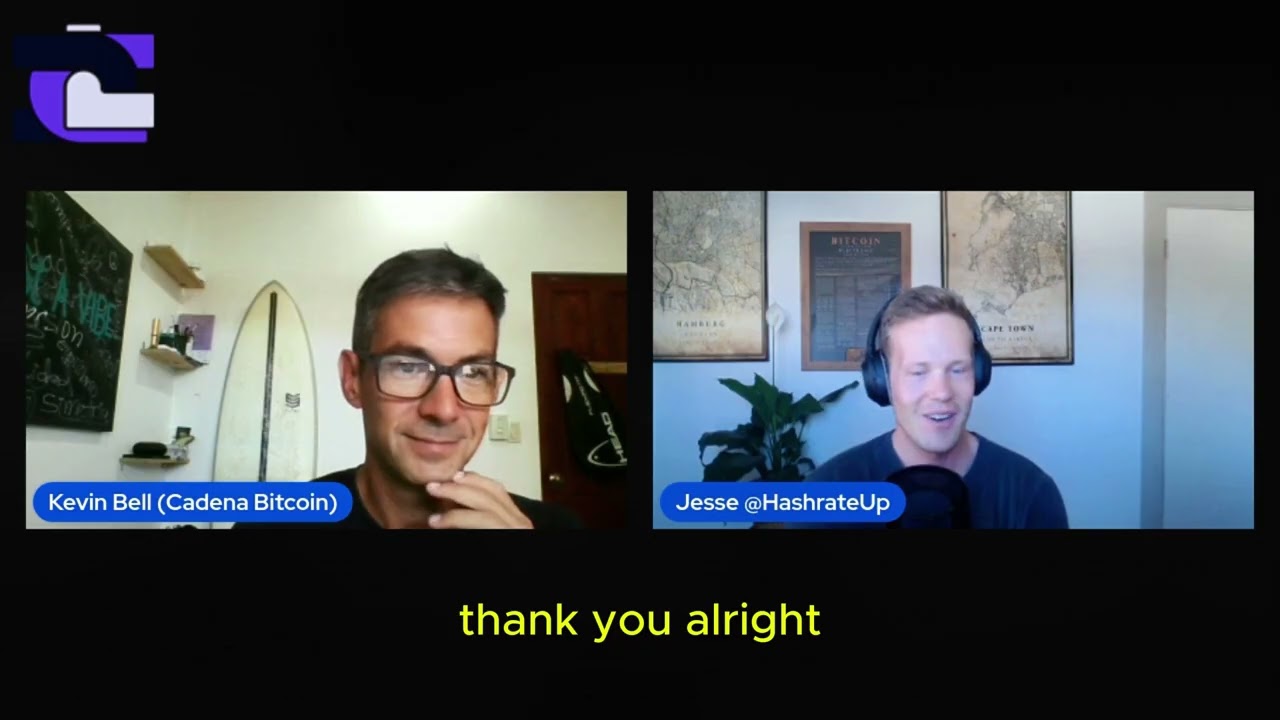
Kevin Bell interviews Jesse Pielke, founder of HashrateUp, about Bitcoin mining opportunities. Bitcoin's price volatility has crushed network difficulty and ASIC profitability, while AI workloads compete for electricity. Africa's cheap renewable power, especially hydro, makes it ideal for mining stranded energy assets.
Chapters
So today we have a very special guest on the podcast, Jesse from HashrateUp, kind of changing roles today as he is the guest on a podcast. Welcome to the podcast, Jesse. Thanks, Kevin.
Thanks for having me. Yeah, I like being the guest sometimes because it gives me space to blurt out all that I want to say all the time.
Well, let's get started. Can you tell us a bit about your background and the company?
Sure, give you the whirlwind version of it. Um, I started, um, with mining in— oh, I think I only started mining like 2 years ago. And my company HashrateUp is now almost, um, 4 years, a bit more than 3 years old. Um, I got started in the Bitcoin mining space because I was working for a company that was selling solar power in rural Mali. And so we had 2 problems solved. Number one, what do we do with all that stranded capacity that we now sit on? Because raising your hand is cheap, um, but then when it comes to putting money on the table for power, then, you know, it's— the hands quickly go down. And so we end up with a stranded solar asset in the middle of Mali without a grid to connect to. So that was number one. And then second problem was, okay, so how do we end up not taking a 30% haircut when we transfer cash money from rural Mali into euros, into an investor bank account. So those two problems is where I got started in my sort of ICO phase. That's where I come from. And then that's why I bought Bitcoin, to partake in those. And then thankfully, quickly left all of those days behind me, started the podcast after my wife told me to speak to a microphone because it was sort of a one-sided conversation. And then moved to South Africa, started my business that I'm now running, uh, since the said 3 years. And so the premise of the business is to bring more hash rates to the continent of Africa, and that takes a lot of money that few people are willing to give to you. So I needed to find a way to make that myself and make the money by educating people around mining. That's what the channel is focused on. Make the money by selling ASICs, selling infrastructure equipment, and hosting solutions as well. So if you're somebody who has machines or who wants to buy machines, um, then talking to me is a good idea because I can find innovative hosting deals all around the world, and that is what I've mainly done over the last 3 years.
Amazing. Well, as we talked about before, I think we should connect and talk about financing of those machines after and how we can potentially help. Um, any comment just on the current market action, um, with Bitcoin's price being volatile and how that impacts hash rate mining and, uh, your business.
Yeah, so there's a, there's a huge debate. I had a meeting coincidentally today with a platform that was providing, um, hedges and, and risk and betting solutions basically on, on difficulty. That's probably not how they would frame it. But, um, so it's a very interesting market right now. You know, Bitcoin does these dips, ups and downs. I'm sure, um, your viewer base and your customers, um, they look at it very, very much in detail and very frequently because they need to keep their LTVs, um, high enough to not be liquidated, right? For miners, it's a, it's a bit of a different story, right? So Bitcoin price takes this huge dump, and at the same time And we've seen hash rate sort of relentlessly grow over the last couple months, and that's now changing. So there's this very interesting time right now where Bitcoin is dropping heavily, and as a result, hash price is being drawn down. But then at the same time, you know, we had that harsh winter storm in the US where most of the hash rate is, which turned a lot of hash rate offline, which in turn meant that the difficulty drops. And then also we have a lot of allocation towards AI. So a lot of the kilowatt hours that would previously be used by Bitcoin miners and big companies in the US, you know, they're mostly pivoting to AI because their shareholder base requires them to. That's me saying that, not, not them. But it creates this, this weird time of Bitcoin where for, um, where for, um, 8 weeks or so, or more, like 12, 14 weeks, we've seen difficulty drop repeatedly, right? I think we had 5 drops and then it stayed stagnant, and now we had a huge drop of almost 12%, if I recall correctly. So the total drawdown and difficulty since October last year has been, I think, 25, 30%. And so just to put that into perspective, you know, during the last, um, drop, the China mining ban, that was like a 45% drop. Roughly. And then when Bitcoin dropped from the enormous heights of $32 back in 2012 or something, um, I made a video on it, um, but then it dropped also like 45%. So if you put those two, um, those two happenings sort of into perspective, then the drawdown right now is, is very, very, um, big. And yeah, you know, miners are suffering right now, um, because even though Bitcoin difficulty and network difficulty has dropped so significantly, Bitcoin hash hash price is still only at $35, which puts sort of S19J Pros and all of those older generation models on the brink of, of unprofitability. And so it's a very interesting time because there's a lot of movement right now around used ASICs. They're coming on the market, and, you know, the, the question is, where does all of the hash rate go? And then you can look into the future at the same time and say, okay, look, if this AI craze is going to keep going, what effect is that going to have on hash rate going forward? Is it going to keep growing like it has over the last 15 years? You know, that trajectory up and to the right. And what happens if it doesn't and Bitcoin price does what gold price is doing and follows suit and goes vertical? That hash price can quickly be at, I don't know, 100, even more. So yeah, it's a very, very interesting time in mining and Bitcoin price in general. I mean, these 3— these drawdowns happen all the time, and I just— at this, I'm, I'm not fazed anymore, you know. I've been doing this for too long to, to be shaken and to be on Twitter and like ask, oh, what does it happen? Why is it dropping? At the end of the day, more people are selling than buying, as stupid as that sounds. Um, and I know where I'm putting my money. Last word, then I'll take a breath. I think it's very different. So it's not different this time, but what's different this time for me is the fact that it seems like other assets are also very volatile, you know. Um, gold has been doing what gold's been doing. It's been dropping 20% in 3 days. It's a multi-trillion-dollar market cap asset. If you look at gold against the rand where I live in South Africa, you know, I'm hurting there as well. And it's sort of like a time where I feel like you have to understand what you want to own truly. You know, you don't want to own dollars necessarily because that's been always the answer in the past, right? If Bitcoin drops, dollar stable, everybody buys treasuries or whatever, and that's sort of the stable asset to flee into. But I feel like that flight-to-safety asset doesn't exist in the same way that it did before. And so that puts the Bitcoin price drop in such an interesting context. But yeah, I'll take a breath there.
Yeah, I'll let you, uh, I'll let you get a breath. I mean, to me it's kind of, uh, you know, the volatility we're seeing is kind of an indication of, you know, kind of the end of this everything bubble. People, you know, we're in the final stages and everything's whipping around because we've denominated in this unstable base of fiat that's secured by money that's printed. And people can buy bonds, which are the base of this financial system, which You know, you're seeing the volatility in bond yields, uh, you know, everywhere from Japan to the United States. And realistically, this money can never be repaid without just printing a pile of additional money. So I guess one other thing I wanted to point out with Cadena Bitcoin, and I'll send you the information after, there's no liquidations on our platform. Everything's locked in smart contracts until the end. And so I just want to see if I can understand, like, again, I'm relatively new to mining, but, you know, I guess what you're talking about is a couple things going on. One is some of this hash rate is being redirected to other applications, specifically AI, or this computing power, I should say. And then I don't know if you can just give me a bit more detail, because, you know, being an economist, supply and demand type things are really interesting to me. But the, you know, I'm trying to understand the process where mining rigs are coming offline, and so it becomes unprofitable for certain technologies to continue to operate and mining. And we're seeing this fall in the difficulty adjustment. It like— who, who is that that's coming offline specifically now? Do you see it with your clients? Uh, yeah, that's kind of my question.
Yeah, okay. So before I get into that, Kevin, just— this is for you, editor— you're hitting the mic. I don't know what mic you're working with, but when you move around, you're hitting your mic and it's creating something that your editor cannot take out. So just want to take a break there and make sure that doesn't happen anymore because it's going to bring your editor a lot of happiness.
Thank you.
All right, pleasure. So twofold answer, twofold answer. So the first one is, um, the, the Bitcoin miners, and I have one here, I have one here. So these things, right, all they do is SHA-256 guesswork for the Bitcoin blockchain, right? They cannot— these machines cannot be used to calculate AI stuff. They cannot be used for inference load or anything else, anything closely related to AI. So it's Bitcoin mining only because, um, AI requires so much more capex and infrastructure. If a data center sets up for AI and builds a tier 3, tier 4 data center with redundancy and cooling and 99.9% uptime, that infrastructure is now specialized for AI computation. Okay, because these H100 graphics cards, chips from Nvidia, they require a very different environment than a Bitcoin miner does. Has to do also with internet and the, the data pipeline that you're connected to and all of that. So, um, what I'm trying to say is, if a data center allocates capital towards AI, that means that cannot easily be used for Bitcoin mining anymore, right? Um, these machines, they cannot do a calculation. So that means if a kilowatt hour goes to AI and is consumed by AI, it cannot be consumed by Bitcoin mining anymore, which then means more structurally the hash rate is going down. That's why I mentioned the, the winter storm, right? There's a winter storm, and that gets us into the supply and demand debate. If there's a winter storm, that means power prices peak because everybody requires electricity to heat their home and survive, literally, right? So what happens to the price of electricity? It goes sky high. Now, um, every Bitcoin mining operation, for instance in Texas, obviously calculates for themselves how much revenue are we making per kilowatt hour, because this machine has a certain efficiency, and that efficiency at certain hash price levels can directly be translated to how much money am I earning for every kilowatt hour that the machine consumes. Okay, so for instance, this machine that I just showed you will make, I think, right now about $0.06 per kilowatt hour. Okay, um, if, if I have a fleet and the average, like, different models, different makes, whatever, I can, I can calculate my average. And if my average is 25 and I'm— or, or 20 joules per terahash and I'm making something like $10, $11, $12 per kilowatt hour, then I know that if, if power price goes beyond that and goes to higher than that, if I run my machines, I'm losing money. Right. So the prudent thing to do now is to turn the machines off. Typically, Bitcoin miners will buy their energy in bands long into the future. Okay. Because they don't want to be exposed to spot market pricing. Not all of them, but some. And that enables them to sell back their power at times where power is, is very, very much in demand and very high, where power prices are high, right? That's— it's not demand response per se, but it's almost like a natural response to, to high energy prices, um, which, which in ERCOT in Texas works particularly well because it's a very liberal free market and nowhere is sort of supply and demand, supply and demand as important as in power markets because it directly impacts the frequency at which the grid runs, which needs to be 50 Hz in the EU and 60 Hz in the US. Anyway, so that's the supply and demand thing. And so every kilowatt hour that is built for AI, all these big data centers, all of these big miners that own power contracts and are you know, do business with AMD, OpenAI, Anthropic, all these big AI giants, you know, they're allocating that, that power towards AI and not Bitcoin mining. And so those, those joules are lost, basically. Now, you asked me who turns off, right? So let's say I'm a small miner and I host a machine with a hoster in the US somewhere at 7.5 cents. If my revenue per kilowatt-hour drops below that, I'm not making money anymore. Then I need to just take the money and buy Bitcoin with that instead of, you know, mining it, because I'm mining at a loss. And so that's who you see, who you see turn off. You see, you don't see particularly miners per se turning off as a whole. You just see operations turn off where that breakeven point is reached. Right. And so the lower hash price goes, the lower the revenue per kilowatt hour goes. And so, you know, then we're talking about fleet refreshes and you want to replace the machines that are now not profitable anymore with new machines. And so there's a lot of movement there. And the reason why I said in the beginning it's very curious time is because typically you would expect if difficulty drops so much, you would expect that miners have an easier time to stay online, right? Because difficulty drop means it's easier to mine, fewer people are hashing, and so that pie every day that gets dished out by the Bitcoin blockchain is divided among fewer people. And so my share of the pie grows if I remain online. And that's always the goal— stay online longer than the next guy, basically. Right, because it's a global 24/7 competition. And so that's who you see turn offline, is all these older machines like what I just held up. This M30S machine is no longer profitable in the region where it was originally deployed, and so now it needs to go find cheaper power somewhere else.
And so I guess my next question is, in terms of cheaper power, and I guess specifically Africa's role, in terms of cheaper power. I'm just curious if you can expand on that.
Yeah, sure. No problem. So, I mean, the, the, you need to always have a baseline, right? Just like, um, in the past, the 10-year US Treasury bond was the baseline, the, the risk-free rate, um, for the global financial economy. You can sort of apply that same, um, methodology here, right? So in, in my perspective, in in my subjective opinion, with my cultural background and the languages that I speak and the way I was brought up, my subjective opinion is, okay, power in Texas is pretty risk-free. If I have a power contract in Texas, that's a pretty risk-free rate. And there's not a lot of risk for jurisdictional or like regulation or regulatory volatility. Right. That's the, that's the right expression. So now if that's my baseline, now I need to understand, okay, is it cheaper for me to mine in Ethiopia for $0.05 or is it cheaper to mine in Texas for $0.06 hosted? You know, if I have hosting environments or $0.07, right. Does that difference in price reflect the difference in risk or not? Right. So this is why on my videos you'll often hear me say, don't just look at power price, especially if you're starting to host. Look at power price in relation to risk. Right now you can say, okay, if I mine in Venezuela illegally below $0.02, you know, that might reflect the difference in risk. But power in Texas is fairly cheap as well. Power in Texas is like $0.045, $0.05 per per kilowatt hour. And so it's a very tough bar to beat. So now if you go to, to Africa, the reason why I'm so bullish on power in Africa is because this continent is not as developed when it comes to transmission infrastructure as the US or Europe. Right. And also there is no currency strong enough on the continent that would be able to paper over and take on enough debt to build out all of that infrastructure. And so all of these renewable energy generation options that we have, you know, tons of hydro, tons of geothermal, wind, solar, of course, right? All of these can theoretically be used and built, but you need money to finance them. And so Bitcoin mining can come in as a, you know, consumer of first and last resort. And consume power from week 1. And a great example of how not to do it is Ethiopia, right? In Ethiopia, power prices are heavily subsidized. It's historically a very communist country. They've got tons of hydro. They've got the biggest hydro dam in Africa, 6 gigawatts of potential capacity. I think something like 32 gigawatts— don't quote me, I'll have to dig up my numbers again. Of financially viable hydropower development that they could do. And so Bitcoin mining brings African nations an option where they can, without the approval of IMF and World Bank, use those resources to, um, to make money themselves, right? They don't need funding. All they need is stable regulation. And that's exactly where, where Ethiopia is going wrong, right? If they went ahead and said, hey, you know, here's 10-year power contract— you know, in the middle of nowhere at a substation where we've got tons of power available. It's just stranded. It's just sitting there. There's nobody to consume it, right? It arrives from the hydro dam at the substation, and then there's no transmission to send it to a market where it can be consumed and paid for. If Bitcoin miners are situated there and not near the capital city of Addis Ababa, 30 minutes away from the airport where power is scarce, you know, they could, they could do a lot of damage financially and make a lot of money as a country without the permission of any outside organization, as is often the case, and potentially even replace the $5 billion of development aid that they received in 2022. But so that's where Africa comes in and where, where power prices are theoretically very, very low. If you manage to have the right conversations, right? So I'm talking private-to-private partnerships, people who own power infrastructure, people who cannot— who built the solar and against their assumptions cannot feed the power into the grid and are sitting on stranded solar assets. There's a lot of that, just like here in South Africa and in Namibia alone. But, you know, the power is not scarce. Like the, the, the energy is scarce at certain times during the day, um, and there's enough energy here that theoretically is cheap enough. But those are very tough conversations to have, and as I said, I've just started. Um, there's a lot of mining in Nigeria, historically in Angola, um, where else? Ethiopia. But those are really the hotspots when it comes to Africa right now.
So I had all these questions I want to get into, but I think it was really important to go into that background. And so I guess with the volatility and energy, uh, I don't know, regulatory, the volatility of Bitcoin's price, you know, with where you are in your business now, I guess what I'm curious is, you know, where the opportunity is and what you're building now and why?
Um, so that's a difficult question. It's a good question, but not an easy one to answer. So I think when it comes to mining, I mean, obviously my, um, my building the network and knowing pretty much like a large amount of the players in the, in the, in the space, especially from the Western Hemisphere, um, there's always opportunities to buy and sell rigs. That's, that's what I do a lot. And there's always, you know, people who want to get into mining and hosting. And I think when it comes to that, I'm kind of convinced there's only really two options to make a hosted environment work. Like this hands-off approach of, hey, I basically buy machines and somebody else runs them for me. The margins on that are getting slimmer and slimmer. And so, you know, buying one machine air-cooled in the US the likelihood that buying Bitcoin instead of the machine and ending up with more Bitcoin is very, very high. So there's two ways, right? You can have all the connections and do the networking and have access to cheap machines and ship them to, to a country in Africa where maybe you just do a revenue split and power is dirt cheap. But that's obviously high risk. But what I like to to sell at the moment is, is hydro hosting. I just released a video on that as well, so thanks for asking. That's what I'm trying to push right now, is, is that idea of hydro hosting because of two fundamental things. First of all, these machines, they run very, very cool, and the wear and tear on them is very, very low. So the, the physical lifespan of the machine is quite long, right? We're talking 6+ years. Depending on the machine. But the data we've seen is that these machines run very stable and very cool, and there's no reason for them to fail. And then secondly, um, you need to optimize for the financial lifespan as well, right? So we talked about that break-even point earlier. If that's reached, you got to turn off the machine. It might still be good, but now you have to scramble and find a different hosting environment. And so what me and my partners at HashBranch are very much selling right now and trying to push our clients towards is, is profit split environments, right? Where you host at a straight rate, maybe $7.50 again for the longest time, and then when the machine is not profitable anymore, you can switch to maybe a slightly lower uptime, which makes power cheaper for the operator, and then you just pay for the power And then a portion of the hosting bill is the profit split, and that profit split moves with revenue, right? So in times of high hash price, your hosting bill is high, but in times of low hash price, which is exactly what you want to protect against to stay online longer than the next guy, your hosting bill is comparatively lower, right? So you can mine right now maybe at a 50-50 split with an older machine at 6 cents. And if it goes even lower, now your hosting bill is 5.5 cents. Again, because that profit is shrinking, which means you in total are giving up less, less nominally. And so, um, that does these two things, right? You buy a Hydro machine, it lasts for a long time. If there's no fan issues, the chips don't run at 60, 70, 80 degrees and fail, and you have to take the hashboards out, send them to a repair center, there's no warranty. Like, it's just not as much fun. And then secondly, again, you know, you— if the, if the drawdown comes like right now, in 4 years from now, whatever, and you in a, in a normal environment you would be unprofitable, now you can switch to the profit split, um, every 12 months or so, and then keep the machine online and running without having to move it. Um, and that's really sort of the other way of mining. It's a very long-term approach, you know. It's not, okay, you want to make your ROI in 3 years, very difficult to do, honestly, you know, with air-cooled machines at 7.58 cents. It's very difficult to do that. And so, yeah, that's really what's on sale this year. And then also I'm building a 12-volt solar miner, but that's very, very early innings.
So you're keeping busy?
Yes, definitely. Yeah, I'm also having my fourth child now. So I'm keeping busy and there's a lot of coffee involved in my daily life.
I had enough sense to stop at 3, and that was 18 years ago, so it's pretty manageable now. Um, just final question, more specifically for building in the Bitcoin space. Do you have any advice for founders?
Um, yeah, so I think— so I stumbled into this, right? I didn't have a plan of what I wanted to do. I sort of found my niche and started what was fun, and then at some point tried to monetize it, and that worked. I have found that people in the Bitcoin space are— there's a lot of yes people, right? Because I'm fundamentally convinced that all of us found towards Bitcoin because we have— we share certain character traits, right, that, that enabled us to open our minds to this new technology that was somehow better money, and then we sat down and worked on it. Like, there's, there's a certain character trait that I think all of us share, um, and so it's very refreshing in business. Like, people want to do business, you know. If you add value, if you have an idea of where to add value, you will find a lot of receptive, um, other businesses in the Bitcoin space that will want to do business with you, um. I was lucky in a sense that I kind of got started in this energy space. And so mining is a very CapEx-heavy environment. So, you know, the margins percentage-wise end up being, you know, not little money. If you're in sort of the payment space, I know that's different. And the financial— I mean, you will probably have thoughts on this as well— then it can be more difficult because there's also more competition and the barriers to entry are a lot less. But generally, I would say I would say, if you have the space and wanna do something, as stupid as it sounds, just go do it, and don't say no, right? Yeah. There's something like, have you heard of the red car theory, Kevin?
I don't think I have, no. Oh, no, wait, I have, yes.
You have? Yeah, so if you got up today, and I asked you in the evening, you know, how many red cars did you see today? You would have no idea, right? But if I said to you, hey, for every red car that you see today, I'm gonna give you $5, now you might even go out looking for them, and you're gonna count exactly how many there are. And that's sort of what I unknowingly did when I started out. I just said yes to everything. Every deal, every contract, just did it. Because you never understand what follows from that. Oftentimes, you know, I had a, in hindsight, not so great, a contract from a big brand in the Bitcoin space. And I should have probably asked for double the money, right, for what I was doing. But I was very green at that point. And so I just said yes to it. And then the connections that resulted from that and the follow-up business that resulted from that were huge, you know, taking that hit in the beginning was definitely worth it. So if you can, I don't know, do it part-time, do it next to your job. If it allows for it, or maybe doesn't, nobody has to know. It's only illegal if they know. Then yeah, just say yes a lot, man, and just start and do what you're passionate for.
Yeah, I appreciate that advice. And one of the words you said a few times here is fun. And I think at the end of the day, I think if you're just following your path and kind of open to, you know, fun course correction and You know, for me, this podcast is incredibly helpful in terms of being able to connect with founders like yourself. So I really appreciate you taking the time out of your busy day. Is there anywhere people can connect with you, Jesse?
Yeah, it's www.hashrateup.com. I'm on LinkedIn and Jesse Pielke, P-I-E-L-K-E, Jesse written J-E-S-S-E. I'm sure we can link all of this stuff below. Um, and otherwise, yeah, no, it's Jesse as well, underscore HODL, HODL, uh, on Telegram and on X.
Sounds good.
And then I should really have a Nostril profile, but I don't.
Next time.
Next time.
Yeah, so again, thank you. You know, I'm going to pursue you. I think there's a financing discussion to have here too. And, uh, again, thanks again and have a great day.
My pleasure. You too. Thank you.
Take it easy.
More from Kevin



Why Bitcoin is more than an investment I wrote the Bitcoin Bible #podcast #interview #bitcoin


When banks freeze accounts the importance of self sovereignty #podcast #interview #bitcoin

Retirees inflation can erase your savings read Bitcoin Bible #podcast #bitcoin #investing


Taxes KYC and How Governments Are Making Bitcoin Harder #podcast #bitcoin #interview #investing

How SeedSigner Sparked the Bitcoin Hardware Store #howtoearnmoneyfromusstockmarket #bitcoin

The three essentials wallet node and miner #podcast #howtoearnmoneyfromusstockmarket #bitcoin

How the Bitcoin Hardware Store was born #podcast #bitcoin #realwaystomakemoneyfromhome