In this video, the speaker argues that the optimal business model for 2026 is a home‑service company—such as cleaning, landscaping, car detailing, or laundromats—because these services are resistant to AI replacement and enjoy massive, ongoing demand. He highlights that these businesses generate recurring monthly revenue with high customer retention, require minimal overhead (no office, no W‑2 employees, no supplies), and can be operated entirely remotely by acting as a middle‑man who connects contractors to clients. An example is given of a client living in Thailand who manages an Arizona cleaning operation from abroad. Additionally, the speaker notes strong buyer interest in such fragmented service businesses, allowing owners to sell them for 3–4.5× cash‑flow multiples, making them attractive to private‑equity investors. The overall message is that home‑service businesses offer predictable cash flow, scalability, and lucrative exit opportunities in 2026.
Chapters
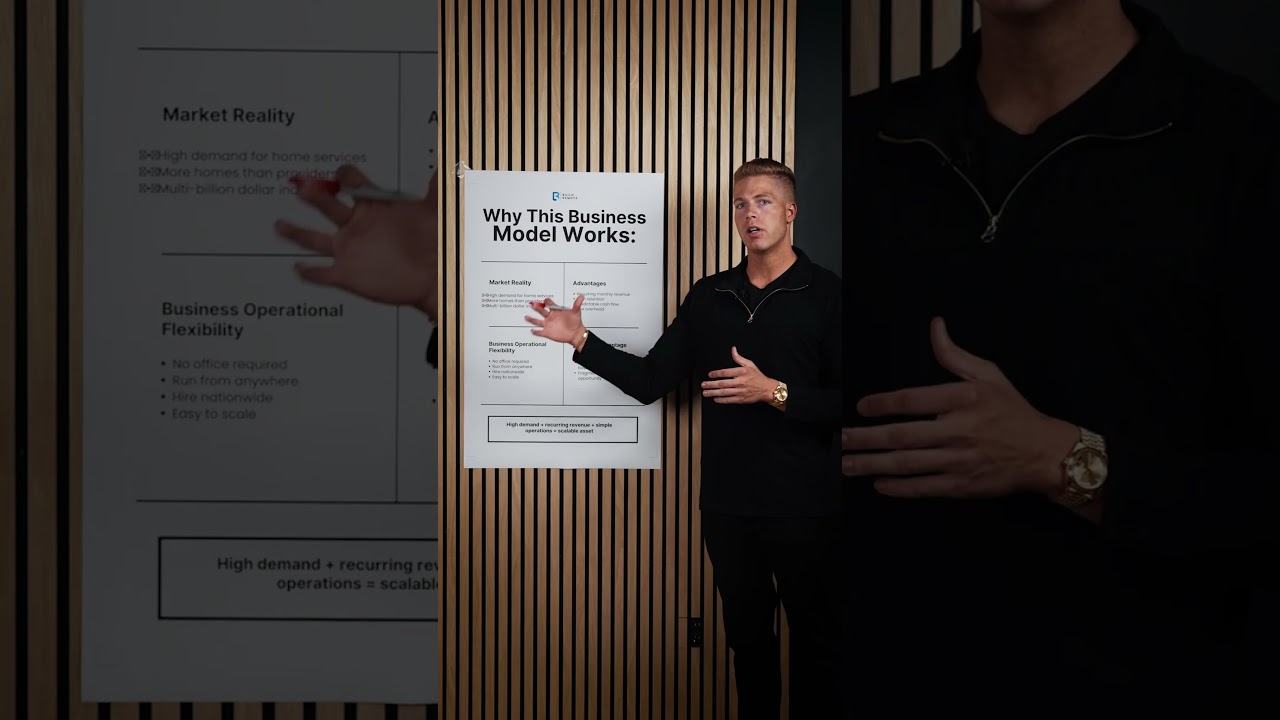
The best business model you can start in 2026 is a home service company. I'm going to tell you why. The reason this business model works so well is if you just look at the market, there's a huge demand for home services because right now everyone's chasing the new AI trend, the AI agency, selling all these services that they don't even understand themselves. So the market is in super high demand because home services are not going anywhere. Cleaning is not going anywhere. Landscaping is not going anywhere. Car detailing. These are going to be some of the industries that are the very last to replace by AI. Yet everyone's chasing these AI businesses that AI itself will replace them, right? So this is a multibillion-dollar industry. And the advantages is this is recurring monthly revenue. So most of these home services— let's use cleaning as an example— you're getting paid every single month. I don't know about you guys, but I get my apartment cleaned every single week. And this is high retention, predictable cash flow, and extremely low overhead. You simply make money when someone does the work. There's zero overhead. You have no office, no W-2 employees, and no actual supplies. You're simply giving cleaning contracts to people who need the work and simply splitting the profits with them. Now, this business is extremely flexible to operate. You can run this thing from anywhere in the world. And I know a lot of people don't think they can run a cleaning business remote. Guys, it's 2026. As long as you have a laptop and Wi-Fi, you can run this thing from literally anywhere. 'Cause like I said, you're not doing the cleaning. All you're doing is connecting contractors who need work to people who want their house cleaned, and you're the middleman. You play your part in the middle, and that's how you profit. So you can run this from anywhere. We have a client right now who lives in Thailand, and she's running her business in Arizona, right? So she's thousands of miles away, and she's handling cleaning contracts in Phoenix, Arizona. Now, another strategic advantage with starting a business like this is there's strong buyer demand. So people are buying cleaning companies, car detailing, laundromats, these simple businesses right and left. So when you start one of these, it's not even just about the money that you're making because yes, you're making monthly cash flow. You can get these things to cash flow $10,000, $20,000, $30,000 a month. But every month that business cash flows, as time goes on, your business becomes more and more valuable. And if you wanted, you could sell these things for a 3 to 4.5x depending on how long you've owned it. So private equity loves these businesses because it's a very fragmented market and that's why there's opportunity. There's no Apple of the cleaning industry. No one is like, "I work with this company and only that company." They don't care. People just want their house cleaned.