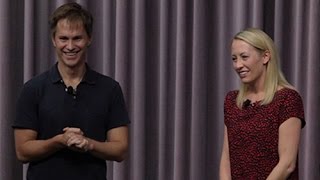
Short YouTube interview excerpt (Kevin and Julia Hartz) about building sustainable competitive advantages at Eventbrite. Kevin describes technical/operational differentiation—most notably a proprietary fraud-detection and deterrence capability protecting a global self-service payments platform—while Julia recounts scaling the company through hypergrowth after a $6.5M Sequoia investment, focusing on building a people-centric, sustainable culture while growing from about 30 to 100 employees. The talk emphasizes defensive operational systems and intentional talent/culture choices as long-term differentiators.
Questions this video answers
$6.5 million
Grow from 30 to 100 employees in less than a year
A proprietary fraud-detection and deterrence team, with engineering and operations systems to detect and deter fraud.
Chapters
But differentiated is, you know, first and foremost a lot of what we think about in terms of beating the competitors. You don't, if you've read Peter Thiel's book, you've read about, you don't want to be an undifferentiated airline, you want to have this competitive, sustainable advantage. I'll mention a couple about Eventbrites and one is that the service is self service and that sounds like a duh kind of moment, but when you're moving billions of dollars in small amounts all around the world, it's actually just a real honey pot for hackers, for fraudsters and so on. And so we've continually been under fire from fraudsters and as a result over the years we've built a fraud detection and deterrence team that in the engineering and operations around that we consider very proprietary and give us advantage when we see new competitors entering the space or trying to gain any kind of scale. Fraud really acts as almost an air cushion of sorts. We've effectively deterred fraudsters from our site and they swarm over to a competitive site or a like site and overrun that. And that's from the kind of algorithm side and also the operation side of creating a silver bullet to stop the bad guys but not stop your customers in a self service manner. So that is a kind of specific example of differentiation. The other that we alluded to that Julia will speak to is just around talent and thinking around talent as a differentiation.
Sure. So in 2009 when we raised our six and a half million from Sequoia Capital, we were at a stage in the company where we knew exactly where we wanted to go and who we needed to get us there. And the plan called for us to grow our team of 30 to 100 in less than a year. At the same time, we were watching all of our sort of fellow tech entrepreneurs go through their own hyper growth stories and come out the other end with broken cultures, loss of identity, and they really had to go back and self correct on some of the hiring mistakes they'd made or they kind of lost their way in terms of the soul of their company. So the idea of growing from 30 to 100 terrified me. And at the same time I felt this irrational love and loyalty towards the company, not unlike what I feel for our own children, to be honest. So I put all of that together and realized that the only way that we were going to go through this hyper growth state and grow our team successfully was if somebody, and preferably a crazy person like myself, but basically any founder, you have a little bit of crazy would be focused entirely on people. And I think what I realized about myself is that through this journey of being an entrepreneur and trying to blend my background with television with this. This newfound reality as an operator of my own company, I realized that I had a keen sense of how I wanted to make people feel. And so I dug into that and took a leap of faith and said to Kevin and Renaud, I'd like to focus entirely on people and specifically the Breitlings. We had built up our customer service operation and our marketing operation, so we understood how to try to find people and how to service them and really what that meant to. To the Eventbrite experience. But we hadn't thought about how we were going to scale our team and what we hoped our culture would be. And one of the things that I think differentiates us from other tech companies is the idea that our culture is designed to be sustainable. So it's actually a manifestation of every single Breitling who is currently at the company. We have the free meals, we have massage Mondays, we have the cool office. Those are just table stakes these days in the startup world. It's actually about how you treat people and how you make them feel that makes all the difference in the world. So what I'm most proud of is not how cool our company is. It's that I know I work at a company where we'll always do the right thing and where we're truly people centric. And that actually means that we put people before the company and the company before ourselves. And that, in practice, isn't always the easiest way to operate. And we get into some really interesting debates. We do things the hard way. We sort of take windy paths to things. Things are not always clean and streamlined and sometimes messy. But ultimately, the fabric of our culture and who we are as a team is what is going to lead us to success. It is what is going to give us the opportunity to be an an independent, standalone company for the long haul.