Cellucom Expo 98
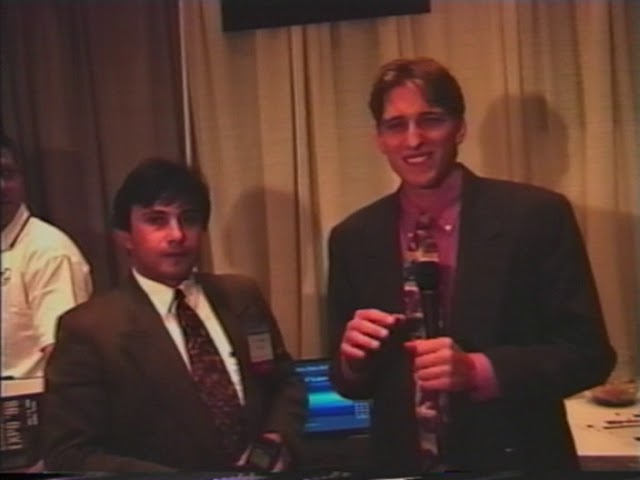
Dave Matthews hosts a live tour of Cellucom Expo '98, demonstrating wireless technologies from Nokia, Nextel, Ericsson, and others. Highlights include the Nokia 9000 Communicator PDA, GPS vehicle tracking, cellular sensors for machines, and a voice-controlled assistant called Serengeti. Eighty-four percent of viewers said they wanted cellular email.
Chapters
Hi, I'm Dave Matthews from NetTalk Live, coming to you live from Cellucom Expo '98, the premier wireless trade show. Let's go inside and take a look to see what Zigo Consulting has put together for the wonderful wireless world. Welcome to the Zigo booth. Hi, I'm Dave Matthews with Tom Evans with the Selemetree product. This little device stuck inside of a copy machine or soda machine will do what exactly, Tom?
Well, it will allow the end customer, in this case the copier distributor or the soft drink vendor, to monitor the status of the machines. How many copies were made? How many soft drinks have might need on a given day.
Okay, so this thing takes the dirty work. You no longer have to go out and check that machine, see if it needs more soda or needs more pieces of paper, I guess.
Right.
A real time saver.
Exactly.
Thanks, Tom. Do we have a demo set up here?
We've got a demo here that is actually live. The unit that you see here connects through the cellular system in Dallas all the way back to our gateway in Atlanta, Georgia, and then on a return trip back to another computer to show the status of this light here. Now we've got the light on right now and it shows that it's on, on the remote monitor. Now I'll cut it off, and then we'll note in a very few seconds this message will go all the way from here to Atlanta and back, indicating that it is now off.
Wow, little bits of data through the cellular wireless system. Awesome technology. Thanks a lot, Tom.
You're welcome.
Okay, I'm here with Beth Gilbrecht of Crescent Technologies. Now, tuning in to NetTalk Live, you know all about this phone, and it's got kind of a clumsy interface. It's a little hard, the buttons are a little small. Beth, what have you done to make using this phone easier?
Well, the whole idea behind smart The idea behind Smart Finder is basically to streamline access of your corporate or your desktop data. When you're dealing with a very limited input and display, you have to push a lot of buttons to get to that nugget of information you're looking for.
Right.
Smart Finder allows you to drill down and access that information. For example, I may have data that's sitting on my desktop, or it could be on my corporate intranet, and it's in a couple different applications. It could be in Lotus Notes, it could be in Sybase, it could be in email. I have an email message that was sent to me 20 minutes ago. Rather than navigating 2 or 3 or 10 different applications, I want to locate information on Beth Gilbrecht. I enter in 4 keystrokes, G-I-L-B. That's 4 keystrokes, enter. What's returned? All of the data values that are associated with Gilbrecht.
Awesome. So instead of having to search manually through contact management, email database, phone database, just search once and it does all the dirty work for you.
Absolutely. Select the item that you want, boom, there you go. The, the whole idea behind SmartFinder was to avoid unnecessary keying, because after a while pushing all those buttons, people just want to take that phone and they just want to chuck it.
That's right, with those little buttons it does get a little tricky to use without some product like this. Awesome technology, Beth, thank you. Chris Hoopes from Nokia with, I think, the coolest product of the entire show. Tell me about this neat little clamshell device.
This is the Nokia 9000 iL Communicator, and we just launched the iL version at the show today. And then the new feature on this that makes it so different is the backlighting. So it's completely optional, you just push the button if you need it, and if not, you just leave it off.
Now when it's wide open, what, what do you do with the keyboard on this?
Basically, this is a GSM phone combined with a PDA, so you have basically most of the functionality of a computer combined with a phone. So it's an all-in-one communications device.
Okay, but you gotta close it. When you close it, this thing turns into a little bit bigger than a cell phone. Check this out.
This is the phone side. So you take a look at this, you can get your phone calls as usual. It's a little bit different in that you talk on that side.
That's right.
The neat thing about it is it's not much bigger than a normal phone. These things are pretty close in size, so this is an awesome product. Thanks for showing it to us. Now I'm here with Wade from Aries Communications, and what is this little device? It looks like a cellular phone without the plastic, is that right?
That's exactly right. What we do is we take a cellular transceiver and we put it in everything from an oil wellhead to a vending machine to a utility meter to about any type of machine device that you find out in the field every day.
Okay, now cellular phones, you think about them as making point-to-point communications, you're talking on the phone. How does your device vary?
Really what we do is we provide very small data, but typically things that are very important to our customers, such as whether they need to go out and service a facility or not. And what we do is we send very small packets over the cellular telephone network, and we provide that at a very, very low cost to our customers.
That's awesome. Nationwide coverage over the cellular network, monitor your Coke machine, your coffee machine, your coffee maker. What do you think?
Coffee makers are definitely in play.
Alright, thanks Wade. Awesome product.
Now we're here on the other side of ARIS Communications with a device that looks like a little black box for your car. Now if you just got a new car and it didn't have the GM OnStar system, Sean tells me here that this black box adds that capability to any car. Sean, tell me what this thing does here.
Yeah, Sean Dalgleish, Director of Business Development with ATX Technologies based in San Antonio, Texas. We've developed a system rather unique for the industry. We've developed a GPS wireless system-level box that can be installed in any type of vehicle, whether it's a consumer passenger vehicle or a commercial trailer or commercial tractor backhoe. The purpose really is in tracking the asset. On the consumer side, we have a voice and data unit where Mayday application calls can be made for emergency assistance calls or roadside assistance calls. On the consumer side, we can actually track the unit on a data-only application. We can track trailers, backhoes, any type of heavy equipment. GPS and wireless GPS being the positioning technology and the wireless currently is cellular amps and microburst cellular. We do use microburst cellular on the commercial side to bring down the rates on the communication side.
That's great, Sean. With the, with ATX microburst technology, you'll never lose that 40,000-pound tractor-trailer. I have found another gem of a technology. Yuri Boyko from FinCo Corporation has taken what I used to do many years ago, try and connect a cellular phone to a laptop Dial an online service, an MLS database, and access homes. It's terrible. It's a mess. Yuriy, however, has taken the same CDPD PocketNet phones and automated the procedure. Tell me what you've done.
Well, actually, we are looking into delivering the fresh new properties which have just arrived on the market the day before and put them into the hands of brokers who will actually have immediate access to these newly listed properties. And all what they will have is to know whether or not they want want to contact a representative, and representative's phone number is there already. So instead of dialing number, looking for somebody, all what they will have to do is just to push the button and it places a call to the representative, and that's where the deal is done.
That's right. What's nice about it is in the old days you had to look up the number, write it down, disconnect your online session, then enter the number back in the phone. It was a mess. Yuri's system does it all automatically for you on the fly through the simple phone interface. Great technology. Thank you. I'm here with Jennifer Hayes from Nextel. Now this looks like an It looks just like a normal phone, but it's got this funky button here on the side. Jennifer, what does this button do on the Nextel phone?
Oh, it does lots of things. I'm glad you asked. Let me tell you. This push-to-talk button allows you to instantaneously get in contact with anybody that's on your fleet. So you may be on the builder's network, real estate, within your own company, auto dealers. And what you can do is with one touch, go alert, menu, alpha, and let's say we want to alert Lance. And we can hit this till we get to the L's, and there goes Lance.
Scott Webster from ORBCOM.
Now a lot of you know for the GPS receiver systems.
Orbcomm takes this system to the next level. Scott, tell me what you guys do.
Orbcomm is a system of satellites, 36 in number, that communicates with literally every man, woman, and child on the planet. Communicates digital data and more or less like 2-way paging. I happen to have a prop here. This is the world.
That's not actual size, right?
No, it's scaled down. Our satellites are in 5 different planes, orbits going around the world, such that there is a satellite footprint covering every part of the planet all the time.
Interesting.
They're in constant motion, but the net effect is that we can provide, via our satellites, 2-way digital messaging to any place on the planet, something never before possible.
Wow.
Okay, now we all know that airplanes have black boxes that tell flight recorder data. Scott, what is this thing? What is this black box?
That's for a different purpose. This is a first-generation radio. Eventually they'll be much smaller, but this device is a 2-way transmit and receive radio. It sends digital information from— this is a kind of an industrial-grade device that would be installed in a truck trailer, a railcar, a shipping container, and it would be able to send back and forth to the home office the position of that trailer or railcar and the status of its contents. It can measure temperature, it can measure the door, whether it's been opened or closed, it can tell you whether it's in motion or not. Anything you want to program in, this can be your remote sensing device.
Absolutely fantastic. Your remote cargo now has a footprint of where it travels throughout the United States. We know where you are. Now I'm here with Andre Nicaso from General Magic. Now, you might remember General Magic from the old Sony Magic Cap. Well, this ain't no Magic Cap. Andre's going to tell us about one of the coolest services I've seen at this entire show. Imagine being able to check email, surf the web, listen to your voice messages, all without a computer. Andre, tell me about Serengeti.
Well, Serengeti is General Magic's new product. We call it your virtual assistant that gives you access to all your important information, but it makes it fun. You can use what we call your VOUI, or a voice user interface, to listen You can respond to your emails using text-to-speech. You can set appointments. You can read your appointments. You can forward your messages. It interfaces with your fax machines. And so it really gives mobile professionals a chance to use the information that's important to them, to act on them, using their voice and a regular cellular telephone or the regular landline telephone.
Good afternoon. Welcome to Portico. You've reached the number for—
Andre Nicasso.
I'm handling all his calls for the moment. May I ask who's calling? Can you tell me your passcode?
420420.
Hello, what can I do for you?
Go to my inbox.
There's nothing new for you at the moment. What else can I do for you?
Get my old messages.
You have 3 old messages. Here's your first message.
Voicemail received April 28th, 1998 at 10:05 AM.
Play it for me.
For some reason I can't understand you.
Play it for me.
Hi Andres, Kathleen.
Can you give me a call when you get this message?
I need to talk to you about the meeting for this afternoon. Thank you.
Bye.
Go to the next message.
Here's the next one.
Email from Deborah Doty with subject Chicago Roadshow.
What does it say?
Hi Andres, just wanted to let you know that I have confirmed the Wyndham Hotel. In Itasca for our Chicago meeting. See you Thursday, Deborah.
Could you fax that to me?
Please say work, home, neither, or just tell me the 7 or 10-digit number to dial.
Work.
Okay, your fax is being sent. What else can I do for you?
Send a reply to the sender.
Say just the sender to reply to the sender alone.
Just the sender.
Okay, I'll record your reply now.
Hey Deb, I got your email message and I faxed that to the office. Thanks very much, and I look forward to seeing you in Chicago next week. Take care.
Got it. To make sure your reply is exactly how you want it, you can play it back. Say try again to record a new one.
Send it.
I'll take care of it. Okay, I have your mail ready. How can I help you?
Go to my contacts.
What do you want me to do with your calendar?
What's my schedule? Go to my contacts, please.
You have one appointment on Sunday, July—
Stop.
What do you want me to do with your calendar?
Go to my contacts.
Sorry, I didn't understand that. What did you say you wanted?
Go to my contacts, please.
I have your address book open. How can I help you?
Look up Dave Matthews.
Dave Matthews.
Company information.
NetTalk Live.
Work phone: 214-538-2880. I have your address book open. How can I help you?
Go back to my schedule.
Okay, back to your schedule. So far, this is your only appointment.
The Red Church meeting.
Starts on?
July 20th, 1998. At 10:00 AM.
And lasts for?
1 hour and 30 minutes.
Go to my next appointment.
So far, that's all there is. What do you want me to do with your calendar?
Add an appointment.
Sure. What date would you like?
Today.
Okay. Now tell me the start time.
4:00 PM.
How much time do you want to block out for this appointment?
1 hour and 32 minutes.
Okay, now let's add a description.
It's a presentation.
Sorry, could you please repeat what kind of appointment this is?
Presentation.
Here's how the appointment is scheduled now.
Presentation.
Starting at.
4 o'clock PM.
On.
Tuesday, May 5th, 1998.
And running for.
1 hour and 32 minutes.
Does that sound right?
Yep.
I'll take care of it. What do you want me to do with your calendar?
Uh, go to my stock quotes.
What do you want me to do with your stock portfolio?
Give me the stock price for BellSouth.
Here is the quote for BellSouth Corporation. The asking price is $66.16. It is down -1.25%. The volume is 826,100 shares.
Give me the stock price for Compaq Computer.
You have no companies in your stock portfolio.
Give me the stock price for Compaq Computer.
Here is the quote for Compaq Computer Corporation. The asking price— Goodbye.
Bye.
Tom Deleva from BellSouth Wireless Data, and he has probably one of the smallest pagers with a full keyboard on it that I've ever seen. Tom, tell me what network this uses and what you can do on that network.
Okay, this uses the BellSouth Wireless Data network, and this is a full 2-way network and it's real-time. So we're going to send a real-time message from this pager to your cell phone.
Now my cell phone has no data service whatsoever. It's just a standard ordinary cell phone, and as I see him send this message off here—
Okay, here it goes. I'm typing in a text message and it's already typed in. I'm just going to hit send now, and it takes about 15 seconds. Most of the time it's taking is to dial the phone, so it's going to this server in New Jersey It's dialing the phone, changing text to voice, and it's now ringing your phone.
Oh, my phone's ringing. Let me see who this is. I wonder who it could be.
So the message sounds like Arnold Schwarzenegger, and it says something like, hello from Cellucom and BellSouth wireless data.
So it takes data that you typed in, converts it to speech, and can call any phone on the planet to send this message, right?
Correct.
Absolutely amazing. And you can call home. Very cool.
I just got a message back confirming delivery of my message. That you actually picked up the phone and answered it.
You mean my boss can find out if I responded, if I heard his message?
Exactly.
Uh-oh.
I don't like this technology.
Cut.
We're here.
We're live.
It's amazing.
It's NetTalk Live. Can you believe what's happening here?
That's what it should be.
That's right. They're going to use that.
We are.
I'm here with Connie Ziego, the founder of this Wireless Developers Conference. Connie, tell us why your company needs to be here next year.
You need to be here next year because this is where it's happening in the wireless developer area. All kinds of new products, all kinds of new service, new toys, gadgets, things you can put in your pocket, things that you can do. You've got computers that you can talk to. You've got data that you can send remotely. You've got the internet in your pocket. It's amazing what you can do.
I know. I can't believe how much pocketability this stuff is. Some of the devices don't even need computers, just use a touch-tone phone. It enables anyone, anywhere to utilize the internet or check stocks, database, you name it.
Newsgroups, stories, you name it. I mean, And you got information at your fingertips whenever you need it. But more importantly than that, you can actually control things around you. You can make a— you can find out, for example, how much rain is collected in a rain gauge and actually display it on a smartphone. And you can do something with it. A valve, or you can shut a valve. You can find out if there's too much electricity running through a control point. I mean, this is actually for business too. So you've got personal goodies that you can play with, but then you've also got some real serious business tangible things that you can do.
That's great. One of my favorites is the marrying of multiple technologies. Like, take a GPS transceiver, put it in a truck, then marry that with a DataBurst or a cellular phone. Now you can keep track of your truck as it drives through the country. Who knows where it'll be? You can find out.
Yeah, it'll be on the web because that's the new way to get information. Because you put that kind of information on the web, you actually see the trucks moving along on the screen. You can double-click on the truck. You can send a message to or from that truck. It's amazing what you can now do. The AVL applications that you're describing, automatic vehicle location, Uses that simple, cheap GPS system that's pervasive all throughout the country, uses the most prominent wireless data package available to them, and, and you can communicate bidirectionally, voice and data.
That's awesome. Connie, this is quite a show. Thank you, sir.
It's great. Thanks.
Now I'm here with Doug Johnson from Ericsson. Now normally you need a cable to connect your PDA to your cell phone. With Ericsson, you no longer need a cable. This little black box has an infrared output that'll output to any PDA device. Doug, tell me how this thing works.
Well, Dave, what we have here is a new product that Ericsson's going to be rolling out for GSM in America. It's called the DI27. Clips onto any Ericsson phone right now. This is the standard Ericsson interface. And what it is is actually an infrared device and a soft modem. GSM, as you know, is a very good network for doing digital data. What we have here is the data coming through The radio being turned into a Haze AT command set and then placed in relative proximity to a product that we call the MC16, which is your mobile companion. It's a palm-type device that Ericsson is selling as a package along with the phone, and what it's going to be able to do is going to be able to program your phone from the screen as well as access your email while you're on the road. be able to access internet, and in the summertime be able to actually access the intranet for your own company. So we're targeting this for the mobile professional who wants to stay in constant contact with his office via email or the internet.
This is awesome. It's a personal area network, no wires required, from Ericsson. Thanks, Doug. Awesome product.
Thank you, Dave.
Larry McDonough from National Systems Research Now, Larry has taken another style box to go inside of a— whether it's heavy tractor equipment, trailers, automobiles, and as I look at it, it's got standard serial ports. What can you do with these data ports on the back of this device?
Well, it can have 3 outputs. One can be used for secondary communication media such as a satellite system, digital radio, analog cellular. We have a differential port if you need very precise GPS GPS positioning as you're driving around, and the other one is an auxiliary port to download positions that have been stored in the unit or to change the firmware configuration of the unit.
That's great. So you've taken a piece of hardware that sits in the vehicle, reports back to a computer, so can you actually watch the little blip travel across the map as you drive down the road?
Yes, you can. We have the software to do that.
Very cool. Now talk to me about your ZEGO Wireless Consulting, your certification. Tell me about that.
Yes, we send people to training up in Detroit, Michigan, to the training up there We were certified to do the firmware development, to develop an application using the ARIES control channel technology. We serve as a hub for that and we provide the data in a standardized format over the internet to a user that has our software.
That's great. That ZEGO certification really paid off. Thanks for being here, Larry. Alright, I'm here with Floyd Sutton and Michael Moon from Software Elements. Now, as I look at your booth here, you guys are doing some pretty funky stuff with wireless data. Break it down for me. Tell me what you're doing.
Well, first of all, we're end-to-end solution providers. We've teamed up with some of the best in the business, particularly in the wireless area, Zigo Wireless. We're one of the first to be Microburst certified. We're part of their steering. We're like grandfathered in because when we got involved with Microburst, it was very, very new technology. We immediately saw a need for that type of technology and we jumped on it. So now that we're certified, we're ready to go into developing microburst products with the assistance of people like Connie from Zigo Wireless. Their staff has been phenomenal in making sure that we get all the research, all the tools that we need to develop and support.
Now Michael, tell me, now that you're certified, what sort of software applications are you going to give to the consumers out there to make the technology work?
Well, we're looking at different markets in terms of what approach we want to take with the wireless data, and one of the markets is AMR. We have some customers who want to just analyze their tanks, be able to look at the flow of product they have in their tanks, and it's a whole gamut, but you have to stay focused in a vertical market because you can get horizontal and Just right.
Horizontal is a hard sell. Alright, well it seems like ZEGO Consulting really paid off for you. Thanks a lot, guys. You already know that this Samsung phone will let you send and receive email and check your stock quotes, but you saw it here first, there's a brand new thing that this awesome phone will do. It's tied in through your laptop. Let's talk to Terry Yates from Samsung to see what this thing will do.
The new data cable that we have that will be out will offer a tethering opportunity for you on your laptop. You're now able to, with your Windows 95, we have developed a device driver that is out and will be available soon, and you'll be able to access the internet using your phone as a wireless modem. So it'll add a lot more opportunities for you on your cellular phone. You'll be able to get your emails, send them, and also access the internet.
So think about it, every application that's IP-based that you use on your laptop, by just plugging in a simple cable to the bottom of the phone, You'll be able to access all those applications in about 70 cities across the United States over the CDPD network. Awesome technology, Terry. Thank you. I'm here with Michael Leibovitz for Cellular Alarm Products. Now normally, Michael, if you have an alarm system in your house and a burglar cuts your telephone line, there's no way for the police to be notified. Or even a fire— fire breaks out, burns the telephone lines— how do they get notified that there's an emergency situation? Well, in our particular situation, we have an interface that retrofits to their panel and can be used as a standby backup or as primary. And if anything happens to the phone line and we're the backup, we automatically send the alarm signals over any packet data technology to the central station. Awesome. So with this, wires are not an obstacle. The wireless data sends a signal.
Right.
Great.
Awesome technology. Thank you, sir.
Thank you.
All these awesome, cool products, and this technology won't even help my golf game.
Would you like to use your PC to preview movies and see what's coming out from the different studios like Hollywood Pictures, Disney, or Touchstone?
Of course.
To do so, just go to nettalklive.com, click on my face, and then on my hot sites link. There you'll find your link to movies.com. The site includes QuickTime movie trailers, interviews, games, music, sound bites, and much more. Welcome back, folks, to the short segment here of NetTalk Live, teaching you everything you need to know about the internet and the World Wide Web. This is really the brief segment, but as I promised when we went to break, we're going to be talking about new technology. But I want to show you where we did a webcast We did a web poll during the first hour. We do these web polls and we asked you a question that we were putting up on the screen talking about, hey, if you had a cell phone, would you— if you could send and receive email on your cell phone and it did not cost you any more airtime charges, meaning it didn't cost you that per-minute charge, would you use it? And 84% of the audience out there said they would use cellular-based email. So Laura, this is— This is what's called— of course it's a cell phone.
Yeah.
But this is a Samsung cell phone.
Okay.
And what we're going to do is— this is for the AT&T PocketNet.
Mm-hmm.
And basically you can do email, etc. This is the little phone that does it right here. Okay, let's see if we can get a close-up on this right here. I'm going to show you how you have multiple— let's see if I turn it for the camera there. So you have multiple options. This particular one's bookmarks and your call list and your email, but it's an intelligent device. We're going to stick one of these in your hands, Laura, for the next few weeks.
Okay.
With no help. No calling Gadge here to bail you out. With no help to really see how easy these items are to use. Dave, tell us a little bit about how this works.
Okay. Back a few years ago, it was pretty popular to take a laptop and connect it to a cellular phone to send faxes from the laptop. But you still had to have the power of the computer to do the data. Now with these guys, These guys, they have what's called a CDPD, which is Cellular Digital Packet Data modem built into them.
A CDPD?
CDPD modem.
Sounds like a bad dog in Little Rascals.
That's right. And I've got a news story pulled up here. You can surf several canned websites. You can't just surf any website because obviously this phone can't display graphics.
I would have to tell you this real quick. When Dave got this new—
I didn't mean to cut you off.
When Dave got it, the first thing he turns it on, he pushes news when we were getting these, and that's how we found out the headline about John Denver dying in the plane crash.
Oh my gosh.
That was my That's good, a true story about how this thing— and I've got another true story here. If we kind of cut to the phone, we can see if we can pull this up. It's Hillary Clinton's birthday, and you can see down— this is tough on TV, but you can see all the text there that you just use these 4 cursor buttons here to scroll through the text. And you can send email through this, you can read different news, you can check your stocks. I know my brother was pretty hot to trot on checking his stocks at happy hour the other night.
Wow.
So you know what, Laura, what I like about I love this, and Luis, we talked about this before, and I know you're going to try them out as well. Did you know you could send a quick email? Don't want to type back on the keypad? You could give options where you send an email, it comes on the phone, option 1, 2, or 3, they can answer yes, no, maybe, whatever. Option 4 may be your phone number, and if they hit that button, your phone will take over and automatically dial the person that sent you the email.
Oh, wow.
This is actually some pretty cool stuff. Luis, you think you could have fun with something like this?
Well, if you're going to give me one, I'm going to use it.
And it works wireless. So we're going to try these out and put them to the test, come back in a few weeks and let you know if this technology that we're hearing about really, really works.
The website to go to is att.com/pocketnet, and you can get a heads up. They even have a little virtual phone that you can play with on the internet.
Check out that website. It's linked to ours. We'll be right back right after this. Did you know you're almost $20,000 in debt whether you like it or not? Find out just how fast the United States debt is increasing every day and get some answers to questions you may have about the national debt when NetTalk Live returns right after this.
We'll be right back with more NetTalk Live.










