Computalk 1-22-95
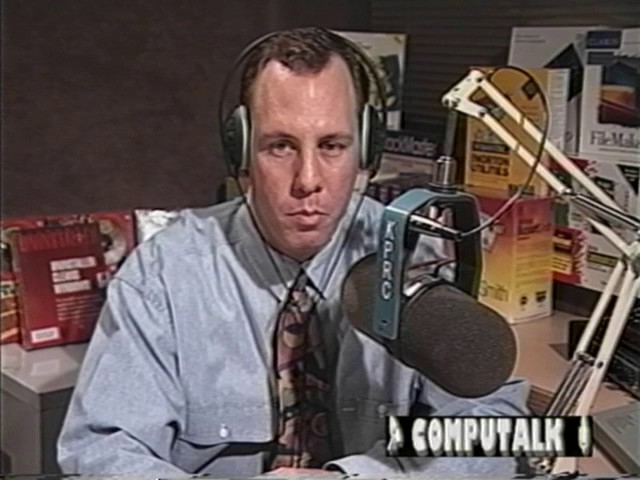
Kevin Surace of Air Communications and Mark Littlejohn of Houston Cellular discuss wireless data modems for cellular networks. Realistic speeds top out around 12 to 14 kilobytes per second, not the full 28.8 kbps modems promise. They field calls about deployment on boats and at flea markets, and address whether cellular phones cause cancer.
Chapters
Welcome to Computalk, the world source for geek-free computer radio and television, with your host Tom King. Tom is a contributing editor to Texas Computing Magazine. From Portland, Maine to Portland, Oregon, Tom and his guests will take your calls. at area code 713-777-5772. And remember, every caller with a non-technical, non-geeky question wins free software. That's area code 713-777-5772. CompuTalk is sponsored by IBM. Get Warp with IBM's OS/2 Warp. Sigma Designs and the Sigma Design RealMagic playback card. Novell, makers of the Novell Perfect Office and Novell GroupWise. Borland Simplify, simplify your life with the new Borland Sidekick and Dashboard. Delrina, creators of WinFax Pro and the Delrina Communications Suite. And AMD, Advanced Micro Devices, makers of 386, 486, and soon 586-compatible microprocessors. And now, America, here is your host, Tom King!
That was cool!
Hello, America, and welcome to CompuTalk, the world source for geek-free computer America. Geek-free computer radio, coast to coast, from Portland, Maine to Portland, Oregon. I'm Tom King, your host, here on KPRC in Houston as we broadcast live worldwide on radio, as well as we are tape delayed on public access, on your local public access channel. Sunday evenings, 8 to 10 PM here, the only live computer radio show with geek-free questions and guests, and we'll be having that this evening as well. We'd like to remind our guests right now, as we are videotaping live in our tele— in the radio studio, for those of you who are watching us on Computalk Geek-Free TV on your local public access channel, currently in the Houston, Dallas, and Austin markets. Tuesdays and Saturdays, 10 till noon, as well as Friday nights at midnight, If you see us on television and we give out a phone number, don't bother calling because you'll get the gardening man and the advice he gives you should be disregarded regarding your computer. Area code 713-777-5772. That is our number tonight. Tonight in the second hour, our topic will be communicating on the run. We'll have 2 guests who have both come in. Kevin Surace has flown in from California. He is the CEO of Air Communications, the makers of a special cellular device. a cellular phone, a fax, and a fax and modem technology all built together, as well as Mark Littlejohn, data specialist for Houston Cellular, as they'll be taking your questions regarding communicating on the run— paging, email, cellular phones, the whole gamut. So we'll be taking all your calls in the second hour regarding that. We're lucky enough in the first hour as well to have tonight's special guest, David Courcy. Dave is the editor of PC Letter Truly the inside, sort of the inside track on the nitty-gritty and what's important in the computer industry. So we'll be taking your questions for David in a few moments. So area code 713-777-5772. Some would call this the first hour's gossip hour. If you have any questions about what's going on in the computer—
Oh!
And we just lost a camera. If you have any questions about what's going on in the computer industry, about Apple, about the recent problems with Borland, Where they just basically demoted Philippe Kahn as CEO and president, though keeping him as chairman of the board. OS/2, Windows 95, or Windows 96 as some call it. Comdex, international markets, the information superhighway. This is your chance to talk to Dave Courcy. So for the second hour, communicating on the run. For the first hour, talking with the editor-in-chief. of PC Letter, as well as a contributing editor for Texas Computing Magazine, Dave Courcy. Every single person with a non-technical, non-geeky question wins free software, so give us a call, 777-5772. Every single caller with a question for Dave Courcy and Communicating on the Run wins free software. Let's go ahead now and welcome our guest for the first hour, Dave Courcy, editor of PC Letter. Dave, thanks for joining Computalk.
Thank you very much for having me.
Dave, your letter has been called the survival guide for the people in the know. What is PC Letter, and why do so few people know about your publication?
Well, few people know about it because we charge $500 a year for it, which is part of it, I think, as much as anything. The newsletter is aimed at senior executives, product managers, product developers in hardware, software, PC companies, personal communications companies. We're published by InfoWorld. I have an office at the InfoWorld building in San Mateo, and I write for a number of IDG publications, Computerworld, Networkworld, PC World as you mentioned. And we're basically a high-level management report explaining the technology and what's going on in the industry to people who in their day-to-day life are so concerned with what's going on very close to them and, you know, the things that most concern them, but they kind of go periscope down a lot of the time. My job is to provide in quick, you know, believable, readable, you know who I am, we've been around together for a while form, some commentary and some insight on what's going on in the industry.
But when you look at the PC Letter, I take it based— your job is to say what you need to say irrespective of whether or not it's controversial. I assume that PC letter does not stand for politically correct.
Now, I will probably tick off half your advertisers tonight.
Okay, well, I'll try to focus on the, the ones that may be leaving.
And if Kevin Surace is standing there, hi to Kevin.
Okay, well, he'll be on in the second hour and he can certainly hear you. Area code 713-777-5772. We'll be taking your calls during this hour. We are just going to open up the gamut. We are going to just run through a number of topics. If you want to jump in and ask, David, questions, let's go ahead and have you come on board. I'm looking right now at your article, The Reinvention of John Sculley and Apple Computers. Let's talk about Apple Computer. Where is Apple and what is the biggest problem it's facing right now?
The biggest problem Apple Computer has right now, and the company seems to be on quite solid financial ground, at least if you look at their current financials.
Certainly their 4th quarter earnings that just came out were very promising.
Yeah, but that's a case of killing the goose to get at the golden egg. The problem with Apple today is that people aren't developing applications for Macintosh. You go to the software store, you walk down the aisles and you look at all the new Windows titles and all the cool things that Windows does. And then you walk down the Macintosh aisle and there's just no comparison. It has been a long time since someone has released a title that would make someone want to go and buy a Macintosh. And that to me is the biggest problem. I think Apple would be far better off, instead of posting all these profits, investing some money to get people to write software for its platform.
Now that Apple faces this dilemma, certainly they anticipated it over 2 years ago in the development of their PowerPC chip, their collaboration with IBM and Motorola and Apple. There's been a lot of squabbling. Many people say the attempted agreement this fall is 2 years too late, and that's what should have been done when they first went to— did the blueprints for the chips.
IBM suffers a remarkable level of cluelessness to be such a large company. And what should have happened was a single desktop and server platform that multiple companies could rally around and add value to. The problem with that is IBM somehow believes that OS/2 is at some point in the future going to become Really important, and that therefore they need to support it. I don't see it. I don't see any evidence that that's going to happen. But IBM believes somehow that it can create an operating system and set a standard. I think it's pretty clear that IBM has lost the ability to set any major standards in the industry at this point, and is unlikely to gain it back until we have another, you know, what— IBM is not alone. The overused term paradigm shift. But until something happens that causes a break between what we're doing now and what we're doing in the future, the winners have significantly been decided, and now it's trying to determine how you're going to play in that world. And IBM just doesn't get it.
For the PowerPC platform and for Apple users, is OS/2 Warp for the PowerPC such a type of application that would make people say, gosh, Let's buy a PowerPC.
OS/2 for the PowerPC is certainly going to happen. The problem with that is nobody's going to be developing any applications for OS/2 for the PowerPC or for any other platform, at least not in any ways that compete with the applications that are available on Windows. IBM and Apple would be much better off throwing their desktop energies into the Macintosh platform and Mac OS, and then using, if you have to, OS/2 Intelligent and the future directions in that area solely as a server platform. I think that would be a strategy that would make a lot of sense, but it's not one that IBM shows any signs of being willing to sign off on.
Area code 713-777-5772. Our guest is Dave Courcy, the editor of PC Letter. Let's go now to our first caller. Bruno, you have a question regarding OS/2 for David Courcy. Go ahead.
I've heard that Lotus has suspended development of their new programs in Windows and are starting to concentrate on developing them for OS/2. Is this correct or is that a false rumor? The only reason anybody is developing much for OS/2 these days is because IBM pays them to do it.
Is IBM paying Corel because Corel is about to have a product announcement?
I do not know, to be honest with you. I presume that they are because, like, they pay everybody else. The reason WordPerfect The reason the project isn't developing for OS/2 is because IBM didn't offer to pay them enough.
How much did they offer?
I do not know precisely, but you hear numbers in the $100 million range talked about.
And, Bruno, for that question, you've just won OS/2 Warp if you didn't have it already. Area code 713-777-5772. When we look at the dilemma of OS/2, is OS/2 going to survive?
OS/2 will probably continue to survive in the same way that the critical care units are filled with people that are, yeah, I guess they're still alive. Here's the status right now with OS/2. IBM has started advertising OS/2 Warp very heavily. They say that since November, they have somehow sold 1 million units. Well, number one, 1 million units is nothing. But we can't find them in any case.
I guess right now the estimated Windows install base is approximately 55 million, isn't that correct?
Yeah, and growing at a couple of million a month.
OK. And the OS/2 install base is about 5 million, about 10% of that.
No, well, that's— I don't believe that that is how many OS/2 users there are, people who sit down at an OS/2 computer and use OS/2 every day. It would shock me if there were. 5 million people who do that.
I guess by comparison, they say there are about 5 million CD-ROM drives that are out in existence.
Right. And every machine is going out with a CD-ROM drive, so that curve is increasing dramatically, and not every computer is going out with OS/2 Warp. IBM— I guess the bottom line on OS/2 Warp, if we lived in a world where the best technology always won, Well, we'd be sitting at Macintoshes talking to Banyan local area networks probably. After that comes the issue of Windows versus OS/2. OS/2 appears to be, or I will cede the point to OS/2 supporters, that OS/2 is a more technically advanced operating system than current versions of Windows. and has some features that will not be in the next version of Windows.
Sure.
I will also say, who cares? For many years IBM was the dominant force in computing despite the fact that their hardware, software, whatever, was not the most technically advanced. The reason for that was they had the relationships with the customers and the status in the marketplace, the dominance, You know, big rock rolling downhill picks up mud, keeps getting bigger.
The leverage.
Yeah, effect that allowed them— you know, nobody ever got fired for buying IBM used to be the saying. And people with better technology couldn't beat them because they just had so much momentum. Today the company that's in that position is Microsoft. Microsoft is probably technically more astute than IBM ever was, if not in inventing things and Taking things that others have invented and popularizing them. So IBM finds itself having the tables turned. However good an operating system OS/2 may be, it is not going to beat Microsoft Windows. So in choosing to use Warp, you are saying, I want to venture a little bit from the Windows family.
Let me ask you this, let me ask you this. If they can't win on the technical merits, Will they ever out-market Microsoft?
You must be kidding.
Area code 713-777-5772. Our guest is David Courcy, editor of PC Letter. We will be taking your questions and your calls at area code 713-777-5772. When we come back, I'm Tom King, and this is CompuTalk.
I don't know. I'm missing something there.
This is New Guinea.
It's so powerful.
I don't see it.
I'm having an out-of-decade experience. I was walking and came upon a fountain which bore the sign, "Don't drink the water." Do you get this? The beggar carries a sign saying, "You're blind." What does this poem mean to me? It's like a collage of images.
Let's face it, not every cultural activity appeals to everyone.
Finding an oasis.
So we're giving you something everyone likes: a choice.
That's why 23,000 arts and humanities groups are inviting you to find something you can get excited about. Just call for a free brochure about what's going on in your community.
I think I'm getting into this.
They're tuning up.
The arts and humanities— there is something in it for you. There's a lot going on in your community. For a free brochure on how to get involved, call our toll-free number. Your first time as a Junior Achievement elementary school volunteer can be a little scary. Can you get kids that young to think about their futures? Call us about volunteering and you'll see. We'll supply you with training for this new program, and the kids will supply plenty of motivation.
You're listening to CompuTalk. You call Tom and his guest with a non-technical, non-geeky question, and you win free software. Just dial area code 713-777-KPRC. That's 777-5772. Macintosh software you win must be picked up at the next meeting of HAWG, the Houston Area Apple Users Group. HAWG meets the 3rd Saturday of the month at the University of Houston Student Center. IBM software you win must be picked up at the next meeting of HAL PC, the Houston Area League of PC Users. HAL PC meets the 1st Tuesday of the month. Callers are eligible to win every 60 days. Listen to Tom for details. And now, back to CompuTalk, where geeky callers get flushed!
And as CompuTalk announcer Bill Waldrop just announced, all Free Software won must be picked up at either meeting of HAWG, the Houston Area Apple Users Group at the University of Houston Center, February 18th at 10:30 in the morning, or HAL PC, the largest users group in North America, whose next meeting is at the Astrodome Sheraton Hotel Tuesday, February 7th. We'd also like to mention that courtesy of CompuTalk sponsor Borland, who we will be talking about in just a few moments, they are providing for the approximately for the first 1,900 or 2,000 members of HAL PC who come to the next meeting a free copy of both Borland Sidekick and Borland Dashboard. In addition, IBM will be rolling out their OS/2 Warp show at the Astrodome Sheraton Hotel, so we encourage you to come. Our guest, back to the phones as we have now, is Dave Courcy, editor of PC Letter. Bland personality, non-controversial, that's Dave. Area code 713-777-5772. Back to the phones. Joel, you're on the air with Dave Courcy of PC Letter. Go ahead. We've got a Windows-based system in our office right now. We're getting ready to buy a new system for desktop publishing and graphic design work, and I've been getting all kinds of advice on what to do and what not to do, but most people seem to be steering us towards the Power Mac and the Macintosh platform, and I just wanted to get your idea on that. I guess his question, Dave, is can we still say that desktop publishing is the area for Macintosh?
What business are you in? What's your main line of business?
He already hung up.
Oh, okay. I don't have any problem at all with that. That would be what I would recommend. The more serious graphic work you need to do for the time being, there's nothing like a big Power Mac to do it on. That is the market that Apple still owns. That is not to say Windows has not made inroads. That is not to say that you can't do desktop publishing, good desktop publishing, on a Windows machine. But I think you will find a lot more support for your efforts on a Macintosh.
And Joel, for that question, you just won, courtesy of Neosoft, the home of Computalk's GeekFree Global Network on the internet, a free 1-month subscription on the internet. Let's go now to Jermaine. You're on the air. Go ahead. What's your question for Dave?
Do you think there will be a new version of OS/2 when Windows 95 comes out? That is an interesting question. I think this gets back to a point I didn't get to make a moment ago because we ran out of time into the spots, that if you go with OS/2 Warp, and particularly if you are a hobbyist, if you think of yourself as the kind of person who goes to user group meetings and likes to play with your computer, Then OS/2 Warp probably is a fun thing for you to play with, because if Windows 95 comes out and it turns out that it is not compatible with OS/2 Warp, you'll take Warp off or you'll decide to stay with Windows 3.1. If you were trying to outfit an entire office, that's a really different question. So if you want to go lay down your $89 as part of your home computer hobby, and I do some of that myself, I don't have any trouble with you using Warp. So, but as to what they're going to do exactly, IBM has not made that clear, and I'm sure that's something that the people at the HAL PC meeting are going to be asking them.
And Jermaine, for that question, you've won courtesy of Novell, Novell's Envoy portable document language publisher and viewer. Area code 713-777-5772. When we talk about OS/2, certainly OS/2's had its problems. Let's talk about Windows 95, Dave. Where is it at and what's the scoop?
Windows 95 is in a holding pattern right now. The software, the betas are actually fairly stable. What you're seeing though is how much work has to go into a product to assure backwards compatibility, and that bodes very poorly in the future.
Have they even stopped adding to the feature list? Is the feature list fixed?
I think the feature list is fixed. It's fairly well plugged, but I think that what's going to happen is if something shows up while they're doing something else, they will add it if it's finished. But they're at a point now where they don't have to add features, but they may if features become available due to the delay.
August '95, will they make the August deadline?
That's an interesting question. Will Windows 95 come out in time? to meet the 1996 automobiles on the way to the marketplace. I would say it's 50/50 or better right now. Many people thought they would make their initial ship dates because the betas looked so good. The real question is, is how much pain do they want to take because they released something that does not have full compatibility in certain areas? So they certainly could ship by that date. I think it's going to be how far along are they and how much fire is it going to generate if they ship.
Back to the phones. Waymond, you're on the air with Dave Courcy, editor of PC Letter. What's your question?
Hi, Dave. I'm a Windows user and I use Microsoft Access 2.0, and I was wondering if you could compare the different Windows programmable databases and maybe tell us where they're going to go with those.
As well as the companies who make them.
Microsoft Access is a product that a number of people I think are getting excited about, particularly the 2.0 release. Microsoft, for a company that does not have lots of database experience, has done a creditable job of getting into the marketplace. There are other competitors out there. There are of course the Borland products, Paradox and dBASE for Windows. And then there are a number of other database products. Long-term, where you're headed in a corporate environment is that you're going to have a set of database tools that are in fact going to be program languages and user interface builders that are going to talk across your network to a backend database. We're talking client-server now. And that backend data store will be whatever it is your company wants to use. So the role of the database is changing. At the same time, databases are expanding. Next-generation operating systems, object-oriented operating systems, are very much databases. You're just sticking a database down at the heart of your computer and letting it manage things, information about your files, information about which applications work with one another. That doesn't get it, I think, at the heart of the question. I think if you're happy with Access, There's no reason not to use it.
And we'll get back to—
You certainly are going to leverage a lot of your Microsoft learning into using Access.
And we'll get back to Dave Courcy as soon as we come back from this break. I'm Tom King, and this is Computalk.
This traffic report is brought to you by Hoff—
So, whose influence are you under?
The air dances with the waters, which brings the rain that feeds the land. That is home to the animals. All life dances together.
In a world so connected, choosing one environmental cause can be hard. EarthShare is 40 environmental charities working together. You and your company can help by calling 1-800-MY-SHARE.
All life lives, or doesn't, together.
And now, back to computer radio for The Free World and Tom King.
That's CompuTalk announcer Bill Waldrip. Back to your calls, area code 713-777-5772. Our guest is David Courcy, editor of PC Letter. Dave, when you have— when you look at the industry, what bugs you the most about the computer industry?
You want to say Microsoft is the answer, but it's not really true. I think what bugs me the most considerably is the hype that surrounds everything. That a lot of products— or more specifically, that we spend a lot of time telling people to buy things just to get the newest and latest because we haven't managed to fix and do all the things we told them that the last version was going to do. I think that bugs me a lot.
And yet when you look at computer magazines, The reviews by just about all magazines seem to indicate that every product that's out there is a great product.
104 new products you just can't live without. I mean, it's like, well, somehow I have up until now.
Well, let me ask you this. Are all computer magazines the same?
All computer magazines are not the same. First of all, there is the upper tier of magazines, with PC World and PC Magazine being 2 good examples. of it that are well reported and completely free of any advertiser bias whatsoever, except in maybe an atmospheric kind of sense. And that atmospheric kind of thing happens everywhere that's advertising supported.
And yet certainly with those magazines as well, a fair amount of revenue comes from companies such as Microsoft where the first thing you see when you open up the inside flap But they fundamentally don't feel that they have to be beholden unto Microsoft.
Right now they think Microsoft needs them as much as they need Microsoft.
And I don't know if I was necessarily referring to Microsoft as much as you see, it's almost like that you see taken from press releases verbatim, you know, third-tier products that you're just not familiar with that aren't the mainstream, and all the reviews seem to be about the same of the products across the board.
Oh, that's true. But my point though is that there are a number of publications that are not published by well-known reputable publishers who I always have my suspicions about, because somehow they always see— they seem to have 5 advertisers and every issue seems to have something glowing about each of the 5 advertisers. And I'm— most of these magazines are aimed at, unfortunately, consumer or novice or beginning users one way or another. So I would encourage your readers, your listeners, to become readers of the publications that, you know, the ZIFs, the CMPs, the IDGs of the world publish, because I think in generally— in general, they'll be better served by them.
I believe it was reported— it occurred this past Monday on roughly the 16th of January that Borland laid off approximately 40% of their 1,700 employees, which came out to approximately 650 employees. They replaced over the past week CEO and Chairman Philippe Kahn, who's now been relegated to, I believe, now just chairman, but has a technology role, and he has a very tight leash in that he cannot speak.
Right.
Unless he has a script in front of him, and Gary Wetzel is now the—
No, Philippe will never speak with a script in front of him, but I understand your point.
Certainly his leash is more constrained.
That is true. I just know he won't speak from a script.
What is going on at Borland, and is the upsizing company now the capsizing company?
Well, what's happening at Borland is the same thing that happened at WordPerfect. Oh, and by the way, as an aside, The WordPerfect products that you're advertising, the Perfect Office and GroupWise, are both excellent products, and I would commend them to your listeners. What's happening at Borland has happened throughout the industry. It's happened a little bit later. It's happened a little bit more visibly. When Microsoft was allowed to have control of both applications and the operating system, and they had the ability to tightly leverage one against the other, and it's going to be even more tighter in the future. You set in motion a process in which the people who have to compete directly with Microsoft just can't keep up very well. It's a real problem for them. And they haven't been able to find a good clear differentiation. And it's hard to beat the mindset of you can't go wrong by buying Microsoft because you know Microsoft is in charge of the market. Right.
Marketplace.
That's what ultimately happened. The price wars have hurt Borland. Borland used to sell its databases for, oh, this side of $800.
They're all now $99. Can't be much of a revenue generator.
Yeah, so despite having perfectly good shipment volumes, you just can't compete. I believe, and Philippe I would say that if Microsoft were a Japanese company, we would accuse them of dumping software on the market for less than it costs to produce. The problem is, is software being an intellectual property, the actual cost to manufacture a given piece of software is very low.
As well as difficult to nail down.
It's difficult to— because what do you say? The X million dollars that it costs to develop Revenue One, how long do you amortize that out over? You know, if you can use it to put somebody else out of business successfully, then it's going to amortize out over a very long period of time. Why not just give the software away?
When we come back, we'll ask Dave about the COMDEX for the Rich and Famous that he'll be putting on February 5th through 8th. I'm Tom King, and this is Computox.
When Raymond was 6, I was afraid to take him to the playground because they were doing drugs. When he was 10, I couldn't let him play ball in the schoolyard because of the gangs. When he was 15, I wouldn't let him go to any dances because there could be a fight or a shooting. Now he's a man, and I realize he's never been a kid.
Give your children back their childhood. Do something now. Call 1-800-WE-PREVENT. Together, we will take a bite out of crime. Drunk driving doesn't just kill drunk drivers. Next time your friend insists on driving drunk, do whatever it takes to stop him.
You're listening to CompuTalk, America's roadmap for cruise in the information superhighway. Videotaped live in studio by the Public Access Cable Channel. Rebroadcast Tuesdays and Saturday mornings, 10 to noon. Internet services courtesy of VideoSoft, Texas's largest internet service provider and home of Computalk's geek-free global network homepage on the internet. Across the fruited plain, if you've got a non-technical, non-geeky question for Tom and his Computalk guest, you'll win free software. Give us a call by dialing area code 713-777-5772. And now back to the host of computer radio for the rest of us, Tom King.
Our guest is David Courcy, the editor of PC Letter magazine— newsletter, area code 713-777-5772. The rumors of the industry, this is your chance to ask the ultimate insider, Dave Courcy. Dave, we were talking before the break about Borland. What is going to happen to Borland, and what direction do you see them going in?
I would believe at this point that they will get their financial house in order as a much smaller company that will be focused on databases and language tools.
Was the demise of Borland when they purchased Ashton Tate?
In retrospect, you would say that spending $440 million on Ashton Tate was probably not the wisest thing to do. You could also say that starting and re-stopping projects was not a very good thing to do. But I think a fair point can be made that they would have ended up in much the same situation in any case, because they never quite found a Lotus Notes-like product or a Novell NetWare-like product that becomes such an industry standard that it provides them a really good foothold in the marketplace.
Now that Novell has come out with Perfect Office, their suite of products, it includes Borland's Paradox.
Yes, it does.
To what degree would Novell want to In order to have a high-quality database.
Paradox is a fine database. They have a license that allows them to sell a million of them, and it's in the professional package of the Perfect Office, and it's a fine database and will continue to be a fine database. I think what may happen is Borland, once everything's in order, could be an acquisition candidate, and Novell would still be a company looking at making the acquisition.
But does Novell want more than one database?
In what sense?
Do they want both dBASE and Paradox?
If dBASE catches on, they'll be happy to have it.
Area code 713-777-5772. Dave, when you see the mergers that are going on and the proposed mergers, is there— we've heard so much about Lotus being purchased by IBM, being purchased by AT&T, being purchased by Oracle. We've heard of Claris being purchased away from Apple Computers by Oracle as well. What is your take on the most recent acquisition rumors?
The big rumor right now is that Larry Ellison, who is the chairman of Oracle, very much wants to have the Mac operating system and to make it available on multiple platforms. The problem with that is that Apple is significantly a hardware company, and somebody else has to take over the hardware business You hear Matsushita and Japanese companies talked about in that regard, but I have to say they're better known for killing hardware platforms than for developing them.
Well, certainly there's been talk as well about Motorola purchasing Apple for the hardware.
That probably makes more sense, although Motorola, again, you'd have to find a way to do it that Apple would not lose lots of momentum. If the Apple If the clone vendors that are being created are able to do something to create some market share, that actually might be a better way out, that the clone vendors somehow take over the sales of Macintosh-based hardware. Or of course, if Ellison got his way, if this is true, you'd start seeing Mac OS running on every platform imaginable, and then you wouldn't have to worry so much about the hardware.
The information superhighway. We've heard a lot about Marc, I believe it's Andreessen, is that how you pronounce it?
Andreessen.
Andreessen. He was recently in Time magazine, a 23-year-old gentleman. Time magazine identified him as one of the top 100 most promising people under the age of 40. I didn't even get in that list. What's so special about Marc, or is there anything special about him?
Marc is credited with the invention of the user interface itself. called Mosaic, that is a Windows-like interface for services provided across the internet.
Now he has a company by the name of Netscape Communications, I believe, and he has his derivative of Mosaic, which is Netscape, and is being popularly received. Is he a child prodigy?
Hard to tell. Marc is an articulate, agreeable young man who does appear to be intelligent and is a nice guy. I have heard some disquieting rumors that perhaps the fraternity house that is the Netscape development team— they basically all came from college together— that maybe it's not the group of rocket scientists that people have suspected that it is. I think time will tell in that regard. Netscape is trying to build, I believe, a proprietary standard for user interfaces for the internet. that will allow them to become essentially the Microsoft of Internet user interfaces. The problem with that is I think, and this sounds odd coming from me, is that probably Microsoft should be the Microsoft of user interfaces. What we need is a way of getting on the Internet that allows you to add new features very easily, so that security features, new viewers, Just anything that people decide they want to do with it can be plugged in. The Microsoft Windows OLE environment and the Apple, Novell, IBM OpenTalk environments both provide that kind of flexibility. I've seen nothing in Netscape's plans that indicate that they're even thinking in that direction.
One quick question with a 30-second response before our last break. When Microsoft announced 2 weeks ago, or it was reported It was reported in the Wall Street Journal that Microsoft had licensed Mosaic. Was that news?
Well, they licensed Spyglass Mosaic, so they have a short-term relationship with a company called Spyglass. They are ultimately going to build their own Mosaic. Yes, it is significant.
I'm Tom King, and this is CompuTalk. Men and women in the National Guard and Reserve face some tough challenges when they serve. Challenges that teach them discipline, leadership, and technical skills that make them better employees. So when they need time off to serve, don't make their toughest challenge—
Hi.
Approaching you.
My hero?
Isaiah Thomas.
Kevin Costner. Mr. Wong.
These are teachers.
But to the kids they've reached, they're heroes.
My hero? Mrs. Wooten.
If I don't get through to that child, who knows? Maybe no one else will. Teachers have the power to wake up young minds, to be heroes, to make a difference. Reach for that power. Teach. Find out how by calling 1-800-TEACH. 1-800-45-TEACH. Be a teacher, be a hero.
And now back to the host of the world source for geek-free computer radio, Tom King!
That's Bill Waldrip, kind of carried away, but that's what I pay him to do. Area code 713-777-5772. If you win Macintosh software, you can pick it up at the Houston Area Apple Users Group at the University of Houston Center, February 18th at 10:30 in the morning, or the Hal PC meeting for PC software Tuesday, February 7th, where there'll be an IBM OS/2 Warp presentation as well as 2,000 copies of Borland Sidekick and Dashboard for the first 2,000 members. And you can join that night as well. We're back with our guest, Dave Courcy, PC Letter editor and contributing editor to PC World magazine. Let's talk about Comdex for the rich and famous.
I put on a conference called DEMO in Palm Springs, and one of the reasons I can comment knowledgeably about what's going on in the industry is because DEMO is a place for companies to show off their latest and hottest and coolest products and technologies. And the only way that you get invited to show your product to the audience is you come and show it to me and convince me that it meets the standards of importance.
What are the dates for the demo?
The 5th through the 8th of February in Palm Springs. End-user corporate IS pricing is $995, but you will get more out of those 3 days than you will out of a week at COMDEX, because what we do is by editing down what's going to be there, we show you the most important products and technologies of the coming year.
Now, if individuals would like to obtain PC Letter, Or CEOs or corporations, how do they obtain PC Letter? Is there a 1-800 number that they can call?
They can call us, 1-800-227-8365. 1-800-227-8365. But should we tell them the secret about, like, getting PC Letter if you don't want to spend $500 a year?
Absolutely.
Well, the secret of this is, is that a portion of the content of the newsletter newsletter, and the newsletter is done every 2 weeks, appears about a month later in Texas Computing, which in fact I named Texas Computing a number of years ago, and it's distributed throughout the state of Texas. And you can just pick up a copy for free and get some idea of the best stuff that's in the newsletter.
Of course, Texas Computing Magazine is available at practically every bookstore and computer store in Houston, Dallas, Fort Worth, San Antonio, and Austin. which is where Computalk, geek-free computer radio and television, will be launching statewide at the beginning of April as well. When you look at the most disappointing alliance, what alliance right now is disappointing you the most in the computer industry?
I am not happy with how Novell and WordPerfect have turned out entirely, but that's not the most disappointing.
Is it as much the fact that Everything's just not a Novell product? It's not Novell Main Street, or is it the integration of the people?
It's the integration of the people. It's trying to change the way Novell has been run in the past, and it would take much more than the time available to talk about that. Really disappointing alliances, I think all the alliances involving IBM are somewhat disappointing because IBM If you—
what do you think is going to be the hottest trend of '95? Was '94 the year of the internet, or is '95?
Well, there's not a lot on the internet. Let's start with that. The internet does not live up to its hype. But at the same time, we are creating something that is fundamentally as important as the telephone network. Because now, just like I can pick up the phone and call you and you answer the phone, Tom, we'll be able to do that with data. And we've never been able to do that before.
Is video conferencing going to be the hot area of '95?
No, video conferencing is still a couple of years off, but it's heating up. I think we're going to see the internet continue to boil. There's going to be some— something's going to happen that people are going to lose interest in it, and they're going to say, ah, it's not all it's cracked up to be. But I think that if you just maintain a low boil under the Internet instead of trying to hype it incredibly, that it's going to do well and it's going to be very important. Applications are going to become more functional and easier to use. Applications working together and helping to make you more effective rather than just merely more efficient, that's going to be where software, business software is headed in 1995. Consumer software is still Yeah. The titles still aren't very good, to be quite honest. The games aren't as good as they should be. The entertainment value isn't there. And in many cases, the prices are still a little high. Something has to happen to keep creating more and more demand so that there's a mass market. But I also am concerned that the way the industry and the market are set up today doesn't really support $39, $29 computer software because of what it costs to advertise, what it costs to promote, and what it costs to develop that software. So a new model is going to have to emerge in how we build, sell, and distribute software. And for the time being, it is not going to be that it comes in online somehow because there just isn't the online connections available to do that.
That's Dave Courcy, the editor of PC Letter. Dave, we hope you join us Uh, more often. Uh, thank you for being on CompuTalk. In the second hour, we'll be talking about communicating on the run with air communications Kevin Surace and Houston Cellular. I'm Tom King, and this is CompuTalk. In a life-threatening emergency, you should know what to do. Say a loved one exhibits unusual symptoms. The first thing to do is—
Clear!
No.
The first thing to do—
Ow!
Tourniquet!
No!
The first thing you do is pick up the phone and dial your emergency number. Call 911 first.
Right.
How about mouth-to-mouth?
I don't think so. To learn more about life-saving techniques, contact your Red Cross.
Excuse me, do you wear your safety belt?
Why, no, I don't wear my safety belt.
Thank you.
You could learn a lot from a dummy.
Buckle your safety belt.
And now back to the host of the world source for geek-free Computer radio, Tom King.
That's Bill Waldrop, kind of carried away, but that's what I pay him to do. Area code 713-777-5772. Our guest for the second hour, our topic for the second hour is communicating on the run. We have 2 guests. We have who've flown in from California, Kevin Surace, CEO of Air Communications. Kevin, thanks for joining us.
Thank you, Tom.
And we also have, courtesy of Houston Cellular, Mark Littlejohn, who is their data specialist here in the Houston market. Mark, thanks for coming in.
Thank you for having me.
What we want to cover tonight and what we want to cover for the next hour for your calls at area code 713-777-5772, every person with a non-technical, non-geeky question regarding how we survive in the concept of the mobile office, that's what it's about. Let's go ahead and start first of all with, with you, Kevin. You have a product that is unique to say the least. What is your product and how should it be used?
The product that we're currently selling is a product called Air Communicator. It is a product that combines cellular technology and data technology. One might call it a combination data fax phone, and essentially what it allows the user to do is plug into any computer, just into the serial port, and actually have data on the run. They can connect to their desktop, to CompuServe, to America Online, or to virtually any other modem or fax machine in the world.
And basically it is a cellular phone with fax and data technology built into it, the modem technology. Whether it's a Macintosh or a PC-based computer, you can plug into it and you— it's the— I guess it's the first turnkey solution That's true. What would there be a— what, if any, would there be a disadvantage to using a product like this?
Well, I suspect that the main disadvantage is it's a little larger than the very smallest cellular phones you could buy that are voice only. But the major advantage to having that— there are really 2 major advantages. One is performance. The integration The tight integration of data, fax, and voice technologies and cellular and RF technologies allow us as a company to produce a product that is more advanced, that will perform better and handle cellular issues much better than trying to send data through a voice phone.
And apparently David Courcy uses one of your products as well.
Yes, David does.
As a matter of fact, when he got off the phone, he was saying that he really loved the product. Let's go ahead now and bring in Mark Little. Little John— little— I'm sorry, Little John— connectivity kit from someone else, what is the probability that you'll get it to work in the first place? Because that's actually a serious issue.
It actually is. It turns out that there are, and in fact have been for the last 10 years, probably hundreds of different combinations of hooking a modem to a phone. And out of those hundreds, uh, I, I think, uh, Mark would agree with me here that, that a few will work.
Back to your calls and our guest, Mark Mark Littlejohn of Houston Cellular and Kevin Saracev, Air Communicator. I'm Tom King, and this is Computalk.
This traffic report is.
Oh, hey, what's going on?
Shh, Smokey's coming. What are you guys up to?
Oh. Be careful with matches and campfires. Remember, only you can prevent forest fires.
Sorry, force of habit. Bummer.
Ah, that's my nephew Scruff reading that comic book.
Improving my mind.
Give me your magic zapper and I'll improve your mind.
Hey, that's me!
Look inside. It's about the adventures you have coming home from school.
Uh-oh.
It gives tips on what to do about bullies, finding drugs, or trouble on the bus. And it shows what happens to Scruff.
What happens?
What happens?
You'll see. For your free copy, write McGruff, Chicago, Illinois 60652, and help me take a bite out of crime. What happens?
What happens?
You're listening to CompuTalk. You call Tom and his guest with a non-technical, non-geeky question. And you win free software. Just dial area code 713-777-KPRC. That's 777-5772. Macintosh software you win must be picked up at the next meeting of HAUG, the Houston Area Apple Users Group. HAUG meets the 3rd Saturday of the month at the University of Houston Student Center. IBM software you win must be picked up at the next meeting of HAL PC, the Houston Area League of PC Users.
Users.
Hal PC meets the first Tuesday of the month. Callers are eligible to win every 60 days. Listen to Tom for details. And now back to Computalk, where geeky callers get flushed.
It's kind of crude, but we're just trying to send a message. We don't want geeky nerdy callers. You can get just You can watch Mark Bunting's show. Watch the Computer Man if you want geeky nerdy. America's source for geek-free computer radio, I'm Tom King. We're back with our topic for the second hour, communicating on the run. We're joined by Mark Littlejohn of Houston Cellular and CEO of Air Communications, Kevin Surace. If you win Macintosh software here, you can pick it up at HAAAG, the Houston Area Apple Users Group, at the University of Houston Center. Their next meeting is February 18th at 10:30 AM.
Thank you.
8:30 in the morning, or at the next HAL PC meeting, the Houston Area League of PC Users. Next general meeting at the Astrodome Sheraton Hotel is Tuesday, February 7th at 6 PM. Back to your questions and your calls, 777-5772. I'd like to say first of all to Jerry, our previous caller, you've won Lotus SmartSuite for Windows. And Wayne, you've won courtesy of Borland ReportSmith.
Thank you.
Back to the calls. Lou, you're on the air with Kevin, Tom, and Mark. Go ahead.
Hi, I've got a question for Kevin. I've got a cell phone with GTE MobileNet service. Can I use that service with the phone I bought, or do I have to get a special type of service?
With cellular data, there's no special type of service required. However, the real question here is whether your phone would be able to send data or not. That's really the question, I think.
And Stuart, for that question, you've won OS/2 Warp for your computer. Now to Lou. You're on the air, Lou. Go ahead.
I think you're getting us backwards there. I'm Stuart.
Well then, Stu, knock yourself out. OK.
I'll tell you what, as I sat in law school in mock trial getting nailed with cases that the opposition was pulling up, I thought how wonderful it would be to have a cell modem that I could log on to Westlaw or Lexis right there in the middle of the courtroom. So that's where I'd like to go eventually, is buy a product like the one your guest has, have a cellular phone that will act as a modem, but in order to download, you know, several cases, which might have several pages each, I'd need a pretty fast modem. What's the maximum baud rate you can get on cell modems right now, or on the gentleman's product?
Okay, to answer your question there, the fastest that we support over cellular today is 14.4. Now to give you an idea of what that really means, that's several hundred, between 50 and 200 pages a minute of compressed text. So in 5 minutes you could do a megabyte or so, or in layman's terms, somewhere between 500 and 1,000 pages of text in 5 minutes. And in fact, we have people using our product exactly the way you said, which is lawyers in a courtroom.
And Stuart, for that question, as an attorney, I'm sure writing is important to you, so you've won courtesy of WordPerfect Write With Me, ages 4 through 10, knock yourself out. Area code 713-777-5772. It seems to be that the movement is that this is a mobile or a virtual office, Mark.
That's right. What's happening, I think, a lot of people are getting to where their primary computer is a portable computer. It's a laptop. I'm a perfect example. I use my laptop at my desk at work. I use it at home. Therefore, if I'm somewhere in between and I wanted to communicate something to one place or the other, I'd like to use it in the car as well.
Aside from typing envelopes on a typewriter, can you think of a core, a critical task that you can't do when you are cellularly connected to your computer?
No, there's very few things you can't do that you— if it's something you could do In the office, any function you can do. Like I said, I do all my work on my laptop anyway, and if I'm in my car, so long as the power is there, if I've been a good boy and charged my battery, well then I'm going to be able to do anything I did at the office.
There's been a lot about the Clean Air Act and especially how it affects Texas with the new year coming on. Talk about the Clean Air Act and some of the aspects that may be encouraging about cellular use.
Well, here again, it ties back to people becoming more reliant on their portable computer. Here in Houston, the Employee Trip Reduction Act is being implemented, meaning that companies with over X number of employees are going to have to reduce the amount of commuting that their employees do per— on a daily basis. Consequently, more and more people are going to be working out of their homes. Fewer salespeople are going to be coming into corporate. to check in as they might. There's the necessity of having your people become more and more efficient away from the office. Consequently, if they can do their job as well or better by not coming in the office and communications is a part of that, well, we at Houston Cellular feel like there's definitely an application for them to maximize the use of their cellular phone.
And if people feel strong about the environment, they want to find out how they can do it with Houston Cellular.
That's right.
Do you have a phone number that they can call you at?
Our, our number is 444-4444, an easy one to remember. Add a 713 to that if you have questions I can help you with, just ask for me.
And if anyone has questions about air communications, you have a very convenient and easy to remember 800 number?
That's correct, 1-800-AIR-DATA.
That number one more time.
Always one more time. 1-800-AIRDATA.
A-I-R-D-A-T-A. I'm Tom King, and this is Coffee Talk. Because disaster strikes someone every single day, there's always going to be one more night someone needs food, shelter, and a place to rest. Please support the American Red Cross. Because without your help, one more night could be hard to come by. Las gangas nos han robado las calles. Las drogas tienen infectado. ¡Ayuda a mi hija! Nuestros niños son las principales víctimas. Pero no podemos perder nuestra esperanza.
La Coalición de Prevención del Crimen te enviará información de cómo puedes empezar. Ellos tienen ejemplos de prevención que están comprobados y te pueden ayudar.
Para unirte, A la lucha contra el crimen llama al 1-800-727-Únete. 1-800-727-Únete.
Únete a la lucha contra el crimen. And now back to computer radio for the free world and Tom King.
Area code 713-77- 877-577-2772. Communicating on the Run with Mark Littlejohn of Houston Cellular and Kevin Surace, CEO of Air Communications. When you look at Houston Cellular, I find it very interesting how you have approached the integration of different technologies. You actually have a division of people whose sole job appears to be helping people put the pieces of the puzzle together, because not everyone is going to use an air communicator That's right.
A lot of people already own a cellular phone, they already own the computer or fax machine. They know where they want to go. We try to help them get there.
What do you find to be the biggest hurdle for people to overcome when they consider using Houston Cellular as sort of a one-stop, or whoever their carrier is, as their one-stop supplier for their, I guess, their virtual office?
Here again, it's trying to take advantage of what they already own. People are reluctant to say— it's like upgrading a computer. I just spent all this money on this product, now I want to do this, and is this product capable of doing that? I want to maximize what I already own. Well, we try to take into account, like a couple of your callers, I got the impression they already own product, they're already cellular users, now they want to fax. We try to take into account what you already own and what are you trying to do.
One of the things about the Air Communicator is the AirTrue technology. What exactly is that technology?
AirTrue is a technology that allows Air Communicator to connect into the cellular network and become an extension of that network rather than a landline modem that's isolated by a phone.
It's why we built Air Communicator from the ground up as a cellular data, fax, voice device as opposed to One of the things I noticed when I used the Air Communicator was even at 0.6 watts was the clarity of the connection. Is that a function of the service provider, your technology, or is it both?
It's both.
What do you find to be the biggest hurdle in convincing people to use a product such as Air Communicator?
The biggest hurdle is clearly if someone already owns a phone. I think as Mark said, it's It's nice if you want to send just a little bit of data to just kind of buy some modem and connect it into that phone. And indeed, if data is not going to be a primary use, that will work for you. If data becomes a primary way of your doing business, you'll probably find that won't work for you. And if I can give a quick statistic that's a non-geeky statistic, one of the things we measure at Air Communications is connectivity of all the different products and different kinds of ways to put products together on the market. And in fact, the second-best product on the market has a connectivity rating of about 53%. That means it connects to a random variety of modems. Now, if you picked one modem, it may connect at 90%, but to a random variety across the country, it connects at 53% of the time.
That's not very encouraging.
Well, it is fine if you're not going to use data a lot. If you were going to do data a lot on the job, in fact, Air Communicator Their connectivity rating is 97%. That's a big jump over the 53%, and, and that's why people would buy our communicator.
Let's go ahead now and do a CompuTalk exclusive. And now, the top 10 reasons to use Houston Cellular as your cellular service provider. Number 10.
With Houston Cellular's exclusive Voice Touch, you tell your phone to call home and it will.
Number 9.
Flat tire in Walla Walla? Your cellular phone is the next best thing to a lug wrench.
Walla Walla.
Number 8.
30 minutes included with cheap rate plan.
Number 7.
3 words, no dial tone.
That's 3 words. Number 6.
Is your ex calling again? Let Houston Cellular's voicemail answer this time.
Number 5.
NACN, we're talking North American coverage, pal.
Before I go on to number 4, if it's your ex-client, do you have caller ID on cellular telephones?
Not yet.
But it's coming?
It may be coming, yes.
Number 4.
Cellular phones. Cool. Comfortable.
Number— number— who thought of that one? Number 3.
No frog-lipped, snooty spokesperson.
A little cut at the British accent there. Number 2.
Houston Cellular phone, modem, laptop, Who needs an office?
And now, the number 1 reason why you would want to use Houston Cellular as your cellular service provider is—
Service, service, service.
That's the top 10 reasons to use Houston Cellular as your top— as your service provider. Back to the phones. Ken, you're on the air with Mark Littlejohn of Houston Cellular and Kevin Surace of Air Communications. Go ahead.
Hi, this question is probably for both Gentlemen, cellular is going to digital transmissions. Is the air communicator digital ready?
No, it is not. There is currently no specification to send data over digital. However, the specifications that are being developed for data over digital have about half the data rate that our current product has. So we're not sure that it's ever going to make sense to send data over digital per se.
Anything else?
Well, that's all, thank you.
Well, even though digital is around the corner for a lot of the service providers in the country, there will always be, or for a long time there will continue to be, an application for the current circuit-switched analog.
Area code 713-777-5772. Every person with a non-technical, non-geeky question for our topic for the second hour, communicating on the run. You win free software, just like the last gentleman who won courtesy of Delrina the communication suite with WinFax Pro and WinCom Pro. When we look at the availability of service, many people might say, I mean, you throw the signal up there, it hits my phone, I'm happy. What exactly do you mean? That seems to be one of the areas that you seem to stress not only tonight but the marketing focus of Houston Cellular.
Well, it's not only the quality of the service that people are concerned with, also the availability of service. Houston Cellular is a member of the North American Cellular Network, which means you have automated access to the system no matter where you are. There's no registration required when you go to another town, that sort of thing. So you're talking coast-to-coast coverage.
What does the term What does PCS mean, Kevin?
PCS means Personal Communication Services. And recently the FCC has held some auctions and will continue to in the 1.8 and 2.5 gigahertz range, basically very high frequencies, to set up new services that will compete with cellular over the next 5 to 10 years. I think Mark would agree with me that it's going to be very difficult to compete with cellular. They have an almost 20 million person subscriber base out there right now. And reasonably inexpensive rates that range from tens of cents a minute to a few cents a minute on the weekends and such. So it will be very, very difficult to compete, yet there are companies out there who are going to spend billions of dollars attempting to do so.
And when we come back, we'll be looking at the top 10 reasons or the top 10 ways to use the air communicator. I'm Tom King, and this is Computalk. You'll find so much in Texas, it's like visiting a whole other country. When you call 1-800-8888-TEX, you'll get this free 264-page Texas travel book.
Come on!
You can walk in the footsteps of Davy Crockett and Jim Bowie at the Alamo.
Hi!
If you like good music, then Texas is the place to be, so come on! Boating? No problem, because Texas has over 5,000 square miles of water. And even out here, you'll still find the friendliest people. Thanks for your free travel book. Call 1-800-8888-TEX. What's that number again? 1-800-8888-TEX. This place never fails to amaze me. Texas, it's like a whole other country. Your first time as a Junior Achievement elementary school volunteer can be a little It's a little scary. Can you get kids that young to think about their futures? Call us about volunteering and you'll see. We'll supply you with training for this new program, and the kids will supply plenty of motivation.
I'm gonna get down with it.
So, whose influence are you under?
And now back to the host of computer radio for the rest of us, Tom King.
Area code 713-777-5772. And now let's go ahead and launch right into another CompuTalk exclusive. The top 10 ways to use your air communicator from Kevin Surace, CEO. Number 10.
Number 10, when you see someone trying to use an ordinary modem connected to an ordinary cellular phone, yell, Look, a wireless wannabe!
Number 9.
Download pictures of Mars while at the airport. When people ask what you are doing, respond, I'm checking the forecast at my next destination.
Number 8.
Have a pizza delivered to you while standing next to a fire hydrant.
Number 7.
Use air communicator to hit dog on the head who confused your leg with the fire hydrant.
Number 6.
If stolen, call it and say to robber, this device will self-destruct in 10 seconds, then hang up.
Number 5.
Call into computers of others waiting at the airport and place anonymous messages on their screen saying, your flight is doomed.
Number 4.
In case of mugging, use antenna to poke out eyes of mugger.
That's actually a pretty stout little poke.
That's a little—
that's a pudgy poker there.
There you go.
Number 3.
Call O.J.'s lawyer's computers in the courtroom and place on their screen Message from Judge Ito. He's guilty, he's guilty.
Number 2.
Call Judge Ito's computer on the bench and display, I see you, you cute little judgy poo.
And the number 1 way to use the air communicator from Air Communications is—
Use on plane to see if it really does make plane crash.
And those are 9 of the top 10 best ways to use your air communicator. Back to your calls and your phone calls, 777-KPRC. Scott, you're on the air with Computalk. Go ahead.
Was that me, Scott?
Is your name Scott?
Yes, it is.
I'm Tom.
It's got to be.
You're on the air.
Go ahead.
You guys are inventive with those 10 different ways, I'll tell you. Hold on a second. Kevin, how do you find time running your business with all that creativity? I mean, you're not making money off of it.
Maybe I should.
Maybe I should go into comedy writing or something, huh?
Go ahead, Scott. What's your question? I'd like for these guys to address the problem when the signal is interrupted by moving from cell to cell during data transmission.
That is a great question, and let me take that very quickly. Essentially, actually, the signal gets interrupted even when you're stationary. You will get hopped between cells. You'll get power changes and other network kinds of things that interrupt data signals. There are a number of protocols on the market that help you deal with that. We think AirTrue is the best, and the lab tests seem to prove that out. And basically, our technology called AirTrue is a protocol that gets you over those humps and gets you over that, that the fact that the data was lost for small portions of time.
There are settings in your modem that we'd be happy to help you with if you want to call with your specific problem, there's a setting for your modem configuration that will tell it to not give up when it hears one of those little glitches in what we call a handoff.
And if they have any questions, they can give you a call.
Call us.
Area code 713.
Right, 444-4444, and ask for me, Mark Littlejohn.
And if they have any— there could be thousands of people who call tomorrow. I'll be busy. And 1-800—
AirData. And you're even welcome to ask technical questions, and, and we'll get you over to our technical people, or you can even ask for me and I will take the call and answer your question.
Say you're, you're out on your oil rig or you're out on your ranch, you have your laptop computer, it's sitting there on your saddle with your horse, and you want to receive faxes and you just have it in roam mode. Is your laptop just Is it going to automatically receive faxes cellularly?
If your phone is in roam mode, sure.
Now I noticed with the Air Communicator it included software from Delrina, the WinFax Pro software or WinFax Lite.
That's true. On the Windows side we include WinFax Lite. On the Macintosh side we include MacCom Center from Smith Micro.
And are there any— what is the strangest What's the most out-of-the-way use you've ever heard of for the Air Communicator? I bet you've heard some wild ones.
Actually, you'd be surprised. Most people, although there are a wide variety of usage, most people are using it in a real application that they couldn't have gotten around. We have a number of producers, film producers for Hollywood and such, that use this product because they're out in the field and they need access to files back at the office. They really have no other way to do that and they don't know where they're going to be or for how long. What they will have forgotten. That's right. They'll need some script for some scene that they forgot or whatever. And in fact, they use it on a daily basis. So it's— I think everything is unique, but there's no extremely unusual cases. Otherwise, people wouldn't try to do it.
Back to the phones. Reed, you're on the air. Go ahead.
Hi. I travel overseas, and I would like to be able to send faxes via cellular phone back to the States.
Well, it depends on where you travel, and Tom hung up on you, so I don't know. But if you travel in one of the—
But I appreciate you pointing that out, Kevin.
If you're traveling in one of the 30-some-odd AMS-compatible countries, in fact, you could take Air Communicator or most other kinds of devices over there, and Air Communicator in fact does work in those countries. If you are in some of the countries If you're in some other country that supports one of the other worldwide standards, and there are a number of them, then you would need something different completely. And in fact, in some of those countries, there'd be nothing available at all because those systems and phones don't support data.
And Reed, for that question, you've won the Norton Utilities. And for the caller before him, courtesy of Microsoft, you've won the complete basketball. I'm Tom King. We'll be right back for our last segment. The air dances with the waters, which brings the rain that feeds the land that is home to the animals. All life dances together.
In a world so connected, choosing one environmental cause can be hard. EarthShare is 40 environmental charities working together. You and your company can help. Help by calling 1-800-MY-SHARE.
All life lives or doesn't together.
When Raymond was 6, I was afraid to take him to the playground because they were doing drugs. When he was 10, I couldn't let him play ball in the schoolyard because of the gangs. When he was 15, I wouldn't let him go to any dances because there could be a fight or a shooting. I was a man, and I realized he's never been a kid.
Give your children back their childhood. Do something now. Call 1-800-WE-PREVENT. Together, we will take a bite out of crime. Drunk driving doesn't just kill drunk drivers. Next time your friend insists on driving drunk, do whatever it takes to stop him.
You're listening to CompuTalk. You call Tom and his guests with a non-technical, non-geeky question, and you win free software. Just dial area code 713-777-KPRC. That's 777-5772. Macintosh Software UN must be picked up at the next meeting of HAUG, the Houston Area Apple Users Group. HAUG meets the 3rd Saturday of the month at the University of Houston Student Center. IBM Software UN must be picked up at the next meeting of HAL PC, the Houston Area League of PC Users. Hal PC meets the first Tuesday of every month. Callers are eligible to win only once every 60 days. Don't even try it. Listen to Tom for details. And now back to the host of the world source for geek-free computer radio, Tom King.
Area code 713-777-5772. I'm the host of CompuTalk, the world source for geek-free computer radio from Portland, Maine to Portland, Oregon. And our topic Welcome back tonight for the second hour, Communicating on the Run. We're back with Mark Littlejohn of Houston Cellular and Kevin Surace, the CEO of Air Communications. When you look at Air Communicator by Air Communications, as we have about 6 minutes left, what is the one thing that you want to convey to individuals?
Air Communicator is the premier data product on the market today. If you are going to do a small amount of data, you should your phone to a modem and that's going to work and it's going to be a lot less expensive. If you want the premier product and you're going to connect many times a day or you just want to connect every single time and you don't want it to hang up, etc., then that's what Air Communicator will give you.
And I guess you really said it in 2 words earlier, it works.
It works.
And I guess, Mark, that seems to be a pretty significant statement by itself.
It is. And Kevin has an impressive product. It is what I would consider the ultimate data communications product for wireless data communications. If someone is starting from scratch and has the application that would mandate the use of that, support the use of that, then it's definitely worth the money.
When individuals are evaluating their cellular needs, what do you think the biggest challenge for individuals is when deciding what services to avail themselves of?
It would be coming up with a true assessment of what they want to accomplish, both short-term and long-term. It's like buying too little of a computer for your needs and finding out later that, oh, I should have gotten that extra size hard drive or that faster processor. If they can accurately assess what what they're going to want to do, give us a call, let us help them, and we will. We'll walk them through it and tell them what they should be considering.
What is the wildest scenario as a data specialist that you've ever had to deal with? Have you just seen some just outrageous setup? Did someone have—
I've been on boats. I've seen— I've talked to towboat operators. I've talked to flea market Vendors. We do, we see and hear all kinds of applications.
Free market vendors. Let's go ahead and get a call from Greg from Dallas. Greg, you're on the air, go ahead.
Thank you. My question involves the use of modems on cellular phones. I'm a little bit concerned about the upper limit. Right now I guess we've got the 28.8. Am I going to be able to use that modem On a cellular phone, and if so, what are the upper limits on data transfer rates over the cellular communication network?
Well, at this time you're not going to get 28.8. A lot of it's going to depend on the type of modem you actually own. I don't know what you own, but if it's a modem that was advertised when you bought it as being cellular enhanced or cellular ready, You may get consistent 12,000 or 14K throughput on that modem.
And Greg, for that question, you've just won courtesy of Novell, Novell's Perfect Office for Windows. Let's go now to— I guess that was— okay, we'll keep him on. Go ahead and let him go. I guess we have about 2 and a half minutes left. What is the next step For Air Communicator, what is the next thing, the next plateau that you want to accomplish with this product?
Well, of course we can't pre-announce products, but—
Pretend I'm Connie Chung.
Don't worry, I just whispered to you.
I won't pre-announce services either.
But what I will say is that, as all products do in this industry, they get—
Wait a minute, you won't pre-announce because you've been told not to. He can say whatever he wants. He's the boss.
We won't pronounce, but what I will say is in this industry products always get smaller, faster, better, cheaper, and that's exactly what you're going to see. We have today the premier product in the industry. It'd be nice if it were smaller, faster, better, and cheaper, and I think that over the course of time we will continue to see that evolve in this product family.
Let's talk about what was a big story real quickly and then died down a bit. The issue of brain damage and cancer with cellular telephones.
Well, every— for every article you hear suggesting that, you're going to wait a little while and hear another article that disputes that. The jury's still out on that. There's no clear-cut evidence that relates one to the other. The only statistics I know, and I'm not one of the people that stays well-read on this. I do pick up articles every now and then, but there has been, with the rise in number of cellular users, there's not been a proportional rise of brain damage.
On a completely different note, how's your chemotherapy going? For people who have— I'm sorry? Unfair. Go ahead. Unfair. For individuals who have further questions about Houston Cellular or how to match up their hardware and their cellular needs, the number?
Give us a call at 444-4444. That's in Houston, area code 713.
And for individuals who have more questions about the Air Communicator, the only turnkey solution right now on the market?
1-800-AIR-DATA.
One more time.
1-800-AIR-DATA.
2 of the easier numbers to deal with we've ever had on the show, as well as 2 of the more fun hours that we've had. We've enjoyed having you We will not be on next week during that exciting, exciting Super Bowl, but we will be back for our OS/2 Warp show. I'm Tom King, and this is CompuTalk.
Thank you.










