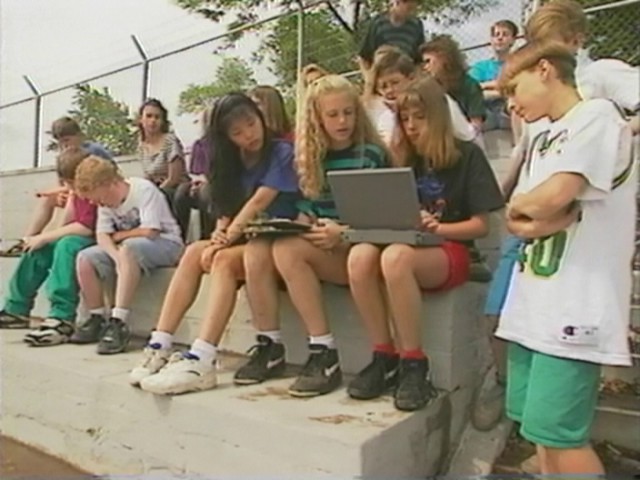
The CTIA Foundation's Mathline uses wireless laptops to bring math lessons, problem databases, and expert advice to schools without phone or cable access. Teachers can access lesson plans and collaborate from classrooms or field trips, connecting math to real-world problems and helping students prepare for the global marketplace.
Chapters
Got it? Almost. Give me one more piece of tape.
Okay.
Come on, let's try it out!
Okay.
2 plus 4?
6!
18 minus 3?
15!
26 plus 11? 36! I mean 37! 8 plus 7! What do we do now? Wouldn't it be great if we could do this without any strings?
What would the ratio be?
Subtract this from the 456.
Be sure to have the x and y axes 2a plus 6 times the quantity b minus aj.
A revolution is taking place in the way we make information available. Wireless communications, technology that converges computing, electronics, and communications onto the information superhighway. Yet there are thousands of buildings in our country with millions of people in them that have no telephones, cable television, Or any prospect of communication services. These buildings are our schools.
Today, many students have no access and no immediate hope of access to the information superhighway. All of us need to bring all of our schools online. To use creative means to ensure that all children and all teachers can use these new technologies for their benefit and for the benefit of our entire nation.
Today, wireless technology is providing that critical connection by linking our nation's teachers and the informational resources they need to do their jobs more effectively. For schools that are isolated from their state and national teaching community because they cannot afford to go online, wireless communications is the solution. For many schools, this powerful cellular connection is already enhancing their efforts at educational reform. The CTIA Foundation for Wireless Telecommunications, supported by your local cellular telephone company, is funding the development and delivery of a nationwide mathematics curriculum. called Mathline. Mathline teachers are using wireless laptop computers in an interactive mathematics program. The idea is to overcome the logistical and financial barriers to accessing electronic information faced by our nation's schools. This innovative connection to Mathline breaks down the walls of the classroom through cellular technology, the same technology connecting today's over 20 million cellular The CTIA Foundation grant harnesses wireless power to provide a math electronic resource center for teachers. Teachers access data for problem-solving projects, lesson plans, databases, collaborative projects with other schools, and advice from mathematics experts. At demonstration sites nationwide, teachers are able to access these resources at times and locations convenient for them. The wireless network The classroom, the teacher workroom, on field trips, or at home. This enables them to increase their effectiveness in the classroom because they have the flexibility to better prepare the subject matter.
Professional conversations mean a great deal to me. It gives me access to all the courses that another teacher has taken that I haven't been able to take. First of all, I'm going to work backwards. I'm going to work with solving the proportion first, And then later, how do I write it? Their ideas keep us from each reinventing the wheel. One person's good ideas can be shared by many others, and we don't have to all struggle to come up with it ourselves.
The power and productivity that makes Mathline possible is revolutionizing the classroom by allowing teachers and learners to connect in an economical, wireless way to the riches and realities of the outside world. Additionally, wireless technology opens the window to how worldwide communications will be carried out in the future.
Teachers have to evolve, and we evolve with the technology, we evolve with society, we evolve with the children. This communication is a 2-way situation. You try to discuss new methods and new ideas.
Once you do your subtraction, now you're taking it out as a fraction because this is 4/56. This would just open up whole new worlds to people in terms of accessibility to information and ideas and could make the classroom much more interesting.
There's a huge capacity for our students to learn math. I believe that all they really need to do is be motivated, be given an opportunity to see math work in a real-life situation, and be able to apply it to something that they are familiar with. If I'm excited about it, then they're excited about it.
Wireless connections, powerful and productive technology enhancing education from coast to coast, demonstrating the nation's ingenuity and commitment to reinventing the way our children learn and to giving them the mental tools they need to succeed in the global marketplace of the future.