Paul Holland at the White House 2009
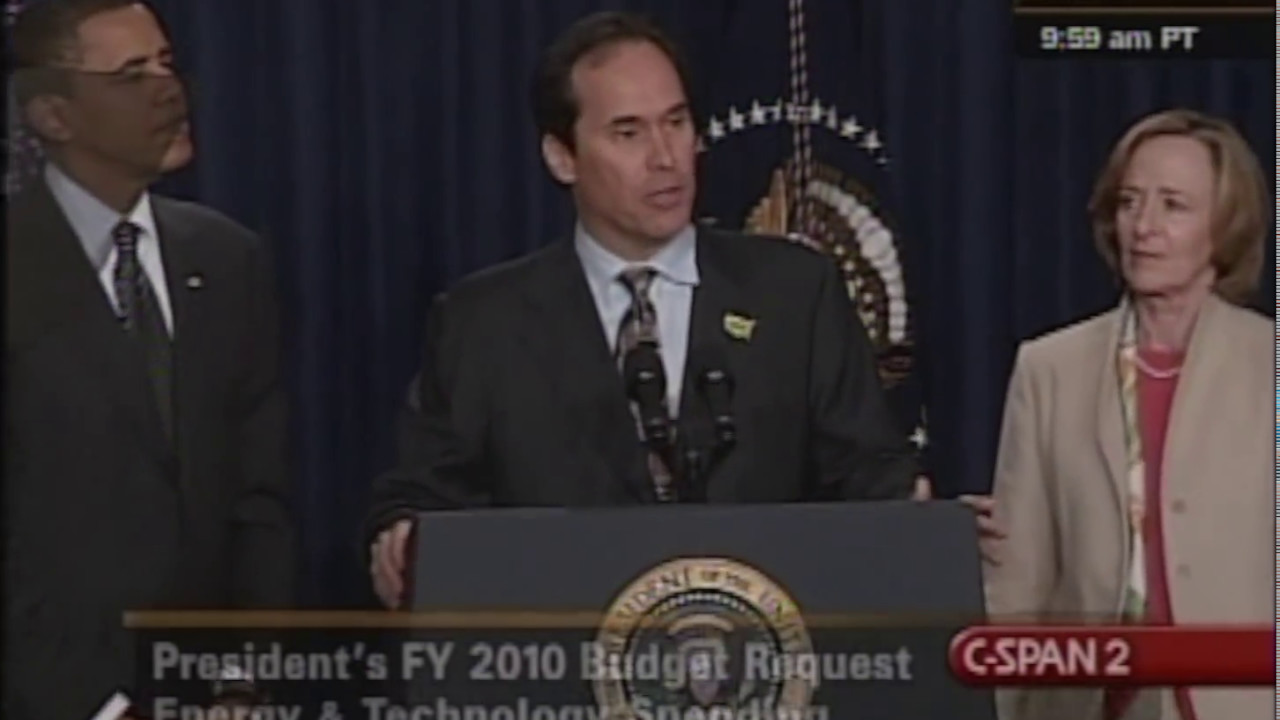
The video records a live White House event in 2009 where President Barack Obama, MIT President Susan Hockfield, and venture capitalist Paul Holland discuss the federal government’s clean‑energy strategy and its role in economic recovery. Hockfield frames the historic scale of the administration’s $39 billion clean‑energy investment—$6.5 billion for R&D—as the largest science‑technology commitment since the Apollo era, emphasizing the 40‑to‑1 economic return of energy R&D. Holland represents Serious Materials and the broader cleantech venture‑capital community, highlighting green‑building products (high‑R‑value windows, EcoRock drywall), the reopening of a Pennsylvania plant, and the importance of the federal R&D tax credit and ARRA incentives for creating green jobs. President Obama then outlines his FY 2010 budget, proposing $150 billion over ten years for clean energy and a permanent research‑experiment tax credit, along with a zero capital‑gains tax for small‑business investments. He cites examples of companies—Solyndra, Orion Energy, McKinstry, PV Powered, Bombard Electric—illustrating how federal support spurs job creation, innovation, and a transition away from foreign oil. The narrative weaves together policy proposals, economic arguments, and real‑world case studies to make a persuasive case for sustained federal investment in clean‑energy R&D and the private‑sector ecosystem that will drive the next wave of American jobs and technological leadership.
Chapters
We're going to leave this recorded program and take you live to the White House. President Obama will talk about energy and technology spending in his fiscal year 2010 budget request. We'll hear about tax incentives for alternative energy and more. Live coverage on C-SPAN 2.
Good afternoon.
Good afternoon.
President Obama, ladies and gentlemen, I'm Susan Hockfield, and as president of MIT, I bring a perspective from America's research scientists and engineers. We're focusing today on clean energy and the truly historic investment in clean energy research, development and technology that President Obama is advocating for the nation. His stimulus bill makes a major commitment to new energy technology and energy efficiency, $39 billion overall, including $6.5 billion for R&D. The FY '09 appropriations bill and the president's FY '10 budget make further increases in energy R&D and key clean tech programs. Let me be clear. With these R&D commitments led by funding for clean energy technology, President Obama is challenging the nation to make the largest and most important investment in science and technology since Sputnik launched the Apollo program. Those Sputnik-era investments spawned a set of technologies that have transformed our lives and workplaces. From the internet to desktop computing to the guidance systems that enable modern air travel to the satellites that drive the GPS systems on our dashboards. The energy R&D technology investments that President Obama proposes have equally profound potential as economic catalyst. That would be good news in any economy, but of course today it provides a lifeline. The best route out out of recession is fundamental economic growth. And since World War II, the largest and most important source of U.S. economic growth by far has been technological innovation, much of it springing from federally funded research in universities. Today, with the world clamoring for alternatives to business-as-usual energy sources, investing in energy R&D and technology represents our best strategy for long-term economic recovery and lasting growth. A 1997 PCAST report from a committee chaired by John Holdren, the president's new science advisor, estimated that every government dollar invested in energy R&D returns 40-fold to the economy in energy efficiency, energy savings, and in new technologies— a 40-to-1 return on investment. Not incidentally, these same investments also offer the only route to the breakthrough technologies required to address the daunting challenges of energy security, rapidly accelerating energy demand and climate change. And as an added bonus, solving these challenges has captured the imaginations and ambitions of young people, students at MIT and across the nation, young scientists and engineers passionately committed to inventing a bright, clean energy future. Let me close by bringing this abstract policy discussion down to the level of actual technology breakthroughs emerging from the laboratories of America's great research universities and labs. At MIT, we've made energy a major focus. The creative brilliance of our faculty and students is producing breakthroughs with huge potential. And as you can see from the display back here and out in the hallway, I brought a few samples with me today. We have some innovations that turn windows into highly efficient, cost-effective solar cells. We're also working to make electric cars truly viable by inventing new materials that make batteries longer-lasting, safe, and rapidly charging. We can now think seriously of charging an electric car's battery in the same time that it currently takes for you to fill your car's gas tank. We're developing quantum dot light bulbs that are 500% more efficient than incandescent bulbs. with no sacrifice in light quality. And we're bringing biology and engineering together using benign viruses to make thin, transparent, nontoxic, lightweight batteries. And we're mimicking photosynthesis, nature's own solar cells. We're also developing safer and more effective and more efficient nuclear power technologies and exploring strategies to capture and sequester CO2. All of these new possibilities represent the fruits of federally funded research. With President Obama's new commitment to farsighted, stable federal support, America's finest scientists, engineers, and entrepreneurs will transform advances like these into an energy technology revolution. For Americans out of work today, new green jobs will help. But for tomorrow, We need new green industries. And the only way to build those industries is by inventing— investing ambitiously now in basic and applied research. Thank you, President Obama, for championing the historic investments in energy R&D and technology that will put this nation back on the road to lasting economic growth. I now turn—
Thank you.
I now have the pleasure of turning the podium to Paul Holland, a board member for the company Serious Materials. He heads the clean tech practice at Foundation Capital, a leading Silicon Valley venture capital firm, and the first VC to build a LEED Gold office building. Mr. Holland.
Thank you.
Thank you very much, Dr. Hockfield. Thank you, Mr. President. Thank you, Greg, and all the organizers today. This is really well done. My name is Paul Holland. I'm here today representing Serious Materials, the leading provider of green building materials that save energy, save money, and aggressively address climate change. Our high R-value Serious Windows and Serious Glass products deliver 4 times the energy-saving performance of today's Energy Star window, reducing heating and cooling costs by up to 50%. Our EcoRock drywall product is 5 times more environmentally friendly than traditional gypsum, reducing the carbon created during production by 80%. At Serious Materials, we are dedicated to reinventing the American building materials industry with a full commitment to green solutions while reemploying today hundreds and tomorrow thousands of American workers. Some of you may know that Serious Materials is in the process of reopening a series of plants shut down by the housing crisis and the resulting recession. Most recently, we opened a plant in Vandergrift, Pennsylvania, on the site of a former traditional windows company that shut its doors last year, in the process devastating the economy of this small western Pennsylvania town. Beginning last week at a ceremony attended by Pennsylvania Governor Ed Rendell, Serious Materials started making its green product line with the help of newly reemployed Vandergrift windows plant workers. In fact, Chuck Wetmore, Who's our plant manager, and Robin Scott, one of the workers re-employed last week by Serious, are sitting here today. Chuck and Robin drove half the night to be here today to help highlight the reopening of the plant. Thank you, thank you, thank you. I'm here for Serious Materials today, but also as the former president of the Western Association of Venture Capital. I'm also here to represent venture capital and in fact the entire cleantech industry. American venture capital firms like my firm, Foundation Capital, have poured billions of dollars of private investment in green infrastructure companies like Serious Materials and CalStar Cement; smart grid companies like Silver Spring Networks, eMeter, and EnerNOC; transportation efficiency companies like Navras and Fisker Automotive; and renewable energy companies like Sunrun and Solyndra, which, as many of you know, just received one of the first disbursements associated with the American Recovery and Reinvestment Act. Thanks to President Obama, our friend Steven Chu, and Matt Rogers over at the Department of Energy. And I know the CEO of Solyndra is here today, so it's great to see you guys. Over the last 30 years, venture capital-funded companies as diverse as Amazon and Cisco, Google and Microsoft, and Intel and Netflix have employed tens of millions of Americans in high-paying and rewarding jobs. Simply put, many of those companies would not be where they are today, beginning the reinvention and reinvigoration of American business and American manufacturing, were it not for progressive federal policies such as the federal research and development tax credit and the ARRA, the stimulus package. Business provides over 2/3 of the research and development funding in this country today, and the federal R&D tax credit is a crucial tool for business. Today, over 11,000 American companies use the federal R&D tax credit, and many of those are small, growing companies with less than $1 million in assets. 60% of the R&D tax credits were claimed by manufacturing companies like Serious Materials. Companies use the federal R&D tax credit to offset expenditures for R&D, which allows them to hire more people into good-paying jobs in private industry. In addition, thanks to provisions in the ARRA related to weatherization, green federal buildings, and a $1,500 tax credit for consumers who buy our energy-efficient, high R-value windows, Serious Materials will be able to hire even more workers more quickly just when this country needs new jobs and, more importantly for the environment, green jobs the most. Every one of America's major trading partners and global competitors offers some form of federal R&D tax credit. Simply put, American businesses like Serious Materials would be at a major disadvantage in the global business arena without the federal R&D tax credit. With that, it is my distinct honor to introduce the President of the United States, President Barack Obama.
Thank you. Thank you. Thank you so much. Thank you, Paul, for talking about the work that you're doing at Serious Materials, and thank you, Susan, describing the research that's taking place under your leadership at MIT. I have to say that Susan made sure to tell me not to touch anything on the table.
That's a good idea.
So I was going to do some experiments for you today, but we decided not to. Finally, I'd like to thank everyone who's here today for joining us this afternoon. I want to introduce A few people on our team that are critical to this effort. As was already mentioned, John Holdren has now been confirmed as our White House Office of Science and Technology Policy. Carol Browner is here, assistant to me for energy and climate change. And behind her is Nancy Sutley, Yes. Who is the Chair of the White House Council on Environmental Quality. So thanks to them. Thanks to all of you for coming. Welcome to the White House. We gather at a challenging time for our country. We face an economic crisis unlike any we've known in a generation. We've lost 4.4 million jobs since this recession began. Millions of families are at risk of losing their homes, and tens of millions more have lost values in their homes. Our financial system has been severely undermined by the collapse of a credit bubble that was— is as irresponsible as it was unsustainable. Now, many of you in this room I know are experiencing this crisis in one way or another. Perhaps you've won fewer investors than you'd hoped, or you've Perhaps you've lost customers. Perhaps you've earned lower revenues than you expected. Perhaps your share price has fallen, or the cost of securing a loan has risen. But you're also helping us to overcome this crisis. Paul's company, Serious Materials, just reopened, as he mentioned, a manufacturing plant outside of Pittsburgh. Last year, that factory was shuttered and more than 100 jobs were lost. The town was devastated. Today, that factory is whirring back to life, the folks who lost their jobs. And these workers will now have a new mission— producing some of the most energy-efficient windows in the world. We've got other examples in this room. Deepika Singh— where is Deepika? Is she here? There you are, right there. Deepika is here from Gainesville, Florida. She's the founder and president of SynMat— did I pronounce that correctly?
Yes.
—that's developing new ways to manufacture microchips that can help power smarter energy systems— from more fuel-efficient hybrid cars to more responsive, efficient lighting for homes and businesses. So these are the stories that are being told all across our country. I remember during the campaign I visited McKinstry Company in Seattle, which is retrofitting schools and businesses to make them more energy efficient. McKinstry is expanding and expects to hire as many as 500 new workers in the next few years. I visited another company, PV Powered, a company developing more reliable solar technology in Bend, Oregon. And then there was Bombard Electric in Las Vegas, which is building up Nevada's renewable energy capacity. And just last week, I visited the Electric Vehicle Technical Center in Pomona, California, which is testing batteries to power a new generation of plug-in hybrids that will help end our dependence on foreign oil. I have to say, Susan, the battery I saw was bigger than that one that's on the desk. But that may be the direction we're moving. So innovators like you are creating the jobs that will foster our recovery and creating the technologies that will power our long-term prosperity. So I thank you for your work. It's said that necessity is the mother of invention. At this moment of necessity, We need you. We need some inventiveness. Your country needs you to create new jobs and lead new industries. Your country needs you to mount a historic effort to end once and for all our dependence on foreign oil. And in this difficult endeavor, in this pursuit on which I believe our future depends, your country will support you. Your President will support you. My administration has begun implementing the American Recovery and Reinvestment Act, which will create or save 3.5 million jobs, and 90% of those will be in the private sector. Through $59 billion invested in clean energy and in tax incentives to promote clean energy, the Recovery Act is estimated to create more than 300,000 jobs. These are jobs that will be created as we double our country's supply of renewable energy, make the largest investment in basic research funding in American history. These are jobs developing new batteries to power the next generation of plug-in hybrid cars, like those being tested at the facility I visited in California last week. These are jobs upgrading our power grid so that it can carry renewable energy from the far-flung places that— where it's produced to the cities that use it. And these are jobs that will be created through today's announced $1.2 billion for research through the Department of Energy's national labs. As we speak, my Secretary of Energy, Steven Chu, is visiting Brookhaven National Laboratory on Long Island, where recovery funds will speed construction of a laboratory that will help develop materials for new solar cells and other clean energy technologies. Through this plan, we have achieved more in 2 months in support of a new, clean energy economy than we've achieved in perhaps 30 years. And the budget I've proposed builds on this foundation. The budget is a comprehensive strategy to grow this economy. We will attack the problems that have held us back for too long: the high cost of health care, the budget deficit, Our broken education system and our energy dependence. We have a choice. We can choose to do what we've done. We can leave these problems for the next budget or the next administration, but more likely for the next generation. But we've seen the consequences of this failure to take responsibility, this failure to seize the moment. We've seen the cycles of boom and bust. We've seen our dependence on foreign oil rise. We've seen health care premiums nearly double over the past 8 years. We've seen our schools fall short. In other words, we've seen enough. We can remain the world's leading importer of foreign oil, or we can become the world's leading exporter of renewable energy. We can allow climate change to wreak unnatural havoc, or we can create jobs preventing its worst effects. We can hand over the jobs of the 21st century to our competitors, or we can create those jobs right here in America. We know the right choice. We have known the right choice for a generation. The time has come to make that choice, to act on what we know. And that's why my budget makes a historic investment— $150 billion over 10 years in clean energy And energy efficiency, building on what we've achieved through the recovery plan. And it includes a 10-year commitment to make the Research and Experimentation Tax Credit permanent. This is a tax credit that Serious Materials has used to grow its business, and one I'm sure others here today have used as well. This is a tax credit that returns $2 to the economy for every dollar we spend. Yet over the years, we've allowed this credit to lapse, or we've extended it year to year, Even just a few months at a time. Under my budget, this tax credit will no longer fall prey to the whims of politics and partisanship. It will be far more effective when businesses like yours can count on it, when you've got some stability and reliability. I've also proposed reducing to zero the capital gains tax for investments in small or startup businesses, expanding and making permanent one of the tax cuts in the recovery plan. And federal agencies will continue to set aside a portion of R&D budgets for small businesses— because small businesses are innovative businesses, producing 13 times more patents per employee than large companies. Finally, building on the recovery plan my administration is implementing and the budget I have proposed, we will be pursuing comprehensive legislation to finally end our addiction to foreign oil and prevent the worst consequences of climate change, while creating the incentives to finally make clean energy the profitable kind of energy in America. And we know how much promise this holds. Orion Energy Systems is a perfect example, which Neal Werfurth— did I say that, Neal, properly?
Yes, sir.
That you right there?
Yes.
Okay. Neal just spoke to you about this. Orion employs more than 250 people providing energy-saving lighting to Fortune 500 companies, and it recently began work on a new 70,000-square-foot office and technology center. Long before this success, Neal had tried his hand at clean energy. He bought 2 solar panel distributorships, but the manufacturing companies he depended on went under. Years later, he started Orion as a distributor for lighting systems, growing with the help of loans through the Small Business Administration. Then, about 10 years ago, he had an idea. It was in the middle of the night, but Neal hopped in his car and drove to a factory in Plymouth. This was one of those moments when the future refused to wait until morning. He grabbed 2-by-4s and a broom handle, He tinkered until somebody else arrived. He had finally figured out a design for a new lighting fixture that made it possible to produce twice the light using half the energy. But as Neal will tell you, this is when the real work began— seeking capital, seeking customers, seeking the support that would allow him to test and improve and perfect what he had designed. And that took time, and that took patience, and it took creativity. Progress is rarely easy, and I know people in this room understand that. Sometimes it takes months to learn that your ideas just won't work, or years to learn that it will. Sometimes the funding dries up, or the investors walk away. Sometimes you have to fail before you can succeed. And often it takes not just the commitment of an innovator, but the commitment of a country to innovation. Often what's required is the support of government, recognizing that our future is what we make of it. Our future is what we build it to be. So all of you, you are helping us to build a cleaner, brighter future and a stronger, more prosperous economy. And my administration and our country will support you in that difficult work. Thank you.
Thank you.
By the way, I was just thinking about this. I suspect this is Orion as opposed to Orion. But the way it was written up, I just wanted to make sure while I was giving you a plug that we got the right plug. All right, that's Orion. All right, thank you guys. Now we take you live to the next.










