In a 2026 interview, Konstantine Buhler of Sequoia outlines the firm’s investment thesis centered on Specialized Artificial Intelligence (ASI), where AI models are built for narrow, high‑impact domains. He cites 2025 milestones such as Waymo’s self‑driving cars operating ten times safer than human drivers, Anthropic’s cloud‑code agents that accelerate software development, and Harvey’s legal‑tech platform with over a thousand law‑firm customers. Buhler explains that training these domain‑specific models requires massive capital, leading to “coconut” seed rounds that can reach hundreds of millions. Sequoia’s early‑stage strategy focuses on founders who demonstrate deep domain expertise, relentless customer obsession, and the courage to compete against AI giants. He highlights upcoming bets: Verkata, an AI‑augmented physical‑security firm that speeds investigations (e.g., a major airport bomb case), Expo, an AI penetration‑testing startup that rose to the top of HackerOne rankings within 18 months, 11 Labs for advanced voice interaction, and Open Evidence, a healthcare‑diagnostic assistant used by surgeons. Throughout, Buhler stresses the importance of specialization, rapid scaling, and bold founder mindset as the key drivers of value in the 2026 AI landscape.
Chapters
This is your bet for the year you think and where you will focus your investments going forward is in the area of do we call it asi? Specialized intelligence as a place to start. Define that. What is the difference?
Absolutely. Ed, Caroline, thanks for having me. 2026 is going to be the year all about AI capabilities in specialized areas. And we got a taste of this in 2025 in some pretty big important categories. Think about self driving. We waymos on the streets of San Francisco and many other places and many other places. And Those are operating 10 times safer than the average human driver. 10 times safer. Also you see other specialized areas, Anthropic, for example, focused on coding and in 2025 went mainstream with their cloud code product where developers can choose to work with cloud code agents to prototype and even put software into production much faster. We're going to see a lot more of that in 2026. It's going to be software specialized capabilities in many new areas.
Now, how big are the checks then you're going to have to write because what Waymo, Anthropic and even like in the legal sector, like a Harvey, have in common is that they are well capitalized at this point. They had to commit a lot of capital to train those specialized models in the first place and then deploy them.
Absolutely. Well, you mentioned to Harvey, I'm focused on the early stage investing and in the case of Harvey, they started really small. They basically focused on an area and they said, hey, this is an area we're going to be deep experts in. That's the legal area. And they focus on the actual user obsession. They now have over a thousand customers for the legal tech space and they are kind of a right hand person to the lawyer. In fact, one of their customers said, I would sooner lose my coffee for the year than my Harvey license. My sister's a lawyer, she uses Harvey. She'd probably say the same exact thing. 2026, we're going to look back at the end of the year and realize how many areas in AI we just couldn't live without.
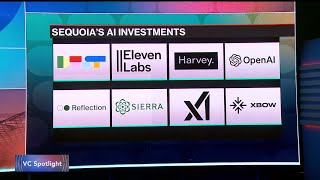
Constantine, where is next? Therefore, because you actually already have made these bets in these very focused areas and applications of AI we just named Harvey. But you're also in 11 labs if you're thinking about the way in which we're going to interact with it from a vocal perspective and create ourselves. But where's next? Where hasn't been disrupted?
Absolutely. I'll give two tastes of what's coming next, one in the physical world and then one in the digital world. So in the physical world, we're investors in a company called Verkata. They are the leading AI physical security company and they, they're basically an extension to those physical security guards who walk around a premise and can now monitor an even larger premise for physical security. They help investigations go 30% faster, dramatically faster. And that sounds like a statistic, but let's make it very real. They were working with a major airport that had a bomb that and they were able to help close that investigation significantly faster. Which means that the airplanes actually boarded flights, got out on time and passengers got to their destination. We're going to see a lot of that now in the digital world. We work with a company called Expo. It's a AI penetration tester. They set out to get really good at finding vulnerabilities in websites and applications. Within six months, they became as good as a human penetration tester, a professional at finding vulnerabilities. Within 18 months, they've actually become best in the world. They're Top ranked on HackerOne, which is the global leaderboard for individual hackers. And they're finding major vulnerabilities at companies, reporting those to the companies, helping them patch them so that the bad guys don't get there. We'll have a lot more capabilities like that in 2026.
What's interesting is how therefore you're going to build and scale at the pace that's necessary. If there's a lot of capital looking for these more specialized areas, there are people building in it. How do you talk to your portfolio companies at this moment? Being like, you need to get that edge, you need to lead the market at this moment because it's an opportunity that's moving fast.
Absolutely right, Caroline. And you know, we think about the word courage. In 2026, there's been so much focus on the frontier for open Air and Anthropic and Google and X. They're doing amazing work. And it can be intimidating for the early stage founder to say, you know what, I'm going to go up and build an amazing big company in the presence of these giants. But we encourage founders to be courageous in 2026. They know areas, deeply know those areas, specialize in that delight your customers and there will be amazing opportunity. For example, in the health care space, we work with a company called Open Evidence, which helps physicians diagnose really complicated problems. In fact, my wife is a surgeon. She uses Open Evidence to help diagnose problems. She takes that extra time and puts it back into patients. That was started by someone who said, you Know what? The health care area is so important that it's going to need specialization, it's going to need these specific capabilities. And they've been absolutely right. That type of courage will continue to pay off in 2026.
I started the week with my column about how there's no point using the term seed round anymore because some of them are in the hundreds of millions of dollars right out the gate with a team of a dozen people. That's the domain that you operate in, but it particularly in the field of AI, how much do you expect that trend to keep happening? You know, you keep saying I invest early, but you know that actually you're not the only person that's looking at asi. And, you know, the whole point is standing up sometimes a research lab from. From scratch.
I loved your article. The coconut round. Right?
The coconut round or the avocado round or the mango seed round.
Yeah. These massive seeds. I'll say how we think about it.
Sure.
First and foremost, we don't think about the size of the seed. We think about the quality of the company. So we take a step back and we look at an AI business. And first of all, we might say, this is an AI business that does X, Y or Z and will cover the term. I will put our finger over the term AI and say, does it still make sense as a business even without AI? That's test number one. And secondly, if it does, then we say, is this the kind of business that we want to spend years really being company builders for? And once we go through those phases, then we look at the financing dynamics and the size of the round and we decide, hey, is this something that we want to do at that scale? I've consistently found that great founders are willing to pick the best possible partners and shape rounds that are smart for the business in the long term and then attract more and more capital in the years to come. That's how we've been approaching these sizable seed rounds.