2️⃣ 🏀 Welcome to the Productivity Madness | Next up is the Home category
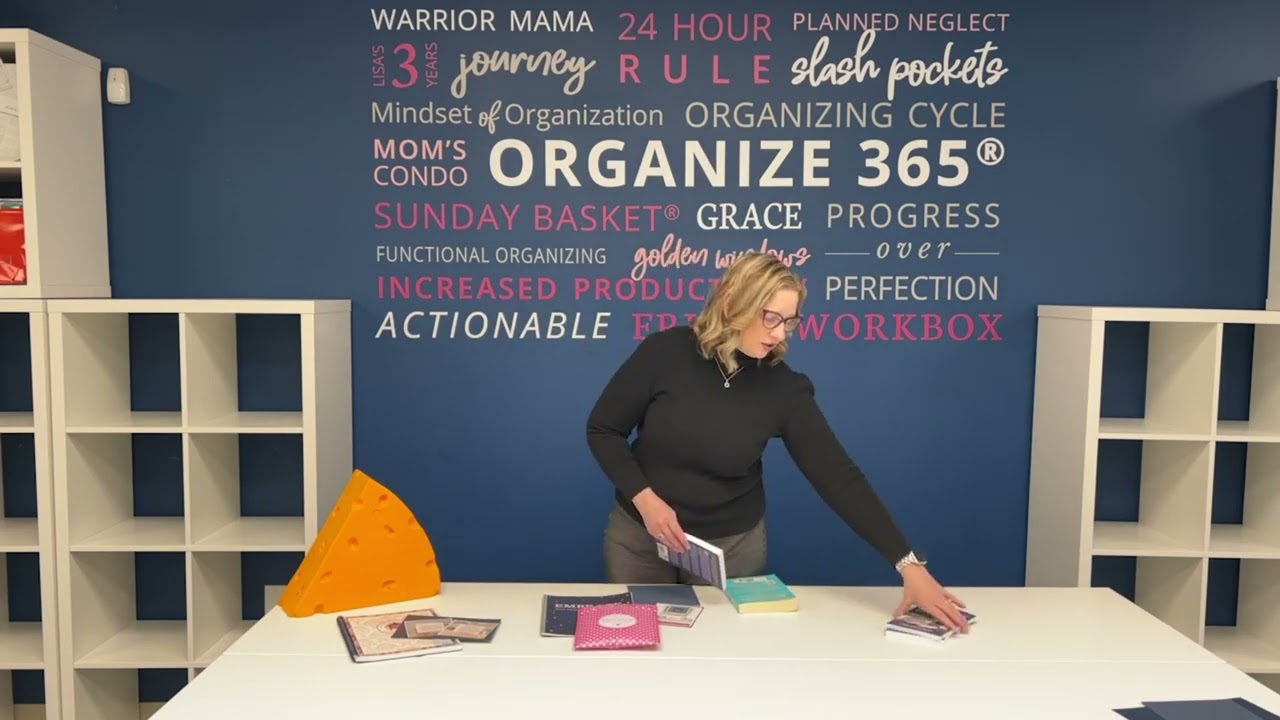
In this presentation Lisa Woodruff explains her approach to home organization, emphasizing that perfectly tidy homes are a myth and introducing the concept of "Swiss cheese organizing"—the tendency to start new projects before finishing others. She outlines her flagship offerings: the 52‑week Productive Home Solution (formerly the 100‑Day Program) that provides a week‑by‑week curriculum, videos, worksheets, community co‑working, and lifetime access; and JumpStart, a 6‑week subset focused on the bedroom, bathroom, closet, or kitchen for people who want quick wins. Woodruff connects organization to personal purpose, stating the Organized 365 mission is to free time for people to pursue their unique gifts. She describes additional services: the on‑demand Embrace Conference (2‑day personal retreat), the Saving Your Story photo‑organizing program, a 9‑year‑old podcast, and four self‑published books covering mindset, ADHD, paper management, and the learnability of organization. She mentions a quarterly virtual book club and a new planning framework called Sunday Basket Home Planning Day, a 4‑hour quarterly event (with an optional 2‑hour prep workshop) that adapts business‑style annual, quarterly, and seasonal planning to household life. Throughout, Woodruff stresses community support, the importance of habit and routine analysis, and the belief that structured planning can replace endless to‑do lists, ultimately helping households achieve lasting productivity and personal fulfillment.
Chapters
What's the matter? You've never seen anybody in a cheesehead before? I wear this ridiculous thing for you to let you know, whoo, you are not alone. We all have Swiss cheese organizing in our house. There, there are no perfectly organized houses, no matter what you see in magazines, on TV shows, on Pinterest, on Instagram. It's a figment of your imagination. I wish these people would just turn their cameras around and show you the room they shoved everything in. When they took that beautiful picture, or they're spending all of their time getting their house to that point where it is going to look perfect because we live in our homes with other people. Do I even need to say anything else? So I have— I was an organized kid. I would organize my room. I organized my mom. She's an artist. I organized our house. I would organize the houses when I babysat. When I was a teacher, I would go into other teachers' classrooms and I organized their teacher closets. Then I started organizing homes in Cincinnati. Like, I love organizing spaces. And here's what I found to be true. You are good at organizing some spaces, but usually not all of the spaces in your house because you're not obsessed with organizing like I am. Like, you like the end result, but you maybe don't love the process of getting there. Like, when the house becomes too much, you're not excited like I am about who I have an organizing project coming my way. You're like, Oh my gosh, I just wanna be able to do what I wanna do. I wanna be able to relax. I wanna be able to enjoy this house. Usually, that's what most people wanna do. So in this first bracket here in the home organizing, we have 2 options here. We've got the Productive Home Solution, used to be called the 100 Day Program. Some of you may know it by that name. So we have that program. This organizes the entire house. I mean, super deep. Soup to nuts. I'm talking you are going to get every single thing in your house organized, all the way organized as a professional organizer would organize. Look at that. It is literally a 52-week curriculum. I sat down and I wrote out a curriculum and recorded videos to walk you step by step by step through organizing your bathroom, your bedroom, your closet, the spare bedrooms. Spare bathrooms, laundry room, family room, kitchen, living room, dining room, storage room, all of it, all of it. The only thing that is not organized in this is paper and children. Other than that, it's pretty much organized in here. And you literally can pick any week, like they're all independent weeks. You go up, that's the week I'm going to start it. Okay. This is— you follow your energy, whatever you want to organize, you go find in here how to organize it. Worksheets come in the printed playbook. You have online videos. There's a community. Tanya has coworking time on Thursdays at noon Eastern, I believe is the time that they're running it. Lifetime program. I know as soon as you get this program, this huge unexpected event is gonna come your way and you're not going to be able to get as much progress done in this as you want to. That's why it's a lifetime program. Like, you literally can do it over and over and over and over again. That ability to keep doing it and doing it with other people keeps people going when they normally would stop. Now, some of you are like, calm down, Lisa. Not everyone needs their storage room organized. Nobody sees that room anyway. Like, I really would be really, really happy if I could just get up in the morning, get dressed, get my shower, get ready, and get out the door and not like trip over things. Forget things, get frustrated with what's in my closet, then you may want JumpStart. JumpStart is a portion of the Productive Home Solution. It is not the Productive Home Solution. This is for people who are like, I just wanna get personally organized, or I just wanna get my kitchen organized, and I may never even wanna do this. These are the areas where I'm gonna spend 80% of my time. Now, I want to give you this little time thought. When you get your bedroom, bathroom, and closet organized, you will be living a 50% of the time organized life. What? It is Lisa math. Here's how it works. You get done at the end of a long day, you go in your closet, you take off your clothes, take a bath or shower maybe before bed, and you get into bed. If all those spaces are organized, you are going to bed organized. You're waking up in an organized bedroom. You go in and you take a shower and you get dressed and you do whatever else you do in your bathroom and you leave your bedroom organized, meaning that for those 12 hours, 50% of your life, you're living organized. You're like, Lisa, that's cheating. You're sleeping some of that time. I know you're sleeping. That's okay. It's no big deal that you're sleeping because you're sleeping in an organized state. Like your brain is literally in an organized state 50% of the time. When you add on your kitchen, 80% of your life is organized because you, after you leave your bedroom, where do you go? Probably to your kitchen to get coffee. That's where I go. At the end of the day, when you come home, what do you do? You go to the refrigerator. What's in here? What's to eat? What can I have? Like, you know, you're in your kitchen, you're in your bedroom, you're in your bathroom. Maybe you're in a couple other rooms in your house, but for the most part, these are the spaces you're in the most. So if you can get these organized, you do end up feeling like you are organized most of the time. I'm going to take the hat off. Swiss cheese organizing. Swiss cheese organizing is when you do this. You're like, oh my gosh, it's such a great weekend. I am going to go take back my closet. And you start to take things out of your closet and then you're like, oh, you know what? I had other things somewhere else in the house that I need to grab for donations. You grab those for donations. You're like, I might as well just go take them right now. Get in the car, take the donations. And then you're like, you know what? I think I'd like a coffee. Go get a coffee, come home. The closet's a mess. This is a mess. Like, You haven't gotten a project finished, but you've gotten more done and you're like, this is never, I'm never gonna be done. Like, it's never done. When you tackle one space all the way to completion, you stop Swiss cheese organizing. The bummer of it is you really do need at least a year, usually a couple years to really get as organized as you want to get. But when you follow a preset curriculum to do it, you can get it done. Jumpstart, these are 6-week programs. Like in 6 weeks, we're gonna get your bedroom, bathroom, and closet organized. It's amazing. Six weeks, we're gonna get your kitchen all the way organized. You can do this. You just might need to have a teacher, a community to support you, and a lesson plan that's already been created by someone who's already done it. Okay, second category in the home organizing. Dun da da da is oh I did in wrong order. I believe. Let's see. Yes. Okay, one of the things, um, that I love, I, I always have from such a young age, is to find what people are uniquely gifted and created to do and then just like fan that flame. Like, I love people and I love the uniqueness of people, and I believe there are a lot of things that we all have to do. You have to clean your house, you have to plan for the week in order to free up more of your time. The Organized 365 mission is not that every home in America would be organized with Organized 365 products. The Organized 365 mission is this. We wanna provide you with products and services that will get you functionally organized so that you can get your time back to do what you are uniquely created to do. And that's what we have in this category here. We have the Embrace Conference. The Embrace Conference was live for 5 years, and while I'm getting my PhD, it is available on demand. So this is a 2-day conference. I'm the only speaker and you have music to listen to, talks to listen to, a workbook to go through. There's a special little gift that you open partway through the Embrace Conference and be watching because we're going to have a fun add-on live component bonus this June so be watching for that. Next to the Embrace Conference, we have the Saving Your Story 4-day conference. Photo organizing program. This is for physical photos. Before I started Organize 365, for 17 years I was a Creative Memories photo organizer. I have made over 300 physical scrapbooks. I love physical photos. I love putting them in archival albums, and I love using the Power Layouts method, which will help you get it done faster. So that is what's inside of the Saving Your photos, story. These are, this is like eating your vegetables and your meat and you have to get organized 'cause otherwise you can't find the keys and get out the door and you're late again. This is cake and ice cream. It's like, I am organized, I am moving into who I'm uniquely gifted and created to be. I wanna have a 2-day personal retreat. I might even take myself to a hotel room so I can watch this with a journal and my favorite foods. Or I have gotten these big projects done, and so I'm gonna take maybe a couple of years and go through all of our family photos and organize them and put them in scrapbooks or scan them or whatever you're gonna end up doing. These are, these are definitely passion projects and things that are available to you once you stop running in the rat race of being organized. You have more time to do projects like this. All right, next in the Organized 365 lineup. Can you tell I like to talk? I'm a big podcaster. The podcast is 9 and a half years old. I've been doing podcasting for 9 and a half years. And during that time, I've also been writing a few books. So we have 3 self-published books, or I have 3 self-published books. The first one I published was called The Mindset of Organizing. And The Mindset of Organization talks about how different generations use their houses differently, look at stuff differently. So the Silent Generation, Baby Boomer, Millennial, Gen X, I don't forget about Gen X because I am a Gen X. We use our houses differently, we look at things differently. And so as I'm organizing multi-generational families, it is helpful to understand the thought process behind how we look at our stuff in addition to how we use our spaces. The next book I published was How ADHD Affects Home Organization. My kids went to a school for language learning disabilities and a lot of the kids there also had ADHD. So the school would bring in renowned experts and I, of course, went and learned and listened to them. I learned a lot about executive functioning and now in my PhD program, I'm learning even more. And as I saw how each of the executive functions as they were defined, as I learned them at the time in the tests that my kids took, I started to see how this disorganization in workplaces and schools Actually is shown in households and some things that you can put in place in households based on which executive function needs support that will help you in getting organized. Then I have a traditionally published book called The Paper Solution. All these books are available anywhere that you buy books, Amazon, you can get them in Kindle version, you can get them in paper version, you can also get them in Audible version. The Paper Solution, we're gonna come back to this one in a little bit. This has all of the information for how to create your own Sunday basket or how to make your own binders. It really is solving the problem of how do you organize all of the information management that we have inside of households that typically is paper-based, but it also is on your computer and in your head. And then the final book I published is called Organization Is a Learnable Skill. This is the story of me in 2012. You may not know it now, especially especially if you did not know me then, but I was not such a happy camper in 2012. As a matter of fact, I was at the end of a 7-year slump of depression and debt and overweight and just, I just was not very happy in my life. I was not very happy in my circumstances. And I woke up in December of 2011. I said, you know what? I'm not gonna do this forever. Like, I'm only 39. I'm not gonna live the next 60 years of my life this disorganized, this unhappy, this overweight, this, you know, all these things. And so if I'm gonna make a change, it's up to me. And this is the story of 2012, starting in January at the lowest I've ever been in my life and ending in December, having started Organized 365, having realized I was a professional organizer and started the service portion of our business and taking back my house. Like, it took a full year and I wasn't totally done at the end of 2012. But in this book, I really— this is the book I was looking for to read. Like, what do you do when you're in your closet? We just talked about organizing your closet. And the problem with your closet is nothing fits because it's not the right size and you have no money to go buy new clothes. So you literally have 3 outfits you can wear and you're just repeating those 3 outfits and they're getting very worn out and you have no financial reserves to go get more money. to get more clothes. And if you were to do what the organizers say, which is take everything out of your closet that doesn't fit, you'd have nothing left. Like, I couldn't look at a bare closet. So how did I solve that problem? I ended up using resale shops is what I ended up doing because the clothes that didn't fit were very nice. And so I sold those and I started to replenish. But I walked through and 3 different times I end up in my closet in that year. And you could see how I'm starting to change my mental mindset. My physical space is starting To change. So if you're like, there's no way, Lisa, you were disorganized, I absolutely was. So that is organization is a learnable skill. Okay, so in our bracket, what possibly could go against 4 published books? I mean, that's, that's a tall order. Like, what here is going to stand next to this? Well, starting last fall, we started taking each of these books and we do one per quarter and we do a virtual book club. It's $12. So you sign up for the virtual book club, you submit your questions in advance, and then for an hour and a half I just sit there and I answer all of the questions that have been pre-submitted based on whatever book we are doing in that book club. So that is the new Organized 365 book clubs. All right, last in this home organizing category is something that is very unique to me. Obviously, like, as you're looking at all of this, you're like, this is a lot. This is a lot. Do we really need this much stuff, Lisa, to organize houses and be productive at home? And I'm here to tell you, yes, we do. And it boggles my mind that more of this does not already exist. Do you realize that you are born and you will pass away someday in a dwelling? Like, you literally live in a dwelling your entire life. You're not in school your entire life. You're not at work your entire life, but you are in whatever kind of household that you're in, your entire life. And yet, we don't have structures and supports and systems for households. We really don't. And the big one, the big one that was a huge game changer for me, and it took me a long time to realize I even did this and then figure out how I could help other people do that, is planning. It's planning and the way I plan. So, the way that I plan at home, I mean, you've probably heard about business planning, but Businesses have annual plans, quarterly plans, plans about the plans, meeting about like offsite plans, onsite plans, meeting, the whole thing, right? And yet at home, we're just like, another day, another day, another day. Maybe if I get done with my to-do list, I'll have more time. Never gonna happen. As soon as you get done with your to-do list, you're going to be bored and you're gonna make a new to-do list. So instead of trying to get done with our to-do lists, we need to figure out like, How do we prioritize and plan all of the things we wanna do, be, and have for our entire lives, which mostly will happen at home? And that is Planning Day. Now, up until this point, huge announcement, big announcement alert, huge announcement alert. Up until this point, Planning Day has been coupled with the Productive Home Solution. The only way to get Planning Day is you had to be in the Productive Home Solution. And as of today, that's no longer the case. It's no longer the case. I realized it was a limitation on my side. It was a bias I had. I know for me, I needed to get my house, my physical space ordered in order to really avail myself of my own planning. However, you may already be organized and you don't need to be organized, or you may be as organized as you want to be and you don't want to be more organized, but you would like to do some planning. So these have now been broken apart. This Planning Day is now called the Sunday Basket Home Planning Day. It is a 4-hour event and we do it 3 times a year. And you're like, whoa, I know. Let me explain. It doesn't matter if you have children or not. Does not matter if you're a parent or not. You were a child, and if you were in the American school system as I was, you naturally, energetically, organically plan. 3 times a year. Once I explain it, it may become clear to you. First of all, there is the August get ready to go back to school energy and planning. Even as an adult, you will buy yourself new shoes, you will get your hair cut, you will go get your annual physical if you're gonna get one because you've been conditioned. This is when I get glasses, this is when I get shoes, this is when I get a fun new outfit for the fall because I'm a human and I live in America and this is what we do in the fall. We get ready and in the fall we are so productive and so August is You will plan your September, October, November, and December. You'll plan your fall and you will plan the fall holidays. Where are you going for Thanksgiving? What are you going to do for your December holiday of choice? And then after your December holiday of choice, there'll be a week, maybe 2 weeks at the end of the year before the new year, and you'll be like, we've got to declutter this house. Even if you're not an organizing, decluttering person, you're like, everything but the cat has to go. Like, everything, everything has to go. Back up the truck, get it out, move it out. You're ready for a new year, new you, freshen up the calendar, and you will do annual planning for January, February, March, and April. As that spring energy hits in March and April, you will start fantasizing about summer. And we don't have a lot of holidays at the beginning of the year. It's— so if you're in a 9-to-5 job, you're like, oh, when is summer coming? I want summer to come. And you will start fantasizing about June, July, and August. Are you going to take a trip? Are you going to— Take off early on Fridays? Are you going to join a pool this summer? Are you going to join a golf league? Like, what are you going to do for summer? And you'll start to plan. And you'll either add May into the first half of that or the second half. Either May will become part of your January, February, March, April, or it'll be May, June, July, August that you'll plan for summer. But now that I've explained it, you do it, right? Yeah. 3 times a year, you're like, okay, this next chunk, this next 4 months, this next 17 weeks, What do I want to accomplish? I just formalize that more in planning day. I literally walk you through for 4 hours. You guys, it's so fun. It's so fun. For 4 hours, we talk about you. Who are you right now? What phase of life are you in? What supports do you need? Do you need more rest? Do you need more projects? Where are you financially? Where are you in your holidays and where the birthdays fall in your family? Where is your time going? Where is your time going Monday through Friday? Where is it going Saturday? Where is it going Sunday? What can you change? What can't you change? We'll look through at all of your tasks, your morning, afternoon, evening routines. Don't check out. No cold plunges here. You do lemon water if you want, but we're not gonna have an 8-hour morning routine. This is like, what are you normally already doing in the morning? Are there any changes you wanna make? Our lives run on habits. 45% of our life is habitual, you guys. 45%. If you don't stop a couple times per year and look at the habits that you have, is what you're doing what you want to perpetuate? I mean, is it? So we take a look at that. Then we look at the work of running a household. We look at our tasks of daily living— laundry, meal planning. We look at cleaning. We look at the Sunday basket. We look at maintenance, all these different areas. This is the last time we're going to be using this planner for Planning Day because I said this from here on really matches the Productive Home Solution. In the fall, we'll have a brand new workbook. She's already in production, she's in final editing, so she will be ready for our fall Planning Day. But if you want to join us for May, you can. This will be a transition Planning Day. What possibly could go up against Planning Day in our brackets? I mean, I I don't know. Well, the short straw is our new planning day prep. I know, 4 hours of planning day. What did I do 2 days prior? I added a 2-hour optional prep workshop. Holy cow, Lisa, how much more can we possibly do? If we're doing 4 hours with you of all this planning, what would you do 2 days prior? Well, 2 days prior, in order to have a really great planning day, it's really helpful to really go through that Sunday basket that we talked about in round 1. And go through all of the possibilities, ideas, and actionables and to-dos that you already have on the mind for your household. Go through your calendar and really look at the next 4 months and really think about what is coming. Look at your finances and really prepare all of the things that you need for planning day. All right. This is our second bracket. When we come back, I'll be showing you all of the products that are going into our third bracket, which is all about work.
More from Lisa






Podcast 726: Time, Money, and the $300 Million Impact of Household Productivity


Parenting Isn't the Only Caregiving Role That's Draining Your Energy #Parenting #Caregiving

Turning 40 Isn't About Age, It's About Responsibility #TimeManagement #Organizing #MentalLoad

The Sunday Basket Saves Hours Every Single Week #SundayBasket #Organizing #TimeManagement

Your To Do List Will Never Be Done, and That's Normal #TimeManagement #Organizing #MentalLoad