3️⃣ 🏀 Welcome to Productivity Madness | Video number three features the Work category
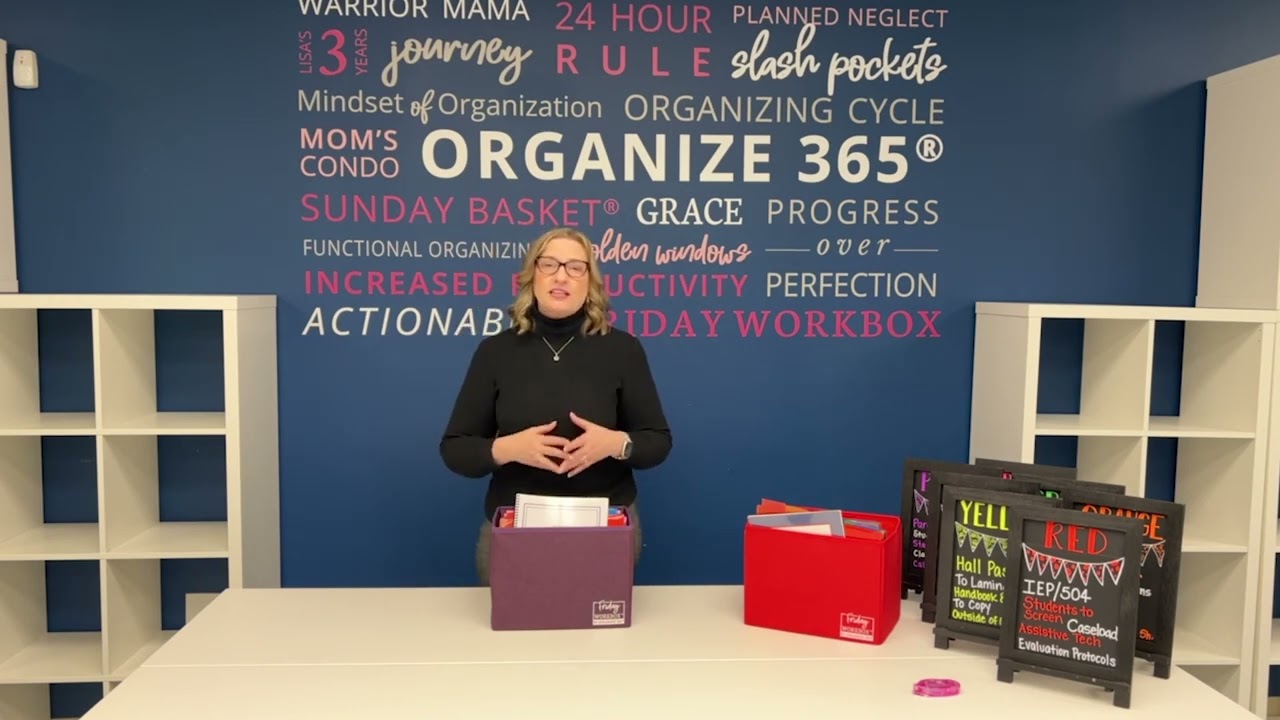
Lisa Woodruff introduces color-coded work boxes for offices and schools that make invisible tasks visible. Teachers pilot the system in Indiana and Chicago; it uses pink for unfunded work, purple for approved projects, green for admin, and blue for meetings. She also launches programs for kids, teens, and solopreneurs.
Chapters
The first time that we did Productivity Madness in the spring of 2022, the teacher work box came out, took a bow, and said, I'm exhausted. I've been through the pandemic. She hadn't been remodeled yet. She didn't have a lot of extras. She didn't have a club. She just, she just did not have the resources she needed. Frankly, as a teacher, she was just depleted, completely depleted. She said, Friday Workbox, I am just going to cede to you right now. I'm gonna go in the stands and I'm gonna stay with my Organized 365 product sisters and cheer you on from the sideline. And hopefully when we come back and do Productivity Madness again, I will have been given some of the love that I deserve. And yes, Teacher Workbox, you have been given some of the love. So the Teacher Workbox came out back when all the other products came out in 2018. But I really hadn't, didn't have the time to really devote to really making visible the invisible work that is done for teachers. We're now in the work category here, the Organized 365 products. We're moving outside of the house and inside of this category, we're gonna talk about all the products that we have that will help you get organized and make visible the invisible work in your paid jobs. In this first bracket, we have the Friday Work Box and we have the Teacher Friday Work Box. Lots of similarities, but education's just its own little bird, okay? Like, there's some things in education that you don't have in corporate America, and frankly, if corporate America knew, they'd be like, we should probably fix that. So let's start with the product that has been inside of Productivity Madness before, the Friday Work Box. The Friday Work Box is really an extension of the Sunday Basket. Once you understand the Sunday Basket, It will make complete sense to do the same thing in your paid job. Again, just like the Sunday Basket, you get a playbook. There is a club. It happens at— I think it's 3 o'clock Eastern, 90 minutes on Fridays, about 42 weeks out of the year, run by Steph. You get a physical box. You get those same slash pockets we talked about in the Sunday Basket. You said you get a set of rainbow. Now in work, sometimes you'll label those the same as we do in the Sunday Basket. A lot of times people will label them Monday, Tuesday, Wednesday, Thursday, Friday. So these are the things you do each day of the week, especially if you have a job where there are certain things you do on certain days of the week. And then the pink, purple, blue, green— the categories are going to change just slightly from the Sunday Basket, but they have the same basis. So pink again is going to be your color. That's whatever you do. It's also whatever is not visible to your customers yet. So if you're a service business, this might be a service delivery, but you haven't launched it yet to your customers. Or if you're a product company, this may be products that are in development. So pink is visible inside of the company, but it's not visible to people who are looking outside into your company. It's kind of secret. And once pink projects are greenlighted, you're like, this is the thing, we're going to do it. It becomes purple. Purple is the work that is very visible inside of companies, and it's the— and it is the work that is usually measured. KPIs, quarterly objectives, all those planning meetings I mentioned in the last video become purple projects. Here's the thing, pink projects become purple projects, and how do they become purple projects? 2 things, when 2 things happen to a pink project, it becomes purple. Number one, financial dollars are invested, and number 2, a deadline is set. So if you have a potential lead of a customer and they sign a contract and give you a deposit, they become purple. But until you get money, until they sign on the dotted line, they're pink. The biggest thing that the Friday Work Box supports you in is making the invisible work visible and also managing the amount of purple projects or customers you have at any one time. As a professional organizer in people's homes, I often would rabbit trail into their office places after we got their houses all organized. And the number one problem that I saw was there were way too many purple projects, purple things that had been greenlighted inside of the company without enough time to support those initiatives. And the time that the company thought was available for these purple projects was in these blue and green slash pockets. This is where you spend 50% of your work week. At least, at least some people, you're spending 75, 80% of your work week in blue and green. You're like, I don't even know what blue and green are. What are you saying that I'm doing? Green is the administrative repetitive tasks assigned to your job description. So whatever you were hired to do, um, it could be financial, it could be checklists, it could be whatever. Like you were hired to do something inside of the company. And unless you are 100% in service delivery, you are spending some time doing your job that is not billable hours, AKA email. Do a time study. Don't do a time study, you might end up crying. We spend way too much time in email. Inside of Organized 365, we don't spend that much time internally in email, but we still have external email coming our way. So email and your job description is the green work. For many employees, that is gonna be almost 50% of your job right there. Once you really get down to, oh yeah, but it's invisible to your employer. Literally, I am an employer. I will hire you to do a job and then you will do the job and I'll be like, why aren't you working on my project? And you'll say, because I'm doing all the administrative work of the job that you hired me to do. And I'm like, oh, forget all that. Do the project. 'Cause I'm a visionary. I'm a CEO. I'm, I'm an entrepreneur. We forget how much work it takes in order to do the work. Then the blue work. Do you know what the blue work is? People. Meetings. Meetings. They're necessary. I have them. I think I'm in 4 meetings per week, which you could say is a lot of meetings. But for some companies, that's like, well, just getting started. How many hours are you in meetings? And when you're in meetings, how many of those You know, when you look at your meeting hours, you need to double them. You need to double them because you have to get ready for the meeting, you have to get to the meeting even if it's on Zoom, you have to attend the meeting, then you have to do the actionables to follow up from the meeting. Meetings. Once you make visible the invisible work and realize there is purple, blue, green, and pink work, and that your purple work is usually, if you're lucky, 20% of your work week, which is only 8 hours, you start to become much more realistic about the things that you say are going to be purple, the projects that are gonna be purple. And as administration and as managers, you then become more judicious and more ruthless at canceling meetings, canceling reports you don't need, canceling portions of job descriptions that worked 5, 10, 15 years ago but aren't even necessary anymore. Because only you as the manager or CEO can reduce the complexity of work. Your employees cannot do that. So So as a manager, this helps you see where the workload is in your staff. As a staff member, this helps make visible the work that you're doing so that you realize, wow, this is why I'm never done at the end of the day, is because I'm spending 2.5 hours on email every day. What can we do to stop that? So that is the Corporate Work Box. Works for pretty much any job. Teachers need a little bit of support. Do you notice the peanut gallery here? Hello, peanut gallery. Hello. So this peanut gallery was created this summer when we launched the new teacher work box. We also did a pilot. A whole middle school in Indiana got— all the teachers got the teacher work box. We did another pilot with a portion of teachers up in a Chicago school. We had some kids going through a kids pilot. We did a lot of testing of the Sunday Basket in the fall of 2023. And these chalkboards have made it to multiple presentations. This is just a, a small Small amount of the invisible administrative work of teaching. Here's what's unique about teaching and work is I went through that. You're like, oh yeah, I do have email. Oh yeah, I do have meetings. Here's what I'm trying to make visible to non-teachers. Teachers are exceptional at their job. Like, no one goes into teaching like, I think maybe I'll have summers off and make a lot of money. No, obviously they're called, they're— They're amazing at what they do. They're called to teach what they teach, to do what they do. And so, I believe that teachers really don't need support from Organized 365 in lesson planning, grading, or teaching. Like, that's what you went to college for, that's what you're uniquely gifted for, like, great. This, all of this, all of this, not teaching, not grading, not even parent conferences. This is all additional work on top of teaching. And having been a teacher, I know this. Everything in academia is for the pupil. And so if it doesn't serve the pupil, it doesn't have funding. I'm here to say that people teach the pupils. And those people, those teachers that teach the pupils, need just a little bit Of administrative support for all of this invisible work. And you're like, oh, come on, Lisa, what could it possibly— what could the invisible work possibly be? I'm so glad you asked. So again, you get a set of rainbow slash pockets in here, and most teachers do label these Monday through Friday because there are certain things that they do Monday through Friday. Just like with all the other Organized 365 products, you've got a physical box, you've got a playbook, you've got an online course, and New, new teacher camp this summer. We're gonna extend it across 2 and a half weeks. It is included in the purchase of the box. Every single summer we're gonna be doing it, this summer going forward. And Labor Day to Memorial Day, all except for a couple of weeks, I think we only take 4 weeks off, there will be a teacher coworking time. So the teacher work box, she really is getting supported in the administrative work that she's doing. So let's talk about what it is, because you may still be like, all right, I can think of a couple of things, but how in the world? Why do teachers have even more slash pockets than the corporate? And you're saying this isn't even the grading? This isn't even the teaching? No. I know, right? Mind-blowing. The first color is red, and red is the IEP color. And if you're in school, you know, and if you're not, I'm gonna tell you. IEP is an individualized education plan. If a student falls a certain amount behind their class, they can qualify for an individualized education plan where their academic is tracked and more additional supports and accommodations are given for those students so that they can, you know, catch up. The percentage of children on IEPs right now From what I'm observing in schools, I don't have a hard statistic on this, is somewhere between 25 and 30% of each class. This isn't just a one-off, people. This is, you know, a large percentage of the class. There are legal things that need to be done for each of those children on a regular basis. That is the first thing inside of the education work box. And in my opinion, back when I was teaching, the thing that I worried about the most, stressed about the most, I tried to get an organization on when we did the pilot program. It was the area where we supported the special educators. We created 2 more workshops for them, and we— they needed an additional box. They had such a big mental load around supporting those students. Orange is going to be the color for calendar. So this is where you can put your ideas for different months. You have an idea for a month, but you're not in that month. You can put the idea there. This is where you do anything, just like in the Sunday basket, anything that you need to add on the calendar. It's also anything related to the computer. So in the lower grades, what some of the teachers will do is create lists, class lists, and have the passwords for all the kids. So when you're in the science program and your 2nd grader forgets what their password is, you just grab out the list and look at the password. Didn't think about they have to keep track of all the kids. I can't even keep track of my own passwords. Can you imagine keeping track of all the kids in your class's passwords for every single class they're in? And everything is digital now. Mind blown. Yellow is for anything that's outside the classroom. Got to go make copies. We're going on a field trip. Here's our fire drill policy. These are the things that we're going to do with the volunteers. Anything related outside of the classroom. Green is good. This, you could do grading in here. You could do checklists in here. This is going to be your administrative work for your grade level, for the things that you need to support you. Do you remember what blue is? Meetings. So it's going to be school meetings, district meetings, grade-level meetings, your handbook. Fun fact, when you're a teacher, you're given a handbook when you become a teacher. At least you were when I was teaching. And then you had to always know where that handbook was at all times. And give it back when necessary. Purple is the color for students. So this is where you would keep class lists, any food allergies, any discipline programs, any of that. Yeah. Yeah, it's like you're the mom too, or the dad. You've got to do the discipline in the classroom as well. And then pink, this is again the color for you. So pink is the color for me. This is where you keep your ongoing continuing education. Yeah, teachers go to college. To teach our kids. And then they have to go back to college. Like, they do so much. And just right here, if you are a teacher, you're like, yeah, that's right, that's what I do. Or if you have a different paid job, you're like, yeah, that's right, that's what I do. Can you just see right here how both of these systems are making visible the invisible work first to you? You may not even have realized this is how much work you were doing in your job, and you didn't have a way to articulate To your boss, or if you are the boss, to articulate to yourself why you need to hire somebody or why you need more support. So these really are your administrative assistants. That is round 1, Business Work Box versus the Teacher Work Box. Good luck, everyone. All right, round, the second in this bracket, second category in this bracket. Now we're gonna talk about the students that the teachers teach. We have 2 programs here at Organized 365. Remember, I was a teacher. The first one is called the Kids Program. It's 100% digital. It's online. I literally, lesson by lesson, you could just plug it in, put your kid in front of it, and I will teach them how to organize, clean, organize their bedroom, how to respectfully share with you what they do and don't like in their clothing so that we cannot waste our money on clothing that kids are not gonna wear. Real easy. Their favorites are already in the laundry, so we deal with whatever's left in their closet. I have 5 lessons on that. And then at the end of the kids program, after we get our whole bedroom clean and organized, we do our Saturday and our Sunday activities, and they both have checklists. I know you thought the way I thought. I can't wait to be an adult because when I have my own house, no one's going to tell me I have to clean my room on Saturday. You have to clean your whole house on Saturday, and you're like, oh darn it, I thought I was going to get out of this. This is just part of life. Housework is part of life. So cleaning your bedroom as a child is the proper size organization space for them to be cleaning and for them to take ownership of. We call it our mini apartment. And then adults, you have to clean your condo, your apartment, your townhouse, your farmhouse. Whatever size dwelling you purchase is also going to be the size dwelling that you have to clean and maintain on Saturday. So on Saturday, We have a cleaning checklist. Cleaning for me means you can run a vacuum cleaner. If you can run a vacuum cleaner on the floor, we're to the cleaning status. So that's cleaning. On Sunday, I teach them to plan. That's right. Starting at the age of 7, and there are children who are younger than 7 doing this, we plan on Sunday. You may say, where's the Sunday basket in the kids program? Your child's Sunday basket is is their backpack. So they empty out their backpack like you as an adult empty out your Sunday basket. I'm waving up here. You can't see it because that's the bracket where the Sunday basket is from round 1. They clean out their backpack. They look at their week. They plan their week on paper. Now, here is the second part of the kids program, which we call Launch. Launch does come with a physical Sunday basket. It also comes with one set of 1.0s because there are some weekly tasks that they need to do. They get started using that Sunday Basket system only using these slash pockets. They don't need the other colors yet. Launch starts around the age of 15 or 16 and goes until about 25, 29. I like to say that you can stay in the Launch program until you do one of two things, and marriage is not one of those two things. The one of two things is you buy a house or condo, or you have a child. You do those things, you're going to move into the systems that I'm going to show you in the next video. But if you rent and don't have children for a while, you can stay in Launch for a long, long time. Because inside of the Launch program, we're going to have a little bit of each of the binders that you're gonna see in the next round. So I'll explain more of that next. A little bit of Financial, a little bit of Medical, and a little bit of Household Operations. So this is the Launch bundle, Kids and Launch. Next, here are some supports that are really great for you in a business setting. If you're in a business setting, if you're a manager, solopreneur, or a CEO, these are going to be very helpful for you. The first is the Meeting Mastermind. So Steph runs the Meeting Mastermind. It's a live class. Where you will watch videos that Steph and I recorded a couple years ago in the very first round of the Meeting Mastermind, where she and I talk about all the different kinds of meetings that you have, why to have them, what the purpose is. And then you'll get the Organize365 Google Doc meeting agendas, and we'll teach you how to use those to reduce reporting out in meetings, aid in holding people accountable without having to verbally hold people accountable, virtually eliminate email between team members inside of your company and more. So that is the Meeting Mastermind. You join it live and you do it with Steph and the people who are in the Meeting Mastermind. And just like everything else, it's a lifetime program. So once you join once, you're then able to go through the live sessions each time. We run one session in the spring and one session in the fall. The second product, uh, I created back in my creative memories. Direct Sales Days. And this is an income and expense binder. This binder helps you keep track of your income month by month, so you can see your profit and your loss right on page 1. And then every single month, you keep these in your work box. Every single month you keep your receipts. And at the end of the month, you're going to fill out your expense tracker. You're going to fill out your income tracker, and you're going to fill out your mileage tracker. The unique thing about this is Again, it's all from a common pain point. I would keep all my receipts. I would keep all of my notes. And then every February when I'm getting ready to talk to my CPA, I had to try to remember what the categories were on the Schedule C on my IRS tax return because I was an LLC. These are the Schedule C categories on your tax return. So this is set up that if you complete this every single month, When you get to February, you could go like this. Here. And you can hand it straight to your CPA, or you can go on TurboTax and do your own taxes. It literally is the easy button for doing your taxes. Here is an example of a month that I have in here. Again, you just put all of your receipts in here, all the information in the back, fill it out. And this is the substantiation you would need if you are ever audited. So what I do is once this one is done, I just put the year on the spine and I have 7 of these. So you need one per year. You need to keep 7 years worth of your taxes. Okay, last category, last in this round. Same as the end of the last round of home organizing, we're gonna talk about planning. You're like, wait a minute, didn't you just say in the last video That we're planning with you 3 times a year, 4 hours at a time? Yes, but that's for your home life. Now we gotta plan for work. Remember I told you we plan for work? So this is planning for work, 4 hours, 4 times a year. Oh, it's so fun. It's so fun. Again, we're gonna start out talking about where are you? Where are you as a worker versus where are you as a person? When you do the home organizing, we're talking about you as a person, Your age, your stage of life, your family makeup at that time. When we do this planning day, we're talking about you as a worker in a company. What is your role? What do you want your role to be? We're doing your beginning of day, midday, and end of day routine. Remember I told you 45% of what we do is habitual? Same at work. Like when we were talking about that green work and how much time email takes. It's never going to take no time. But it could take less time. How do we make it take less time? And then each time that we go through the Friday Work Box, because we're planning day, because we're gonna do it 4 times, we go through all of these colors and we plan them. But I deep dive into one color every single quarter. So once you get through a full year, you've really gotten deep diving into each color, and there are just so many. Go to the Organize 365 website, you could see a flip through of this workbook that goes with the planning day. The thing I will say about planning your work, especially if you're a solopreneur, a manager, a CEO, is that you know what you're doing in your head. But when you have to articulate it on paper, even to yourself, you start to see, oh, this isn't gonna work. There's too many purples here. I need to figure out how to have less purples, more pink. I have done so many coaching programs. I've read hundreds of books. I've been in masterminds, like everything that I learn, I pour into these planning days. So they really are, they really are a business coaching program and in a really practical, tactical way. I will say someone who has coordinated a lot of offsite events for a lot of high-level corporations attended our planning day and she said, wow, there's something you do, Lisa, that is unique. that I didn't even realize I was doing. She said, you can plan at the CEO level down and at the employee level up. So it doesn't matter. We have 50% of people that come to Planning Day are inside of companies that have 500 or more employees, and they're not the owners of the company. And then 45% are solopreneurs. So, so everybody's in the office, in the audience, everyone needs to plan. And there is something in here for everyone. What in the world could you put next to planning day, Workbox planning day? Oh, look, I added on another 2-hour workshop. I know, I can't get enough. But the truth of the matter is, through planning, through organization, through looking at my time differently, I have unlocked so much time that I am going back to school and getting a PhD while working full-time, while living with my daughter and grandson, and I still have time. I still have more time. And it's because of the amount of planning and thinking about my thinking that I do. So Workbox Planning Day happens in the 9th week of the quarter. And then the Friday before the next quarter starts, which is usually 3 weeks after Planning Day, there's an Implementation Day workshop. We have a lot of great ideas on Planning Day. Then we need to really vet those ideas, make some decisions, and then right before the next Quarter starts, we go through our Work Box, we go through our planner again, we go through our calendar, we say, all right, these are gonna be our initiatives, these are gonna be our purple projects that we're gonna have our whole team work on. Let's get ready, let's go. We have one more section to see, and that will be our paper organizing coming next.
More from Lisa






Podcast 726: Time, Money, and the $300 Million Impact of Household Productivity


Parenting Isn't the Only Caregiving Role That's Draining Your Energy #Parenting #Caregiving

Turning 40 Isn't About Age, It's About Responsibility #TimeManagement #Organizing #MentalLoad

The Sunday Basket Saves Hours Every Single Week #SundayBasket #Organizing #TimeManagement

Your To Do List Will Never Be Done, and That's Normal #TimeManagement #Organizing #MentalLoad