4️⃣ 🏀 Welcome to Productivity Madness | Our final video today features the Paper category
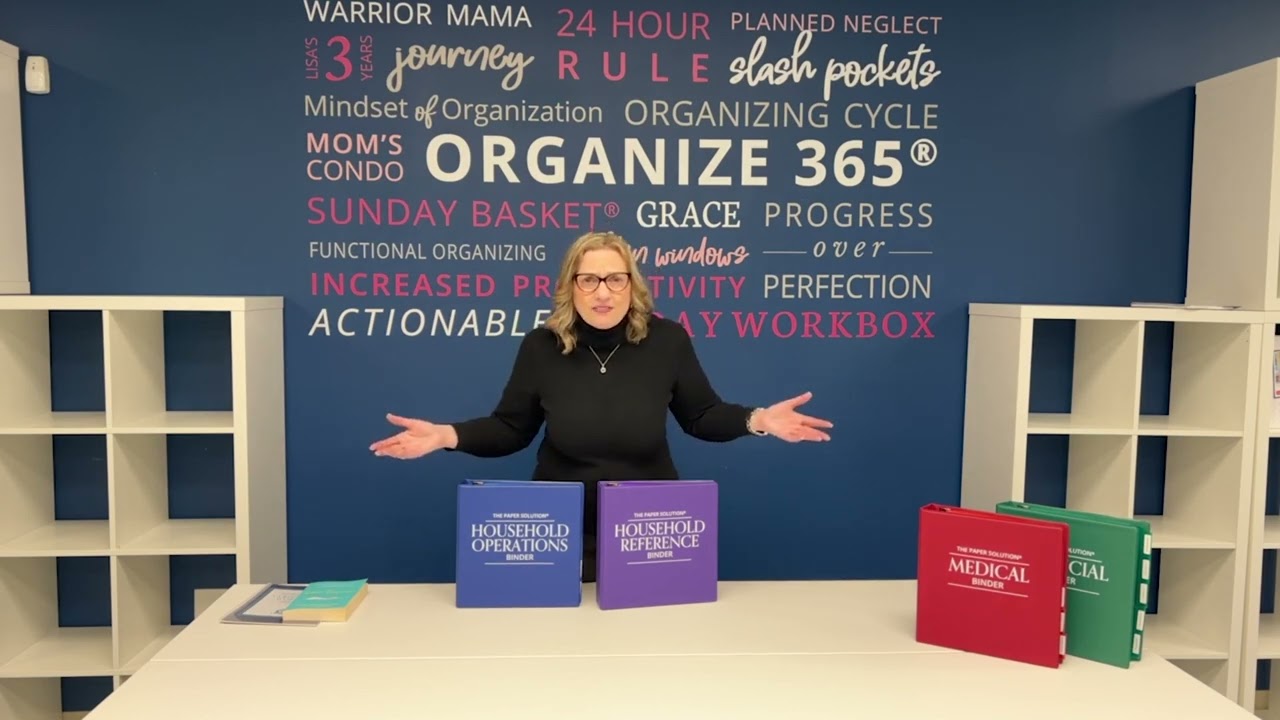
In this presentation, Lisa Woodruff of Organize 365 explains why paper remains essential in the United States, outlines the systemic reasons for its persistence, and introduces her comprehensive "Paper Solution" framework. She describes the shortcomings of traditional file cabinets, the development of portable binders (Household Operations, Household Reference, Medical/Financial, and IEP binders), and the color‑coded system that separates people, property, medical, and financial information. Woodruff highlights the importance of portability for emergencies and estate settlement, shares personal anecdotes about caregiving and estate administration, and promotes the Paper Solution Certification, in‑person and virtual paper‑organizing retreats, and specialized products for families with children who have IEPs. The talk concludes with a call to download a productivity‑madness bracket and vote on upcoming playoff games.
Chapters
Here we are with paper organization. I told you we'd come back to The Paper Solution book and we have a whole category just for paper organization. Now you may say, I don't have that much paper, or maybe you'll say, oh, I have so much paper, I don't know where to get started. I've been talking about paper organization for a decade. Let me just tell you, I bring it up at parties. It's not, it's not a very fun Party topic. I would go to networking events, people would say, what do you do? And I said, oh, I own Organize 365 and we help you organize your home and your paper. And they go, paper? I said, yeah, you know, paper, file cabinets, binders, to-do lists, mail. And they go, I don't have paper. And they'd walk away. A little bit later, same person would come by and they'd say, our kids' papers, paper. Yeah. They'd walk away, come back and they'd say, so you said to-do lists or paper? I said, yes. And they go, I have so much paper! And I'm like, okay, come, come on in. You know, for a long time it was really hard to talk about paper organizing because maybe you're like me, I grew up in the '80s and '90s and we were told we were going to live in a paperless future. Do you remember that? Like everything was going to be paperless. And then we walk around with this, you know, computer of a phone in our back pocket and all this information is at our fingertips and everything's so easily digitizable until it's not. And there are many people all over the United— all over the world using Organize 365 products, but the United States has a special problem with paper. that is, I'm just gonna say, never going to go away unless we stop being a capitalist society. And the reason why I say that is because in Japan, birth certificates are digitized. Like, that's a digital-based country, right? Yeah. In America, you have a baby, they're like, here's a birth certificate, here's a Social Security card, keep track of those. And then when you're 52 and you wanna get a TSA-compliant driver's license in order to go on an airplane, you need to go find that Social Security card From 52 years ago. Good luck. I mean, these little tiny pieces, but— and that's just from birth. And there's so many things inside of the United States that are paper-based because we're a capitalist society. Another example, if you live in England where you have socialized medicine, all of those different doctors and hospitals all talk to each other because it's all paid for by the government. So it all is on one system. That's not how it works in America. In America, we have different medical insurance agents and we have different pharmacy networks and we have different doctor networks and we have different hospital networks. And when you're inside of one of those networks, everything can connect and can talk if that organization is very digitally sound. Here in Cincinnati, I could think of 2. Cincinnati Children's, I'm telling you, if your kid is in Cincinnati Children's, They know what they had for breakfast. Like, they're very digitally organized. So that's great. In the adult system in Cincinnati, UC Health is amazing. Like, UC Health, very digital. Their MyChart works really well. I'm in a couple of other systems in the Cincinnati area that, I mean, you take the test and the doctor doesn't even have the result. Like, they can't even find the result because the digital is just not where it needs to be. So, So I feel like, I feel like some of us come into paper organization with this resistance and the thought is this, I shouldn't have to be doing this. I live in a digital world where everything can be digital, but it's not, so it's not my fault. All these systems need to get their act together so that I don't have to manage paper. Yeah, such is life. So we must be in charge of our paper trail. And really, it's not just paper. If you can replace the word paper with information management, so instead of The Paper Solution, it's the Household Information Management. And as we go through each of these systems, I'll explain to you what information we need to find and where it's located, if it is actually in paper or not. So the book The Paper Solution is available anywhere you could buy books in paperback. It's available in Kindle. It's available in Audible. Next to that, in our Productivity Madness, we have the Paper Solution Certification. So there is a certification for paper organization. In here, we organize the Sunday Basket, all these binders I'm about to show you. So all of these binders and the Sunday Basket, you're able to be certified, do workshops, do classes, and organize people locally. Once I started sharing these solutions for paper organization, I found out that many, many, many professional organizers such as myself had tried all of the ways we knew to organize paper until I created these binders, which were more file cabinets, color-coded file cabinets, digitized file cabinets. None of these solved the problem. Even in my clients that could afford to have me come quarterly to update their file cabinets, it just was very hard to maintain these systems. And they never really had what they needed when they needed it. And that's when I realized that file cabinets are a problem. Not just the maintaining of file cabinets, but the non-portability of file cabinets. And this really hit home in, I think it was 2017, 2018, when the hurricanes went through Texas and the wildfires really started to kick up in California. And I would have people emailing Organize 365 who had organized their file cabinets the way I said to organize your file cabinet. And they had to evacuate. And they said to me, how do I evacuate my file cabinet? And I said, you don't, you just leave. And so they left their houses and I thought, never again will my answer be, you just have to leave things behind. And the next year we came out with these binders. And now these not only organize all of your paper, but they keep it in a portable form for evacuation purposes. But also, you're gonna find out as we go through these binders, you're going to need them Not in your house, with your CPA, with your lawyers, with your family members. So that is the Paper Solution Certification and the Paper Solution book. Now let's talk about some of these solutions. We're gonna start with these 2. These will organize your household space. There are 2 binders that we need for organizing our household. One is the Household Operations and one is the Household Reference. Have you been paying attention to the colors? Yes. Do you remember what blue is for? Blue is for people, the people in your family. So everything in this operations binder is about your family, the people that you commune with. And when you move from house to house, if you do, the information in this binder will go to the next house, the next house, and the next house. This purple binder is your household reference binder. This binder If you could imagine it, it's kind of like your lesson plan or your information management for the physical dwelling that you're in. So if you move to a new house with your people, you would get a new purple binder, and this binder would stay at the existing house with the new owners. People management, house management. And I like to think about my house as a person because, boy, is she a lot of work. I mean, She needs to be cleaned, she needs to be maintained, like she's just, she's a lot of work. And inside of each of these binders, most of this information actually is in paper form, especially for the household reference binder. So inside of the household reference binder, you're going to have any receipts for any home improvements you do. And as you notice when we go through these binders, they have workbooks in them. And the workbooks really guide you on your adult scavenger hunt to find find all the paper and information that you need in order to make these complete. So we talked about, oh, this is when you purchase the home and any improvements you do. This is all household appliances, home decor. Do you know the number one question that is asked when your house is on the market? What color is that wall over there? Yeah, it's the number one question that is asked to realtors. What color is is some wall in the house, which usually the realtor does not know. And then exterior and landscape. What I have found is when people have their household reference binder and they have it on the counter during their open house, it just creates so much transparency and so much security for the person who is going to be buying the house because they know you're not hiding anything. You're literally showing all your receipts. Mm-hmm. You're showing all your manuals, you're showing all your everything related to the house. It really helps in transparency. Also, when you're living in the house, it saves you so much time and money. The other day, the heat went out. We live in Ohio. It was like 27 degrees outside. Heat went out. I said to my husband, heat went out. Here's the guy that fixed it last. Here's the receipt for what happened last time. So he called the same guy to come out to our house. We didn't remember who we had called. He called the same guy. Came out, the part had broken and it was under warranty. Saved us $300. Where do you have that kind of information? For us, actually, it wasn't in a file cabinet. It was emailed to me. That's how I get receipts now. I get them by email. But whenever I get those emails, I print them and I put them in this binder because they're easier to find. Is everything in your email searchable? Yes, it absolutely is searchable. When your heat is out, do you remember how to search for the person that fixed it 2 and a half years ago? What the name it was? How to find that receipt? Like, it's just easier. Paper makes communication so much easier. Paper also takes a lot of emotion out of a situation, as we'll see in these next binders. Being able to hand that paper to my husband, and then I went to work and he stayed home for the person to fix it that time. It just happened to be his turn. It was by the flip of a coin. I knew he had all the information he needed. He didn't have to get any more from me. No one was arguing about like, why don't you know? You, you've been there, right? It's very easy. Household operations. Inside of your household operations binder, you have family information. So emergency medical, all of that kind of stuff. Meal planning, household cleaning, electronics, like all of the things that go with all the electronics that you have, and holiday and event planning. So you can see inside of these sheets, like for electronics inventory, you know, the name, the model, location, the warranty if there is one, the purchase date, how much you spent on it. One of the things I love with my electronics, like for my washer dryer, for example, is if the machine is 10 years old, it probably is going to get replaced instead of repaired. I don't like that statistic, but I remember when I went to the home supply You know, Home Depot or Lowe's, and I was getting a new washing machine and my washer was 10 years old, and this was like 15 years ago. They said, oh yeah, they're only made to last 7 years. I'm like, what? They're like, yeah, they're only made to last 7 years. Like, this isn't the 1950s. Like, your washer dryer isn't made to last 30 years anymore. So that then helps inform me of if I'm going to replace or if I'm going to repair a washer. Because I know when I bought it and how much I spent. Here at the end, I want to just flip through this section for you. This is the holiday and event planning, and boy, do we have a lot of sheets related to this. We also have a free holiday blitz that will be coming out next fall. None of these sheets, but additional sheets where we really teach you how to plan. I know, more planning, right? How to plan your holidays in advance so that you, as a happy homemaker, can actually enjoy them just like the family that you plan all the events for. So these 2 binders, they really support you running your family, vacations, pets are also in here, and you running your household, all the things related to your household. Next we have the medical and financial. I don't know if you could see how thick that paperwork is there inside of the financial binder. I actually made these binders first. These binders were not created because I had a file cabinet problem. To be honest, almost everything in my file cabinet ended up in my household reference binder. But they were created because I had a lack of experience problem. And my lack of experience was in my mid-30s. In my early 30s, my parents had gotten divorced, and in my mid-30s, my father became ill. And so I was power of healthcare for 9 months along with my sister, also power of attorney along with my sister. And then my father ultimately passed away, and I was the executor of the estate. If you have not experienced this yet, you will. And when you do, there's no playbook. And yet almost all of us will be power of healthcare, power of attorney, and settle an estate. I estimate that my husband and I will settle 5. We've settled one of probably 5 that we will end up settling. And so you don't want to think about that, but it is our reality. And once it's your reality, You will do what I did, which is go to Google, as in like Mad Libs for adults, to like tell me what I don't know. There's so much that you don't know. Next, we're gonna talk about paper organizing retreats. These are in-person events where you literally fill your car full of paper and you bring it somewhere and you sort the paper in person with people. We had one of these a couple weeks ago here in Cincinnati. And we were sitting around the table, there were about 12 women. 3 were in the process of settling estates, 1 for their father and 2 for their spouses. And we had an open conversation about where do you get this information? How do you know what you need to know? If you go to the Organized 365 podcast, you can hear me talk with the owner of Everything But the House, Jackie Denny. And we were talking about, you know, women are going to have this job of settling estates. There's academic literature. the administrative burden of settling your spouse's estate when you too need support as an older woman. And it is women because women outlive men, like they just do. So we need support, we need help. When you go to be power of healthcare for someone, as I mentioned earlier, sometimes you'll be in a great system where you get into the MyChart and you could see history of years gone by. But especially Especially for adults, it's extremely rare that all of your medical history is going to be in one medical system in the United States. You're gonna have a test over here, a specialist over here, a chiropractor over there. Your pharmacy over here might not be tied into this. And when you are a power of healthcare, you want to make the best decisions possible and gather as much information possible for the loved one that you are caring for. And information is so powerful. I remember when my sister and I were taking care of my father, we started to learn that when certain numbers got low enough, that's when he would get a blood transfusion. So we got a little notebook and we started keeping track of those numbers. That information— keeping track of that information inside of here is really helpful. Now, we were Power of Healthcare for 9 months. Sometimes you'll be a caregiver for a family member for 5 or 10 years. Really supporting you in that caregiving role, making visible the invisible load of that additional responsibility, is part of the function of this binder. But if you remember back to the portable Sunday basket, this can go right inside of that portable Sunday basket. Your loved one's mail can go in there too, because you're probably going to be doing a Sunday basket for them as well. Power of, um, power of attorney. Just some things you may not know. This is the financial binder document. These are all available digitally, so you do get a digital copy as well. And they can be editable, so you can save them if you want to digitally. But I find that the paper is so much more powerful. So when my father did pass away, I did as you would do. I went to the file cabinet to find all the information I was going to need to settle the estate. And inside that file cabinet, I found car catalogs and golf scores and some manuals for selling the house. Not helpful. I still don't know what his password was to get into his computer. Not that he was a very digitally savvy guy. He— here's what you think. You think, I have a 401, I have my title of my house transfer into a trust or transfer on death. I have life insurance. Check, check, check. I'm good. I'm good. I have a will. I have those 4 things. I have those 4 things. I'm good. I've done my estate planning. That's the easy part. That is the easy part. Do you know how easy it is for a beneficiary to get access to a 401? It's like a flip of a switch. Super, super easy. What's a little bit more difficult is getting out of your Verizon contract, returning a leased car. Selling the family home, figuring out how to get the miles off of a credit card and closing a credit card. Didn't think about any of that, right? And estate lawyers and estate financial planners and wealth advisors, they don't think about any of that either. Big assets— houses, cars, 401s— having a will, extremely important. The minutia and the 6 to 18 months it's going to take to settle the estate. None of that is in this binder. Like, this is all the day-to-day administration of settling in the state. I know it's not really happy stuff, but it is household organization. I mentioned either in this video or the one before, you are going to be born in a household. You're going to pass away in some kind of a dwelling. Like, your entire life you will need to be maintaining your information management. This information can be found on the computer. This information, in here. Dad, did you have chickenpox? When was the last time you got your tetanus shot? Did you— I mean, like, do you even know this information about your parents? Do you know this information about yourself? Do you need to go interview your parents about yourself? Like, part of this is like, oh my goodness, this information is in my mom's brain. I need to go find information about my health history from my mom, right? Or from my dad. So this information is in somebody's brain. This information is usually in your brain or it's in many, many, many, many, many different digital systems, different places you need to find online. Annually, my husband will give me a sheet of paper of all the different places that he has— we have personal assets and the updated password and login information. And that's just the ones he knows about. He's not handling any of the everyday bills like I am. I've got a whole book of these kinds of passwords. So this is your medical versus your financial. And we already mentioned the paper organizing retreat. Paper organizing retreats, you could do them virtually, which is kind of nice because you're just on Zoom. That is, remember we were talking about the certified organizers, the certified organizers, they have virtual paper organizing retreats. You log on from your Zoom. They're usually 3 to 6 hours. You're sorting your papers, asking your questions online, and you're doing it in a community. Or you could do them live in person. Here we do a couple a year here at the Organize 365 headquarters. Certified Organizers also do them all over the United States in person as well. Literally, somebody filled an RV full of paper in Canada and drove it to Cincinnati, Ohio. People will drive 14 or 18 hours to get to Cincinnati, Ohio. You may say that is unusual and also maybe I will too. Do you know how much easier it is to sort paper when you're surrounded by professional organizers who have done this over and over and over again and other people who are also bringing laundry basket after laundry basket after laundry basket of paper that they have just shoved in their laundry room, mail they haven't opened for 5 years? You're not as unusual as you think. This is a pretty common Phenomenon. None of us need to know what to do with this paper because none of us thought we were gonna have to deal with it this long. We thought if we kept just shoving it away, maybe we wouldn't even need it. But you're gonna need it. So bring it, come, it's really fun. In our bracket, remember, this is our fun Productivity Madness bracket. Our last Organized 365 product is a specialized binder for parents who have kids who have IEPs or in the process of getting an individualized education plan. I wrote this as a parent of kids who have have IEPs and also as a teacher who has helped kids get qualified for IEPs. Just like you're gonna settle in a state and you're gonna find somebody who's already settled in the state to tell you the backstory on that, this is the backstory of somebody who's already been through this process. What do you do? How do you do it? How do you organize all this information? We also give you 4 colors of slash pockets. And of course, Each color means something. So pink is the medical information. Purple is the school information. Blue is the team that is supporting you and your children. And green is all the money it's going to take for these kids. So you are going to use a lot of professionals, a lot of blue professionals inside and outside the school system, inside the medical system and outside the medical system. You're going to use medical diagnoses and to get more services at school. And so that purple school color is right there in the middle, and it bridges the gap between this medical and the school resources that you have. So there we have it. We have filled our bracket. We've got our Sunday basket products, our household products, our work organizing products, and now our paper organizing products. And now it's time for you to download the bracket. And vote, and then we will start to have our playoff games. Thanks so much.
More from Lisa






Podcast 726: Time, Money, and the $300 Million Impact of Household Productivity


Parenting Isn't the Only Caregiving Role That's Draining Your Energy #Parenting #Caregiving

Turning 40 Isn't About Age, It's About Responsibility #TimeManagement #Organizing #MentalLoad

The Sunday Basket Saves Hours Every Single Week #SundayBasket #Organizing #TimeManagement

Your To Do List Will Never Be Done, and That's Normal #TimeManagement #Organizing #MentalLoad