508 - The Future of Executive Function Research As It Relates to ADHD
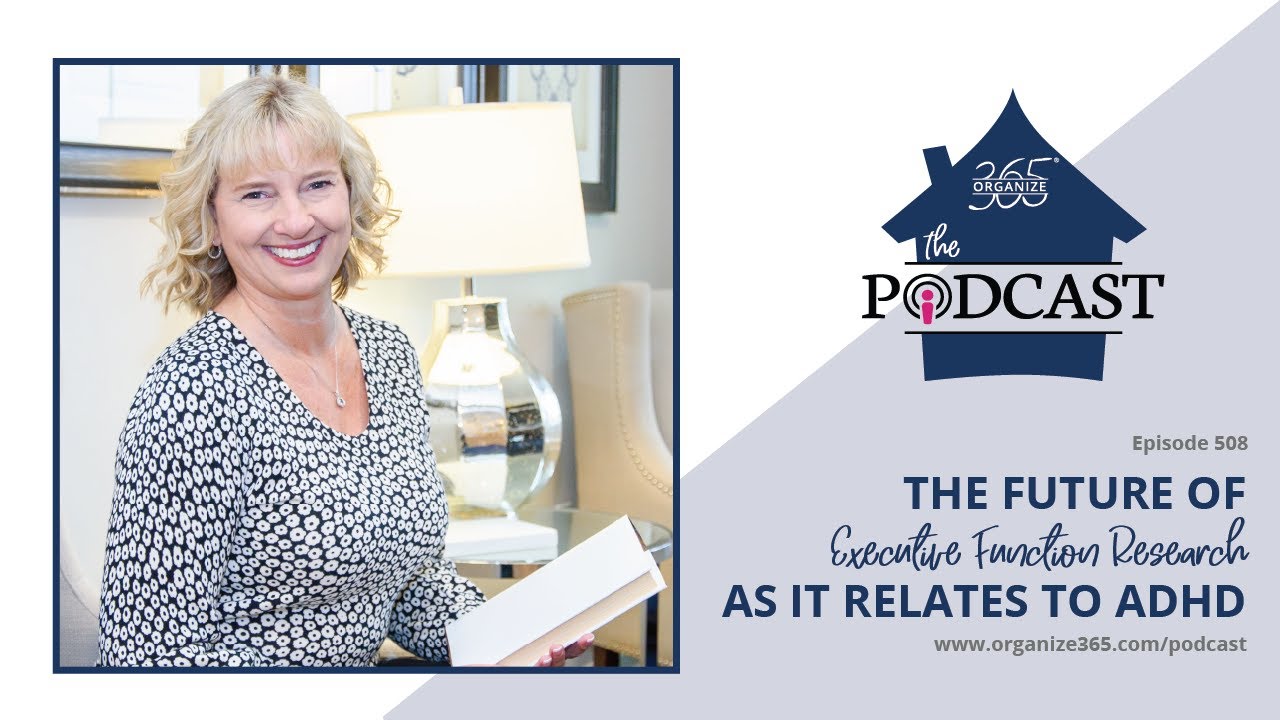
Lisa Woodruff discusses her ADHD diagnosis and frames it as an evolutionary advantage for handling rapid change. She's pursuing a PhD at Fielding University to test whether her organization systems train executive function, with 87% of Americans believing organization is learnable but only 13-18% considering themselves organized.
Chapters
This week's mailbag comes to us from Andrea. Hi, Lisa. I had to share my Sunday Basket story. My son had an IEP from high school, and he submitted a copy to his university 2 years ago in order to receive notes as an accommodation if needed. He's now a junior. The disabilities office at the university had some major technical issues this summer and needed students to resubmit the documents. I knew right where to look to find the IEP, and he scanned it and submitted his copy. Sunday Basket for the win! Thank you so much. Do you have an Organize365 success story? If so, we would love to hear about it. Please send us an email at customerservice@organize365.com and tell us how you have taken back your home, Your paper and your life with Organize 365.
Welcome to the Organize 365 podcast. I'm your host, professional organizer, productivity expert, and motivational speaker Lisa Woodruff. This podcast will help you embrace progress over perfection and create lasting, functional organizing in your home. I have so much to share with you, so let's get started. I think it was 3, 4, maybe even 5 years ago when Monique, Monique Orbe of the Sunday Basket Club, said to me, Lisa, we should have you tested for ADHD because I know you have it. And then when we find out that you have it, we could show that the Organized 365 products help ADHD. And she just said like off the cuff. I was like, oh. And that has stuck in my head for quite a while. Like, do I have ADHD? Now we know that I do have ADHD. But what she was saying is not like, I have ADHD and we should get me diagnosed, but Lisa, you're a productive, purposeful person, and organization is a learnable skill. And if executive function is made up and comprised of mostly organizational skills, which you both inherently had and cultivated and learned for yourself so that you're able to be so productive in society, if you figured out how to do that, then we should tell other people so that they can learn the skill of organization and they can also be productive at what they're uniquely created to do also. Don't add any words into what I just said or judgments or like, if you're feeling triggered, I'm not trying to trigger you. We do, like, we so easily take what other people are saying, put our own lens on it, and then sometimes feel judged or less than or that we need to be changed. I'm not saying any of those things. I am not saying any of those things. I am saying that I have always said, I know I've said it dozens of times in the podcast, I believe ADHD is an evolution of the mind. I think that all of us need to start to be able to see the big picture, respond to changes quicker, see assimilations between 2 things that are completely different that could become some 3rd thing that is even better. Like, these are things that people with ADHD just naturally do. I've always been in awe of that. I did not know I was diagnosed as ADHD until this month. The world is changing at such a rapid pace. Humanity is having a hard time keeping up. And that exponential change, I always knew that exponential change was coming because when my kids were enrolled in Springer School and Center in Cincinnati, Ohio, they had speech-to-text or text-to-speech software on their computers that was developed by Ray Kurzweil. And Ray Kurzweil is a futurist. And one of the things that Ray Kurzweil has studied or has talked about is the age of singularity, when everything— I don't even know how to explain it, but basically the rate of change or the pace at which things are changing will be so fast that man will not be able to keep up with it. And I remember hearing about this in like the early 2000s, and it's scaring the bejesus out of me. Because I was like, I don't know how that is gonna happen, but I understand how things become exponential and I understand how technology is going to become exponential and that the amount of things that will change so fast that it will be hard for you to keep up with it. I understood all that was going to happen in the future. I didn't know what it would look like. I had heard futurists talk before COVID about the fact that, you know, schools and governments and all these things would not function the way they are today. In the future because of technology. Because technology, actually what technology does is it makes, makes a level playing field for so many things, and it actually is a race to the bottom of money. Like, it's not really a capitalist way of doing things. Let me give you an example. So I just, at the time of this recording, GE Aviation has just announced that they are laying off hundreds of people because the wind turbine industry is not profitable. Like, renewable energy is not profitable like oil and gas is profitable. And so while renewable energy is good for the planet, it is not something that you can really make money on. Like, I was reading another article last week about how gas stations in the next 10 years are going to mostly go outta business if we go to electric cars. And so how will gas stations survive? And you talk about putting in electric vehicle charging stations. Well, because I went to this other meeting, because this is all I do is go to fun meetings, this other meeting with the Ohio Department of Transportation, which Ohio is like one of the leading states in electric vehicles, you may not know that. And then after our group meet with them, a month later, we met with the largest leasing company in Cincinnati and they talked about electric vehicles. Like, I know more about electric vehicles than someone in my position should know. To put in an electric vehicle pump, like a fast charging station, is $150,000. And you need this certain different kind of electricity grid plug-in thing. That's not the technical term for it. So if you're a gas station owner, in order to put in fast charging electrical vehicle stations, it's extremely expensive. Like if you want to put in, you know, like 4 or 5, you're going to invest like $1 million in the infrastructure. To put those in. But the cost to charge at a fast charging electric plug-in place, it's not $50, $60 to fill up your car. It's like, what, less than $20? And also it takes time. So even the fast charging ones take a certain amount of time. That's why all the Tesla stations are set up next to a Whole Foods and a Starbucks, because you plug in your car and then you go get your coffee and then you go do whatever and you come back and your car actually tells you when it's ready, 'cause these cars are so smart. So that is a great example of how, like, I think intellectually all of us are like, okay, yeah, electric vehicles, this is gonna make sense. We probably should move that way. At least one of our cars should be an electrical car. In the United States, only 2% of any cars sold are electric vehicles. I think it's 7% in the state of California. Again, really weird that I know these stats. So it's not a lot of people. As soon as the hurricane went through Florida, Last month I was like, oh, the electrical grid went out. That's not good for all the people who have electrical cars. So there are some roadblocks that we have here. But I remember when I got my last car, I really considered getting a Tesla. And the reason why I really thought about getting a Tesla was because the— it was before COVID so the cost of the Tesla was a little bit more than a regular car was going to be. But what I said to Greg was, if I'm gonna keep it for 10 years, 'cause I hardly drive at all, What I love about Teslas is it's basically a computer. So every couple of years, you could just pay to upgrade it, and then you have the most upgrade. That's the thing that drives me nuts about my car is like it doesn't have the latest technology. It's still a car. Like the car didn't change that much, but I want like the latest maps thing or it to plug into my phone or whatever. Tesla allows you to upload. But the other thing I said to Greg is I was like, look, there's like no maintenance on this thing. Like you change tires and you have brakes, but I mean, there's no engine to maintain. There's no oil to change and there's no gas to put in it. So just the gas alone is gonna save you hundreds of dollars every month. So if you add that up, like you could save like $6,000 a year not using gas if you have an electric car. Like over time, the electric car pays for itself. Do you see what I'm saying? So I understand the logic and there's some kinks that we have to work out, but as we stop paying for gas for our cars, There are a lot of people whose jobs are dependent on the fact that we use gas in our cars. And when we go to electricity for our cars, first of all, I don't think we've really thought through the fact that our electric grid is not as secure as you guys might think it is. And our electric infrastructure really needs to be supported, fixed, rebuilt. I don't know a lot of things. I don't— I just know enough to know the work needs to be done. You can't just add a whole bunch more stuff onto the electrical grid. There are a lot of people who make a living right now in the oil and gas industry, at gas stations, actually in the production of oil and gas, in the trade of oil and gas. There are just a lot of people that have those jobs. All of those jobs are going to go away and they're going to have to go somewhere else. Now, my husband sells valves that are in the oil and gas industry. He specifically doesn't sell valves in there, but his company is mostly comprised of that industry. So when Biden took office, He closed down the XL pipeline in the United States, which laid a whole bunch of people off. Now we have this war in Ukraine and Russia, and I keep saying to Greg, open up the pipeline. He goes, I know, but the problem is it takes 11 months to reopen this pipeline. Everybody has to get back into those jobs again. And the people who would open the pipeline up again are afraid to open it up because what if the government changes their mind again? 'Cause it's so expensive. So anyway, I got to all of this from The Age of Singularity, and right there, that whole thing. We can definitely check off the box that Lisa has ADHD. This is how I think, people. These are the thoughts that I think at night. Nothing is a yes or no answer. Nothing is black and white. Like, yes, we need to be more energy independent. When we had the XL Pipeline open, actually the US was gasoline energy independent. You may not have known that. But also we need to have renewable energy and also we have to be good for the planet. But also the humans on the planet need to have jobs so that they can pay for things. And as you get to the age of singularity and as all of these things change, Many, many things that used to be done by humans will be done by machines, will be done by renewable resources, will be done in these things. So where am I going with this? The amount of change that has happened to the world in the last 2 years since COVID happened has been exponential. It's almost like when COVID happened, the exponential effect of this singularity kicked in. And many people have not been able to keep up with the change. I have a hard time keeping up with the change, and I love change, and I love to talk about change. I have a hard time. I observe a lot of people not knowing how to process how fast everything in our lives has changed in the last couple of years. You can't just go to stores anymore. They all changed their hours. Like, everything we do now is different than how we did it in 2019, which is disconcerting for people and challenging. And it all affects our executive function. So executive function are the things that your brain does in the prefrontal cortex in the front of your brain that helps you pivot, iterate, respond to changes. And those things are the 4 that I talked about with Barbara Hunter that are emotional-based. And then there are the 5 that are organizationally related. So the emotional-based ones are the inhibition, the ability to shift, your emotional control, your ability to self-monitor. I'm not gonna talk about those going forward in Organized 365. They are way outta my wheelhouse. But what I have over the last 10 years discovered is that the 5 that are related to organizing, Organized 365 has created systems and tips and tricks and programs and supports for those levels of executive function, which are, Initiating, getting started. Your working memory, holding information in your head. Planning and organizing, planning days. Task monitoring, which is knowing what needs to be done next, which is the Sunday basket. And organizing your materials, like organizing your house, like the Productive Home Solution. And I'm like, oh my gosh, Monique was right. At this point, I don't even think it matters if you have ADHD or not. I'm just gonna start moving into, we all have executive functions, and I believe, this is my hypothesis, I believe that we can impact our executive function, we can change it by learning the skill of organizing, and then we'll be able to do more of what we're uniquely created to do. So in order to prove this, We need to do research, and Organize 365 has done a bunch of research in the last couple of years, and I have loved it. I have really enjoyed doing the research. I've really enjoyed working with researchers and universities and doing academic-level research and uncovering that I was right. Like, 87% of Americans believe organization is a learnable skill. That is like mind-blowing. Like, I cannot—I always said it, but I thought people—I didn't know if people believed—they believed it. Like, they—they agree too. Like. Thousands. At this point, we have surveyed, I think, 8,000 people. Like, that's a lot of people. And if 87% are saying organization is a learnable skill, then obviously we're onto something. At the same time, with the Swiss cheese organizing, when you divide organizing into the 4 categories of organization, personal organization, family communal space organization, paper organization, and storage organization, And those same exact people who said that organization is a learnable skill then give themselves a grade on each of these. We have only 13 to 18% saying they're organized in any of those categories. So what that leaves us with is 87% of Americans believe organization is a learnable skill. Only 13 to 18% say they're organized in even one of those areas. That is a huge chasm. A great divide between people who believe it's learnable and people who have actually learned the skill. And you know what happens then? Like, as a teacher, you have a whole bunch of demoralized students. Yeah, yeah, yeah, I know it's learnable. I haven't learned it, so guess something's wrong with me. No, no, I say no. I say we just have not been teaching it. Like, it is not— that's what I'm here for. Do you remember, oh my gosh, I've said this on the podcast a million times, when I was a first grade teacher, I was 25 years old, stood in front of that classroom, and I knew I had the kids in my classroom that would likely be retained in first grade. And I said to those parents, there is no way your child can fail first grade. Only I can fail to teach your child. So if you work with me, we will support your child. We will move on to second grade for every single student in my classroom. I was only 25 years old. Here I am 25 years later, And this research says to me, I have failed, not you. If 87% of the students agree that they can learn the skill, but, you know, only 13 to 18% are achieving the skill, that is a problem for the teacher. That is a problem for me. And I want to solve that problem. And so in order to do that, drum roll please, I'm finally going to get my PhD. I've been talking about this for 7 years. I've had many people try to talk me out of it. And I'm like, you know, I really feel like teaching the skill of organization, I've always said it has nothing to do with containers. Like you need a couple, you definitely need a Sunday basket, but it's not the Sunday basket that gets you organized. It is the teaching and the way that these programs externalize the organizational parts of the executive function of the brain That allow you to become an organized and productive person and free up your time to do what you are uniquely created to do. And so that's what I wanna do research on. So I was like, okay, I wanna do this research. I share it with the team and they're like, this sounds like a large research project. So I want everyone in the research project to take the brief, which is 3 surveys, and then 18 months later do it again, and 18 months later do it again. And we do the Sunday Basket, we do the Productive Home Solution, and— figure all of this out. In order to do that, I want all the research to be done inside of Organized 365 with me as the lead researcher, and the only way I could be the lead researcher is if I actually go get a PhD. So I have applied to Fielding University out in California, and I was denied. Don't worry, gets better, because you guys, I have a teaching degree. So I have a teaching degree. I don't know, they're like, you don't understand research, statistics, uh, writing an APA-style paper. You should have seen this paper I turned in, you guys. I researched everything, I downloaded all the things, I kept rereading it. I, I did the best I could. I knew it was not right. And I was like, I'm pretty sure I'm not doing this right. They're like, you didn't do it right. I was like, yeah, I, I, I was pretty sure about that. And they said, but good news, good news, we have this one year that you could take where you can learn research statistics, APA-style writing, and actually you'll take 3 of your PhD-level classes in this first year, so you'll actually start with, um, a lot of your classwork already done. And I said, yes, please. So starting this January, I am going to start taking my PhD, and then if everything goes as planned, in January of 2024, I'll be starting my PhD, and we will be starting this research project on executive function, a longitudinal study on Measuring your executive function. I'm not sure if it'll be the BRIEF that we use, but some kind of test that we will use. Then you go through and you learn the Organized 365 systems, and then we retest that same screener, whatever we use, at 18 months and 3 years to see if your executive function profile changes over time. And I'm pretty sure it does. Like, I think that this is how this works, but we need to be able to prove it. because we have universities ready, we have businesses ready to implement this, and they would like to see some of the research. So I'm ready to do some of the research. So if you're still listening, the biggest part about getting a PhD at the age of 50 is how am I actually going to do it? Because I'm not going to stop running Organized 365. I'm not going to stop traveling for Organized 365. I'm not going to stop dating my husband or, you know, being a grandma to Grayson or any of these things. And so I have been wrestling with Over the last 6 weeks, once I finally decided, like, you know what, I don't even really feel like I have a choice. Like, I really, really, really want to do this research. And when you want to do research at this level, like, other research institutions don't want to do your research. So the only way to do it is to bring it in-house. And we bring it in-house. If I'm not actually a research PhD person, then I'm running a team, but I'm not leading the team. And I wanna be leading the team and I wanna be 100 years old so I could be doing research for the next 50 years if I get my PhD. So I'm gonna get my PhD. Now, it's a full-time program. Get your PhD, it's a full-time program. I'm going to Fielding University, which is for business owners. So the classes are in the evening, but it's still gonna be 25 to 30 hours worth of schoolwork every week. Every week for 4 years. I'm a little nervous saying it, A little bit. And so I have been passively getting my PhD for the last 6 weeks. Remember how I talked to you about passive organizing? You try it on and see if it's gonna work. So I've been passively getting my PhD over the last 4 to 6 weeks, and I'm like, okay, if I was getting my PhD right now and this thing that just happened in our life happened, how would I still get my PhD work done? How would I still be the wife, mother, and business owner that I want to be? And I've realized that, you know, a long time ago I outsourced cleaning my house. So the 26 hours a week it takes to run a home that Pew Research Institute said, I've already outsourced that. So I can't gain that time. I've already gained that time. And up until now, I've worked 50 to 60 hours a week inside of Organized 365. I don't really feel like I can or want to take more time away from Greg and Abby and Grayson and Joey. I'll probably take 5 hours a week away from that household time that I was doing just because the sheer amount of number of hours. But really, I need to find 20 to 25 hours in the work that I'm doing inside of Organized 365. So how am I going to do that? 2 things. One, I am dividing my calendar into 3 chunks. So from maybe Sunday night, but definitely Monday morning all the way until Wednesday night, that is all Organized 365 time. So Monday, is when I get any of my projects done inside of Organized 365. Tuesday and Wednesday are always meeting days. I get all of the meetings done inside of the company, and then the team's ready until next Tuesday. So end of day Wednesday, end of my workday Wednesday, after I play with Grayson and take my bath, I will start my PhD work. And I'm thinking I probably will have classes on Wednesday and Thursday night, but I don't know now. If I have a class on a Monday or Tuesday, I'll have that. All the classes are Monday through Thursday. So whether I have a class or not on Wednesday night, I will be doing schoolwork all Wednesday night. Thursday is ponytail day. Mondays and Thursdays from here on forward, you'll see it, ponytail day. You know, they did a study and they found that part of what holds women back is the fact that we wear makeup and, you know, it takes us so much longer to get ready in the morning. And I've really been looking at every single minute and how I spend it during the week. I spend a lot of time getting ready in the morning. I like it. I like the way I look. I like the things I do. But that is one thing that on Wednesday night, you know, Thursday morning, I will just be doing a ponytail. I'll still wear makeup. I can't go that far. So Thursday morning, all day Thursday morning until I go to bed Thursday night is all going to be PhD all day. So 14-hour day. I have over time Made it so that I can literally work a 14-hour day with no break. I'll eat, but I don't need a break to keep going. And I don't hit the point where I'm like, I just can't do this anymore. I've really worked on my stamina and my energy levels, so I know I'll be able to do that. So Wednesday, all day Thursday, and then Friday morning I'll return back to the company. Now, I probably will come into the office on Thursday just because that way I can't be interrupted when I'm in the office by people at home. And work in the office. Might work at home, I don't know. So then Friday is going to be a flex day. If I need to do doctor's appointments, if I need to do something PhD-related, if I need to do something office-related, Friday is always a catch-all day for me. And then when I get home from work on Friday, all day Saturday, that's definitely going to be family time. And then Sunday until our family dinner is over, which is usually 6:30 or so, that's all going to be family time. So I'm dividing my week. purposefully into thirds: a third work, a third PhD, and a third for the family. Some other ways that I've already assessed that I can save some time is that I don't care what food I eat. I don't care. I always eat the same exact breakfast, so that's super easy, and I usually eat the same lunch, and I'm just going to eat the same lunch. It's going to be the exact same lunch. I was going to try to figure out how to get my Panera salad, and I talked to Stephanie at the office. She's like, we'll just have— Lunch will show up on your desk. I'm like, great. So I'm outsourcing that. You would be surprised how much mental time that takes. It takes a lot of mental time. Another thing that I've already proactively done is I went ahead and I looked at all of the different things that I might need to do medically, and I'm doing them all before the middle of December. So I'm 50. I was supposed to get a colonoscopy last year, and I was like, oh heck no, I'm not getting a colonoscopy while I have a PhD. So I called, got the colonoscopy scheduled. Now this is terrible. So I called Hauled over, and I said, "Yeah, I need to. I need to get this scheduled." They're like, "Okay, which doctor do you want?" I was like, "Do you have this date available?" She said, "Are you telling me that you don't care what doctor you get? You just want it on this certain date?" I said, "Yeah, this probably isn't how I should be scheduling this, but I know there's not a problem. It's just a routine colonoscopy, so I really want this date." She's like, "Well, you happen to have gotten a really good doctor." I was like, "Oh, that's good." Like, as I was having this conversation, I was like. Oh wow, you really shouldn't make a medical decision based on the date that you're available, but also I'm gonna. So I scheduled the colonoscopy, I scheduled the mammogram, I scheduled, I already had the dentist appointment scheduled, I scheduled a routine physical with full blood work, which I usually only do every other year. I don't do it every year. I scheduled the meeting with my hormone person instead of in January, we're gonna do it in December. Like I scheduled every single meeting you could possibly have, every single thing related to my health, in December, so, or before December. So I would have all of that done. So when I start school in January, I don't have to try to fit in any of those things. And then the last thing that I did is I made a list from January to December, and then I wrote down every single holiday our family celebrates, all the birthdays, all the anniversaries, all the special things. And I've put that in my Sunday basket. And between now and the end of the year, I wanna really think about, okay, What does the family look forward to in all of these? What foods do I make? What things do I want to add? What decorations do we have? What decorations do I want to add? Then thinking about the fact that Grayson's going to be 1, 2, 3, 4 years old during this time, are there any specific things that I want to make sure that I buy or do with him in these different years? And I'm literally going to sit down here and plan it all out. And then when we do planning days like we do for the Productive Home Solution, I'll grab this sheet every single time and just make sure that in the next 120 days I've bought the thing or ordered whatever we need or made the food or had somebody made the food or ordered it in, however we're gonna do so that the memory-making family time in the next 4 years, I will remember and I will be my best self at all of those holidays so that I don't miss anything because I was in school and I was running Organized 365 because I don't wanna give up either of them. Now, if you're listening to this in real time, beginning of November, we always have the Holiday Blitz. So the Holiday Blitz is coming, and that is when we help you do what I just said. Like, I just don't think normally, although I think it's a good thing. Also, it's not normal. So how I think about the holidays is exactly what I just told you, like memory-making, the memory, the memorable things that you Love, somebody planned. Somebody planned them. Sometimes they happen like off the cuff, but it's extremely rare. Usually someone orchestrated it and someone planned it. But in addition to planning what you want the holidays to look like from now to the end of the year, there are a lot of things you are planning on doing from now to the end of the year that either your family doesn't like, they forgot that you do it at all, or they don't really care. And what I found the first time I did the holiday blitz and I interviewed my family and figured out what they wanted for the holidays, what they wanted sometimes was happening and I didn't even realize it was happening. And there were a lot of things I was spending a lot of time and energy doing that they didn't value or notice or was not really that important to them. It doesn't mean what I was doing wasn't valuable. It just means that everybody has different love languages and different things that they look forward to at the holidays. And truth be told, you only have so much time and energy. So I wanna help you make the invisible work of the holidays visible to you so you can consciously decide if you do or don't wanna continue doing these things that you're doing to make the most impact for your family. You know, the 80/20 of the holidays for your family so that you can spend the holidays making memories along with your family instead of being the camp counselor and exhausted. So that is what the Holiday Blitz is. So I hope that you will join us for that in the beginning of November. We have a bunch of these blitzes each year, and each one is designed to make the invisible work that is about to hit you visible so you can consciously decide what you want to do, pick your 80/20 of what's going to make the most impact so that you can move forward. And big announcement, I'm getting my PhD, so I'm 80/20ing every single thing in my life. If you Have ideas, suggestions, tips of how I can make this even better, or, uh, any tips for a 50-year-old going back to school, go ahead and send those to customerservice@organize365.com.
More from Lisa






Podcast 726: Time, Money, and the $300 Million Impact of Household Productivity


Parenting Isn't the Only Caregiving Role That's Draining Your Energy #Parenting #Caregiving

Turning 40 Isn't About Age, It's About Responsibility #TimeManagement #Organizing #MentalLoad

The Sunday Basket Saves Hours Every Single Week #SundayBasket #Organizing #TimeManagement

Your To Do List Will Never Be Done, and That's Normal #TimeManagement #Organizing #MentalLoad