561 – Interview with Jacquie Denny – Founder of Everything But The House
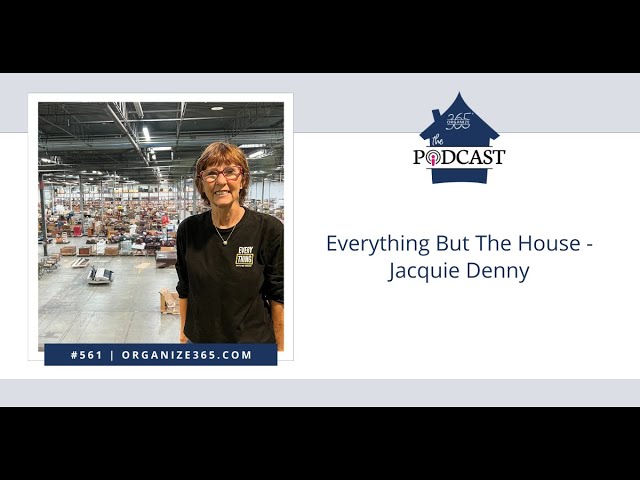
Jacquie Denny co-founded Everything But The House, which turns estate sales online. The company now handles 35,000 to 40,000 items monthly across 126 countries, with a $407,000 Chinese vase among recent sales. Denny explains how valuation works and why planning early matters for downsizers and their families.
Chapters
And now that you can hear me, it's so much better because I'm not that great at sign language. Well, there are a few signs. There are a few signs that I'm good at.
Jackie, welcome back to the Organized 365 Podcast. In this podcast, we are going to talk all about the company that you and Brian started, Everything But the House.
Thanks, Lisa. It's so nice to be here. I love it.
So I mentioned in the last podcast that we had met early in the Organized 365 years when I was doing in-home professional organizing. And I had read online that Everything But the House was hiring professional organizers to organize in different houses. And it was headquartered here in Cincinnati. And you were a female business owner. It was like all of the things that I wanted to hear about. So we had lunch back then. And at that time, that'd been like 2012, 2013. Everything But the House would have been about maybe 6, 7 years old.
Okay. Just a baby.
So we— you mentioned how you had had a tag sale and you met Brian at the tag sale, and then you guys decided to start Everything But the House and partner his operational skills with your marketing and visionary skills. Why don't you tell us about those first 6, 7 years and what it was like when I actually met you the first time.
Well, you know, it's funny because when I met Brian and we talked about putting estate sales online and he was the tech guru on this, not myself, you know, the biggest thing was the first thing we had to figure out was to replace his 6-figure income. He had a stay-at-home wife, 3 kids under 7 years old. And so we had this business plan because, you know, our very first online sale was just $10,000, and we were so excited that we took our spouses to dinner. Now, absolutely crazy now when we think of, you know, we've done million-dollar sales. And but, you know, it was just this nugget that we were starting to think about. And so, you know, it was immediately adopted by people. They could see the tremendous difference in pricing that we were getting and marketing and visibility we were giving them. And the higher the value of the family inventory, the more they wanted this world reach, this global reach. Because let's face it, we have bidders in every state and 126 countries. And I don't care if it's, you know, we just did a Chinese vase last year for $407,000. And it went back home to China. It had been brought over here after World War II by a service member as something for his mom. Ended up in this little tiny farmhouse in Indiana. And the guy had no idea. We went to clean out his mom's house and we're like, oh, this is nice. He goes, yeah, my dad brought that home for my mom after World War II. $407,000.
Wow.
Oh my gosh. So, you know, very quickly we became adopted. We became— I mean, we replaced his income easily. We just continually outgrew ourselves. And we still do that today. The need is deeper and deeper because think about it. When I was young, no, no, none of the older generation ever moved out of their house. They didn't downsize. People stayed in their house till they passed. So now every year I've got a generation who's one passing away, and then I've got a generation 2 who's downsizing for a better senior lifestyle. And then I have that group of people who just get rid of stuff because they're tired of it and they're buying new. So, you know, the event-driven opportunities have gotten much broader for this industry. And then I have people who make their living by going out and going to thrift stores, garage sales, flea markets, and they make their living by selling stuff online because they, you know, don't like the typical 9-to-5 thing. They, you know, it's just a choice for them. So they are a group of clients with us as well now. So, um, you know, the first, the first iteration of this company was we went in the house, we photographed everything there, And then the clients came and picked it up there. We weren't handling it. Well, the problem with that was the guy who drove on the lawn with his truck to pick up the piece of furniture, or the, the 2 82-year-olds that came to buy a bed upstairs and scraped it all the way down the wall across the hardwood floor. So, and in some neighborhoods where they're more private, they didn't want 120 cars coming to pick up their stuff in one day. So as positive as the business model was, there was a negative side to it that we, within 6 years, thought, hmm, if we picked everything up from the house and had a facility and sold it, that would remove all the cost to do people's lawns, redo their hardwood floors, paint their walls. But that replaced cost again. So Here's what I tell everybody as an entrepreneur. That first pure business model is probably the least costly you're gonna run because it's usually off the kitchen table.
Yeah.
You know, it's out, it's outta your car, you know, and then you grow a little bit, you have to add some staff and then you have to add some insurance and then you have to add some, you know, so now I'm up to like 364 employees, 300,000 square feet. Full benefits, education packages. I mean, the whole enchilada.
So, okay, so go all the way back to that first six years because I remember when I met met with you, you were hiring. You were you had not quite brought everything back to Cincinnati yet. You were still doing everything in people's houses. You were hiring professional organizers also to help catalog. But then, and correct me if I'm wrong, but I remember at that time when I was on the everything but the house. website, it was like when you were done, it would be broom swept. Like, you would do the sale.
Yes.
And then also you would handle all of the donations. And so every— like, the house would be ready to put on the market because everything would be done when you were done. That was that iteration of the business.
And it was lovely, but we were not profitable.
And that's what I wanted you to say, because I remember having, having breakfast with you. I said, so what about the paper? And you're like, what paper? And I was like, you know, the file cabinets, the paper. You're like, we don't do paper. I'm like, you do everything but the house and the paper. And I think that, um, so I stuck with that. I was like, okay, good. She's not gonna do the paper. I can, I can take off with the paper, which obviously I have. But I think why this part of the conversation is important is because your business model has grown and changed. My business model has grown and changed. And it's not because we didn't have a good idea to begin with. We both had ideas that were too big for one company to solve. And so to do everything that you were doing was not profitable because not everything in that— the money that came out of the estate couldn't cover all of that labor to be done in all of those different cities.
Well, and that's it, because every house you go in, whether it's a million-dollar home or a $100,000 home, has saleable, donatable, and disposable. And we were trying to be that one-stop shop. And the reason was, it was a good intent decision because it takes all this work off of people when they can be focusing on caregiving or grieving. But the truth is, we were only charging for the selling part, commission on the items we sold. So then we had all this labor for donatables, disposables, Because they always paid for the junk king pickup or whatever that we did. But we still had all this labor project management to support it that we weren't able to cover, because the value of the inventory I'm selling doesn't bring enough in commission for me to cover it. So then we had to go back to— and we still get it once in a while. A client will say, yeah, but you're everything but the house. Why won't you take that? wheelbarrow with no wheels. Somebody will use it, right? I'm like, no, that's really disposable. So, you know, it's kind of difficult. It's an education play, just like you are.
Yeah.
When you explain to people the importance of doing the paperwork the way you do it, professionally and thoughtfully and organized, versus somebody taking it home and it's sitting on their, their kitchen table and somebody's spilling coffee on it. And now it's one big pile of smudge. It makes sense. But when you transition a business model from everything to I do the part that I can cover cost on, right? We had about a year and a half of real negative pushback, because what would happen is I'd go sit with family, and I'd explain what we're— and they're saying, well, that's not what my friends have. You did it.
Yeah.
And I'll say, and then I tried the next step was, okay, I will do the donatable and the clean out here, the number of hours to pack it for donation. And then when I would add that up, they'd say, oh my gosh, then I'm gonna owe you money. And I'm like, exactly. So, you know, we did, we have evolved over the years to a organization that pays for itself. It's sustainable. But along the way, again, it comes back to all those labor hours of support it takes to do a process for people. I mean, I, I tell people, you know, I can spend 3 days just digging out an attic that's sat floor to ceiling.
Yeah.
If you don't understand the hours that are spent at this task, And then, you know, once in a while you have a sibling who comes and spends a day, and then they get it. The light bulb goes on. Mom and Dad typically never get it because they have curated this house full of stuff over 50, 60 years. So they don't understand. I now have 2 weeks to get this empty for you so you can get it on the market. They don't understand that, and I don't expect them to. So we evolved to what we do today, which is—
And I think— oh, go ahead.
Go ahead. No, go on, Lisa.
So I think that, you know, as you were starting in 2006 to 2011, you primarily also were dealing with the Silent Generation, and they were selling their homes that they had been in 50, 60 years. Now we have Baby Boomers that are both passing but also downsizing for lifestyle choices going forward. And what I find to be great about the baby boomer generation is they're very proactive. They like things done their way. They really like to be in charge. So if that is you, then be in charge. Take charge of your stuff. And so when you're hearing this, because you're not going to settle your own estate, just laying it— you can't. There is a limit to what you can do. That's it. You cannot come back from the dead and do your own work. So You know, make some of the hard choices now and be in charge of it and get people to come in and clean it out for you, or do it a little bit over time so that it is not left to the children to do it. Because at the end, somebody does need to do it, and there is labor involved. You can either pay for the labor, you can use your children's labor, you can use your own labor. Like, I mean, ask for it for the holidays. Hi, I would like you to come spend a day with me and help me clean out the attic. It's a gift for everybody. You know, it's not a bad gift.
And you know that I, I love the self-serve thing. I love people being involved, but this gentleman down in Indiana would have probably sent that vase to Goodwill. He thought it was useless.
That's true. That's true.
So I always tell people there is a cost of somebody who knows what they're doing. And, and it's, you know, it's the truth is he would have probably lost a $400,000 vase because he looked at me like, that is He's like, that's junk, right? And I said, yeah, this isn't, you know, the things he, the things he were focusing on were the exact opposite of what needed to be focused on. So there's a cost of expertise. And there should be, because somebody has spent hours and hours learning that and perfecting that to keep you from making costly mistakes. So, but in the end, there's a lot of selfless platforms. Families can do it. Sometimes people—
Oh, no, Jackie. We don't want your job. We want you to do your job. I remember when my grandmother was downsizing, she said to me, she said, this bowl that looks like nothing is worth thousands, and this bowl that looks like it's worth thousands is $10. And, like, she told us, like, what everything in the house was actually worth so that when she passed, she did— she was German. She was like, get the money. If you don't want it, get my money back for you. She was, like, telling you. But then I have another friend. In between when we met last time and this time, you know, that 10 years, who used the Everything But the House services. They were moving from a fully furnished house into a— I think they moved into a very nice studio-type apartment so they could do a lot more traveling. They were in their 50s, early 60s, and you came in and did exactly that. You looked in, you're like, okay, here's what it all is. You put it all up in auction. They sold what they could sell, they got rid of the rest, and then they downsized and bought what they wanted for their new place. So I think that that's a great example of what Everything But the House has evolved to. You don't have to be settling an estate to call Everything But the House. You can do this proactively, like, hey, can they— to have them come and get walk through and get an estimate and say, hey, we think these couple of things would really generate quite a bit of income for the rest of your living years.
And people do that all the time. They come up with a medical expense or they call me and say, I have a first edition book collection. We've decided to sell that and go on this big vacation we've always wanted. A lot of people will sell stuff to help with college expenses, saying that they have a painting from mom and dad. Sorry, they have a painting that mom and dad gave them. They kept it. They don't really like it, but they know it's worth something.
Right.
And now they're looking at college tuition and they're like, you know, is it really worth that? And, you know, here's the other thing. A lot of times people think the longer you hold something, the more valuable it gets. That's absolutely not true. Everything from Babe Ruth to the Lone Ranger has a cycle in which people actually want it.
Mm-hmm.
The people who remember the Lone Ranger, most of them are gone now. So where a Lone Ranger cap gun, when I started in this business 35 years ago, was $5, $600. It's $35 now.
Hmm.
It's the toy collector now, not the Lone Ranger fan. So everything has a life cycle, and if you hold too long, you've lost your opportunity to sell that. So it's like everything's market-driven. So when you have a Joe Burrow signed card Sell it now while Joe Burrows is hot, because I promise you, last year I was selling his signature for $3,000, $4,000. In another 5 years, it will be $300, $400 because he will no longer be at the top of his game. So I always—
Oh, Jackie, do you have to say that on a podcast? The Bengals season is just starting, and I actually have a t-shirt I wear now.
And I love Joe Burrows. I am like a fan of him. I think he's adorable. And I think he's marvelous. But I hate— but Joe probably knows this as much as I do.
Yeah, he's gonna sign a really nice contract soon, not 10 years from now.
He has a shelf like, like, yeah, like everybody else who's played. And so I always tell people, you know, there is— it's everything's market driven. You know, it used to be everybody wanted big brown furniture with Marble tops. When I started in this industry, a marble-top Eastlake dresser, $2,000, $3,000. $200, $300 now. IKEA used furniture, $500, $600. It's all changed, guys.
Wow.
Yeah. Wow.
Yeah. Wow.
IKEA.
I'm like, there are some IKEA pieces that I really love. You know, I remember when our children were born, first grandchildren, both sides of the family, just like I was the first grandchild, both sides of the family. We're spoiled rotten people.
Yeah.
Toys, ridiculous layettes. My children had layettes of clothing. Who even has that anymore? But mine did. They had layettes of clothing. They had everything that they needed. And we had, like, Zippo money. Like, we, like, very quickly had Zippo money. And we were like, we have all this really nice stuff for our kids under the age of 5, and now they needed to go to Springer School and Center and all these extra doctors. And we were drowning in medical debt, and I felt guilty selling their stuff that they had gotten from 1 to 5. And then one of my friends said to me, or it might have been my mom, it probably was my mom. And she said, well, that's an investment. We bought that for them, and then you resell it, and then you take the money and you put it into their education, and you do it like Like, these things are meant to keep going forward. Like, if you hold on to this expensive baby toy that somebody would pay whatever, you have one of those like $700 strollers or something, and you can get, you know, $400 for it on resale because it's only like a couple of years old. Take that $400 and pay for a month of preschool versus holding on to this $700 stroller until you're 95, and it just gets thrown out in the heap. And I And that, that thought process when my kids were young and all of a sudden we were in so much medical debt, I thought, okay, money is supposed to be fluid. Things are supposed to be fluid. Like, they serve you for a season and then they go on to the next thing. And yes, there are some things I've held on to for my whole life, or like, I have my great-grandmother's— it's like a desk that has bubble glass in it. I love it. It's 120 years old. I don't even know what it's worth. It doesn't matter because it has all of my grandma's memories in it. Um, but a lot of things I'm like, okay, it served its useful value to me. Can I sell it? Can I donate it? So can somebody else get value out of it? Maybe not financial. And if you're always looking through that, I remembered as, uh, I was touring your place and you took me to the jewelry, I was like, oh, I didn't even think about jewelry. Can we talk about jewelry? Yeah.
Well, and of course there are always things that will hold value, and I think the 3 big categories are Art and jewelry. And now the big category is luxury goods. Um, you can sell a luxury goods purse, shoes, and, and get as much as you paid for it right now.
Wow.
So I mean, it's everything from Louis Vuitton to Chanel to Hermès is just— um, so yeah, those things always have an intrinsic value. Um, in art, is it First-tier artist? Is it a regional artist that has become popular? A lot of artists now become popular prior to when they die. It used to be the only time an artist got popular was when they died. Then anybody knew, everybody knew there'd be no more paintings, so we gotta buy them now. So it had a finite number. So yeah, there, there are a lot of things that hold value and almost always return what you paid for them. I tell people the Big things that don't influence value are, first of all, if it's old doesn't mean it's value. What you paid for it has no influence on what you're going to sell it for, and how much you like it has no influence on what you're going to sell it for. I always tell people, here's what influences what you're going to sell things for. Is it a narrow market item or is it a broad market item? Which means, well, a lot of people want this Or will— if a few people want it, you're not going to get much back, not much activity. If almost everybody wants to own a Joe Burrow's card that is signed right now, as they do, it's going to be crazy when they go up on my site. So that's what I always tell everybody. Market drives whatever we're selling. It's not that I didn't do a good job when that dresser only brings $200. That's what the market's paying, folks. So when I go out on an appointment, Lisa, I will tell somebody, if they're stroking that table and telling me, oh, this was Aunt Tilly's table, and if I don't get $800, I'll say, you know what, the market's $100, keep it. And their face just drops.
Well, and that's what we found. I mean, I would love for you to tell us what furniture does keep value, because my father had a freshly furnished High-end decorator house, and none of, none of it was going to sell. And my sister loved the dining room table, but it was too big for her room. And I was like, Dad paid a ridiculous amount for this table. We're gonna get hundreds for it. You should pay to have that glass resized for your place and take it. And she did. And so if— And then we had our whole family. We're like, go through the whole house. What, what furniture do you have? Everybody in our family has Furniture from my dad's because we just, even if we could have gotten a couple hundred dollars and it would have added up to like whatever, $3,000, it wasn't going to make a difference in the solvency or insolvency of the estate. And yet all of our family members have furniture from dad's house that they love that's worth way more than, you know, a couple thousand dollars.
Well, I always tell everybody, and it's funny because families tend to focus on the furniture as being the big ticket items when I come in. And so then I have to tell them the story, and I'll say, well, currently I am downsizing the largest generation in history, and they're all going from 4 bedrooms to 1 or 2. So the furniture soft assist market is bedroom sets because everybody's getting rid of multiples. Couches— I can tell you, I've been in houses with 7 couches in. They have a couch in every bedroom and every— family room, maybe one in the garage if they get tired, couches, and then you named it, dining room sets.
Yeah.
This generation is not embracing the formal dining room set. And I'll have people, oh my gosh, we paid $18,000 for this. And I said, when? They'll say 20 years ago. And I'll say, okay, I used to be an insurance appraiser when I was young, young, young, and I was working through college. For every year you own furniture, you take off 10%, which means in 10 years it has no value. So I always tell people, you're focusing on furniture. That's not what's going to bring money. Here's what's going to bring money: first edition books, the clothes in the closet, the canoe in the garage, the sports memorabilia. And if you have an unopened box of Pokémon cards from '92, $20,000, girl.
Okay, okay. So I just gotta— so there are people listening going, well, I'm not downsizing, but I have something that you just mentioned. So what I loved when I came over to everything but the house. I saw the whole facility. You don't have to do— you don't have to come out to, like, a New York estate to settle everything. Like, if somebody's like, oh, geez, I haven't worn real jewelry in, I don't know, 20 years. I never want to, but I would love to travel around the world and go to Australia. They can send the jewelry to you, and you will send them money, right?
Yes. We send them a prepaid mailing envelope, and it's high value insured. They send it in, we send them a check, it goes up on the platform. Generally it's sold through within 30 days. So that's the other thing, because we sell about 35,000-40,000 items a month. In relationship to us, most large auction houses do that in a year. So because of the volume we do, generally we will have items in here and sold through in 30, 60, 90 days tops. If it's a specialty sale, which needs a lot of authentication and research, but it's really quick to be able to get money returned. And if I go into a home and they tell me, you know, we have a medical bill due, I'll get it in here tomorrow and get it through in a week for them. Because in the end, I mean, Brian and our hearts are still to be advocates for families. Some people are just selling stuff to go on vacation. Some people are selling stuff to pay a medical bill. And so we meet each client on the field that they're on to help them accomplish what they need to accomplish.
Yeah, I know. I mean, in 2008, I know Greg and I both took our gold class— gold class rings and we sold them for the gold value in order to keep the kids in school. Like, yeah, well, we did.
And think about it, my class ring was sitting in my dresser drawer. drawer, and I was never going to wear it again.
Right.
I mean, so I always tell everybody, there are just some things that are important to us for a certain period, but now it's not. So to me, to be able to sell those and put it towards education makes much more sense than them sitting in a dresser drawer. Lisa, some people can't get there emotionally, and you know that. You've worked with them, I've worked with them, um, and they will— here's the biggest sin in America today. People will actually, because they emotionally cannot let go of things, will pay to store them even though they're never interacting with them. And they're creating a diminishing return on any value in there month after month after month. Generally, their kids are the ones who find they have a storage locker when we're emptying the house. And we go and empty it. And by then, either there's been so much degradation because it wasn't stored properly.
Yeah.
Or the mice have moved in. I hate to tell you folks, but there are mice all over the world and they'll find paper when they can find it. But storing something you're not going to enjoy is creating a diminishing return financially. The only person that loves that is the person that owns the storage facility.
Right.
So I tell every family when I go in, look, I want everybody to keep what they want here. But I want you to take it home and live with it. And when you see that vase, you think of Grandma, or you see that chair, you think of Mom. Please don't put stuff in your attic and basement. It makes no sense. It serves no purpose. And that's hard for you depending on your emotional barometer.
Right, right. So to close out, let's say somebody is like, okay, I— what are the services that Everything But the House offers, and how would we avail ourselves of those opportunities either now or in the future?
So I always tell everybody, um, we do a free consultation. Um, we do everything from partial downsizing to single item sale to full liquidations and estates, and it's just a call or go to ebth.com, fill out a quick form. It takes 30 seconds. Our goal is always to call you back within 24 hours in peak season, which is when all the houses are on the market from April to September. It may be 48. And if you get antsy, there's an 800 number on the site, ebth.com, that you can call. And I also throw my number out there, which is 513-293-6937. I never want anybody to say that.
Oh my gosh, everybody's going to text you, Jackie. And I could care less.
You're so fun. I mean, it's just I feel so sorry when I run into somebody and they say, oh, I wish I'd known about your service. Yeah, we had a guy who we paid to clean out the house. He said it was all stuff. And I said, you know, here's my thing, guys. I can sell a mixer. For almost a KitchenAid mixer for almost retail right now on my site. So don't think that it doesn't have value. It may not be valuable, but it will add up to a nice check to do something in your life with.
And you're in Cincinnati, but your service is all over the United States. Is that correct?
No, I just got back from New York last night.
I'm always like, Jackie, you're like, I'm here. I'm in Nashville. I'm here.
Yeah.
So we're always somewhere.
We have crews that specialize in traveling all over the United States. I always tell people, when I have one out of market, the first step will be sending me pictures of the project to make sure the logistics to handle it will offset the cost of doing it. But, you know, absolutely, the only place I haven't done is Alaska and Hawaii.
I knew you're gonna say that.
I almost did one in Alaska, big coin collection, but coming across the border, there was such a cost issue for the family. And that— so there are some things that don't make sense. But, you know, if you wanted to mail it in, it probably would have been okay. So yeah, I actually was asked to do a castle in France, had to pass on that. Just the logistics of getting the stuff back on the boat.
So minus a castle in France, Definitely contact Everything But the House. Jackie, I am so glad that we have reconnected. And it's so— it is reassuring to me to hear how much Everything But the House has changed and then to hear your origin story from the tag sale. I often will feel guilty, and sometimes Organized 365 clients will say, Lisa, why are you changing again? Like, why do you have to change it? It's perfect just how it is. Like, the company is perfect just how it is. And You know, the world is changing and growing and evolving, and we're not changing anything. Don't have heart failure. Everybody's like, no, what is she changing? I'm changing nothing right now. But if you are following someone like Jackie or someone like myself, and you've been watching us for years and years and years, and you're like, why are they making changes? Because you have to. Because you find out some things as a business make more sense. And as a homeowner or a friend or a family member, Yeah, you can invest more time without a financial reward, but it's hard to do that in business and then pay for people's benefits. So you have to kind of figure that out.
Unlike the government, we have to be profitable. We, we don't have a printing press here. Wish we did.
Oh my goodness.
Just saying, you can edit all this stuff. You know you can.
Oh no, I'm not. I never edit anything. What are we on, like episode like 1,000 something? We don't edit. I don't have time to edit things, Jackie.
Okay, Joe Burrow, I really do love you, even though I know you're going to age out.
No, no, he's smart. He's going to get his good contract in the next couple of years and then he will be good to go. Yeah, everybody knows I'm like not even into sports, but now I like— because we went to the Super Bowl, I like— I have like a Bengals shirt. I wear it on Sundays. I sit next to Greg while he watches the game.
And you do work.
Of course. So, of course, I'm doing homework or something. I'm studying for my PhD.
Thanks for this opportunity. I just— any question, anytime, you know I'm there.
Oh, Jackie, thank you so much. I'm sure we will have you back on again in the future because as you and I have been talking offline, there is a— there's a need for more education and more candid conversations about what happens in your 50s, 60s, and 70s. Especially as a woman in caregiving. There's so much focus on your 20s, 30s, and menopause, and then it's like no more information for women for the rest of your life. Well, who's going to talk about it if we don't talk about it?
And we should.
We, we should. Jackie, thank you so much for joining us on the podcast. It's called Everything But the House, and the URL is ebth.com.
Thanks. Bye.
More from Lisa






Podcast 726: Time, Money, and the $300 Million Impact of Household Productivity


Parenting Isn't the Only Caregiving Role That's Draining Your Energy #Parenting #Caregiving

Turning 40 Isn't About Age, It's About Responsibility #TimeManagement #Organizing #MentalLoad

The Sunday Basket Saves Hours Every Single Week #SundayBasket #Organizing #TimeManagement

Your To Do List Will Never Be Done, and That's Normal #TimeManagement #Organizing #MentalLoad