Back to School Summit: Planning with Sarah Hart-Unger
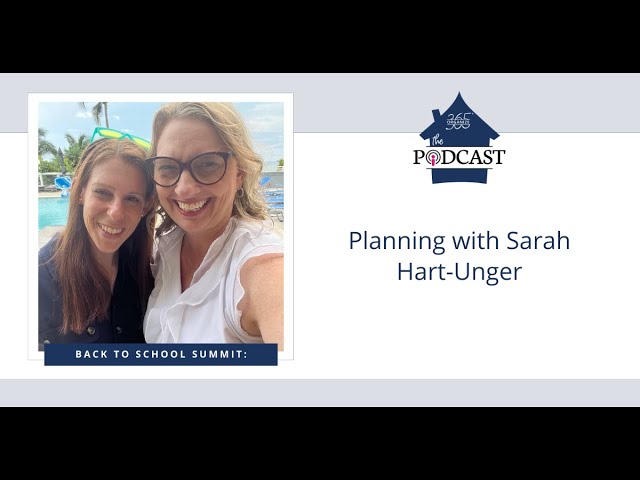
In this Organized 365 podcast episode, host Lisa Woodruff welcomes repeat guest Sarah Hart‑Unger, a physician‑turned‑planning expert and host of the Best Laid Plans podcast. The conversation weaves personal anecdotes, professional insights, and practical frameworks for effective planning. They discuss the origins of Sarah’s love for planning, how motherhood reshaped her system, and the evolution from high‑school datebooks to sophisticated weekly, monthly, and seasonal planning rituals. A central focus is the concept of "quintiles" – five distinct seasonal planning blocks that align with school calendars and life phases – contrasted with traditional trimesters and quarterly business cycles. They introduce the term "planning privilege," highlighting how invisible household labor often goes unrecognized and how intentional planning benefits everyone, especially those whose lives are otherwise planned by others. The hosts explore the Back‑to‑School Blitz and Holiday Blitz events, the role of Planning Day for families and business owners, and the tension between planner products versus the planning process itself. Sarah shares her "Best Laid Plans" podcast origins, her website (theshoebox.com), and resources for listeners. Throughout, they emphasize planning as a habit, a skill, and a tool for reducing stress, increasing efficiency, and fostering emotional well‑being across different life stages.
Chapters
Oh my goodness, Sarah, welcome back to the Organized 365 podcast.
I am so excited to be here. I can't believe I'm a repeat participant with Organized 365 now. I'm almost a regular. Thank you so much for having me.
Oh my goodness. I— and last week I got to meet you actually in person when I was in a conference in Florida. That was so amazing. I love how Our virtual friendships become in real life friendships.
Yes, and we had no shortage of topics to talk about, all things planning, space, organizing life. It was fantastic.
Yeah, it was so great. And so before, like a month or so before I came to Florida and met you in person, I was going through some old SlashPockets, and I found an email you had sent to me a couple of years prior. And I brought it with me to Florida. And before I could even pull it out, you knew what the email was of. So tell everyone, what did you send me an email for 2 years ago?
Yes. Well, I had just kind of gotten into the Friday Workbox and really understanding Lisa's world. And I was like, we need some sort of physician-specific, I don't know, plan or product or something like that. And that I wanted to be a resource if she ever wanted to start anything like that up. I'm— I work part-time as a physician. I was full-time until very recently. And That is one of my passions in helping my fellow medical providers learn to plan so they can enjoy their jobs all that much more.
And so this is just a great, like, full circle moment of how these silly slash buckets and printing out emails keep these ideas top of mind. Because spoiler alert, we're not creating this product right now. Like, this is not what Sarah's doing in her business, and it's not a rabbit trail I have the ability to go down right now. But I guarantee you, sometime in the next 29 years, Sarah and I will collaborate on this, and probably some of you will be like, hey, I want to work on that too. And I love that Organized 365 is a place where really proactive, professionally development-minded women come together to learn not only how to organize themselves and become more productive, but also how to then take that learning into whatever unique field and niche that you're in. So I As a teacher, have always known that the products and services that we offer here are just like the tip of the iceberg. They're just like they're they're the scaffolding for whatever everyone else is uniquely created to do. And today, Sarah and I are going to be talking about planning. So I got this idea to support teachers in the education camp that is going to happen the second week in July, which is the same week that we do the back to school. School Blitz, which is also now the same week that we're going to help homeschooling families get ready for their school year as well. Like, the second week in July is kind of like all hands on deck. How do we support everything education? And as Sarah would say, education adjacent. She likes to say adjacent. I always think of you when I hear that word. And, and all of it involves planning. Like, I mean, I say no one wants to plan in July, but actually some of us kind of do. So that's kind of due because we know that it's going to give us so much more capacity in the future. So in this specific podcast episode, Sarah and I are just going to geek out on planning and everything related to planning. Are you game?
Yes. And July totally makes sense. Obviously, school calendars are going to vary, but if you are one of those lucky families who gets to start in early to mid-August like we do in Florida, like, yeah, planning has to happen in July. You don't want to wait until things are actually going to do the planning because by then, I mean, there's still some benefit that can be had, but you're going to get much more benefit if you're ahead of the actual event.
Yeah, I'll say Florida and Georgia and any other states that start like August 1st to the 10th are like, your, your back-to-school blitz is almost too late for us. And then people in New York who aren't getting out till the end of June are like, why are you already talking about school? So there is no perfect time, but this is what Organized 365 has determined the time will be.
So Sarah, let's start with how did you first fall in love with Yeah, I guess I think I've just always liked to have a lot of balls in the air. Like even as a high school student growing up, I was not content to just be in the orchestra. I wanted to be in the orchestra and the chorus and the play and cheerleading and get good grades. And, you know, I wanted to do a lot of things and in order to make that happen without becoming incredibly stressed out, planning had to enter my life. So I've been doing it for a long time, but I feel like my methods have Only become more refined with time as I've had different types of things to balance other than what's on a high schooler's schedule. And I just find that the time spent planning comes back to me twofold. Number one, I feel like I am much more efficient. So there's the concrete, oh, I get so much more done. And there's the emotional piece of, oh my gosh, I feel so much better about my life. I feel less overwhelmed. I feel like I can do it. So It's kind of like the concrete and the emotional. And my sort of thesis is that I think most people don't spend enough time planning and they don't spend enough time thinking about how they plan because there are ways to plan more effectively and there are ways to plan that might be more spinning your wheels and stressing you out. So that's why I've dedicated so much of my work in the past few years to all things related to planning.
Okay. I'm so glad I asked you that question. Because I don't know how I would have answered it before you answered that question. But you're right, like, as you were talking, I remember the planners I used to buy in high school, and I would go to the office supply stores, and I would buy planners, and I loved them. So, and they were just like, you know, datebooks, and I had a certain design that I liked where it showed you the whole week, and it showed you in a vertical kind of like we do the Organized 365 agendas, not in blocks like it went down the page, and it was a 2-page spread. And I would take all of my assignments and I would figure out when I was going to get the work done in order to get it done ahead of time. And I was doing it so that I had more time to earn money and babysit. And so I was task stacking. And I mean, I babysat 20 to 30 hours a week when I was in early high school. And by the time I was in college, I was babysitting like 40 hours a week. So I would stack all of that and then like, what work could I do while I was at a house when kids were sleeping versus what work did I need to do at school? Or at home. And you're right, it started in high school.
Yeah. I mean, they give you that assignment book. The funny thing is a lot of times they'll hand out assignment books even to middle schoolers without a lot of guidance on how to use them. And at that age, I think kids are very capable of planning, but they're also going to need some help. So if this is you and you have a kid in the upper elementary years or a child entering middle school, not only do you want to make sure they have the resources available to plan, but you're probably going to have to show them what you do, help them actually do it, um, because it's not necessarily something that comes all that intuitively to most of us, including me. I feel like my methods have really, like, taken a lot of time to, to hone and develop.
Yeah, I'm thinking back. I went to the Hallmark store and bought mine because, yes, we didn't— I'm so old, they didn't give us planning assignment books when we were in school. Like, you just had to figure it out on your own. Uh, a lot of people didn't figure it out, by the way. So that reminds me that there was a period in Organized 365 where we made planners for kids, and we had one for grade school, and we had one for middle school and high school. We don't have that currently, but people have asked me to bring it back. There was a little bit too much in there. I would probably redesign it again. But you're right, if we do bring it back, I need to do the training that goes along with it, not just the book.
Yes. So we have an old copy of one of your kids' planners, and I'm not gonna discuss which of my kids Because they might be embarrassed. But this kid still has it in their room. They look at it all the time. Um, so I, I think you have something there with those kids' planners, and they probably deserve to see the light of day again.
Okay.
All right.
Well, that'll, that'll go back into another pink slash pocket. We'll see when they come back. Now, I talk about how naturally in our homes we organize 3 times a year, and I thought it was because I was a teacher and a parent, but now I realize it's because in America We just have been kind of conditioned that you have like Labor Day to December and then January to the end of school. I say Memorial Day, and then from Memorial Day to Labor Day is your summer. These 3 times a year, we just seasonally, because that's the school cadence we have, that's our cadence. You actually divide the year into 5 segments. They're called quintiles, which we've talked about on the podcast before. But will you refresh our memory? Because I think there are some advantages to your quintiles over just the trimesters that I have.
Yeah, I mean, it's similar to the trimesters with a couple of extra cut points. And quintiles are also adaptable based on what your school schedule looks like. So maybe you're in a year-round school, or maybe you, you know, again, are so far south that you start in the beginning of August versus being up north. So the way I've conceptualized it is New Year's is the beginning because, I don't know, that's just my nature. I love January 1st. It feels like a fresh start. I know it's arbitrary, but I'm just gonna embrace it. So January 1st to spring break, because I always feel like that's the point in the year where like, Then after that, you have this weird acceleration of crazy stuff to the end of the school year, and that felt like a natural cut point. It's also, there's some holidays there like Easter, Passover, et cetera. So January 1st to spring break, spring break to the end of the school year, that's quintile 2. Quintile 3 is summer. That's all Q3. It has its own special feeling. That's what I'm thinking about now as we're recording this and what you might be kind of coming out of as you listen to this. Quintile 4 is the back-to-school season. I feel like it deserves its own— it's its own energy. You're getting the routines down. And then yes, I could have considered I continued that until December, but to me, November and December have their own special flavor. They're reflective, they have holidays, they're family-focused. You're already getting ready for the next year. A lot of people travel. So that's Quintile 5, or as I like to coin it, reflection season. So that is how I like to divide up my year. And the reason I feel like it matters is I do do sort of a seasonal dedicated planning session before each of these quintiles to set up routines and various household tasks and decide what my focuses are for the family and for work, et cetera. And so for me, having 5 fresh starts is better than 3, and I like that it goes along with the school year. So that's my quintiles.
I love that because, um, that may resonate with you when you're listening and be like, yes, I need to do this 5 times a year. But also what I love about it is the customization. So we're giving you 2 options that are not plan your year in January for 12 months. That doesn't work for anyone, by the way. Businesses do it quarterly. Like, even a business that makes an annual projection goes every 90 days and they update their projection. Like, they don't expect that it's just gonna like go flawlessly. I will say, now that I am in the empty nesting phase of life, I do not have a crazy May anymore. Like that. Yeah, I know, right? If you are a parent, you're like, there is a time in life where I will enjoy May again. Yes. The only thing that happened this May was Mother's Day and I went on a business trip. Like, so everybody's on Instagram going, it's Maycember and everything's crazy. And I'm like, why are they, why are they going crazy? And because I, I am not in the active parenting years of school, but if you have kids in school, May is its own season. Like, just the month of May is a whole season. And like, you better— it's a marathon. Like, just— Yeah, be prepared. Now, the end of November and December is always going to be more chaotic and memory-making for everyone because there's so many holidays and it's the end of the year fiscally, and there's just so many things happening at the end of the year. The Back-to-School Blitz helps you get organized for the fall, and the Holiday Blitz helps you get organized for that. And people will say doing the Holiday Blitz revolutionizes their holidays. Like, it makes it more of an enjoyable event where they're actually able to enjoy the holidays instead of just getting stuck in the to-do list. So I do think that the planning, the annual planning that you do is very season-specific, phase of life-specific. When I think, and I've been thinking a lot about my mother-in-law, you know, May and December, her happiest months because there's so much family time. The rest of the time is very lonely. Like if you're stuck in a season of life where you're a parent or you're a business owner or you're whatever you are, and this is how you're trying to process through those chaotic memory-making things of May and December for you are life-giving to people that that's maybe kind of the only stuff that's on their calendar for the entire year. So if you keep that in perspective, then you're like, okay, this is really meaningful for Grandma or for Aunt Betty or for whoever that really doesn't have this chaotic fun life that we have. Which leads me into— you started a whole podcast about planning. Why did you start a whole podcast about planning?
I did. I mean, it started during 2020 and work was feeling rather bleak in the medical field, and I just needed— I had already been doing my podcast with Laura Vanderkam, which is Best of Both Worlds, going on like almost 6 years now, but I just like needed something else. And I found myself during that crazy time getting really obsessed with planning and bullet journaling and Especially planning my day. It was very difficult to do longer-range planning when there was so much uncertainty, but there was so much comfort in like, you know what? I have this show I'm excited to watch and I'm planning that little spark of fun because there's not a lot of options right now. And I'm going to write it down and savor it and look forward to it, et cetera. So I just felt like there's such value in thinking about our time and our activities in that concrete way. And so I set out to review planners initially and I did a lot of that and I still do a lot of that. But then I also, I mean, I realized I have so many thoughts around things that are quote unquote adjacent to planning, like, you know, pitfalls of tracking things or ways that we decide to store our memories, things like that that aren't necessarily exactly planning but are planning adjacent. So Best Laid Plans was born. And yeah, you can hear all about various planning techniques, weekly planning, seasonal planning. All things related to planning, because I think it's so important, and I get feedback from people that it has helped them. I feel like the number one thing people say is it's helped them to use their time in a more intentional way. And if I can bring that to people, like, I mean, what else is there? That's— it makes me so happy.
Yeah, and what I love about that is, I mean, because I listened to your podcast, I've listened to it from the beginning. I was like, how many planners can we possibly review? FYI, lots. There are lots of planners which helped me come to the next conclusion. I'll tell you next. But what I love about, especially having watched you launch and grow that planner, you started with reviewing planners. I started the Organized 365 podcast with a program I had back then called the 40 Weeks, One Whole House, and those episodes don't even exist anymore. But so often what we do here at Organized 365 is provide you more time and space to figure out what you're uniquely created to do. And so watching you, Sarah, launch that podcast. You can see— I mean, like, I can literally listen to you evolve into a planning expert from like, okay, I like planning and I'm going to review, review these planners, to you are now a planning expert. And I love the example of how you just start, like, to figure out what you're uniquely created to do, or what your spin is on something, or what your version of the expertise of the field that you're in— like, there are Thousands of planners. Like, it's not gonna be like you have the only planning idea, or like everybody has to plan Sarah's way. But there will be people who are like, okay, I do bullet journaling, and I like quintiles, and I wanna listen to planning every week. And they will become devotees because you explain planning in the way that it works best for them. So if you are trying to figure out what you're uniquely created to do, you have to just start. And then I will say, listening to your podcast is Part of why we don't have a planner anymore.
Yeah. Oh no, I killed the planner.
You killed the planner. You may be getting some emails about that now. So when you figure out what you're uniquely created to do— so I feel organized 365. I've been doing that for almost 12 years now. It's a constant iteration and refinement of actually what only you are uniquely created to do. So I, I don't think there are very many companies out there that are actually teaching the skill of organizing. There are a lot of decorating companies, there are a lot of decluttering companies, but not ones that actually teach the skill like a teacher would of how to get organized. So I'm kind of unique in that. And let me just tell you, I— there's a lot of room for me to grow because like we just talked about a medical box, like the products and services and courses I could create are infinite because there are not many people who are doing what I'm doing right now. There will be. But there aren't right now. And so Planning Day, which I have 4 times a year for business owners and 3 times a year for homeowners, is something no one else is doing, especially not at the level I'm doing it. Like, it's like, it's like a mini PhD every time you show up. Like, you will be swimming in information because you've never thought about planning the way I think about planning. In a good way. In a good way. I think you could give your opinion. But I was conflating that with the planner I had created in order to walk you through planning day. So there was planning day where I talked to you about the next season you were going into and what the decisions that needed to be made. And then there was a planner component about how you would then act out that plan for 90 days or 120 days. The problem is there are thousands of planners on the market, and everyone has opinions about their planners. And also, hello Australians, they're in a totally different season than we're in. And I realized that I was bending myself into a pretzel trying to get the planner that I created to match the planning that I was providing. And when I finally sat down, I, I think it was probably because I was listening to you talk about all these different planners. I was like, you know what? What is the one thing that I'm uniquely created to do? Teach you how to plan, not provide your planner for you. Any planner will do— online planning, physical planning— what, like, it doesn't matter. It's the planning day that is unique to Organize 365. And so now we just have a workbook for the household. It's a workbook that you go through that helps make all the decisions, and then you pick whatever planner you want. The Workbox one does have a planner component at the end, but it's very— it would work for bullet journaling. It's, it's very— it's not a meaty planner at all. It's just 13 pages of plans. I use it as a journal. I don't even use it as a planner. So thank you, I guess.
No, I think it does make sense because really people want different things out of their planning tools, and more and more people gravitate towards, you know, hybrid digital and paper solutions. I know a lot of people who do prefer that their schedule basically be digital and live in the cloud, but they love a physical representation of what their list and day looks like every single day. And then there's other people who really like to have everything on paper and want to have everything in one book. And that's why there are like, again, I mean, people think I know every planner. That is hilarious. There are— I probably know 5% of the planners. No, less. I don't even know. Like, because all the time people will email me, oh, do you know about the Calibri planner? That was just one example. I'm like, no, I've never seen this before in my life. There are probably 1,000 or more different brands of planners out there in this world. Some come from different countries. It's, it's actually really, really amazing. So I think it makes sense. And I know firsthand that the pages that are left in your workbook are super, super useful and could be used in conjunction with any type of planner. Plus, I kind of like just having like a dedicated workbook that's just for planning day that I know it's just going to get like used for planning day and then can be referred to.
Yeah, it's 2 completely different skills: the skill of planning and the skill of acting out the plan. These 2 completely different things. Okay. So now when we met in Florida, you told me this phrase that you coined, and I cannot wait to discuss this. I'm so excited. I'm like a kid on Christmas morning. I was like, what? Okay. The term, and then I'm just gonna let you go, is planning privilege.
Yes. Okay. It's a little bit of a pivot. Um, so a lot of people listening to this have families. And a lot of people listening to this do a lot of life management for the members of their family. I know I do. I'm good at it. I enjoy it. But then every once in a while, particularly common from men, honestly, I'll hear something like, but you don't really need to do all this. You can just live more spontaneously. What's the point of all this? And I take major issue with that. And I coined the term planning privilege because I think some of the people that do not understand the value in planning are people whose lives are being planned for them. Someone else is doing the labor and doing the work of making things run smoothly, of making sure there's something for dinner in the house that everybody can eat when everybody gets home from work, from making sure that, you know, like the lawn is getting taken care of one way or another, all different types of things. Um, but that, that work, like Lisa likes to point out, it's often invisible work. And so It doesn't get acknowledged and therefore isn't seen as important. And I would love to have more men. I actually had a voicemail from a guy recently and I was so excited. I'm going to play this on the podcast because maybe he'll encourage other men to be more vocal. But planning is for everyone. And I think everyone benefits when we give it the attention that it deserves, including, as I mentioned, those emotional benefits. So maybe you get a lot of stuff done for you on the household side of things. But maybe there's work stress that could be better managed with a little bit more intentional planning. So I believe that everybody can benefit from it, and some of the people who might doubt its power might be getting a little planner privilege.
So my husband likes to ask me to go with the flow. I always tell him, I don't like where the flow is going. I like to make the flow. Why do I have to go with the flow? And usually he asked me to go with the flow. On the family trip to Florida because I like to make the flow. And in Florida, it's not my family and they have like a set way of doing things. And I have learned that this one week out of the year, I do go with the flow. It is painful for me. It is painful for me because I like to be in control, but not even that. Like, I like to know what we're doing. And I like to, like you said earlier, I like to do a lot. Like, I like to do a lot in a day. I feel best when I am productive. I actually get migraines when all I'm supposed to do is like lay by a pool and read a book. Like, I will end up with a migraine. I will end up with like— I'm not a good relaxer. You do not want to take me on your tropical vacation. I'll be like, I think that there's a mountain we should hike. And I don't even know how to hike mountains because I just don't want to like lay there. I could do it for a day. So I'm not a good go-with-the-flow person. But there are people planning that trip. Like, which day is fishing day? Which day are we going to the— get our nails done? And which days are we going out to dinner? And where is that dinner going to be? And do we have reservations? Because you cannot be on vacation in Florida and just show up at a restaurant. Even sometimes when you do have a reservation, you're waiting for 2 hours in the rain under a tent, because that's just how it is. Like, somebody has to be doing the planning. So in some instances, Lisa, you need to go with the flow because somebody else is gonna do the planning, which is fine. But if no one is doing the planning, the flow sucks. It just flows into like a puddle of nothingness. And so either you're the flow maker or you're the flow goer. Know which one you are. But if you are going with the flow, let's say for the holidays, and you magically show up at 3 different dinners where there are all these other things happening. Someone planned all of that, and you need to go over there and give them a big hug and say, thank you. Thank you for my planning privilege of this holiday season. And then when you become the adult, you realize, oh yeah, you're the person in charge of all that.
Yes, that's so funny. I was even thinking that like, um, when you're on your trip to Florida, probably the only reason it works to go with the flow is someone else has created somewhat of a flow, right? Because if it was just you two, like, going with the flow would be like, wait, we don't have We, we have nothing. Um, and I am someone who enjoys a tropical vacation, um, and doing very little. And honestly, my husband and I will sometimes like, um, if we're able to have somebody help with the kids, like spend a lot of time like binge watching a TV series and get a massage. And that's all our activities for the day. But I feel better about doing those things when I've already, when I know what else is on my plate. Otherwise it would be incredibly stressful. So I think planning can like give you that gift of doing very little when you want to. Yeah.
Well, yeah, even a better example is in between my PhD program on a break, somebody said like, take your— go out with your husband so that he knows you still exist. So we went to Kentucky, like an hour and a half away, but I happened to have planned it. Well, that's when our break was, right before the Kentucky Derby. You might have heard of it. So I'm like, we're gonna go see a horse race. Luckily, I got my ticket 6 weeks in advance. And we couldn't go on Friday. I couldn't figure out why, because that was like the Friday before the Kentucky Derby anyways. We went on Thursday, and then I had to stay in a hotel that was in the neighboring city, 45 minutes away. Then we did a train ride. You had to make sure you got that. We couldn't go to any of the bourbon distilleries because it was— everything was sold out. Like, I waited the morning of to get tickets at one of them. I had a meeting at 9, so I thought, well, 9:30 would be fine. Nope. Whole month sold out. I'm like, okay. So we leave and Greg's like, why are we driving so many places? I'm like, oh, this little thing, Kentucky Derby. Might have heard of it. And so we're driving, you know, we went to one of the horse tracks, then we stayed over here, then we drove back here, and we're driving all around. We saw a couple of historical homes. We saw Mary Todd Lincoln's home, the president's wife, and it was just fascinating. And Greg was like, why are we driving here? Why are we doing this? Why are we going this way? I'm like, I have planned this all. This took me like 6 hours to plan all of this. All you have to do is listen to comedy in the passenger seat. Could you knock it off? And by the end, he said, this was a lot of planning. I was like, it was a ridiculous amount of planning. planning for all, like the whole entire trip didn't cost very much, but to know when the historical homes were open and which homes were open and in which order you were going to do it, because where the car was going to be located and how long it took to get from one thing to the other and where you could eat dinner. And he was like, this is a lot of planning. And it was a simple little 90-minute away trip for 2 overnights, took me 6 hours to plan the thing.
Travel is such a great example of that. Yes. Oh my goodness. But it was worth it because while you were there, you got to do all kinds of stuff that it would have been very hard to do if you hadn't put in that, that work.
It was so worth it. I told Greg he could plan the next one. I don't think we'll go anywhere. Just saying. Anyways, he'll be like, oh, we're going to a hotel half an hour away. That's all we're doing. It'll be fine. But he will have planned it. Okay. So Sarah, here's a question. I I'm wondering, how did becoming a mother change your planning?
Yeah, it really did. I think it just put an enormous layer of challenge onto what was already challenging because I had my first child when I was finishing up my fellowship training for pediatric endocrinology. So it was a pretty busy time to start. My husband, um, he's a vascular surgeon and he was finishing his training, so he was around, you know, not at all. Not at all, but very little during the— they really, they take those guys and women who go into surgery and they just steal them basically until they're done training. And there was just so much to plan. And at the same time, there was less that I could plan for myself personally because I had a baby to take care of.
Mm-hmm.
So the funny thing is I actually went from a daily planner that was very elaborate to a weekly planner because I needed to see all the pieces of what was going in the household. And because I didn't want to overwhelm myself, I knew I couldn't get as many tasks on that would fit in a full page because my life was so constrained. So having like a tiny little box to put the tasks made things feel more manageable. So I kind of had to change a lot about my planning style. And I think this— that period of time, even more than high school when I enjoyed all my activities, was when I just embraced that like, if planning isn't gonna happen, life is going to be like one emergency and chaotic event after another. I'm not going to be able to Joy motherhood, which, you know, has so many intrinsic rewards and wonderful moments because I'm always gonna be stressed about, you know, what's coming around the bend. And I'm not saying that, you know, using a planner made all that easy. It's still an incredible adjustment, especially I think going from zero kids to one kid. I have 3 kids. I didn't find any of those subsequent kids nearly as challenging than having that first one and just having my life flipped upside down because all of a sudden I'm in charge of somebody else's very Delicate and precious, fragile life. So yeah, I mean, that's when I felt like I had to really start firing on all cylinders. It's when I developed the practice of my weekly routine because since I was still working and I had daycare to deal with and I had to pack certain stuff for daycare, I knew that I had all weekend to basically prepare for battle for the next week. So it's when I really drilled into my weekly planning. And I think somewhere around there I read David Allen's Getting Things Done. I might've read it for the second time. I don't know. I need this. My brain is a sieve. I'm sleep deprived. I need a way to make sure I'm not losing anything in this mayhem because if I am focused on one thing and then I forget to bring my daughter's bottles with me to daycare, my day is ruined. Even if I made some brilliant scientific discovery at work, that other piece was key. So, just having a system that made sure I didn't lose track of any of the little things Was, was very, very important at that time.
Yes, and David Allen, Getting Things Done, he is the one who says that your brain should not be used to keep things in. You should write everything down. Like, the one big thing I took from him is write everything down. Now he has a lot of digital ways of storing it, which didn't work for me, which is why I created the Sunday basket, because when I would write things down, I would want them written down on paper, and now I have boxes to sort them in. But that is where that original idea came from. And I think it's genius. Like, if you're still trying to use your brain as a to-do list reminder, like, the only thing you're going to get is a migraine. It's just not a very— it's just not a very good use of that computer, is all I have to say about that.
Totally agree. And it becomes— if you're able to hold on pre-kids, once you add a child and the change in routines and the sleep deprivation that come with that, you will lose your grip. Like, that will be That would be the end. At least it was.
Do you think you plan more or less now, Sarah?
I plan more because I'm not just planning for myself. Planning privilege aside, I do a lot of the planning kind of for a household and a family. I have 3 kids. They all have their own activities now. We're talking about back to school. I got one going into kindergarten, which is very exciting, one going into 4th, one going into 6th. So we're spanning multiple phases of life. I gotta, you know, make sure all the pieces fit together. Plus I work clinically part-time and for myself part-time. So it all does fit actually. It really does. My life is not that hard or that hectic, especially if you compare it to like, let's say those residency years or when I had a newborn. But at the same time, it takes work to make sure that it doesn't feel that way artificially just because things are haphazard and getting lost. So gotta be much more proactive than reactive with all of those different flavors of things going on. And I definitely do more planning now than I did even 10 years ago. And I mean, that's going to change, I'm sure, someday when I have an empty nest. And I can't even imagine that from this juncture. Maybe there'll be less planning. I feel like that'll be kind of sad, but maybe I'll have other really fun, exciting things to plan, or I'll go into like some great volunteer thing and be planning for that. So who knows?
Yeah, I'm gonna say there won't, because once you have this free time like I did, then you decide to get a PhD, and then you have to really plan in order to do that. But I want to— if you could think through like How much time do you spend planning? Like daily, weekly, monthly, quarterly, quintile? However you do it.
Like, oh my gosh, how much time do you spend planning? So I spend not that much time each day. Like each morning I would say it takes me about 10 minutes to look at my weekly list and my calendar and like kind of decide what I'm going to do. Weekly, it probably takes me an hour or 2 to plan out the coming week. Monthly, a little bit of a bonus weekly plan, maybe 2 hours. Seasonally, I like to spend at least half a day. And then for the year, I like to spend at least a full day. So, I mean, that sounds like a lot, but the amount of time that saves me and the amount of stress that saves me is so incredibly worth it. And if you can imagine how much time some people spend on social media, It's, it's actually not, not that much time. Um, I spend more time probably reading or running because I'm a runner, like, than I do planning. And yet the planning really does pay off dividends. So yeah.
Well, and obviously you're an expert-level planner. I mean, it takes longer to learn the skill, but what— it's a habit. Like, really, I see planning more as a habit than as like a to-do list item. I mean, you wash your hair, like, you wash your body, like You change your bedsheets, you do the laundry. Like, it's just another thing that we do. But this thing happens to make everything else easier and give me exponential time to do stuff that is gonna matter longer than the laundry that I did. Like, the laundry is gonna have to be redone, redone, redone, redone. But the same amount of time spent planning each week, just, it gives back exponential returns in my estimation.
Yes. No, I totally think so. Planning is, planning is, you know, what you say about organizing. I feel like organizing is for your stuff so that you're not, your space is not holding you back and your things aren't holding you back. And then planning is sort of like the equivalent for your time.
Yeah. What are you most looking forward to in the Back to School Blitz this year?
I am just really excited to, um, kind of set up our, our back to school routines. And I know you do a lot of time, like talking about morning routines and like making the lunch routines and Stuff like that. And since, again, I'm going to have a middle schooler, I think I'm going to have to pay extra attention to making sure that she has enough independence and just really kind of thinking through how we might do things a little bit differently. And even things like homework routines, whereas it used to be very supervised, I think I'm going to help a lot with the planning. I want to help her plan. So that's going to become a new part of my routine because she's going to have more assignments. And then— So that she can be a little bit more independent in the execution. So yeah.
Oh my goodness, Sarah, thank you so much for coming back on the podcast. Where can people find out more about you if they want to deep dive into planners and everything planning adjacent?
Yes, well, of course, the podcast, it's called Best Laid Plans. You can find it anywhere you can find podcasts. And then my website is theshoebox.com. SHU are my initials. Someday, I joke, I want to get the Best Laid Plans URL, but apparently it's like $25K and I just can't do it. Not yet anyway. So it's theshoebox.com. You can find all of my resources. I even have courses on planning. They're very different from what Lisa offers. Actually, I have some people who have done both and love both. So that makes me so happy. Yeah. So all the planning resources you can find there. And if you subscribe to my newsletter, there is some planning content there as well.
Awesome.
as well. Awesome.
Well, Sarah, thank you so much for coming back on the podcast. Uh, we'll have to figure out another time when you come back again.
Thank you so much for having me. This was so much fun. I will talk about planning and back to school and all, all the related things all day.
More from Lisa






Podcast 726: Time, Money, and the $300 Million Impact of Household Productivity


Parenting Isn't the Only Caregiving Role That's Draining Your Energy #Parenting #Caregiving

Turning 40 Isn't About Age, It's About Responsibility #TimeManagement #Organizing #MentalLoad

The Sunday Basket Saves Hours Every Single Week #SundayBasket #Organizing #TimeManagement

Your To Do List Will Never Be Done, and That's Normal #TimeManagement #Organizing #MentalLoad