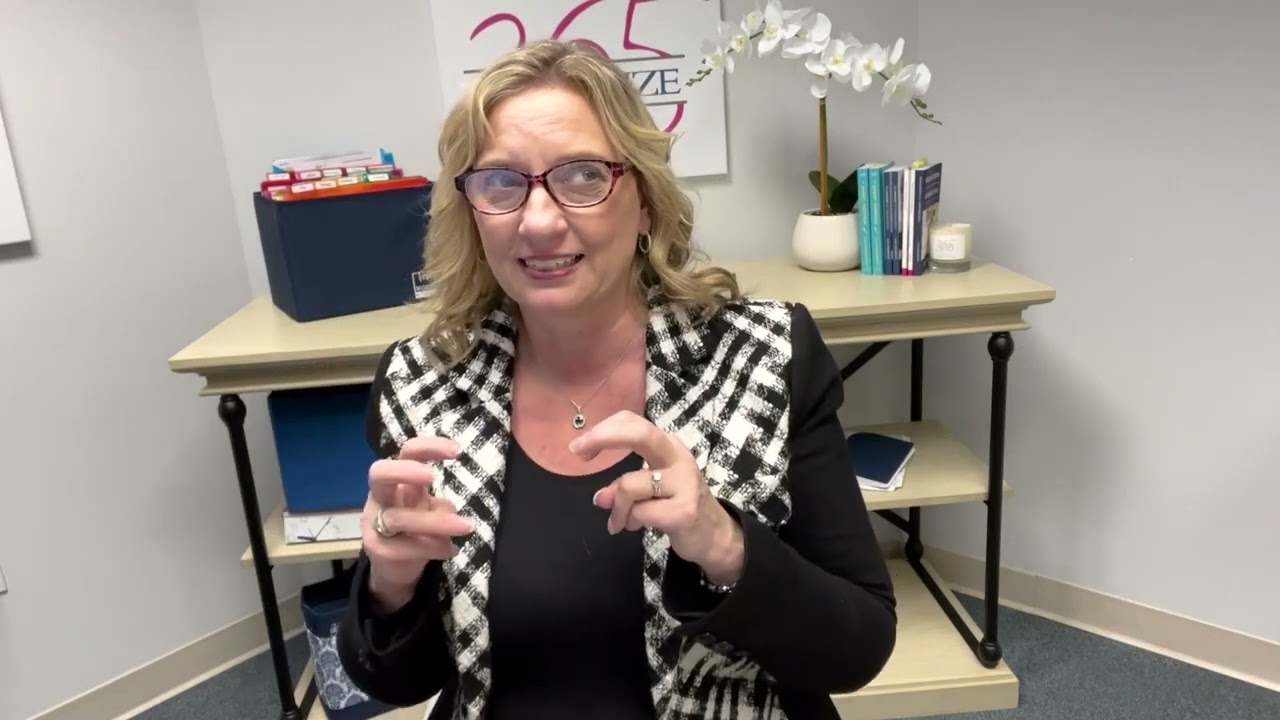
In this Friday Live episode, Lisa Woodruff celebrates a decade of teaching the skill of home organization. She begins by asserting that organization is a learnable skill and reflects on her background as a middle‑school math, preschool, and computer teacher, emphasizing the teacher’s responsibility to break down concepts in multiple ways. Woodruff describes how she transferred that classroom mindset to in‑home, paper, and small‑business organization, initially offering one‑on‑one services in Cincinnati before expanding through podcasts and a series of programs: the original 40‑Week "One Whole House" course, the 100‑Day Home Organization Program, and the current Productive Home Solution. She explains the evolution of these programs as a response to curriculum updates, student engagement, and the need for more efficient delivery. Woodruff then critiques common misconceptions about organization, distinguishing it from decorating and perfectionism, and argues that true organization is a functional system where everything has a place, not a flawless aesthetic. She introduces a new framework of four organization categories—personal, family/communal, storage, and paper—and shares recent survey results showing that only 13‑18% of respondents have systems in place for each category, highlighting a gap between belief in learnability (84‑87% agree) and actual implementation. She underscores the role of a dynamic teacher who continuously updates curriculum, draws parallels to her own 4th‑grade history experiences, and stresses the importance of engaging adult learners amid competing distractions. Finally, Woodruff thanks the Organized 365 community, announces limited‑time free shipping on products, and wishes listeners a happy Easter and Passover, noting her first Easter with her grandbaby.
Chapters
Happy Friday! This week on the podcast, I'm talking about 10 years. 10 years! A decade. A decade of teaching the skill of organization. Yes, you believe it, I believe it, we all believe that organization is a learnable skill. I, as a teacher, have always had the feeling that to teach a skill, to be a teacher, for you to learn as the student, The onus is on the teacher. It's on me. Like, if I can't figure out how to break it down, share it with you different ways, then how can you possibly learn a skill? I was a middle school math teacher, I was a preschool teacher, I was a computer teacher, like, and in every instance, I always took it on myself to come up with new and exciting and different and multiple ways in order to teach whatever I was teaching so So that my students enjoyed learning and they learned whatever I was teaching them to learn. And I have taken that same energy, that same thought process into the last decade of teaching in-home organization, paper organization, small business organization. And along the way, I thought I had this limiting belief that I could only teach that to you one-on-one in person when I was organizing in homes in Cincinnati, Ohio. After 3 years of doing that and training a team to do that in my place, I started sharing my thoughts on the podcast— the mindset of organization, what you have to think about, how I make decisions, the questions that I ask, what areas to organize first. And I kept sharing all these ideas about how do you become an organized person in your mind, like how do organized people think and why do they think that way and how did they get there and how can you get there yourself. And then a few years later, I started a program called the 40 Weeks, One Whole House. You might have heard that. It then became the 100-Day Home Organization Program. We've been doing that for 6 years, and has now morphed into the Productive Home Solution. So if you've been following around for a little bit, or you've heard all of those different titles, and you're like, I don't understand how this became this became this, and furthermore, why? Like, why not just have 40 Weeks, One Whole House? That sounds like something I could do. Or— 100 days. Why did we have to change it from 100 days? Well, as a teacher, like, think of a class that you loved to take. For me, it was 4th grade history. 4th grade history, we learned about colonialism. And you might've learned this too, where you, you had the string and you walked around the classroom. And then when it got to be your turn, you dipped it in the wax and then you walked around the whole classroom again, like in a little parade. And you kept doing that for like, I don't know, 2 weeks. An hour, and at the end you had this teeny, teeny tiny hand-dipped wax candle. And then I grew up in the Akron, Ohio area, so we got to go to Hale-Firman Village. We got to see a blacksmith and all these different things. Like, it was just so fun to imagine what it must have been like living in the early years as America was becoming a country. I loved it. I loved everything about it. Now, as an adult, I know I loved it because I was learning about it in a school where we had indoor plumbing. I don't know if I'd have loved it as much as if I was Living it in real time. But I loved it. I loved the field trips. I loved how that teacher made everything really come to life. I just loved her personality. I just loved everything about my 4th grade teacher. Now I'm 50 years old and my 4th grade teacher taught up until I was 40 years old. And if you think that she still taught her classes that lesson the same exact ways, you know, 20 years after I learned it with her, of course she didn't. Like, Every year I'm sure she added a new thing because one, it makes it more interesting for the teacher. Like if you're gonna keep teaching something over and over and over again, you have to really, really love it. And in order to really, really love it, you need to be able to add new spice of life in there. Secondly, like I'm pretty sure that the curriculum for the state of Ohio has changed over the last, you know, 50 years, 40 years. And what we learned when I was in 4th grade is not really what the state's standard is now in 2020. Like, 1980 is not the same as 2020. You would not expect that the 4th grade teacher would have the same exact curriculum and be teaching it the same exact way 40 years later, right? No, of course not. And teachers are good teachers because they are avid learners. They're asking questions and they're learning and they're excited about what they're teaching. And so they're always learning and developing themselves. And they bring all of that to whatever they are teaching. And it's no different than when you're an adult teacher teaching adult things like business and marketing and whatever it is that you do as your profession. Like, you're always learning and growing in that. And when you're not learning and growing in that and your job becomes more like you can mail it in, like, in a way maybe that's great because you can like show up and leave on time, but also it becomes boring. And then You lose kind of the energy that you have around your job. So dynamic teachers are always pushing the envelopes of what is possible, questioning why we do things the way we do them, and coming up with new and interesting ways to question and think about things that we've never thought about before. One, to keep ourselves engaged, and two, to keep our students engaged. Keeping adults engaged is way harder than teaching kids in school. Not because you're not willing to learn, of course you're more willing to learn almost, but because there's so many different things competing for your attention. Like, okay, so I taught middle school math. Some people loved middle school math. Most of my students did not, but it didn't matter because they had to spend an hour with me a day. So I knew I at least had this certain amount of time to impart my knowledge on them and come up with some fun way to teach them something they really didn't want to learn or they were struggling learning, and I would come up with fun ways to do it. Well, in teaching the skill of organization, which 84% of you in our first study and 87% of you in our second study agree is a learnable skill, so yay, we all agree that organization is a learnable skill, I have to compete with Netflix, Instagram, your actual job, your housework job, what you want to do on the weekend, a sunny day, the fact that you felt like having a nap or something like— I have to compete with all of those things in Even though you have a desire to get organized. And the biggest thing that I have to compete with is not even that. It is what you think organization is. That's the biggest hurdle that any professional organizer or anyone who's teaching you something about home, paper, or work organization has to butt up against. It is your own preconception about what Housework is. What does home organization look like? How do you organize paper? How much paper do you have? Why do you even need paper? And we learn almost all of that from 3 sources. One is our family of origin, whatever our parents did and our grandparents did, or however many family members you've been in their houses and you've seen the behind the scenes, whatever they did is most normal to you. Number 2, whatever your favorite TV shows are, you're kind of taking that in and your subconscious is saying, yep, that is what a good TV You know, that's what a good house is, or that's what a bad house is, based on this fake thing that you're watching on TV. Or third, and this is almost the most detrimental of everything, it is the fake perfect ideal of what your house should look like, based on Pinterest or Instagram or a magazine. Some still life image of some space that was cleaned up for that picture, which behind it looks like complete chaos. And you're looking at that perfect picture and going, that is what I want. How do I get that? That's not organization. That's decorating. I am not a decorator. Oh my gosh, I should show you my desk right now. I can't because I'm doing this on two phones. But I mean, it is like a bomb went off in here because I have been going from meeting to meeting to meeting meeting. I need to record these videos because I'm actually getting my hair done while you're watching this. I need to get these over to Aaron so I can move to the next meeting. Next meeting. I got in here at six a.m. and I'm leaving. At 8 PM because I'm going from thing to thing to thing to thing to thing. This is a picture. This in front of me is real life. And organization is having some spaces that look like this and some spaces that look like a hot mess, but always knowing where everything is. And when you need to at the end of the day pick it all up, you know where it all goes. Everything has a place, and when everything is put away, It is organized. I never espouse that my house, or your house, or your office, or your car, or your whatever needs to look perfect, because newsflash, if you haven't figured this out yet, it will look perfect for like 5 seconds, and then one thing will lay on your desk, or the laundry will need to be done, or you'll use one glass, and all of a sudden the kitchen, the laundry room, the desk are no longer perfect. Because perfect is not an ideal. It's not a thing. It's not a destination. Like, it does not exist. It exists for a moment in time and then it is gone. And if you're striving for perfection of a certain decorating style, you're never going to feel organized. But if you want to have a system for regularly checking everything in your business and in your home, having checklists that you could check off and know that it is done, Believing done is better than perfect, that you're never going to get through your to-do list, but you know where your to-do list is when you have some time to do it, and everything has a place, that's organized. And organization is a calm inner knowing that you have your stuff together. When you get called for that piece of paper, you're going to be able to find it and retrieve it within minutes. That when you are on the road and you get called from home and someone wants to know where XYZ is, you can say, look here, here, here. They've got it, you don't have to turn that car around and go back. And you know what I am talking about. It means walking into a store or doing your errand list and actually being able to complete the whole errand list with having not forgotten something to put on the list or forgot to bring something with you that needed to be returned or purchased or taken in or fixed or whatever. To be able to leave the house, do the errand list, come back, and the to-do list is done, that is organized. That is living an organized life. It's an inside game. It's an internal peace and knowing, and it totally is a complete mindset game. So learning the skill of organization, 87% of you in our last study believe that you can learn the skill of organizing. We're about to release this research, is what's gonna be coming out in the next couple weeks. We are gonna start defining home organization as 4 categories: personal organization, family and communal space organization, storage organization, and paper organization. How many of you feel like you are personally organized, or all of your family spaces are organized, or your storage area organized, or your paper is organized? And the survey that we just did, the number of people who said, I have a system in place and this category is organized, not I'm organized, but like of those 4 categories, that space is organized, Ranged from 13% to 18%. Oh, those are not good scores. Like, no, no teacher is going to be able to, um, get their teacher bonus if there was a teacher bonus, which we know there's not a teacher bonus, but you know what I mean. Like, that is like, if we're doing standardized testing for people believe that organization is a learnable skill and the teachers out there have gotten people to be able to Do the skill of organizing. The teachers are all failing miserably. So I want to change that. I want to change that. And over time, I've realized that it is not just the Sunday Basket. It's not just 100 Days of Organization. It's not just Spaces in 40 Weeks that were appropriate for stay-at-home moms of school-aged kids. Frankly, that's all that that one worked for. It is a complete system, a different way of thinking about organizing and these distinct areas in which you get organized, which are your personal spaces, Your family spaces, your storage spaces, and your paper spaces. And I'm so excited because there's so many of you who have actually gotten organized with all these iterations that Organized 365 has had, and we are just going to make it so much faster and easier now. And you guys are the pioneers, you're the OGs of the Organized 365 community, and you are literally paving the way and have given me, the teacher, the, the time the latitude, the grace in order to not perfect but become excellent in the way that I teach home organization so that I can now chunk it out so that the people who follow behind you are going to be able to do it easier and faster. So thank you very much to you. All right, a few more announcements just for this week. We only have a couple more days in free shipping, so if there's like— you want more slush buckets, you want to get the highlighters that we have, you want to get a Portable Sunday basket, you want to get a sweatshirt, there are 3 more days of free shipping that will end Sunday at midnight. And also, happy Easter on Sunday and happy Passover today! So it is a great weekend of celebrating with family, and many different religious occurrences are happening this time of year. So I hope that you get some time to enjoy with your family. I hope you have good weather. I think Cincinnati's supposed to have good weather. You know, on Easter it can either be bright and sunny or snowing. You never know, it's Ohio. I mean, either way, it'll be my first Easter with my grandbaby, so I cannot wait. I will see you guys next week. Bye.