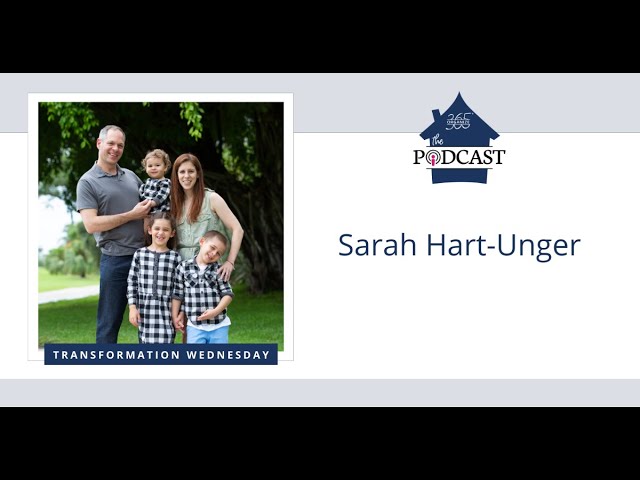
In this episode of the Organize 365 Podcast, host Lisa Woodruff interviews pediatric endocrinologist and podcaster Sarah Hart‑Unger. Sarah shares how she first discovered Organized 365, describes her two podcasts (Best of Both Worlds with Laura Vanderkam and Best Laid Plans), and outlines her life as a mother of three, a part‑time physician, and a self‑described “organizing junkie.” The conversation explores how children’s developmental stages create distinct “golden windows” for organizing (especially around ages 5 and 10), and how the frequency of tasks like sorting clothes shifts from every six weeks to a few times a year. Sarah explains her custom “quintile” planning system—five periods aligned with school calendars—as a more functional alternative to traditional quarters or trimesters. She details her use of the “Sunday basket” as a physical tickler file, including a modified version for kids’ artwork, and debates the merits of boxes versus binders for preserving memories. The pair discuss the 100‑day program, moving homes, and how a move can serve as a reset for decluttering. Sarah reveals her habit of spending three hours each week reviewing her calendar to align professional, family, and personal commitments, and how organizing physical spaces (e.g., the storage room) serves as a mental release. She outlines her next project: a closet overhaul to align personal style with identity, contrasting it with shopping. Finally, Sarah offers advice for newcomers—embrace imperfection, start with tiny habits, and view organization as a fun, iterative process. Throughout, both hosts emphasize the community of “self‑improvement junkies” that makes organizing sustainable and enjoyable.
Chapters
Sarah, welcome to the Organize 365 Podcast.
I am so excited to be here. As a longtime listener, this is super, super exciting.
It's so fun to talk as podcasters because we both listen to each other's podcasts. So it's like we've been talking in real time, but we have not at all.
It is a little bit surreal. I feel like this is such a privilege and a blessing that I actually get to sometimes speak face to face with people. I get to listen to their wisdom all the time. So yeah, this is super, super fun.
Yeah, so fun. So how did you very first find Organized 365? Is it because I went on your podcast or had you found me before that?
I honestly don't know. I think that when you reached out to Best of Both Worlds, the podcast I do with Laura Vanderkam, I think I I was— maybe had already heard of you, and I think I had— I think someone had recommended your podcast. So I think I had already been listening to you, but I hadn't taken like a deep dive. And then it was after you came on that I really started diving into what you had to offer and became a very regular listener.
So tell everyone who's not familiar with you, tell them about your podcast, and then also tell them who lives with you in your house.
Yeah, so, um, well, my podcast, I, I co-host Best of Both Worlds with Laura Vanderkam. That's been out since 2017. I think Lisa was one of our like earlier guests, maybe 2018, like very Fairly early on. And then I actually have another podcast called Best Laid Plans, which I launched in 2020, which is all about everything planning and planning adjacent. It's kind of like what I do with paper and things in my mind that Lisa does with everything, basically. But yeah, that one is a solo podcast. I have a few guests. And then in the rest of my life, I am a mother of 3. My kids are 5, almost 9, and almost 11. I am married to a surgeon and I'm a part-time practicing pediatric endocrinologist. So 3 days a week, I'm fully in that world. I like doing a lot of things, kind of like Lisa.
Oh my gosh, your youngest is 5.
My youngest is 5. That's why I feel like I'm in such a golden window right now. And that's all— you have made me realize that. And everybody made fun of me because they're like, didn't you say you were going to organize your house last year? I'm like, you don't understand. I've just reached a golden window. Now it can happen.
But it's so true, right? It doesn't matter how many financial resources you have or intellectual resources you have. Or jobs or whatever. Like, there, there's no organizing children like, like babies. Like, it's just an— it's never ending. Like, the constantness of change from 0 to 5 is just like, it's just managing the chaos. I mean, it's awesome. I love it. I love little kids, but it is not a set it and forget it, or I'm gonna power through this one weekend and be done. No, it is a constant treadmill of organization and work, a 5-year constant treadmill.
Yes. I feel like when your kids are toddlers, you are forced into reactive mode no matter how much you prefer being in proactive mode. It's just too bad. Like there's always something to react to. It's moment to moment. You have to keep your baby safe. That's your number one priority. And yeah, there's not really any, there are very few breaks and maybe when they're napping, you wanna nap too. So, you know.
Yeah, there's, there's none. So we live with our grandson and like he knows, like the second that I do anything, he is like, I'm gonna pick this up on the floor and put my mouth. And I'm like diving across the, the room like, what is that? And I get him out of his mouth and he's like, and he just smiles at me. Listen here, buddy, you cannot turn your back on that child. It's exhausting.
It is. It is. And it's not like 5 is like a walk in the park, but yeah, I feel more peace coming on, more structure. Bedtime is less of a battle. We still certainly have our struggles, but I do feel some time and some energy definitely opening up. So your golden windows have Have proven true.
Yeah. And I say 5 because that's usually when they go to kindergarten or they're close to going to all-time school. Like, sometimes all-day school is kindergarten, sometimes it's first grade. Um, but also, I remember I have a degree in early childhood, and they talked about the, the stages of children. And 5 and 10 are actually like golden years for children. Like, they really kind of— they have really good years. Like, a 5-year-old and a 10-year-old, they just kind of are centered.
I can totally see that because my oldest is in a place— it's a new world of parenting and I love it. I actually, I love big kids. I didn't realize how much I was gonna love it. Like, this is the parenting I was waiting for and it's so much fun, even with hormones thrown into the mix. Like, give me a tween any day. I love it.
Okay, and so one more thing I just want to say, like, as long as we're talking about this. So once you get to your youngest one is 5, they kind of like get centered. It's not that active parenting gets easier. It's just that the organizational part of active parenting can actually be relegated to 3 to 4 times a year. Like, you are going to have to go through your kids' clothes every spring, every summer, and every fall, and usually the break between Christmas and New Year's, or whatever December holiday you celebrate, and the New Year. Like, you're gonna need to go through their clothes. You're going to need to go through their food. But when they're under the age of 5, that's happening like every 6 weeks.
And so that's the continuum.
Yeah, there literally is no break because you turn around like, oh, it's a different toy, it's a different— this is different diaper. Oh, now we don't have diapers now. But once they get to 5, at least you can catch your breath. And that's when you actually could do like a 1 month, I'm gonna reset the house. Okay, it's gonna stay reset for maybe 6 weeks. Okay, I have to reset. And it's not a weekend, it's still a long period of time. Um, but at least you start to catch your breath. Now when those children hit like 9, 10, 11, like your youngest one is 9, 10, 11. Now you're getting to an every half a year cadence. Yeah, yeah. And it's, it's really like you can set it in September and it will go all the way till spring break and you're good until— and summer's just summer. So you start to have less organization that you need to do day to day. But active parenting is active parenting. I mean, it is not, you know, passive income or anything. It is a full-time active job. Like, I don't know what you thought you signed up for, But this is a lifetime pursuit.
100%. And one thing, I mean, we're turning this into a parenting podcast. I love it. One thing I have found actually is that I find it harder to outsource my parenting with my older kids than I ever did with my babies and toddlers. I mean, not to— that sounds very cold, outsource, but like we've always had childcare because I worked full-time at many points outside the home. And, um, you know, it's almost like, well, anybody can change this diaper and this baby still knows that I'm the mama and like I'm nursing them or like whatever, you know, like we have this relationship. But with my, you know, 11-year-old, it's like, Oh, you need help with like your specific math homework, or like you want to talk about your friend dilemmas, and I don't want someone else doing that. Like, I want to do that. So it is such a different— different things are required of you. Um, and in some ways the time is— in some ways the time is actually more. Um, yeah, it's just, it's just a different energy.
Yeah, I mean, it is a full-time job times however many little full-time jobs that you have, and it doesn't end when you're not in the active parenting years. It's just that you get bigger breaks between, um, The amount of active parenting that you do. So yeah. All right. So Sarah, I'm just gonna guess you're pretty much an always been organized type person.
You know, I wouldn't say my spaces have always been organized. I always tell this story about when I was in 4th grade. This may have been a pivotal moment in my life when my 4th grade teacher made me dump my desk out in the hallway of the classroom because it was so like stuffed and full of And I guess it must have been the messiest one because, I mean, if they were all like that, I don't think she would have thrown it out there. So no, I have not always been. Maybe I have been ever since. Maybe I'm scarred. I don't know. I'm like you. I'm very functionally organized. So you wouldn't look around and think like, oh wow, everything's lined up beautifully. But I am ruthless about getting rid of things and I don't like the struggle of not knowing where something is. So as my life has gained in complexity, as you— I have this job and all these kids and all this, I have just found the necessity of being organized about many things. And I'm ruthlessly organized about my time and kind of like my tasks. Um, yeah.
And have you always been about your time and your tasks?
I would say yes. I— that has always come more natural to me because I am like an academic. I did well in school. I always had some goal ahead of me, which, by the way, I have been fascinated learning about your PhD journey. And I am just— I soak up every one of those episodes. I mean, I have no intention of like going back and getting a PhD, but I— they're, they're just They're so great. I love that energy. That, or that, like, how do you organize tasks that have parts that are repetitive and are very complex in a way to not waste our time and get the most out of them? I just, I love that stuff.
Yeah, I think we just nerd out on productivity in general. Like, I was thinking about that actually on the way into work today because there's somebody commented on the podcast, they're like, stop talking about the PhD. Like, if I hear you talk about this PhD one more time. And I thought, But come on, you guys, I've been podcasting for like 9 years. How many stories do you think I have stored that you don't already know? Pretty much like, like, stick to organizing. I'm like, I am in the next phase of life. There are only so many ways to organize your underwear drawer. Like, there's not that many ways. And so really, as you go through different stages of life and phases, You learn how to use your organization and time management skills in different settings. And like, I would love to follow, and I love following all the medical shows, which I'm sure you don't watch because they're just total whatever. But I'm always like, how are they doing it? And I know it's a TV show and I know it's fake, but I'm literally watching when the nanny comes to get the kids or when they have to stay late and like, like the actual real-life scenarios that they play in or Or the order in which they show things. I'm like, oh, I could, I could put that into my everyday life. I listen to podcasts that have nothing to do with my life at all, and I still glean a lot from those.
100%. I think for everybody that's not excited to hear about your PhD, you're going to get 3 new listeners that are super excited to hear about your PhD. So I would just keep being Lisa and keep telling us what's going on with your life. We are here for, for all of it. So yeah.
So, all right. So, Sarah, you love planners. You have a whole podcast all about planners, and you have so many different planners that you've tried. It's just fascinating to listen to. But you and Laura are also very goal-oriented, and you plan your life in quintiles. I plan my life in trimesters. I think it would be fascinating for the audience if they're not already listening. to best laid plans. Just to hear how you've always planned in quintiles, like that was pre-Organized 365, right?
Definitely pre-Organized 365. I don't remember when I came up with it or when I realized that I was doing it, but my problem was that so many things are in quarters. I think I would have resisted less to trimesters, but quarters for a parent with kids in school like did not make any sense, especially like the one that bothered me the most was like July 1st. I'm like, what's this? It's the middle of summer. It's nothing. Like, my new stuff already happened, and it happened when school ended. And that's when it like occurred to me. It was that, that cut point that it was like, this doesn't work for me. And then I was like, well, what are my quarters? And I came up with quintiles, which are January 1st to spring break, spring break to the end of the school year, the whole time that the kids are off from school, the start of school to November 1st, and then November 1st to the end of the year being like celebration and reflection and holiday season, just because I feel like those 2 months have such a different energy that I cannot lump August 15th, which is when schools start in South Florida where I live, to December. It didn't make sense. So that's how I came up with 5. 5 is not like— there wasn't an obvious name, so quartile, quintile, that was the closest I could come. So yeah, that's how I like to divide the year. And I do make annual goals, but I then drill down at each level. And my second level after annual is coming up with goals for the quintile because each quintile does contain its own energy and happenings and rhythms and routines, and they're all different.
Yes. And I, I love that you can, like, at the beginning of the year, even know what your quintile goals are. I think I'm older than you. I probably did that when I was younger. I had the same realization in that quarters don't work. Like, because think about when quarters are. April 1st means nothing to a homeowner. July 1st, even less. That's a Bermuda Triangle of months. October 1st? Like, are you kidding me? Like, what? No. What? These are not— these are not new energies at home at all. So I was like, okay, same like you. My kids were in school at the time. I was like, well, summer is its own season. Like, that is just its own season. So Memorial Day to Labor Day, even if you're in school during those times, mentally no one's in school. So it's kind of a joke. Um, and then from Labor Day to the end of the year, and then the end of the year back to Memorial Day. But there definitely is like May is its own month. December is its own month, and I like to say that each of these trimesters start organized and productive, and they end chaotic and memory-making, and then we move into the next one. But it that reframing, just that changing when the quarter ends or changing when the trimester ends changes your expectations on yourself and your family.
It does, and I think well, it's funny you said like making goals for the whole year, like as if I was making like cute no, I only make one quintile at a time. So I thought okay, that's what I do. I plan for the season I'm in, and then when the next quintile rolls around, I'll look at my annual list and think, okay, what is it time for now? What is my spring energy saying to me? What's on the calendar, etc.? So, um, but yeah, the trimesters— your, your cut points also make sense to me. And you do have an uncanny ability when you say like, oh, I know what you're gonna be thinking of like this month of the year. Like, I'm always like, oh, she's right. Like, how, how does she know that? I don't know, but it's, it's great.
I'm totally obsessive. So I'm glad to hear you say that, because that's what I love about the Productive Home Solution planning days, and then the quarterly planning days we do for work. Like, we just finished our, our planning for the next quarter in work, and I have ideas, and, and everybody, we're just looking at each other going, yeah, that has to go in the Friday work box. That has— like, we can't even talk about what is 90 days from now because we have so much on our plate now to do in the next 90 days, and we just focus on it. I just think you do better. When you have a shorter horizon than a full year. I don't know. I could be a totally different person by December. I have no idea.
I love looking at the year in a more speculative way and thinking of the big projects. But I agree with you in terms of the actual what's going on to my calendar. I do better zooming in. And I love to go from quintile to month to week to day. I really like diving into those layers and thinking about how each really is going to inform the next.
I, I am like scheduling out my life to the minute. I'm holding up my weekly plan and it's— yeah, yeah, Sarah's face.
I love that because this is on video. I mean, like, I was just—
It is on video, down to the minute. Like, oh my gosh. So I'm in bed with Greg and I'm scrolling through my phone and we're watching, I don't know, Saturday Night Live or something. And I'm scrolling through my days and I'm scrolling around and I guess I was doing this like half an hour. He goes, how long Can you actually look at your calendar? Because I was just looking at the days of my calendar, and I was just processing through. Okay, okay, okay. I can't think of this here, and I have been doing that from an hour before at my computer before I came in and started watching TV. And I'm sitting here going, yeah, I am spending no joke. I'm spending probably three hours a week just looking at my calendar right now, making sure everything's actually going to get done, and I'm not going to drop any of the balls because hello, a PhD is a lot of work. And being a business owner is a lot of work. And then also I have my job inside of the company that I own. And then we're also redoing all the financials and looking at loans. And then taxes are due. I'm like, Greg, do you know how long it takes to do taxes? Because there are 2 adult children plus our taxes, plus the business is actually 3 different businesses' taxes. I'm like, you're not doing any of this. And then we got new flooring on the first floor because at Christmas time we were like, well, instead of replacing the carpet, Why don't we just do flooring? Which we did 2 weeks later. And then the upstairs carpeting, I finally got the warranty to go through that I've been fighting with for 6 months. That's happening in 2 days. We're recording this at the beginning of February. And I'm like, yeah, I'm looking at my calendar because I not only am doing school and work and in work and helping Gabby with the grandchild, and we have 10 doctor's appointments that got added in the last 2 days, plus I'm moving.
Great.
So I'll help. And I'm like, when we got the flooring on the first floor, what did you do to help? Nothing. And we're about to get all new carpeting upstairs. He's like, I'll help. What does that mean? Just saying you'll help does not mean you actually— I'm like, he's not moving a darn thing. And when I do move things, I don't know how— maybe your man doesn't do this, but I will move things out of the way. And I could leave them there for months and they will never get moved back. Until I decide to do it. I don't understand. So yeah, I'm looking at my calendar like a maniac because there are not as many hours in a day.
But I actually, I would argue that that time spent staring at your calendar is worth it. Like, I— first of all, I think you won't need to do as much of it later on when you have the routine down. But I think figuring out exactly what you want your rhythms to be and like, probably some of it is also like scripting, like getting your brain, okay, this is how it's going to be. This is how it's going to be. And you're going to be like, once you're in it, you're just going to be like in it because you've spent so much time thinking about how it's going to go. And figuring out like what fits where. So I love that, and I think you should spend as much time as you need. And I love that little weekly calendar that you just showed me. It was awesome.
Yeah, I think, I think that I thought maybe, maybe I'm the only one, but I thought that once you got your life organized and knew where your time went, that then you just like wake, wake up and your days would just go. And actually I mean, I guess it can, but I get too bored. So then I just shove more into my days and I, and I commit to more things. My capacity and ability to do more is growing exponentially, but I mentally have to spend so much more time planning in order to pull it all off.
Because I think you've like made room for that. You made room for all that explosive growth by having all the other parts of your life, you know, taken care of because they're organized. So I think that totally makes That makes sense.
Yeah. Okay, so we'll move away from planning and goals, which I think you and I could talk about for hours and days. So let's talk about physically organizing all those children that you have. And I think you even moved, didn't you?
We did. So we've moved a couple— we moved in 2019. We moved from Miami Beach to Cooper City, Florida, which is like a little suburb between Fort Lauderdale and Miami. And then we moved around the block in Cooper City, like, because we were renting and we decided to buy a home. So that was fun. So I'm not planning on moving again for a while, but the move definitely was an opportunity. I did use it to get rid of a lot of stuff. Interestingly, I had done a lot of the 100-day program in my old house. I had gone through kitchen, I had gone through closets. I forget what else I went through, but I did a lot of it. And then I was like, no, I want to do it all over again in my new space. So yeah, I mean, it is very interesting once you have different space to work with. All of a sudden you see new projects come at you and like different redundancies might become clear, or you realize that you have a gap somewhere in something that you need. So it is, it is very different when you move. You have a whole new set of things to do.
So you said that you have been listening to the Organized 365 podcast for a long time. I know you've done the 100-day program. I know you have a Sunday basket. What did you want to share about that?
Yeah. So, I mean, I love the Sunday basket. I use the Sunday basket in kind of an unconventional way. I think I actually have like 2 Sunday— I mean, I didn't call them Sunday baskets. I honestly was sort of doing this before you, but you put like the routine to it and the ritual and now I have the actual box. But like, I just love having a place to put things that are on paper that are organized that like I know I'm going to see. It's like David Allen back in the day, I think he talked about, he called it like a tickler file and I was always like blowing that Like, who has that? And yet the Sunday basket to me is like a very functional tickler file. And I have like a dual one. Like, I have my actual Sunday basket because it's a little bit bigger that I make sure I religiously go through that one like once a month. But then I have my like collecting stuff on top of my desk basket with like things that are more urgent, like bills. So I kind of like, I guess I would say I modified it a little bit, but I just love the idea of having a repository of organized folders that are near my desk that I know I'm going to go through without fail at least every month and like not miss anything. Plus have a couple of folders in there that are much more speculative, that are things that I want to see but aren't necessarily things that need to be actioned on right away. And I love seeing that stuff again and again. And another thing that I do with mine that's totally not prescribed is that my kids' artwork. So I have other boxes where I collect my kids' art and I'm pretty ruthless. I don't keep a lot of it. I keep what's special so that I have 3 kids and they're banker-sized boxes and I'm planning on only having one box for each kid and that's it. That's all they need. I mean, I don't have any Of my art, and I'm okay. So, and, and think about like the digital collections that are out there of everything that they've made. So anyway, um, in the back of my Sunday basket, if I see like something special that one of my kids have made, I put it there. And that, that part only gets looked at like, I, I go through that like every 6 months almost and then decide like what's actually worth putting in the forever boxes. But I just love having it in the back of my Sunday basket. Like it's just the perfect, perfect spot to it. And it's somewhere that like is out of the way, but it's It's not going to get lost either. So yeah, I love the ritual of having a place to go through my paper where I know I'm going to see it, and that is thanks to you.
And thank you. And also, yeah, it's not rocket science. So I've always said— I mean, I have never said that I developed the Sunday basket and no one has ever had a Sunday planning routine. No, obviously, duh, lots of people have. All productive people have it. Any productive person you talk to, they're like, Yes, you don't plan on Sunday. Like, find your most productive friend, whether they know about Organize 365 or not, and say, so do you spend any time planning on the weekend? And they'll look at you like you have 18 heads and be like, of course I do, don't you? Because that's just what productive people do. What the Sunday Basket does is— I was a kindergarten teacher, so I take what productive people do and I make it so anybody can do it. And of course you're supposed to modify it. It should fit your life. It, it totally needs to be modified. Now, with the caveat that if you were not raised by organized people and you don't have a lot of organized friends, then you need a little bit more structure in order to learn the skill of organizing. But I'm telling you, within a couple of years you're gonna be black belt level. And so yeah, modify it, make it work for you. Like, no one's coming to check your Sunday basket and make sure you did it right. So that— but Sarah, we're gonna talk about these bankers boxes. Okay. Here's, here's what I know to be true. Being 50 and my children are grown and your kids are little and you're in the thick of it. And you just said you don't have any of your artwork from when you were a kid, right?
Correct.
Do you think that your children 15 years from now are gonna be like, oh, Mommy, thank you so much that you saved all of my artwork in a box and you're giving it to me now as I'm moving out into my own life? No.
Yeah. Or do you think that you 15 years from now are gonna be like, oh, you know, I have nothing to do today, so I think I'm gonna go through some bank The irony is like you're on this side of the spectrum and Laura Vanderkam is horrified that I only have a box worth for each kid. She's like, but I have a room for each kid.
She does? Oh, I love her.
I don't know if you're in a full room, but she keeps a lot and she shamed me for not keeping— not shaming me. She would never shame me. She's much too sweet.
I don't care if you keep all of it or none of it. I just don't want you guys keeping it in boxes and rooms. Let your kids— this is like their work. This is their— this is like your planners, Sarah. Like, if your kids said, okay, I'm glad you did that page in your planner, Mommy, now I'm going to take it away and you're not allowed to look at it again, and you didn't have access to your planners, you might just shrivel up and go into the corner somewhere. So this is your kids' work. Like, it's literally their job. So I think it would be much more impactful if you got them each a binder. And you put sheet protectors in it. And then when you go through your Sunday basket, like every 6 weeks or once a quarter, at the end of every quintile, you're like, oh, it's our work party! And everybody gets a cupcake, and you get out all the work, and everybody gets out their binders. They're old enough now. 5 is old enough. And they're like, oh, these are the 5 pieces that I want to add. And they add it to a binder. And then, Sarah, this is the beautiful part of saving the beautiful artwork. They'll tell you the story. When you do this with them, they're gonna be like, oh, this is when we did marble painting. Oh, this is when Bobby said that he liked me. Oh, this is when I did it. And they'll start telling you all these things that are happening at school that you never heard about when they put these papers in their books. But here's the even more important part than that. When they are having a bad day and when you are not available, you will find them in their room flipping through their binder. Just like you go through your planner to process through your life and what the goals that you've set and where you are in your goals and where you're going. This is their work, and they will remember their friends and the things that they've done well and the certificates that they've gotten, and it will fill them up on the bad days. But you're shoving this all in a box that you're going to give to them 15 years from now. They're not going to want it. And this is what we do. This is why it— you know, I just did a whole bunch of new videos inside of the Productive Home Solution for our living room and dining room. And Monique says, Living room, dining rooms coming up in the Productive Home Solution. You have no videos, Lisa. I'm like, I know, I know, I know. I'm gonna do the videos. So I went and I did the videos. You'd go see 'em if you're in the Productive Home Solution. And I had these bookshelves, um, 2 years ago created for our living room. And I finally pulled outta the basement all the signed baseballs and footballs and yearbooks, and it's all in our living room. And I see the baby toys that were mine when I was a kid. And Greg and I both have wooden puzzles that we're gonna do with our kids. Like, I have very few toys, but we both have wooden puzzles. That the kids are gonna be able to play. What good is this stuff in your storage room? Well, someday, 80 years from now, your kids are gonna have to decide if they're gonna keep your Fisher-Price phone, if they even know that's what it is, because, you know, it's a kind like this. They don't even know what that is. What are we doing?
So if you let— if you give your kids all their artwork, A, how many binders build up, and B, does it eventually—
how many planners do you have?
Sarah. Oh, I throw them out.
Yeah, yeah. But you have like 14, and I think I'm gonna do this one next, and then the Hobonichi this, and then I get these pens, and like, you're like all about it. Like, this is your passion project. This is their work. You will have some kids who are like, I don't even know why we're doing this. You have to keep one binder. Fine, they'll keep one binder. And then you'll have the child that has 20. What do you care? Binders aren't that expensive. Like, have them pick out what color lattice binder they want. Have them out of the Organized 360. It'll come. They have, they have an Amazon package to open from the Organize 365. They're gonna get to open their package, put a bookshelf in there. 20 binders doesn't even take up that much space.
It's true. That is true.
It doesn't. Yeah.
All right. Well, one kid is gonna have, one kid is gonna have an empty binder.
If you'd like me to come on the Best of Both Worlds podcast, we could sell Laura 1,000 binders. We'll just put a whole pallet. Binders will go to Pennsylvania.
Yeah, Laura, but it is true. Oh man, I don't know. I— okay, I will take this under consideration. My kids have never seemed to be scarred by me carefully putting stuff away. Oh, they're not.
They're not. They're totally not scarred. Like, you've done nothing, absolutely nothing wrong. The problem is you've created additional work for yourself, mental and physical work, for what future purpose? True.
Very true.
Yeah, because if it's just gonna go in a box, it can just go in a round file. I mean, it's really kind of— yeah, there's not much difference.
No, that's very—
sorry for being so harsh with you, but I feel like my boxes— yeah. Also, I'm going to be down in the Fort Lauderdale area at the end of May, so I'm gonna check. Make sure this box has become binders.
To be fair, they, they are boxes with like dividers by each grade and everything.
They're beautiful, beautiful boxes. But this is so, this is so the classic organization answer to a problem versus a functional answer to a problem.
Yes.
And I think that that is what your podcast and our podcasts do so well, is it's not about what it looks like when you're done. It's about how do you feel and how does this make you the future person that you wanna be?
Yeah.
And I think a quintile memory party would be fun. Maybe we should start having those.
Quintile memory party would be fun. That would be fun. It would be fun. You could just collect everything in like one place, but then you have the kids go through it by quintile and decide what they wanna put in their binders. That would be kind of fun.
Yeah, it would be fun. They'd probably look forward to it.
Yeah.
Can't wait to hear about it. Maybe we'll add it into the Productive Home Solution program. That'd be a good summer project for kids. That's what I always say in the summer, like, just buy the, buy the supplies and give them to your kid in the month of July. I mean, because what are you trying to get the end product to be? They don't need to be in the right order in the binder. Doesn't matter how many binders there are. You don't want to make the binder. Let your kids make the binder.
And I have at least one kid who would probably do a better job with any binder than I would, so they'd probably make the binders for all 3 kids. They probably would.
And they probably need something to do anyway.
Yes, they would channel their artistic energies and they'd probably have a great time.
Win-win. I think this sounds like a winner for me.
Yes.
So, um, where are you in your organizing journey, Sarah? What do you want to do next, or what's your next project?
That's a great question. I think I'm ready to— I think I want to turn to the bedroom right now and do my closet and personal belongings in here because my kitchen has gone through a couple rounds of 100 Day and I feel really good about it even though we I feel like I did a good job like getting rid of redundancy and clearing off my counters to the extent possible and all of those other things. So it's the personal space I think that I'm ready to get into right now.
And that makes sense with the age of your kids too. You're finally getting a little bit of that time where you could be like, okay, I'm going to take just a little bit of time for me.
100%. And I feel like I don't necessarily want to spend lots of energy on like their toys and stuff because as you've mentioned, their stuff doesn't stay organized. Even though our routines are a little bit more consistent, definitely, especially the youngest one. I've learned that the hard way. I'll do all of her books and all of her toys and her room looks great for 5 seconds and then she doesn't even want it that way. So, what was the point? And then also, a week later, it was as if I did nothing. So, I think I am more at peace and some of that is thanks to your teaching that this is not going to stay organized. So, You know, I, oh, I had my oldest watch your video. It was so much fun. Your movie when you went into that house and we were like, yeah, like this is functional organizing. Like it doesn't have to be perfect. The kids felt like it was organizing. And so that has like lessened my desire to like do much with their stuff. But I feel like my stuff at this juncture will stay organized and my kids are past the age where they're gonna like come in my closet and mess it up and stuff like that. And things are more stable. So yeah.
Personal belongings.
Clothing closet, probably the books that are in our room, um, that kind of a phase. Yeah.
So, um, what do you wish you had known sooner about getting organized?
Ooh. I mean, I think that lesson I just mentioned is really powerful. And that's like, if it's someone else's stuff and they feel it's organized and they're functional with it, then that's— then it's done. Like, there's not a magical level of like, Pristine color coordination that you need to get to to be organized. And you're going to be able to move forward with things in your life more at a level of functional organization. Because honestly, the energy it takes to maintain the picture-perfect organization is going to take time away instead of giving you the time back that you've gotten from getting organized. So I am just more and more into the functional, what is done, what is usable, what is letting me live my best life. And then you spend just as much time talking about organizing time as space. And so I love that part. And I just, I just think it's— I think it bears paying a lot of attention to, even maybe before you have your spaces organized.
Well, you have to have more time in order to get the physical space organized. Yes.
Yes, true. Good point. I mean, that's why planning day is so awesome.
And I think that, you know, the physical organizing that I do at home is usually because I'm trying to work something mentally out. And but yet I do it in physical form. Like when I'm really frustrated, I'd be like, I'm going downstairs to organize the storage room, which always— I don't know how it gets so out of hand. People just put stuff in there like it doesn't matter. You can have it. It's beautiful. It's totally a store. It looks like you walked in Home Depot in there. But yet I just went in there to get something yesterday and there's like every— everything that is broken, everything that is extra, everything we don't know what to do with, they just shove it in the storage room. So my daughter is in the basement, which is where the storage room is. So the packet probably broke yesterday. So I went in to get more Ziplocs, and of course there's a gigantic broken packet blade in there. First of all, I don't even know how you break a packet blade, but apparently we did. And second of all, it's now shoved in the storage room. And I have told her this before, when you break something, walk it upstairs and put it in the trash. But you know what they do? They put it in the storage room.
It's like purgatory.
Yeah. So whenever I'm frustrated, I'm like, I'm going in the storage room. I love it in there. Like, nobody finds me in there. No one ever goes in there. I get to organize. I always get to clean something and move stuff into the trash. I get to see a big reveal. Like, I, I love it. And usually I'm listening to a podcast or I'm listening to an audiobook, or I'm thinking through a conversation or problem I have in my business. By the time I'm done, I have that energy out, but also I have more clarity about whatever I was thinking about. And so I think that's what decluttering and organizing does for you, is it gives you that physical release to match the mental decisions that you're trying to make.
Yeah. And I think even things like organizing a closet is like you're making the decision of like, how do I want to present myself? Like, what kind of things do I want to wear? Like, how do I want my life to look that I'm wearing this type of thing? Like, there's like a deeper layer to it. But I think like, that's why I'm drawn to doing that right now, because I want to rethink some of those things. Yeah, I like that. The deeper what we're trying to really accomplish by organizing our physical stuff.
Completely. And I'm about to do my closet as well. I'm telling you, I'm doing my closet like every 3 weeks. And I think it's because I'm trying to mesh so many different roles into what I'm doing in addition to being on stage and speaking like 5 times in the next 4 months. So that's another hat I'm wearing. And so I'm looking through my closet. I'm looking through my closet. The nice thing about decluttering and organizing your closet Versus going to the mall is that when you go to the mall, you're going to spend the time. Obviously, you're going to spend money, and you're going to buy maybe things that you love, maybe things that you don't, for the future that you think that you're going to want. But when you organize your closet, yes, you have to drudge through the past and some of your past purchases that maybe weren't the best, or past body sizes that you might like better than the one you currently have. But you're dealing with the known quantity and you're literally able to manipulate your physical life in that closet and make decisions and get rid of and literally reduce this physical weight on you. Like, you feel lighter when you're done, even though it's not easy. And you're working with the known quantity and you're just spending time instead of money. And as you do it, you are puzzling through. Like, today I'm wearing all black again. I'm like, darn it, I wanted my wardrobe to be navy and not black, but I got great black clothes. Like, These are the things we think in our head. Like, I think my colors are more navy than black, but I own all these black things. Like, and you think through like, okay, well, fine, it all fits. So this is what I'm gonna wear. So I'm gonna just get over it and move on.
When you organize your closet, you're gonna have a higher ratio of things you love to things you don't love. When you go shopping, that might not be the case because like God knows what you're gonna bring home and what's actually gonna happen in a few months. So I agree, it can be certainly the right first step to take before you go out and buy stuff.
And if you are always— and this is one uniqueness to the Organized 365 listener, we are all self-improvement junkies. We are lifelong learners, self-improvement junkies, always trying to improve ourselves and the world around us. That is just the one universal. Whenever I talk to banks or marketing people or whoever, they're like, who is the Organized 365 customer? And they're expecting me to say like, oh, she's a suburban white blah, blah, blah. And I'm like, It is anyone, mostly women from the age of 7 to 90. And they're like, that is not a demographic. I said, who is interested in, who is not going to live this way anymore? And they're willing to do whatever it takes in order to be a proactive person. That is the Organized 365 person. It is all of you who are listening. And it is really a unique group of people. Like, we are so fun to be with. I've been looking for you my entire life. That's why I love going into the app. Like, I do my Instagram stories because it's easier for me to record on Instagram and then I could put in the little pop-up things and I could put in my captions. I'm just used to doing it. And then we put that over in the app and then I just spend all night like commenting to everybody inside of the app from my Instagram story that we import because I love the conversations. Like, I love talking to you guys. Like, I just love it so much. I finally found all of my people and we are all on this journey knowing that there is no finished to-do There is no perfectly organized house. Like, we are just in process and we're getting better and better and better, and we're loving our life more and more and more, and we have more and more capacity the older we get.
Yes. I have to say, I love your planning day in part because I love your, your, like, your clients so much because the chat that goes on is like so much fun and there are so many like-minded people Like, I just, I just feel like it's a big party of like organizing nerds, and it's the best. So if you have not been to Planning Day, you 100% should go to Planning Day. If you're listening to this and you enjoy it, you will absolutely enjoy it. It's like a party.
Yeah, it, it is. You know, I recorded that podcast about the first year I made the Sunday basket, and I turned 30, and I had achieved all my lifelong goals. And I honestly had. And now I'm 50, and I'm like, okay, I'm hoping to get to 100. And I'm like, oh, So I'm talking to Greg. I'm like, oh, this is when we'll start the research lab. Oh, Greg, this is when we'll buy the building. Oh, Greg, this is when we'll start this camp. And he's like, what are you talking about? He's like, retirement. I'm like, boring. Okay, so this is—
we'll do that.
And I'm like, the capacity, the ability to do more as you get older. Like, there are so many entrepreneurs I know right now in their 80s, and they are who I'm watching. I'm only watching entrepreneurs that are in their 80s that are not retiring. Because I'm like, how boring would that be? Like, definitely I'm gonna start traveling more, um, but I have zero desire to, like, what the 1950s version of retiring is. I don't even play golf. Like, you're not— I'm not retiring. Greg's like, aren't we gonna retire to Florida? Because that's where he's from. I'm like, no.
You can just move here anyway and hang out.
You go there as much as you want. His father lives down there. And I said, I don't even really want to buy a place in Florida. No offense, Sarah, but there are a lot of natural disasters down there. Like Ohio, we're way safer. Like tornadoes, but like, you know, wipe out like whole cities. So I'm like, you can rent as much as you want in Florida, but I really don't want to maintain 2 houses. But that was like the dream of my parents' generation was, and my parents did, they had 2 houses. I watched it. It looked exhausting to maintain 2 houses in 2 completely different states. Like, no thank you.
Yeah, I agree. No, thank you. Although sometimes I do want to have a house outside of Florida for that reason that you just mentioned.
You can come see me.
I'll come see you.
Just come on up. I want to—
yeah, I want to— I want a Vermont cabin, but, you know, I've been someday.
I'm not in Vermont. I, I'm in cornfields in Ohio. I'm in Ohio. It's beautiful here. So, Sarah, you and I are both, um, organizing junkies, I would say. What advice would you give to someone who's just signed Starting out, like, let's say this is the first Organized 365 podcast episode they listen to, or maybe they've just been listening for a couple of weeks and they've stumbled upon this one. What would you say to them?
I would say there's nothing perfectionism— perfectionist about this journey. Like, just do something and it will build upon itself. Start with little tiny habits and like let it grow and experiment. Like, this is supposed to be fun. If you organize your kitchen and you don't like it, you can do it a different way. Like, that's okay. But you probably will have learned something along the way. So take any little bit of perfectionism like out of your mind, because I don't think that really has anything to do with organizing. And it will make you less afraid of the journey and it will make you enjoy it so much more.
I love that because I think so often when you see people who are chasing many dreams, as you and I both are, and enjoying what they're doing and are super productive, which you and I both are, You think, well, how are they doing that perfectly? We're not.
We're totally not.
100%. My house looks like, I don't know. I mean, I have it cleaned every single week because I like it to be remotely clean because I'm 50 and I'm not in my active parenting years. I looked at the kitchen and the family room and I was like, well, I'm going to work. And I just walked out. And it's been that way for 3 days because I've asked for it to be picked up for 3 days and no one's picking it up until I'm going to pick it up. And I was like, you know what? I don't want to pick it up. I just walked out. It's not perfect. My life is not perfect. Sarah's life is not perfect. But we are doing what we want to do and what we're uniquely created to. And it's really fun. And once you realize you don't have to do it perfectly and your to-do list is never going to be done, go chase your dreams. Like, you can do it. You can do it.
I love it. Yes, you're never going to check everything off. So just, just keep adding, keep thinking about it, keep triaging, and enjoy it.
Thank you, Sarah.
Thank you.
More from Lisa






Podcast 726: Time, Money, and the $300 Million Impact of Household Productivity


Parenting Isn't the Only Caregiving Role That's Draining Your Energy #Parenting #Caregiving

Turning 40 Isn't About Age, It's About Responsibility #TimeManagement #Organizing #MentalLoad

The Sunday Basket Saves Hours Every Single Week #SundayBasket #Organizing #TimeManagement

Your To Do List Will Never Be Done, and That's Normal #TimeManagement #Organizing #MentalLoad