Transformation with Jacquie Denny - EBTH
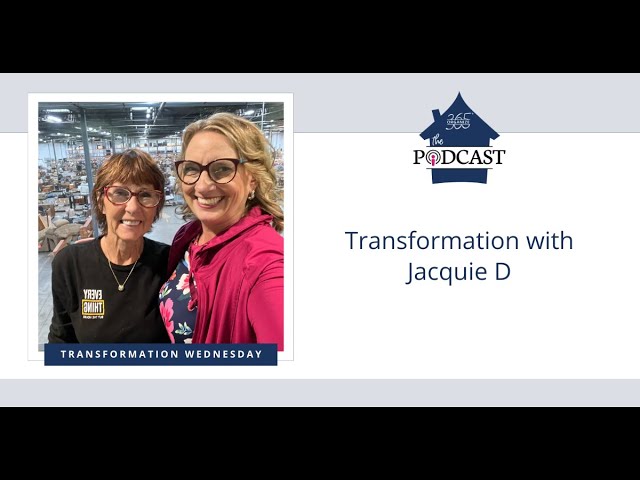
Jacquie Denny, co-founder of Everything But the House, started the online estate-sale platform in 2006 after a family experience showed her traditional auctions didn't work. She spent a decade caring for four parents while running her business, and talks about the emotional and financial toll of caregiving, sibling coordination, and how organization and clear communication help families manage end-of-life logistics.
Chapters
Jackie, welcome to the Organized 365 podcast.
Thank you, Lisa.
So Jackie and I met, I think it was, oh my gosh, 10 or 11 years ago, just when I was starting Organized 365. I asked you to meet me for breakfast and you said yes. And I was like, oh my goodness, Jackie's gonna meet me for breakfast.
Then you had a 10-year lapse.
Then we had a 10-year lapse, and now we are back together again. So we're gonna talk about the company that Jackie co-founded, Everything But the House, in the next interview. In this interview, first, I just wanna hear more about you, Jackie, and your organizing journey and what led up to starting Everything But the House. So let's just start with, tell us a little bit about yourself. Where were you born? What was your early adulthood like? Um, get us up to like, I don't know, your 40s, I guess.
Wow, that seems like a big bite, but okay, I'm gonna jump in. Um, so born and raised here in Cincinnati, uh, went to Catholic schools, uh, Xavier University, uh, studied marketing. Big takeaways from my marketing class was the largest generation was coming down the pipeline. They were going to overwhelm every service known to man if we weren't prepared societally, and we still are not. So, so right after I graduated from Xavier, had a great aunt who had no children. Husband had predeceased her. And that was really my first insight into the process because I was co-executrice with an attorney. And my mom, and well, they had no children, and the 2 other living relatives were in Florida. We kind of won by default on this. Big old home in North Avondale, I think, is what it would be considered. And because they'd had no children and lived there 60-plus years, it was quite full. The attorney recommended a local auctioneer. He was the guy he generally partnered with. Me and my mom had no concept of what was going to happen. And to be honest with you, as I stood in the front yard and watched things go for really pennies on the dollar, not because he was a bad auctioneer, not because anything malicious was done. From my perspective as a marketing major, there was no market in that front yard for the finer things. It was fine if the tools and the plastic stuff went there, but she had artwork, she had jewelry, she had fine antique furniture. And so everybody was buying it pennies on the dollar, which made them happy, which made them popular— the auctioneer very popular. But, you know, I just walked away from that feeling that, that it just— that the process wasn't effective for what the inventory was. So I start digging into the history of auctions and find out it started in like the 1700s for cattle and crops. And that's how we're still doing it. And that was like 1980-something, and that's how we're still doing the process. Um, and wasn't really a fan of auctions, never thought I'd be an auctioneer. It was that negative of an experience. So I kind of started helping friends because I was working for Avon Products in marketing, um, and in their sales force. So I start kicking around and his friends, grandparents, parents were going through the process, kind of digging and rolling up my sleeves. You know, my husband probably, you know, after about 6 months said, if you're going to do this every weekend for friends, you probably ought to organize and at least charge for some of your time.
Yeah.
Yeah. And you know how we are as women that, you know, that labor thing. So, you know, I started in 1988 a tag sale company with a dear friend of mine called Sorting It Out.
Okay.
And so what I realized is people did not only need somebody to sell the stuff they didn't want, they needed somebody to find the titles and help their kids who lived out of town organize financial paperwork or help the attorney find the will. So it became this bundle of services. We became wildly popular, just like overgrew ourselves instantly because we actually addressed The problem, which was not the selling of things. Easy is part of the equation, Lisa. It is the other things you need to support them going through the cleaning out process. Like, don't throw away the documents, don't throw away the titles. Because most of our parents didn't own a, um, an organizational cabinet or a filing cabinet. You know, the paperwork was in the kitchen drawer and the bedroom nightstand and sometimes in the closet. So, you know, that quickly became popular. Brian, who has been my partner now since 2006, started coming to our tag sales. He was rehabbing a home in Pleasant Ridge, a big old Victorian, wanted to buy period furniture. And we just clicked in that we knew the big thing was being an advocate for these families, not just selling their stuff, but being a real advocate for families. Because you know what, kids already have full-time jobs, Lisa.
Yeah.
And you know, this is a full-time job. So, um, Teresa was going back to what we call a real job with benefits. She was going through a personal change. And I was actually interviewing with a major company to go back into sales. And Brian said, you know, you really should put this online. And I'm like, well, I just got my new smartphone and I don't know how to use that. So Brian said, well, you know, Brian built the website. He came up with the name Everything But the House. And the reason we chose that is most of our referrals were realtors and we wanted to let them know we weren't going to start selling the real estate and Okay. Cut them out of the revenue stream. So that's how the name got chosen. Um, and very quickly Brian became the nuts and bolts, the tech, the, you know, all that. And then I continued to build relationships, be the public face. Um, 2006, we took it online. And again, you know, one of the comments Brian made, and I wholly agreed, is You know, eBay at that time was fully accepted, and the next generation were really buying online. They didn't want to stand in line on Saturday morning because their kids were in soccer. And so there was this huge shift going on, and we were the first company in the United States to put estate sales online starting at a dollar with no reserve.
Amazing. Okay. We're gonna get into that story next.
Okay.
So I'm gonna make you go back to your personal story again. You're very good at marketing, Jack. You got it right back over to Everything But the House.
Okay.
But I think that the unique opportunity in this podcast interview is that you and I have had a couple of offline conversations. And like you mentioned at the very beginning of your story, women, we tend to— we're very communal. And we're very helpful. And as soon as we experience settling an estate and being executrix of an estate, we know what our family and friends are in for, and we just come, like, right alongside them and walk them through that journey.
We do.
And that's great, and it's necessary. But when you have not experienced it yet, or if you're in the middle of it and you don't— as connected as we are today, we actually have less family and friends to walk through that journey with us than we did in the '80s and '90s and the early 2000s. And so when you— and I didn't know you had a marketing degree from Xavier. I'm going to learn so much. So you were living in Cincinnati. I would love to know, you mentioned you had a spouse. Did you have children? What were those years like when you were raising the children? And then we'll talk about once the kids went to college.
So actually, sorry, I went down the wrong rabbit hole.
No problem.
You give me a rabbit hole and I'm gonna go right down it. So anyway, um, get married too late. I was 32. Um, knew from early on I was not going to be able to, to be a bio mom. I had a health situation that, uh, prevented that. Um, so we adopted children. And one of the nice things about sorting it out, it was a flexible job. My husband travels a living, so I could work on weekends when he was home. I could be home during the week with kids. So this just became like my portable job doing estates for families. And so then I get to the point where I'm now starting to care for our 4 parents because my husband's travel. And I'm glad you mentioned that because I think we're like a deer in the headlights when this comes up. So the first one was my father with cancer, followed by my mom, his dad, his mom. So because I was kind of the stay-at-home sibling out of 6, of course, everybody thought, well, Jackie will do that. And, you know, it starts out kind of fine because, oh, it's a doctor's appointment maybe once a month. Well, then they get a terminal illness and then it's 3 treatments a month and 2 follow-up doctor points. And now I'm running to the pharmacy to pick up medicine, and now they can't— they can't cook, and now I'm cooking. So it's this gradual immersion into this process that, you know— and at the time, I— my kids were, uh, junior high and high school when we started this journey. And at the same time, I'm trying to go to gymnastics and Help kids with homework at night, you know. And then when Mom became too much for Dad, we moved in Mom with us because now I can set up a bedroom on my first floor.
Right.
So I always tell everybody, and the truth is, for most of us— I grew up in a blue-collar family. My parents' combined income best year was about $40,000, and they raised 3 kids in Catholic schools on that. So for my parents, hiring people to do Doctors visits, cleaning, cooking, grocery shopping, washing, paying bills, bathing, dressing, administering medication was not an option. And that's a short list, guys.
Yeah.
You think, yeah, if you think it's a little time commitment, that's a short list of what our parents need because they're living longer. And so the needs become greater and greater. So, you know, at that point, I was full-time caregiver, a full-time mom, running a business, and pretty much feeling like the rug was being pulled out from me every other day. Because the other thing is, guys, when your parents are going through aging or illness, the landscape changes constantly. You know, I think, I got this, I got this, it's all on the calendar.
Yeah.
And then we'd go to a doctor's visit and they'd say, oh, by the way, she needs a 4-hour test this Thursday.
Right.
And like, so I always tell people that, you know, that became paired with knowing what I know about downsizing, kind of this all-encompassing process that needs to be done for every family. And I think that's why we clicked, because we looked at the hours people are spending now. When it came to my in-laws, he had worked for P&G, had pretty good retirement. We still did all the, what I call caregiving tasks because we wanted to. And when I say this eats you alive, it's not a negative statement or that my life has flashed before my eyes. It's, it's because it's true. Never—
All-consuming. It's all-consuming.
All-consuming. Never regretted a day or a task.
We did.
But in the end, it is overwhelming. And the more organized you can be, the better off you're going to be because it's going to change anyway. So we went through 4 parents in 10 years passing away, each with a different type of cancer. I think for each of them, it was about a 2-year process from diagnosis to This, 2 parents wanted to pass away in their own home. 2 parents were willing to go the route where they were in a care facility short-term at the end. Either way, it, you know, when you think about all the tasks you have to run your own family, your own life, and you at least double it, and sometimes it's quadruple depending on the needs of the person.
Right.
That's where the organization part comes in for me, Lisa. I mean, that's it, plain and simple. And then if you find you have parents like mine who have no documents in place, I don't even know if they knew what a document was. Because my parents, I mean, my dad went to 6th grade, my mom at least graduated from high school, but relatively, you know, it wasn't like we had a lot of money to worry about, but you still have to have documents.
Right.
So, so there's a roadmap to follow and people aren't guessing. So to me, a lot of communication needs to happen in these families. A lot of patience needs to happen in these families. And if and when you can afford it, offload tasks like shopping and cooking and cleaning. I think for most of us, we want to do the caregiving tasks ourselves. That's our give back to parents who gave up everything they probably wanted in life to raise all of us. But anyway, so yeah, that kind of began— it got me to about age 58. My daughter was in— just going to her first year in college, my youngest. And I'm thinking, yay, parents are done. And we did that with a lot of dignity. Daughter's in college, son is off and married. I'm going to retire. And then, and then, you know, this industry exploded and I'm having people from everywhere, everywhere all over the country because now we're on the internet saying help. And all of a sudden I'm just sitting there going, oh my gosh, this is a lot of people to help. So, yep, that's, that's me.
Yes. So I want to give a little bit more and then let you go on another rabbit trail. I love your rabbit trails. Because it's so fun to have somebody else rabbit trails in the same places I rabbit trail to. So we're just gonna do it publicly.
Ew.
So as I'm doing the research now about housework, and, you know, in the media, it's just a big argument about men aren't doing enough. And in academia, academia is very much a feminist discussion. But when you look at the actual research studies that are done on housework, Almost every study I found, well, all the studies I found, but I'm going to say almost because I haven't found all of the studies yet.
Yeah.
All have— they clean the data until they're only looking at spouses. So everyone's married, everyone owns a home, and everyone has children in the studies that are done, which is really a very small segment of the population at any one time. You're going to spend a lot more of your years not in active parenting years, and some people never in active parenting years. So the, the second part of that is there are a few studies that deal with caregiving of elderly, not nearly enough. And the difference in parenting and caring for elderly is you don't know how long you're a caregiver.
Nope.
It could be 3 weeks. It could be 30 years. You have no idea how long you're gonna be a caregiver. Um, and when you're talking about when you were in marketing and you were learning that the biggest generation is coming, I'm Gen X. We are the receiving end of the biggest generation that is still making waves through. And one of the things that I learned with my coworkers is that our parents tend to get divorced. So your parents, like, you guys had 4 to deal with. One of my coworkers had 8 parents, and she only has—
Oh, wow.
One sibling. So, so we have lots more parents and a lot less siblings to take care of the parents. So the problem has actually gotten much, much bigger. Not smaller, because there are less people to support the people who are aging. And because of a lot of divorce that happened in the '70s, '80s, and '90s, there are a lot more people to be supported by these fewer amount of children.
Well, and the other part of that is, Lisa, I remember when my parents were taking care of grandmothers, grandfathers, great-aunts, and uncles, you know, most of them grew up and stayed in the same town.
Yep. Yeah.
So we all as a generation went off to college and moved away and didn't come back because we liked the college town or our job took us across the country or across the world. So now it ends up the sibling that stayed in town, right, becomes the one doing all the work. And for me, the point you hit that makes the most sense is all of our parents were of finite care. We knew that from diagnosis through end. But I've had friends who have had parents who end up with cognitive things that go on for years and years, you know, and they try very hard to keep them home. They try very hard, but, and then even when they go into a facility, then it's the visits and the follow-up and the advocating on your parents' behalf and the money. And so I always Tell everybody, I was lucky. Every one of our cases were very finite. No memory issues, no cognitive issues. They all lived to write about, you know, my mom was the oldest, I think, at 92. My dad died quickly. So yeah, so anyway, guys, it is— it's something that starts to own you. The whole process starts to— Mm-hmm. Own you, Lisa. And so, I mean, that's what I mean. When I saw your one podcast, I was like, oh my gosh, I'm so proud of you. One, from that breakfast at Panera where it was just a little baby idea. But now, as determined as you are, Lisa, it's not like I was concerned it wasn't gonna happen. But yeah, you know, you see the growth and development you have went through from what you thought you were starting. And it's the same thing. Yeah, I think I'm gonna sell stuff for people. Yeah, that's really not what this process is. I mean, you become, you know, you become a lot in there. You become their children when their children live out of town. I get, I get Christmas cards from people. They still call me to stop by and have dinner. I mean, because you become their relationship, their supportive relationship.
So, and I think the more we can have like So we— you kind of know as a child, like, okay, I'm going to graduate from however much schooling I'm going to have, and then I'm gonna start my hashtag adult life. And you think when you're a child that hashtag adult life is or isn't gonna involve a spouse or children, like you decide what you want in that, and that there is or isn't gonna be some kind of a career. And really, as a child, you only project to 40. And I think you think at 40, you're just gonna fall off a cliff and there's going to be nothing else. And then you're about to hit 40 and you go, Oh, I'm only 40. Like, I'm gonna live to be like maybe 80, or in my case, I mean, my family, 100. I'm like, wow, that's a lot of time. What am I gonna do with this 40 or 60 years? And you don't even start to think about it until the end of your 30s. And by the time you get your brain wrapped around the fact that you're gonna live for a long, long time, you realize there's this whole other caregiving year.
Yeah.
Like, there's, there's all this stuff that happens from 40 to 100. That hits you out of nowhere. It's like you get blindsided. And yet, for millennia, people have been doing this. So why doesn't anybody tell us this is coming our way?
Well, and it's still like the Wild West in this industry. I mean, it still has to be figured out. I mean, I, I look from 2006 to now, how many times we've had to adjust this business model. Because as much as you and I love doing support services, it's very hard to monetize to make sense for people. It's the hardest. And everybody from medical caregivers to people who do shopping for people are finding this thing. How do you monetize this, be effective for the client, not drain their pocket?
Right.
And people don't understand this labor and monetizing this labor sometimes. Sometimes I have to sit down and it's a whole education piece on the phone with the kids and, and then with the parents. And, you know, because it's not your next-door neighbor coming in and making a meal because I have a lifelong commitment. This is a time consumption for you and it is bumping time from other things you should be doing with your family for, you know. So it's a— I always tell people it's a real job. It's a real—
It is.
And so, you know, that in itself is one of the struggles in our industry still, monetizing that, people to understand it. You know, I'm a little bit probably in a better seat than you in that part of my job is not just the support services, but production by selling their stuff. So by selling their stuff, I can offset some of that cost for them. But the amount of hours to do things It is, it's tough. I mean, I always tell people it's not just the cost of your time, it's the emotional cost. It's the cost of the gas, the wear and tear on the car, the time away from the things that you aren't plugging into in your life. And it's just, and it's not a negative when you're talking about this. It is a reality for everyone caring for aging parents. Don't you think?
Absolutely. And when you talked about taking care of your 4 parents in 10 years, it was under the guise of— I was like, yeah, I'm gonna be an empty nester. And then all of a sudden I became a grandparent. And you said, yeah, we had like whatever, 18 months, and then we were in this next decade. And, and all I could think of is get to Europe with Greg, get to Europe with Greg before I can't get to Europe with Greg.
Yeah.
Get the PhD done before I can't get the PhD done. And like, I have my— I'm really cramming this PhD into a small amount of time, but luckily my chair is in her 60s and she's like, I understand what we're doing here. I said, thank you, let's go.
Right.
Because I can get it done and I don't know what's next. I don't know what's going to happen with my mom, Greg's mom, Greg's dad. I don't know what's going to happen with the baby or my— I don't know the unexpected, but I know my capacity and me at this time. So I will run as fast and as hard as I can because when the family needs me, I will put my goals and my ambitions on the sideline and I will be— I will take care of the family like I will do it. So when I have these open spaces where no one is like really needing me, I, I'm working 67-hour weeks and I've charted it out. I know exactly what I'm doing because I know that I do not always have that opportunity as the female head of the household. I will always make my goals submissive to what the needs of the family are. And I want to.
And you want to. And that's our nature, one, as caregivers. And that's kind of the way we were built genetically. But, you know, it is the fact that you're going to do that. And here I'm 68. I mean, I thought I was retired 10 years ago. And it's— there is no horizon on this. And, and to be honest with you, now that the kids are gone and the parents are— I'm like, I love, I love what I do. Although I'm like you, I'm like, you know, my husband said the other day, so when are we going to start taking all these trips on our bucket list? And I'm like, well, if we get one a year, and he goes, you'll be 90 by the time we get any of them done, because he said you'll cancel at least one or the other every year.
You know, I think, Jackie, what my goal is, so in this PhD, I wanna get it done in 5 terms. Nobody have heart failure. Just, you've seen what else I've done. You know, I'm gonna do that.
Yeah.
So I'm gonna do 2 terms, and then in April, we're going to England, and we were gonna go to Italy, and I decided on England instead of Italy because to go to Italy, you have to transfer planes. And here in Cincinnati, we just got a direct flight to Heathrow. Did you know that?
Yes.
And I'm like, do you know how much time that saves me? That saves me like at least half a day. So, and also—
Gosh, Lisa, to miss Italy because you don't—
No, no, no, wait, I'm getting it. I'm gonna get to Italy in a year.
But this will be our first flight.
Well, I mean, come on. No, I'm gonna do this for 2 reasons. One, I've been to Europe, but I mean, that was when I was 16. Greg has never been to Europe. So I think a direct flight to Europe, to a country that speaks English, and you stay in one city and then you come back is gonna be very comfortable for both of us. And then when the PhD is done a year from April, we will do the Italy trip. But my goal is to travel internationally at least once a year and then also do another trip with Greg domestically.
You have to really put a stake in the ground on it because if you don't, it will never happen. So, you know, and I, you know, I, when I look at your generation and I look at what's coming, you know, some of the things that can be helpful is before a parent gets ill, to discuss it with siblings when you're out to dinner, you know, mom and dad are getting to that age, and they're going to start needing support. At one time, they'll decide to stop driving.
I—
my mom gave us her keys. She'd had a little fender bender. I think she was 72. And she said, you know, I just get nervous. So then we knew it was going to the grocery and who's going to take her to the doctor.
Yeah.
And who's going to take her to church on Sunday morning? You know, luckily for— because we each have 3 siblings, me and my husband, you know, I knew the boss at my job, so I could be a little more flexible than the rest of them. So if something had to happen in the middle of the day, or, you know, your parents get to the age where my mom calls me, she's fallen and she can't get up, you know.
Mm-hmm.
And I go over and she's cut her hand because her skin is thin now. But the more discussion you can have before you get into the tornadic system that you're going to go into, because here's the thing. In our discussions, when we were already— we found we had siblings who just were not caregivers. There was no sense asking them because they would be short with a sick parent. They would probably run late For a— and that's not because they're bad people. It is their personality. So what you have to decide in these family discussions is who can you depend on that will do it with a glad heart, not resent, you know, the fact that they're having to give up this time. And, and so we ruled out a couple siblings who just totally said, you know, it's not my thing. And so it wasn't. And then to go forward from there and try to get people fairly involved based on, you know, what their, their job would allow. Like I said, I knew the box. Yes, yes, the job. You know, and then the other thing is, you know, it's sometimes you may have to have conversations with siblings like, look, The last 4 weekends I've spent in care. You need to step up and give up this week. And you have to be able to have hard conversations because in the end you want to still have Christmas and Thanksgiving to dinner. And if you become the resentful one because you're the one that— so there, there's just a whole—
I need to write—
we need to write a book. We need to write a book because I'm just saying, I'm, I'm starving.
So I'm the oldest of all of my cousins on both sides because my parents were both the oldest and they had me very young. I mean, they just got graduated and had me, and then their siblings waited a while. And so I'm the oldest. So I've broached this with my cousins. I've broached this conversation with my parents' siblings, like, hey, you need these binders for your kids. But my, my cousins are, you know, they are millennials. I'm a Gen Xer, and I'm the oldest Gen Xer. So, I mean, there's a, a big age gap there.
Yeah.
Um, and then, like you said, everyone used to live in Cincinnati but moved away. So now Greg is living here with his mom, but his siblings, uh, his sibling has moved away. And so, you know, you don't see the day-to-day. And if you only come back every once in a while and you see the marked decline, you know, like Who do you think's dealing with this all the time? And so, yeah, when you have the conversation, people who are not in the city and at that place mentally, they don't want to have the conversation. They would just rather pretend that this is not actually happening.
That's right.
I remember when my father passed and we were doing the house and doing the funeral, and I'm, you know, a checklist girl. So I had my checklist and I came in. And my, my sister saw me. I'd gone in the back room. I came out with my legal pad. She stood up. She said, I'm out of here. And she just walked out of the, out of the room. And all my dad's siblings were sitting there. They go, what's going on? I said, I think I grabbed the legal pad one too many times because I'm like, here's the list, here's the list, here's the list. Because there is a case, like, you know, mortgages have to be paid, funeral arrangements have to be made. Like, you cannot just put your head in the sand. Like, Somebody's got to move that flow through. And sometimes that person who is like, fine, I'll do it, I'll run this, then gets some of the backlash for the emotions that people are going through that are not related to the factual, we have to sell the house because we don't have enough money to keep it. And that goes to the person who's actually taken the onus of like, all right, we've got to clean out the house. Then they get the— I don't want to clean out the house. I understand. I don't either. But we can't afford this house. So this house needs to be cleaned out.
Well, you do become the target as the decision maker, because a lot of times I would have to make a decision. And then we'd be sitting around and somebody'd be questioning the decision. And I'd say, well, I said, great to be an armchair quarterback here. But, you know, I'm the one that's sitting in the emergency room. And this is a decision I made at the time. And I made it With good intent. And that's the other thing I always tell people, always assume good intent no matter what comes out of somebody's mouth. Um, because things come out of people's mouths that, you know, we all were raised in the same home if you have siblings, but then you go out, the world gives you a different lens to color through.
Yes.
So me and my 3 siblings are as different, you'd think we were raised by different parents because we've had such different life experiences to color what we do. And so those are the things that I try to help people through, um, resolving sibling issues, trying to make it fair, trying to make it understandable, trying to use our indoor voices. Um, I mean, I've had siblings in fistfights in the middle of rooms over a Rookwood ashtray because no mom said I could have it. And I'm like, no, I'll Buy you one, because the way you're behaving now, you'll never talk to each other. And then, you know, here's the thing, people are going to say things that are hurtful and mean, and give grace because we all need grace.
Right.
I'm just telling you. Um, but yeah, it's, it's, um, overwhelming process. It's easier to look back on it and see what you could have done. Your organization, Lisa, helps a great deal because, you know, really The last thing that people are thinking about is organizing. They're so overwhelmed with the diagnosis. And, you know, it's hard to see your parent need help or put a diaper on and off. Or I took on the catheterization and bathing of my father because he wanted to pass at home. We couldn't afford nursing care every day. I mean, I became— and hospice was so wonderful.
Hospice is amazing. They are amazing.
They are just amazing human beings. Amazing organization, guys. So, yeah. So I just tell everybody the cost is significant, but not something any of us wouldn't do. And if you don't want to do it, just raise your hand and tell your siblings, can't do this. Not my bailiwick. Can't do it.
And if you can't do the physical care or you're not in proximity, there are still things you can do. And that's how I'd like to end this one. Like, Yeah. Your parents are not always going to have enough money at the end of their life for the care that they're going to need. And if one sibling is going to do more of the physical care, then the other sibling might have to not eat dinner out once a month in order to send money to the person who's doing the physical care. Because sometimes when you're the one in proximity, you're the one that's making a lot of financial expenditures You know, add this person to the meal, add this person to the birthday, every holiday with this person, not begrudgingly, like—
No.
But also that means you're not taking vacations. You're not doing other things because you are the one doing all the primary care. And I see this in so many families, so many families that the person who takes on the primary care also ends up getting the financial bill.
Yes.
And the other siblings don't see that.
No, they don't. And, you know, all you can do is bring it up and say, hey, you can't be there, you know, can you send $100 a month? Because you're right, it's gas, it's beating up your car, it's adding another person to the bill, you know. And there's always expenses. I mean, you know, it's medicine that mom's coverage didn't cover. And so, you know, we're just kind of writing the check. I mean, it's kind of— Some of us are just built this way, Lisa. And when you are, embrace it, do it, forgive those who can't, try to work with them.
Right.
You know, long term, right? You know, and I've even told some people when they've had siblings who were particularly ugly during the whole thing, self-centered, just say, you know, at one point you may decide that you don't need that sibling in your life anymore. Just because you're related doesn't mean they've respected or valued you enough as a sibling. Because there are some really tough situations that come up during this. We're all in a pressure cooker at this point, right? Some of us rise to the top, some of us don't.
And if you are a person who is not close enough to be able to be the caretaker for whatever reason, or whatever your job is, whatever other thing that you're doing in the world, And you don't always have to send a check. It may be that, okay, well, I'm gonna make it so that I can go home every 6 weeks. And when I go home, I'm gonna fully deep clean the place, and I am going to make freezer meals, and I am going to do all the laundry. And I'm going to, you know, they'll have a checklist, and I'll replace all these things or whatever. Like, or maybe you're like, okay, I'm home. And when we're not at the hospital visiting mom, what can I do for you in your house? It'll relieve time because you're like, Be creative about how you could support your family members so that you can stay in relationship. Because at the end, you know, I've talked about your sibling is the longest relationship you will have. And if you can, you really don't want to eliminate that relationship.
You know, just— I mean, it's just contributing at whatever way. We had one sibling that lived in Texas and she did that. She would come in every quarter for about 2 weeks. She was taking time as best she could. But she'd come in, we were off, she would cook, she'd put things in the freezer. It was actually— everybody looked forward to her coming. It wasn't, you know, she came in to pat mom on the head and walk away and say, great job you're doing here. So, you know, and, and don't assume that people know what you need for support.
Right.
Be verbal. Say, you know, look, I've got to take mom to the doctor. My daughter needs to be picked up at gymnastics. I know you're done with work at 3. She needs picked up at 5. Can you help me out?
Ask.
Don't assume people are going to know what your needs are and then be resentful because nobody stepped up. So, yeah.
Yeah. Anything else you want to talk about your, your personal life or the, or the personal of being a caregiver before we move on to our next interview?
You know, I think being a caregiver prepares us the best for who we— how to understand what to set our children up for. That's the good thing. All the missteps that we've made with this generation and all the learning process, if for nothing else, gets us to a better road for this next generation in this process than it has not Okay.
All right, well, we will stop it there, and then, uh, you'll be back in 2 days on the podcast, and we're gonna learn everything about Everything But the House.
Thanks, Lisa.
More from Lisa






Podcast 726: Time, Money, and the $300 Million Impact of Household Productivity


Parenting Isn't the Only Caregiving Role That's Draining Your Energy #Parenting #Caregiving

Turning 40 Isn't About Age, It's About Responsibility #TimeManagement #Organizing #MentalLoad

The Sunday Basket Saves Hours Every Single Week #SundayBasket #Organizing #TimeManagement

Your To Do List Will Never Be Done, and That's Normal #TimeManagement #Organizing #MentalLoad