Women's Work: Fair Play - Redistributing the Housework Cards with Eve Rodsky
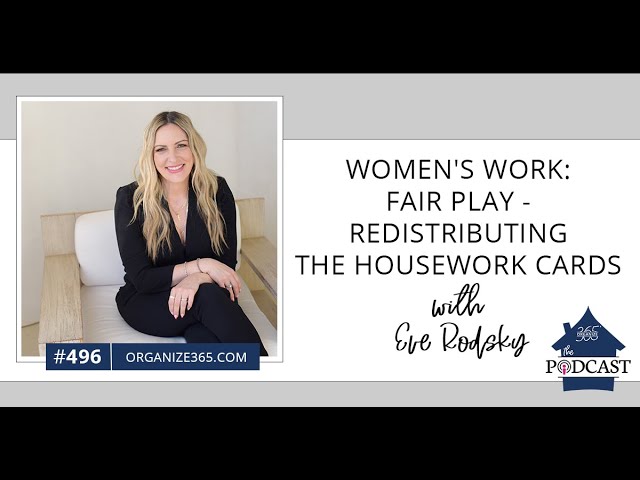
Eve Rodsky explains why household work stays gendered and how her Fair Play system fixes it. The framework divides 100 household tasks into conception, planning, and execution phases, assigning ownership instead of assuming shared responsibility. Men overestimate their housework, women underestimate it, because invisible cognitive labor goes unrecognized.
Chapters
Eve, welcome back to the Organized 365 Podcast.
Lisa, I was listening to our first episode again together. That was a really fun time where I felt like we were sort of— who knew what was gonna— who knew we would be where we are today, right?
No. Oh my gosh. So it was December 2019. If you guys want to go way back in the, in the podcast, I will also link it in the show notes here. But you had already been doing a lot of work in this field. You'd already come out with the book Fair Play. But I almost feel like you and I both, we knew that we were in the right field. We understood that the work we were doing was important. But the last 2 and a half years, it's like, it's like the importance of it has exploded and our understanding of the true problem versus the surface problem we thought we were solving is like night and day.
Absolutely. And it's so ironic because my agent keeps texting me, you know, Fair Play is the number one bestseller in women in business. So how ironic, right, that a book about the home is a bestseller with women in business? Because I think finally, finally, we're moving past sort of these lean-in era of blaming women for not being able to keep up with men, and instead looking more holistically at What has kept us back, and there's individual solutions and there's systemic solutions. And I think you and I went; we had a nice conversation about the individual solutions, and we'll keep doing that with the systems.
Yeah.
How we tie it to sort of these broader advocacy of what what's happening with women in this country and being able to protect our bodies and our rights—that is that that's. the deeper work that I think the pandemic has gotten— has got— it's gotten deeper for me, Lisa.
Well, I think everyone has— like, whenever you have a traumatic event, which we all collectively experienced, you figure out like, what is truly important. Like when my dad died, and then we had to sell the family home because my parents had gotten divorced, and I'm settling an estate for a spouse who's still living. And like, you're in the middle of all of that. Um, you come home and like, you just declutter your own storage because you're like, this is ridiculous. I don't need these things. And I think everybody collectively realized we don't need this stuff. It's It's the people, it's your time. Like, we really finally, I think, started valuing our time over our money.
Well, that's what I— that's what I'm hoping. I'm hoping that, um, the silver lining of this horrific past 2 years is that existentially we start to understand exactly that really truly— and what we both work in the home, Lisa and me, right? We work in the home, we work on systems in the home, and that's why we always come together. Because who knew, you know, that organizing, you know, the closet is actually really actually related to women's time poverty and their ability to control their own destinies and financial power and bodily autonomy and voting rights. Everything actually stems from the home. And so when we come together, we look at systems. And I think, Lisa, really what we're learning, or what we've seen after the past 2 years, is that part of the personal being political is really understanding what, what serves us personally. And for so long, for so long, we've been fed these messages that we need a bigger house, we need a bigger car, we need 2.5 kids to make us happy. we, we need to focus on happiness to make us happy, right? All these things. And it's actually— we found out now that focusing on happiness makes us more sad. Uh, the extrinsic, if it's not internally motivated through your own value system, does not make you happy. So many people are saying, is this it? Is this what I worked so hard for, right? And then you end up binge-watching Netflix and doom scrolling and taking edibles and drinking or whatever it is to numb The pain, because we're not in touch with our internal value system. That is what I saw happening, and that's why I knew there was a crisis coming. I didn't know it was a pandemic, but when you and I talked in 2019, I was on my way to Davos to tell world leaders that I thought we were one crisis away from not only losing women's labor force participation of 20 to 30 years, but of losing mental health capacity and physical health capacity for women, because I thought of the individual burnout crisis. I had no idea we were going to have this kids now coming back into the home crisis and sandwich generation and people sick and dying and all of the other disruptions. So we, we've been in this work, you and I have been in this work a long time because we, we work in the home. So we're the canary in the coal mine.
Yeah.
And we, we see that if you don't get your home right, then it's going to be very hard to fight for these bigger systemic solutions.
Well, and I think also, like, so your podcast episode is the end of a 6-podcast series that we're actually doing here in Organized 365. So just to catch you up, because they haven't even published yet, the first one is I went back in my own history. I'm a 4th-generation female college graduate. My great-grandmother got a teaching degree, my grandmother got a home economics, my mom got a teaching art degree, and I got a home economics degree. And so I read the book The Secret History of Home Economics.
Yes.
Which was the path to college education for women. Like, that is how I am a 4th generation female college graduate, is my great-grandmother got a degree in teaching. I found out she never was a teacher. It was the only degree available for women. That's why she got that degree. And then that university then created a home economics, which is actually in the science department, which is like a technical degree that my grandmother got. Again, she never did home economics. They were all entrepreneurs. And so, It is interesting to me how we label things. Like, it is. And I'm just now rereading, uh, The Feminine Mystique. It's from like whatever, the '70s. I'm like, I mean, this is what everybody today is saying. So it's so funny what we were saying today. It's not like we're having this big revelation. This big revelation happened in the '70s and the '60s and the '50s and the '40s and the '30s. Like, literally women in the late 1800s were having— they were paying to have someone else do their laundry so that they could love on their kids. And that was acceptable in society. And now we feel guilty if somebody else does our laundry. Like, it's just like we're running around in circles chasing our tails over here.
Well, when you don't understand our history, I think that that's the problem, right? The problem with the past 20 years is we tried to erase the gender division of labor, right? I mean, Gen X, especially for me, was, it felt like a generation where I was told to keep my head down.
Yep.
I'm gonna get out of a single-parent household by education. I was told I could be anything I wanted to be. All these lies, right? They were lies. And then Lean In came and basically said, you just have to lean in harder till we fell over. And then we had all the productivity specialists telling us we just needed to wake up at 3:00 AM to get all of our, you know, self-care in. And I was like, okay, well, I'm gonna die. Because I don't get sleep. So how is that like short, long-term self-care? So there's all— so we've been blaming women, blaming women, giving them solutions, self-help solutions that are really not about, uh, understanding the broader context of what we've— the history or the fight. And then on top of that, men started to say to women, well, if you're so overwhelmed, just get help. So instead of saying, I will help you and be a partner in the home, which is the only solution, it's the fair play way. Um, and it applies to roommates, single parents, LGBTQIA couples, because it's about valuing care, and we need white men to do it, to value it. So that's the movement. But to get there, for so many years we missed the mark by men saying, well, if you're so overwhelmed, I will buy you help, right? Again, that, that is help. That is great if it's valued. But the problem is—
And if you can afford it.
Exactly. If you can afford it. And childcare is not affordable. And so then we were saying, well, then you Black and brown women have to be paid not even a living wage so that these families can be built on the backs of your domestic labor. So everything sort of got really messed up about this conversation. So now that you and I've been doing this deep work, it's valuing people who help in the home, paying them a living wage, whether it's organizers, domestic workers.
Yeah.
They have real childcare workers' true value. We pay our dog walkers more than we pay childcare workers in America. So writing that wrong—
It's true.
Understanding that this is valuable work, the work in the home is valuable work. And then now on top of it, basically saying, we also existentially need to really take a look at what we value, not all the shit that's in your garage that you've been accumulating, this third mountain bike, all the stuff. But really, you know, your philosophy, Lisa, really works well with Fair Play because it's really about, as you— as people know from your podcast and from your work, you know, really, again, taking a step back to take a holistic view of what you value. And that's really important.
I think the hardest thing is that if you catch one podcast interview, or if you read Eve's or my book, or you read one of our research, or you watch Eve's documentary, but you don't— it's the holistic work, really, because You know, Eve, I've read your book, I've watched your documentary, and now, now that I have the Fair Play cards, I'm like, oh, like even for me in this industry, it became so much clearer. So like if you read the Organized 365 research or you read a one-off book and you don't listen to the podcast or you're not in the courses, then you don't have the full picture. Like this is our work. Our work at home as women is to understand the invisible work, the emotional labor, the mental load that happens at home enough so that we can give it a voice so it can be discussed, so then we can decide, one, first of all, to get rid of as much as possible, but then secondly, who is going to do the rest and how are they going to do it? So I'm going to kind of pull all of our work together in this kind of mishmash conversation, and I want to start with this. Organized 365 started doing research in 2020, 2021, I don't remember, 2020 or 2021, that's a detail. And when we did the research, what we found was We surveyed men and women separately so that we could have a men compared to women, and then we did over 1,000 women so we could have a women-only study. And the first thing that we noticed when we got the study back was we had people self-report how much of the work they did at home, like what percentage of all of the work they did at home. And men's numbers were almost the same as women's. And I was like, okay, well, we really should have asked if you're married and have— we should redo the study. where we have men and women in the same exact family report, because there's no way everybody's doing all the work, which what that— I wanna hear what you said to that. But what I said to that, the immediate thing I took from that very first study we did was like, oh, I get it. Nobody realizes how much work you're doing at home. So because you don't think there's that much to do, you figure I'm doing this much, I must be doing the most of it. And the truth is there's so much that First of all, there's too much to be done. Nobody can get it all done. It's never-ending. And second of all, women are doing more than men, but men are going to report that they're doing more because they cannot cognitively believe that there's actually that much to do. Is that— that's kind of what I took from it, but I don't have— I mean, that's— come on, that's the whole thing.
That's the crux of it. We know, yes, there's 2 things. Number one is running a household, especially a household with kids or pets, is a full-time job. It is actually more than full-time job. Breastfeeding itself is 1,800 hours a year. That's a full-time job. So there's just actually not enough time for women to do all this. However, what has happened is, um, men— we now know from science, and I always say, you know, make sure that if you're working, if you, if you care about a family system or you're getting advice, look at someone's research, look at their bibliography, ask questions about where they got their data. Um, we have a lot of data and, and lots of bibliographies, lots of scientists. We interviewed people in 10 expert disciplines, and what we found was men over— historically over-report, um, and women under-report. Now, the reason why I, I was able to see And also sociologists who came out with studies, especially shout out to a woman named Alison Daminger, whose studies came out right the same month as Fair Play. But Lisa, I was, I was seeing it in a different way. So the Fair Play system is predicated, as you said, on 100 cards. There's 100 cards that can be in play for your family. God forbid, hopefully they're not all in play because some of them are wild cards like death, new job.
Yeah, we're gonna talk about that.
Problems. So there's 100 cards. Typically, most people say they have about 80 cards in play if they have children, about 60 cards in play if they don't have children. Now, what was happening, Lisa, when I first did my first iteration of the cards was when I would say, who handles health insurance?
Yes.
Who plays with the kids? Who teaches them to ride a bike? What was happening was in— especially in the hetero cisgender couples, Men and women were saying, we both do it. We both do it. So I was having a hard time creating a system for people who are reporting that they both do something. So what I had to do, and I talked about this a little bit with you in 2019, I had to take a step back and ask the most important question I've asked in the past decade. And that was, how did mustard get in your refrigerator?
I love this.
And we talked about this a little bit. I will bring it up again because it gets the crux of what Lisa found as well. Yeah. Once I realized that when I said, you both do groceries, and I asked that question, I heard that primarily women were the ones noticing, noticing that their sons— Johnny liked French's yellow mustard with their hot dog, or they would choke on their protein. In the business world, we call that phase conception. You get paid big bucks to notice what's going on around you. Then the next thing was stakeholder buy-in for what everybody needs for the grocery list and monitoring that mustard for when it runs low. And as Lisa would tell you, throwing out the mustard jars that are done, right?
Yeah.
Now don't hoard them in your refrigerator, even if there's a little bit left. So, so that phase, the planning phase for groceries, was also staying with women. And then women would say to me, well, my partner goes to the store, Eve, and he brings home not the French's yellow, spicy Dijon, every time. And you want me to trust him with my living will? The dude can't even bring home the right type of mustard. Once that became clear in 17 countries, including the Nordic countries that we think have it better but don't in terms of cognitive labor— when I realized that the conception and planning was staying with women and men were executors, that's why they're over-reporting, because you can only see the execution. You can't see the cognitive labor.
Right.
So if you see somebody folding laundry and you think that that's part of laundry, well, they're not. They're, they're forgetting that there's which fabric softener to buy, how to separate the clothes. I'm looking at all the bins all over the house, not just the one in the, in the laundry room or in your apartment, you know, downstairs and your, and your thing downstairs. It's actually understanding when you need the laundry by. It's getting the laundry back in the right home, not just leaving it unfolded and all, you know, dirty or wet. Um, and it's such a big, long process that if you're somebody who helps with the folding, you're not going to understand that laundry is so much more than laundry. And that's the crux. When you keep the conception, planning, and execution together, which I call their ownership mindset, BPE, everything changes, Lisa. Everything changes.
So the podcast right before this, I explained how I worked my way out of a job. Eve, I do nothing at home. So I went on my own book tour in 2021 because the book tour in 2020 was obviously canceled. So I did my own. It was 6 weeks. Craig was all freaked out. Lisa, everything's gonna fall apart. I'm like, dude, I do nothing here. I do nothing. He's like, no, you do everything. I'm like, no, I literally do nothing. Because when you say on these cards, like these food cards— Eve, I do nothing. I don't go to the store. I don't clean out the refrigerator. I don't plan the meals. I don't cook the meals. The only thing I do actually do is do the dishes. And I only do them 3 times a week because no one seems to care, and I only want to do them 3 times a week. So I only— I do nothing. I do nothing.
I love it.
And Greg was like, I cannot believe he's still— when I got back, he's like, oh yeah, it just didn't work around here. I'm like, I have somebody clean my house. Like, I was like, you had to do your own laundry. That's the only thing that changed between me being there and not being there. It took me 5 years to work my way out of a job, and I did work my way out of a job. I could have never done it when the kids were younger. Because they needed— I wanted to be, and I was the primary caregiver. And still to this day, I am the one that understands what they need. Like, I understand when, you know, one of them says, my ears are clogged. I'm like, oh, here we go, you need this. Like, I just know, I just know what to do. And that's fine. I love, love, love having that role. But working my way out of being the caregiver of everyone in the family took me 5 years because your kids want to become adults. Your spouse doesn't necessarily not want to be.
Mothered.
I don't really want to be an independent adult again. They were when you met them, but then they really like all the productivity that you put in place. So what I find interesting about these cards, if you have read Fair Play or you watch the documentary and you're like, I don't get it, you have to buy these cards. So all of these home and out cards, there are a ton of them. These are exactly what we do in the Sunday Basket and the Productive Home Solution. Then you have these caregiving cards, which are mostly childcare related. And 60% of the Organized 365 community is not in active child-rearing time.
So we don't— those out, take those, burn them out.
We put them in the kids program. That's why the Productive Home Solution is literally for anyone in any size dwelling anywhere in the world. You organize yourself and your space. And when I made that distinction, it changed Organized 365 from every other organizer on the market because they all default to the mothering and everything that has to happen in the home. There is so— there's so many good systems that you could put in your house that if you invest the 12 to 18 months, you can get all your systems in place like you would a business. And then the, the, the laundry, a lot of the laundry and the dishes, the things that are of daily living, you just have to do those even if you're on vacation. And then child, that's just— you're in that phase of life. You have children, you chose to have children, like that is the phase that you are in. Um, I thought it was interesting, some of these caregiving ones that you have— pets, parents-in-laws, special needs kids— these take so much time and we don't really think about them. But before I get to the magic and the wildcards, because I really want to talk about those, I think those are what throw us for a loop. Eve, I think it is so interesting. I don't really remember it from the book, but in the documentary it really like just hit me in the face. Your family of origin, like, if you wouldn't mind sharing, like Like, you are such a successful, accomplished, really at the top of your class woman, um, business leader, researcher, like therapist. Um, to hear your story of origin made me understand so much better, like, your perspective of where you were coming from and why you didn't just hire help. Like, you didn't just hire a nanny. You didn't just hire— like, you could at your position, have just hired all the help that you needed. And it would have been a done deal. But because of your story of origin, you had a different perspective you were coming from. And I think it's really impactful, if you wouldn't mind sharing that.
Absolutely. I mean, again, it comes back to the fact that when you come— I think when you come out of a place where you're a parental child, right, that's what psychologists would call me, somebody who comes out of a home of, you know, trauma, or we all have that. But for my particular situation, my mother was a social worker in the Lower East Side of New York City. It was not a physically safe place to grow up. My brother and I were subjected to a lot of gun violence and drugs and a lot of things in New York City back then in the 1980s. And I think what was really interesting about that, that experience was, A, you know, it was still our home. So, you know, people are always othering and afraid of everything, but, you know, it's your home, it's your community. I was not afraid of my community. I love my community. But what was really hard was nobody saw that my brother was disabled. We were sort of on our own, and I really became my mother's partner, Lisa. And then I almost surpassed her because she really didn't do any of the— she couldn't hold the cards. So we would eat cereal for dinner, we would, you know, put ourselves to bed. I planned my own birthday parties. So she wasn't really seeing. And of course, she was doing her best. And it was, you know, it would have been a lot easier if my father— my father had stayed around. And I reunited with him as we got older. But as a young child, being there with somebody who is holding all the cards metaphorically, and you see how hard it is for them, and they're getting eviction notices, and they're trying to keep your stuff together and come to your parent-teacher conferences and just do the bare minimum to get by, you have to help. And so for me, my ethos my whole life was, you have to step in. You have, you know, no one's going to do this for me. And then from there, I vowed I would have an equal partner in the home because I didn't want to repeat the patterns my mother had. And Lisa, my husband Seth was an equal partner.
Yeah.
He was until we had children. And I think it's so important to understand that that advice, like it all depends on who you marry, is actually toxic advice because men do 5 to 15 hours a week less, less after kids come. We all, all of us in, in the research shows every single person in America gets more conservative in their beliefs about who should raise kids once kids come into the world. It, it becomes something that happens to us. We get socialized in it, and then all of a sudden we are living assumptions about who should do things as opposed to structured decision-making. So whether it's organized 365 Fair Play, all we are, we're not telling you how to live your life, right? Or what choices to make. Lisa made a different choice than I did in terms of the childbearing years. We're just telling you, you get to have agency over what you choose. You don't have to, through assumptions over your gender or your station in life, have other people choose for you. And, and we're helping you on the systemic level, but individually, you have agency. To say no. Just because I'm not a primary breadwinner does not mean I still have to hold all these cards.
And even if you are, often they still do.
Exactly. And we now know that women who are primary breadwinners actually do more housework and childcare, um, than their partners. So it doesn't ever— there's no family structure where women have it easy. And we're trying to make it easier by basically saying You're living in polluted air, but you gotta breathe the air. And we, we believe that you can change. There are some secret formulas, whether it's, again, the Organized 365 formula. Our formula is really this idea of boundaries.
Yeah.
Systems and communication. That's our secret formula. The systems we talked about, that's the CPE, the ownership, but it's also, you can't do it alone. You gotta put your boundaries and your communication in place as well.
Well, and I think, you know, my daughter Abby is a single mom. She lives with us. Um, and I was talking to someone about it. I was like, oh, so I'm 50. I'm a grandma now. I was like, I'm such a young grandma. No, actually, the average age of becoming a grandma is 50. I'm like, oh, so young. And then, um, Abby was like, well, actually, my birth mother is much younger. I was like, you're right, your birth mother is a much younger grandma than I am. Significantly younger grandma. I was like, oh, interesting, interesting. So, you know, everything with me is like a Google search. I was like, I wonder how many babies are born to single mothers every year. It's 40.5%. So 2 out of every 5 babies that are born in the United States is born to a single mother. And I don't know, is all of them have parents where they can live in a full apartment in the basement?
No.
And I'm like, oh my gosh. And then I'm hearing your story and I'm like, Because I, I literally cannot make the math work for either my single son or my single daughter in living an adult life. Like, the money doesn't work because they don't— I mean, the money just doesn't work if you don't cohabitate. I don't know how you live on your own. Even if you do go to college and get a job out of college, you don't start at like a high page. So you literally— anyway, you do what I'm doing. It doesn't work. The math doesn't work. It doesn't work.
We, you know, you, you, what you do, as we know, is, you know, you try your best, or as my mother did, you know, we lived in a rent-stabilized apartment.
Yes.
In a place that wasn't, you know, again, physically safe, because that's all she could afford. You, you know, we, you go to Pathmark, that was our supermarket at the time, you look at unit prices, you do your best, right? You, you do everything you can for your family, you care. for that family. We all care for our families. But what happens is these structural barriers become so hard that you feel like a failure because you're not doing, you know, you don't look as perfect as everybody else on TikTok. You don't have the perfect home with the 2.5 kids. So we're all striving for the wrong, the wrong things. And so the beauty of the choice of being able to say, Fair play, like we said, is not about you saying how you're going to live your life, but it's about saying you— a whole— the whole world has been conspiring against women to basically say your time is infinite. Your time is sand.
Yes.
Men's time is diamonds. We're going to protect that time. So the way it comes— would come out is your daughter is a single mother. She's already going to be paid less because of the motherhood penalty, and especially if she's a single mother, that will hit her harder. So then she gets paid less in her salary. And now she's also— and they say, well, it's because she also has to handle everything at home. And so then all the stuff at home that we're talking about, because it's undervalued and underpaid, also falls on someone like your daughter or my mother. And then you get in this vicious cycle where you're underpaid, you're doing all the domestic labor, and you burn out. You burn out. There's no paid leave in this country. Childcare is not affordable except for in one state. There's just not a system in place. So, so even though in our first podcast together and here we talk about the practical, the ownership mindset, grab a card, you know, understand what boundaries means, that your time is diamonds. It's just about counting it in 24 hours, not in dollars. You can push back against the notion that you, as even if you're a stay-at-home mom, have to do it all. It doesn't— it's not going to change until we keep talking to each other, we normalize this, we talk about how unfair it is, how basically the backs of, of society has, you know, has been, has been, you know, the unpaid labor of women. And so that is— that's, that's the cultural movement.
It is, it is interesting. Like, so, I mean, Abby lives with us, so we've got a little baby. I mean, I've got the baby in my arms all the time, like I come home, I am like, baby. Like, when he is sick in the middle of the night, she brings him to me. I am like, I don't even care. I am like, OK, I will take the baby. So, I remember when Grayson was little and I am helping Abby and Greg says, well, Abby should be doing XYZ. I am like, when is she going to do that? And he is like, well, you know, whenever. I am like, she is doing laundry. She is doing dishes. She is doing this. Like, he still doesn't even see everything that she is doing. And yeah, she keeps getting different babysitting jobs, but then she keeps losing them because Grayson gets sick and then he has got to do this. Like, she just does not have that time freedom. And I like, I don't care if she plays on her phone while I have the baby for a couple hours at night. Like, I really don't, because I remember being a mom and Greg would come home and he would take the kids and he would do the bath or whatever, and I would get that hour and I would just love it. So I would earn money at home, like for the fun things, and Greg always had the healthcare and he paid all the actual bills that we had to have. So that was the arrangement we had. With Abby, she's got her own arrangement. But then I look at my friends who, like you said, the marriage was working just fine. They were both college graduates, had these high-powered careers, and then all of a sudden the baby came along and the woman takes the maternity leave because she has the breasts. And so she's at home with the baby, and then, uh, the, the spouse does not stop for maternity leave. And then all of a sudden the woman's locked in, and like, they're just locked in. And they're like, well, I want to work again part-time. I want to do this. That's like, okay, well then you have to. And everything's on her about like, what do we do with the kids and how we do this? And then you get to the after hours.
Yeah.
You have to. And then you get to the after hours, it's like, well, you chose to go work part-time, or you chose to do this. So when you come home, you still— and I mean, it does not matter what income class you're in, what race, what whatever. Like, this is the conversation during childbearing years that happens everywhere. So When I was staying home with the kids, I would go out and I would do direct sales at night, and it was so much grief from Greg about it. Like, this happened, that happened, the phone calls, that I just stopped doing shows at night. If I couldn't get a babysitter and do it during the day, I didn't. So I got really, really good at getting my customers to buy more during the day. I would hire a babysitter at night. I still get grief even about that. So I just was really good at recruiting. And I would grow my whole company that way and not do it during the evenings and the weekends because I just didn't want the verbal. And so I just figured out how to do it all during the day. And I think we've all figured this out because it's not about earning money with your time. It's about, like you said, about being able to do whatever you want with your time. There should be no reason why a woman of any age can't take a Saturday and spend the whole day reading a book.
That's exactly right. Why is it when I ask women, do you believe— what I ask women, 2 things, and I'll ask your listeners this. Okay. When was the last time that you did something for yourself outside of your roles as a parent or grandparent, partner, and/or professional? And by professional, I mean paid work or pay, you know, working unpaid in the home. When was the last time You did something that was the most important thing you did that day. You can tell me the most important thing you did that day was outside of those 3, those 3 Ps. And I will tell you, Lisa, it is hard for women to tell me things. But I will say when they do, it's so wonderful. I had a woman who reached out to me on direct message saying, I read your second book, Unicorn Space, which is about this Yeah. Topic that we deserve permission to be unavailable from our roles as parents, partners, and professionals. I love it. They go together. You are you. You have an identity outside, no matter again whether it's Lisa's life choice, you're a stay-at-home mom, whether it was my life choice and you are working for, for paying a full-time job, whatever choice it is, you still deserve permission to be unavailable from those roles. So I remember I asked that question in this group, and it was sort of silent. And then one of the women slipped into my direct message, my DMs, and said, I want to let you know that I can answer your question now, that the most important thing I did today was outside of my roles. And she said, I jumped into the Atlantic Ocean. And this is the middle of winter. And I said, oh my God, tell me more. So she tells me that this concept of what we're talking about today, this permission to be unavailable, which is in Fair Play, and there's a whole second sequel about it called Unicorn Space— space to be consistently interested in your own life. That is the antidote to burnout, not a walk around the block or drink with a friend. The space to be consistently interested in your own life. But it doesn't exist. It's magical. That's why we call it a unicorn. It's mythical. It's magical. Doesn't exist until you reclaim it. So this unicorn space, she said to me, okay, I read your book. I know that it has to have a couple of components. It can't just be self-care like a manicure. It has to have an I wonder statement in front of it. I wonder X curiosity. It has to have connection with others, sharing with the world, and some completion point. So she said her— she wondered what it would be like to jump in the Atlantic Ocean. The connection was she signed up for a polar bear group. There was a local polar bear group to jump into the Atlantic Ocean. And then she did it. She completed this. She did it. She actually jumped. That cycle, or similar to what you're doing with this podcast, Lisa, right? You're curious. You reach out to guests. You connect with these guests in such a beautiful way, relatable way. And then you, no matter how you think the episode is, whether it's not perfect, you upload, you upload it, right?
Yeah.
You took the step to say, I'm willing to share myself with the world. And you did that with your book. and your system that was working for you, and then you said, I want to share this with others. It's scary to put yourself out there. And so sometimes if you feel like the domestic labor conversation that we're having is overwhelming, or you don't necessarily feel like your time is diamonds yet, a great entry point into this conversation is just to pick one day next week— your homework— one day next week And one of those days you have to report back to us that the most important thing you do that day is outside of your roles. That's a good place to start.
It's, it's so hard. So I, I will say that I was not able to do this until I earned a significant income. And even then, like, Greg doesn't want me to have a warehouse. I have one, by the way. He does not want me to do any of these things because they're out of his comfort zone and they're out of his Mental model of what a wife is. Like, his mom is a fabulous cook. Like, Greg is like— I'm like, I can buy whatever you want, buddy. What do you want me to pick up on the way home? I'm an entrepreneur. Like, he just does not— can you imagine? What would you do with me? Like, you don't know what to do with me. But once I finally started an income that I knew was, uh, significant in our relationship, I felt like I had the permission to then be like, okay, I've done my job. The kids are raised, the kids are great. I'm also financially contributing to the home. So while he goes on fishing trips and he goes on golf trips, I do none of these trips. I go on work trips and he counts those as vacation. So I was like, fine, if they're going to count as vacation, I'm going to make them vacation. So I went on a 10-day road trip all the way out to Baltimore and back. And I did a book signing and I did speaking, but also I stayed at the Longaberger Inn.
Yes.
And I went to a couple of— And he's like, what are you doing? Like, this trip doesn't need to be this long. I was like, you went on 2 golf trips and a fishing trip, and this is how many days it is, and I'm going to do it. I remember that whenever my grandfather would buy anything for his— he had like a Model T and all these different cars— she would take the equivalent dollars and she would buy jewelry. Let me just tell you the jewelry that she left us. So she did that, that kind of fair play in that way. And so now I am going to start traveling. I was going to travel and then the pandemic happened. I was going to travel and then the baby happened. And now I'm going to travel if I have to take this grandbaby with me. We're traveling. And Greg's like, do you have to go on this many trips? And I'm like, yep, because I'm the business owner and I'm planning them and I'm going to do them. And yes, they are work, but also they are my unicorn space. And it's, it's okay. You, you have to give yourself permission. No one is going to give you permission. Your parents, your spouse, your kids, they are not. Like, they've called 3 times during this interview and I did not take the call because Oh my goodness, you guys, I am allowed to record a podcast interview without answering a phone call. I'm allowed to take a business trip and spend an extra day going to a museum doing my own adult homeschooling that I'm putting myself through. I can get a PhD if I want, because you would want that for your kids. You would want that for your spouse. So you should want it for yourself. Like, if you would say yes, if your spouse said, hey, I've got this opportunity to go on this 5-day trip, you wouldn't even think twice about it. You'd be like, okay. But when it comes to us, like, we won't even ask. We won't even ask. And so just consider asking, especially, by golly, when you're done with the child-rearing years. Like, I put in my penance. I mean, I have raised the children. I— we have grandchildren. But I mean, it's not my child. Like, I should be able to— at some point, you should be able to go read a book, go take a vacation, go enroll in a class, go jump in there, do whatever you want. Like, you should be able to do some things that you want to do.
Absolutely. And I think, Lisa, the beauty is that it's never too late. And I think that's what you show people, that whatever your life stage is, remember, it's never too late to invest in yourself. It's never too late to realize that it's not your fault that, um, society has told you that the only things you're allowed to do are be a parent, a partner and make money. There's never been a place in society for women's leisure. There's never been a place in society for women's intellect, ideas, ruminating, activism. So to make that space, we really do have to reclaim it. That's why it is a unicorn space. And if Lisa— what I want to say about travel and culture is that that's a, that's a very popular unicorn space for a lot of people, travel and culture. But I want to do an exercise with you about it. I think it would be a fun way to end the podcast because it's another exercise people can do when they start to think about the thing that maybe they lost or that they love. And again, I do not— we're not talking about friendship here, which is important, and we're not talking about, um, self-care, which is also important. We're talking about an active pursuit that makes you you or that you want to share with the world. So that's why it's not a spin class. If you want to sign up for a marathon and share the finish line, that would be it. It could be axe throwing, it could be singing, it could be performing, it could be learning, reading. If you are going to do something with it to share with the world, if you read for yourself, that is more self-care, but reading for to-do. And this is not about being productive, be productive. It's your internal value system. What keeps you alive. So my challenge is to think of one thing like that. So for Lisa, we're going to pick travel and culture because she already just said that. And so what I want you to do is pick one thing where you're feeling really resonant, you know, right now. And if you're stuck, we have creativity cards in our newsletter. You can sign up for our Fair Play newsletter. We'll send you a prompt of 50, 50 cards, unicorn spaces, suggested unicorn spaces. But what I want you to do next in the exercise is tell me why. Why? What does travel and culture bring up for you? Tell me when you're in, if you can picture yourself in a new place, or say you're in the Sistine Chapel, or you're wherever you, a dream place right now, what feelings? Tell me the feelings that it evokes for you.
So I love to go to museums specifically of entrepreneurs that have created big movements. Or presidential homes, libraries, whatever, anything related to the President of the United States. And what it brings up for me is the— I just find it so interesting to learn about the childhood of these people, and then the people that they were in contact with, and how they persevered and were able to overcome whatever obstacles were in their path, but also specifically the time and place they were in, in history, which was unique, that made whatever they were doing explode instead of just kind of be like a slow burn. And I just love to see how they then took that and how it impacted the world.
Well, that's so beautiful. Now tell me about the values that brings up, um, for you. Like, what values I'm hearing— like, the values I'm hearing are learning, um, learning is number one, learning, overcoming obstacles. What else? Anything other— anything else?
Yeah, it's the value of perseverance and having— holding tight to a vision that you can see that others can't, and then watching how that makes an impact beyond you.
I love it. So what the values that came up when you went that one step deeper were learning, perseverance, and impact.
Yes.
And so what I will say that you can back into, if you're not sure what your deeply held values are, because we said we've been so messed up with these intrinsic values, start with something that resonates with you today, because you can back into it. Because what I would say to you, Lisa, if you're having a bad week, instead of saying, you know, have you traveled this week, what I'd probably say to you is, have you had an opportunity for learning this week, Lisa? Have you had an opportunity for perseverance this week, Lisa? Have you had an opportunity to make an impact this week, Lisa? Right? So I can return that back to you as a gift and say, you probably— you're— if you're having a hard week, none of maybe those things that fill your cup weren't there. And so then you can prescribe yourself, well, I want to make more of an impact this week. So I think I want to do a speaking engagement, or I feel like I really want to do more learning this week. So I'm going to just go and sit at a library all day. So you give yourself back the values, and you can get there if you're not sure what yours are by understanding the things, the unicorn spaces that you love. Because for me, when I start to think about why I love dance, I realized that it was connecting, it was being in the present, because I have a monkey mind, I'm never in the present. And it was the, it was the idea of being able to perform. And I realized how much I love performing. And so then I said, well, then I want to take my, my my books and maybe I'll make them into a one-woman show. Like, you don't know where your curiosity—
And you're like a documentary.
Oh, or like a documentary, right? Yeah. Anyway, it becomes— so those are the, the 2 exercises I would say. Give yourself a day next week, listeners, where you can tell me the most important thing you did that day is outside of your roles. And then the other thing is pick something that you love, whether it's art, music, presidential museum travel.
Yes.
Whatever it is, ask yourself why you love it, or why it's— you love it today. And then start to really spend a little time journaling about what values, what values it brings up for you. Because those are the values you want to give back. Like, I'm gifting Lisa, even if she can't travel because she— of her grandbaby the next 6 months, I'm still gifting you back learning impact Yes. And learning impact and perseverance.
Yeah.
That is it. You, you get those things. You get to do those things.
So good, Eve. So good. Um, and the other thing, the message I think that sometimes gets lost is because I want to do, be, and have more, that what I have today must not have been enough, or I must not have valued it. And so I want to really make sure everybody knows that, like, yes, I have loved everything I've done my first 50 years and the things do in the next 50 years will also be good and different. It doesn't mean that what I did in the first 50 years was not valuable and wanted and loved.
Absolutely. Abundance, abundance, abundance. This is not scarcity. Just be— not either or. Time for yourself. It's a both and. Yes. Because you want time for yourself, you want time to travel, does not mean you don't love your children. It does not mean you're not very grateful, um, for what you had. And I think so, right? So much of us So many people have been told, don't complain, just be grateful.
Shut up.
You have it better, you have it better than everybody else. Right? Right. And so anyway, I think we'll gift you that today, that it's okay to want more. It's okay to connect with yourself and to live by your own values. You do not have to do what everybody else does around you. And we are always here to support you.
Yes, Eve. Okay, how can people find you? Where can they get the book and the cards? Where can they watch the documentary? This is coming out in August.
Yes, July 8th. So it's coming out actually really soon.
No, this podcast. Oh, the podcast.
So the documentary will be out. The documentary is out. You will find it on iTunes, uh, or I think Amazon Prime as well. Um, you can, uh, absolutely find everything, all of our free tools and resources on fairplaylife.com. Sign up for our newsletter because we're always releasing fun conversational tools like those creativity cards I was telling you about. Abundance, abundance, abundance. Follow us on Fair Play Life.
All right, so we're gonna say goodbye for this podcast. Bye everyone. Bye everyone.
More from Lisa






Podcast 726: Time, Money, and the $300 Million Impact of Household Productivity


Parenting Isn't the Only Caregiving Role That's Draining Your Energy #Parenting #Caregiving

Turning 40 Isn't About Age, It's About Responsibility #TimeManagement #Organizing #MentalLoad

The Sunday Basket Saves Hours Every Single Week #SundayBasket #Organizing #TimeManagement

Your To Do List Will Never Be Done, and That's Normal #TimeManagement #Organizing #MentalLoad