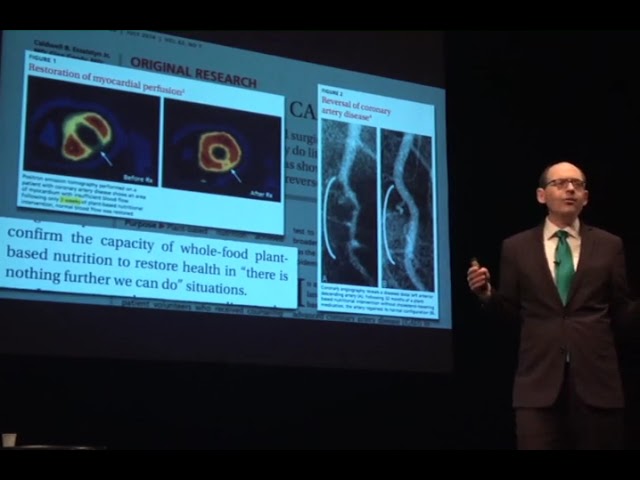
In this 2022 YouTube presentation, Dr. Michael Greger (SCPM, MBA, PMP®) shares his personal motivation—his grandmother’s dramatic recovery from end‑stage heart disease after a Pritikin‑style lifestyle—and explains why he devotes his career to summarizing every nutrition‑related study for the public via NutritionFacts.org. He argues that the leading causes of death in the United States are overwhelmingly diet‑related and that a whole‑food, plant‑based (WFPB) diet can prevent, treat, and even reverse many of them. He reviews landmark evidence: the Ornish heart‑reversal trial, rapid plaque regression within weeks, IGF‑1‑driven cancer mechanisms, the dramatic insulin‑dose reductions in type‑2 diabetics on a WFPB diet, and the superior blood‑pressure, kidney‑function, and mental‑health outcomes of plant‑based eating. He contrasts the slow, industry‑backed acceptance of smoking risks with the current suppression of diet‑risk data by food and meat industries, highlighting how misinformation delays public health action. He walks through the United States’ top 15 killers, showing how plant‑based nutrition can mitigate each, and urges individuals to adopt the diet now rather than wait for systemic change. The talk ends with a call to share the message, a plug for his new book “How Not to Die,” and an invitation for Q&A.
Chapters
Allow me to begin on a personal note. This is a picture taken of me right around the time that my grandmother was diagnosed with end-stage heart disease. And sent home to die. She already had so many bypass operations, she basically ran out of plumbing at some point. You get so scarred up inside. Confined to a wheelchair, crushing chest pain, her life was over at age 65. Nothing more they could do. And then she heard about this guy Nathan Pritikin, one of our early lifestyle medicine pioneers, and what happened next is detailed In Pritikin's biography, my grandma was one of the death's door people. Francis Gregor, my grandmother, arrived at one of Pritikin's early sessions in a wheelchair. Mrs. Gregor had heart disease, angina, claudication. Her condition so bad she could no longer walk without great pain in her chest and legs. Within three weeks, though, she was not only out of her wheelchair; she was walking ten miles a day. She was given her medical death sentence at age 65 when the doctors abandoned her. Thanks to a healthy diet, she was able to enjoy another 31 years on this planet till age 96. To enjoy her 6 grandkids, including me. This is a picture of my grandma taken 15 years after she was abandoned by the medical— this is taken at her grandson's wedding. And indeed, that is the reason I went to medical school, all thanks to my grandma. Thank you. Now, years later, when Dr. Dean Ornish published his landmark lifestyle heart trial proving that heart disease could indeed be reversed— arteries opened up without drugs, without surgery, just a healthy plant-based diet and other lifestyle behaviors— I assumed this was going to be the game changer. I mean, I'd seen it in my own family. But here it was, in black and white, published in some of the most prestigious medical journals in the world, yet nothing happened. I said, wait a second. If effectively the cure to our number one killer could get lost down some rabbit hole and ignored, what else might there be in the medical literature that could help my patients but just didn't have a corporate budget driving its promotion? Well, I made it my life's mission to find out. For those of you unfamiliar with my work, every year I read through every issue of every English-language nutrition journal in the world so busy folks like you don't have to. Very nice. I then compile all the most interesting, most groundbreaking, most practical findings into new videos and articles I upload every day. To my nonprofit site, nutritionfacts.org. Everything on the website is free. There are no ads, no corporate sponsors, strictly non-commercial, not selling anything. Just put it up as a public service, as a labor of love, as a tribute to my grandmother. Oh, thanks. New videos and articles every day on the latest in evidence-based nutrition. What a concept! So where did Pritikin get his evidence from? Well, a network of missionary hospitals set up throughout sub-Saharan Africa uncovered what may be one of the most important medical discoveries of all time: the fact that many of our major And commonest diseases here in the Western world were universally rare, like heart disease. For example, in the African population of Uganda, coronary artery disease, almost nonexistent. Wait a second, our number one killer, almost nonexistent? What were they eating? Well, they were eating lots of vegetables and grains and greens. And their protein almost exclusively from plant sources, and they had the cholesterol levels to prove it. Very similar to what one sees in modern-day plant eaters. So wait a second! Maybe they were just dying early from something else; never lived long enough to get heart disease. No, here's age-matched heart attack rates in Uganda versus. St. Louis. Out of 632 autopsies in Uganda, only 1 myocardial infarction. Out of 632 age- and gender-matched autopsies in Missouri, 136 myocardial infarctions. More than 100 times the rate of our leading killer. In fact, they were so blown away they went back, did another 800 autopsies in Uganda. Still just that one small healed infarct, meaning it wasn't even the cause of death. Out of 1,427 patients, less than 1 in a Whereas here, heart disease is an epidemic. Here's a list of diseases commonly found here and in places that eat and live like the U.S., but were rare or even nonexistent in populations that centered their diets around whole plant foods. These are among our most common. diseases, like obesity, for example. Hiatal hernia, one of the most common stomach problems. Varicose veins and hemorrhoids are 2 most common venous problems. Colorectal cancer, number 2 cancer killer. Diverticulosis, probably the most common disease of the intestines. Appendicitis, number 1 cause of emergency abdominal surgery. Gallbladder disease, number 1 cause of non-emergency abdominal surgery, as well as ischemic heart disease. Our commonest cause of death here, but a rarity among plant-based populations, which suggests that heart disease may be a choice. Like cavities. If you look at the teeth of people who lived 10,000 years before the invention of the toothbrush, pretty much no cavities. Didn't brush a day in their lives, no flossing, yet no cavities. Why? Because candy bars weren't invented yet. So wait a second. Why do people continue to get cavities when we know they're preventable through dietary changes? Well, simple because the pleasure people derive from dessert. May outweigh the cost and discomfort of the dentist's chair. And look, right, if you believe the benefits outweigh the risks for you and your family, then go for it. I mean, I certainly enjoy the occasional indulgence. I got a good dental plan. But what if instead of the plaque on our teeth, we're talking about the plaque building up inside of our arteries? Another disease that can be prevented through changes in our diet. Okay, now what are the consequences for you and your family? Okay, now we're not talking about scraping tartar anymore. Now we're talking life and death. The most likely reason our loved ones will die is heart disease. heart disease. It's still up to each of us to make our own decisions as to what to eat and how to live, but we should make these choices consciously, educating ourselves about the predictable consequences of our actions. Atherosclerosis, hardening of the arteries, is a disease that begins in childhood. By age 10, nearly all kids raised on the standard American diet already have What are called fatty streaks, the first stage of the disease building up inside their arteries. And then these can turn to plaques in our 20s, get worse in our 30s, and then start killing us off. If there is anyone here this evening older than age 10— 10! Then the question is not whether or not to eat healthy to prevent heart disease, it's whether you want to reverse the heart disease that you likely already have. But is that even possible? You know, when researchers took people with heart disease, put them on the kind of diet followed by populations that did not get heart disease, a plant-based diet, Their hope was maybe we can slow the disease down, perhaps even stop it. Instead, something miraculous happened. The disease started to reverse, to get better. As soon as people stopped eating artery-clogging diets, their bodies were able to start dissolving some of that plaque away, opening up arteries without drugs, without surgery. Suggesting their bodies wanted to be healthy all along, but were just never given the chance. This extraordinary improvement in blood flow to the heart muscle itself was after just 3 weeks of plant-based nutrition. Let me share with you what's been called the best-kept secret In medicine. The best-kept secret in medicine is that sometimes, under the right conditions, the body can heal itself. You know, if you whack your shin really hard on a coffee table, it can get all red-hot painful and swollen and inflamed, but will heal naturally if you just stand back and let your body work its magic. But what if you kept banging your shin in the same place day after day? In fact, 3 times a day— breakfast, lunch, and dinner? It'd never heal. You'd go to your doctor and be like, oh, my shin hurts. They'd be like, no problem. We train for this. Whip out their pad, write you a prescription for painkillers. You're still whacking your shin 3 times a day. Oh, it still really hurts, but oh, it feels so much better with those pain pills on board. Thank heavens for modern medicine. It's like when people take, you know, nitroglycerin pills for crushing chest pain. Tremendous relief, but you're not doing anything to treat the underlying cause, right? Our body wants to come back to health if we let it, but if we keep re-damaging ourselves 3 times a day, we may never heal. You know, it's like smoking. One of the most amazing things I learned in all my medical training was that within about 15 years of stopping smoking, your lung cancer risk approaches that of a lifelong nonsmoker. Isn't that amazing? Like your lungs can clear out all that tar and eventually it's almost as if you never started smoking at all. And every morning of our smoking life, that healing process started until wham! Our first cigarette of the day, reinjuring our lungs with every puff, just like we can reinjure our arteries with every bite. When all we had to do all along, the miracle cure, is to just stand back, get out of the way, stop reinjuring ourselves, and let our body's natural healing processes bring us back towards health. Sure, you can choose. You can practice moderation and hit yourself with a smaller hammer. But why beat yourself up at all? The human body is a self-healing machine. We've known about this for decades. 1977 American Heart Journal. Patients like Mr. F.W. here, heart disease so bad couldn't even make it to the mailbox. Started eating healthier, and a few months later climbing mountains, no pain. Now there are these classes of fancy new anti-angina drugs on the market now. Costs thousands of dollars a year, but at the highest dose may be able to extend exercise duration as long as 33.5 seconds. It does not look like those choosing the drug route are going to be climbing mountains anytime soon. See, plant-based diets aren't just safer and cheaper; they can work. Better, because you're treating the actual cause of the disease. Now, heart disease, though, is our number one killer. What about our number 2 killer, cancer? What happens if you put cancer on a plant-based diet? Well, Dr. Dean Ornish and colleagues showed that the progression of early-stage prostate cancer could be reversed With that same plant-based diet and other healthy lifestyle behaviors, and no wonder. If you take men, put them on a plant-based diet—excuse me—if you take men eating the standard American diet and you drip their blood on human prostate cancer cells growing in a petri dish, you can suppress their growth by about nine percent. But you take those same men, put them on a plant-based diet for a year, and their blood can do this. The blood now circulating throughout the bodies of these men suppressed cancer growth about nearly eight times better than before. Now, this was for men and prostate cancer. They wanted to repeat this study using women and breast cancer. But look, they didn't want to wait a whole year to get the results. Women are dying now. Breast cancer is number one. cancer killer of young women. So they said, let's see what a plant-based diet can do after just 2 weeks against 3 different lines of human breast cancer. This is the before, cancer cell growth powering away at 100%, and this is after 2 weeks eating healthy. This is kind of the before picture. What they did, researchers laid down— this is what's called a photomicrograph, photograph taken under a microscope. They laid down a confluent layer, carpet of breast cancer in a Petri dish, and then they dripped the blood of women eating the standard American diet onto that cancer. And as you can see, it kind of breaks the cancer up into these kind of cancer continents here. But then you take these same women, put them on a plant-based diet, and retest 2 weeks later. So same women, they act as their own controls, same women before, then 2 weeks later, They lay down another carpet of breast cancer and drip their blood on it 2 weeks later, and all you're left with is just this— just a few individual cancer cells left. Their bodies cleaned up within just 2 weeks eating healthy. Their blood became that much more hostile to cancer before and after. Eating healthy for 2 weeks. Now suppressing cancer cell growth is nice. Getting rid of it is even better. This is what's called apoptosis, programmed cell death. Their bodies were able to reprogram cancer cells, forcing them into early retirement. This is a similar image. This is a type of imaging called tunnel imaging, measures DNA fragmentation or cell death where dying cancer cells show up as little white specks. So as you can see, for example, here, here's a dying cancer cell. So even women eating pretty poor diets are not totally defenseless. But you take those same women, put them on a plant-based diet, test 2 weeks later, and their blood can do that. It's like you're an entirely different person inside. Before and after just 2 weeks eating a plant-based diet. What kind of blood do we want in our body? What kind of immune system? Do we want blood that just kind of, you know, rolls over when new cancer cells pop up? Or do we want blood circulating to every nook and cranny in our body with the power to slow down and stop it? Stop it. Now, this was after 2 weeks of plant-based diet and exercise. They had these women out walking 30 to 60 minutes a day. You say, well, wait a second. If you do 2 things, how do you know what role the diet played? So the researchers decided to put it to the test. This is what we saw before, the cancer-stopping power of diet and exercise. In this case, plant-based diet on average for 14 years along with daily moderate exercise, just like out walking every day. That's the kind of cancer cell clearance we can get. Compare that to the cancer-stopping power of your average sedentary meat eater. A little burger, I don't know if you can see that in there. Which is essentially nonexistent. All right, but here's the interesting group in the middle. This is 14 years standard American diet, but 14 years of daily strenuous hour-long exercise like calisthenics. They wanted to know if you exercise long enough, if you exercise hard enough, can you rival some strolling plant-eaters over here? And the answer is exercise helps, no question. But literally 5,000 hours in the gym, no match for a plant-based diet. Here's that same tunnel imaging we saw before. Even if you're a couch potato living off of fried potatoes, you're not totally defenseless. You can knock off a few cancer cells. You exercise for 5,000 hours, you can knock off cancer cells left and right. But nothing appears to kick more cancer tush than a plant-based diet. We think it's because the consumption of animal protein— meat, dairy, and egg white protein— increasing our body's production of something called IGF-1, insulin-like growth factor 1, which is a cancer-promoting growth hormone involved in the acquisition and progression of malignant tumors. But if you go on a plant-based diet, the IGF-1 levels in your body drop within 2 weeks. And if you continue eating healthy, they drop even further. And your level of IGF-1 binding protein goes up. IGF-1 binding protein is like our body's emergency brake. It's one of our ways our bodies protect itself from cancer, protect itself from excessive growth. Sure, in as few as 2 weeks, you can drop your body's production of IGF-1. But wait a second. What about all the IGF-1 you have circulating in your body from the bacon and eggs you had 3 weeks ago? Well, your body— your liver releases this snatch squad of binding proteins to type any excess IGF-1, pull it out of the system. Your protective levels go up within weeks, and benefits continue to accrue the longer you eat healthy. This is the experiment that really nailed IGF-1 as the villain. Same thing we saw before: healthy diet and exercise, cancer cell growth drops. Drops cancer cell death shoots up. But here's the interesting column here: What if you add back to the cancer just the amount of IGF-1 you banished from your system because you started eating healthier? What happens? You essentially erase the diet and exercise effect. It's almost as if you never started eating healthy at all, right? And so this is why this is the reason we think. A reason why the incidence— the largest study on diet and cancer in history found that the incidence of all cancers combined was lower among those eating more plant-based, because they're eating less animal protein, less meat, egg white, and dairy protein, which means less IGF-1, which means less cancer growth. How much less cancer growth? Well, This study of thousands of folks followed for nearly 20 years found that those eating the most protein had 75% increased risk of dying prematurely, fourfold increased risk of dying from cancer. But not all protein, specifically animal protein, which makes sense given the higher IGF-1 levels we're talking about. The The academic institution sent out a press release with a memorable opening line, that chicken wing you're eating could be as deadly as a cigarette, explaining that diets high in animal protein quadruple one's risk of dying from cancer, which is, you know, comparable to what one might get from smoking cigarettes. So what was the nutrition community's, the scientific nutrition community's response to this revelation that diets high in meat, eggs, and dairy could be harmful to the health as smoking? Well, one nutrition scientist says it was potentially dangerous. Why? Because a smoker might think, hey, why bother quitting smoking if a ham and cheese sandwich is just as bad for me? So let's not tell anyone about this whole meat and cheese thing, right? Shh. It reminds me of this infamous Philip Morris cigarette ad that tried to downplay the risk by saying, hey, you think secondhand smoke is bad, increasing the risk of lung cancer 19%? Well, hey, Drinking 1 or 2 glasses of milk every day may be 3 times as bad, 62% increased risk of lung cancer. Or doubling your risk frequently cooking with oil. Or tripling your risk of heart disease by eating non-vegetarian. Or multiplying your risk 6-fold if you eat lots of meat and dairy. So, they argued, let's keep some perspective here. The risk from secondhand smoke may be well below that of other everyday activities, so breathe deep. That's like saying, yeah, don't worry about getting stabbed because getting shot is so much worse. How about neither? 2 risks don't make a right. And you'll note that Philip Morris stopped throwing dairy under the bus once they purchased Kraft Foods. Just saying. Killer number 3 in the United States— so every year the CDC compiles the leading 15 causes So I thought, well, let's just go through the list, 1 through 15, talk about the role diet may play in preventing, treating, and reversing our top 15 killers. We talked about killer number 1. Killer number 2, just 13 to go. Killer number 3 used to be heart disease, cancer, stroke. That's— Oh! 2007. Now it's heart disease, cancer, and COPD, chronic obstructive Thank you. And that's why we have obstructive pulmonary disease like emphysema. Thankfully, plant-based diet can be used to help prevent COPD, can be used to treat COPD, significantly improving lung function over time. Though the tobacco industry had a very different spin on this. I mean, if adding plants to our diet can improve lung function, wouldn't it be easier to just add plants to cigarettes? And indeed, The addition of acai berries to cigarettes evidently had a protective effect against emphysema in smoking mice. Who would have thunk it, right? Next, they're going to start adding berries to meat, right? And indeed, I couldn't make this stuff up, ladies and gentlemen. The addition Of fruit extracts to burger patties was not without its glitches. For example, the blackberries dyed the burger patties with a distinct purplish color, which kind of turned people off a little bit. Though evidently you can improve the tenderness of lamb carcasses if you infuse them before rigor mortis sets in with kiwifruit juice. You can even improve the nutritional profile of frankfurters By adding powdered grape seeds, though there were complaints that the grape seed particles became visible in the final product. And, you know, if there's one thing we know about hot dog eaters, it's that they're picky about what goes in their food. Oh, oh, pig anus, okay, but grapes? Ew! Killer number four is stroke. Preventing strokes may be all about eating potassium-rich foods, but most Americans don't even reach the recommended minimum intake of potassium. By most, what do I mean? I'm talking more than 97% of Americans don't even reach the recommended 98%. Don't even reach the recommended minimum daily intake of potassium because 98% of Americans aren't eating enough plants. Potassium comes from the words pot ash. Take any plant, put it in a pot, reduce it to ash. You're left with pot ashium, potassium vegetable alkali. That's where they got. But who can name me one plant particularly high in potassium? Banana, of course. I don't know. You know, wherever I go in the world, that's like the one thing everybody knows about. About nutrition, like potassium, banana— like Chiquita must have had a great PR firm or something. Turns out, turns out bananas don't even make the top 50 sources, coming in at number 86, right behind fast food vanilla milkshakes. It goes fast and then bananas. It's funny when I was writing the new book, How Not to Die. You know, I went back to check to make sure the USDA hadn't expanded their nutrient database, and they had. Now bananas don't even make the top thousand sources, coming in at number one thousand six hundred and eleven, right after Reese's Pieces. I kid you not. The most concentrated. Concentrated forms of potassium. Whole food sources of potassium in our diet are number 1, greens, number 2, beans, and number 3, dates. Actually, bananas don't even make the top 1,000. In fact, if you look at the next leading cause of death in the United States, bananas— Could be downright dangerous! Alzheimer's is our 6th leading cause of death. 4 million Americans affected. 20 years ago, wasn't even in the top 10. The latest Nutrition guidelines for the prevention of Alzheimer's says the two most important things we can do is number one, cut down our intake of meat, dairy, and and junk, and replace those with vegetables, legumes, which are beans, split peas, chickpeas, and lentils, fruits, and whole grains. And this is based in part on data going back decades now that people that eat meat. Red meat, white meat—doesn't matter. Between two to three times the risk of becoming demented later in life, and the longer one eats meat-free, the lower one's risk falls. Killer number seven is type two diabetes—a disease that can be prevented, treated, and reversed. With a plant-based diet, something we've known since back in the 1930s. They put a group of diabetics on a plant-based diet, and within 5 years, a quarter of the diabetics were off insulin altogether. But look, plant-based diets in general are relatively low-calorie diets. Maybe their diabetes just got better because they lost so much weight. I mean, to figure that out, what we'd have to do is put people on a— put diabetics on a plant-based diet, but force them to eat so much food that they wouldn't lose any weight. Then we could see if there are benefits unique to plant-based diet beyond just all the easy weight loss. Well, we'd have to wait a few decades, but here it is. They took a group of diabetics, put them on a plant-based diet, Weighed them every day. If they started to lose weight, they were made to eat more food. In fact, so much more food, some of the participants had problems eating it all. They're like, oh, not another salad. Oh. But eventually they adapted. So no weight loss despite restricting meat, eggs, dairy, and junk. Okay, so wait a sec. With no weight loss, Was there still a benefit for their diabetes? Well, insulin needs were cut 60%, and half the diabetics ended off all their insulin altogether. How many years did this take? No, 16 days. 16 days later. So we're talking diabetics who've been diabetic for as long as 20 years, injecting 20 units of insulin a day, then 13 days later on none, despite no change in weight, off their insulin in less than 2 weeks. Here's participant number 15, 32 units of insulin on the control diet, and then 18 days later on none. Lower blood sugars on 32 units less insulin. That's the power of plants. And no weight loss. So this was just— his body worked that much better because of about 2 weeks on a plant-based diet. And as a benefit, cholesterol dropped like a rock to under 150 in 2 weeks. So just like, you know, modest changes in diet will only get you modest benefits for cholesterol reduction, right? How modest do you want your diabetes, right? Asking diabetics to make moderate changes in their diet can leave them with moderate vision loss, moderate kidney failure, moderate amputation— maybe just a few toes or something. Moderation in all things is not necessarily a good thing. Remember that study that purported to show that diets high in meat, eggs, and dairy could be harmful to health as smoking supposedly suggested those who eat a lot of meat, eggs, and dairy four times as likely to die from cancer or diabetes? Well, if you look at the actual study though, you'll see that simply. Not true. Those eating a lot of protein during middle age didn't have 4 times the risk of dying from diabetes, they had 73 times the risk of dying from diabetes. Now, those that chose moderation, only eating a moderate amount of animal protein, see, they just had 23 times the risk of death from diabetes. Killer number eight is kidney failure, which can be both prevented. It can we can help prevent and treat with a plant-based diet. And no wonder kidneys are highly vascular organs. So Harvard researchers found three dietary risk factors for declining kidney function. Number one, animal protein. Number two, animal fat. Number three, cholesterol. Animal fat can alter the actual structure of the human kidney based on autopsy studies showing plugs of fat literally clogging up the works in autopsied human kidneys. And the animal protein can have a profound effect on normal kidney function, causing what's called hyperfiltration. Increasing the workload on the kidneys, but not plant protein. So you take people and you give them a meal of tuna fish, and you can see increased pressure in the kidneys 1, 2, 3 hours after the meal in both diabetics and non-diabetics. So we're talking adverse effects, not, you know, decades down the road, But within hours of this going into our mouth. Okay, but what if instead of a meal— what if instead of a tuna fish salad sandwich, they had these people eat the exact same amount of protein but a tofu salad sandwich? What happened? Absolutely nothing. Their bodies were able to handle plant protein without even batting an eyelash. So wait a second, why does animal protein cause that overload reaction but not plant protein? We think it's because of the inflammation triggered by the consumption of animal protein. How do we know that? Because if you give a powerful anti-inflammatory drug along with that tuna fish, you can abolish that protein leakage hyperfiltration response to animal protein. Ingestion. And then there's the acid load. The consumption of acid-inducing foods— we're talking about meat, dairy, and eggs— causes the formation of acids within our kidneys. And this can cause what's called tubular toxicity, damage to the delicate urine-making tubes. Within the kidneys. As you can see, animal proteins are acid-forming, tend to be acid-forming, particularly fish, which is actually the worst, whereas plant proteins tend to either be neutral or base-forming, actually alkaline, particularly dark green leafy vegetables, counteracting any acid that's formed in our kidneys. And so the key to halting the progression of chronic kidney disease may lie in the produce aisle rather than the pharmacy. No surprise then that plant-based diets have been used to treat kidney disease for decades now. Here's protein leakage on the conventional low-sodium diet. That's what doctors would typically put kidney patients on. And then they switched them, though, in this study to a supplemented vegan diet, and then back to the conventional diet, vegan diet, conventional diet, vegan diet, switching on and off kidney dysfunction like a light switch based on what was going into their mouths. Killer number nine, respiratory infection. Wait a second! What possible role could diet play in respiratory infections? Well, obviously, you haven't seen my video "Kale and the Immune System," talking about the immunostimulatory effects of kale. Is there anything kale cannot do? Boosting antibody production sevenfold. But this is in a petri dish. What happens in people? If you take older men and women, their 60s and 70s, right before getting their pneumovax vaccination, their pneumonia vaccination, split them up into two groups: half continue to eat their regular diet; the other half, you just add a few servings of fruits and vegetables to their daily diet. What do you get? Significant boost. Boosted protective antibody response. Just adding a few servings of produce to our daily diet can significantly boost our immune function. Killer number 10 is suicide. We've known for years now that those who eat plant-based diets have significantly better mental health. Only about half the depression, anxiety, and stress scores compared to those that eat meat. The thought was that it's this arachidonic acid, this inflammatory long-chain omega-6 fatty acid found in animal products, that was inflaming people's brain, impacting their mental health, found predominantly in 2 places: chicken and eggs, by By far the 2 most important sources, but you don't know until you put it to the test. So University of Arizona researchers took men and women eating the standard American diet, removed meat, removed fish, removed chicken, removed eggs as well, and got a significant improvement in mood scores within just 2 weeks. It could take drugs like Prozac months to take effect. Within just 2 weeks. Why? Because of the Perhaps because this arachidonic acid was adversely impacting mental health via a cascade of neuroinflammation, brain inflammation. But it appears we can clear this inflammation from our brains within as few as 2 weeks by cutting down, cutting out our consumption of eggs, meat, chicken meat, and other meat. from our diet. And this is— you say, wait a second, am I just cherry-picking here? What about all the other studies that have shown different diets improved mood? There aren't any. So this recent meta-analysis found that only the plant-based diet intervention was the only randomized controlled trial showing diet could significantly improve mood. It's kind of hard to cherry-pick when there's only one cherry. Works in a workplace setting, too. GEICO Insurance, actually, thanks to Physicians Committee for Responsible Medicine, they introduced this vegan workplace intervention where they added vegan options to the cafeteria. and some education, saw a significant improvement not only in physical function, general health, which we'd expect, also vitality and mental health. And of course, what the company cared about is the bottom line. Also improved worker productivity, no question. So they expanded this across the country to about a dozen sites and found significant improvements. So they ran— so there were control sites where they didn't do anything versus Those sites all of a sudden added something like lentil soup and bean burritos to their cafeterias. What happened? There was significant improvements in depression, anxiety, fatigue, emotional well-being, daily function, emotional health. And so, you know, dietary lifestyle interventions in general, including exercise, can not only help physical health but also mental health. And diet-wise, plant-based diets have the greatest a bounty of evidence supporting their use for mental health interventions. Killer number 11 is systemic blood infections. What possible role could diet play? Well, certainly there are food poisoning bugs that can burrow through the intestine, get into the bloodstream, or in women, can crawl up into their bladder. We have known for decades now that it's actually bacteria creeping up from the rectum that cause bladder infections in women, but we didn't know where this reservoir of bladder-infecting E. coli was coming from until now. And that was we found that chicken, that these UTI-causing bacteria originate in chicken. And so we now have proof, direct kind of DNA fingerprinting Fingerprinting proof of a direct link between you know farm animals' meat and bladder infections in women. Solid evidence that these urinary tract infections can be what's called a zoonosis—an animal to human disease. You say, "Wait a second! Can't you just cook the meat through? You know, buy a meat thermometer. Who undercooks chicken? What's the big deal?" The big deal is what's called cross-contamination. If you give 40 families a frozen chicken to prepare and cook in their home as they normally would, multitudes of antibiotic-resistant bacteria jump from the chicken into the guts of the volunteers even before they eat it. So you could incinerate that chicken to ash. You don't even have to eat any of it, right? But you're infected before it even makes it into the oven, right, because of cross-contamination in the kitchen. Within days, the antibiotic-resistant chicken bacteria was becoming a major part of the person's gut flora, meaning that the chicken bacteria was like taking over. You say, okay, well wait a second, what if I practice good safe handling guidelines as well as cooking guidelines? Well, researchers did indeed do this, repeat the same experiment, give people a chicken and— not that anyone actually does this, but instructed them how to do the official kind of USDA recommendations to spray everything with bleach solution, wipe everything down with bleach, let it— okay, go through all that and they still found significant levels of Salmonella, Campylobacter, bacteria, significant serious human pathogens on utensils, on the counter, the dishcloth, around the sink. If you— the reason that if you go into people's houses that there's more bacteria, there's more fecal bacteria in their kitchen sink than on their toilet seat Is because people tend to rinse chickens in the sink, not the toilet. So unless our kitchen is like some biohazard lab, the only way we're going to guarantee not leaving infection around the kitchen is to not. Yes. Bring it into our homes in the first place. Right? Now, the good news is it's not like you eat chicken and you're infected, you know, eat chicken once, you're infected for life. In this study, the chicken bacteria only seemed to last for about 10 days before the good bacteria in your gut could kind of muscle it out of the way, get rid of it. The problem is that many people eat chicken more than once every 10 days, so they'd be constantly reintroducing these chicken bugs into their systems. The— wait a second, you can't sell unsafe toys, you can't sell unsafe cars, how is it even legal to sell unsafe meat? They do it by blaming the consumer. As one USDA poultry microbiologist said, look, raw meats are not idiot-proof. They can be mishandled when they are like handling a hand grenade. You pull the pin, someone's going to get hurt. Now, while some may question the wisdom of selling hand grenades in supermarkets, our poultry microbiologists disagree, saying no, it's the consumer that has the most responsibility, just refuses to accept it. It's like a car company saying, yeah, we installed faulty brakes, but it's your fault for not putting your kid in a seatbelt. The head of the CDC's food poisoning division famously responded to this blame-the-victim attitude coming from the meat industry. She asked, is it reasonable? Is it reasonable that if a hamburger is undercooked that their 3-year-old dies? Is that reasonable? Not to worry, the meat industry's on it. They now have FDA approval for a bacteria-eating virus they can spray on the meat. And now there's been some concern within the industry about consumer acceptance of these so-called bacteria-eating viruses. May present somewhat of a challenge to the industry, so they're not going to label it or anything. But if you think that's going to be a challenge, check out their other bright idea. The effect of extracted housefly pupae. This is a sciencey way of saying they want to smear a maggot mixture on the meat. What? It's a low cost. Think about it. Look, maggots thrive off of rotting flesh. However, there have been no reports of maggots having any serious diseases, right? So they. They must be filled with some kind of antibacterial something, right? Have you ever seen a maggot sneeze? I didn't think so. So let's take some maggots, grow them 3 days old, wash them off, towel them off, a little Vitamix action here. Voilà! Safer meat. Are we talking about kidney failure? What about liver failure? We've known for decades that you can treat liver failure with a plant-based diet, significantly reducing the toxins that would otherwise build up eating meat without a fully functional liver to detoxify your blood. Though one does have to admit there's some people eating plant-based diets with worsening liver function. They're called alcoholics living off of potatoes and corn and grapes, strictly plant-based, but not doing so good. It's not— we're not clear what— Killer number 13 is high blood pressure, which currently strikes 78 million Americans. That's about 1 in 3 adults. And as we get older, our pressures get higher and higher, such that by age 60, most of us have high blood pressure. You say, wait a second, if most people become hypertensive when they get older, maybe it's less a disease and more just an inevitable consequence of aging. No, we've known since the 1920s That high blood pressure need not occur. Blood pressures of a thousand rural Kenyans was measured. They were eating a diet based around grains and beans and vegetables, fruit and greens. Our blood pressures go up as we age; their blood pressures go down. The ideal blood pressure, the no benefit from reducing it further blood pressure, it's not 120 over 80. If you went in with a blood pressure of 120 over 80, your doctor would give you a gold star. But the ideal blood pressure appears to be 110 over 60. 70. And so the people at 120/80 actually benefit from blood pressure reduction. So the ideal blood pressure, the no benefit from reducing it further blood pressure, 110/70. You say, wait a second, is it even possible to get blood pressures under 110/70? It's not just possible, it's normal for those eating healthy enough diets. So a few years at this rural Kenyan hospital, 1,800 patients were admitted. How many cases of high blood pressure did they find? Zero. Wow, they must have low rates of heart disease, right? No, they had no rates of heart disease. Not a single case of atherosclerosis, our number one killer, was found. Rural China, same thing. About 110 over 70 their entire lives. 70-year-olds, same average blood pressure as 16-year-olds. Now you say, wait a second, Africa, Asia, vastly different diets. But what they shared in common was that they were plant-based day to day, with meat only eaten on special occasions. Now why do we think it's the plant-based nature of their diets that was so protective? Because in the Western world, The only folks getting it down that low were the strict vegetarians, the vegans, coming in at an average of about 110 over 65, according to the American Heart Association. This is the largest study of plant-based eaters in human history, studied about 89,000 Californians, comparing those that eat meat compared to so-called semi-vegetarians or flexitarians. Those eat meat more on like a weekly basis than a daily basis, compared to those that don't eat any meat at all except fish, compared to those that don't eat any meat period, compared to those who don't eat meat, eggs, or dairy. And as you can see, there's a stepwise drop in risk The more and more plant-based one's diet gets for high blood pressure, this leading killer. Same thing with type 2 diabetes, the stepwise progression towards lower risk. Same thing with obesity, right? And so sure, we can wipe out the vast majority of our risk eating strictly plant-based, but we get benefits significantly accruing all the way down the line towards the spectrum of eating healthy. So it's not black or white, it's not all or nothing. Any movement we can make towards eating healthier can accrue significant health benefits. For high blood pressure, we can show this experimentally. You take vegetarians, you give them meat, pay them enough to eat it, and their blood pressure goes up. Or you take meat eaters, you remove meat from their diet, and their blood pressure goes down within 7 days, and this is after most of them had to reduce or stop their blood pressure medications. They had to stop because if you treat the cause of the high blood pressure, you don't have high blood pressure anymore. You can't be on blood pressure medications. You'll get dizzy, fall over, crack your head open or something. It's dangerous, right? So lower pressures on fewer drugs. That's the power of plants. So, does the American Heart Association recommend a no-meat diet? No, they recommend this low-meat diet, the so-called DASH diet. You say, well, wait a second. I mean, when the DASH diet was being created, were they just not aware of this landmark research done by Harvard's Frank Sachs? No, they were aware. The chair of the design committee that came up with the DASH diet was Frank Sachs. So see, the DASH diet was created with the number one goal of capturing the blood pressure lowering benefits of a vegetarian diet, yet contain enough animal products to make it palatable to the general population. They didn't think the public could handle the truth. Now see, you can see what they were thinking. They were like, look, just like drugs never work unless you actually take them, diets never work unless you actually eat them. So they're like, oh, we can't say strictly plant, but no one's going to do that. So if we come up with some kind of, you know, if we soft peddle the message with some kind of compromised diet, maybe on a population scale we'll actually do more good. All right. Tell that to the 1,000 American families a day that lose a family member to high blood pressure. Maybe it's time to start telling the American public the truth. Killer number 14 is Parkinson's disease. Can a plant-based diet reduce one's risk of Parkinson's disease? Well, we know that most studies done to date looking at dairy product consumption and Parkinson's disease found an increased risk of Parkinson's disease. Associated with dairy. Why might that be? Well, the current thought is that it's because our milk supply is contaminated with neurotoxins. High levels of, for example, these organochlorine pesticides found within the brains of Parkinson's victims and in the dairy supply. We're talking about toxins like tetrahydroisopropyl So quinoline, which is what scientists use to actually try to induce Parkinson's disease in primates in a laboratory setting, found mostly in cheese, actually. So there's been calls on the dairy industry to please screen your toxins— screen your milk for toxins. Good luck with that. Of course, we could just not drink it, but then what would happen to your bones? That is a myth. The milk consumption has not been found to protect against hip fracture, whether you're drinking it in your adult years, whether you're drinking your teen years, doesn't matter, doesn't work. In fact, there may even be more fracture risk with higher milk consumption. That would explain why countries with the highest milk consumption actually have the highest. Hip fracture rates as well, but you don't know until you put it to the test. So Swedish researchers followed 18,000 people for a number of years and found that milk-drinking women had higher rates of what? Higher rates of death. Significantly more heart disease, significantly more cancer for each daily glass of milk. And they had more hip fracture rates. So, for example, 3 or more glasses of milk a day nearly doubled their risk of dying prematurely, and they had more hip fracture rates. So more milk, more fractures. And milk-drinking men also had higher rates of But for some reason, you never see these kind of milk ads. I don't know, this kind of— And finally, killer number 15 is what's called aspiration pneumonia, caused by swallowing difficulties due to Parkinson's or stroke or Alzheimer's, things we've already talked about. So here's our 15 leading causes of death on a plant-based diet. Can help prevent nearly all of them, can be used to treat more than half of them, and even reverse the course of disease in some of them, including in some cases our top three killers. Now look, there's drugs that can help too in certain circumstances. Yes, you can take you know cholesterol lowering drugs for your heart. You can take you know insulin injections and sugar pills for diabetes. Usually takes a couple different. Classes of high blood pressure medications to force people's blood pressure down, but the same diet does it all. It's not like there's one, you know, a heart-healthy diet is somehow different from a brain-healthy diet. No, a liver-healthy diet is a heart-healthy diet, is a whole-body healthy diet. One diet to rule them all. And what about drug side effects? I'm not talking about a little rash here. Prescription drugs kill more than 100,000 Americans every year. So wait a second, 106,000 Americans every year. That means that the 6th leading cause of death is doctors. The 6th leading cause of death is me. Yes! Thankfully, I can be prevented with a plant-based diet. No, but seriously, compared to 15,000 American vegetarians, those that eat meat, about twice the odds of being on aspirin, sleeping pills, tranquilizers, antacids, painkillers, blood pressure medications, laxatives, of course, as well as insulin. So plant-based diets are great. For people that don't like taking drugs, for people that don't like paying for drugs, and for people that don't like risking drug side effects. Anyone have any thoughts as to solving our healthcare crisis? Hmm. I've got a suggestion. There's only one diet. That's ever been proven to reverse heart disease in the majority of patients. That's a plant-based diet. You know, anyone tries to sell you on some new diet they heard about, do me a favor, ask them a simple question. Say, wait a second, has this diet been proven to reverse heart disease? You know, the number one reason me and all my loved ones will die? If the answer is no, why would you even consider it? If that's all a plant-based diet can do, reverse the number one killer of men and women. Shouldn't that kind of be the default diet until proven otherwise? And the fact that can also be useful in preventing or reversing and treating other leading killers like type 2 diabetes and high blood pressure would seem to make the case for plant-based eating simply overwhelming. Most deaths in the United States are preventable and related to nutrition. The number one cause of death in the United States, according to the Global Burden of Disease study, the largest study on risk factors in human history, funded by the Bill and Melinda Gates Foundation— number one cause of death in the United States: our diet. Number one cause of disability in the United States: our diet. Bumping tobacco smoking to number two, cigarettes now only kill about half a million Americans every year, whereas our diet kills hundreds of thousands more. So obviously, diet is the number one thing that's taught in medical school, right? It's the number one thing your doctor talks to you about when you go see them, right? How could be there be this disconnect between modern medical practice and the science? Let's do a thought experiment. Imagine yourself a smoker back in the 1950s. The 1950s, the average per capita cigarette consumption was four. 100,000 cigarettes a year. The average person walking around smoked half a pack a day, on average. The media was telling people to smoke. Famous athletes agreed. Even Santa Claus wanted you to smoke. I mean, look, you want to keep fit and stay slender, so you make sure to smoke and eat lots of hot dogs to stay healthy. slim and trim. A lot better than that apple there. I mean, sheesh, right? Although apples do connote goodness and freshness, reads one internal tobacco industry memo, which brings up many possibilities for youth-oriented cigarettes. They want to make apple-flavored cigarettes for kids. Shameless. For digestion's sake, you smoke? I mean, no curative powers claimed by Philip Morris, but it's good for your Better be safe than sorry and smoke. Blow in her face and she'll follow you anywhere. No woman ever says no. They're so round, so firm, so fully packed. After all, John Wayne smoked them until he got lung cancer and died. You know, back then even the paleo folks were smoking, and so were the doctors. Now, this is not to say there wasn't controversy within the medical profession. Yes, some doctors smoked Camels, but you know, others Preferred Lucky's. There was a little disagreement. The leader of the U.S. Senate agreed. I mean, who wouldn't want to give their throat a vacation? Not a single case of throat irritation. How could there be when cigarettes are just as pure as the water you drink in Flint, Michigan? Maybe. But don't worry, because if you do get irritated, no problem, your doctor can write you a prescription for cigarettes. This is an ad in the American Medical Association, Journal of the American Medical Association, right? So when the AMA is suggesting that smoking may actually be good for you on balance, What? When the American Medical Association is saying that, where could you turn if you just want the science? What's the new data advanced by science? Well, she was too tired for fun, and then she smoked a Camel. Babe Ruth spoke of proof-positive medical science. That is when he still could speak before he died of throat cancer. Now, if by some miracle there was some smokingfacts.org website back then that could deliver the science directly, bypassing commercially corruptible institutional filters, one would have become aware of studies like this. This is an inventive study out of California published in 1958 showing that smokers that nonsmokers had at least 90% less lung cancer risk than smokers. This wasn't the first. When famed surgeon Michael DeBakey was asked why his studies back in the '30s linking lung cancer and smoking were simply ignored, he had to remind people what it was like back then. We were a smoking society. It was everywhere. It was in the movies, It was in the medical meetings where one heavy haze of smoke. Smoking was, in a word, normal. So, back to our thought experiment. If you're a smoker in the '50s in the know, what do you do? I mean, with access to the science, you realize the best available balance of evidence suggests your smoking habit, not so good for you. So do you change or do you wait? If you wait until your doctor tells you between puffs to quit, you could have cancer by then. If you wait until the powers that be officially recognize it like the Surgeon General did in the subsequent decade in the '60s, you could be dead by then. It took more than 7,000 studies 1,000 studies and the deaths of countless smokers before the first Surgeon General's report against smoking came out. You'd think maybe after the first 6,000 studies it could have given people a little heads up or something. Powerful industry, right? One wonders how many people are currently dying from dietary diseases. Maybe we should have stopped smoking after the It's the 3rd study like this. As a smoker in the '50s, on one hand, you had all of society, the government, the medical profession itself telling you to smoke. And on the other, all you had was the science, if you were even aware of studies like this. All right, well, let's fast forward 45 years. You know, there's a new Adventist study out of California. Warning Americans about something else they may be putting in their mouth. Of course, it's not just one study. Recent review found that mortality from all causes put together, including lots of dreaded diseases like stroke, cancer, significantly lower among those eating more plant-based diets. So instead of a smoker in the 50s, imagine you or someone you know. Going along with America's eating habits today, what do you do? I mean, with access to the science, you realize eating habits not so good for you. So do you change or do you wait? If you wait until your doctor tells you between bites to change, could be too late. If you wait, in fact, after even after the Surgeon General's report came out. The American medical community still dragged their feet. The AMA actually went on record refusing to endorse the Surgeon General's report. Why? Oh, could it have been because they just got a $10 million check from the tobacco industry? Maybe. Okay, so we can see why the AMA was sucking up to the tobacco industry. But wait a second. Why weren't more individual doctors speaking out? speaking out? Well, there were a few ahead of their time speaking up against industries killing millions, as there are today, many of those at this conference. But why not more? Maybe it's because the majority of physicians themselves smoked cigarettes. Just like the majority of physicians today continue to eat foods that are contributing to our epidemic of dietary diseases. What was the AMA's rallying cry back then? Everything in moderation. Extensive scientific studies have proven that smoking in moderation— oh, that's fine. Sound familiar? Today, the food industry uses the same tobacco industry tactics, supplying misinformation, twisting the science. The same scientists for hire paid to downplay the risks of secondhand smoke and toxic chemicals are the same paid for by the National Confectioners Association to downplay the risks of candy, and the same paid for by the meat industry to downplay the risks of meat. Animal products and processed foods kill at least 14 million people every year. Those of us who are part of the evidence-based nutrition movement are talking about the lives of 14 million people, in addition to all the other good that might do in the world. So maybe Plant-based diets can be thought of as the nutritional equivalent of stopping smoking. But how many more people have to die before the CDC says, "Don't wait for open heart surgery to start eating healthy as well." Until the system changes, we need to take personal responsibility for our own health, for our family's health. We can't wait until society catches up to the science again. Because it's a matter of life and death. When Dr. Kim Williams became president of the American College of Cardiology last year, he was asked in an interview why he himself follows the same diet that he recommends to all his patients—a strictly plant-based vegan diet. He said, "I don't mind dying," Dr. Williams replied. "I just don't want it." To be my own fault. Thank you so much. Thank you. Thank you. If you would like to share this talk with anyone else, I recently was videotaped in a talk. I gave in Great Britain. If you go to bit.ly/LondonTalk, you can share that link with anyone and share this talk. For those of you who want to see the entire series of talks I've given for years at Summerfest, here they all are, and I have those DVDs out on my table. And as you can see, if you have been eating your carrots, you can see they've been— they're taped by Aaron over here who's standing— he's right there. Who's done all four and now the fifth? Thank you so much. And I'm so excited to have here for the first time my new book, How Not to Die. All proceeds donated to charity, of course. And all my work is available free at nutritionfacts.org. Thank you again. Seal for watermelon. Oh. I have a Q&A tomorrow for questions, a Q&A tomorrow morning at 8:30. Happy to answer any questions you may have. I'm happy to sign books or anything. Thank you. Thank you.
More from Mario

Boost Learning with Studio: Turn Your sources into Audio, Video, MindMaps, and More





Anima Christi - Beautiful Choir Performance in Corpus Christi 2025 - Stockholm - Sweden