Peter Diamandis @ IEM Chihuahua, Mexico 17-Dic-2018

In this keynote, Peter Diamandis opens by challenging the audience to recognize how rapidly the world is improving and changing. He presents data showing historic gains in income, lifespan, education, and safety, arguing that exponential technologies are the engine behind this progress. He contrasts linear, slow change with the current exponential acceleration driven by Moore’s Law, AI, robotics, 3D printing, synthetic biology, renewable energy, 5G, and the Internet of Things. Through vivid case studies—Kodak’s missed digital camera, Blockbuster’s fall to Netflix, and the rise of unicorn startups—he illustrates how established firms can be displaced when they ignore exponential tools. Diamandis explains how once‑scarce resources (aluminum, diamonds, energy) become abundant via technology, and he outlines the imminent transition to cheap solar, massive battery production, and electric vehicles. He highlights the coming global connectivity boom via 5G and satellite constellations, projecting billions of new users and trillions of dollars of economic activity. The talk then moves to biotech, describing rapid cost declines in genome sequencing, CRISPR gene editing, stem‑cell therapies, and the vision of personalized “sick‑care” turned preventive health. He showcases AI milestones (Deep Blue, AlphaGo, AlphaZero) and emerging digital assistants that can perform tasks for anyone. Diamandis emphasizes the power of prize‑based incentives (XPRIZEs) to solve grand challenges in health, education, climate, and space, and he calls on governments, academia, and industry—especially in Mexico—to focus strategically, partner with global entrepreneurs, and create ecosystems that nurture crazy ideas. He introduces the concept of continuous education through CGLAC University to keep pace with the tsunami of change, urging leaders to partner with entrepreneurs via minority stakes and ecosystem collaborations rather than outright acquisitions. He outlines the future of agriculture: autonomous robotics, aggressive genetic engineering, vertical and urban farming, and cultured meat (lab‑grown steak) as ways to make food production more efficient and sustainable. He advises legacy corporations to secure board support for experimentation, invest in external “lion” startups while keeping them independent, and build regional specialization through annual conferences, venture funds, and regulatory sandboxes. Finally, he affirms that great ideas can emerge from anywhere, including Chihuahua, and stresses the importance of fostering a culture that treats failure as learning, encouraging investment in promising local projects.
Chapters
Good morning. Mr. Governor, Madam Mayor, it's an honor and pleasure to be here. And as the Governor said, my job here is to wake you up to how fast things are changing. In the next hour, hour and 15 minutes, I want to give you a sense of 2 things. One, that the future is going to be much better on the whole than we all perhaps think And the second is it's happening much faster than anybody knows. We are living during the most extraordinary time ever in human history. There's never been a better time to be alive. Never been a time where your children have more opportunity, where we have the opportunity to create the future that we want. It's also true that I don't think any of us truly understand how fast the world is changing. So my job here is to give you a sense of the technologies that are coming together to transform our planet. I'm going to break it into 5 parts. The first part is to give you the data to show that the world is in fact Getting better. So I had the chance to write a book called Abundance: The Future Is Better Than You Think. I was very proud. It was at the top book of the year. It was one of President Clinton's favorite books. Can we keep the slides on the entire time? Thank you. It was one of President Clinton's favorite books, and when he introduced me. in New York, he said, Peter, why are you so positive about the future? Don't you watch the news? And I said, President Clinton, I'm positive about the future for 2 reasons. One, no, I do not watch the news. We can talk about that. And second, I look at the data. So let's— we evolved a piece of our brain called the amygdala. And the amygdala was the very first place that everything we see, Sorry. That everything we see and everything we hear goes to it. And back when we were evolving in Africa, if you missed a piece of good news, that's too bad. You miss a piece of bad news and your genes were out of the gene pool. You were dead. And so it turns out that we pay 10 times more attention to negative news than positive news. And of course, the news media knows this. And what's the job of the news media? It's to deliver your eyes to their advertisers. And so, if you open the newspaper tomorrow, any newspaper, any place on the planet, there's 10 times more negative news than positive news, because that's what we pay attention to. And I'm not saying that the news is not true. I'm just saying that we're not seeing all the amazingly good news in the world as well. So, let's take a look. Over the last 100 years, the global income for every nation on the planet has more than tripled. The lifespan of a human being has more than doubled. The cost of food has dropped 30-fold. The cost of energy, 50-fold. Transportation, hundreds of fold. Communications, millions of fold cheaper. This is over the last 200 years, people living in extreme poverty. Over the last 200 years, it has plummeted from 95% to down to 15%, and we're about to take the entire world out of extreme poverty over the next 20 years. This is literacy around the world. It's exploded from 15% To near 85%. This is the number of years that people are spending in school around the world between the year 1870 and today. Why? Why is it exploding? Why are we seeing more and more people in every country around the world spending more and more time in school? I'm a father of 2 7-year-old boys, and I think about this. 200 years ago, the chance that your child would live to age 5 was a coin flip. It was 45%. Half the children never lived to age 5. Today it's 4%. Why has it gotten so much better? It used to be dangerous to be a mother, to give birth. This is maternal mortality rates. Why have they plummeted like this? This is average life expectancy. How old? We forget that 100 years ago, for men, the average age was 40, right? Many of you wouldn't be here with me today. Neither would I. And then we doubled the human lifespan. Perhaps we're going to double it again. We talk about and worry about overpopulation. Well, these are the numbers in the United States. The replacement is 2.1 children per family. In the United States today, we're below the replacement level, right? Which means the population will begin to shrink. A lot of my friends around the world are worried about underpopulation of planet Earth, not overpopulation. The global average has gone from 5 Down to 2.4. Bill Gates has a great TED Talk. He says you do 2 things to a population of a city or a country: you make the population healthier and better educated, and the number of children per family rapidly decreases. Yeah. This is another way of looking at that. That blue line in the 1950s was 6 or more children per family. And how rapidly it's decreasing. This is the number of hours worked per week in the developed world, and we are halving the number of hours. I know all of you work twice as much as you always do. This is safety from cars and airplanes. That red-orange line at the bottom is safety of deaths from airplanes. In 2017, there were zero commercial deaths from flying a plane, right? It truly is the safest means of transportation on the planet. That blue line is cars. We still have 1.3 million deaths around the world from cars, but as we go to autonomous vehicles— and I'll speak about this— that number will go to near zero as well. This is the global death rate from natural catastrophes. Earthquakes, hurricanes, floods. Look, why is it going down in the '50s, '60s, '70s, '80s? Why is it reducing? It's not that we're having less storms. It's the impact of satellites in orbit imaging what's going on, better computer models, better data. Right? This is from a friend at Harvard named Steven Pinker, his book, in which he shows us data that we are living during the most peaceful time ever in human history. But you wouldn't know that watching the news all the time, right? So why is this happening? Why now? Why is the world getting better on all of these levels? Not every level, there's still problems. Of course there are, but on so many levels, why is it getting better? And I would say it's because of these exponential technologies. It's these technologies that are becoming available around the world, and I hope to share that with you and to show it to you and for you to feel confident that these technologies, while they are somewhat scary because we don't know what's happening, Because the world is changing. We all like to know we humans like the world not to change. We like waking up in the morning and saying the world is the same as it was before. But the only constant is change, and the rate of change is accelerating. In my job and the work that I do with Singularity University, and I'm very proud that there's an SU chapter here in Chihuahua. Is to help you. You fear things you don't understand, but when you're able to see what's coming and understand what's coming and how to use the technology, you fear less and you start to think strategically. How will we use this? Let me say something with it from in in full. What's the right word? You know, I want to say in full honesty, I'm so impressed by the conversation you guys are having here today because frankly, every country, every state should be having this conversation about how do we bring together academia, industry, and government because the world is changing and if we wait for it to change, it's too late, right? So congratulations, first of all, for doing this. Thank you. I think that's amazing. All right, let's talk about part two here, which is linear versus exponential. So we humans evolved in this world. It was a local and linear world.
Muy importante.
It was a world in which nothing changed century to century, millennium to millennium. You know, 10,000 years ago, 100,000 years ago, things were constant. And things that affected you were only local. Nothing affected you on the other side of the planet. But today the world is global and exponential. Something happens in China or India, you know about it seconds later. Things are not changing decade to decade. They're not even changing year to year. They're changing month to month. And if I were to graph it, it looks like this. This red line is all of us. It's our children, it's our politicians, it's our CEOs, it's our employees, it's our students, it's all of us. We have not had a hardware or software upgrade in millions of years. It's been a while. This technology curve is computers, sensors, networks, AI, robotics, 3D printing, synthetic biology, augmented virtual reality, all these technologies doubling in power year on year. And the difference between them is either stress or opportunity, depending on your point of view. So let me share a story. You guys remember Kodak, right? The year is 1996. Kodak is at the top of its game. It had a brand globally. It was the center of everyone's vacation. What most people don't know was that 20 years earlier, in 1976, Kodak had invented the digital camera in their labs. And when they brought the digital camera to the leadership of Kodak and they said, here it is, the future of Kodak, Kodak said, what are you, crazy? That's a toy for kids. It takes 0.01 megapixel images. Besides, we're in the paper and chemicals business. They forgot what business they were in. Their business was not paper and chemicals. That's where they made their profit. Their business was to preserve people's memories on vacation. And so a few decades later, Kodak went bankrupt, put out of business by the very technology that they had invented, the digital camera, but that they had ignored. In the same year that they declared bankruptcy, another company called Instagram was acquired by Facebook for $1 billion, but they had 13 employees. And I'm given this moment in time where maybe you're thinking, company gets displaced by exponential technology is the name I call it, the new Kodak moment. And we're going to have a lot of these new Kodak moments. This is what it looks like. That yellow line is film falling off a cliff, right, as it's being disrupted. That orange line is digital pics on your phone, 1.6 trillion last year. When Instagram was purchased by Facebook, people laughed that Facebook paid a billion dollars for Instagram. But guess what? It's worth a hundred billion dollars today. Here's another example. I don't know if if you guys remember Blockbuster. Is Blockbuster around? So here's Blockbuster, and you can see Blockbuster falling off the cliff. Here comes Netflix, and along slow down.
Well, in this time
between 1999 and 2010, Netflix was in a still very linear business. They would mail DVDs in the mail to you, and then in 2010. So they start using exponential technologies for broadband, and they start providing Netflix as a video delivery service, video on demand. And look what happens. It goes from $2 billion to $150 billion in 8 years. This is the kind of growth you see when you're using these exponential technologies. This is half the story. Here's the other half of the story. In 2007, In December of 2008, where those green lines are, look at the relative position of Blockbuster and Netflix. On this date, for the second time, Blockbuster refused to buy Netflix. They had 2 opportunities. And this is what the earnings call— this is the CEO of Blockbuster who says neither Redbox nor Netflix are able On the radar screen in terms of competition. So here's the challenge: as CEOs, as leaders, we become so convinced of how we are doing what we do that we refuse to question. We only defend our position. How fast can things change? This is a list of retail companies. Sears, JCPenney, Macy's, Best Buy. Down at the bottom is Amazon, right? I'm sorry it's so small, but $17 billion back in 2006. And if you went to the company CEOs and said, listen guys, Amazon is going to eat your lunch, it's going to destroy you, I guarantee you that all of them would say, you're crazy.
E molto lagberga.
This is, you know, it's an online bookseller. They have no stores. They sell books. How fast can things change? Well, -94%, -90%, -70%, and down at the bottom there is Amazon at +3,000%, right? Today it bounces between $800 billion and $1 trillion. Your competition is no longer the traditional company in the US or in France. Your competition are entrepreneurs taking crazy ideas and making them real. For all the CEOs here, let me say something. The day before something is truly a breakthrough, it's a crazy idea. Say that again. The day before something is really a breakthrough, it's a crazy idea. If it was not a crazy idea, if it was expected, it wouldn't be a breakthrough. Right? If you're— if you're not investing in crazy ideas, if you're only investing in ideas that are safe, and that are— you're stuck in incremental progress. So I ask CEOs all the time, where is your crazy idea department? When some kid who's 22 years old walks into your office and says, I've got this crazy idea, do you kick them out or do you invest in them? If you look at the top 10 companies in the world by value, 5 of them were started by first-time entrepreneurs in their early 20s. We got a question. You know, all of these companies now going bankrupt. PR from 17, 21 retailers. You know, just disruption is coming around the world.
Toys R Us.
We're also going from I've got an idea to I'm running a billion-dollar company faster than any time ever in human history. Right, my friend Chad Hurley starts YouTube on his credit cards and he sells it to Google for $1.6 billion 18 months later.
PayPal. PayPal.
There's no way to explain Uber or Lyft to the taxi companies or the rental car companies. The question you ask is the most important question. Airbnb. So, so the top hotel companies— Hilton, you know, InterContinental, Hyatt— never asked the question, how do we double the number of rooms without spending any money? Right? Because that's what Airbnb does. So it's the questions you ask that are going to be the most important things. The crazy questions you ask. This is an eye chart. I'm sorry. On the left is 2015. I'm sorry, 2011. On the right is 2015. Every one of those logos is a billion-dollar startup we call a unicorn. What I want you to simply see is the frequency at which these billion-dollar startups are coming into existence. By the way, I'm going to give you a chance to Download all of these slides at the end. So this is Singularity University in Silicon Valley. Again, so honored that SU has a presence here in Chihuahua, and hopefully we'll be able to be a partner in your growth. So what is exponential field? What does it mean? You know, we are linear thinkers. If I take 30 linear steps, one, two, three, four, five, and 30 steps, I'm 30 meters away. I'm in the first third of the room here. But if I take 30 exponential steps, where an exponential is a simple doubling, you know, 1, 2, 4, 8, 16, 32— if I take 30 doublings, where am I? I'm not in the middle of the room here. In 30 doublings, I'm a billion meters away. I've gone 26 times around the planet. So the difference between linear thinking and linear growth versus exponential growth, which is what we're seeing with computers, sensors, networks, AI, robotics, is why a company like Kodak or Blockbuster can't catch up after it misses the boat. This is Gordon Moore, one of the founders of Intel. He creates these— those computer integrated circuits in your phones and your, and your, and your computers. And he said something. He said, listen, 7 years after we started Intel, we've noticed that the transistors on a piece of silicon is roughly doubled every 12 to 18 months. And he said it's likely to continue. And we call that Moore's Law. It's continued for 50 years. I want to show you what that looks like. This was the first integrated circuit. It's about— it's 2 transistors about 2 centimeters each. And then this is what they started the company on in 1958. This is their first commercial product in 1971. It's got 2,300 transistors about a dollar each. Now, if we fast forward to today, this is the Core i9. It's got 7 billion transistors, right? And it's 27 billion-fold price-performance increase, right, in 45 years. I have no idea how to think about something 27 billion-fold better. Let me give you another way of looking at this kind of rapid Progress. In 1956, this was a 5-megabyte hard drive, and if you had a cargo airplane, you could move it from location to location. Right? We noticed when this happened. This is 128 megabytes, 25 times, 1,000 times cheaper for something you could lose in your pocket. But did we notice when this happened? When 9 years later, now it's the same size, the same price, but 1,000 times more memory. And it's not slowing down, right? Today we have a terabyte for something the size of your thumb. This is a 10 trillion-fold improvement, right? This is why the world is different today. Than 45 years ago. This is why you're having this meeting, to be clear. This is the amount— this is a graph of computer power per $1,000. So over 110 years, if you invested $1,000, what amount of computational power, how many operations per second could you buy? And it's a pretty smooth curve, and it's going to continue. And when it does, you know, 5 years from now, $1,000 buys you the computational power of the human brain. Then 25 years later, $1,000 buys you the computational power of the entire human race, 8 billion people. Now your kids' homework gets very easy. So faster, cheaper computers is the foundation, is the bedrock upon which all these other technologies are being built. As computers are getting cheaper and faster and more available, always on, everywhere, we're seeing networks and sensors and AI and robotics and 3D printing and blockchain, all these technologies are also becoming faster, cheaper, more available. And you can hire experts in any one of these. Perhaps many of you are experts in a number of these. But it's the combination of 2 or 3 or 4 of these coming together that are creating new business models, which is for me the most interesting, exciting, and disruptive part All right, let's go to part three, and and it's a notion of that technology is taking those things that used to be scarce and are making it abundant over and over again. So it's a notion that few things are truly scarce. Let's dive in. I open my book Abundance with this. The year is 1861. Napoleon III is at the palace in Versailles, and he is bringing the King of Siam over for dinner. And to demonstrate how wealthy he is, Napoleon feeds all of the troops with silver utensils. Napoleon himself eats with gold utensils, but the royal guest, the King of Siam, is fed with aluminum utensils. In the year 1861, aluminum was the most precious metal on the planet. Even though the Earth's crust is 8.3% aluminum by weight, All the aluminum on the planet is combined with oxygen and silicates to make this brown substance called bauxite. And it was so energetically difficult to extract the aluminum, to create pure aluminum from bauxite, it was worth more than gold and platinum. Until a technology was discovered in the US and in France in the same month called electrolysis. That was able to extract the aluminum so efficiently, so easily, it became the cheapest metal on the planet, going from the most scarce, most expensive, to the cheapest, most abundant metal we have. Here's another example. What would you think of as more scarce than perfect diamonds? A 5, 6, 7, 8-carat diamond. Right, this is what we're taught, both men and women. There is a friend of mine in Silicon Valley who runs a company called the Diamond Foundry. He's got a machine about the size of a large refrigerator. In one end comes water, methane, electricity. Out the other end comes the perfect diamonds. 6-carat, 8-carats, 10-carats. How big would you like it? Would you like color? Would you like instructions? No problem. He can add those. Again, it's technology turning what we used to think of as scarce into abundance. So what do you think is scarce? Energy, water, health, learning, money, resources, expertise, communications. The fact is. That I would posit that none of these are truly scarce. Time is the hardest one. We'll talk about that. Let's talk about energy, especially here in Mexico. It's a critically important sector. So we live on a planet, Earth, that is bathed in 8,000 times more energy from the sun than we consume as a species in a year. Right? It isn't that we don't have plenty of energy. We have plenty of energy. It's just not in a useful form. So last year, the price of coal was 5 to 6 cents per kilowatt hour. We hit an all-time low again in solar energy. In Mexico, The price of solar was 2.7 cents per kilowatt hour, right? Mexico should become the net energy exporter to the United States. In Abu Dhabi, 2.4 cents. The prediction is that in 10 years' time, it'll be below a penny per kilowatt hour. It'll become uneconomic to Burn coal or natural gas or oil. There is one of the Saudi princes who said, "Listen, the Stone Age did not end because of lack of stone." Excuse me. Either will the Petroleum Age end for lack of petroleum? So this is the Gigafactory in Reno, New York, who's one of my benefactors and a friend. He has cracked the code. The battery production and what he's producing is extraordinary. Right. 100 of those factories combines enough batteries for the entire planet to go 100% electric. And I believe, as many, that will be at least 80%, if not 100%, an all-electric economy in the next 20 years. What's going on? $90 billion in automotive investments are going in right now to making all the fleets electric, right? Why? Because the Netherlands and Germany and Sweden and parts of China and all of these countries are saying no more internal combustion cars can be sold after 2025 or 2030. So every one of these Companies, $90 billion, right? Volkswagen alone has committed $30 billion to electrifying their entire fleet. Now that has a massive impact in the automotive space because electric vehicles have something like 50 times less moving parts. Let's talk about communications. Something is going to happen next year and the next year after that which is going to change the world. We're about to deploy the 5G networks, right? So your phone is typically on a 4G network, right? It's 10 to 100 megabits per second. The 5G networks are 100 times faster. We're talking about downloading a motion picture on your phone in under a second. But it's not just 5G covering all of Mexico and all of the world. It's also Google deploying Google Loon, which is tens of thousands of satellites floating up in the stratosphere. OneWeb with a population of 900 satellites covering the entire planet. And then SpaceX with a population of 4,000 and then an additional 7,000 satellites delivering gigabit connection speeds to every single person on the planet. So here's the implication. In 2017, last year, we had 3.8 billion people connected on planet Earth. Half the world was connected. In the next 6 years, we're about to connect every single person on planet Earth. How do you do that? Va a llegar. Él es médico. Habla de carne de laboratorio genética. La picaña hecha en laboratorio. So what are these four billion people going to want to create, to discover, to consume, to desire? If these four billion people are not your direct customer,
they're your
customer's customer. Right? We're about to see four billion new consumers coming online, tens of trillions of dollars coming into the global economy that is. Never been accounted for before. These 4 billion people are also going to accelerate the rate of change. But it's not just people we're connecting. We're about to start connecting everything. So this is the Internet of Things. By 2020, in a couple of years, we're about to connect 50 billion connected devices, right? My watch, my ring, my phone— all of these things are connected, and each of these devices have dozens of sensors. This ring alone has 15 sensors in it to measure my sleep, right? We're going to head towards a trillion sensor economy where everything is being measured all the time, right? We have a couple of dozen cameras here, but that's just the beginning. 10 years later, it's 500 billion connected devices, 100 trillion sensors. And as I teach my kids and as I teach CEOs, in the future, it's not what you know, it's the questions you ask. It's going to be much more important to ask the right questions. In the future, because you're going to be able to know anything. If you're in the fashion business, you can ask the question: Madison Avenue, New York, what's the average color of a woman's blouse? And the cameras and the AIs will calculate that for you. So what are we seeing in orbit today? There are a couple of hundred private satellites. If you want to know what your competition is doing in China or India, you can look. You can ask. You can say, how many cars are in the parking lots? How big are the packages people are walking out of? In the United States, by 2021, there's going to be 1.6 million drones in the air. One autonomous car with a LiDAR, the laser imaging radar, and cameras is generating 750 megabytes of data per second for one car. Imagine millions of those cars imaging everything on all the roads, and then whatever these augmented reality glasses we're all going to wear in the future that will replace your phone. I'm just curious, is there anybody here in the room that does not have their cell phone with them? Anybody? No way. Okay. Right? This has become part of our brain. This has become part of who we are. We are evolving with these things. Let's talk about capital. It used to be that capital was the differentiator, but we're heading to a world of capital abundance. So crowdfunding Is the ability for someone to come up with an idea, wherever you live, in Tanzania, in downtown Troward City, in Los Angeles, wherever you are with an idea, the merit of your idea, and then put it up on a website and say, anybody who wants it, pay me for it. Give me advance capital to fund my idea. So here are the numbers. In 2017, we reached $34 billion of crowdfunding available in the world. By 2025, it's going to be $300 billion in crowdfunding. So in the future, it's the value of your idea that matters, not who you know. Who you know is still important, all right? But I just want to say it is leveling the playing field of access to capital around the world. Last year we hit all new time highs in venture capital, $19 billion in Asia, $48 billion in the US, $14 billion in sovereign wealth funds coming in. So just more capital is being available to accelerate technology. Another field that I'm passionate about, one One of my massively transformative purposes is a notion of longevity.
Interesante. Mira,
how do I add 20 or 30 healthy years on every one of your lives? So I spend a lot of time on this. There are tens of billions of dollars being invested into longevity by companies like Google, like my own. Right? So I want you to imagine that by 100 years old, you have the aesthetics, you look good, you feel good, you move good that you did at 60. Right? This is what the potential is. I've had the pleasure to start 2 companies, Cellularity in stem cells, Human Longevity in genetics and data, and there are a dozen other companies. Many of these companies are in testing right now. One of the reasons we age is that we are born with this large population of stem cells, and these cells are there to repair when anything breaks. But it used to be that the average life for a human was 30, not 40, 30. You would, you would have a baby at age 13, and then by the time you were 26, your baby was having a baby. This is, you know, 10,000 years ago, 50,000 years ago. And then before food was abundant, before we had McDonald's, right? The last thing you wanted to do was take food from your grandchildren's mouths, so you would die. And give your body back to the environment. And so the body was never engineered to live into your 40s, 50s, 60s, 70s, 80s. And so one of the reasons that we age is that our population of stem cells in our body very rapidly decrease after the age of 20. One of the things that we do in cellularities, we give you back placental stem cells to help rejuvenate the body. And this is— we're in phase 1 and phase 2 clinical trials in the FDA. The ability to sequence your genome. You are a machine running a computer code of 3.2 billion letters called your DNA. And those 3.2 billion letters make you, you, And you, you, right? They differentiate us. The first human genome was sequenced in around 2000-2001 for $3 billion. Then it dropped to $100 million. Last year it was $1,000. Right now it's about $500. Next year it's expected to be $100 in one hour to sequence all 3.2 billion letters. Every single human will be sequenced. This is about completely transforming the healthcare industry. Today, healthcare is sick care. What do I mean? You go to the hospital, you go, oh, it hurts. It's too late! You want to find it at the very beginning and stop it. That's the point. Right? That's the future of healthcare, where it's cheap, it's efficient, it's easy, it's personalized for you. We also have this technology called CRISPR, right? Editing genomes. And CRISPR 2.0 is a technology to edit one letter, one letter out of your 3.2 billion. What does one letter mean? Well, it turns out that 32,000 Out of 50,000 human diseases are caused by one letter being wrong in your software code. So imagine the technology able to go and make that one single change. The other company is based in San Diego. It's called Human Longevity. You go for 3 hours, and I hope you will, and we sequence your body. Your genome, your microbiome. We do a full body MRI, MRI your brain, your brain vasculature, coronary CT, a lung CT. We generate 150 gigabytes of data about you. It used to cost $25,000. It's down to first visit $3,000. I'm saying that because these people who used to come were They could afford the best healthcare. But still, 2% of them had brain or aortic aneurysms. 2% had high-grade tumors they didn't know about. In total, 14% of people who come through this thing have something going on in their body they need to know about. We're going to change this. We're going to change healthcare where you're being monitored all the time, just like your car. Just like your plane, and in the morning you get up. Something is wrong. You go and fix it. And don't tell me you don't want to know if something's wrong. Bullshit! Of course you want to know. You want to know, and you want to fix it right then and there. All right, let's go into part four. This is about exponential technologies. What are the technologies coming? Where are they? What's in the lab? What's coming to market. Let's talk about robots first, because robots are part of the manufacturing industry. They're part of your labor force. This is a robot competition that was being held by the US Defense Department in 2015. This is what's called a blooper reel. This is a reel of all the robots failing. But I want to show you how fast things have changed. So let's take a look Let's take a look at this. All right, let's fast forward now just 2 years. This is Boston Dynamics, uh, Which is now owned by SoftBank in Japan. Japan needs labor; they have an aging population, so this is part of their equation. Let's see how fast things moved in two years.
Article.
Mira eso.
Yeah. It wasn't better motors or materials; it was neural nets. It was AI learning how to move the robot better. Dos años. Let's look one year later. This is again Atlas. This is another robot, right? This is an autonomous car. Larry, Sergey, and Eric. When Larry decided he wanted to invest in autonomous cars, this was again after a competition. Being held in the desert by DARPA, he wanted to save lives. He hired the team that won this competition for an autonomous car out of Stanford, and he invested. And you have to think about this: when he started getting the autonomous car working, and he went to the automotive manufacturers, and he said, "Hey, check it out! Do you want to join us? Do you want to?" Do you want to work with us? What do you think the car companies said? They said, of course not, it's crazy, no one wants an autonomous car, it's never going to work. Well, every car company today has got an autonomous car division, and they're saying, we don't sell cars anymore, we're now car as a service. How fast is this going to change our lives? Let's take a look. This is New York, 1904. What? If you look very carefully, there are two cars there. Now let's fast forward. This is 1917. The horse and buggy is gone. How fast did this change occur? Well, in 1908, the Ford Model T production line came online. Four years later, there was more cars than horse and buggies. That's not fast. The change occurred. So what have we seen? Waymo is the division of Google spun out to build. They're operational in 25 cities in the United States and now have permission in Arizona for the purpose of being able to drive the car without a driver. Forward-looking companies to come and experiment here in Chihuahua to say yes, if you want to test your autonomous cars here, or if you prove to us that you have good safety data. We'll let you come and demonstrate here. It's called regulatory arbitrage. How do you create regulations that allow companies to come here because they can do it more rapidly? They're not fighting against the other industries like they have in the United States.
This
is the car they're going to be using at Waymo. This is an electric Jaguar. This is a car being put out by General Motors, which has no steering wheel, no brakes, no rearview mirror. The question of how fast is this going to impact your life? The prediction is that car ownership will be gone in 10 years. You're not going to own a car. Why? Because an autonomous electric car is 5 times cheaper than owning a car. So if you get 80% of the money back and you're chauffeured every place and you get to sleep in the back of your car or do your email or play video games or meditate, you don't have to worry about car insurance, you don't have to worry about your teenage kids getting, you know, drinking too much and driving. All right. So this is a topic that comes close, near and dear to Chihuahua's heart, which is it's not just autonomous cars, it's flying cars too, air taxis. So what we're seeing is almost every major aviation company focused on the idea of building electric autonomous vertical takeoff and landing Air taxis. So this is Airbus that is building this kind of capability. Bell that you have here, right? Bell changed their name from Bell Helicopter to just Bell because the helicopter as we know it is eventually going to become an autonomous electric flying vehicle. There are about 20 startups, about $1 billion a year. This is a result of what's called, uh, DEP, uh, direct electric capability, and increasing battery technology and autonomous systems. So one of the major investors in this that's been catalyzing this is Uber, right? Um, I'll show you this video in a second. They have a conference every year The next one is coming up in June. I'll pass on the date information to you. I was a keynote speaker at their event last year, and their goal is to test vehicles in Dallas and LA in 2020 and become operational in 2023. So why is Boeing and Airbus and Embraer excited about this? Because the business model that they're showing for these vehicles Is that these vehicles will be ten times as many as all the other airplanes combined on the planet. Right? So these will be the most produced aerial vehicles more than any time ever before to meet the populations of downtown São Paulo and Mexico City and Chicago and LA, where 15% of the population is not driving anymore. There is So a short video from Uber. Take a look at what's called, um, these, uh, these, uh, mega platforms where the— these autonomous Ubers are landing and taking off. You will hop in your autonomous car, it'll take you to a mega skyport. You'll then get into a vehicle, a flying vehicle. You'll fly where you need to go, and Then go down into an autonomous Uber and go to your final destination. Thank you. Right, let's talk about manufacturing and 3D printing. So in the past, manufacturing was a subtractive technology. You start with a block of aluminum and you cut away everything that you don't want. And you end up with a sphere of aluminum. It's wasteful, it's difficult, it's expensive. Where we're going to a large degree, not every place, but it is additive manufacturing. You start with a powder and then you use laser sintering if you're doing metal or other composites and you build very complicated structures. We are now 3D printing in Every color known to man in 500 different materials. Every metal, ceramics, chocolate, glass, stem cells, manufacturing, precision manufacturing of three-dimensional structures. Let me show you a few of these technologies just to take a look. This is a company called LaserTech. It's a quarter million dollar machine. It's 10 times faster. It's laser cladding. This is a dear friend of mine, my business partner Avi Reichenwald. He was the CEO of 3D Systems, one of the top thinkers. I work with him every year to look at where is 3D printing going. This is from a few months ago. Let's take a look at it. That Avi, what he's describing here in metal printing.
This is one of the first industrial strength direct metal machines that is combining additive and subtractive by depositing powdered metal in what's called laser cladding and using 6 axes of machining in the same machine to completely finish a part to commercial strength and condition. So this is really the industrialization of digital convergence, of digital fabrication in a bath, right, in a way that scales as a machine tool.
So you're 3D printing final metal products,
finishing
in
a CNC
machine, in titanium, in any metal?
Any metal that you want. Wow. Any metal that you want.
So I know, and I'm sure that your companies are using Utilizing 3D printing and technologies, it's just a speed. It used to be that you if you bought the one machine differentiated from other places, but the prices are coming down. Accessibility is is being available. We're also able to 3D print computer circuit boards now, which blows me away. Let's hear again.
This is another Israeli startup, by the way. Surprise surprise called Nano Dimension that is bringing to the market the first. 3D printer that can print fully functioning printed circuit boards. Fully functioning printed circuit boards. So you can iterate on a circuit board like in hours. Wow. Hours. They're at CES and I was blown away to look at that technology.
So one of the interesting areas in vehicle design is called generative design. Concept that instead of building things the way we always have, we can now build things that look more like like a tree or nature, where we measure the stress and we can actually make things look more organic. So if you look at the body there, let's show a short video here.
Different design, different management can be really disruptive. To our industry, we have some very unique design challenges in some of our upcoming vehicle programs. One of those is the C bracket, which is a fully functionally optimized design for mass. We chose to use generative design as our design tool to come up with different options for the C bracket. Through generative design, we could come up with over 150 trunk solutions that we just couldn't have thought of with any other existing design.
So this is about Creating parts that are 40% lighter, 20% stronger, much cheaper, because it just isn't— you're not just putting a beam here. You're looking at what the stress and the strain is, and you're building something that's the perfect design for that, and you're iterating. This is what GE is doing in 3D printing turbine engines. You reduced 855 parts to 12 parts, 20% less fuel burn, 100-pound weight reduction. And so it really is sort of a future of reinventing how we manufacture what we manufacture. I'm Mario Sebok. The things that we can design— houses. These are 3D-printed houses, beautiful design. Let's hear Abhi again on 3D printing housing technology.
This is the latest that actually happened in Thailand. This is a full-size house being 3D printed in 10 hours. Wow. And the speed and performance and intricate design that can be achieved now just boggles the mind. And this is the case with the 10x improvement. Yes, horas una casa.
I do not think I mean.
All right.
Share that.
Let's go into the biggest area that scares people or gets them excited. It's the field of artificial intelligence, AI. So we may remember AI as the very first time it got a lot of public attention was when IBM's computer Deep Blue competed against the world's champion in chess, Kasparov. And in 1997, And won against Kasparov. Well, an event occurred a couple of years ago in which a division of Google called DeepMind played against the world champion of the game Go, which is quadrillions of times more difficult than chess. And what's interesting was that AlphaGo, which is the computer code that won against Lee Sedol beat the world champion of Go 10 years ahead of when people predicted would happen. What I'd like to do is show you a short video of, uh, of the creators from DeepMind of AlphaGo. Can we get a sense of how fast this technology is, is progressing?
When we played against Lee Sedol, we actually We had a system that had been trained on our human data, all of the millions of games that had been played by human experts. We eventually found a new algorithm, a much more elegant approach to the whole system. Instead of learning from human data, it learned from its own games, and that became a project which we called AlphaZero, with zero meaning having zero human knowledge in the loop.
The next stage was to make it more general so that it could play any 2-player game, not We wanted to see if it would work as well with things like chess, and we showed it the rules of Japanese chess, but in fact any kind of 2-player perfect information game.
What we discovered was that actually this exceeded all of our expectations.
AlphaZero could start in the morning playing completely randomly, and then by tea it would be at superhuman level, by dinner it would be the strongest chess entity that's ever been.
After about 8 or 9 hours, it was strong enough to be able to go out and defeat Stockfish, the incumbent world champion program, which was vastly stronger than Deep Blue, the program which had previously defeated Kasparov.
I can see that AlphaZero is trying something new.
So what you saw there is a computer program, AlphaGo, that you gave it the rough rules of chess, and it played itself without any training. And within one day of playing itself, perhaps in billions of simulations, it became the most powerful chess player on the planet. In one day. So the potential for an AI to, without Within a constrained system to learn elements is what we're talking about. I'm going to show you a video here. These are robot arms in a group inside of Google, and these robot arms— keep the volume down, let me talk over it— these robot arms are trying to pick up an object. And rather than tell the arm go down and grab it here or grab it there. The arms are randomly trying to pick things up. And when one arm succeeds in picking something up, it says— it reinforces the neural nodes. It says, okay, that version worked. And when an arm didn't pick it up, it said that approach doesn't work. And what's interesting was when one arm did something that worked, all the other arms then knew it. So it's like if we're in high school and Madame Mayor learns algebra first, everybody here learns at the same time. By the way, that's how autonomous cars are going to become so much better. If I'm driving, I have a Model S and a Model X Tesla. If they're autonomous and they are on a road and they encounter some gravel and ice that has never been seen before, if they learn how to navigate because they can see the the traction and skids and whatever, that information gets passed to all the cars. This is out of China. I go to China every year for a week or two. This is one of the companies called Facebook. To identify anyone's face in three seconds from video. Now, I want to show this video. I'm just curious how many people here have seen the Google Duplex video. You raise your hand if you've seen it. Okay, just a few people. Great. So this is a what's called a Google digital assistant. Think of like Siri or Google Now, but this is a digital assistant that's designed to make you an appointment someplace, to find for a haircut, to find for whatever. And so this AI assistant is about to call a hair salon and have a conversation with a woman who picks up the phone who doesn't know she's talking to an AI. Take a listen. Bring the volume up.
Hi, I'm calling to book a haircut for a client. Um, I'm looking for something on May 3rd. Sure, give me one second. Mm-hmm. Sure, what time are you looking for around? At 12 PM. We do not have a 12 PM available. The closest we have to that is Do you have anything between 10 AM and, uh, 12 PM? Depending on what service she would like, what services is she looking for? Just a woman's haircut for now. Okay, we have a 10 o'clock. 10 AM is fine. Okay, what's her first name? The first name is Lisa? Okay, perfect. So I will see Lisa at 10 o'clock on May 3rd. Looking great, looking great. Have a great day, Matt.
Fascinating, huh? Now, if you ask that AI about the weather or about music or anything else, it doesn't know. It knows how to make an appointment. But you can imagine having 1,000 specialized AIs that are helping you. You know, how we use our time differentiates the wealthiest and the poorest people, right? We're all born with the same 24 hours in a day, 7 days a week. And if you need to go and, you know, hop in the car and drive to the library to find a book, and they don't have it, go to the next library to find a book, and the next library to find— finally find a book. You spent hours trying to find a piece of information, and then Google makes it available instantly, and it levels the playing field. This is about how we use our time. This is, you know, that Google Digital Assistant is free. It's giving everybody an executive assistant, right? So when we talk about the negative sides of AI, we have to remember it's also uplifting everybody. Leveling the playing field. This is another AI called Ava. I want you to imagine next time you go to the doctor's office, or next time you go for customer service, this is your customer service. Let's take a look.
Ava is an automated digital assistant. So she's a digital human and she's designed to basically guide you through problem-solving skills.
Hello, my name is Ava. How can I help you?
So we're going to see these digital assistants who understand your emotions, can mirror your emotions, never get upset, always remember the conversations, laugh at your jokes over and over again. I'm going to just mention this: there is over a billion dollars a year being spent. Right now, by entrepreneurs at Facebook, at Google, some of the companies my venture fund's investing in, in connecting your brain to the cloud. Ray Kurzweil's prediction— Ray is my business partner, the co-founder of Singularity University, our chancellor— his prediction is that by 2035, we're going to be able to connect your brain With the cloud, if you want a million times better memory, if you want a million times more intelligence. So when I say that we have no way of understanding how fast the world is changing, this is what I'm talking about. This is just a Brian Johnson, a friend, has committed $100 million. Elon's committed another $100 million. This is a company my my my fund is. back in open water. I'm going to skip this video of myself with Ray, but, you know, Ray has an 87% accuracy rate in his predictions. So if it's true that we're connecting the brain with the cloud by 2035, that's 17 years from now, that's going to start to change a lot of things, right? We're already connecting brains to cloud, right? I said nobody here does not have this device. This device is just an external version of my brain. I have my phone numbers, my addresses, my calendar. I don't memorize any of these things. I put them here. All right, I'm going to close on this segment, then we'll go to Q&A, which is the power we have to solve the world's problems is extraordinary. So one of the things we have is an abundance of expertise on the planet. As I was growing up, my— this was my world of Apollo. Hard to believe it was 49 years ago. And this showed me what the world could do in the 1960s. And then I also watched this scientific documentary called Star Trek. And this showed me where the world was going. And I wanted to be an astronaut so badly. It was everything I wanted to go and go to space. And then I realized my chance of becoming a NASA astronaut were 1 in 1,000. I had a better chance of becoming a basketball star at 5'5 than I did a NASA astronaut. I read one day about this guy Charles Lindbergh and learned that in 1927 he flew from New York to Paris to win a $25,000 prize. I didn't know you competed for a prize. It turns out a guy named Raymond Ortez, who was a hotel owner in New York, born in France, moves to New York penniless, becomes a hotel owner, offers up a $25,000 prize. Today it's about $5, $6 million for the first person to fly nonstop between New York and Paris. And it was amazing, this $25,000 prize— I'm reading Lindbergh's book— inspires 9 teams who spent $400,000 trying to win this guy's $25,000 prize. He doesn't pay any of the losers, only the winner. I'm saying, what a deal, that's fantastic. I said, I'm gonna create my own prize for SpaceX. $10 million is enough money to attract the entrepreneurs, but not for the Boeings and the Airbuses and the Lockheed Martins. It would have to be privately funded, carry 3 people over 100 kilometers land, and do it again within 2 weeks. Those were the rules. Incredibly, we had 26 teams around the world who spent $100 million going after this $10 million prize. And this is the winning vehicle on October 4th, 2004, in the Mojave Desert. It's now hanging in the Smithsonian Museum in Washington, D.C., next to the Spirit of St. Louis that inspired this in the first place. And so I realized early on that if you have a dream, a vision, whether you're a government or a private individual, or philanthropist, if you want to solve a big problem, you can say, listen, here are the rules. I don't care where you went to school, what you've ever done. If you do this very specific thing, you win the money. If you don't, you don't. It's very efficient. You only pay a few, right? You also get the world's population watching. Richard Branson came in and bought the rights to create Virgin Virgin Galactic. I was just at the launch where it went to space a couple days ago. On the heels of this, I was able to create an amazing board of trustees— Larry Page and Rajat Tata, James Cameron, Elon Musk, Ray Kurzweil— a group of benefactors who fund our prizes and support where we're going. We've launched about $150 million of prizes, another $200 million in development. And so we're asking the question What is a problem that should be solved that's not been solved yet? What does it look like when it's solved? What is the target? And then we're saying, okay, who's going to solve it? So let me share with you some of the things we've done. This is Qualcomm. They funded a $10 million prize for a handheld mobile device that can diagnose you or your kid at 2 o'clock in the morning when you're sick. It's not for a doctor or for a nurse, right? It's for the individual. This is about the future of healthcare. It's about diagnosing you instantly, right then, right? 15 different diseases. This was awarded last year. This is a prize called the Global Learning XPRIZE. It's $15 million funded by Elon Musk, the DeVos family, Tony Robbins, Scott Hasson, who fund the operations. And we have asked teams to build a piece of software that could take a child in the middle of no place. In this case, we're testing it in Tanzania. We went and we visited 1,000 villages to find out which villages had zero literacy. We chose 141 villages, 2,500 kids. We had 700 teams provide software. We narrowed it down to 5 Finalists. Google gave us, you know, 5,000 tablets. We put it on these Android tablets and we gave it to the kids and we're in testing right now. The competition will be over in March and then the winning software we're going to open source and make it available to everybody, right? And so this software, hopefully you can program it to teach kids Spanish or Portuguese or whatever language How much you want, right? So you can build a billion teachers a year, right? This is not about— this is half of education. The other half is making them a good person, socialization, empathy, all those things. We have a Carbon XPRIZE, $20 million. Pull the CO2 out of the smokestack and turn it into a product more valuable than the cost of extracting it. I just came back from Greece. This competition is going on right now. Build a robot that can go out autonomously and then go down 4,000 meters, 12,000 feet, and map 250 square kilometers in one day, 24 hours, and then come back. We have 5 finalists. We're going to award this in the next few months. I love this prize. This is an Avatar X Prize. All Nippon Airways, the Japanese airline CEO calls, head of innovation calls and says, "What's going to make the airplane obsolete?" And and so we we had a whole bunch of conversations. So what's going to cause people not to get into an airplane? So this is an exercise in which I want you to imagine in the future I'm not standing here. I have a robot here that looks like me, perhaps it's an E Ink face. I'm at home in Santa Monica, Los Angeles, in my pajamas with VR goggles on and a haptic suit. And as I walk around, the robot walks around. As I look, the robot looks. And I see through its eyes, I take actions through its hands. Right, this is about a future of of displacing action and senses. Not for everybody, right? But for emergency workers, for healthcare workers, for disaster situations. We had over 400 teams enter this competition. I'll close on this slide. This is Water Abundance XPRIZE. So half the disease burden of planet Earth is due to unclean drinking water. Every year we have an event in Los Angeles called Visioneering, in which we pull together all of our sponsors, our benefactors, and we debate and we discuss where should we be launching XPRIZEs. And so one of the ideas 4 years ago was, can we produce clean water? More importantly, it turns out that there are quadrillions of liters of water in the atmosphere. We call it rain when it comes down the right place. But could we pull water out of the atmosphere? A thousand liters, sorry, two thousand liters in twenty-four hours for two cents per liter or less for renewable energy. That was the that was the goal. And we launched that. It was funded by Ratan Tata out of India and out of Australia. Australia. A lot of times we'll have a government come in because they want to be known as being the leader in that area. And it was won a month ago, right? So imagine being able to put one of these machines in a village or post a hurricane or an earthquake or a disaster to provide clean drinking water. Again, just like energy, there's plenty out there. It's just not in usable form yet. I'll end on this slide, actually, that a negative mind will never give you a positive life. I truly believe we're alive during the most extraordinary time ever in human history. We have the ability over the next 20 years to give every man, woman, and child on this planet access to food, energy, healthcare, water, education, All these things, walking around with a device that gives them access to more knowledge and information than the President of the United States or President of Mexico had 20 years ago. It's crazy. We don't think about this. We're alive during an amazing time. If you like these slides, if you send an email to that address, you'll get a download of my slides. I put out a blog every Sunday. It's an honor and pleasure to be here. Thank you, and I look forward to our questions now.
Thank you, Mr. President, for your comments and this brilliant conference. Now we have time in the audience for questions and answers, and we ask you to do it by using our Slido platform. Tenemos 45 minutos para preguntas y respuestas, por lo que les solicitamos utilizar la plataforma Slido para hacer las preguntas. Les pedimos desde su dispositivo móvil unirse a Slido en www.slido.com. Ahora introducimos el hashtag #MitigarVenezualizaciónDeMéxico. Y ya tenemos en pantalla las primeras preguntas. ¿Preguntas?
Damos inicio.
¿Cómo ven México desde el extranjero? ¿Creen que tenemos Potencial económico para el futuro. Sí,
seguro. How are you seeing Mexico from abroad economically?
So my view of Mexico was a limited view. It's I'm not in a I think conversations I've had with some of the leadership here of industry, government, is the same conversation that I would have with— which I had when I was in Brazil 3 months ago, when I was in Greece 3 months ago, which is every government is going to need to figure out Its specialization and its focus. I'll give the example in Brazil when I was there. It was like, yes, there are hundreds of industries. It's a 300 million person population. It's large. But Brazil's image and their focus is likely to be from an economic standpoint. Their goal is probably going to be focusing on energy. Not petrochemical energy, right? Agriculture, not beef, or food, not beef, not agriculture, food. Become a leader in energy, a leader in food, and then the third area that you said is the environment due to the rainforest they have. In Greece, the conversation I had with leadership there was like, you know, what does Greece want to become? What's the What's the vision you want in 20 years? And, you know, perhaps it is a vision of you want to become an expert in, or the leading nation in hospitality, then that's what you double down on. Do you want to be in vitality? Then that's what you double down on. Smaller countries cannot afford to do everything for everybody. There needs to be a focus. There needs to be a focus. Maybe it's one focus is going to be the most successful focus. So in Estonia, a small country of 1.4 million people, their focus is blockchain. Israel, which has been very successful because of an existential threat, their focus is defense and security. So what is The focus going to be for Mexico, for Chihuahua, for the cities. And I know that this work is going on. I know that this is the conversation you guys are having on right here, right now. Next question, please.
Next question. Estaría dispuesto a conversar con nuestro presidente y convencerlo de no invertir en refinerías de petróleo?
Would you be willing to talk to our president? and convince him of not investing in refiners, but rather—
Oh my God, right after I convinced my president that coal is dead, you're telling me nuclear is dead, that it's been dead. It's the craziest idea in the world. Let me be very clear, the political systems in most parts of the world are there to stabilize, right? A political system is there to stabilize people because people like knowing their job's going to still be there and knowing that the world is going to be the same. And the problem is that if you stabilize your country and your economy and your educational system, all it means is that it's going to break because the The rest of technology is accelerating, and it's going to become massively stressful unless you have the guts to reinvent yourself, which is why you're here. Things are going to fail miserably, and so it's really tough. And this is why a lot of the breakthroughs and a lot of the reinvention occur. From private sector, right? Which I think which is why this conversation is initiated by to a large degree the private sector, right? You know, Google did not go to the government and say, "Hey, let's reinvent the library." They just said, "We provide this. It's a million times better and it's free." Right? The same thing is going to happen to healthcare and education, and the same thing is going to happen to energy, where you're just going to stop. Buying energy from from you know the companies that are investing in wind and renewables are just going to provide it cheaper and cheaper, and the government is going to at one point realize it's an unsustainable investment.
Next question: Where currently have a big no? Okay, this is where the Will we see a bigger disparity, but will the lower-income persons have access to a better life?
That's a great question. Thank you for asking it, Lourdes. So I want to frame this idea because it's very important to me personally. It's what I live for. It's what I care about. It's not about a world of haves and have-nots. It's a world of haves and superhaves. Let's talk about that. For all of human history, from ancient Egypt to the earliest days of the conquistadors to whatever, it was always the king and the queen on the hill and 99.99999% of the population living in poverty. There was a few, the landowners, the industrialists, but the majority of everybody living to survive. Life used to be about survival. We forget how difficult life used to be. You'd work 80 or 100 hours a week just to survive. And from my standpoint, we're— that was a world of haves and have-nots, and the majority of the world was have-nots. The work that I'm doing with the X Prize and Singularity University is to create a world of haves. And yes, there will be super haves, but that's okay. There will be a larger wealth gap? Absolutely. I don't care, as long as we can meet the needs of every man, woman, and child. If every mother wakes up knowing that her child has access to the best healthcare on the planet, all the food, All the water, all the energy, the best education—that's an amazing world. And I don't care if there are people living on Mars.
Next question: Which is the best way to stay up to date with these advancements? Yes, great question. To incorporate them into our future as entrepreneurs.
Yeah, another great question. So here's the difficulty we all have. Our brains, 100 billion neurons, 100 trillion synaptic connections that are in our skull here, evolved for a very different world. It evolved hundreds of thousands and millions of years ago when the world was local. All you cared about was this linear. Nothing changed century to century, millennium to millennium. But the world today is global, messy, The only way I know to keep yourself abreast is constant education, right? It is, it is constantly renewing this. That's why we created CGLAC University. Uh, in the back over there is heading the CGLAC University chapter here in Chihuahua. It is how do you How do you educate yourself? How do you stay on top of this? Because the technology is constantly changing. There's a tsunami of change coming, and your job is to surf on top of it, not to be crushed by it. Every company here is going to change this decade, period. We're also going to be creating more wealth in this world this next decade than we have in the entire past century. How do you partner with those entrepreneurs, right? Every one of you— I'm very proud to be looking Thank you. Thank you for your support. You know, there are thousands of entrepreneurs around the world who would love to partner with you and your brand. I'm using you as an example, but for every company here who want access to your data, who want access to your customers, who are open to investments, you don't have to do everything in-house. How do you partner with an ecosystem of entrepreneurs from Silicon Valley, from Israel, from UK, from wherever the world so that you as they're learning, as they're doing experiments? Remember I said that the day before something is truly a breakthrough, it's a crazy idea. So how do you let them try the crazy ideas? 99 will fail, but you have your eye. When that one succeeds, you can double down on. Investments. You don't want to buy the company because as soon as you buy the company, you crush the entrepreneur's desire for independence. Why do you want to take 20%, 30%? You want to get— you want to be educated with them. So how do you partner with those entrepreneurs? And once you decide what is the brand that Chihuahua wants to be the leader in the world, then you hold an annual conference, 2 conferences 2 conferences a year, 3 conferences a year on that subject, and you created a venture capital fund on that subject, and you changed the laws to support that subject, and then entrepreneurs around the world come here because— and you create educational courses in universities to support that subject, right? So how do you create that level of focus, which is the whole purpose here?
Next question. Agro-industrial industry 15 years from now?
The agriculture industry?
Agro-industrial.
So, I mean, it's clearly one of the most important industries in the world, and while it's changed, it's going to change a lot more. So when I think about agriculture and the entire food system, what is it? What that system is, is about getting energy from the sun into your body, right? So the photons of sunlight travel 8 minutes, hit a plant on the ground, some corn, whatever it is. The chlorophyll turns that— the photons into covalent bond energies, create hydrocarbons, and then a cow eats that corn And then you eat the cow, right? It's really getting sunlight into your body. If you think of food as that. And the question is, what's the most efficient way to do that? It's been changing. We're going to see robotics, obviously, fully autonomous systems take the farmers out of the loop. We're also going to see genetic engineering begin to engineer crops. In a much more aggressive fashion, you'll create rice that can grow in salt water if you're worried about rising tides. But there's something else going on, which is how the food is produced and where the food is produced. So in in agriculture and plants and growing plants, you'll start to see a number of companies that are producing foods in down. What's that? Vertical farming, right, where you take a large building and it's growing 24 hours a day, 7 days a week, and where the light provided to that plant is the exact frequency of light that that plant needs, and the micronutrients in the, in the roots are the exact micronutrients measured precisely, and there's zero pesticides, And there's no transportation cost because the food is produced right there in downtown New York, Chicago, Detroit, or Mumbai. Right? So we're going to start to see this vertical farming, urban farming change part of it. The second part is the meat we eat. The Earth is not a planet for people, it's a planet for cows. Look at the numbers for a planet dominated by cows and livestock. 30% of the non-ice landmass of the planet is used for raising livestock. The energy, the amount of energy, the amount of grains, the amount of water that we put into that livestock is massive, massive investment to get meat. So what's happening? We're working on XPRIZE here. There are a number of companies focused on this, like Memphis Meats and JUST and a few others. We're saying, stop this crazy way. How about instead we take a stem cell, a muscle stem cell from a cow, and in the lab we grow the meat? We grow a steak, and by the way, not just any cow. We're going to go to Japan and get Kobe beef and take and get the best, or ahi tuna, whatever it is. And the goal and their objectives will be to create a meat product that tastes better, is cheaper, uses none of the energy or water or land, right? So it's reinventing the entire food cycle. People may say that's disgusting, and I'll say, have you ever gone to a slaughterhouse? I think that's disgusting, but that's a different conversation.
Next question: how to push traditional organizations to change from traditional linear paradigm to exponential mentality?
It's hard. It's very hard to change. It's also— it's Especially very hard when you're successful. The challenge is when you're doing well, you don't want to change because you're at the top of your game, right? Like Kodak was at the top of its game, and then by the time it got disrupted, it was too late. Same thing for Blockbuster. So you need in a— and I think it's a very Hard for leadership. The only way I know is 2 things. Number one, the board of directors of the organization needs to support the CEO in making that kind of change because it's risky. And unless the board is saying we want you to do more experiments, take more risks, a CEO would be crazy to take the level of risks and experiments that are required otherwise. First point. The second point is, it's hard to change the way you've been doing business for 30 years. And if you've got a great company making cash, you don't want to bother that. So instead, what you should do is not try and turn an elephant into a lion— keep the elephant operating as an elephant— but find lions that are in your industry or, or next to you and invest in them. Don't buy them. You'll kill them if you buy them. Do not buy them. Take a minority position. Take a position on their board. Give them access to your data. Your data is your gold mine, right? Give them access to your customers. Give them access to your brand. Partner with them. Keep them separate, right? So Facebook buys Instagram for a billion dollars. Does not integrate them and make them Facebook Photos. They keep it Instagram. It grows to $100 billion on its own because they did not crush it, right? So every one of you have things that you don't value as much as you should. You have assets in the forms of factories, facilities, machineries. You have your brand. Some of your brands are amazing. You have cash. Cash is the best asset. You have customers and you have data, and it's how you use that with an ecosystem of entrepreneurs that you bring to you. You say, listen, I'm looking for the top 20 entrepreneurs in the world that want to, uh, that are in this industry and partner with them. All right, that's one way.
And this is our final question. Will you Will you invest in projects from Chihuahua?
I'm clear that innovation and great projects can come from any place on the planet. This is the world we're living in right now. You don't need to be living in downtown Silicon Valley or New York. The fact of the matter is, it is a function of of the idea and the passion of the entrepreneur. I think one of the most important things— I said this to the head of the national government in Greece— I said, your job is to rekindle an entrepreneurial community here. And it's the same here. To make your entrepreneurs your heroes. To let them know that if they if they swing for the fences, if they try and they fail, that's okay. A country that makes failure game over is a country that's not going to progress. In Silicon Valley, we call failure experience. Right? So yes, of course, a great idea, if it comes from Chihuahua or comes from, you know, from Athens is a great idea. Your job is to support it as you would a young child who has tremendous potential. So as I said when I opened up, Madam Mayor, and to the Governor, and to the leadership here in Chihuahua, I am so impressed that you brought this event together, that you're taking the time now to have these conversations, because the time is now. I wish we'd be having a lot of these conversations back where I live. Thank you. Anyway, an honor and pleasure. Thank you very much.
Peter, thank you for being with us in Chihuahua, but especially thank you for inspiring us. Inspiration is the basis for entrepreneurship. And I'm sure you've inspired many entrepreneurs who are with us today. And most importantly, thank you for shaking us out of our comfort zone so that we can understand together how we can ride the wave of exponential technology and create that future for Chihuahua. Thank you on behalf, on behalf of Chihuahua. Here's a selection of Chihuahuan wine. Hope you enjoy it. Thank you. Thank you.
More from Mario

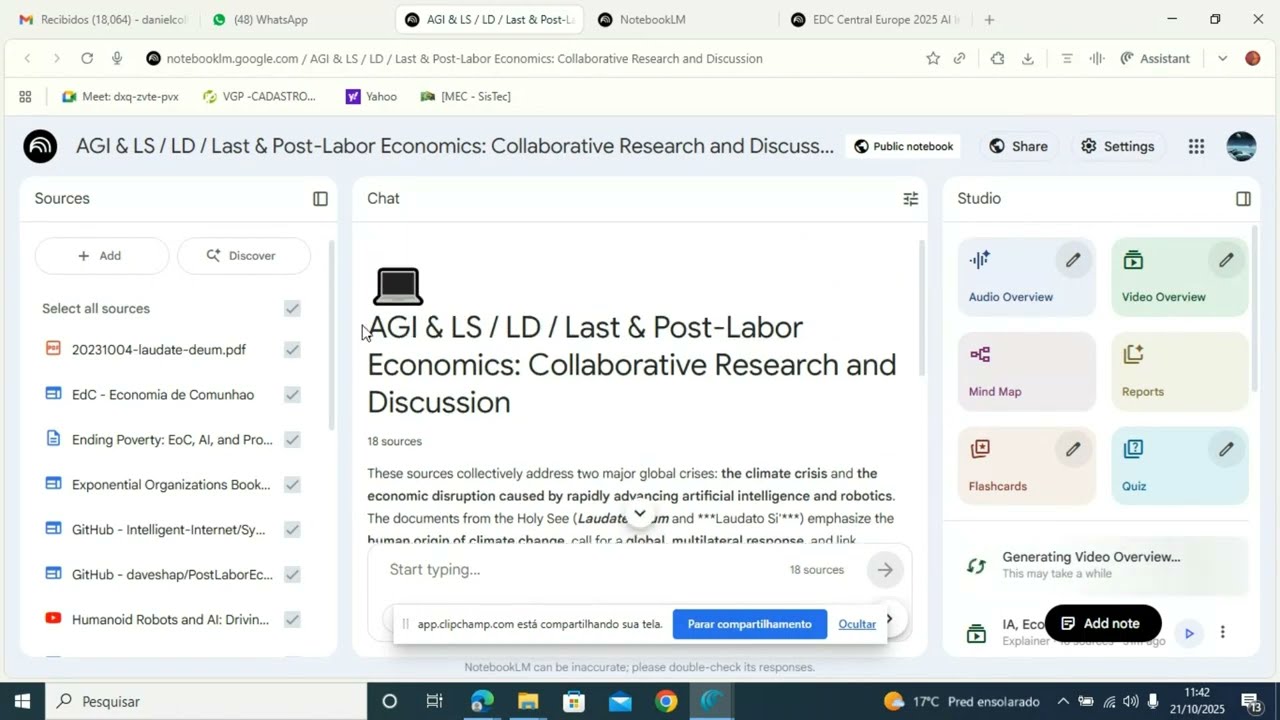
Boost Learning with Studio: Turn Your sources into Audio, Video, MindMaps, and More




Anima Christi - Beautiful Choir Performance in Corpus Christi 2025 - Stockholm - Sweden