In this eulogy, Bernard Brown, a Cambridge contemporary of Sir Roger Scruton, recounts their shared background, early education, and the intellectual bond formed at Jesus College in 1962. He describes Scruton’s shift from biochemistry to philosophy, his wide-ranging influences (Spengler, Wagner, Wittgenstein, Eliot) and his belief in the unity of science and the humanities. Brown details Scruton’s formative months in Rome (1966), highlighting the city’s impact on his aesthetic sensibility, his notebooks, and his emerging conservatism rooted in the preservation of cultural heritage. The speech surveys Scruton’s major works on aesthetics—particularly "The Aesthetics of Architecture"—and his philosophical approach that blends analytical rigor with passionate appreciation of beauty. Brown then outlines Scruton’s conservative political thought, citing "England: An Elegy", "The Meanings of Conservatism", and his support for Brexit, while noting his nuanced stance on European integration. The talk also covers Scruton’s public service, including his chairmanship of the Building Better, Building Beautiful Commission, his knighthood, and his influence on public policy regarding architecture and community. Personal anecdotes illustrate Scruton’s character: his love of writing, music (Wagner, Carissimi), hunting, farming, organ playing, and deep relationships with family and friends. The tribute concludes with reflections on Scruton’s perseverance against academic ostracism, his lasting intellectual legacy, and the speaker’s gratitude for their friendship.
Chapters
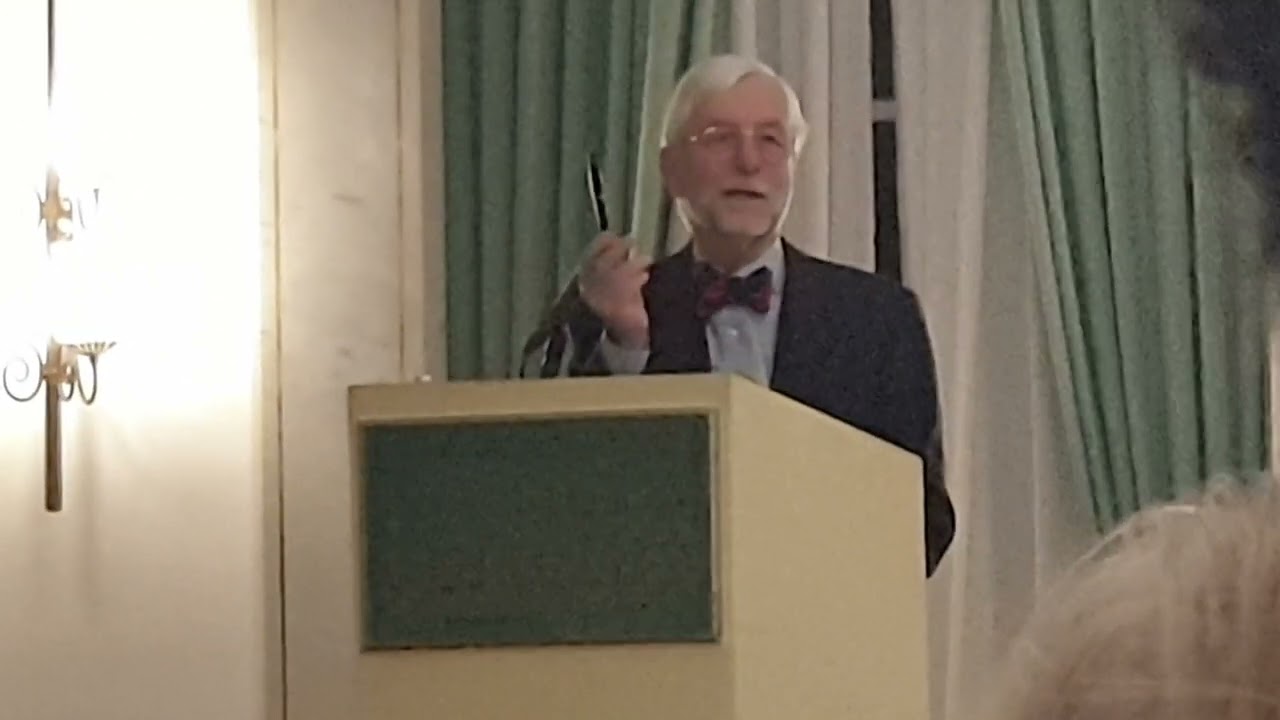
Well, I better introduce myself. Sir Roger and I met in 1962 at Jesus College, Cambridge. I'm very proudly wearing a tie which is a memory of those times. The colours red and black of Bishop Alcock, who was the founder of Jesus College. And we had several things in common. We both came from Royal Grammar Schools. Today in England there are 7 Royal Grammar Schools, but we came from— he came from High Wycombe, I came from Guildford, both in southern England. And these had ancient traditions because these schools were all founded by a royal person in the 1500s. And so they were generally very careful with their use of education. And we both had— these were all public schools, so we had a more or less rebellious sense of being slightly out of place in a— I'm referring to Cambridge because many of the people from Cambridge came from private schools and a much more, let's say, well-ordered, we might say today, type of education. And we considered the establishment as rather stuffy. We had both of us studied physics, maths, and chemistry in the last years at school. And I went on to continue with natural sciences, specializing in physics, but Roger immediately changed to philosophy, to a large extent on the advice of his tutor, Lawrence Picken, who is an extraordinary man who knew a lot about everything. He was a really incredible man. And I had an incredible impression of Roger, of his broad education. He introduced me to Oswald Spengler and his history— well, his Decline of the West, but his theories of civilizations, to Wagner, which I hardly knew about then, and leitmotifs, and to Wittgenstein and the importance of language, to T.S. Eliot and his Four Quartets, and many, many other things. He was an extremely knowledgeable 18-year-old with a very broad spectrum. In those days, we often talked about the great divide between science and other forms of culture, literature and so on. But Roger was an example of somebody who just saw no division. It was all knowledge. The scope of university, to a large extent, is to broaden your skills and interests, to develop your intellect and so on. And we emerged into the adult world and had to decide on what studies would most— would most help us to contribute to society. Biochemistry was very popular with ambitious students, and even Roger at school had decided he would do biochemistry. But he went on, as I said, to philosophy. But it was interesting that 1962 was the year in which Crick and Watson were awarded the Nobel Prize for determining the structure of DNA. And Roger struck me immediately with his inquiring mind and logical approach, but then also his warm and delicate interest in people of all types. And his fascination with the achievements of culture. So let me return to his development. In 1966, as Sophie mentioned, he came to Rome, and he spent several months here on that occasion, and he went round the city, starting from a base where he stay in Piazza Biscione, which— where he stayed in a flat belonging to the granddaughter of a previous president of Italy. And I think this was very informative for him because he was uncertain about his future, he had very little funding, and he lived a highly bohemian— slightly bohemian lifestyle. But Rome had a great impact on his sense of beauty, as it does on all who appreciate art. He visited selected treasures of its history with my future wife as his guide, as Sophie mentioned, and she presented Bernini and Borromini, Cavallini and Masaccio, And knew he would appreciate with passionate conviction the grandeur of the urban landscape, the delights of tumbling angels, the flowery robes of antique mosaics. And here I'm quoting from Roger. I don't know, shall I make a little sign when I quote something from him? Yes. The poetical atmosphere of medieval cloisters. The central, the special spirituality of the Quattro Santi Coronati, and much more. The priest who guided them through the fascinating frescoes of Santa Cecilia explained their beauty in Latin. Later, my future wife asked me, do you realize your friend Roger is a genius? And I said, yes, of course. But she noted his analytical ability, his love of light and the way it can be modeled by architects, and his wide mind. So as I'm sure most of you know, his first books were on aesthetics, and he started with one on art, and then he did a very fascinating book on the aesthetics of architecture, and I'll go into that in a moment. But also I must say he was very interested in writing. Now this comes out in one of the Dooley books on Conversation with Rudolf Scruton, where he asked him about what was his aim in life when he was a student. And he said, to be a writer. And he wrote in these black exercise books, which I think my future wife had found, which were rather unusual because they were beginning to go out of stock in the shops in Rome. But they were thick and very attractive black books, and he used them as notebooks because in those days there were no computers, of course. And he wrote with a beautiful Montblanc pen in a wonderful black calligraphy. So it was also a pleasure to receive his letters written in the same way. So his effect— another effect of Rome I wanted to mention was his realization that he was on the bourgeois side. Many of you would have read that in his book, he mentioned about the French students throwing cars in the air and vandalizing shops and their violence and destruction. And he said he felt a surge of political anger. What was the reaction of the students? But he already knew that from Rome, that he was on the bourgeois side, because he didn't like a lot of the football clubs. He called them weirdos and Bohemians, as it were, and he rejected their opinions. But let me go back to the aesthetics. He soon found his own way of using his analytical philosophy and putting into inspiring language the powerful logic which informs his aesthetic judgment. Rational and sensitive explanation created with passion and awareness, which never loses sight of our humanity and our networks of relationships. I contributed more than 25 photographs of the Roman buildings to his second book out of about 60, The Aesthetics of Architecture, to capture particular aspects that he mentioned. And after more than 40 years, his book is still a central text. Its main points involve the aesthetics of architecture as an aesthetics of everyday living. He went into taste, imagination, Judgment, and could I say good judgment? Yes. Appropriateness, attention to form and detail, the sense of style. He mentions the aesthetic experience, imaginative contemplation of an object for its own sake, as an important part of a person's life, and the relation to self-consciousness and to values that are shared. Aesthetic judgment lays a claim upon the world. It issues from a deep social imperative. It matters to us in just the way that other people matter to us. These are also, to my mind, an explanation of his own personal development. The impact of Rome and Italy was important, considered as place and architecture, but also as observation of life. His realization also came to recognize the great value of preserving our cultural heritage, which is the base of his conservatism. Even though he did note that several young people were not very interested in the other things. But anyway. So buildings are part of the public order and contribute to urban design. He noted how the Sistine Roads in central Rome are coherent and harmonious, and which preserve the mystery and sanctity of the holy places and the interest and charm of the journey to them. That's just a reminder of his time living in this precise area. Let me jump a little bit forward to 2009 when he invited me to lunch near the Vatican with a cardinal and several bishops at our table. He'd given a talk sandwiched between Cardinal Scola, the Patriarch of Venice, who talked about the end of modernity, and Monsignor Ravasi, soon to become a cardinal, who talked about the importance of art in expressing Christian belief. Roger's contribution to this seminar was the aesthetic and the— the beauty and the sacred, sorry. And to quote his words, in the religious experience, the opposition between the aesthetic and the ethical is transcended and reconciled. The encounter with the sacred is It is a fusing of the experience of beauty with the sense of moral order. So his reasoning goes beyond the recognition that so many antique churches re-embodied beauty and splendour to help worship, as he recognises the position of the numinous in our ancestors' lives and indeed to ourselves today. Thank you. Mm-hmm. Let me talk a little bit about his conservatism, but I'll only make a few remarks. In his book England: An Elegy, it's really a lament for the disappearing past with a host of reasons to preserve the best features of social organization. His earlier book, The Meanings of Conservatism, is densely argued. Conveying the concepts of authority, constitution, law, and liberty, and the defense of conservative principles against the vacuity of much left-wing doctrine. His defense of values had an immense, an eminent practical side, and his activity behind the Iron Curtain is now well known, resulting in the important awards which Sophie just mentioned. Certainly a considerable part of his output were pungent criticisms of those who provided flimsy justification for the antagonist worldview. And I may say, even in the early days— Sophie mentioned how he suffered with the New Statesman affair. But that was, in a sense, was a kind of moment when he reached maturity. His opinions were in many ways respected, and so it was a great surprise to go back to his youthful days when he was criticized very vehemently by the left wing and their culture, which was described by the previous panel on the cancel culture. Now, one of his books, political philosophy, Arguments for Conservatism, is an extraordinary outpouring of culture in everything, and I cannot now summarize its depth, but just let me hint at the last chapter in praise of T.S. Eliot and his poetry. This outlook is inspired by the importance of sacraments and ceremonies in which the external— the eternal becomes present. The continuity of the institutions where the conservative message goes beyond politics, but it's a message that must be received if humane and moderate politics is to be made a possibility. I just say on Brexit, he was very much in favor of Brexit, and I didn't like that. I was living in Italy, as I think I mentioned, at that time, and I felt the European idea was a good thing, and if anything, the UK formed a counterweight to many of the other nations and could help in ensure that the UK— that Europe remained at the service of its people without exaggeration. And in fact, he eventually mentioned that once Brexit had gone through the referendum and the referendum had won, that he thought that the government should have made a serious attempt at renegotiation of the treaties. So instead of exiting, it would have perhaps created a different Europe. But anyway, as far as I'm concerned, Brexit means that I personally, as a UK citizen, am deprived of the vote living in Italy. So it's better I don't speak about politics. Let me conclude by thanking Roger for the many profound philosophical books and all his other works, lectures and interviews, his operas, his novels. His interest went into the most difficult problems of aesthetics of the visual arts, but also the ineffable mysteries of music, especially of Wagner, and continued into conservation, religion, wine as an expression of terroir or place, Hunting. Beautiful book on hunting. Which describes how he met his wife, certainly very, very well. And of course interpersonal relationships. His friendship was a great gift which lasted until the end of his life. I was very privileged to be one of the speakers at his belated 75th birthday party. with friends held in a London club, and which he described as speeches to warm the heart. This was a beautiful occasion with 3 Lorca poems set to music by Roger. On the day he passed away, that was the 12th of January 2020, my wife and I visited several places in Rome which Roger had appreciated. And the last one of these was the beautiful church of Santa Maria dell'Anima, where we enjoyed a wonderful Baroque 12-part Mass by Giacomo Carissimi, who had died on the same day, but in the year 1674. I know Roger would have loved to have been with us. He suffered more than most from senseless and uncaring ostracism by the academic community. to which he contributed so much. We thank him for overcoming his shock at the injury he unjustly received and at persevering in his work, which leaves an important and lasting contribution to society and to intellectual life. And as Lucy— as Sophie mentioned, he was knighted on the Queen's 90th birthday list. For services to philosophy, teaching, and public education, and for his particularly significant impact on thinking about national liberty, freedom, and Western values. And I think those rather nicely assume his ideas. He was later appointed to chair the Building Better, Building Beautiful Commission, and its purpose was to suggest ways of improving design and help grow a sense of community and place. And as Cynthia mentioned, he was dismissed from that position but then reinstated after the explanation of the new statement's author's exaggerations came out. And he managed to submit the final report shortly before he died, and the government, I think, largely agreed with almost all his viewpoints. So this was a vindication of his conservative work. He was a wonderful person with a deep love of humanity and its culture. We all remember his genial personality, his depth of understanding, His interest in the individuals he encountered and his dedication to communication, especially with the young, of the enthusiasm and passion for intellectual achievement, his enjoyment of Scrutopia, the name he gave to his property and farm, farming itself and hunting, his Sunday role as organist at the local church. And of course, his deep love of family. And I'm not going to really do more than mention his horse, Sam. So thank you very much for listening, and I hope I've given you a reasonable picture of his life as an— especially as a person, and my great friend. Thank you.