The world according to Tucker Carlson @ #MCCFESZT2021 in Esztergom, Hungary 🇭🇺
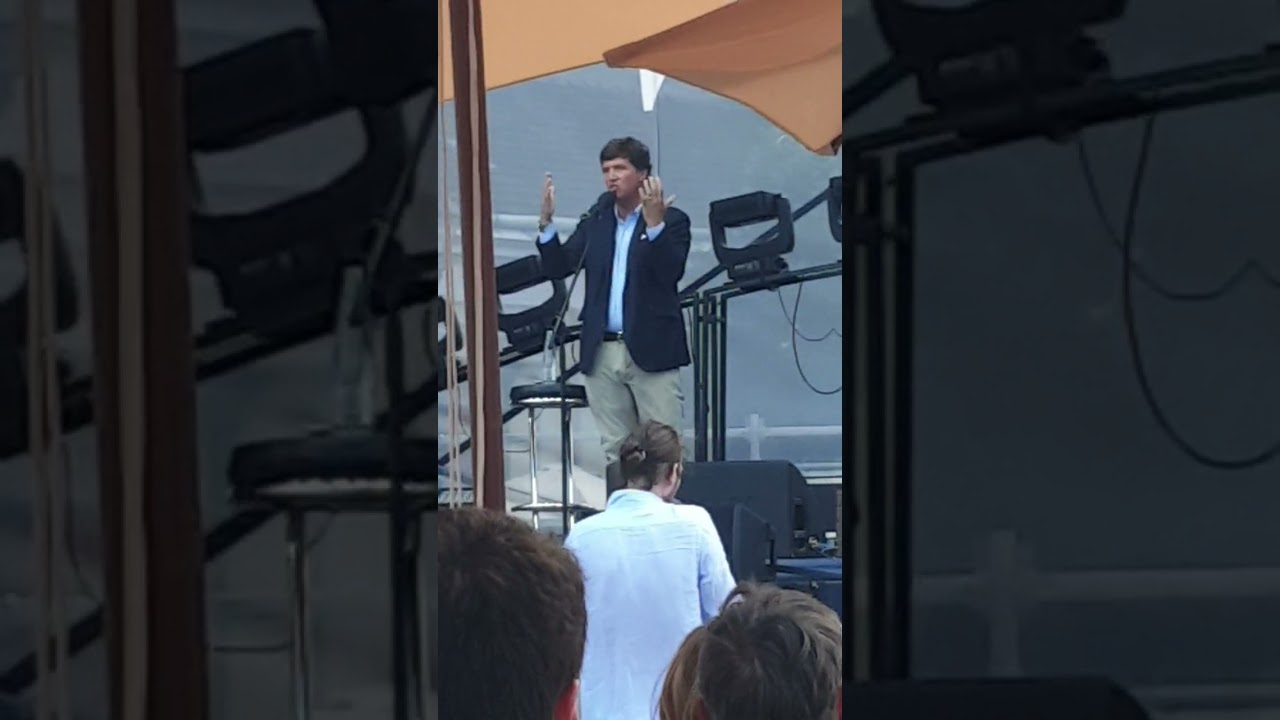
In this keynote at the MCC Festival in Esztergom, Hungary, Tucker Carlson opens by thanking the hosts and reflecting on his experience traveling abroad as a U.S. media figure. He contrasts the media environment and political culture of Hungary with that of the United States, arguing that both countries suffer from growing authoritarian tendencies, censorship, and a loss of humor. Carlson cites a tweet that claims Hungary’s media is dominated by the ruling party and uses it to highlight similar media alignment in the U.S., especially under the Biden administration. He discusses the importance of language control and the banning of humor as tools of authoritarianism, invoking Orwell and the concept of “illiberalism.” Carlson then describes his observations at the Hungarian‑Slovak border, praising the low‑tech but effective border enforcement and the personal pride of a Hungarian guard who keeps the fence clean. He expands this anecdote into a broader argument that order, cleanliness, and respect for one’s country are virtues, linking them to family values and good governance. The speech moves into a critique of American political discourse, the erosion of civil debate, and the dehumanizing effects of modern, brutalist architecture. Carlson emphasizes the restorative power of nature, beauty, and perspective, suggesting that aesthetic appreciation and humor are essential for a free society. He concludes by urging listeners to care for their country, maintain simple virtues, and resist the cultural decay he perceives in the United States.
Chapters
anniversary of the institution, and we thought that this would be a great occasion to organize this festival. But we had no idea that it would receive such an increased coverage in the international media. But we really appreciated this, because what we figured is that MCC is exactly for this, providing a platform for exchanging ideas in an open and free manner, bringing together people with different views, and providing an opportunity to have meaningful discussions and debates. It is my honor to welcome our next speaker today, Mr. Tucker Carlson, the anchor and host of Tucker Carlson Tonight, viewed by millions of people, and according to the Time— or I would say even according to the Time— the most powerful conservative in America. Please join me in welcoming Tucker on the stage. Tucker, the floor is yours.
Thank you for having me. This is by far the weirdest thing I've ever done, but I'm really enjoying it, and I'm grateful to be here. Dennis Prager is standing there; it's unbelievable. Like last time, Dennis does. Oh, bless you. Anyway, thank you so much for having me. We have been here for a week, and and we've loved it. We've really, really loved it, and it has been very different from what we expected. So I work at Fox News in the United States. Not available here. Sadly, I couldn't agree more. And every year we try to go someplace around the world and see what it looks like and see how people live outside the United States. The US is a continental country and it's very cut off from the rest of the world, as those of you who are from there or have been there know. And you don't really get a sense that there are other people in the world living, you know, happy lives. And so once in a while it's worth getting out. So we come here. I was impressed personally by the response of your government to the 2015 migrant crisis. Hungary stood alone essentially in saying no thanks, and that struck me as a totally legitimate thing to do. And Budapest is a beautiful city, nice people, good food, so we came. So we were here 3 days. I don't do social media. I don't know if you know what social media are. It's sort of the beginning of the end of civilization and literacy, so I don't participate at all. So I had no real sense of how our trip— I mean, we just in the end run a cable show. We're not elected to anything. We have no actual power other than the power to talk unimpeded, which is increasingly a rare luxury in the United States. So I didn't really have a sense of how it was going, uh, until yesterday. And I'm gonna— I need my glasses because I'm getting a little old. One of my producers sent me the following tweet. Now, this is from someone whose name you probably will not recognize. I won't say it, but this is a longtime Washington Post columnist who works for The Atlantic magazine, who is reportedly an expert on the region, as we say in Washington where I'm from. The region. And the region can encompass like a huge geographic area with, you know, maybe dozens of countries with different cultures and different languages. But in Washington, we reduce it to something called a region, and you become an expert in the region, and you are the person we ask when we want to understand what's going on there. So this person who sent this out is an expert on the region, and I happen to know since I live there, this person is actually stupid. Most people don't know that, so people read her Twitter feed. So I read the following, and I want to read this slowly Slowly, for those of you who don't have English as a first language. So I want you to catch every word. And those of you who are from America will understand why it was the funniest thing I've read this year. And I'm quoting: In Orbán's Hungary, more than 90% of the media is controlled by the ruling party. Businesses are physically and legally harassed if they don't toe the party line. Election— listen, this gets better. Elections are manipulated. And my favorite, party leaders are mysteriously rich. And I thought to myself, wait a second, that sounds familiar. I live in that country. I live in a country where over 90% of the media are aligned with the ruling party. In fact, I work at the only mass media outlet in the entire country of 340 million that is not aligned with the ruling party. You watch CNN, which I believe is available here, and I think they may be here today. Welcome, CNN. I worked there for many years. CNN! And you will never hear a single word on CNN that deviates from the party line coming from the White House of the United States, from the Biden administration. That's exactly right. I have lived in cities I know that if you were dumb enough to put up a sign in the window of your store in an American city disagreeing with the prevailing party orthodoxy on any one of a number of questions, whether it's immigration, human sexuality, who you're going to vote for, you get your window smashed. If you disobey the political orders from the ruling party, they'll shut you down. And I live in a country where Barack Obama, who has never actually had a paying job in the private sector, is now living on, you know, a $30 million estate on an island off the coast of Massachusetts and throwing himself a birthday party, I believe today, with 200 servants. So I think we're checking the politicians become mysteriously rich box on that. So I read this and I think— and I am as patriotic American— Thank you. As you're going to find, I'm not leaving. I will never leave no matter what happens to the country. I don't have a foreign passport. I'm in. In fact, that's one of the reasons I'm so passionate about it, because I have nowhere to go and I've got 4 children and 4 dogs and they don't travel well. We're not leaving. So I'm all in on America. And I think, you know, this is a, this is a really dark moment in American history, but I think that it will improve. So I'm not attacking America, merely the current condition of America, when I say that I read that and I laughed out loud. Because it's hilarious. You're lecturing this landlocked Central European country of 10 million that has free and fair elections, which has a much healthier media balance. I'm sure every person in the front row is from the opposition media, whatever that is. I don't know, because I don't speak Hungarian, because it's a secret code inaccessible to those who weren't born speaking it. So there's a lot I don't know about Hungary, But I know a robust political system when I see one. No one in Hungary on the other side has to hire armed bodyguards. Lots of people in the United States do, I can tell you. You are living under physical threat if you disagree in a loud way. You are immediately censored if you're dependent upon social media to get your message out. I think America is the greatest country in the world. I will always think that, but don't tell me it's freer than Hungary. Thank you. Because that's a lie. So I read this and I, and I find it hilarious because it suggests not only a high level of stupidity, which after all these years in Washington I take for granted because that's the, you know, that's the soup I'm drinking, that's the world I live in, but it also suggests a total lack of self-awareness. A total lack. It is the equivalent of gaining 40 pounds and yelling at other people for being fat. It's insane. And I thought to myself, this is not just, you know, contemptible, but it's also a sign of ebbing freedom, of freedom going away. When they ban humor, you know you're moving towards something dark. You are— and they have banned humor in the United States. You are not allowed to laugh at things. Nothing is funny. Everything is dead serious. This tells us 2 things. Why do they do that? The first 2 things authoritarian movements do: first, they try to control your language, and second, they stop you from laughing. Why do they do that? Well, they control your language so they can control your mind. And those of you who were born speaking Hungarian— someone said to me the other day that Edward Teller, when he won the Nobel Prize, said, I would not have won this if I didn't speak Hungarian, but because I do, my brain works differently. I think a language as complex as Hungarian, totally indecipherable. I mean, I pick up Spanish going to Taco Bell. I've not picked up one word of Hungarian this entire week. I think it's true especially for your language, but it's true for all languages. Words determine the way that you think. And if you take the words away, as Orwell famously noted in about 4 different books and 100 newspaper columns, you take away people's ability to think about things. So that's the first thing they do. The second thing they do is make it illegal to laugh, particularly at them. Now, why do they do that? Well, partly because they're thin-skinned and insecure, and that's why they went into politics in the first place, to prove something to their absent or alcoholic fathers. Granted. But there's a deeper reason for it, and that is that humor is perspective. How do you find something funny? By rising above it to a high altitude and looking down at its By seeing things in their entirety, by looking up from the script and gazing around and noticing where you are and finding it hilarious. That just in fact happened to me. I, I was kind of in my own world texting with my wife, and I look up and I'm right across the Danube from Slovakia about to give a speech to people I don't know. And I thought to myself, kind of hilarious. Where am I? Not really sure. Enjoying it? Yes. Because I had perspective. Perspective is the one thing they refuse to allow you. This is the way it is, this is the way it's always been, and this is the way it's going to be. Now, that's an obvious lie, but in order to convince you of it, they have to eliminate any reference to the past. They topple your statues, they tell you to shut up and stop talking about your family or your country, be ashamed. of what your ancestors did, hate your history. They prevent you from having old words because old words describe old ideas. And above all, they prevent you from rising above the current situation and looking down to assess it clearly, otherwise known as comedy. So I'm not bragging when I say the United States has been— I'm 52— for my life the single funniest country in the world. A truly hilarious place. We have an entire economy built on being funny. It's called stand-up comedy. And we led the world, as we did in aerospace, in comedy for generations. It's all gone. It's all gone. It is no longer allowed. So I think if you're going to, you know, recognize what's happening, you first need to recognize that this is not liberalism. That is being imposed on you. That's one of the many words they've stolen. It is illiberalism. It is the opposite of liberalism. It is a totalitarian idea that everyone behaves the same, everyone reads from the same catechism, from the same list of slogans, and that everyone obeys. That is the opposite of Enlightenment liberalism, which forms the basis of my politics and my worldview. Okay, that's the first thing. The second thing is They hate it when you leave the country and look around because you might conclude that, hey, even a, you know, a country with a GDP smaller than the state of New York that has no navy because it doesn't have an ocean, that is stuck between hostile neighbors, that's been overrun by foreign powers, you know, for the last 900 years, even a country like that can have kind of happy people and can stand up for its own citizens. So if they can do it, if they can If they can do it, why can't we do it? Like, how hard is it? I went to your border the other day. Oh. Yeah, I went to your southern border. We bombed down there on Wednesday, and the producers and I were talking on the trip down, and, you know, obviously Hungary's not as rich as the United States, but they're technologically advanced. They've created all these Nobel Prize winners. You know, they sort of— they understand math, okay? That's why they're good at chess. So clearly their border barrier is going to be this super high-tech wonder of science that can detect Syrians 30 kilometers away and stop them in their tracks. So we get there and your border wall turns out to be a chain-link fence, and there's nobody there. There's not one person there. I grew up on the U.S. border, actually, on their border with Mexico, 15 miles from the border. I know the border very well. I know what it looks like now, and it is a perpetual scene of human suffering. Children crying, people getting hurt, garbage everywhere. It's, it's a disaster. It's a hellscape, and it's a sad thing, not simply for the United States but for the migrants trying to come north. It's bad for everybody because chaos always is. So I look at your border and I'm thinking, well, what is the secret here? How can this country— I didn't even see anyone with a gun. There was one guy with not even a Vizsla. He had a German Shepherd. Which I thought was a little bit degrading to your national pride. Got to be honest. If the Vichy is involved, it's your dog. It's not my call. Labrador. Now you're speaking Spaniel. Get some Springer Spaniels—an underrated dog. We have four. But here's my point: It took about an hour to figure out how exactly a country much less rich and technologically advanced than ours. with a much bigger, as a proportion of population, border problem than ours could secure the border completely. And we found out in the afternoon over the space— I timed it, it was about 26 minutes— where 2 migrants from the Middle East, I believe they were from Syria, were apprehended. 2 young men. And they were taken into custody right in front of us, and they were photographed, they were patted down on the outside of their clothes, and then they were led away right in front of us. They were led away. Now, I'd read enough about Hungary to know that when you're led away in Hungary, obviously you're going to the dungeon. So I decided as a journalist I should follow these unfortunate young men as they were led to hang from the rack in the basement of the castle. So they went through this door and I followed them, and I said to the guy who was escorting us, what is this? And he said, this is our border. And they were led politely out and brought to the other side, and that was it. The whole thing took 30 minutes. That was the whole process. They weren't dropped off in downtown Budapest to beg or to live in a shelter. They were just politely told, I'm sorry, you don't have permission to come here. See you next time. And sure, they'll try again. I said, will they try again? Oh, absolutely they'll try again. What are you going to do that time? Bring them back. How many times? Well, the record is 52, but we can go to 53. We can do that. We have the technology. We have guys who can walk, and we'll just escort them through the border door. Okay. And that's why there's no one at the border. So I thought about this for a second, and I thought, what does this say about Hungary? It doesn't suggest profound technological sophistication. It suggests profound commitment. These are people who've decided they want to do something, and using the lowest-tech means possible, are achieving it much more effectively than the powerful United States government. So what's the difference? And by the way, if I, if I sound critical of my own government, it's because I am. But there's nothing I believe in more than America, so I just want to be totally clear on that. And I really think— I don't actually really think what I'm going to say anyway, and pretend as though I think dawn is coming soon. But here's the point. You behave this way if you care. If you care. If you think of your country like your home, you don't want it to look crappy. It's really that simple. Simple. If it's your house, you want to be in charge of who sleeps there. That's not a complex principle. It's the most basic human principle. So as I'm standing at the border, literally at the border fence, thinking about this, watching the German Shepherd amble past, I was trying to talk to a border guard who, by the way, like, as, as noted, like every Hungarian I have met, every— from the driver to the waiter to the border guard— had better English than our own president. I say, how often Do people come to the border? How often do you see migrants putting ladders atop the concertina wire? Is this like every hour, every day? Is it at night during the— yeah, I'm trying to ask the dumb journalist questions. And he said, well, and then he stopped and he looked down like very intensely, like something bad had happened. And I'm from the US where we have poisonous snakes, so I immediately thought, you know, I don't know if they have cobras in Hungary. Again, I don't speak the language. So I step back and there is a plastic sandwich bag about that big on the ground stuck at the bottom of the chain-link fence. And this guard reaches down, grabs the bag, and puts it in his own pocket. And I don't think I've— I have seen in my life very few displays more powerful than that. So here's a border guard. I don't know what they make. I'm guessing not much. He's a civil servant. He works for the government. And he's so offended by the idea that there's litter in his country that he puts it in his own pocket. What does that tell you? It's the clearest possible expression of love and respect. When you love something, you keep it clean. Period. I've said this on television many times, and every time I do, they call me a fascist, as if cleanliness were a fascist quality. It's not. It's a virtue. Order and cleanliness are essential to human happiness. And if you have teenagers, you know, because they're filthy. They're disgusting. They live in filth. I have 4. I can attest to this. It's not a moral failing. It is a failure to teach clear virtue. Happy people are organized. My father always made us make our beds in hotel rooms, and I would always say, why would you make your bed in a hotel room? You have a chambermaid to make your bed for you. And my father said, because you respect yourself and you don't have an unmade bed because you're not a slob, because you're not an animal. And the same is true of countries. If you care about your country, it's clean and orderly. And you can tell precisely the point when people stop caring about their country is when drug addicts start building tent cities on the sidewalk. California! The entire state of my birth, California. You too? You're a refugee? It's disgusting. And for reasons that used to confuse me but now make perfect sense, the one thing they flip out, they become enraged if you complain about, is that. So you can stand up in the public square in the United States and say, you know, I think our marginal tax rates are too high, or I think, you know, we should erect more tariffs against American corn, or foreign corn competing with American agriculture. Any kind of policy issue. And people will say, you know, that's a good idea, it's not a good idea, let's debate it, it's fine. That's within bounds. That's allowed. If you stand up and say, there's a vagrant defecating on the sidewalk in front of my house, and I came out this morning with a rolled-up piece of paper and smacked him in the nose and said, get the hell out of here! You can't crap on the sidewalk. It's my sidewalk. It's my house. It's my city. It's my country. It's not allowed. I'm sorry. I feel sorry for you. I hope you find someplace better to go. I hope you get your life in order, but you're not going to do this here because I live here. If you were to say that out loud, oh, you're a fascist. Oh, so why is that not allowed? Why can't you say that? I'll tell you exactly why. Because it reveals how little the people in charge care about the country they run and about you. They don't care at all. And it's obvious. If you treated your children the way our leaders treat us, you would be Declared universally an unfit parent. Really? You encourage your kids to do drugs because you might make money off it? Really? Is it good for the kids? Shut up! Oh, you know, your schools are terrible. Like, you refuse to teach your kids basic English or math or history, and you don't care. You're not sending your kids to school. They're truants. You're a bad parent. You're letting your kid live outside and soil himself. You refuse to treat his mental illness. You treat drug addiction like a virtue. You encourage, like, the most degrading kinds of sexual behavior. Are you joking? We're gonna take your kid away. You're a terrible parent. There are differences between parenthood and political leadership. Of course, there are greater limits on political leadership, thank God. But the theme is the same. The most basic prerequisite to leading people is caring about those people. That's the most basic prerequisite. And that's one of the reasons that all good parents are the same. They may have different traditions, different beliefs, radically different beliefs, different religions. But when the parents really love their kids, the kids are going to be okay. I had kids really young. No idea. We had no idea what we were doing. We got married at 22, had kids at 25. Parents weren't— our parents weren't around really. We bought some book, but it was stupid. And I remember saying to my wife, like, how do you do this? You know, how do you raise children? We had enough trouble house training our spaniels. Like, really, a child? And she goes, you know, I think it'll be fine. You know, just Just love them, and you'll be fine. And they'll kind of forgive you your mistakes in the end if they know that you really love them. And my kids are gone now, and that has that has proven to be true. It is true of political leadership too. And by the way, the opposite is true. The inverse is true. If people, the people you lead know that you secretly have contempt for them, they will never forgive you, and they never should. And I would say that's true, and I don't want to get off. And I'll stop in just a second. I don't want to get off on all my theories, but I just can't resist saying this since we're standing in the middle of Central Europe, looking at this vista which really moves me, looking at these buildings which move me, not simply because they're old and some have bullet holes, which in my view are a very useful reminder. I wish I lived in a city full of bullet holes in the building, because every morning you look at them and you think to yourself, it could be really bad. Because it's been really bad. There's a lot at stake. Make wise, sober, long-term decisions, or else you could wind up with more politicals. It's true. It's true. And if I were to level, and I could spend all day leveling very accurate accusations against the American foreign policy establishment, but the main one would be that they have no sense of how bad things can get. And it's— this is the bad side of the upside of America. America is an optimistic country, always has been. Came from all around the world, showed up in this mostly untouched continent with the most fertile farmland in the world and an ocean to separate us from the lunatics. And it gave us the feeling that anything is possible, and everything has been possible. And I've never stopped being grateful for that or proud of it. But the downside to that, the flip side, the obverse, the other side of the coin, as you say in Hungary, Is that Americans have no sense of how bad things can get, that it actually could be a lot worse. Our physical isolation cuts us off from the history of the rest of the world. There's not a passion to study what happened before in a place that you're building anew, right? Right. So we don't have a sense of that. So I love your bullet holes. Let me just say, I'm probably the only visitor to your nation who's complimented your small arms and artillery scars. But here's what I like more about the landscape of Hungary, a few Soviet remnants notwithstanding: it's pretty. It is pretty. The buildings are pretty. The architecture uplifts. So this is another— this is another third rail in American politics. You're not allowed to know that our buildings are grotesque and dehumanizing. Why are they bad? Because they're ugly, and ugly dehumanizes us. And by— let me be more precise about what I mean when I say dehumanizing. Dehumanizing is the act of convincing people that they don't matter, that they are less significant than the larger whole, that they are not distinct souls, that they are not unique, that they are not created by God, that they are merely putty in the hands of some larger force that they must obey. This is what all authoritarian movements do. You don't matter. Wear a mask, you're all the same. Ugly architecture, brutalist architecture, glass and steel architecture, Mies van der Rohe architecture was designed to send that message. Not to uplift, but to oppress. And it is very noticeable. And this is never noted in the United States, which unfortunately over time has had its Aesthetic sense dulled. We've been told it's not important. What matters is GDP. Really? You know, get the new microwave or whatever, the new car, the new place in Aspen. Yeah, I'm not against any of that. I'm not against wealth for sure, but I would trade it to live in a pretty place, a place that uplifts your spirit by looking at it. Why is it more clarifying and refreshing and joy-giving to sit in a meadow than it is in a parking lot? Yeah. Because sitting in a meadow reminds you— you can't help but know that you are connected to nature created by God, which will endure after you're gone, which existed before you arrived. Nature is the reminder of human folly. There is a limit to what people can achieve. I don't care what some stupid politician promises me. He'll be gone. So will I. So will my grandchildren and great-grandchildren. So will my civilization. But nature will endure. That gives you, like humor, perspective. And it connects you to the eternal. And it gets you asking questions about what happens after you die. And maybe accumulating wealth and power isn't the point of life. Maybe there's something bigger. Maybe there's meaning. That's what nature reminds you of. The parking lot suggests That this is all there is. It's utilitarian. Cars park on top of it. They have no respect for it. It was built by people. Everything about that landscape, about the harsh, angular concrete landscape of modern cities, tells you that you are worthless and that beauty and truth and eternity do not matter. Why are they telling you that? Why do you think they're telling you that? You think there's some reason? Yeah, so they can manipulate you for their own power and aggrandizement. So physical beauty, aesthetics matter maybe more than most things, actually. And we can debate what is beauty, but it won't be a very long debate because, like pornography, we know it when we see it. What is beauty, say the academics? I don't know. Thank you very much. Go to a Shinto shrine in Japan. You don't even know what Shinto is. I didn't when I went there. I don't have any idea what this weird religion is. I don't know anything about Japan. I've never been to a shrine of any kind. I'm an Episcopalian. I show up at the shrine and I immediately recognize this is beautiful in a way that doesn't make full sense to my Western brain. I've never seen it before. I've never been confronted with these forms, but I know it the second I see it. This square is beautiful. Leaving aside all the momentous things that must have happened on those cobblestones, this square is beautiful. It was created to remind you that something is bigger, something is more important, and you are part of that. So the last thing I'll say is, you know, I don't think if you're Hungarian you fully understand how provocative your country is to the rest of the world. And I have had— I've had probably 20 people say to me, oh, we're just Hungary, like, we're this little country, nobody thinks about us. You know, we just get invaded a lot and produce great literature, but no one cares. Well, people do care. They care because your example, not because you're taking Transylvania back or something. Not because you threaten your neighbors. Let me put it that way. Not because you have aims of territorial expansion or because you're inventing some microchip that the Chinese couldn't figure out. No, because of the quiet, happy simplicity that's obvious when people visit here. The cleanliness, the order, the openness of the society, the lack of crime, the control of the border— these are not complicated concepts. These are things that in my childhood we took for granted in the United States but no longer can. You still have them, and that offends the people who have so misruled the West that our countries no longer do have those things. I don't mean super complicated networked washing machines. Who cares? There was one of the dumbest columnists that we have in the United States— there's no IQ test for columnists in the United States, and there probably should be, but there isn't. Our First Amendment prohibits it— wrote a piece today saying The problem with Hungary is it's not a model for the United States. It's 10 million people. Like, they, you know, we couldn't replicate what they have here. And on one level, I guess that's true. I mean, I don't understand. It's a parliamentary system. I don't even know how that works, and I've covered politics for 30 years. Of course we're not going to recreate the Hungarian parliament in Washington. Like, what? No. The lessons of Hungary have nothing to do with your system of government or your specific leaders or the results of this or that election. The lessons are much deeper. Care about your country. Try to make it nice in the most simple way. Not the richest, not the most technologically advanced, not a place with the most LEED-certified buildings, but places like— a place where people can, I don't know, do crazy things like have children if they want to. Yeah, in a country where they might want to raise those children. Where they might be able to eat food that's not pumped full of garbage that destroys your body and lowers your testosterone level to the point where your sex is indistinct. Not that
that's happening anyway.
Like decent food, decent streets, safe, clean, family-oriented. How complex is this? Not very. It would have been recognizable 1,000 years ago. 2,000 years ago, before you guys even showed up here in this plain— calling it a plain? Basin! Excuse me. It would have been recognizable at any time in history. These are the things that people actually want. They don't even know what the GDP is. They'd like to be richer rather than poorer, get it? But mostly, they want to live unmolested, following their own customs that they inherited from their parents, that they hope to pass on to their children. without being lectured or hurt, in an environment that uplifts rather than degrades, in a place that is clean rather than filthy, orderly rather than chaotic. That's what human beings want in every culture— in Africa, Asia, Australia— maybe not Australia, but— Just kidding. But in every place around the world, because it's not a cultural desire, it's an innate human desire. And any government that takes that into account and tries to achieve it should be proud of what it's doing. The people who live there should be grateful, and they should not allow the people who have mismanaged the rest of the world to tell them otherwise. Period. So stay proud of where you're at. I'm sorry for talking so fast. You wound me into a frenzy. I really appreciate being here. God bless you.
More from Mario

Boost Learning with Studio: Turn Your sources into Audio, Video, MindMaps, and More




Anima Christi - Beautiful Choir Performance in Corpus Christi 2025 - Stockholm - Sweden