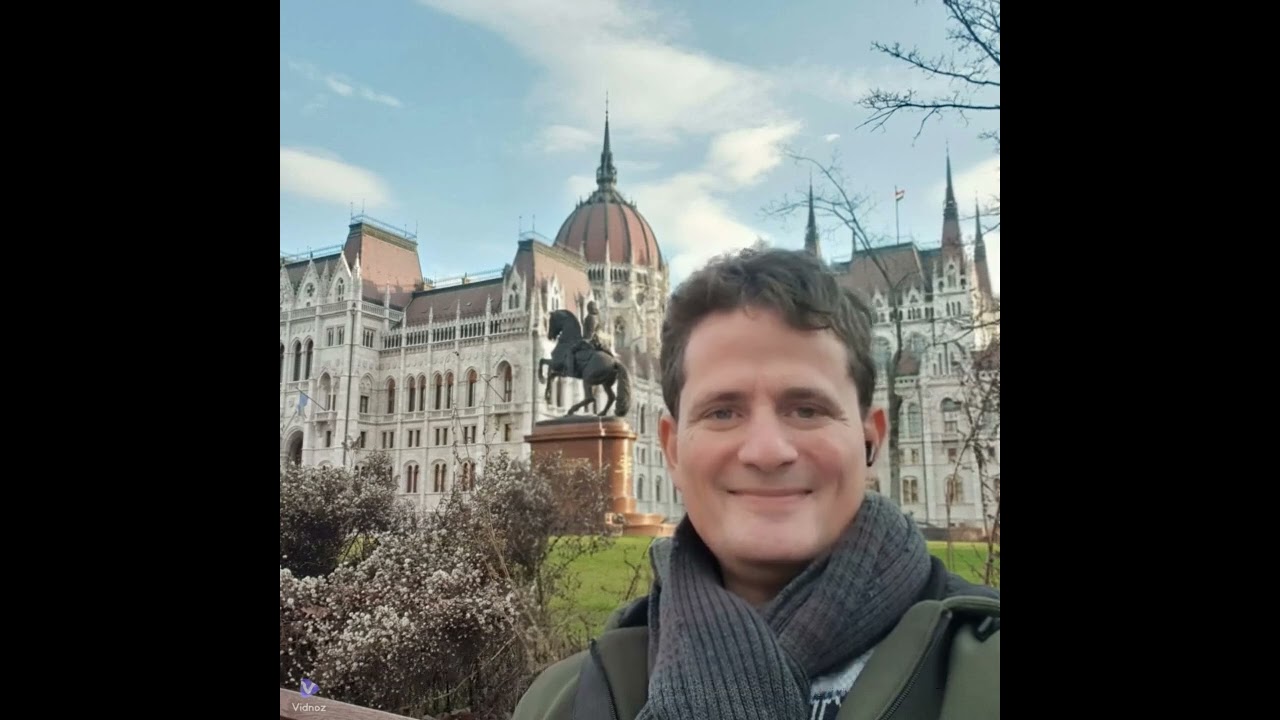
In a public interview at the Matthias Corvinus Collegium in Budapest, U.S. commentator Tucker Carlson and Hungarian politician Balázs Orbán discuss a range of topics. Carlson argues that the Biden administration deliberately sabotaged the Nord Stream pipeline, labeling it the largest act of industrial sabotage and a massive CO₂ release, and predicts the collapse of NATO as a result of U.S. antagonism toward Germany. Orbán reflects on his experience speaking at the Heritage Foundation gala, noting that his presence in Washington signals that Hungary has become a point of fascination for American political elites, who view it as a threat to liberal democracy. He praises Hungary’s “moderate” political stance, describing it as a non‑revolutionary preservation of national culture that appeals to many Americans. The conversation shifts to education, where Carlson emphasizes the value of reading physical books, warns against the shallow consumption of digital media, and critiques modern universities as having lost their intellectual purpose. Orbán asks for advice for younger generations; Carlson responds with a cynical view of mainstream media, urging skepticism toward dominant narratives and suggesting that truth often lies opposite to what mainstream outlets proclaim. He concludes with personal advice about humility, open‑mindedness, and the dangers of hubris when judging other cultures or countries. The dialogue blends geopolitical speculation, cultural commentary, and personal philosophy aimed at both Hungarian and international audiences.
Chapters
I plan to keep— I mean, there's so much I want to see in the world because the world is resetting completely. The post-war order is collapsing. NATO is going to collapse, obviously. You can't have the main— the driver of NATO, which is the United States, sabotage Germany's main source of cheap energy in Nord Stream. The Biden administration blew up Nord Stream, and the Germans are so self-hating they won't say anything about it. They sort of put their head down like, no, I don't want to talk about that. Okay. But I do want to talk about it because it's important. First of all, it was the biggest act of industrial sabotage in history. Second, it was the largest man-made CO2 emission in history, which, if you're a global warming cultist, is like the devil himself come to Earth. And the Biden administration did that. But third and most important, it was an attack on Germany, which is the most powerful country in Europe. Western Europe is America's last main ally, and we just attacked our most important ally. NATO cannot stand long term. At some point, the Germans are going to wake up and be like, wait a second, we had chemical plants 2 years ago, now we don't. You just wrecked our economy. I just, I don't think it can continue after that. I really don't. Maybe I'm wrong, but I don't see how it does.
I can remember the day after I was in your show, I spent some days in, in Washington, and the day after, that was the 50th anniversary conference of very famous Heritage Foundation, probably one of the most influential, uh, think tanks in the United States and in the entire world, actually. And it was a big gala. You, you gave a wonderful speech there, and, um, more than 1,000 people showed up. And, you know, I'm— my face, my character, everything, I'm just a Hungarian, you know. Foreigner.
Just a Hungarian.
Foreigner in Washington, DC. So it's, uh, but, uh, but more than— I would say more than 50 people recognized me and, and, and told me on that night that, you know, I saw you in Tucker yesterday and you did a great job, but I saw you, I was watching it. And, you know, it was a very strange, um, observation for me because Because this was the point when I realized that even the political leadership or elite, I think mainly on the Republican side, but probably in a hidden way the Democrats are also following you, but you're following what you are saying. I mean, which is, I think, in the 21st century media environment, when you have, you know, opinions coming around and it's very easy to get an opinion, very easy to create a narrative that there is one single person and there's one single show who is a trendsetter for— not only for the ordinary people, but also for political elite and political leadership. This is quite something. How— does it give you a responsibility, or do you recognize that?
I mean, I don't have a lot of self-awareness. I have this— I wear the same clothes every day. I have the same haircut I had in high school, so I'm not very aware of myself. Um, I'm faintly aware that I'm faintly ridiculous, but that's all I know. Uh, so I don't— I don't have— I'm not aware of that. But I will say 2 things. One, we did that show at a moment when there was a power vacuum in the parties, and certainly a, a lack of ideas in the parties. Like, the Republican Party has ran out of gas. Democratic Party ran out of gas. They had no new ideas. They were like— and that's what the trans thing is on some level, you know. They just like took the civil rights movement of the '50s and early '60s, removed African American, put in trans, and it's the same thing. It's like there's no new idea at all. It's just the same template. And the Republican Party stopped with Reagan. Peace through strength. Reagan was a great president, famously, but like the world is very different from what it was 40 years ago, but they can't update the files in their head. So our contribution was just to try and think a little bit differently about it. I would say in your specific case, one of the reasons that so many people recognized you is because Hungary really is an inspiration to a lot of Americans, not because it's radical, but because it's not. It's interesting. So there are revolutions all over the world all the time. My country, thank heaven, has been immune from that for 250 years. But there are always revolutions, and they always promise utopia, and they always fail to deliver. Hungary is so inspiring because it's doing the opposite. It's it's not a revolution, but it's also not a counterrevolution. It's this is my read on it. This is a country that knows who it is, understands its own culture, and has decided to preserve it—not through any radical means, not through gunfire. I mean, just as an outsider, one of the things that instantly strikes me is that Hungary is at the center of the conversation in think tanks all around Washington. How do we stop Hungary? How can we get US taxpayers to send more money to Hungary to stop Orbán? Because that's democracy. When a superpower subverts a democratic election in another country, that's democracy. Anyway, but they're very obsessed with Hungary because it's such a huge threat. But I come here and I notice first thing how moderate your politics are. Like, no one seems on the verge of killing anybody else. Even the people who hate Orbán don't seem like they want to kill him. They just don't like him or they want somebody else, but they don't. It doesn't seem superheated and crazy. It doesn't seem revolutionary. It seems just the opposite of revolutionary, actually. And there's something wonderful about that. There's something wonderfully moderate about that. What Hungary is saying to the West— we want to be part of the West. Hungary is part of NATO. It's not doing anything crazy or revolutionary. Just like, hey, maybe don't push your garbage on us so aggressively. We've got our own thing going on here. We're pretty happy with it. Maybe you just leave us alone a little bit. I just find that thrilling to watch. Thrilling because it's rational, it's incremental. It's— I hate revolutions because they never improve anyone's life. And Hungary again is a model for how you can preserve your dignity. You can have a pro-human society without killing anybody, without screaming, and without blowing up what you already have. It's awesome.
I think this audience never heard anything like this before, that the Hungarian politics is very relaxed.
So you should come to the United States or go on Twitter for a day. Whoa,
true. So Matthias Corvinus Collegium is an educational institution. This is, this is the main reason why I wanted to have a discussion with you, not just touching the very important political issues, but talk about— talk for younger generation. We have many young people in the audience and many of our students, and I want to ask you about your experiences on education. So it's like, what was the best thing you learned from your school? What is the best advice you can give to to young people now all over the world, here in Hungary, in your country, United States?
I mean, the American education system, which is very famous, um, and still mildly prestigious, is so different from the European system, and particularly from the Hungarian system, that I'm not sure there are any lessons to draw directly. From my experience was the most important thing I ever did other than get married was read books. Not tweets, not electronic, but paper books in traditional form and read them every day. And that to me is education, is reading. But books. My father, who was a self-educated person, entirely self-educated person, but a deep intellectual, very smartest man I've ever known. His his most acid, his most biting insult to people who presumed to be intellectuals always was that he would always say, he reads magazines. In other words, it's— he has a shallow understanding of whatever it is he's expounding on. Okay, okay. And there's, there's something about forcing yourself to read a book all the way through to sustain an argument or a series of connected ideas for 300 pages that's entirely different from consuming information online or in shorter form. So I would just encourage, you know, schools come and go and their purpose changes over time. Most modern universities were once effectively seminaries. Now they're anti-God. So colleges change. Right. But reading books, books themselves do not change. If you read good books consistently through life, You will become educated in a true sense and wise, which is the point. It's not accumulating information is not the point. Your iPhone can do that. Becoming wise, able to discern between good and bad, truth and falsehood—that's the goal.
And you know we have this overwhelming. This is a nice song, but you know get. Getting knowledge is one part and being well-informed is the other part. So we have this overwhelming noise online. What would you recommend for young people? How they could— how they can become and remain well-informed in this online news? Okay, following Tucker Carlson, but no, no, what are the other platforms?
No, no, no, I would—
Ways of—
Look, if I, you know, start with the knowledge that you're being lied to at scale. Not just one person, but a collection of people, a network of people acting in concert, knowingly or not, with one another in order to tell you things that are not true. And not just not true, the opposite of the truth. And that there are reasons this is happening, but it is happening. That's, that's the thing to know. So I mean, I personally, I hate to say this because it's very dark and cynical, but it's also true. I assess people's honesty by how The so-called mainstream, which is not mainstream in any sense, but the predominant voices regard them. So if somebody in power says, well, you're not allowed to think that, my first question is, well, why? Probably because it's true, actually. Probably because it's true. Very few people are punished for lying. I can't remember the last time I saw a public figure in the United States punished for lying. They're caught all the time. No one is ever punished. Instead, people are punished for telling the truth. Maybe not the whole truth, maybe a variation of the truth, maybe just something that points toward the truth, but it's the truth that is illegal. And so I assess it in reverse. If the people I don't trust— if The Atlantic magazine is screaming that you must go to jail or be silenced, I want to know what you're saying, because I bet it's a little closer to the truth than what The Atlantic magazine is telling me. In fact, I'd bet my house on it.
And, um, looking back, what advice would you, would you give for your younger self?
My younger self? Don't be so arrogant. You know, I would give that advice to my aging self. I would give that advice to every human being, and it's advice I've given my children many times. Don't be so quick to assume you're right. Don't be so quick to assume you know. Don't be so arrogant in the way you approach other people. Don't be so judgmental. Forgive us our trespasses as we forgive those who trespass against us. It's conditional. You're not forgiven until you forgive. And when you realize how stupid and silly you are, you're much more likely to forgive, and you're much more likely to be open-minded. Don't assume you know. Just imagine, just in your own life, if you've ever known someone or had a close relative, and everybody here knows this experience, who's gotten divorced. You have a close friend or a sibling who's getting divorced, and when it first happens, you think, well, one, one part of the marriage, the husband or the wife, was horrible. He was an alcoholic. He cheated on her. She was mean. You think you know what actually happened in that marriage, but the more you learn The more you realize, actually, I don't really understand what was happening in that marriage. No matter how close you are to it, you can't even understand someone else's marriage. You're telling me you're going to understand someone else's country? I don't think so. So go into every decision, every situation with the knowledge that you are seeing it incompletely. You are not seeing all the facts. You do not understand everything that has happened when you weren't there. You don't really know. The best you can do is guess with good faith and an open mind and hope you got it right. That's the best you can do. And if you go into life with that attitude, you will arrive at a wiser conclusion than if you approach it like your average Atlantic Council person approaches it, or the NATO leadership who's like wrecking the Western world right now, or the Biden administration with— or your ridiculous, absurd, grotesque American ambassador to Hungary goes into it with, "Oh, I know what's right for you." No, you don't, son. You don't know. Actually, you don't know anything about me. You don't speak Hungarian. Leave. Right? So that hubris, that belief you know things you don't, that that lie that you can control things you can't, the most basic of all. Human misperceptions, which is that I am God. No, you're not. That's how we get into trouble. That's how people die every time.
Thank you very much, ladies and gentlemen. Mr. Tucker Carlson.