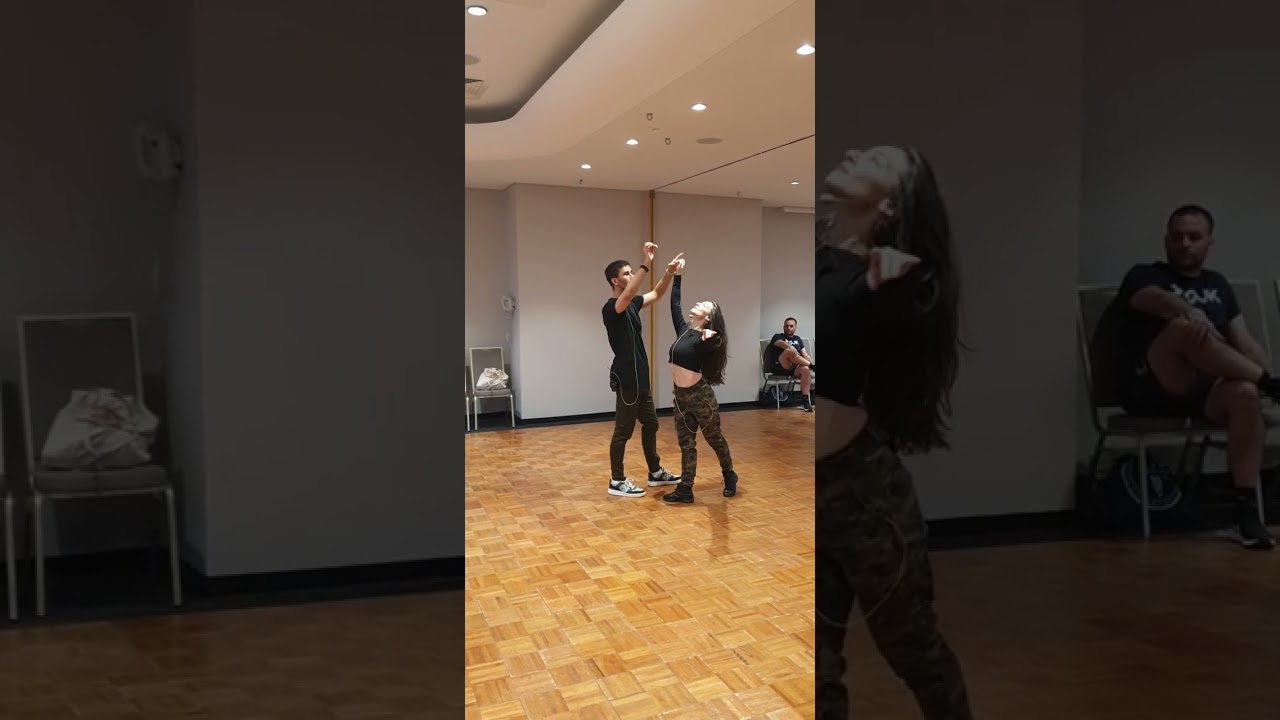
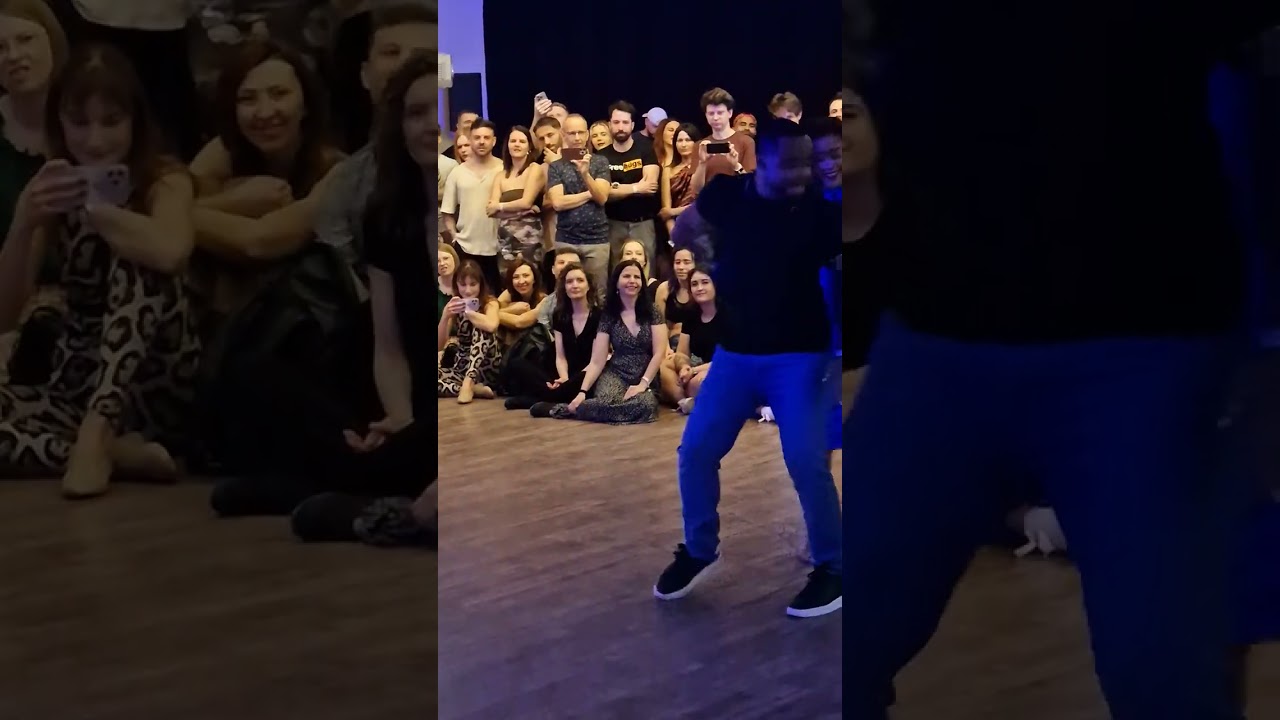
In this workshop segment from the Warsaw Zouk Festival, instructor Mikael demonstrates advanced Zouk traveling wave techniques, focusing on the chin‑driven active wave and its contrast with passive undulation. He explains how the wave originates from the chin, travels through the hips, and requires a stable frame to transmit energy to the partner without explicit arm leads. Mikael then introduces the French truss, emphasizing an elastic, forward‑pull connection where the leader guides the follower backward and forward through a give‑and‑take tension rather than pushing. He combines the active wave with the French truss, aligning the wave’s quick‑quick‑slow timing with the truss’s extension and contraction, and shows how to embed these concepts into common Zouk basic step patterns such as the square and piano steps. Throughout, Jess provides brief commentary, encouraging full extension, awareness of partner positioning, and noting the variety of theoretical approaches. The segment ends with applause, highlighting the instructional and enthusiastic atmosphere.
Chapters
Now we're talking about active waves, where the chin is driving the wave. Okay? So we are here, we take this extension up, that is our starting point, it's like diving in the pool. We do up and the chin is driving and then the body goes. But see, I'm not staying here. Here is the finish. I'm going to go with my chin and go to the contraction point. So it's the same contraction that you have in the passive wave and then my chin drives my wave. To go up until the extension points. Okay, if I'm doing just this, I'm doing half wave. I need to go here until the extension here and then drive again with my chin. Go up, extension here, contraction here, extension. Yes, and to finish the wave, we can here. So we are there. Go down. Here, now we are up. Now our chin is coming neutral and the energy is going down in the hips. Okay, so connection-wise, we're here together and it's exactly— it is not, it's not an arm work, okay? It's a body work, but my frame is here to send the energy to my partner. Okay, so I'm here. If I'm doing the wave alone and my frame is not moving, it's not working. I need to try to not explicitly lead my partner, but I need to imply her body to go with mine. Okay, so I'm here. The movement starts from and go down. Say yes together. Extend up and recycle the yes and together. And here we can even like play this passing. So it's the same exercise. It's just switch direction. The movement is going. To finish in the hip. Yes.
Yeah, leaders. Mika has a lot of flexibility. I'm sure all of you do too. I would say play with your full extension, but also have a look at who's at your partner. You know, because sometimes it gets a little wavy, too wavy. Anyway.
Okay, and now we are here doing French truss. So in the French truss, just one tip that is very important connection-wise. We are leading the partner to go forward and we are not pushing her to go backward. We let her go backwards. So the followers— it's a concept of elastic, basically, or extension. So the followers, even when they are going forward, they are trying to go backward, and then we just lead them to go backward. So I bring her with me and I let her go, and I bring her back with me. And I let her go. And I let her go.
There are many theories, and you're going to hear a lot. This is just one of them.
Okay? Yeah, because if I'm here, I can change for push and push. It's possible. But if nothing is changing in the intention of our body, we are still keeping the same extension thing. Okay? So now we're going to combine the active wave and the French class. So basically, it's like when I'm doing how. When I'm doing how, I'm here. I'm preparing the passive undulation on the first quick quick. Quick quick to go went. And you see the head is going to extension on the pause that is just after the so. Slow went. Quick quick slow went. And it's exactly the same idea. Slow went. Quick quick slow went. Quick quick slow went. Quick Quick. So every time the chin is changing on the and. And now it's going to be the same for our shift weight. So we are here, 1, 2, and 3, and quick, quick, slow, and quick, quick, slow, and quick, quick, slow, and quick, quick, slow, and quick, quick, slow. And then— Go back to neutral hips and core. Yes? So we have this, and the contact here that is similar is just the way the partner is going to find the extension backward is not with the back of the hands, it's going to be with our frame here. So somehow it can be different, it's just a different feeling, but it's still the same movement. So we're here, 1, 2, and 3. Another way, we can just make sure we are more sideways with our head. And we're gonna find the contact forward with the body and away on the moment she goes back. And here we can go with the hips. Chérie, chérie.
Hey!
Okay, a few options. So this was really an introduction, but you can use on several patterns of basic step. The one I use the most is this one when I'm doing a square with the Frenchy Tras. I'm here, and I'm still doing the square, and it gives an interesting movement as well. Okay, so you just kind of keep asking him direction, but then you give a nice, nice feeling. And the other one I use a lot for you to know is when you are using piano here. One, two, and three, four, and five, six, and seven, eight, and one, and three, four, and five. Six and seven, eight and nine. Ay! Okay? And there are many others. That's it!