WM (Wise/White Mirror) meeting Tuesday December 8th 2021

The meeting brought together Anurag, Kim (founder of Positive Prime), Mario Sebok, Ross, Caitlin, and others to discuss the progress and challenges of the Positive Prime platform and the broader Wise/White Mirror community. Key points included: the need for stronger user engagement and testimonials for Positive Prime; ideas to turn vision‑board style content into NFTs and metaverse assets; exploring blockchain‑based community currencies (Goodcoin, Lovecoin, Transhuman Coin) and regulatory hurdles; leveraging wearables and neuro‑feedback devices (Neorythm, Apollo Neuro) for wellbeing; concepts of the "Wise Mirror" as a reflective, AI‑augmented tool for personal growth; cross‑disciplinary projects in smart‑city, immersive art, projection mapping, and XR experiences; the community’s current status as an interest group with occasional podcasts, comics, and VR demos, seeking clearer monetisation pathways and collaborative leadership. The conversation was informal, collaborative, and forward‑looking, with participants sharing personal experiences, technical ideas, and calls for more structured projects.
Chapters
Here we go. Excellent. Thank you. Great. Hello, Kim. Talked to you a short while ago. Meet Mario. I don't think you folks have met. Mario's up in Europe, in Budapest. No, sorry. Where are you now, Mario?
That's right. Budapest this week still.
That's right. Yeah, yeah. Interesting. So
Mario, we've exchanged messages with Kim already sometimes. How's Prime Positive doing after this wonderful year of positivity with a pandemic and everything?
Positive Prime. Yeah, it's I think Kim, are you able to hear all right?
Ah yeah yeah yeah sorry I had my mute on. Say that again.
How was this Positive Prime during a pandemic? It must have been a very good push for new users, right?
Um, yes and no. Um, we find that enormous number of people who actually need something like Positive Prime, They are so stuck at the moment that a lot of people who know they need help still don't yet have the motivation to get the help. It's almost like people are frozen in the fear or the frustration. So you'd be surprised, oftentimes when most people are really stressed, they'll turn to alcohol or other drugs or other distractions because it's easier than actually working on yourself.
I agree, Kim, and I've mentioned about 6 months ago when we first met, how about some testimonials and some nudges to help people engage? Because this is so new, the concept that you can work on yourself. and really get out of a rut, basically priming yourself, basically, right? This is something that all the winners— I mean, you talk about Tom Brady, you talk about these people that are greatest of all time, it's a mind game. But us commoners don't really believe the mind is so powerful, right?
Well, it's interesting. Um, we have a lot of testimonials and we have a lot of stories on our Facebook groups and on our official Facebook page. And, you know, we have lots of, um, great videos in our sales funnels that describe, you know, other people's, um, faithful uses. Um, it's, it's a good observation. We're, we're much better at that now than we used to be. And we also have— yep, I think we've lost Mario, or have you lost me?
Yeah, I think maybe Mario's connection sometimes has been a bit flaky. Last time too, I think. Yeah, so yeah, Ross has just joined us. Hello, Ross from Cleveland. Hi. Hey, how are you doing?
Fantastic.
So I was just thinking today, I wanted to do a couple of things on the agenda and try and, you know, I think we want to— we're trying to recap obviously amazing things we've been discussing over the year. We've been all over the place with our Wise Mirror calls, which has been amazing, so many learnings. And I thought today I just wanted to, yeah, obviously talk about the year, but focus on a couple of things. And Kim's kindly joined us, and one of the hot topics we've been discussing is crypto and blockchain and how we're applying it with new forms of currency and value exchange and all that. So I wanted to tap the Wise Mirror network to get some wisdom around that topic because we've been evaluating that for Positive Prime, and I'll let Kim talk about that a bit. The other thing we'll go into is something I just put up on the Wise Mirror chat, which you would have seen, is the Wise Mirror. Literally, remember we've been talking about it, how we can look at and see a reflection of ourselves, our soul, in the mirror and go deeper into tapping our true potential and projecting what's meaningful for us. So that— how do we really bring about that true wise mirror phenomena? Through maybe a gadget, through a virtual means, through— well, with technology, but with other means that we've been discussing in our overall attributes and ideas. through our storytelling and all that, which I know, Ross, you've had some amazing revelations and creating great, uh, you know, pieces of art and, uh, and so many things. Yeah.
Yeah, the story's going great.
That's wonderful. That's, that's great to know. Yeah. Mario, are you back?
Yeah. Yes, I'm sorry I was dropped, but Kim, I would really entice us to use White Mirror as a focus group because we have 40 or 50 people in the WhatsApp group and I haven't heard even myself, I must say, nobody doing the trial of prime positive. And we really hit that dead end you mentioned about people not believing it's, uh, they can get benefits out of priming themselves. So I'd really wonder how we could engage us as the White Mirror Group to actually do some of it and report back as a community, how, you know, so it doesn't become just an individual endeavor but a community endeavor and we help each other with that. I don't know if that's—
Thanks, Mario.
That's for you, Isabel.
I've actually watched it a few times. Yeah, I've mentioned Positive Prime. so many times within Wise Mirror, but a while ago now. And I'm glad you bring it up again because actually that's the reason why I was just talking with Kim, and she's back with us luckily now because she's a very busy person. And we want to tap the network here, definitely for Positive Prime. And one of the topics is very much on crypto. I'll let Kim give a bit of a background maybe on— if you wanted to mention, talk through where we're at.
I'll try and give a very short summary. One of my desires is to provide my community with a vehicle or an opportunity for them to experience more financial freedom so that they can actually bring about the goals, the wishes, the desires what it is that they want to achieve. So in terms of Positive Prime, most of the users consider Positive Prime in some respects like a— it's like a business tool because you can personalize each of the pieces of content. The interesting thing is that most people that I guide I suggest they use it as a gratitude journal meets a vision board meets a tool that accelerates learning and change. And so if you upload all of your own photographs of what it is that you desire, the experiences that you want to have, anything that is ostensibly what you would put on a vision board or a dream board, And if you put in photographs of people that you want to work with or collaborate with or meet or party with or whatever, and then you also put in photographs of anything and everything that you're truly appreciative of, grateful for, thankful for, you know, it's your family members or your pets, or it could even be a photograph that you take of a gift that you've been given. And when, when you see all of these personal photographs interspersed amongst all of the content in a particular session, there's a lot that then goes on with associative conditioning and neuroplasticity and the work around refining your identity and the placebo effect and self-fulfilling prophecies and the Galatea effect and so forth and so forth. But anyway, one of the interesting observations that I have is that we have tens of thousands of people who use Positive Prime to help them gain clarity on what it is that they do want without any judgment around whether what they want is either good or bad, right or wrong, moral, immoral, ethical or unethical, whatever, right? Whatever you want is what you want, and you've only got to actually answer to yourself and so forth. Arguably, we hope it's good for the planet and the environment and your fellow man and all other species. And the point is though, Most people have these incredible desires, they have these wishes and these hopes and dreams, but often they don't have a vehicle that allows them or facilitates— they don't have an opportunity that gives them the income so that they can actually experience their dream life in however lavish that might be or however simple it might be. And so I'm, um, motivated, driven, committed to designing and developing something that could work for my community, of which there are already tens of thousands, and it's growing by 10,000 to 15,000 per month. And so I've been thinking, um, is there an opportunity for us to create our own blockchain-based investment bank? Is there an opportunity for us to create our own community that collaborates in a trading pool so that we become a significant or substantial client of a hedge fund? And I could go on and on and on. So I just play around with these ideas in my mind, and that's the easiest way for me to explain what it is that I'm up to. And then I'm connecting with different blockchain engineers on what is possible, but much more at the moment, I'm connecting with people who are very cognizant of the regulatory nightmares that people in the blockchain space are actually having to deal with at the moment. Um, I hear stories of US regulators seizing bank accounts and assets I hear stories of the big banks in Australia causing the collapse of other cryptocurrency wallets. I hear that there are regulators who are actually going through 400 applications where it looks like only 2 to 10 are going to get through. So I think that there's this very heavy hand at the moment that will stifle innovation, and it makes it too scary to even attempt. to think about how do you create some of these more innovative and disruptive ideas. Anyway, so I'm talking to Anurag about all of this, and Anurag is like, Kim, I'm sure that we've got a lot of people in our community who at least know others who are playing in this space. Does that make sense?
Yeah, it does. Well, uh, I have a few things that this rings the bell. First, if you're building a vision board, actually you'll be building a piece of the metaverse. And the metaverse will be first a digital asset that you can NFT it, and eventually it will become bankable. And the metaverse is not such a far-fetched idea to be bankable, let alone Facebook, Microsoft, all these companies are kind of betting the farm on this. So my first idea came, first you dream, dream alone is just a dream, right? Then how do you gather people around your dream? That's how it really becomes bankable because when you're talking about investing, it's people putting time and attention and money, but time and attention today are money. Think about what Facebook and Google does with time and attention. We are in an attention economy. Therefore, I think the leaderboard, this vision board that you do provide for this, it's as a mirror for the person to look at himself, is only the first step because then once you are like your best self, your best mirror, your best vision board, you have to go and share and make that— into an NFT that you can see kind of reverse bid and see who gives more money for this vision or whatever. So I think the first step you already got, which is how does somebody look at himself and look at his best self and makes his vision board. Then the second fact, how does he share this and how does he share his NFT on the metaverse? So that's, that's where you're looking for. You're looking how do you transform this asset that is his best self into an NFT on the metaverse.
Yeah, wow, I like that. Thank you, Mario. That's actually a really interesting input. Yeah, thank you.
Can I say something?
Yeah, sure. I just wanted to quickly welcome Caitlin. Hi, so glad you could get on. Uh, yeah, I will just come back to you. Sorry, you go ahead.
Yeah, so spontaneously it was the, the Mirror posts, and I, I started— I had some events I was hosting today, and then Sometimes things come and it's like serendipity, so I just jumped in.
Wonderful.
The way I work, I can definitely hit the ground running and get context through conversation. So Kim, what you were saying spoke straight to me, and I also agree with Mario. You know, it is, it is a way of making things digestible and having a vision that, you know, you put it out there and see what can sell. And I do think that people say, oh, you know, data is the new oil, and I work with attention and definitely with those qualities of meditation meets inspiration. So yeah, so I'm happy to talk more and give context and also just join in the conversation right now.
Yeah, that would be lovely.
Anurag, how are your eyes?
Yeah, thank you, Caitlin. They're getting better. My left eye, the good eye, is improved. My right eye will take a little bit of time, but it's on the mend for sure. I'm healing well with positive priming myself, which Kim has founded. So I've been really very blessed with an amazing community of people, everybody sending so much love and energy. So yeah, thank you.
Awesome.
Ross, you wanted to say something, but we'll definitely get time, we'll come back to you with a lot of ideas here.
Yeah, the, um, so I've been seeing, uh, with claims, you know, saying, you know, crypto, the best money we've ever had. Um, and there's a lot of commercials on TV for crypto.com and different, uh, you know, things about crypto. And, um, I think that Visa commercial kind of speaks to one, a very early thought that I had. When at least in like currency speculation, and I realized that blockchain and crypto is you know just like something like currency speculation goes. I was I was very early on. I was thinking, okay, so. Um, you know, people are investing in cryptocurrency and then they can, they can do like, they can buy things. Like, you can actually buy, you know, goods or services with, you know, Bitcoin and Ethereum. But, you know, I think people, when people think of it in terms of like a financial investment, I think there's an expectation of like turning it back into, um, you know, money in your bank account. And early on I was like, that's interesting that on one hand people are saying Oh well, this is really great because it goes around the banking system that's basically controlling the world. Yet when it's time to turn it back into like real money, or should I say something that most people will accept, then you have to. Go back through the traditional banking system. Um, and I always thought that was kind of strange and not that exciting. Um, and I think that there are some pretty creative things to think forwardly about and say, okay, um, once people have invested in this, or in— and that could be time, attention, you know, time, money, attention, etc., um, you know, how can that energy be converted, um, into something that's useful to people that doesn't have to get converted back through the traditional banking system? Obviously it could be used, you know, if something, you know, if you have a, you know, a form of cryptocurrency that's accepted by, you know, e-commerce, you know, you could buy, you know, stuff with it or whatever. But there's more creative, um, things that can be done. And by asking that question early, like, okay, like, what do you, what can you do with it? And I'm familiar with— I went to Ithaca College, so there was Ithaca dollars, and many stores in town take Ithaca dollars and things like that. And there's a lot of answers to this. I just wanted to mention the traditional endgame for a lot of people, at least when it comes to investing, You know, how that sort of last mile, you know, typically plays out, at least, you know, in my view.
Wonderful.
I think it's important, Ross, because there are more real people with real lives, with real problems and real obstacles and realities to deal with than there are others on the other end of the spectrum. So this will always be about what's going on for the masses, even if there are some really visionary, very advanced, way further down the track technologists or futurists. The very concern that you have is like, so what, so what do people do? Do they make it on the blockchain and then they convert it back into the fiat world? Yeah, because we're real people with real lives and we have, you know, realities, right? That's going to be for the majority of people for a lot longer than we think.
Yes, that's the realistic— that's the realistic stance. Yeah.
Well, I think it's a multi-dimensional play, right? But there'll be a whole community playing up on obviously the virtual worlds we've been have been developing for a while. The metaverse was in the making and now it's imploding, exploding to a level, but there'll always be interconnections and interesting bridges between the different dimensions. And that's what I think we want to ensure, that they're done in the most smooth and positive way that people can transit from one aspect to another. And I think even to raise their own level of, you know, contribution to humanity and community. And I think that this is what we kind of be seeing with AI, right? As we've, you know, Ross, you shared that video also, as I was mentioning in my comment about uncanny valley going into a more real, you know, we just, it's been exponentially growing and now we need to have ensured that we have the right ethical, all those facets of, you know, the white mirror. elements in space, in place there for that to happen. So very interesting. Maybe I'll— if it's fine, Caitlin, do you want to do a little intro? Because you've done so many amazing things. That was— I know you've had such a busy period, but I'm so glad that you finally made it to the Wise Mirror call. If you want to just give us a bit of a background maybe for everybody on what you've been working on, and I know you've authored some amazing books and all too, and And, uh, yeah, involved with just so many fun, fun stuff, you know.
Yes, welcome, welcome, Caitlin.
Thanks. So happy we met in Burning Man, of course. Thanks to Ross, who reminded me of that amazing Technology Meets Spirituality where you were on the, you know, on the podium giving an amazing talk. And, uh, unfortunately came in last, later on, but I did listen to the recording and it was just so synergetic with White Mirror. And I'm glad you joined the community with us. With Wiseman. Yeah.
Yeah. There are many moments since then that things have come up, and it's been— whether it's a conversation with Doug Huhulen, a lot of different things with the Peter Diamandis book club. There are lots of people that, you know, White Mirror, your group comes up, and there are crossovers. Okay. Creative constraints. I guess just to bound it a little bit, I will say, I started out as a programmer out of school, then went into education design and was really intrigued by the way that we get into creative mindsets, states of flow. I'd been living overseas in Switzerland when I founded my company Mindwise. And I feel like maybe there were some people from White Mirror, like in 2019, there was an offsite near the World Economic Forum where Gene Oh You was and a bunch of other people. Anyway, so way leads underway, and I've been working with mindfulness design and storytelling and looking really at the ways that we conduct experience design in metaverse places and spaces and how, how we have well-being baked in, not as the icing on the cake, but how human measures of well-being, you know, there are new metrics that go beyond GDP, which I think, you know, we're referring to right now. So fast forward, I was born in Boston. I am not Swiss by birth, but I have friends around the world. I ended up moving the company to the US, and I teach a course at Stanford now called Virtual Wellbeing. I also do a lot with Jeremy Bailenson and the Virtual Human Interaction Lab. I live outside of San Francisco, and it's just an interesting place, space, time. For the past 2 years, I've also been hosting a lot of live experiences inside of XR metaverses. So kind of like this landscape behind me, I started researching wonder and awe and looking at how the brain and body rides the waves of wonder. So now, even in December, I have a bunch of experiences. Basically, my company is like a design studio. So we have a bunch of experiences for people to share in that have to do with winter solstice, darkness and light. And I've been really drawn to shadows, like the shadow stories and creation. So I do shadow storytelling workshops. So yeah, December run of shows. The company is called Mindwise, but it's really all my domain. So yeah.
Wonderful. That is fascinating. I mean, so many synergies there. Yeah. And serendipitous that, you know, I could, you know, I was talking with Kim earlier and that she's here and you're here. And I can just see just deep connections there with Positive Prime that Kim founded and everything we've been talking on the roadmap for Positive Prime with integrating the metaverse in there further down the track. But also right now we've been talking many wearables. And in fact, I was telling Kim about the new wearable I've just got, Neorythm, which is this new one I just got yesterday from Omnipem in, um, in Europe. Has anybody tried this? You guys heard of it, or—
I've heard of it.
It's actually a magneto, um, uh, well, it's a transcranial magneto, you know, resonance sort of therapy. So energy frequency healing, really similar to the Apollo Neuro, which I'm wearing also right now. I was telling Kim about earlier. So there's—
I'm familiar with Omnipath, not that particular device, but—
Oh, okay. Yeah, this, this is their latest, um, you know, headset basically, or brainwave, um, headset. Yeah.
What's the model called?
Yes, I'm testing it. It's called the NeuroRhythm. Cool. Neorythm. Yeah, if you just go to OmniPay, I'll try and paste the link for you in a second.
Awesome.
Yeah, so, uh, yeah, I think, um, boy, we can talk of so many things. I was saying that today's agenda, we were talking about, uh, you know, aspects of how we could incorporate blockchain more meaningfully with the right crypto elements of how Goodcoin and Lovecoin, which Julia Mossbridge has been talking about, and We've got the Transhuman Coin, which our fellow colleague Peter Zing. I'd actually requested him to get on the White Mirror call today, but I think he's very busy. He's a director at KPMG, and he's extremely busy. That's why he hasn't been able to make it. But he's been promoting the Transhuman Coin, which he's committed actually very thankfully and gratefully to provide funding through the Transhuman Coin for White Mirror projects too, for Wise Mirror projects. Awesome. So we have an amazing commitment there for positive impact coming from there. And the other topic I thought we were going to go deeper into was the actual white— what the wise mirror of reflection into our soul and things I just posted. And I'm glad it tickled Caitlin so we could serendipitously move on with that nudge.
Yeah, in that regard, Anurag, I'd just like to close the last with suggesting Michael Collins as an Aussie from Magellan Group to have a future talk to us in the next call or the following, since he's all into NFTs and metaverse, and also about the Transhuman Coin. I think we deserve a 15-minute presentation because— Sure. On the chat, we— it's just too much over our head. I'm a little bit like him. We know it exists, but it looks like we don't know if it's Santa Claus or if it's quantum theory. If it's something that's—
yep,
we— so we would need some experts to chime in to really make use of this. And regarding to this vision of yours, which I find very useful, I can really see that the white mirror, wise mirror being an app. I can kind of envision this app. It's kind of, I say it would be a mashup from what we see of Emerson AI and what we know is, for instance, soul machines like Leta. You know, Leta, we've been talking about the Leta experiment already. for 40 weeks or so, 30 weeks or so. If we could have that kind of experience, somebody that would talk, so we would haven't— we wouldn't have this interface text-wise, but it would be— I love Ross's video of that android that really looks human. Oh my God, that we—
Yeah.
Oh my God. I don't know if you guys saw that video. If you didn't, you gotta see it. So I think this is the next layer of interface. If we would bridge from, from text to human faces, which is avatar or whatever, how you want to call this android thing, and then people would actually have conversations with some sort of pre-human conversation. We're here having human— to human conversations, right? Thank you. And I love Caitlin's, I would like to know more about you. I lived in Lexington for 4 years. I love the Boston area where people are in the future already, 20 years ahead. I love, I went to Stanford. I'd like to deep dive in what you're doing, but a human-to-human conversation could be enhanced by having a pre-human prep. with some sort of Android device, which is kind of prime positive prime. But
yeah,
I don't know if I'm all over the place, if I can help envision this, but I'm trying to hone into your vision. I love the 3 quotes you sent, and I think that that's right on the money. People need short snippets of wisdom. Great.
Yeah. Anyone else want to— Caitlin, what are your further thoughts on what we've talked about here?
I just, you know, I feel like we were leading toward the word agenda because I love human connection. And sometimes I think the only— well, one of the dystopian elements of like watching Ross's amazing video was just thinking, okay, who's programming behind this? Like, what are they trying? It's really nice when Sophia wants to be my friend. You know, I just sometimes wonder, you know, is she eliciting my trust for a certain purpose? And so to me, it's not necessarily that I want AI to supplement for human. I do think it can serve a great purpose. I'm just questioning sometimes if there's agendas at play. So that's when I think it's nice to actually have a context. When I'm meeting an AI, I want the relationship to be And put in a frame so that it can complement human-human relationships and not totally supplement, but that's just a color so far.
I think that's why I've been calling it augmented intelligence. So, and then obviously it's that positive, and what we've been talking a lot about is the awakened intelligence, and that, you know, event session we did especially with Alan Thompson and Stephen Altair was that roadmap to AGI with that awakened intelligence. And I think that's kind of what I'm nudging, that we need to ensure that roadmap. And I think the touchpoints we've had with Loving AI, you know, the discussions with Julia Mossbridge on the unconditional love, there's some amazing nuggets of wisdom from there that can be harnessed for the roadmap to that company and to the future wise bots and the robots that are coming about, because there's going to be a massive explosion now of these, um, of robotics, which has been in the making. But I think now we're really at that inflection point, I feel, with, um, again, with that video and other things. Hmm, very interesting. And so in terms of the, um, the wise mirror that concept that we're talking about. You know, we— I think we've been brainstorming in the last 2 calls a little bit, just we didn't go deeper into it. But I thought that's a topic we should really try and nail down a little bit further and say, okay, what is it that we can do as a community and come up with that concept and where can it plug in? Not necessarily that we have to— we're going to reinvent the wheel or create something from scratch, but connecting the right dots across so many different initiatives which are there. And that's what I feel all of us here have so much to contribute in that, you know, Positive Prime. We've just been seeing just amazing touchpoints with the great transformation we're all going through, you know, post-pandemic in this new world order, in terms of what Caitlin's been working on and the metaverse and all the, you know, in terms of how meditation has really gone about and changed this whole world. We've seen so many new documentaries, and I resaw Heel recently. I don't know if others have. I just saw.
I watched it last. Yes, it's amazing.
What struck you, Ross? Tell us about what what was your impression?
Well, you know, I I love Bruce and Greg and Deepak, and so they they really had, you know, some of the um the speakers that. Are quite well known in, you know, not necessarily mind medicine, you know, mind energy medicine. And then they had some, some people that I wasn't familiar with. They had actual, like, clients. So they had They had like a— first of all, there was the, um, the sort of narrator, um, the— there was, it was, there was a story of a person, um, setting out to, uh, learn about, um, mind energy medicine, I, I think is, um— what they were calling it. I took some notes, but, um, okay, so the documentary, it was a, it was a story. So we had like a central figure to follow, then we had luminaries, um, who were giving wonderful insights, and then there were patients that, um, patients or clients, um, that the, uh, that the main narrator or the main explorer She was meeting with, and then these clients were telling their stories, and we were learning about people that they were working with on a variety of modalities. I thought the organization of the documentary was really good, um, that they got you, um, like they, they dealt with the beliefs Um, you know, a lot of what Bruce Lipton in Biology of Belief, um, and his, his science, just like, like having a, uh, like a section in of the film talking about, um, the, you know, unconscious beliefs. Yeah. And then, um, there was sound healing and there was, uh, uh, EFT Um, there was, uh, a number of modalities, and the, the way that they prefaced, um, things— they had, um, you know, they had these like more general insights from these luminaries. There were the, the clients, their stories, um, and the different modalities, and the way that they wove everything. Together. They didn't like— they didn't jump around too much, although they, they, they did occasionally, you know, cut back, like, let's check in on this client, let's check up, check in on this client, where they started with like the interviews of the clients, and then one client would go and see, you know, one practitioner, and then another one would go see another practitioner. It was— the structure was really good. I thought, um, I mean, I was familiar with, with a lot of the information. I learned new stuff, but I was, I was already— it's a little hard for me to, um, to judge because I'm familiar with a lot of the information. But, um, I thought it was presented very, very clearly, um, um, in an interesting way.
Yeah.
Um, informative. Easy to follow.
No, I think you're right. It just touches on so many topics there, epigenetics and everything, as you said, you know, which Dr. Joe Dispenza's and Gregg Braden's and all these worlds colliding with different fields of thoughts. And, you know, I was recently watching the Global Wellness Institute and the Global Wellness Summit keynotes and talks and all also. And there was this thing on Shinrin-yoku, which is something I've been planning to do a lot more of. I've really enjoyed, which is, I hope people know, forest bathing. So really getting deep into the jungle. There's a Japanese professor who goes very deep into the whole science of what forest bathing is actually doing. And I think what's happening there, and in fact, I just got a note from Naveen Jain this morning, he's mailing me the latest Wyomn full health test kit. So I'm actually very keen to now immerse more into that. So Finally, I've got my dialogues back happening with Naveen Jain. And I was listening to Peter Diamandis's recent podcast and all too, which he was really talking about also the work in the, you know, the life company out of San Diego, forgetting the name of it now, on longevity, Human Longevity Inc., HLI, all the work they've been doing there with the nucleus research and the, you know, things that he's invested in one of his many ventures, along with, of course, our SU research and work happening.
Yeah, I think, um, I think if we can help collectively develop a tool that helps people unpack what their unconsciously held beliefs are, things that are sitting inside their subconscious that are driving their behaviors, um, that are, you know, environmentally, um, you know, programmed but, um, can be reprogrammed. Mm-hmm. Um, and, you know, shadow, um, underworld, I think of in, in my story, um, I'm, I'm likening this type of technology Um, to Egyptian, um, under— underworld interests and Osiris. Um, and, um, yeah, you know, a journey to the, uh, to the subconscious. Um, bringing in emotions. Um, I've long said that I think emotions are a gift because they're a window to the subconscious. Mm-hmm. We have an unconscious reaction to things. We have an emotion that comes up and we don't know why. And we say, huh, I guess I, I think maybe I have a certain belief that I didn't even know about. And it was, it was, it came to our consciousness. It bubbled up through the, the unconscious via emotion, emotional responses. And, um, uh, they were, they were, they were, um, in HEAL, they were talking about, um, signaling from the heart to the brain, which is another thing that we've been interested in. There was another thing that I was going to say, but I don't quite remember right now. But, um,
but yeah, besides HEAL, there have been so many other great things like Wisdom of Trauma. And, you know, so many great documentaries. We're doing a special show end of February as part of our Singularity chapters. So Tom Cronin, our dear friend, he'll be— I spoke to him a few days ago also. He's been moving to a farm right now outside of Sydney, and we'll be doing a special show of Enter the Portal, his documentary there, which is obviously talking about the explosion of meditation and stuff there. And I think it's up for renewal now. There's a lot of things which are new elements there. And I think stuff that Caitlin's been doing really in, in the VR space, in the metaverse meditation and all those— would love to hear maybe some more points, what you see as the new formation of how do we bring this. And maybe even, um, companies like Calm. And, um, you know, I was involved with Relax VR for many years where we had a VR-based meditation sort of a thing, but we've had Calm and Headspace, we've had so much funding And it's still taken them a while to launch more things in the metaverse, but it's around the corner, I believe. I don't know if you know more there, Caitlin.
I'm intuiting here, you're asking me a little bit of prognostication at the end of 2021. And it's kind of interesting because I'm not sure. You know, I think that it's a time that Obviously, it's been kind of, you know, people feel very isolated. And I think the wild card is— Yeah. I was speaking at AWE with Philip Rosedale. We were on a panel where he was talking about his work with High Fidelity and some of, you know, these— we've had short-term approaches where I think there was this ambition toward people having mass adoption of XR. including VR. And then there was this trough of disillusionment that we went through. And then now it's just interesting as things are somewhat more accessible tech-wise, we've also hit pandemic times of isolation and people also being a little bit like, you can't roll out devices as easily. They're more of a standalone at home versus—
Mm-hmm.
You know, me as a past educator, I could see classrooms using VR and classrooms using XR, but right now people, sometimes don't want to either put a headset on or, you know, it's hard to adopt it through corporate groups. And I'd love to see society all having a nicer rhythm. And I think that's the question: how do we have a rhythm where we don't consider it binary, like going into a device or into the quote-unquote real world? So Right now, I'm thinking about metaverse turning into an omniverse where we have a better relationship with the tech that we use and devices that are better feeling that we can engage with and maybe use some kind of combination of tools and maybe have a headset on for like 45 minutes. And then you probably feel a certain amount of fatigue and you don't want to stay in there for a long, long time. But you still have better haptics and better look and feel and better fidelity. And, um, you know, I think I was at TransTech 2 years ago and I saw that some of the wearables were, um, just starting to develop what I call, um, kind of this mindful integration where they're not just measuring heart rate variability and then making me nervous about my metrics. They're, they're allowing me to interact with the interface in a way where it doesn't make me feel analyzed as much as supported to make slight behavior changes and track and not feel like I'm being monitored in a, in a clinical way. So that's what I predict. I predict more people using wearables, kind of like you are. I see you kind of using them and not feeling restricted, but feeling like it's an invitation. Hopefully more people in social environments that support their goals and make them feel less isolated. And I do see on the side, I've been talking with Nanea and places like Tripp, and I think they are trying to gamify meditation and take that into social. uh, Tripp is a company that has meditation devices or experiences that are mostly solo, but they just partnered with Niantic, which kind of makes me wonder, well, Niantic is more of an AR company. Mm-hmm. Um, how is— how are the different interactions, um, hopefully going to— I, I think that right now people are establishing what, what standards are and what what ethics actually means and what use cases. And I think the more people, um, more people who are talking about this and actually talking about things like crypto and how everything can fit into social systems that we want to build that are more equitable and lateral leadership, I think that people are listening, and that's a really good sign. Maybe NFTs woke people up. So anyway, I'm looking at very small seeds of community building in different places that start to have momentum. And that's why I've been involved in different projects, working with groups, some groups related to Peter Diamandis, a lot of different futurist places.
Right.
But rather than just drop those examples, I think the real experiences that we have with other humans, that's how we met. We ended up in the same place. and had a dialogue together and, you know, found those natural common bonds. And I think more of that needs to be visible. And that's why I'm telling myself, Yeah. even though I'm with the shadows, it's like, step out of the shadows. Don't just, you know, create walled gardens where people exist in their own beautiful worlds that other people can't access. Because sometimes I think I'm just a translator. People are curious about Metaverse and actually having it fit meaningful life design. And I'm okay, well, I can, I can kind of give you some examples and, and lead you in and serve as a guide in some experiences that, that feel good and allow you to form that connection.
I do interactive installations, and I've been really interested in and developing ways to combine projected AR with wearables, uh, biometric sensors and such. And so that, um, and combining this with, for example, a projection dome. So, um, you know, I love the immersion of VR. I, I'm very inspired by, um, the experiences that can, that can be had in, um, Altspace, um, and, uh, VRChat But also, like, pre-pandemic, I was at, um, this local, uh, festival of art and technology, and I was doing things with it with a headset, and I, I couldn't really tell. I was, I was doing some gravity sketch, and I couldn't tell if somebody was coming over to try and talk to me and learn about it because I had the goggles on. I did. So, like, the next year I did a thing where it was basically like like goggles that was hanging from like, um, like a, an arm that was, uh, had a counterweight. And so you could just— I called it casual VR so that you could kind of like walk up to it and just like, you know, take a hard hat and be like, um, and like kind of move around. It was a tethered, um, it— you just used an Oculus Go, but it was attached to an arm. So in that, in that sense, it was tethered experience. And I developed that partially because I didn't want to just have to like man a station for the whole festival and sit there and hand out the headset and be there when someone takes it off to make sure they don't put it on the floor. And like, and so, um, to free myself, you know, I'm— I, you know, went from like VR to like, you know, VR on a stick to, um, Doing projection in a dome. And because I love the idea of being able to be in an immersive environment that you can look at the screen, but you could also look at another participant and you could have that nonverbal communication like, yeah, this is really awesome, huh? Yeah. Yeah. And also Um, have, um, like sometimes there's just like a joystick where it's like very obvious, like what the interaction, you know, modality is. And sometimes there's just like, you know, just distributed sensors where like, you know, people sit in chairs and like built into the armrest there's like some sensors and things. And so they can— we can have that biometric sensing going on You can have that immersion going on, yet because it's projected AR, you could still turn around and look at other people. And also, there's a— there's an international art festival coming to Cleveland where I live called FRONT International, and I'm very interested in, you know, showcasing local artwork to the international uh, community, uh, who will hopefully be able to, uh, come into the city this, this upcoming summer, um, and combine things like, um, you know, uh, um, markerless, um, AR on the phone plus projection plus NFTs as a way to provide exposure and also sales. for local artists in a way that we could just say, you know what, this street is our, is our gallery for today, and democratize that space where someone can't say, well, someone might say, well, we don't really want you projecting it anymore on our building. But, you know, you can't tell somebody not to hold their phone up and see somebody's artwork on the building and then purchase it, um, and then support local arts in that, in that regard.
That's true. It's kind of like a future cities, um— I love the idea. I, I too really love projection mapping and combining it with music, and I feel like the more, the more people see some— I guess it's just, it's not all one form. I feel like we're coming off of Art Basel in Miami and all of these talks about future cities and really people feeling like their culture is represented and it's not just one place, but it's an invitation. I love the idea too of projection mapping one person. Maybe it's a chance for Ross to show what his inspiration is and we're all invited inside that space. space and get to feel that real-world component with the exterior. You just made me think, I'm going to drop this in the chat. This might be a little bit off topic, but there's the Culture DAO is having their hackathon in a week and a half, and then there's a demo day. So I'm going to be part of the demo day, and I think the group there seems really— I mean, I don't know them deeply, but a lot of what I'm doing is— I didn't, I didn't explain this, but I also got a team and I won a grant from the Smithsonian to convert some of their open assets into AR spaces. So the idea was to build a virtual museum with a lot of those assets and make it something that's gamified. And the team and I ended up creating a lot of open NFTs, so not, not ones that have— we're not really marketing them as such, but how do you authenticate something? How do I share something with Kim and say like, this is actually the Egyptian artifact? And then how does someone in Egypt say, wow, you know, this goes beyond the turmoil of past centuries when like the British would take an Egyptian artifact and remove it from its original— place in space, you know, you can recreate places that give more agency back to the original sources. So I know I'm getting super off topic, but there are groups there that are talking about things like, like not just ownership, like I'm having this myself, but what does it mean to have new standards for valuation and trading and culture? So I find that— Very on topic.
Just yesterday I had a meeting with around— because I've been doing a lot of exploration in smart cities and smart places, smart communities. And we've been discussing obviously about biophilia and all these. And what actually drove George Skiliopoulos, who's part of Wise Mirror, even me to the World Economic Forum last year was Smart Futures Tasmania. We've been building a concept of a floating smart city. as a melting pot of multiple cultures and actually using a lot of experiential technologies like AR, XR, and exactly what he was saying, Caitlin. So we would love to know more about what you've been doing there, and maybe that could be included in this space. And another group I've been in touch with on a real mashup of many different aspects is Hubtropolis in South Africa. They recently did a big launch in Dubai, which he was wanting me to come to, but I couldn't go there because of lockdown and my eyes. But Hubtopolis is a 10-year, 27 cities around the world from scratch redesigning very human-centric sort of elements of regenerative, sustainable, smart cities basically project which is in the making right now. So the first milestone is actually to showcase through digital twin many aspects of that through virtual reality and mixed reality. So that's, you know, a really interesting one.
Oh, great. There are lots of crossovers. I kind of misspoke, by the way. I put the link into the hackathon itself, and if that's too heavy right now, like maybe we're all very busy, this is the Eventbrite link in the chat now. That's to the demo itself. So if you just wanted to to view the projects and see, like, get a feeling for what they'd been up to. That's what I'm going to do because I just want to take that and then maybe do the hackathons in the future when I have more capacity. Because I'm at this, like, December, like, the— there's not a lot of time, but you're trying to use it wisely.
Sure. But it was interesting you mentioned earlier about, well, so TRIP, you know, was incubated at TransTech about 5-6 years ago, I think. And TransTech, of course, you know, more recently I was doing the EIR role with TransTech Australasia. Kim has been part of that, and we've had other people like Peter Thompson, who I spoke to this morning. We're creating a really interesting device on sound healing, on frequency healing, and that sort of space, you know, called Kaima, which is a great product in that space. So I think there's interesting touchpoints of where a lot of these new technologies and devices— obviously, as you were saying rightly, you know, it's not about individually using but seeing what value they're providing in a more deeper meaningful sense rather than just alert us or alarm us with our high, you know, HRVs or low HRVs rather, or in high BPs or whatever it is. Definitely, there's some great cross-synergies there to bring together.
I'm really curious too, if I could ask the room, because I recognize that I also spent time in October, I was with family, my sister got married, so she had a very small wedding, but it was, you know, us just— I went across the country, and that was around the time I discovered White Mirror, Wise Mirror. So where is the group at in like the stream of— I don't know if you have— where are you in the development stages? Is it— Oh, okay. Is it an incubation stage to build something that might be in like a place in metaverse, or is it a meetup group? How would you describe it? Because I do follow, it's like a fire hose. The amount of content in the thread is really awesome. And
on WhatsApp, yeah, in WhatsApp.
But then sometimes I'm thinking, okay, wait, how would you describe it to me as someone who's just joining the call and wanting to run with you?
Yeah, no, no, you're right, Caitlin. Actually, last— this year, we haven't really been doing as much in terms of projects. Although we did, we had a deadline, and we'd actually brought together 2 comic books, we had great stories, we're actually still incubating a lot of great ideas. But we had a VR experience, which Brian Kravitz, you know of him, and Ross, and we all sort of built together around the connected experience. And we brought that to the SingularityU Australia Summit, which was in March. Interesting. So we showcased elements of White Mirror that time. But, and we did a lot of work, and all the project work was on this book, Discord, but we haven't been very active on Discord. Kind of more this year, we've been pivoting more into more wisdom sharing amongst each other and some great people coming on board who've been cross-sharing ideas, but we haven't been doing so much in projects. Again, because of lack of funding is one topic, and I think we've all been— yeah, I've also been inundated with a lot of things, and I think we've just had a great number of people who've joined and I think just to share amongst each other and the human connection, as you were saying, has just been so strong. Like a lot of the work I've been exploring with Kim, with Samantha, who's I think still with a client right now, but she's been doing great work with quantum healing and does a great meditation and all with us. But I think— Samantha, are you there? I think you're still with a client. I know you normally— you're— we see your lovely face there, um, and you've been thankfully hosting this session. on the Zoom for us. But yeah, you— we have the website, so we also registered wisemirror.org along with the whitemirror.live. So the way we've been saying is White Mirror is a subset in a way. The umbrella body is Wise Mirror because that's really the original name I'd even thought of with the article I'd written last year, and as a community that we've been discussing, you know, together.
Hi, Kim. Thank you.
Oh, okay. Thanks, Kim. No worries. Um, but yeah, we've kind of been reconsidering how we, we are moving forward with more tangible projects and collaboration amongst each other. So, uh, you're rightful in saying that, yeah, it's, it's not easy right now, it's a bit confusing. But we've got people in the back, like Ross has been working on some stories, he's got a poem, he's got a few songs actually, which has been developing.
I've got a song. Yeah,
yeah. And we've got a few poems. We've also, like, Samantha and myself wrote a couple of poems on Wise Mirror, but I think we've just been representative of the community in many podcasts and other, other stations and channels and stuff. So, um, yeah, that's kind of because I've myself been trying to linger on and find new projects to pay the bills and stuff, and it's been a little bit difficult to man— to do more here. But we, I think we want to harmonize and optimize our work here. We'd love to have any thoughts from you, or you know how we can move that forward.
Yeah. Thank you. I'm loving the conversation. So thanks very much.
Yeah, I think that's the value right now. We've just been cross pollinating lovely ideas and things.
Yeah. Awesome.
For the time being, Caitlin, I would say we. We're mostly an interest group that has meetups, and we've been publishing these on the YouTube channel for internal purposes. We haven't found anything that delivers monetizable traction to go into projects, but ideally we would love to do it once we see a clear path that does not alienate the community, which is heterogeneous, as you could see. Today is a small view of people, one in Europe, one in America, 2 in America, 3 in Australia. So
yeah. Right now, yeah. But of course, yeah, there's— I mean, we've had many people that at times we've had themed talks by Tom Cronin, by around music, for example. We had a great session with the group here, you know, the India Jeeva. Then we've had Julia Mossbridge on TILT, the Institute for Love and Time. We've had some interesting sessions, I think, with different people across the thing. But at the moment, I feel that we can, yeah, we really can cross-pollinate some of the thoughts and we have manifestations, I think, or touchpoints because I've been involved with another sub-entity, you can say, of the broader Wise Mirror called the Wisdom Path Project with Stephen Altay, who's very much part of us here, and many others. And Brian, we were on the call this morning on future smart cities, actually. And then we've got another discussion around wearables going on. We've got other sub-projects going on. Then there's another Thomas Potter from Germany who's been working on the Flow project, the Percon Flow. You might have seen a lot of things from him earlier. So there are little sub-elements of touchpoints we have with other specific projects already where we're influencing and contributing, I think, in many a form. So
there was the Mars Girls prototype launch.
Yes, a lot of ideas on Mars Girls.
We were thinking a whole series on like superheroes of exponential futures. Mars Girl was gonna be one of the, like, Wonder Woman, and you would have many. Yeah, that was kind of the Marvel 2.0.
Yeah, I think to do a White Mirror as, as a direct flip of Black Mirror, that series will obviously require a lot of funding and a lot of other— so we didn't want to necessarily do that. It's more as a, a flip on a positive, from me to we, and darkness to light and all these different flips that we've been discussing. And WeTopia, that is our punchline really, I think, creating that utopia to WeTopia, which is that future that we do so much so desire to live in. And we've had some good podcast sessions with Naveen Jain, who's been actually our honorary ambassador, you can say also. So we had him, I did a big session with him along with our CEO of Single IDU Australia. And we've had, you know, him also at our SU Summit in Australia, and he was on a special roundtable session with us. So we have people in the background who are very much encouraging what the community is about. But I think once we have more clear pathways forward and funding, then we can do more tangible things. But yeah,
well, it's— And it's
a great conversation with Doug too, by the way, in the last few weeks. I know you've been— it was great to meet him with you, actually, at that, in the middle, in VR, obviously, at that time. In fact, you know, after that call, I haven't been on VR because of my eyes. And I've been scared, actually, to get in VR. I got on very briefly to do a session in Trip, because I know they added a lot more content, and I wanted to explore new things. Yeah. But I've been very scared in a way to be in VR for too long, because I know before, when my eyes were— I didn't have this nudge, I was doing— spending a lot of time in alt space VR. And maybe it's— it was a signal for me to reduce my time in, in that space and be a bit more careful. So yeah, I'm also kind of wondering now when I can get back to a bit more VR, but being very careful, seeing what I've been through.
Take your time. Don't rush back. 20 minutes, 20-minute max. That's what Jeremy So yeah, well, we was—
I was spending a whole hour and a half sometimes with Ross and with Brian, and we used to have VR calls every Friday. I remember our time, yeah, for White Mirror for a whole year pretty much, or 6, 8 months or whatever. Yeah, spending too much time on there.
I spent— yeah, and then, yeah, 2020.
Watch your eyes, Ross. Yeah, look after them because, you know, you've got myopia like me. You need to be careful.
Yeah, no, I mean, that's, that's me too. I used to— I mean, I'm a writer as well, and sometimes I would remember things because it would get dark out. I'm like so focused, I'm like, oh, I'm ready. And my, my eye doctor said to me that I needed to put up a sign on my computer that said blink, like remember to blink. And it was funny. I needed a reminder. It's like, okay, that's it. Like, I try to be very mindful, but I think when you get into ideas or when you have a very creative brain, you can ride that wave and just sometimes lose it.
When you get in the flow, right? Yeah, yeah, yeah.
Your physical body is sort of just, just, yeah, that state of flow.
And you lose track of time totally. And that's what used to happen every time for us in VR or in so many modalities, right? And you're looking at the screen or you're totally engulfed in not realizing. And like when you just said blink, I think it's, it's kind of interesting that it's between that blink, right? Or when you're blinking, it's that direct connection to the soul, right? That's actually, that's a good one to consider for you blink in front of the mirror. And that's your, it's between thoughts, that point of direct singularity, maybe, or that connection.
I know, these are really simple things. But sometimes, you know, even when I used to teach middle school, I'd be like, look at this. And I'd be like, is that all that contains you? And it's like, no, you can't be that big. And I get very playful. So do you—
That's why I'm sitting out here in lovely nature. You can see here, it's so green and beautiful here. It's just about to start raining here in Sydney, in South Sydney. Yeah,
it's beautiful. Do you meet every Monday at the same time?
Yeah, yeah.
Okay,
okay. What's your time right now?
Uh, it's Tuesday already here.
Sorry, Mario. Tuesday. Yeah, I spoke for myself because I have to run right now, but, um, okay, no worries. That way I know how— I mean, I, I know how to find you, but still, it's been really nice tonight to have more context. And, you know, I, I like, um, there's a lot of gravity, like there's a lot that's in common between us. So thank you. Don't be afraid. Anything happening that you want to join, you know, just let me know. And in the meantime, if I find any good things, I'll just also feed them your way.
Wonderful.
So great. Awesome. Good to see you.
Thank you.
Yeah, you're, you're in Pacific time, Caitlin, just to— you're in San Francisco? Okay.
Yes.
Have a good night then. I'm just waking up here.
And good morning.
Thank you.
Bye.
Afternoon here.
Thanks for joining.
Great. Cheers. All right, guys. Yeah, I also need to kind of rush to get something done. But, um, yeah, that was great today. Yeah, I think Mario, you said something, so let's definitely try and get this some call. Did you want to reach out to Michael Collins, sorry, for a session next week, Mario, to do the session?
Yeah, I would suggest we do, but I am not in Aussie time, nor I have the Aussie— let's say, I think it would be best if either of the— any of the Aussie players, including SU, would invite him for a session.
Because, I mean, I don't— I thought, are you in touch with him already? Or you can just write him a note and ask him if you don't mind.
Oh,
you're not in touch?
Okay, okay. So I'd suggest maybe a direct cold call from you or anybody from SU Australia.
to, to, um, talk about, you know, next time maybe. That's what we were thinking today.
But yeah, I would love Peter Singh to do a little bit of moderation because then we have 2 people. It's better a dialogue than a monologue because when you have one of these people, they can rant for hours on NFT, but you need somebody to cut the cut them to what's applicable for the general audience and not the technical details.
Yeah, yeah, no, no, that's right, that's right. Okay.
Maybe Peter and Mark both would be valuable at the same time.
Sure. Okay, let's try.
Just before you go, um, check out, uh, the link I just posted. It's smartbylighthouse.com. Um, it's Called Smart Magazine, um, lowercase sm uppercase art. They are connected with Lighthouse Immersive.
Oh yeah.
And, um, as you might know, um, they're the, uh, organization that's been putting on these Van Gogh, um, these immersive Van Gogh exhibits all around the
All right, okay.
So, uh, they're interviewing me, um, about, um, projection mapping and immersive art that I'm creating.
Right, right. Looks really interesting. Yeah, no, keep us posted on that and share it on the, on the thing. Yeah, wonderful. Great. I think I'll need to give my eyes a rest now. And, uh, wonderful chatting with you guys. We'll See you next week.
Great.
See you next week.
Okay.
Ciao. Thanks for recording, Samantha.
Yeah, thanks, Samantha.
Yeah, good things. See you soon. Bye.
More from Mario

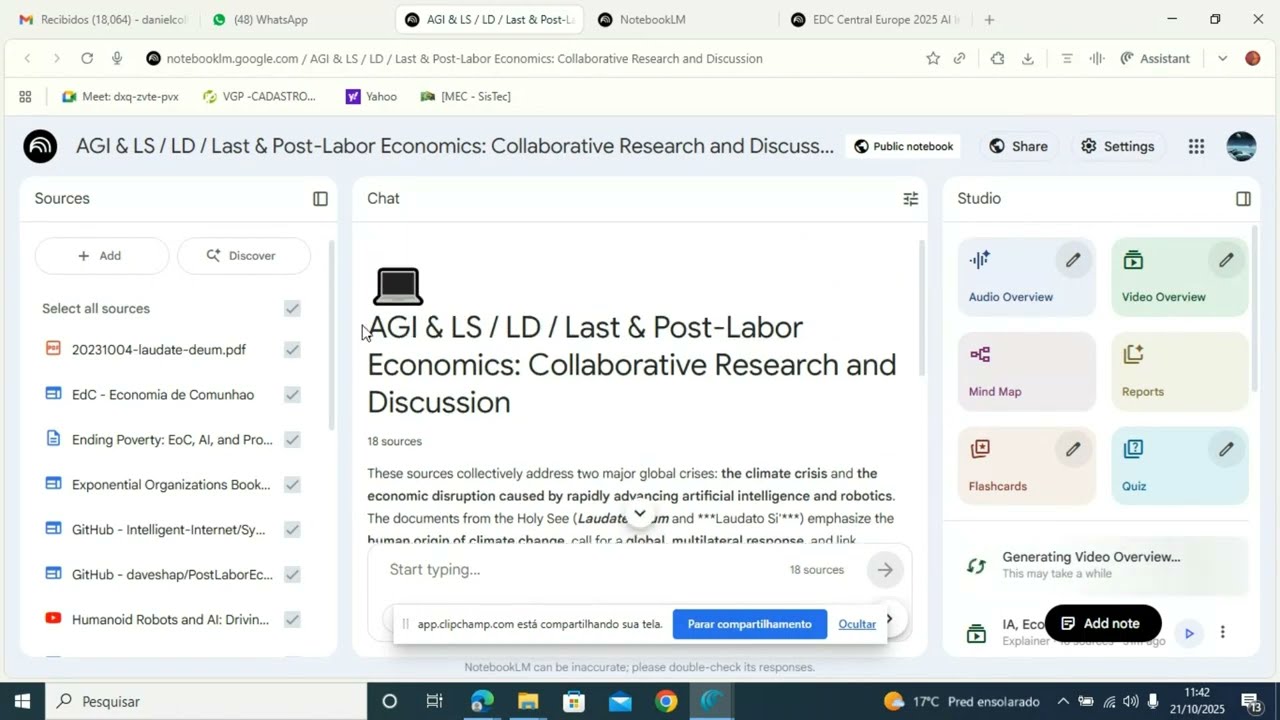
Boost Learning with Studio: Turn Your sources into Audio, Video, MindMaps, and More




Anima Christi - Beautiful Choir Performance in Corpus Christi 2025 - Stockholm - Sweden