WM (Wise/White Mirror) meeting Tuesday March 22nd or April 12th 2022

The YouTube meeting brings together Mario Sebok and a multidisciplinary team (Alan, Anurag, Ross, Roy, Samantha, Amy, Yeliz, Chamira, Jay, Stephen, and others) to plan the “Wise/White Mirror” world‑building project set in the year 2045. The group reviews the contest requirements – a timeline, a Q&A, day‑in‑the‑life essays, and a short media piece – and establishes a tight four‑week schedule with weekly milestones and sub‑group work streams. A major creative focus is the “Intelligent Mirror” narrative: Ross proposes a psychedelic video installation featuring a character called the Natural Philosopher (NP) who converses with an AI‑driven “intelligent mirror” and explores concepts such as smart vs. intelligent vs. wise mirrors, Gardner’s multiple intelligences, trans‑personal intelligence, and the possibility of training AI through collective mystical experiences. The team discusses how to translate these ideas into visual media (trippy video trails, AR/IoT‑enhanced mirrors) and how to integrate music, editing, and storytelling. Anurag and Mario outline project management tactics (weekly brainstorming, rough drafts, final draft by April 7, submission by April 15) and suggest sub‑groups (media, essay, Q&A). The meeting also includes a brief guided meditation intended to spark creative insight and to be possibly incorporated into the final art contribution. Throughout, participants express enthusiasm, collaborative spirit, and a measured optimism about meeting the deadline while exploring deep philosophical questions about AI, consciousness, and future governance.
Chapters
Project ideas or the amazing media element that you will do for our world build. That sounds really exciting.
Hey guys, how are you doing?
Hey Anrush. I think Ross just disappeared.
Sorry, I'm just trying to get my headphones working. They're not quite working.
I'm sorry, I'm sorry, Alan. I pressed the wrong button and I left.
I was gonna say, did you press the wrong button?
Yeah.
Oh good.
I heard, I heard you say that my ideas were amazing though.
I definitely said that. Yeah, I love what you're doing with the media thing. I think you're gonna, you're gonna knock this one out of the park. What's Roy's, uh, input here? Are you gonna give him half? Are you gonna give him the edit? Or what's the So I didn't quite get how, how you guys would work together, how you would collaborate.
So, um, I, um, you know, I haven't talked to him.
I, I spoke to Roy an hour ago, actually, so he's joining the call. He's managed to change his, um, schedule to— okay, so yeah, uh, he'll be joining shortly.
Great.
Hey, Samantha. How's it going?
Hello.
Hello.
Have you, uh, did you invite the community, the other community?
Yeah, so, um, I don't— I know Amy could like— might not be able to jump on because she's in a meeting, but, um, Ali said he was gonna, and Alex. So yeah, I sent them the link.
Great, excellent.
Yeah, we've started. Channeling, channeling a tune.
Very nice. So you've got some poetic artwork for us, hopefully, right?
Yeah, just—
yeah, yeah, in progress. That's fine, we'll discuss that. Yeah, so I think there's a multitude of things, um, um, that we can— um, Alan, maybe if you don't mind just pulling up the sheet.
Uh, oh yeah.
And let's start sort of nailing down as people join in. There's Roy. Hey, thanks, mate.
Hey.
Hello.
How are you guys?
Great.
Ah, yeah.
So Ross, I think the beautiful— yeah, I think you saw my comment about the awakened parallel with the intelligent mirror, you know, with that concept that you'd got. I think let's go through that story and we can jointly sort of nurture it further. So we'll work on that also as a content piece, but let's try and just do a quick overview first where we're at and who's working so far, at least as people are joining in, um, and let Alan drive the scenario.
Yeah, okay, let me give my, uh, I have to click the correct share button, not the Google share button but the Zoom share button.
I don't know. I'm not sure if I saw what you're talking about. So, um, is it— was it like a message that you sent on, uh, Reply?
I'm still not doing much. Um, there's a lot I haven't been able to read because of my eyes still. So yeah, it's just bits and pieces that I've seen, but we'll talk through it. We'll talk through it.
Okay. Awesome.
Do the overview first quickly.
Let's do the overview. Let's do the due date because that's kind of important. It would be good to have everyone's submissions in the next, say, 1 to 2 weeks. So by, uh, definitely by the end of March, but the sooner the better. And then we'll review it in a week or 2 after that for submission, but it's due in April. This world build is essentially about using our imaginations to come up with what it might look like in 23 years from now, in the year 2045. So artificial general intelligence, or the singularity, has existed for at least 5 years. Mentioning different nation states and intergovernmental places like the EU. Mentioning how laws might work, governments might work. They want this to be utopian, or at least not dystopian, so nothing's going wrong, or it's not like we're living in concrete bunkers and the nuclear hellfires are raining down on us.
Okay.
They have said there have been no major wars or other global catastrophes. The world is not dystopian, the future is Looking bright. There are 4 pieces to this from memory. One of the pieces is to draw up a timeline with 2 events per year between now and 2045 and 1 data point. So that could be a change in GDP or a decrease in employment, etc. That's the first piece. The second piece is probably the questions and answers.
There are 13 questions.
I reckon these would actually help us drive the entire project. So this might be a really nice place to start, even for today, just getting some notes on where people think we might be and some answers to this. Third piece, day in the life. We're inviting a few people to write a 1,000-word story or essay on what the hell is happening in 2045. So a day in the life. So they can be really specific on like, I get up and I do this and I go to sleep and I communicate with these people? Is there any concept of work or companies in 2045? That's a— that's one that I'm definitely not getting involved in because that's really difficult to answer in 23 years from now. And the last piece is the media piece. One original non-text media piece created after January 2022. Could be art, video, music. 5 minutes.
Wow.
bring the world to life through vivid visual and/or auditory storytelling. Cool, that's the context. I did it pretty quickly, so happy to field any questions.
No, it's 5 minutes max.
5 minutes max. Yep. Yeah.
So that, that's the part where Samantha's also probed an extended community where we've—
Wonderful.
Yeah, and hopefully some of them will join soon. And let's get started, as you said, Alan, with the questions, I think. How does that sound, guys?
Good, good. That'd be great. Hi to Roy over there. Haven't seen you in a while because I've been away. So good to have you involved here. I've been away too. Yeah, we've both been away. We're finally back together again. We got the band back together. Yeah.
By the way, just before we start, sorry, I'll just say I've been pinging Peter Story back and forth, so he's Um, yeah, he's saying he's a little bit busy during this time, so he can't join the call, but he's happy to contribute and participate. He actually shared something which I'll— I think it's in my, in my WhatsApp, so I'll just copy paste it in the chats. Let me do that as we, as we're doing, continuing on.
Awesome. And Mario, I know Mario's been pinging me about, um, being involved in this and playing around with the sheet.
Yeah, I thought he was going to join today, this call.
Okay, well, I'm here.
Oh, I can't even see you, Mario. Where the hell are you?
Ah, hi!
I'm in Dubai.
He just dropped in.
He's in— yeah, at the World Expo. Awesome.
Well, I must say this was a very timely, uh, sweepstake because it might help us deliver a very succinct project According to our, our manifesto, I think this is very aligned. I'm so happy.
Totally.
Awesome. Yeah, good to have you here, Mario. So we've got myself, Samantha, Robbo, Roy, Anurag, Mario contributing to this one. Yeah.
Right.
So each answer must be less than 250 words, and we start with question 1: The dynamics of an AI-filled world made depend a lot on how AI capability is distributed. So this is kind of ethics and fairness. In your world, is there one AI system or a few such systems, or are there many systems of comparable capability or something else? Wow. Yeah, these are all beastly questions.
So it's kind of asking, is it a centralized versus distributed or Framework based on a kind of a hub and spoke type model, kind of. Is that what one of the angles that we— you're reading to from that?
Uh, I read into it as, as geopolitics. So are we all using China's AI, or are we all using Elon Musk's OpenAI? Or has the UN got a massive AI and we all use that? Or does each country have their own and they kind of triple check with each other for redundancy?
Yeah, that's that's what I was saying in a way. That is a hub and spoke, right?
By 2045, would we already consider multiplanetary AI?
Mm-hmm.
Yep, that's a good point.
Because if it's multiplanetary, I think the answer is that at least.
Well, certainly by 2045 we'll have something like that, if not sooner.
Well, that would, uh, that would, that would assume that either humans have gone to other planets or, right, or we have contact with them.
Or maybe I wouldn't, I wouldn't stretch it that humans are already colonized, uh, have colonized, but maybe a robot colonization that's terraforming Mars for sure. I mean, uh, you could, you could send robots first. They spend 100 years terraforming Mars, and then humans will eventually come.
Yeah, I mean, that's a good— that's a good— that's an interesting scenario, because if you're going to send a robot to Mars, then the, the amount of time that it would take to communicate would be such that you would have to imbue this Robot with some kind of AI so that I could get some work done.
Nah, we'll have telepathy through the machines by then, Robert. Instant, faster than light.
Uh, yes, but is the robot capable of telepathy if our humans— if humans are robots?
And I have an idea how Facebook had typing by thought like two years ago. So yes is the answer. Well, that's an idea.
I'd be curious to ask this question to Leta AI and see what she would answer.
Yeah, that's an interesting point. We could actually answer all of this through GPT three, but or or. or a modern AI, but I don't know if that would either rule us out or make us look—
I'd say to have a first draft and then obviously tweak it.
Let's put down buzzwords. I think multi-planetary is great. Distributed, maybe just as we say. Distribution. What else will we?
I was gonna say, Anuraj, for point one, yeah, we've got geopolitical them separated like that. And also, what about corporate? So I mean, Microsoft is bound to have maybe the Asia Asia platform, and Amazon's A3 is probably gonna. Morph into something, and then you've got Google. So maybe there'll also be a lot of corporates, and then just like the way that the internet has shown us that it all kind of pushes one person, one company out in front, might be a front runner.
Yeah, but I think that point— yeah, something about the corporate, the organization But also the transhumanism, you know, sort of that everybody's a transhuman in that form.
So yeah. Yeah. If it's okay with you guys, I might ask if we just skip down some questions that might help us out with these bigger questions. Maybe even from question 3: In America, Europe, and China, how and where is national decision-making power held, and how has the advent of advanced AI changed that? And if that was— that one's too hard, then we can skip down to question 5.
I mean, I've been actually— I've actually been thinking about something similar to that. You know, in my stories, I've been thinking about, you know, what is cyber And, um, and, and makes me think of cyber— you know, I think of these buzzwords kind of like cybercrime and cyberjustice, uh, and I've been wondering, well, what is, um, what are all of these? Um, and I have, uh, through my etymological research, gone back and found that, um, the first, uh, Time that somebody has put together the words CYB, the letters CYBER, is Andre Murray Pierce's scientific knowledge classification of cybernetic, and he says that it's a form of political science. And I translated it. Um, from French and, uh, cross-referenced a bunch of what he was saying. Um, and basically what cybernetique is about is a government, um, using, um, the right technique of governance for the right situation. Um, and, um, to me, um, when a government does not do that, that actually— in, in my story, that I concluded that that would actually be considered the, the true cybercrime. Real cybercrime is when governments do not consult the ruling playbook and choose the right technique of leadership to fit the situation. Um, and if I can do this etymological research, then perhaps a— an AI would also come to this conclusion. So perhaps that between 2022 and 2045, a lot of, um, uh, interest has gone into the concept of, uh, cybercrime. And, um, I think that a good application of ANI would be as paralegals, because so many citizens around the world do not know the language of law. And so people are not able to, you know, people can't follow the laws if they don't understand the laws. And people can't defend themselves if they don't understand the language of law. So I think that AI being applied to actually helping both citizens and governments understand law could really help unclog the judicial system and Perhaps through all of this interest in art, um, in cyber law and— well, cybercrime is a technique you hear. There are 2 other techniques, 2 words that we don't hear right now that I think we will be hearing about, is if you have cybercrime, how can you have cybercrime without cyber law? And really, how could you have cyber law without cyber justice? So cyber law and cyber justice are, um, are what I think could be these emerging, uh, phenomena. And then what helps you, um, I, I think that fuzzy logic is going to come into play, whereas you don't just have a person who is guilty or not guilty, but you have a range. Somebody could be 65% guilty of Statute 4 and, you know, 25% guilty of, you know, Statute 12. And looking at a a combination of, um, ANI, uh, language, uh, because AI is really good at language. Obviously, that's kind of what the Turing test and, and with these language models working on language is kind of like the first greatest— that and math are like the greatest problems that AI are working on. Um, so you combine that with a very strong interest in law and cybercrime and cyber law, and then you get cyber justice, and looking at what is the origin of cyber and cybernetique, and you say, oh well, cyber justice is when a government utilizes the, the right technique of governance for the right situation, then I think, um, going back to looking at this question, Um, we're looking at like, uh, uh, question 3.
Yep.
Yeah, so national decision-making power and how is the advent of advanced AI changed that? Well, I think that we have, um, you know, really language is Language is the is how we make treaties with each other. Language is how we make we we form these social contracts with each other. We we form bonds. We form agreements, and if we're able to better keep track of that, that I think that we are able to have a more fair society because we can better track what. People the guarantees and the, and the promises that people have made to each other. And also we can have governments, um, dealing with their people and also with each other, um, i.e., nations dealing with each other and saying, hey, you know, this idea of, uh, reaching into your nuclear toolbox, you know, is not the proper technique of governance. for, uh, you know, negotiating, um, you know, what it is that you're trying to achieve. That's just— that is— that's, that's, that's cybercrime.
Can I, can I jump in and add to number 3? Um, so I think one of the big issues that we currently have and have had for a long time is that because of the way that our political systems work, There's always a push for getting reelected, and that really influences the direction of policies and what they're promising. It's— and it's very short-sighted. Whereas if you've got some sort of AI planning that can, well, How would we do it? It helps the popu— it helps formulate longer-term plans like, you know, reforestation as opposed to setting up an oil refinery or something like that. You know, it's like those big sweeping decisions at the national level. Like we've just got one in Australia that they've— it's a bit— maybe it's a bit of a knee-jerk reaction, $4.3 billion to build a shipyard in Western Australia. And, and, you know, if you had some sort of series of AI— I don't know what you— AI consultants.
Mm-hmm.
So you would consult the AI and say, look, we've got this situation, and the AIs will make recommendations. And that would be— it would show factual, you know, this is what I recommend based on this, this, this, this, and this, making the guesswork more educated. I mean, I think— what's point number 3? How has the advent of advanced AI changed that? So maybe it's, um, it helps with the long-term planning and provides sophisticated predictions. Oh, that's like, yeah, the predictive models. Yeah.
I had a little bit of feedback in regards to the legal side of things, Roy and Ross. Just having a bit of a background in that space and thinking about, Ross, your notions of cyber justice and how that's measured, and then just exactly what you yourself just said, Roy, in regards to, you know, how would we have a framework for making these bigger decisions past a 4-year election cycle. So that's something that obviously is quite prolific in our democracy, in our structure of democracy and the Westminster system where every 4 years there's political interests that come into play and then the next election. So everyone's in that last year or 2, everyone's looking to the next election cycle and everyone's Like everyone's priorities are all mixed up. But yeah, if there was some sort of bipartisan agreement or some sort of framework in which, you know, parties can put aside their own kind of partisan politics and look at interests that are in the collective good of our societies, that's definitely something that is needed. And going back to what you were saying, Ross, in terms of the notions of cyber justice, So I find it interesting in, in a common law setting. So unlike in the States where you guys have your rights really codified, here we interpret them because we don't have a Bill of Rights in Australia.
God knows why.
But, you know, we still— And we're interpreting them off case law and common law. And, you know, maybe that's strategic in a way too for government to maintain or at least the judiciary, to maintain that interpretation, the ability to interpret what our rights are. But putting that aside, the notions of cyber justice, and I just think of common law notions of justice, and common law notions of justice are very linked to principles, and those principles are very like I know, Ross, you mentioned that it would be cool to get kind of a bird's eye on how much, how much this principle has been respected, you know, the degree at which it's been respected. So in law, especially in common law countries like Australia, we have tests. So we have specific tests that, you know, the reasonable person's test. is a great one that maybe might be known to some of the people on this call. The reasonable person's test, you know, it really sets the basis of defining what a reasonable person is. And there's no, like, there's no room for gray in that. There's like, the discretion is at the, you know, behest of the judge. But it's clearly defined how you would, you know, what, what you need to tick off to be considered a reasonable person and then be covered under all of these other bodies of law as a reasonable person. So yeah, I think there's, there's probably some, some work to do there, or at least there's an angle to take there in terms of having to press the, the ideas of, you know, maybe proportional justice or outcomes that are seen to be, that are seen to be, uh, you know, finding justice or delivering these notions of justice. If that makes sense to everyone on the call. Yeah, sorry.
Thanks.
Thank you.
Sorry, I'll just take a pause here. Um, hey guys, we've just joined. Hi, Yeliz, Alexei. Um, And who else has joined? Sorry, just checking. Stephen, Stephen, the 13 traits. So please jump in anytime— sorry, the 13 questions. And by the way, I was just typing on number 2 there earlier. Sorry, I don't want to break the flow.
Excellent. Now add in for sure.
I did something there, which if people are happy, we can extrapolate that, the thinking around that basically. I think everything the war currently is presenting and what it shouldn't be doing is what we are, you know, is what we can include here and all the learnings from that. So that's why I just put that awakened intelligence.
So, and in there, maybe just reading that 13, I think maybe there's a, there's, I'm guessing, going to be a really amazing potential for AI to help with marriages. So, you know, when a husband and wife fight, they could be an amazing arbiter, like a counselor, you know, and it could be, you know, because it's so personal in nature, you don't want to a lot of the times you, you don't want to tell other people, and having an AI that's not judgmental and etc., etc., that might be one of the notable possible ways that help people find marriage fulfillment.
Yeah, excellent point. Thanks, Roy.
Shall we still try and go in order if it's fine? Because then we can just skip through and come back if you don't mind, you know. So absolutely, yeah, I think number 1 we had, number 2 I've put in some things. Has anybody got anything else to add to that? Or— and 3, we've had a good discussion, which points there. So Alan, each one has to be 250 words, is it?
Yeah, that's right. Yeah, so we can just get some dot points here, and then if anyone wants to pick these up and take these away to play with, that would be awesome. Hmm. I suppose a big, big question is, on top of questions 1 and 3, is the AI going to be held by the UN or an intergovernmental organization, or will each country have its own AI? Because that will determine the answers to a lot of these questions. Are we all going to the, you know, the World Economic Forum or the UN For answers, or are we just going to Australia, or if we live in America, to the US government's AI and, and having our usual 200 countries with 200 different sets of rules and 200 different answers?
Right.
Or is it Google's, or is it, you know, some corporate thing that perhaps does not want to do business with, uh, some rogue country?
Yeah, yeah, the politics makes it very boring.
Well, yeah, you know, like looking at the situation now, you know, you have corporations who are, you know, rightfully, you know, pulling their people out of Russia. Um, and, you know, so, you know, extending to— I mean, obviously they still have veto power in the UN, but, um, so they are still connected in the UN as far as it serves, serves their Weird purpose, but you know if they end up on their own internet, you know that's kind of an you think like well are they going to have their own AI system and is it going to talk to the world system? And if and if you're we're using and in in you know question two, you know if the world is avoiding major wars by you know. AIs, you know, saying, "Hey, this doesn't make sense for us to have a nuclear war because one for one reason we're gonna blow up our servers." Michelin self-destruction.
Yeah.
Very Skynet kind of. But you know, but if you have if you have a country, you have your If you're— if you have a rogue state whose AI does not, uh, communicate with everybody else's AI, are they going to, you know, add to that conclusion? Are they going to come to say, well, I'm willing to take that risk, you know, for, you know, for whatever reason?
As long as we keep the evil game AIs separated and never put them in a live system. So, you know, the GTA 15 AI that's supposed to, you know, drive the car into the, into the lake, let's keep it in the game, not—
Well, one thing is, uh, we will have base reality and we'll have metaverses. So, uh, the decision-making is always done what comes from the metaverse to the base shared common base reality. And since we'll have simulations of base, uh, in the metaverses, it'll be a voting game of how, which proposal ran in backtested scenarios through our AIs on the metaverses. So we'll have, and we'll have the undo option. Everything will be able to be undone if we do not, uh, appreciate its actual outcome on the base reality. So I think it's much, much different than an extrapolation of today's world because we are scratching the surface on the metaverse, which is our Facebook AI, Twitter feeds, YouTube links. All that is our metaverse. Imagine that time to the nth power. That's the metaverses we're gonna be enabling with a personal AI. So everybody will be able to make their personal or their group AI and propose to the com— So it'll be just pretty much, uh, popularity game, and you can roll it back.
Yeah, I think very much like Ready Player, right? So it'd be multiple realities that you try, you know, get in and out of, and it's, it's basically the Matrix format in a way, right? That's what we can say that, okay, what, how do we see that metaverse being a really the WeTopia and what, what are those touch points we can bring in. Sorry, I'm also noticing that people are typing in things here. If you don't mind just typing it directly into the document, any, anything, anybody. I think my eyes are headed for my strain, so I'm not looking too much at the screen now. But if you guys don't mind typing it straight in.
Yeah.
Anurag and Alan, in respect to the The national decision-making power. I'd like to propose a hypothesis that maybe nobody has suggested at the moment, but I don't know because I do apologize, I haven't been able to be at the other meetings. But it could well be, on the strength of our current United Nations, which isn't exactly united, and the fact that different presidents of Security Council can veto things that apply to themselves. It could be in fact that a completely different form of what we might call United Nations actually arises, and that is a group that forms by way of 3 different groups. And they are not governed by countries because countries, of course, can be divisive, as we're seeing in the world at the moment. But in fact, are actually 3 different groups by way of thought. So there is a whole— Now, these 3 different groups, obviously, you're going to have an AI group that's AI-dependent, that promotes much more AI use. And there'll be an AI, what I might call an AI-neutral group, that is much more coexisting with AI and has a neutral stance, but it's neither positive nor negative. And equally, there is going to be, as we well know, there'll be anti-AI groups even at 2045, no matter what, because the odd car might drive into the lake. And so it could be that this issue might become a really global one that's in fact very important. And that speaks to a new type of unity. And here I like Hermann Hesse's Glass Bead Game, but a new type of unity that's actually brought about by way of thought. And that the wise thinkers, you know, speaking to our wise mirror whole ethos, is that that is in fact what forms the new 2045, even possibly politics or a new form of nationality that we become instead of dividing into countries, that we become more looking at what the awake intelligence or thought thought categories, not quite the right word, but you know what I'm getting at.
Yeah.
So that in fact, they become the decision-making group and that it is an alliance between— because you need the naysayers as well as the supporters and the neutrality. So that's just the thought I had that we could, just because it's novel and different and also because it potentially looks at a different kind of geopolitical, and it's more thought political, you know, that there's a whole different arising that—
I love it, Stephen. I think, yeah, I'd like the Federation, you know, it's that interplanetary wise men that we have from all different walks and scenarios who are So, Anurag, so I wasn't quite so bold as to suggest— which is probed depending on the— yeah, can you hear me?
I'm losing your mic.
Yeah, I mean, I wasn't quite so bold as to suggest that wise mirror become the national decision-making power.
Oh yeah, no, no, no, I wasn't saying that. I was saying— no, no, no, no. Yes, but it's like a wise men. That's what we're saying, like a wise group of wise men. Exactly.
The wise peoples.
Yeah.
Exactly.
Wise group of wise counsel.
Yeah, exactly.
Yeah.
So, and I think if it's drawn from, you know, particularly those 3 dynamics, then you've got a whole different kind of way of looking at where decision— because it's based on wisdom, then it's based on thought, and it's also based on both supporting AI but also supporting those that maybe are not quite so It might— don't, don't feel quite so much affinity with it.
Yeah, I quite like that. It sounds like the concept of an overarching world government. I'd like to be able to find a term that is not world government because we don't want to be hooked in with New World Order and all that kind of thing. But if we can find a term for it, that will be helpful.
Yeah, exactly.
Well, you know, it makes me think of the benefits of Matriarchies and matriarchal societies and how you have—
Federation.
You have the mother, you have, you know, like a council of like mothers and grandmothers, you know, who are the ones who essentially gave birth to the rest— literally physically gave birth to the rest of their society, you know, preventing wars and such things from happening. So I think that there's great benefit to think of that, uh, that addition to this, uh, equation.
We'll definitely earn, uh, woke points for that, Robbo, except I think the team's all white dudes. That's right.
I mean, historically, we can learn from actual matriarchal societies. I mean, so we're not We're not trying to like come up with a conception, a concept of our own of like what would a matriarchal society be like and how would they be able to preserve, you know, peace amongst the tribes. We could just look at existing ones and just use them as models.
Yeah, yeah, right, Robert. Because in fact, if you look at the essential qualities of what this Wetopia actually is, and stay, for example, was fundamentally peace or wisdom or love, then you do want to look at what is that core. As Alan said, without it being called a world government, but what is the core representative spectrum that would best actually support that? And it might not be white dudes firing guns at each other, right? So it might not be the leaders of those countries that are, you know, Predominantly intent on mining, pumping people full of vaccine, which is like mining, and pumping countries full of missiles and projectiles, which is kind of akin to mining and injections. So I do think, Alan, if AI had got hold of medicine about 1,000 years ago, it would have projected a vibrant You know, vibrational medicine path rather than a pharmaceutical medicine path.
Nice. Yeah, for sure. All right, can I invite us to move on to, uh, question 4? Hi, is that Elise?
Hey, this is Elise. Hi everyone, can you hear me?
Yeah.
Yes.
Oh, cool, cool. Hi, um, I want to add something to number 3. I think the main question is going to be the conflicting ethics. So maybe AI and also a possible mirror may show the alternative worlds, almost like each country having different ethics. And when there is a conflict, AI can create an alternative Parallel world, so leaving the decision-making to the people rather than the AI. Does that make sense?
Like a city. Yeah.
Like.
Can you give a concrete example of that one, Yeliz?
Okay.
What's that?
Can you give a concrete example of that?
Right, I'm also trying to imagine it in my mind too as I share it.
I have a crazy example. Like, um, I know it's not a perfect example, but let's say, um, let's say in one religion you have to do something like— let's— okay, um, pork in the Muslim religion. Um, maybe they would have a separate reality where there's no pork anywhere. Is that, is that something that's like—
Right, something like that. Let's say, for example, we, um, the nations, even in the nation, in between the states, uh, the law enforcements are different. California is different than Texas. So when there is a conflict, uh, comes to surface, um, AI may show an alternative world. Let's say It's— so think about like we have a representative from LA and a representative from Dallas, and they're having a conflict. AI comes on board and shows the different 2 worlds, so representatives get to experience the other model of the world before a decision is made.
Yeah, I love that.
I think that's really—
yeah, you're kind of talking about a very deep context and then building multiple scenarios on that context. So offering, okay, which one makes sense? And then you do— AI is basically offering multiple layers, you know, of decision. And I think this is where the thinkers can come in, actually, guys.
Yeah, I was gonna say, that sounds like Intergovernmental kind of like alternate dispute resolution, and you're basing it off 2 kind of, uh, uh, what do you call them, scenarios. Um, uh, I've forgotten the word right now, but, uh, yeah, like, uh, mock scenarios.
Hmm, right.
So, uh, we let go of the notion that there is one ideal But it's instead AI creates these ideal worlds for everyone, then seeing it, feeling it, a decision comes up.
Hmm.
Yeah.
And, and AI needs to be trained. And so these, these AIs could be trained by everybody. I'm trying to think of an example of some sort of a game Or a gaming scenario where the players would be encouraged to be generous, um, because, um, you know, the, the sort of, um, like, let's say you have, uh, a certain number of, uh, coins or whatever, and then you have to give them all away. Like, you might put them in— the idea is that you won't get to get your own bag, but you have to get the bag from, you know, other people. What I'm trying to say is, like, how can you get people to act, at least in a training data type of scenario, and maybe it's gamified, where people are motivated To, uh, people actually benefit. Um, people could benefit personally by, uh, giving things away because you can't— the rule, part of the rules is that you can't benefit yourself, but you could benefit from something that somebody else donates.
You've come a point.
Yeah, exactly.
You give your citizens tax breaks for participating in such an exercise.
Yeah, yeah, there's lots of potential.
So are we harnessing this into the answer somewhere, guys? Who's, uh—
I didn't consolidate that into a sentence, but we could do. I mean, I've got, um, the AIs create alt-parallel worlds and allow humans to compare and experience these. Humans could make a decision based on the model. What would we like to add to that?
I think just the word, the term context, deep context, maybe in there.
Maybe an emphasis on karma over capitalism. I don't know. That seems to be. A very short phrase.
Maybe something bridging that cultural divide.
Hmm.
I think one of the most exciting things is digging up some of the lost culture. So, for example, there's 400 or 500 Aboriginal languages here and all sorts of different belief systems that run through from Western Australia all the way over to New South Wales. What if we could grab what they were doing 20,000, 30,000 years ago and just have that as some, as some context or some perspective?
Oh my goodness, Alan, it's like you've tapped into my reality. I was literally 3, 4 days ago in a meeting with an entrepreneur who's linking the indigenous people's view in Hawaii with exactly what the Hawaiian economy needs to shift, you know, out of its, out of its current Americanism, but back into adopting some of the wātawindā elements and the, the, let's, what, what they call it, you know, stored knowledge. In other words, that it is stored, but nobody's accessing it at the moment. So I love that.
Right.
I love that if AI can create parallel worlds, it can also create access to the traditional worlds of the indigenous people, you know, which creates a very grounded and very real connection for people right across the world to, you know, the AI itself. I'm thinking of the, you know, the potentially averse AI groups that they can see, wow, there's actually these incredible benefits we haven't sourced. And that is the ability to actually retain and make use and have access to you know, the Indigenous knowledge in a way that supports governance, because that's what we're talking about in 3. Love that.
Love that.
Like a contextually specific, like contextually relevant decolonial kind of process.
I think that that's a great global movement, right? Because we've got the Indigenous from, yeah, in Australia we've had this wake-up happening for so long. All around the world, really. Yeah, I mean, the Red Indians, the, you know, you name it. Even in India itself, there's tribal people who are living in remote parts who've actually got so much wisdom that is lost in— with the rest of the world.
Yeah, I think that's the right word as well, Jay. It's like the post-colonial, decolonial knowledge perspective, I suppose, which is growing now more than ever. Or even southern theory is another word.
Yeah.
And just having that maybe as one of those 3 perspectives, you know, from maybe traditional Western views, whether it's like philosophy, sociology, even health. And then you've got, yeah, all the various other— I don't know what the word is— epistemologies even, and how they, yeah, how they kind of relate. But I guess that's, like you mentioned, cultural, the cultural angle and just broad context. Actually, it reminded me of Tyson— I always forget his surname— Unakora, I think. He wrote a book called Sand Talk, an Indigenous Australian, and one sentence that always stood out was that he said, in Indigenous cultures, to solve a problem or get to the heart of an issue, you have to consider it as complex off the bat. Only then can you find simplicity.
You don't—
You're saying that in Western cultures, you generally try and simplify the issue straight away. which actually leads to more complexity. So I wonder if, yeah, that could be one viewpoint or perspective that can— I don't know how else you would do it, you know, feed into an AI sort of model and factor it in.
Yeah.
Who's our speaker at the moment? Sorry, I can't see you in our people.
Chamira, Alan.
Oh, hey, Chamira. Can you dig up that quote and we can throw that in here, the bit about simplicity? Because AI does give us access to enormous complexity and then allows us to simplify it. So that might be useful. Thank you so much.
Yeah, no worries.
We'll go.
I think the tapping into indigenous wisdom could bring in some of that matriarchal, such like conflict resolution and de-escalation that I was You know, trying to hearken back to.
Fantastic. If it's okay, let's jump into question 4. So when we were answering question 3, I also pasted some notes into question 7, which was, what is a new non-AI technology that has played an important role in development of your world? And I just was listening to the— this concept of bringing forward culture. So we brought forward roads from the Romans and currency from before then. We've probably got stuff from the Aztecs and the Mayans. minds, what are we missing, either because that's been destroyed or because we haven't had the breadth to be able to look at it all? So that, that might be a very long, long answer for someone to put into words, but it's an exciting thing to— for us to identify.
Well, I think of, uh, like, uh, resource, uh, distribution. Um, like sometimes I think like Oh, well, I buy things because, like, they're on sale, but then I have to find a place to store them. And so I have to pay more money for a bigger house to store the things that I might need later because I have this fear of not being able to have access to them later. So, I mean, resource, you know, Redistribution of resources, I think, is actually the next question, is number 4. And I mean, like, if you get to be a billionaire, I think you get to maybe have like, you know, a star or have something named after you.
And then—
I just can't—
You can't be like, okay, that's enough. Like, you don't— one person doesn't need, you know, $17 billion, or one person doesn't need It's just like I think that there's a fear going on.
Do you think with Elon Musk on the board, though, if we call for the fall of capitalism, or at least the capping of billionaires, do you think that might be a big call?
No, I think it's touching on the circular economy part, right? On the shared economy. So we can mention that.
Can I just say? What if we don't need to cap billionaires or even care about the Gini coefficient if the poverty line has been moved down so low it doesn't really matter to 99% of the population? As in, you know, if you're spending all your time in a virtual world and you live like a billionaire anyway, Yeah, so there's no poverty.
We've eradicated poverty.
Yeah, so if you've eradicated poverty, everything is just a plus. So if you're a billionaire billionaire, great, you're a billionaire.
Good idea.
Yeah, yeah, your quality of life is still excellent whether you're a billionaire or do you just— you're not doing anything, just writing poems.
Well, I mean, this is, uh, that's in multiverses, therefore when you're talking about the multiverse and the metaverse, resource issues are not a problem. Resources are restricted and scarce on base reality, but on the metaverse, the resources are pretty much abundant. Therefore, the resource problem has been solved on the metaverse, and base reality, it's about offering in. So you basically have to convince the people in real base reality this of a metaverse that's best fit for reality. And it's opt-in and undo, so you are not coercing the base reality into anything. It's a voting system of opt-ins. And eventually only consensus metaverse— metaverses become base reality, as long as they do not conflict with other consensus base realities in other geographies. And then the limits of geographies will also be decided by metaverse renderings.
And not introducing false scarcities. Because I don't remember what the name of the metaverse is that people are trying to buy up virtual land because the idea is that, oh, land is limited, and so investing in this land now is going to be a good investment. That's artif— that's an artificial scarcity. I also think even the idea of like, oh, we're only going to mint a certain amount of Bitcoin, you know, has, has, you know, possibly a certain effect in that realm as well.
That's right. I mean, there would be— that point you brought up, there would be, and still there will be scarcities because, as you said, like, where will people congregate? And if you, um, I mean, you could have your own personal worlds and own personal You know, palace. But then when you congregate in a shared space, that's immediately now, you know, who gets to have the the apartment at the top of the whatever it is meeting hall. You know what I mean? It's a there will be still things that we have to share.
Yeah.
Yeah.
Attention will be scarce because we'll have so many competing. Elements in so many metaverses. So prioritizing attention, AI is gonna be a tool for helping you best have return over attention.
And that's happening now, right?
Where you're limited, your attention span is for your lifespan distributed. And what to do now at this moment that best makes use of your attention is an AI function that you'll tweak.
That's awesome. And even people say that, you know, one of the, one of the, one of the greatest things of value is really our time. Well, right now, yes, but when we ex— when we have life extension Then, you know, time may not be as much of a commodity as attention. I think attention will still be a greater commodity than even time or space.
I think just an extrapolation of what it is now, right? Because the rate— what we're seeing with obviously all that social media distraction, it'll be, you know, yeah, exponential. It has to be. Where would you, you know, put your energies and where, you know, So time will still be finite in that sense, you know. So it is still be a function of that, you know, what what is worthwhile, what is you know. Yeah, it'll again come back to your passions and your obsessions. I would I would think right.
Yeah, and also maybe there will be some versions of VR that. Allow you to experience time, uh, slow. Like, you might have a—
Under stress.
Have a simulation where, you know, you experience 4 hours of time, but it only takes half an hour. So you could just cram 100 hours into a 24-hour period, things like that. Yeah.
I think right now it's called magic mushrooms, right?
Or just Stephen Altair. He's the DMT chemical.
Yeah, that's how we dream. We actually dream really a lot, a lot in a very short amount of time. So it is, it is, the potential is there, I guess. I don't know.
Yeah.
Hey, I was just saying, Alan, thank you for that. Yeah, I like, I like being, having my brain DMT'd.
Yes.
The, yeah, what Yeliz said about the, you know, parallel world experience experience and being able to go into that. So I was thinking on 7, what if we were to add that our— is it a new non-AI technology? Potentially it could, that it's based on intuition. And that in fact, you know, when we look at a lot of existing AI, and this is— I'm not going to oversimplify it here, so apologies in advance, but to a certain extent it's based on pattern recognition. And as we evolve towards AGI, then rather than just probability values, there's actually going to be a unique AI intuitive quality, right? Which at the moment is just starting to form, which of course, when you get to true AGI, is actually— you start to speak right into the heart of that intuition, you know, in addition to pattern recognition. So one of the things that I was considering in terms of point 7 was that if our AI is intuition-enhancing, so you can think of all these kind of add-ons, that AI assists shogi players to think through more intuitive moves, and the football quarterback to work out how to outsmart the linebackers, all that sort of stuff in sort of play. Because especially in games, it's quite interesting if you look at AI analysis versus, say, the intuitive analysis coaches. So once that intuition comes in, then we start to look at a whole different— I guess you call it intuition/intelligence accelerated society where intuition and imagination, which up till that point have been fairly unique to human beings, and where they actually become enhanced by utilizing all the experience and the ideas and patterns and probability values that are stored within AI. So that aspect, and that's speaking right to the heart of what Yalise was saying about the fact that you start That a lot of the intuitive solutions that we know, like, hey, if only I could put myself in the shoes of a Russian soldier and actually really help to understand what's going on, and then put myself in the shoes of a Ukrainian refugee, I start to develop a really kind of deep intuitive sense of compassion and walking on both sides, really literally being able to be in those parallel worlds. You know, we strap Putin into being the Ukraine refugee, just to give him a little insight into what's happening. Now, those kind of intuitive— you know, because what Yalise is talking about is, it's a really wonderful intuitive solution. And so those kind of intuitive technologies, uh, I, I think could be, you know, one of those special, um, basic ways in which non-AI technologies, it plays such an important role in, in a new AI, um, enhanced in intelligence, uh, I'm not going to call it variation, it's not a virus, but a new, a new non-AI technology that in fact works with this, you know, exactly what you're finding out with LaMDA, that almost some of the answers become so close to your own intuitive response to something that, that's, that really speaks to how we can really help each other. So that, that could be wonderful.
Stephen, the definition of our awakened is definitely around what you would exactly what you're saying, right? So I think intuition is definitely that key facet that we're seeing from AGI, which will have some intuition, but to take it really to such a deeper level, Is what the AWI, and and I think that's what we are proposing, right? So we want to say this is our unique concept of what we are proposing from Wisemira as the awakened intelligence, which has all those traits, and at such a deeper degree that they are you know each technology is only just keeping up with how it can be deployed in that form.
Right, right. And and in fact, the we could reprogram or get Alan to. Reprogram later with a new version of, you know, wise mirror input, inputting all of this data and call it, we could call it Yeliz.
Oh my God.
I didn't know it was going to go there.
It'll be a trip.
Oh my goodness.
Let's, let's say just love, a state of love.
Totally.
It's the same word, isn't it? Yeliz in love, isn't it?
Oh, with this motivation, oh my God, my day is gonna be bright.
Yeah, guys, we've got 25 minutes. Um, I just wanted to sort of switch gears a little bit because we've also got, um, I think Samantha, you, uh, has, uh, Amy been introduced by you?
I think— Yes.
No.
So maybe if you don't mind, we can, uh, uh, I mean, sorry, I didn't want to abruptly close. Is there any other points right now on this one? Otherwise we just have to Because given the time, I just wanted to get for another part of what we are contributing for this.
I invite everyone to add to any of these 13 questions in their own time over the next week or so in column C or D. I'll paste the document in the chat once again. It's an editable document, so you just type straight in there. It's always saving, so you don't have to do anything fancy. But yeah, any questions that you feel you're informed enough or you just want to give opinions on, Let's get some answers going in terms of keywords, and then we'll write out 250-word proper answers later.
A method for keeping, uh, all the ideas would be using different columns. Therefore, we'll have for the answer 12, for instance, column C to all the end so that nothing is lost, and then eventually we can recap.
Yes, yes, I don't intend on deleting anything out of here, so we'll keep it all as is. And Google's got a really nice rollback history anyway, if we are concerned, but all good. Cool. So I've pasted that in the chat and happy to hand over to Samantha unless anyone else has any comments on any of the 13 questions.
Alan, just very happy that you're doing such a brilliant job of scribing for us.
So thank you, my friend.
I'd also want to add, um, like extraterrestrial, um, intelligence by then. I think it's not just going to be— I think it's going to be intergalactic beings, isn't it?
Yes.
Yeah, I think that's what we— interplanetary, but intergalactic is a better, better way to say it. I love that.
Yeah, right, right. We could— and we can enhance that description with like space migration, you know, all of the— that is 2 ways. It's not just them visiting us and saying to Samantha, oh, oh, it's— we've been waiting so long, you know, but it's us actually as part of space migration protocols, you know, developed because it's funny, Samantha, I was just in a talk a few months ago with a biologist, you know, interplanetary biologist from the University of Manchester who was talking about, you know, who's talking about this really huge shift towards developing the capabilities to meet whichever way it comes, whether it's us visiting by chance somewhere in the solar system or visits by. So I think that those are really, you know, all of those incorporated into this present, you know, again, real grounded, powerful chunks of, you know, AI landscape. I think it's beautiful.
Yeah.
Yeah, I love that what Yeliz has just wrote: galactic sisters and brotherhood.
Totally.
Yeah.
I think consciousness hacking and and soul transformations and all that will be part of the new spiritual order, right? Samantha and Stephen. Yeah. So yeah.
Yeah. And wait, Samantha. Sorry, sorry, Yeliz.
You go.
We'll definitely—
we'll need the new love in marriage with galactic beings.
Yeah, Samantha, when it— when you're rubbing, um, that cat like that, it reminds me too much of a scene from Captain Marvel. So I'm kind of expecting that, that, that is in fact an enhanced extraterrestrial being on your, on your lap.
He just keeps vanishing. He's a shapeshifter. And then he just appears.
Yeah, great.
So Samantha, let's dive into—
Yeah, I don't know, Amy and Alex, are you with us? Um, so Amy and Alex are both together in a partnership, but they're musicians. And, um, we have Ali as well. And we all came together on the weekend and we went through the whole manifesto and we went through the whole competition. And I dropped us into a meditation and just traveled us to 2024. And just started to open the channel for, for magic. So we're meeting again this week. Are you here, Amy?
Yes, I am here. I managed to jump on.
Hello, Johnny.
Welcome.
Can you see my— oh, you can't see my video, can you?
Oh, that's—
yeah.
Wow, I managed to jump in on the last end of that, just juggling the corporate job here. And wow, incredible, some really fantastic minds. So yeah, we jumped to 2045 and just had— it's just very early days, but we've just started to download some ideas and we're hoping to basically create a song and then a music video to go with it. So I guess we've got some dates booked in like the next few weeks. So it's just early days at the minute. Started to get ideas down. So I guess we'll start jumping on the calls and give you updates as and when something more has come to fruition.
Wonderful.
Maybe if you've got the draft script as you develop it, as you kind of— and that we can review before the— Yeah, finalized.
100% more minds better.
Yeah, great.
So what we were thinking as well, so, um, we were thinking of having it like a portal, so, and using lots of different instruments. That was Amy's idea of like using lots of different instruments, maybe creating something Quite like it. Do you share what— because this was your perspective.
I was just thinking, you know, like everyone just kind of fits into a box when it comes to like music, um, you know, certain genres. And Alex and I are very fortunate to have like 26 instruments in the house. So rather than having, you know, just rock or just la la la, um, to in— to basically create our own genre with all these different sounds and take people on a journey Um, using a lot of the content that is Wise Mirror and all of the information that you guys are putting together. And then visually using— well, so far this is sort of where we're at, like having a portal, like a physical, um, using like different sacred geometries and having a portal to take people out of this fear-based thing into like love-based things so that this song will be like a, I guess, like a frequency for people to, to tune in, like literally tune in or tune out, we could say. Um, so then like with the music video, it would be more kind of like psychedelic but using specific like mandalas and specific sacred geometry As a visual portal as well.
Wonderful. I think we've actually been toying on some of these ideas earlier with Ross, and Stephen's also a great musician. We've got other musicians, I mean, on board also here. So I think it'll be wonderful to collaborate as you have the draft or the first piece ready. Then we could, you know, pick up at next week's call. How does that sound?
Okay, yeah, perfect.
We can have the review the draft, and or if you can share that, Samantha, on the chat beforehand, that'd be great.
Amy, in perfect sync. I, I've just been teaching a group about how to develop their own personal yantras and mantras, so I, I love that. That's beautiful, right into your zone. So yeah, I love it. You know, any, any— I think anything that we can do to actually I think that's really beautiful. I think it's really beautiful. I think there's a, there's kind of a wonder and an awe to all of this that I think that's one of the keys to AI. You want to keep the wonder and the awe alive, and the ways that we can do that is through, through all of this, through actually involving lots of people from many different disciplines to support that unfolding of that wisdom. So I love that.
I guess, like, just while I'm on here and I have the opportunity to, to chat with you guys, um, given that it is very early and we've got such a short time frame, like I think 2 weeks actually we have, um, it might be worthwhile getting— if, if there's any specific things that you absolutely want in, even if it's just a couple of one-liners each, And it will help with the songwriting process. So if you know absolutely you want this to be in it and this to be in it, and then everyone bring it together and I can sort of curate it and then give it back to you and we can sort of fine-tune it. Is there any way of having a chat around that?
Yeah, I'll let Samantha coordinate that if that's fine. If you want to—
We are so in tune. I was just thinking then I'll create a document And then if we can get everyone to at least write a couple of keywords that is like potent to them, like what you were saying, Ross, about words being— makes contracts, like the words are spells, because then that is going to be the Weetopia. So it's not just we're taking stuff off the website, like collectively, like for me, it'd be tune. Like that's going to be one of my keywords that I contribute to the piece. But everyone will have like their, like maybe like 3 words that's like so potent for them that can symbolize WeTopia or like a sentence or a quote that we could all, that we could maybe incorporate in. So I'll create a Google Doc now and everyone can just add their words into that.
Amazing. Because I meditated on it and I got, you know how sometimes it's like you've got this vision and it's like, you just know you have to run with it. And sometimes you're just there as a supporting piece I felt like, I felt like there's a lot of wisdom between you guys, and I can just help support, put it together.
Sure. Wonderful. So actually, yeah, given the time, sorry, we wanted to, because Ross has been doing some really good work with the, we've also got an AR piece, we've got kind of a mixed reality type scenario, we've got a story that he's been building. And I think it's so everything is interlinked, right? So We, yeah, see what we can. And maybe, Ross, if you want to share your screen with the script or with the, with the story that you've got.
Um, we're gonna, um, go into, um, uh, Eric's screen.
I think, Alan, if you don't mind, can you, uh, bring that up?
Or, Alan, you could just go to 2045 Media Piece Development. Because you already have my Google Drive link.
Of course.
Yeah, yeah, I could do that for you.
Okay, and I'll drop it in the chat as well because we really want to harmonize, um, the story here, the, um, the music, obviously the, the song, the composition, all sort of going hand in hand, right? And it becomes a lovely package which is, um, sort of flows from one, uh, you know, kind of transmedia In a way, really flows smoothly from one to another.
Yeah, I'll drop this in the chat, um, what Alan's about to bring up.
Yeah, have you got that screen share okay? Yep, yep.
Yeah.
So Ross, do you want to just take, take us through the thing?
Yeah, so, um, up until this point, um, What I thought might happen is I would take a video installation that I've been working on, which is very psychedelic looking, and, you know, I only know what I can shoot. So my thought was that I would create a sort of futuristic set and Um, I would interact with this thing, um, and I could still do that. And we can, um, maybe I don't even have to build this, um, you know, futuristic set at all, and I just interact with, uh, the, this, uh, video installation that I've created. Basically, it's black, and when you move, it creates these like trails with like colors and fractals and everything in the— and it, when you, when you hold still, it goes back to black. And when you move, it only shows you the visuals in the part of the image that, that moved. So I was— and I've been working on other stories relating to this too. So if it If a lot of this ends up just being part of the stories that I'm working on, uh, you know, that's fine. I've been thinking about this for a while, uh, anyway. So, um, when I say I, basically me, um, would be playing a character. I call it NP for Natural Philosopher. So I'll just read this to you. Uh, I have a conversation with an intelligent mirror. We discuss what is a mirror. What is a smart mirror? Perhaps that is a mirror plus AR plus IT plus IoT. We discuss what is an intelligent mirror. This is the thing that I'm having this conversation with. That would be something that has computer vision, augmented reality, AGI according to this story, and also biometrics. And finally, we discuss what might, might a wise mirror be and how might it be achieved? How it might be achieved. Perhaps through good judgment, experience, and training. The topic of different types of intelligence, including according to Gardner's theories of multiple intelligences, comes up, and perhaps we talk about how this intelligent mirror having AGI, or artificial general intelligence, is really mostly based on mathematical and linguistic types of intelligence. And, um, that could be considered to be a base level of human intelligence. And perhaps the designers of this AGI had not yet considered these other forms of what Garner identifies as other types of intelligence, i.e., environmental intelligence, intrapersonal intelligence, interpersonal intelligence. And I personally have a theory that there is something that when you combine those 3 types of intelligence, there's an 4th type of intelligence called— or 10th, depending on how you're counting here— which I call a transpersonal intelligence. Um, I tell the intelligent mirror that artificial transpersonal intelligence might be achieved only after enough people, uh, train it. Um, and in order for people to train the ATI, enough people would have to perhaps experience transpersonal intelligence, um, maybe through DMT, maybe through another means, um, gather and enter it into AGI as training based on a natural model. Um, during this conversation, um, basically, um, you know, I'm, I'm talking about, well, what constitutes a mirror? You know, in ancient times it was looking in a pond of water. Or it was looking at a highly polished metal surface. And nowadays you can actually have a mirror by separating a camera that's displaying it, what it sees, to a display. And perhaps I place the display or projector because that's how I'm gonna do this. Uh, Uh, install a video installation anyway using a camera and projector. Uh, perhaps I place a camera facing a meditation chair and I undergo an ego death slash near-death experience slash depersonalization slash dissociative experience, uh, brought on by the intelligence between the intelligent mirror and this meditation chair. And perhaps the AGI undergoes an Experience as well. Um, let's see here. I don't want to repeat myself. Oh, um, uh, similar to a trippy sort of experience. Um, now I start talking about, um, you know, there's kind of a, like, you're— when you have like a trippy experience, sometimes you're tugged in, um, in a direction where you want to remember and control the experience. Or you want to have a deeper experience, uh, and let the experience kind of just wash over you, such as in a meditation. Um, so this character decides to conduct a thought experiment, um, initially not about intelligence. He is conversing with— he Side of the conversation. Um, so this character would be kind of interviewing this AI, but, um, the answers are not moving their lips, um, when it's answering. So perhaps I'm wondering, am I having a conversation with the subconscious part of myself? Am I channeling some sort of other entity? Um, who am I really having a conversation with? The natural philosopher is consciously torn between dropping into a deeper, more subconscious experience by letting the experience just wash over him like a dream or a meditation, or seizing the opportunity to participate more intentionally, like a lucid dream or interactive immersive art installation. He is trying to maintain a flow state and not break and possibly end his experience, balancing his deeper access to mysteries by being ferried into a shadowy underworld or a blinding overworld with the more memorable and more easily integrated quest for knowledge. He sees this as a yin-yang receive and push that swirls and keeps his experience rolling on. He wants to know if he's having a telepathic conversation with some being or entity, if it's all in his head, or if he's taking— or if he's talking to indeed an artificial general intelligence or perhaps a superintelligence, natural or artificial. He feels that his conversation may veer off and is trying to keep it going while also trying to gain some lessons, or at least some memories he can retain when and if it does conclude. One more paragraph. When he hears his conversation is with a so-called intelligent mirror, he tries to balance learning about it while realizing that perhaps he's talking to a usually hidden aspect of himself, and that there may be an aspect or purpose to this to learn about himself as much as it may be an opportunity to meet some quote-unquote other. Part of this challenge is the potential branching of ideas with the pursuit of the intelligent aspect of the mirror— aspect of this intelligent mirror, right? So there's the intelligent mirror. So he's trying to maintain a thread where he traces the evolution of what he calls an ancient or traditional mirror up through smart mirrors, up to an intelligent mirror, and finally better trying to grasp intelligent mirror by contrasting it with what he calls a wise mirror. So basically, this thing can only be 5 minutes. I'm not going to get to this full, you know, storyline, you know, in 5 minutes. And we're all, you know, thinking about other ways to incorporate other media that we're all working on anyway. So in a nutshell, what I'm talking about is, um, okay, so what is a mirror? Well, a mirror is, um, uh, when a wave or a ray reflects off of something, um, and that really happens when you change mediums. Um, the traveling of waves inside a medium and until it reaches another medium or interfaces with another, other medium of a differently dense or otherwise different property medium. So essentially, it's okay, I'm talking to an intelligent mirror. That's something with AGI. I say, well, let's talk about what is a mirror, what makes you an intelligent mirror, and sort of compare and contrast that to a smart mirror, which is something that we do have in 2022, and contrast that to How might that compare and contrast to a wise mirror? What would be a wise mirror? Why the intelligent mirror is probably not a wise mirror? What would it take to achieve a wise mirror? And we could say that, oh, well, it's transpersonal intelligence. And okay, how do you train an artificial transpersonal intelligence? Perhaps the answer is by giving the computer this experience of itself, um, by pointing the meditation and pointing the camera into the meditation chair and pointing the intelligent mirror into the meditation chair and creating this experience, uh, and/or perhaps it is me having this experience and other people having similar types of basically mystical experiences, and the collective, um, is the one that provides the training data, um, so that we, we arrive at a wise mirror that is capable of making these, uh, higher, uh, decisions because the wise mirror has actually been trained by a large number of people that have themselves have had these mystical experiences.
Hmm, wonderful. Great, Ross. I mean, I think there's a lot of good content here. And, um, yeah, like I was saying, you know, awakened intelligence is what's paralleling with the wise mirror part, which is probably that penultimate phase that we can extrapolate to. And we could probably also include, um, elements of, um, you know, time travel through the mirror in there, the future self. So mapping back, you know, what you're seeing as your projected reality, maybe as we talked about the metaverse. touchpoints and multi-layered realities in there. So, uh—
And really, like, what this media piece— what, what they're— what the content, as far as the contest is interested in, is the contrast is interested in the media piece being somehow a reflection or a, a summary or whatever of, uh, or an illustration of the points that we make in all of these other sections. So it's very exciting to meet you, Amy.
Hi.
And hear of your work on this, using— utilizing music and song and video. And Roy is an amazing filmmaker, and I was already talking through Honoraj to him about possibly editing some of the video content that I provide So maybe I just provide video content and then, you know, you're already working to incorporate people's ideas into the song. So I've given you some— a lot of food for thought.
Mm-hmm.
So perhaps what I do is provide a portion of the visuals through me interacting with this interactive video installation that I've created, which is a very trippy thing. It's very like, um, um, I don't know, it's— you were talking about psychedelic and I'm like, I'm working on a pretty psychedelic looking, uh, video. So, um, amazing.
That's right.
Cool, cool.
So, uh, I think that we could, um, we can incorporate, um, All of our ideas. And, um, one of the reasons, as being a filmmaker myself, I know that it's not good to edit your own stuff. So I'm thinking that, um, you know, by provide— I could provide some video and, um, you could provide some video and we could all flow into this music that happens. And then as a object, more objective third party that's not connected to the we call the image making or the content making that Roy could put this together in a way that is like another perspective. You know, because an editor is an artist.
Absolutely. Also, I wasn't 100% sure. I thought we had until the 15th of April. So with the new time frames, like. The more hands on deck, the better, I think.
Yeah, I think we're aiming that we— if we can get something, you know, fairly draft ready, the final draft, say by the end of this month or first week, because we want to make sure we review everything thoroughly and do a good, you know, streamline of all the content. So, you know, I was just thinking maybe it'll be great if we streamline our energies in little groups, because I can see there Ross, Amy, Samantha, Roy, if maybe if we're able to sort of work in a subgroup to streamline this work and harmonize it together for the ART contribution. And we've got the 13 questions where Jay, Chamira, you know, Mario, I think everybody can contribute everywhere, of course. I mean, there's no, there's no nothing to stop.
Yeah, the more the merrier, for sure.
Yeah, yeah. But I'm just thinking in terms of the timeframe because I am putting Mario's hat on and saying We project management a little bit, and also how do we optimize our brainstorming techniques. Mario, do you want to say anything?
Well, Alan, from today we have exactly 1 month for submission. Therefore, I believe we have to have milestones every week. Like, imagine we have 4 more meetings at this and then we submit, and There's always a possibility of if we get into a deadlock and we have two good ideas, we have always a possibility of having two submissions, three submissions, four submissions. Doesn't matter. So we'll have to keep that in mind because first two weeks I suggest we brainstorm and amplify our scope and the The following 2 weeks we're gonna have to cut down to what is the bare maximum characters and minutes we have. So let's keep the brainstorm working these next 2 weeks, and then the following 2 weeks it's about selecting and going to the final drafts.
Yes.
So don't, don't worry about having final drafts by next week, but To have rough drafts would be very positive.
Yeah, I mean, 2 weeks from now, say a final draft too, if we can aim for that too. We have 4 weeks or 3 weeks, obviously, you know, but I think we—
Yeah, I would, I would say 1 week before the submission. So let's say April 7th. Yeah, we should, uh, kind of have 1 week to agree on the final draft. So by April 7th, we'll have to have close to the final drafts and then have one week to decide on the final submission. And on September 14th, have an exceptional call to agree on the final submission draft, the final draft.
Mm-hmm.
Great.
How does that sound, guys?
That sounds wonderful.
Right, Alan?
Good.
Yeah, the earlier the better, I think. Yeah, so that we've got time to review it. So I encourage people to take this away when they feel inspired and just jump into it, and then great, let's have an update in a week.
Sounds good. Yeah, wonderful. Let's do a meditation to wrap up, I think, Samantha.
Yeah, Samantha, I think, um, uh, I will, uh, connect. Uh, you are already connected with, um, uh, Roy and others, uh, who want to work on the media. Uh, you're connected to Amy, and so maybe we'll connect through you to figure out how we can, uh, get together as, as some kind of subgroup.
So it's done. Subgroup.
Done.
Okay, great.
Amazing. Awesome.
Okay, beautiful.
Yeliz, did you have anything else further? Sorry, I know you've, you've given some wonderful contribution.
Any—
Totally perfectly fine. Um, yeah, thank you so much.
Great, excellent.
Okay, I have to be a quick one because I've gotta, gotta be somewhere.
Yeah.
But yeah, we can do a little few minutes.
Yeah, 2 minutes is fine.
I invite everyone to close down their eyes and just take a few moments to arrive and taking some deep breaths.
In through the nose and out through the mouth. Just being fully present, feeling your breath as it flows. In and out, creating some space to pause and to be. I'm just feeling into that space, that vast, limitless, infinite potential. Becoming one With it all, you are everything, and you are nothing. Now just tuning in. To that awakened intelligence. You are the awakened intelligence. Now tuning in. To the Weetopia in the quantum field, tuning in to 2045. Just allow your consciousness to take you into the future. And just observe. Observe what you see. Observe what you feel. And observe what you hear. Now tuning into love, that unconditional love source energy, with your awakened intelligence. What worlds will you create? Now just bring in. Your awareness into your heart center, bringing your awareness to this present moment.
Just.
Take a note of what you might do today in this now moment to start to work towards that WeTopia that we all get to co-create. And just taking another deep breath in through the nose, feeling all of that love energy, and just letting go of any limitations with the exhale, breathing it all away. And when you're ready, give your hands Toes, a little wiggle, and bring your awareness back into this moment. You may open your eyes. Thank you. Namaste.
Namaste. Thank you.
I'll be so curious to see, to know what everyone saw, but like, I do have to go. So, um, maybe share in the group. But yeah, I'll be— I'll think— I think I'll, I'll do a meditation and record it and maybe like go a little bit more in, in detail, and, and then we can all listen to it and like write down what we see. Maybe that'll give us some Yeah, prompts, because we're trying to think from the mind and it's actually not in the mind that these answers are going to come from.
I'm also thinking maybe we can even include a short meditation in the, in the entry as part of the art contribution. Yeah, that would be great in, in the piece that's developed, but put a very unique perspective through a meditation in there.
Yeah.
Yes, wonderful.
Thank you, guys.
Thank you everyone so much.
Thank you.
Yes, thanks guys.
Very cool.
Thanks for coming.
Thank you.
More from Mario

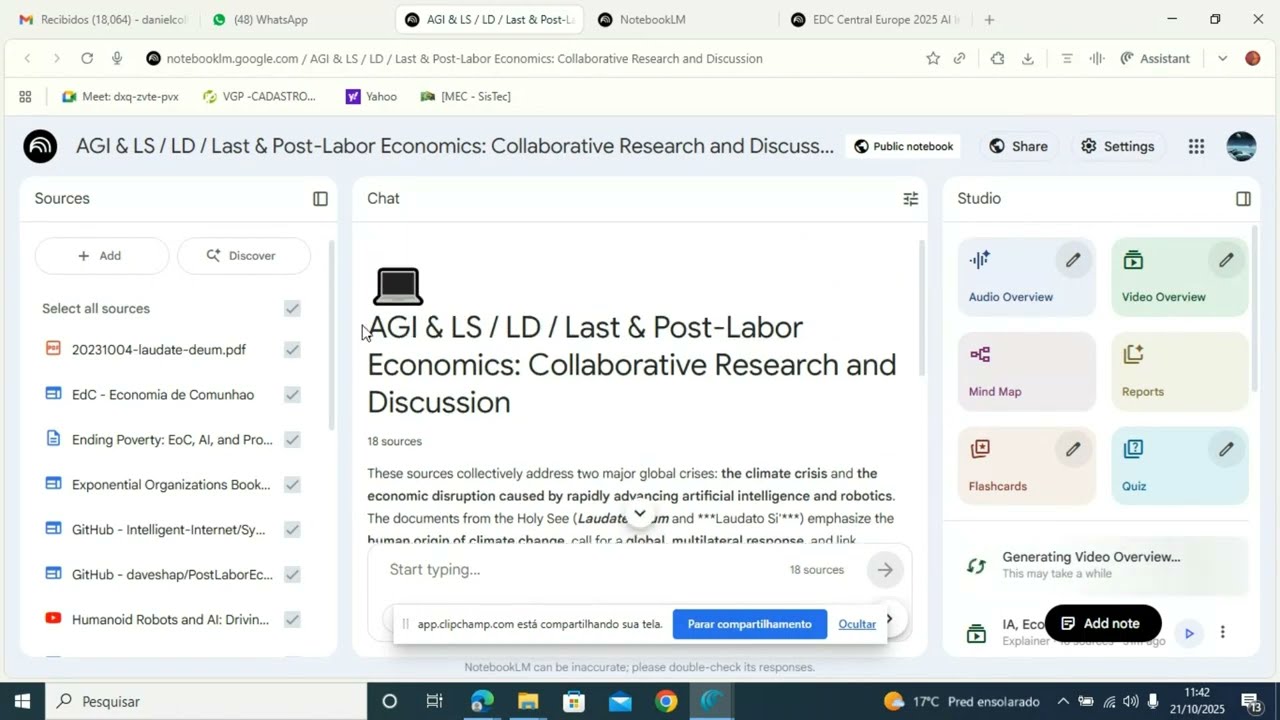
Boost Learning with Studio: Turn Your sources into Audio, Video, MindMaps, and More




Anima Christi - Beautiful Choir Performance in Corpus Christi 2025 - Stockholm - Sweden