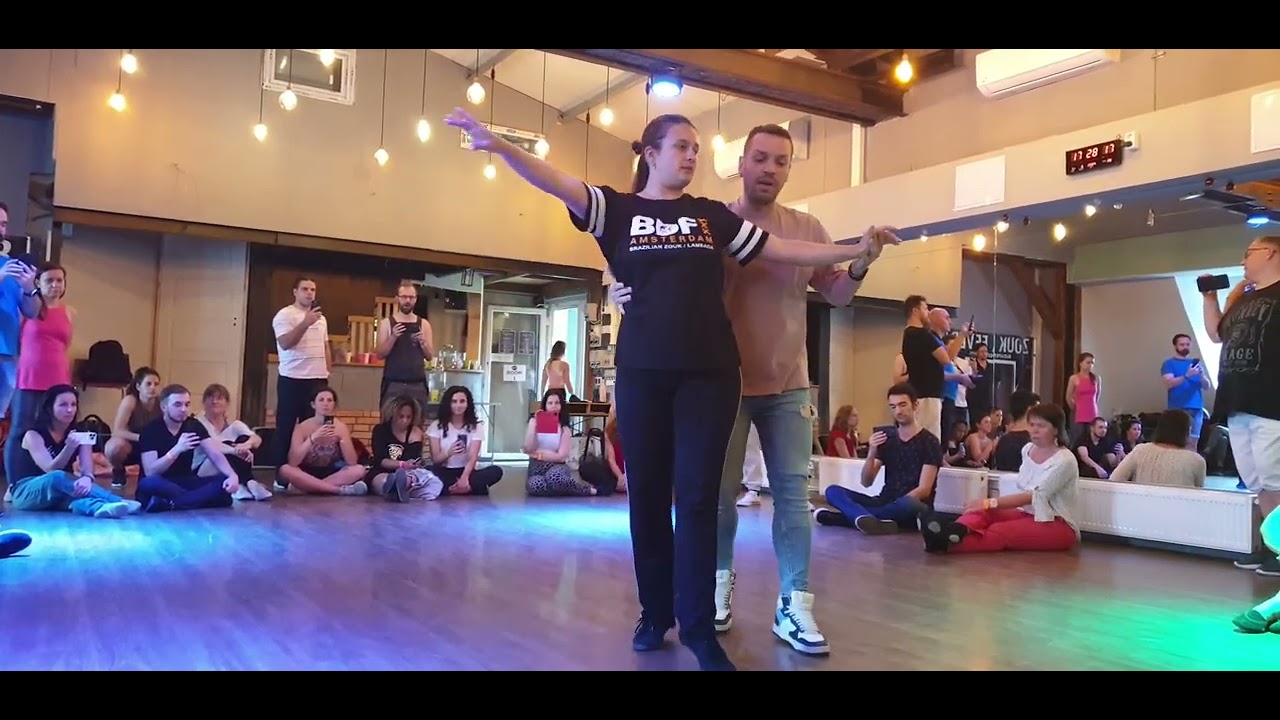
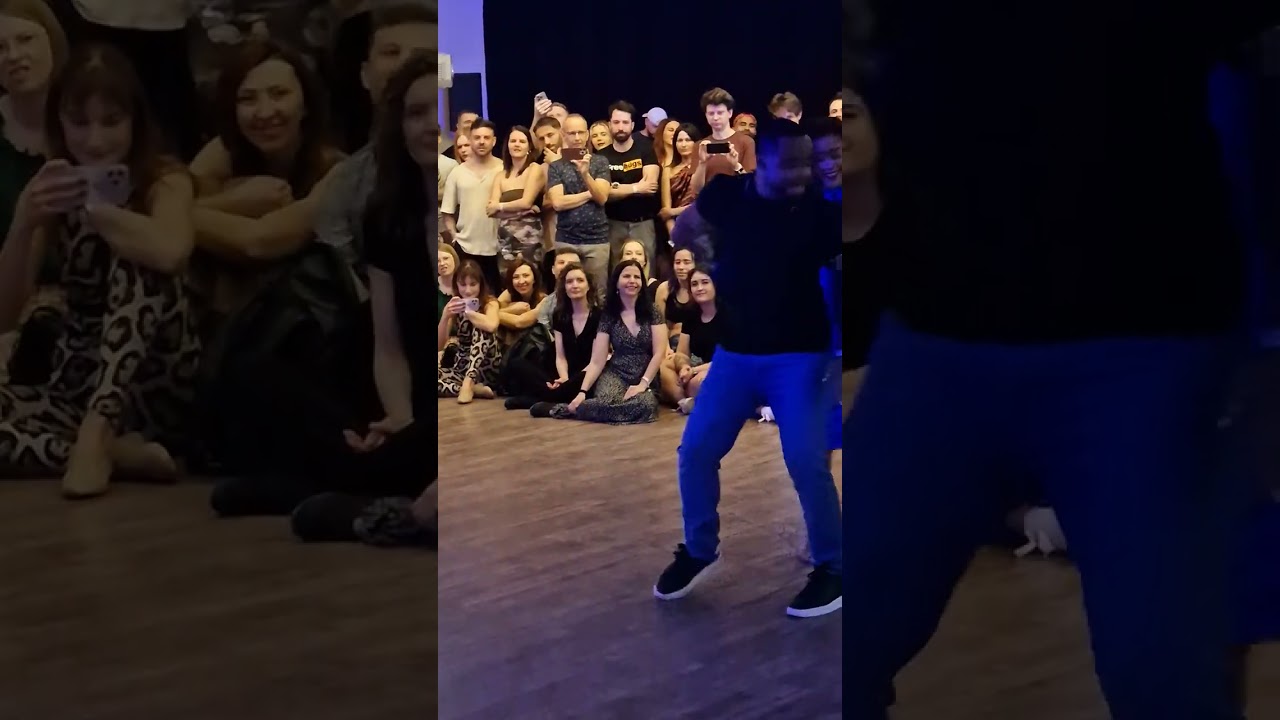
In this segment of the Budapest Zouk Fever class recap, instructor Alexandre (Speaker A) provides a step‑by‑step instructional walkthrough of a complex partner sequence. He demonstrates the reverse lateral footwork, emphasizing a small step with a knee‑snap centered in the movement, and explains how to manage extreme side extensions. He outlines the rhythmic pattern (slow‑quick‑quick‑slow‑quick…) and describes how to give the follow a clear impulse for a turn without over‑driving the rotation, using hand placement to guide the finish. He then shows variations: returning to the basic step, shifting into a shadow position while creating space for the follow to step between the leader’s legs, and adapting the step count to maintain flow. The segment concludes with styling cues—head reach, quick tilts, and coordinated head‑level changes—integrated into the final sequence. Throughout, the tone is instructional and supportive, aiming to help dancers internalize precise timing, body alignment, and lead/follow communication.
Chapters
And then the follow is doing the normal lateral. And I'm doing the reverse lateral. So I'm trying to do a small step and snap with the knee in the center of the movement. And I have to go to the extreme, uh, to the side. So we go to the back, small step, and then she's going to the other side. Prepare, small step, and she's going there. So slow and quick, quick, slow, quick, slow, quick, slow, quick, slow, and quick, quick. So from here, when I touch my left leg, so I'm leading her to turn. But not giving her the impulse to turn like, so that she can travel and turn. Because when she turns, I'm also this part, you know, like all the way to the end. Here I'm rotating her, actually almost bringing my hand to this side to keep her exactly in this position because only a smooth transfer and my hand is already here, she turns all the way back. So I want to give her the impulse to turn there. So I'm trying to turn on this part so her step doesn't change like it's slow to quick and then I'm just going like Slow and slow, slow and slow. Here, once I have our left leg free, I can start exactly like you might imagine I'm doing here. The same, uh, the first circle, our front foot first. Quick, quick, back.
And now she can play with her arm which is free. She can play here.
To finish the movement from here, I can just step left, right, going back to the basic step, holding the position. We can also do the same movement but instead of staying in her side, I can just stay like this, shadow position, but then I have to adapt a little bit my step because if I don't adapt, she doesn't have the space to step back. So I'm opening my legs at this moment exactly to make her step between my legs. Okay, but if I stay here, this is also possible. Then we can follow exactly the same line. I can go in here, a little more close, or from the basic step to finish. The right, I can lead her to turn also, simple turn, and raise the step. This step, last twice. From the base, I'm leading her to turn to the left side, raise the step, and preparing and turning. There, I can turn the door and turn and apply the head, 20 steps back. I'm teaching together, so as I lead, the little foot starts moving up with me, uh, so it's not being, uh, being by the arm or by the chairs. It's also teaching together. And then when they're And then you want to think that my head is in the same line, and then as you close the level separator here, boom! I just give you another beautiful score. Be careful, do not rotate here because it's not going to affect it. Okay. It doesn't get changed. It's approaching the same. So slow, head reach, quick tilt, boom, boom! Slow, head reach, quick tilt. So, and also, as soon as you get the whole sequence complete, slow, head reach, quick slow, head reach, quick slow, head reach, quick slow. Wow!