Google Exploit Secrets Revealed: SEO Game-Changer 2026 with Mark Williams Cook | Agency Insider Show
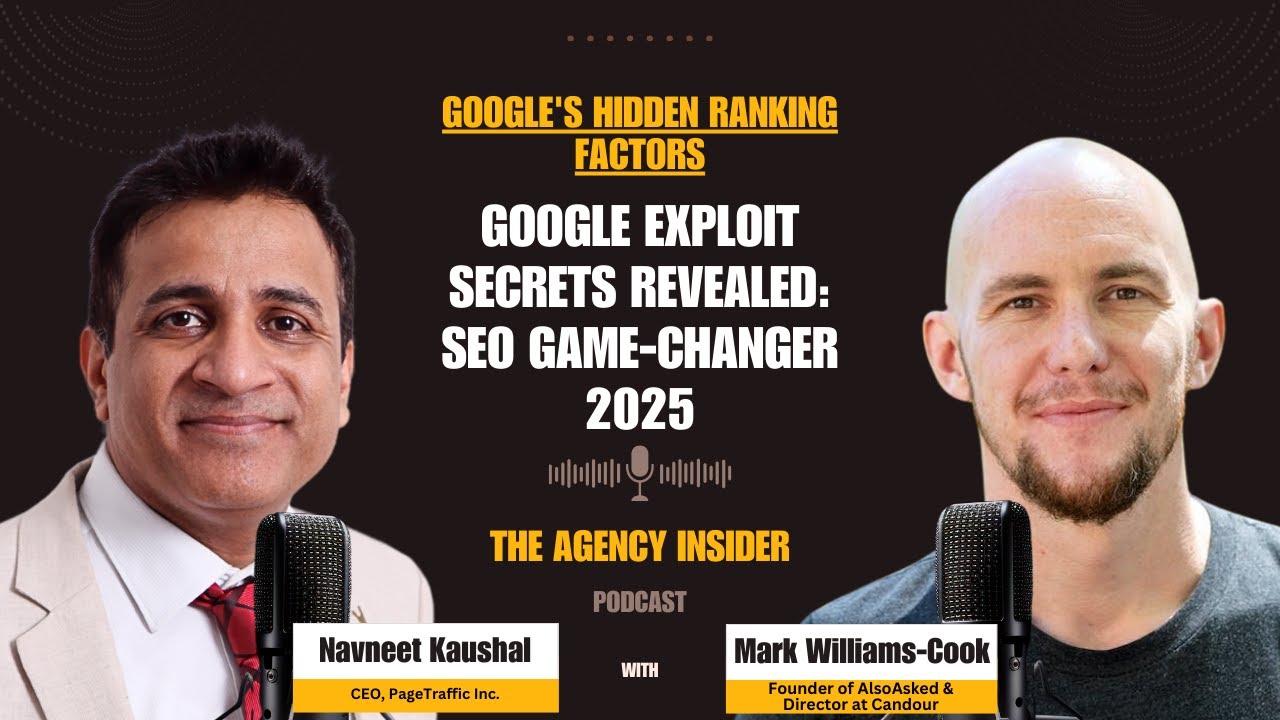
Mark Williams-Cook, founder of Condor Agency, discusses a Google Content Warehouse leak that exposed internal ranking factors like predicted click-through rates and site-quality scores. He explains how to use People-Also-Ask data for content strategy and why Google favors expert-driven content over AI-generated material.
Chapters
Welcome to the Agency Insider Show. I'm your host, Navneet Kaushal, and today we have a very special guest joining us, Mark Williams-Cook, a renowned SEO expert and a digital marketing strategist. Mark is the founder of Condor Agency and has made significant contribution to the SEO community through his innovative approach and insights. Welcome to the show, Mark.
Thank you very much, Navid. Very pleased to be here. Very pleased to meet you.
So before we dive into the juicy stuff, could you share a little about your journey in digital marketing and SEO and what led you to start Also Asked and deep dive into Google exploit analysis? Sure.
Uh, so I've been working in SEO around about 20 or so years now, and I'd say 16, 17 of those years have been agency side. So most of my professional career has been agency side. I actually got into SEO like a lot of people did around that time, which was by complete accident. So I was making websites from a very young age, like 11, 12. I think I was making my first websites and it was a lot easier back then. It was literally just HTML and drag it up on FTP, you know, no continuous integration and containers and stuff. So, um, and the short version is basically one of the sites I made, uh, a community site, had some kind of Amazon affiliate stuff on and it started generating like some really decent revenue. Um, and I had no idea why. Um, so I was selling at the time, through an Amazon affiliate, basically one DVD player a day or 2 a day. And my friend helped me install at the time something called AWStats. And we found out that all the traffic was coming from search engines. So that was my kind of moment of, huh, that's really interesting. Yeah, I use search engines. I wonder how they rank websites. And I started learning in kind of forums and actually built up my own like little portfolio of affiliate sites. And before I got my first agency job, it kind of helped me, I think, get my first agency job and kept them running for sort of side things most of my career. There were some points where I was earning more from my own sites than I was getting paid in my job.
Right.
Yeah. And that eventually led me, you know, I enjoyed working at agencies and began to Make it a short version. We started in a running candor because we wanted a slightly different agency environment to work in because agencies can be really tough places to work. Very focused on revenue and squeezing the most out of the time of the people there. So we've done a few things kind of differently for how we'd want to be an agency. Like we have things like a profit share for everyone that works here. We capped the size of the company and the amount of clients and such. And from this, doing our work, so how did we come across— how did we decide to make Also Asked was, I think, how a lot of this kind of project is made, which is through necessity. So we've been using the kind of data that Also Asked gives, which is the People Also Ask data from Google for many, many years. And I actually did a talk at a marketing conference quite a few years ago now, and I showed them how we were using this People Also Ask data. And at the time, we just had like a command-line Python tool we had written that we were using to do it. And I assumed most people were also doing that, but I had a huge amount of people come up to me being like, oh, can we have the script and stuff? And I was like, yeah, sure. and gave it out. But then the issue was people were contacting me for like support on how to use Python and this didn't work and debug this. And I realized, okay, it's a useful tool, but there's a barrier to entry there. Certainly like a random, say, person who does content writing and doesn't have any technical background is gonna struggle to get a Python environment running and all this, which is why then we were like, okay, let's build a web version. Um, and initially we did an alpha And just put it up for free to see if people liked it. And it got absolutely hammered. We were doing like millions of searches a month, which unfortunately was then incurring lots and lots of cost to the point where we had to close it. I mean, the last month that we ran the alpha, it was projected to cost us like about £10,000 in like proxy fees.
Wow.
It's a lot more efficient now than it was, thankfully. But it got to the point where we had to say, look, If it's— you can still use it for free in a limited capacity, but if you want to continue using it, like, we have to charge something because it's not economical to run it. So then we worked out kind of a paid model, which started very cheap because we wanted it to be accessible. And then that actually money that we got from people that supported us meant we could go on to develop more features and it kind of grew. grew into what it was today. And it was actually today, it was a little milestone for us. So we, today we were the headline sponsor for Brighton SEO, which is like the biggest SEO conference in the world. So it's a long way from 2 of us kind of building Also Ask to get into that stage.
So how long, how big is your team now at Also Ask?
Oh, now it's massive. It's 3.
I fucked it up massively.
I mean, we could, without going sort of too much into the depth of running a SaaS company, I mean, there's def— we could definitely do more with a bigger team. Um, but we've been bootstrapped the whole time. Um, we are currently actually taking on another full-time developer to speed up kind of feature deployment. Um, because we're spending a long time like on support stuff at the moment. Um, but we don't want to take investment money for what we've got, and we want to keep small because, um, you know, we speak a lot to our customers. Like, I— it's me normally. If you go on live chat for Also Asked, it's just normally me chatting to you. So I— and I love doing that because I hear in the frontline feedback customers have about what they would like to see and what problems they're having and what they like. And then I can feed that directly into the, the product. Um, development then.
Okay. Uh, and of course you mentioned SEO. Of course, last talk you mentioned SEO, uh, treating SEO like a video game. Could you elaborate on this unique perspective and how it shaped your approach in SEO?
Yeah. So, uh, this is in reference to this, uh, to the talk I did at Search Norwich. Um, right. Which, to take one step backwards, talking about conceptual models of SEO, which is trying to essentially build in your head an idea of how a complex system like a search engine, and it is an incredibly complex system, is going to work. And video games is one way I kind of explored this. I mean, probably the most helpful thing I did, I think, at the beginning of that talk was I did this example where I just drop a tennis ball, right? And I asked people to imagine how high it's going to bounce. Because my point to this is, you know, there's some known but not, I would say, generally known calculations you can do with the coefficient of restitution to work out how high a ball is going to bounce, right? And almost nobody, if you pick them randomly off the street, will be able to tell you how to calculate that, but almost everyone will be able to guess how high it's going to bounce, right? And this was my point that they have this conceptual model in their head and it's a way to make SEO more accessible in terms of, you know, Google has these incredibly complex algorithms. And my overarching point was you don't necessarily need to know how every individual piece works to understand what the output's going to be. And the example I gave to explore this was video games. So I've throughout my whole life played a lot of video games, and some people said I'm completely wasting my time. Other people joined in with me. But I honestly feel that some of the most valuable professional skills, including SEO, have been formed or influenced by that, because the way I view, at least the type of games I like to play, are their optimization challenges. Okay, and by that I mean, the example I gave in the talk was a game released in 1996 called Theme Park, which is like a simulation game where you're running a little business to make money from the theme park. And that, that's your optimization goal, right? To make money. And much like Google, there are different levers you can pull to affect that outcome. And what I found particularly fascinating about this game was there's various knock-on effects and undocumented features, as there are with Google. So to give some clear examples for this, if anyone's wondering what on earth I'm talking about, A documented example for something to do with SEO from Google is, say, a title tag. There is clear documented advice on how to use title tags. And just like in the kind of manual of the video game for video park, for theme park, there is documented advice. For instance, you can change the ticket price for entry of your park and you'll make more money if you put the ticket price up. Up until a certain point, you know, if you made it £1,000 to get in, nobody's gonna come. Same with page titles. Google tells you to make them descriptive of the page and think about keywords, but you can't just put 500 words in your title. I guess you can, but it's not gonna work, right? You're not gonna rank for all those things. And they're fairly obvious documented things. But the fascinating thing to me about SEO and why I'm still doing it after so long is that it's this ever-changing, evolving puzzle. So the example that I think is quite fun that I gave in Theme Park is you can have these little shops and you can sell chips and fries to people and you can change the amount of salt in them. And if you put lots of salt in the fries, people get very thirsty, which makes them want to buy drinks. And then you can put drink stores next to them and you can pump the price up of the drinks and people still buy them, right? Because they're really thirsty. So you— your optimization goal is is better met because people are spending more money. And that's not documented in the manual anywhere. And it's this interesting chain of reactions. And I was saying there's loads of undocumented things, like the majority of things really, I'd say, about how Google works are undocumented and require collaboration in the community and data points and studies and experiments and tweaking to find out. Again, the most basic example to give one, I think, is like anchor text. So Google never really was like super clear that the words in the anchor text were that important to your ranking. And it was discovered by the community. And actually, I think the funniest examples were we had a spate for a few years of what was called Google bombing, which was you could get any page to rank for anything by building enough links with the correct anchor text.
Yeah.
And the kind of capstone example of that was getting the, I believe it was the George W. Bush biography page to rank number 1 for miserable failure. And Google obviously had to patch that as well. And then again, without stressing this point too long, the other really interesting similarity between SEO and video games for me was, so I play online competitive games, right? And in that sphere, there is a concept of what's called the meta, not to be confused with the company that owns Facebook, but the meta refers to the optimal way to play the game, the optimal strategy, or the optimal things to do. And what happens in online gaming is when the meta is discovered, people gravitate towards playing that way because people generally want to win. But the kind of metric for the games company is they want people to have fun, right? That's their optimization metric, right? More fun, we make more money. So I guess it's they make more money, but they do that by kind of measuring fun, right? But if everyone plays in the same way, the game becomes less fun. And certainly it makes it less fun for people not playing in the optimal way. So what they do is generally they'll update their algorithm, they'll update how the game works to break the meta. Exactly the same as we discovered Google bombing works. You can just change this anchor text to what you like. Google's like, okay, well, we want to preserve what we consider, at least what Google considers to be a good SERP, a good result. So we're going to have to change the rules slightly. And there's this, that I see that all the time in SEO. There's this chasing of what's the, what should we be doing in SEO? What really makes an impact? we got— we kind of sway like a ship from one thing will be effective and then everyone swarms around it and then we see this big change. And I think the most obvious example we've probably had in like a decade is the helpful content kind of update where we had, um, before the helpful content update, we had a whole second renaissance in niche blogging, guest blogging. And this was, this was driven, I think, by all of the algorithm updates Google had done previously with things like BERT. So using their bidirectional encodings to understand queries better and how important specific words were. Um, and they'd made some specific changes around domain diversity, so they weren't just surfacing the same big sites. And the end result was people found actually, if you started with like really niche zero volume stuff, you could pretty much get brand new sites to rank. So of course then people were like, how do we optimize that? We do it in bulk. And we had this whole flood of AI, you know, I can't think of a polite word for it, stuff. And Google ranked it, right?
Right.
So Google had to obviously kill this. And I think, again, without, unless you want to explore it, I think one of the main problems was the way by the nature of how AI text is generated made it harder for some of the older statistical detection of spamming content to work. And some of the old patents I went into in the talk, I think, don't work as well as they used to with AI content. So Google put in a big wedge, which was essentially, although I don't think it's an accurate description, but it's a fair one to say, like brand as this wedge. And that's become the new meta, right? So I pointed out in the talk, I haven't checked it recently, but just before I did that talk, LinkedIn was ranking for like 90-odd thousand loans terms. And these are all AI-generated spam, but they rank because they're hosted on this domain that is having its authority abused, even though now Google knows that's a problem because they are specifically manually enforcing site reputation abuse. So that was a very long story and I guess a very speed run through what I covered in the talk. The way that I've grown up thinking about how to win at video games and optimize video games has served me very well in my approach to SEO. And I would recommend anyone plays more video games.
Well, I stopped video games long time back. I think I should start that right now. How has your background in programming influenced your SEO strategies?
Um, so that's interesting. So I think I'll be first, I want to be super clear in that I consider myself always like an amateur, uh, programmer, an amateur coder. So I've never professionally, like I've never professionally had a role that's solely a developer. And I've never, say, gone to university and studied computer science or programming. So I'm all self-taught. So certainly when I was starting SEO and building my own sites, I did kind of a lot of what now would definitely be just called spam. They call it programmatic SEO now.
Okay.
The programming side of things was really, really helpful for me because firstly, it did allow me to experiment and automate, you know, where it— so I used to—
we—
it used to be called kind of like dynamic pages, what programmatic SEO is called now, where, you know, do things like scrape information from the web that was maybe hard to find, build a database from that, and then build a script that would automatically build pages. For me. So those kinds of skills allowed you to generate websites that would take other people days and weeks and weeks of work. And especially, we were outranking big companies because they've got the extra kind of bureaucracy of they have to have a meeting about it first and then it has to be put into a pipeline. Whereas you're sat there eating your cereal in your pants and you've already finished and you're taking the dog for a walk. So there was that side, um, from a, from a, um, sort of more legitimate SEO point of view in agency world. I mean, that's, that was how things like Also Asked were born, right? So it allowed us to do these shadow IT projects because again, when I started SEO, Screaming Frog didn't exist. We had Xenu, um, Xenu's Link Sleuth.
Yes.
Um, but many of the tools that we take for granted now didn't exist. So we were doing our own crawling, um, to check for like broken links and competitive research and scraping the SERPs, you know, all before we had these SaaS platforms. So early on, it was massive. More recently, I would say it's been super helpful in knowing what is possible as well. So I still use— today, for instance, we're using like Python along with AI libraries to do things like 301 redirect mapping. So we're using like vector comparison, so the Facebook similarity search for vectors to make vector embeddings of pages and compare how similar they are. And again, that would be days of work. So we've done sites with tens of thousands of URLs and managed to produce perfect 301 redirect maps in hours by doing them and then manually checking the ones that it wasn't too sure about. I think that advantage is less than ever because I am using now myself ChatGPT and Perplexity to speed up my coding. We're in the early stages of this at the moment, so it's really helpful if I just want to have a simple script to do a job. 9 times out of 10, it can just do it. Um, certainly helps debugging code. I haven't managed to get it to do anything like too complicated yet, um, in terms of when you start writing code where you've got kind of multiple functions that you need to pre-plan how they're going to interact and what libraries and modules you're going to use and not use, then AI tends to go a little bit off the rails. Um, but again, this is relatively early time. So if anyone isn't a coder, you know, now is such a good time to start playing with these tools because they can tell you— not only they— not only can they write the code for you, but you can literally be like, how do I get this to run on my Windows machine? And it gives you guidance on what you need to download and if you need to install anything. Um, you know, I wrote my first Chrome extension last year, which I've never done before, and I had zero research, and I was just asking ChatGPT along the way, you know, what's a manifest file and where do I need to put that? And it told me, and it got it up and running.
All right, so now let's jump into the juicy stuff for which we are here, uh, demystifying Google exploits and data insights. So Let's deep dive into Google exploits. Mark, the term Google exploit might sound a bit intimidating to some of our listeners. Now, can you demystify what it really means? Specifically, how does understanding these mechanisms differ from simply following SEO best practices?
Hmm. That's a good question. It's a very, very good question. So by Google exploit, I mean, the definition kind of that is, um, we saw some, you know, data, some parameters that ideally Google doesn't particularly want you to see.
Mm-hmm.
Um, this isn't like the source code of the algorithm or anything like that. Um, and it's different to— there was a Google, what was called Content Warehouse leak, which essentially listed, um, some variables that Google, uh, uses potentially in some of their systems, although we don't know exactly what. Specifically, what was so interesting about what we discovered was the variable names also had values attached to them. So it wasn't just, oh, there is a thing called site quality. We could see this site has this particular score. And because they're surfaced by, um, by Google, it's a fair assumption, I think, to say that they are used somehow in ranking or post-ranking. And to be clear, the difference there is ranking, as far as I understand it, is this kind of long process that happens where Google decides, you might guess, which URLs it's going to rank for a particular query. Post-ranking is the thing that happens relatively quickly after that, where we have things like feature generation. So maps, featured snippets, and maybe even some tweaking, some re-ranking of the results that happen. And the exploit that we had was showing us what values Google was surfacing on the front end. So this is what they— I think what they were mainly using post-ranking. Doesn't mean that those numbers weren't used during ranking. If anything, it means those numbers do exist in ranking. It's just that they are also useful to reference post-ranking. So if they want to re-rank results or decide what to show and what not to show. So in terms of how does that change versus best practice advice, It's a good question because it doesn't— I wouldn't say anything goes against best practice advice, right? And the example, actually, I think I kind of covered this in the talk I gave, which is that if you boil Google's SEO advice right down to a kernel, you know, it would probably end up something, you know, like build helpful content for users, right? And you can't fault that because it's not wrong, right? You should absolutely build helpful content for users. However, I think it is disingenuous to say that's all that is within the Google algorithm because, I mean, the point I made is quite bluntly, Google exists to make an ungodly amount of money, right? And that definitely has an impact on the type of results we see. Um, You know, the most obvious example is Google has all kinds of features and tricks to essentially keep us on their search result page. And the reason they want to keep us on the search result page is that's where they can make the most money.
Right.
Even if they send you to a website that has Google AdSense, their ad platform running, they're still getting a smaller cut of the money than if they are the person that serves that ad. And of course, there is a very double-edged argument that they will give, which is, well, we have data that shows our users prefer to stay on the page. I think all of that philosophical debate is moot now because Google has been found to be a monopoly and has been found by a judge to be abusing their power to do all these things. So I think it's kind of a waste of breath trying to argue that they are. So I think going into SEO, you need to accept that's the case. And outline of any SEO strategy for me is always you need a business model that isn't getting in the way of Google making money. Because if you get in the way of Google making money and you're relying on them to generate you traffic, at some point Google's going to come and take your lunch. So with that as the kind of playing field, how does information of an exploit change how you do SEO? It helps you see from a factual basis the things Google are looking at, um, and you can— you have a new set of what I would call axioms. So axioms are things that we know to be true, right? Because a lot of SEO work is You'll build, you have a few axioms like Google uses PageRank, right? And we know links are important, right? They're like our axioms. And then we start building on ever increasing levels of abstraction. Like, well, I think, you know, I, I think links from, um, you know, .gov sites are more important because they're .gov, or I think that sites, uh, links from related sites are really more important. which all makes logical sense and there's supporting material, but the further up this chain we go, the more kind of we're going into guessing territory. So when we get data from things like the warehouse leak from the exploit, it allows us to be like, ah, well, we know our kind of our guess where we were 3 points high here is actually true. So we can— we know anything that stems from this is actually worth more. So To give you a concrete example, and the most interesting one for me has always been, and something I'm really interested in, is around click-through rate. And this is one of the most confusing examples for SEOs, and it's a brilliant demonstration on why SEO testing is very difficult to do. So Google has for a long time said, we don't use click-through rate in ranking, in our ranking algorithm, right? And it doesn't matter how many, you know, what kind of click-through rate your site gets. People are like, okay, fine. And then people go away and people test things as they do. And there's a few of these. Rand Fishkin did one that was quite well covered, but there's been several where people do click-through rate manipulation studies where they'll pay a whole bunch of people to click on this result in position 7.
Right.
And lo and behold, 2 days later, it's in position 3. And so everyone wags their finger and says, hey Google, you're lying to us because we can reproduce this and we can test this. And Google sort of is quiet about it. And what kind of came out of this for me in looking at the data was what I believe is happening is in this instance, We saw from the exploit there was lots of data around predicted click-through rates. So what Google thought people were going to click on based on the query, which makes a lot of sense, right? Because they want to show you things for a query which they think you're going to click on. And actually it makes even more sense when you consider with Google Ads, paid ads, for many, many years, like even when I was doing Google Ads like 15 years ago, they calculate a thing called quality score, which affects your— used to affect, not so much now, I'd say— your cost per click. And one of the factors of that was your predicted click-through rate, how good they thought the ad was. So it makes perfect sense they would apply that same model to organic. So what they're actually doing then with that prediction is saying, for this query, we know people like this kind of website or this kind of content, and there's various know, boring mathematical ways they can represent that to get this click-through rate. And they use that as part of ranking. Now what that means is it doesn't matter if someone clicks on your site 100 times, it's not really going to affect your predicted click-through rate because the model is aggregate data. It's so big, it's not really going to have an impact. So that statement that Google made of, you know, we don't use click-through rate on individual sites directly in ranking is true. You know, so then the question is, well, why do we see the rankings change, right?
Right.
Um, and then this has got to do with, I think it's kind of sneaky, but the wording around, uh, post-ranking. So the thing that happens after ranking. And again, another axiom, another, um, bit of grounding we had was during the DOJ, Department of Justice trial, where Google showed us loads of documents from like the mid 2010s, like 2016.
Um, right.
Um, and the name, specific names of different systems they were using. And they gave examples of when, what I believe they're doing is when the click-through rate of the SERP wildly contradicts what their model says, or it, or it changes very quickly. So they have that RankBrain thing going on that's tracking SERP interactions. they know something has changed in intent, right? So the example that they gave in the DOJ trial was, we have a SERP for nice pictures and we have the ranking, and then there's a terrorist attack in Nice, France, which is spelt the same, and everyone's clicking on something different. They're clicking on the country. So we decide actually we need to pop that to number 1 because it's what everyone's clicking on. And I think that's the same thing we see with CTR manipulation. So suddenly site 7 gets, you know, it's ranking number 7 gets clicked on. So that front end kind of system goes, oh dear, I think the prediction is wrong. Something has changed. I don't need to know what, but everyone's clicking on this. So I'm going to pop it up to number 3 or whatever. Because in all of those click-through rate studies, when the manipulation stops, the rankings go back to how they were ranked in the ranking system. So for me, this is like confirmation. And, you know, even with the Google content leak, hearing all of the different systems that they use, um, and understanding that, you know, there is a, that there is a Googlebot crawler, but the Googlebot crawler isn't doing anything with JavaScript. That's done, you know, later in it with, uh, their rendering service. All of these things are really helpful to understand how you should approach SEO from a technical point of view and what you need to be focusing on. So the last second example I'll give of that was when we uncovered the site quality score. We've discovered there was a very specific score that if you fell below this, you wouldn't get some rich results like People Also Ask results. Which means if part of your SEO strategy is, oh, we're going to try and get these rich results to get clicks, and you're there optimizing your kind of on-page and you're like, oh, but I read this guide, this is how we get featured snippets. You don't realize you're not even in the race to get featured snippets because you haven't qualified. And that was one thing that became obvious looking at this data was there was like these multiple levels. Um, that Google seems to put you through. It's like, if you want to be in this race, you have to come in the top 10 in the last race, and then so on and so on. So again, it alters strategies where it's like, okay, well, we're not getting featured snippets, and it may actually be because we've got no brand and nobody links to us. The content is fine. So making— understanding that there is a prerequisite order to things as well. And like many good SEO people have said for many years, it's not just about focusing on one particular tactic. If you want to be a good marathon runner, you need to, apart from train, you need to have a good diet as well, right?
Right.
You can't just go out running and then eat burgers all day.
Right, right, right. Okay. Now, so is exploiting these insights about finding loopholes or is it more about understanding Google behaviors to create better content? better content and experiences?
Yeah. Again, so one of the, I mean, I'll just answer the question. Yeah. Answer the question directly, which is, yeah, it's definitely not about finding loopholes. Um, I can tell you there's nothing, there was lots of really, really interesting things in there, but there's nothing that lets you kind of like hack how Google is working. Um, You know, that's, that's the point of this system. Even if someone could understand exactly how all these things worked, I think it would be unlikely you'd just be able to then rank for anything you like because you still need all of those. The way you're scoring in a lot of these situations is by doing the work, by writing the good content, by getting people clicking on it and engaging with it and not bouncing off elsewhere and people deciding to link to it and being on a site that has been around and has been getting coverage for a long time. So no, it's, you know, it's, it's all about learning how to deploy your kind of SEO resources in the most effective way for your, for your specific instance, that there isn't a one-size-fits-all SEO. You know, that was one thing again that was highlighted with the exploit, which was the clear classification of things like YMYL, your money, your life queries. Google has told us that they focus on different sets of their ranking factors when it comes to these kind of queries. So what applies to, you know, a gambling website may not apply to a website that sells dog leads. You know, so no, it's not about exploits. It's about having that advantage by that understanding, because that's what SEO is, right? The O is optimization. It's not doing anything secret, it's doing 100 things slightly better than all of your competitors.
Okay, now you, you also mentioned that Google uses a consensus score for rankings. Could you elaborate on what contributes to this score, and is it strictly about corroborating content with authoritative sources, or are there other levels like, uh, user behavior signals.
So I think I just want to be careful here in— there's factually what we found, which was that Google appeared to be measuring consensus on at least some pages by counting the amount of bits of paragraphs of content that agree, disagree, or are neutral to the consensus. And it seems from that collection of those 3 things, they calculate an overall consensus score. Okay. Um, there were also classifiers for queries that logically I think would be related, such as, uh, a Boolean for is debunking query. So is something a debunking query? That's factually what we had. Google has released publicly information about how they tackle misinformation and disinformation, and they specifically mention the concept of consensus in that documentation, how they use consensus and in what situations they use consensus. Google has also specifically said previously, at least, like, you know, we can't algorithmically determine what is correct and incorrect. You know, they, they have to rely on consensus, I believe. So from that, my, my personal opinion and professional kind of conclusions from this is, and this is partly just trying to think logically about, again, what Google is trying to achieve as a search engine and what good results would look like, in that consensus would be consensus, which is agreeing with the general agreed opinion, would be important in cases specifically like YMYL, which is where they mention it in their documentation. So if you were telling someone how to treat cancer, for instance, you know, horrible topic, but you would hope that Google would provide results that have genuine scientific evidence that might actually help people. Rather than whatever made-up at-home cure someone thinks they have. So in those cases, I think you have, from an SEO point of view, from a practicality point of view, if you're in those areas, like we work in, like drug rehab is one of the areas we work in, which is why I'm Wild Topic. If we're publishing information about those things, I think it's worthwhile considering If you have content that is contrary to the consensus, I would maybe separate it. So the page that I want to rank for something sensitive like that is providing authoritative, factually based, referenced, citated content by an expert. If I want to talk about alternative things, I would just make a separate place for that. I think it's a really interesting conversation when you come to things like politics, right? Because there is no objectively correct answer. There may be consensus, but does, you know, in politics, you know, does consensus matter so much? I would argue no. Like, that's kind of the point in politics, right? So, but that doesn't mean that a consensus score can't be used. I think it actually means it can be used so it can guarantee some diversity in the results. So that might mean for a topic where there isn't an objectively correct answer, an algorithm may intentionally say, okay, well, we'll make sure we have some things that agree with the consensus. make sure we have some things that disagree and we'll make sure we have some middle-of-the-line stuff. And then maybe on top of that, we'll see how people react to those things and if anyone uses the feedback tools on Google for, this is a bad result kind of thing. So I do think there are important topics like politics where subjectivity reigns and that's how you would, how you would use consensus. So I'm not saying to succeed at SEO, you must publish content that goes with the consensus. I'm saying there's some areas where that may well be the case. Logically, I don't think that would apply across the board.
Okay. Now, so what's your advice for agencies or marketers who want to build a robust content strategy that aligns with these consensus-based rankings?
So I was having this conversation today with with a client that engaged with us and wanted us for their niche to provide them content end to end. So they said, we want you to research the content, write it, and upload it to the site. And I said, that's not actually something we do. We can help you with content strategy. We can help you with keyword research, with gap analysis, finding out what your— customers actually want to read, what competitors do. We can brief it, but we won't write it. And they were kind of like, why? And my answer was, well, there's no one in my team who is like a genuine expert in what you do, right? So we could do that, but we would be getting all of our information from maybe Googling stuff. And if we can find someone to like interview or something, we could write it that way. Now, in my opinion, that's just a very slow and inefficient way to do what ChatGPT is going to do, right? Which is just research things online and, you know, do kind of retrieval augmented generation approach. My advice to them was, yes, you should do all those things to get you up to the briefing stage. Then you should be talking to someone who is an actual expert. And as a tip for people that run agencies, one of the ways we've been doing this now is actually to have video interviews with product service experts, a bit like how we're doing now.
Mm-hmm.
And I'll have my content brief and I will essentially, similar to how you're doing to me, kind of feed them questions. And even if we go off script, I will explore that. And then once we've got that video, even if we're not going to use the video content for social media or even the website, We transcribe it, and then as a first run, we can get an AI to make an article from that. Because we haven't generated the content from an LLM or what exists online, so we haven't done RAG, we still have, hopefully, that expert's unique insight, their unique take, which then obviously needs to— it does need to go through an editor and make sure tone of voice and everything is correct with, and it is all factually correct. But I found that having a human conversation with someone, we can actually get a lot more useful information out of them rather than if I send them an email being like, can you answer these 10 questions about this thing and also write about this topic? They tend to be very robotic in that they just answer the questions and they spend a lot of time thinking about how they're writing because they're probably not professional writers, right? They've just been asked to write something. Whereas every— most people at least, will find it easier just to have a conversation. So that would be my advice in terms of if you're needing consensus is don't— you need consensus, but you also need a reason for a search engine to rank you. Because if you are just writing what exists as the consensus, why would Google ever want to rank your content instead of generating an AIO itself? This would defy the first rule that we spoke about earlier, which is they want to keep you on the SERP. So you're not giving them a reason to send them away.
Right. Now, you also talk about Quality Score, which of course we associated with Google Ads, but it's intriguing to know it's also something applicable for the organic results as well. Now, how do you think it influences a site's eligibility for rich results or other Google features? I mean, you mentioned some of them, but if you can elaborate on this. Yeah.
So, so to be super clear and differentiate between the two, the, the parameter that we found was called site quality and the Google Ads score is called quality score. So quality score and site quality are different. They sound very similar, but they're calculated differently. Now, with site quality, I ran a whole bunch of tests with Spearman correlation tests with different metrics from tools like Ahrefs to try and see if I could get an inside track on how Google was calculating this. So like, is it related to the amount of links or the number of links? Is it anything to do with the link graph? And I couldn't find anything to do with like Ahrefs data, which is what led me down the path of trying to find the patent. Now, there is the patent called Site Quality. It's quite an old patent now. I presented that in the talk because I think it's the best piece of— the best axiom, if you like, of information I have where this is correct, this is a patent. The important thing about patents is that They're not necessarily used at all. Just because a patent exists doesn't mean it's used. And secondly, it may have changed somewhat, or it may have changed drastically since that filing. So I would— knowing what Google is using now in terms of kind of AI and hearing about that, I would be surprised if site quality is being used as described in the patent. So I think the broader strokes of what it describes, which to put it very, you know, to maybe do it injustice, is roughly some kind of like brand navigational score for how much people are looking for you specifically, which I think is interesting with the changes we've seen. That was the kind of score that we think it's generating. And in terms of rich results that are generated post-ranking. So featured snippets, um, and the example I'm always interested in, which is People Also Ask results, um, anything where a site is basically determined to be good enough to be highlighted, um, on, you know, the Google page in a kind of special manner is what they at least appear to be using this score for. Now they could be using it for other things as well that I haven't found or aren't— weren't visible to me. Um, but there was this, uh, the cutoff was 0.4. So it's a score that goes from 0 to 1. Um, I believe it's, um, like a logarithmic score in that getting from 1 to 2 is much easier than getting to like 6 to 7, for instance, the difference. Um, and I believe that because we had around 800,000 sites to score for them, the domains. And the distribution was kind of this normal distribution curve where most people fell into that kind of middle score of 0.5, 0.6, 0.7. And then it really started dropping off and there were very few sites that were like 0.9. And when we were specifically scraping different features, there was nothing below 0.4, which is how we determined, okay, that is the cutoff. So again, that's super interesting. That says to me that— and it makes so much sense when you explain it. If Google's going to gamble on putting your content featured on that search result, They want to be sure that you are a thing, you are a brand, you are a real website, and you're not just some site written by a random that appeared a week ago. So I just think it's quite a— we rarely talk about— well, it's rarely talked about just in terms of content quality because you're like, yes, quality content, helpful content. It's also who is delivering it. The other analogy I sometimes use with clients is when it comes to trust and authority, everyone's got friends who maybe exaggerate a lot, and they've got friends maybe who are just very literal and always tell the truth. And if someone tells you a hard-to-believe story, you can hear the same story of 2 different people and walk away thinking, I don't think that's true. Or you can walk away thinking, wow, Alex said that, it definitely happened just like that. So, and it makes sense. Google applies that model in the same way. You know, just because your content looks good, it also needs to be delivered from the right platform to make the whole package believable and for Google to risk repeating it as a featured snippet or something.
Right now, are there specific indicators like backlink profile, content structure, or UX that Significantly impact or improve this quality score?
So site quality, uh, I couldn't, I couldn't see anything that would be easily measurable. No, because I tried to tie it back to, uh, like link graphs. Um, I think trying to, I mean, is it, is it related to like content quality? I wouldn't even know how to go about measuring that. I mean, that's like a Google-sized task, right? It's like, okay, tell me what you mean by site quality first, and then we're going to get into an hour-long discussion on how we define content quality.
Right.
So the short answer is no. I had these scores. I think my feeling is from looking at the painting, a lot of the influences, and this is the point, a lot of the influences of this are external. This is like PageRank in that the reason PageRank was so important in terms of search engines is because it wasn't under the direct control, at least for a while, of site owners. Because when they were using meta keywords, everyone was like, cool, I'll just put all the keywords in. And that's why people like AltaVista struggled, right? When Google were like, okay, we're going to democratize this a bit and it's what other people say about you.
Right.
or how they link to you is important. I think this is a similar vein to site quality in that it's how many people are searching specifically for you and it's how many people are specifically clicking on you in the search result. They're not things you impact with, you know, how many keywords you've got in your content or how well-written it is or what images you use or how fast your site is. And that's the point.
Okay. Now, now Google calculating estimated CTR for each queries and URLs, of course, which something which we knew is something Google didn't agree. Now, can you shed light on how these predictions might shape rankings and how brands can adjust their strategies to meet Google expectations?
So I think your predicted CTR will have a minimal impact on how well you rank. All these things obviously work together, compound each other. You know, there's a lot that goes into ranking. 100%, you should be doing some kind of A/B testing on things like page titles, arguably meta descriptions. I'm not a big fan of them because Google changes them all the time and it's kind of query dependent, but I think page title is particularly important. There's loads of very affordable platforms like seotesting.com, very quick and easy, set up a test. It's another good use case for LLMs. There's been some great work using things like BERT and GSC data to fine-tune models to actually suggest what might be a better page title for you. So I've seen some very smart people automating this process by having feedback loops of analyzing their GSC data for click-through rates, automatically adjusting their page title, setting up A/B tests, and when they have a statistically significant winner, guy, like putting that as the kind of candidate page title. So I think that's worth doing because it's an easy thing in terms of if you have a 2% click-through rate and you can get 2.5%, even if you don't change your ranking, you've just got 25% more traffic for that keyword, right?
Yeah.
So that's massive, right? And I think that's SEO. SEO to me is getting more traffic from search engines. It doesn't necessarily mean you have to move up a ranking. You just want more traffic. So Um, for me, that was, that's now more important, I think, than it did used to be. Um, so I'm, I'm not saying it's going to change the world of SEO, but for me, I've certainly said, okay, for every single client we've got, I want to have a system where for their popular pages where they're not ranking number 1, perhaps we are constantly working on iterative improvement. And I, you know, I mentioned earlier about the SEO testing stuff. That's something we use heavily now, especially on big sites. You know, if you make a change to a single category and then a month later you found, okay, there's a 6% uplift and all the control groups are the same or down, and then you can just deploy that site-wide. And it's a very easy argument to make then because that's the other obviously difficulty, right, about SEO, which is forecasting and a Trying to justify why changes are being made, and then if you make a site-wide change, there's the argument of well, could that have happened anyway, or are more people just searching? So split testing for me ahead of time just knocks all those arguments on the head and makes it easy.
Okay. Now, what are some underutilized data sources or analytical methods that you believe agencies should start leveraging today?
I'm always going to say People Also Ask data because I think it's still the most underutilized. You know, I banged this drum for so long. And I'll tell you why. It's for, I think, going into the future that we're going into, which is that people use more words in even typed search queries than ever before.
Right.
When I was using AltaVista, it's like 1 or 2 or 3 words tops you'd use because the search engine was basic. Now people's search queries are wildly specific. This means to me, unless you're using tools that are very intelligently grouping together groups of these searches, that things like search volume are less important than ever. Because if you give me a 5-word query, I can probably rewrite that query 20, 30 different ways and it will mean the same thing. So unless you're going to get me the search volume accurately for all of them and add them up, you know, it's kind of a bit of a moot point to me. So, and Google, you know, is good at deciding, well, all these queries kind of mean the same thing, so I'm just ranking this page. You know, there's loads of examples now where you see pages ranking for terms and the terms aren't even verbatim on the page. It's that Google just understands that, right? So the reason I like People Also Ask data is firstly, we know from the DOJ documents, Google uses their People Also Ask box as an induction feedback loop to understand queries better. So they're like, because query, the intent, lots of people talk about query intent now. Intent is not objective. Meaning you take the same query and 2 different people might want 2 different things from that query. It might be completely different because lots of words have multiple meanings, right?
Right.
They're completely different subjects. And firstly, that's the data that people also ask. PAA data immediately surfaces. You put in a query and sometimes I do that with clients and they look at one of the branches of the tree and they say, Oh, well, no, that's not anything to do with us. And I'm like, yeah, but it's important you know that a percentage of the people searching, yeah, aren't looking for even your industry. Because what proportion of this search term that you've brought to us with 5,000 searches a month is actually then looking for what you do? Is it 80/20 or is it 20/80? So firstly, there's that. Secondly, the way in which keywords and intent is mapped and understood. So a really good example is if you put in, say, something about, say you have a query like, is my dog poisoned, right? So your dog ate chocolate or something. And you ask keyword tools like, what's related to this? And they'll give you semantically related terms or Google Suggest will be like, my dog is my dog and it'll give you all the suggestions, and then it will give you lots of similar searches. What you get in People Also Ask data is queries that maybe don't even contain any of those keywords, but they're like the next most likely thing to Google, which will be things like, um, how much— what can a vet do for poisoning? How much does a vet cost for poisoning? Because that search is probably being done in distress. Because someone's like, you know, their dog's been sick and then they're on Google like, oh, what do I need to do and how much is it going to cost and should I take them to the vet? So they're not like semantically related in that way of these, but they are related in that these searches happen in close proximity. That's the data you get from PAAs, which can then inform the actual intent of what you should be writing about. You know, you don't want to be writing about maybe like pet insurance at this point, because they either have pet insurance or they don't. It's not the time to sell them pet insurance.
Right.
And lastly, the other fascinating thing to me is there is no keyword data source that is updated as quickly as PAA data. If something happens in the news, if there's an election called, there's some kind of emergency, you do a Google search, the PAA data is already showing what people are searching for. And in SEO, sometimes being first to publish is massively important because there's no competition and you get all of that traffic. So the, like when the last version of GPT was released, I was using this as a demonstration during training in every keyword research tool. It'd been out like 3 days, said, oh, there's zero search volume for GPT-4.0. I'm like, it was obviously not true because it's all over headline news. And you put it into Google or into Also Asked, and immediately you've got, how is ChatGPT-4 better than ChatGPT-3? How much does ChatGPT-4 cost? So we know what the intent is already. So I think in terms of, you know, how many agencies and how many companies are monitoring PAAs around topics for when they change to be the first to publish? Because intent doesn't intent kind of naturally drifts. Another great example was around COVID. So we've got a feature on AlsoAsked that does like a timeline, which shows you how intent shifts over days, months, weeks, years.
Right.
And if you look back 3 years ago for searches around COVID, it's all these searches where people are asking things like, what are the symptoms for COVID and how long does it last and all this. And now, The searches are basically like, do I still need to stay indoors? You know, what's the law? Like, people, it shows people's now apathy and they just need to know, are they allowed to get on a plane and can they go to work? And they don't really care about the symptoms anymore or anything like that. So if you had content that was ranking for something before, it's, and you haven't updated it, it's probably not relevant to actually when someone searches for the same query.
Yeah.
What they're looking for now, and I just meet so few practitioners that are monitoring that. People look at keywords once, they write the content, and then they go, "Cool, we've done it. We've done that page.
Onto the next thing." Right, or onto the backlinks.
Yeah, yeah, exactly.
Yeah, exactly. Right, right. Now, if you could boil all this down into three actionable steps, what should agencies or marketers focus on immediately to make the most of these? Google Exploit Insights?
I'd bang the drum and say, um, well, yeah, PAAs. I wasn't going to say that, but yeah, we'll get that in first. So PA data for me, for those reasons, is something I would definitely be on top of. Um, I would, um, think about how you can use your marketing to, um, overlap with your SEO. So I'll give you an example. Because there's been lots of advice going around, which is just build a brand, right? Which is great, but it's kind of hard to build a brand. It's like a big job. So my small bit of advice would be, if you're doing, say, adverts, rather than say, visit alsoasked.com, I would say, just search Also Asked. Or I know we rank number 1 for people also ask tools, so search for that. Because what you're then doing is you're generating that demand in the search engine and you're demonstrating that people are picking you. And you're increasing your brand searches. So I think anything you can see, there's things outside of SEO you can do that demonstrate to search engines that, you know, you are the person, you are the brand for this topic. And lastly, I would say using the words, it's kind of like what not to do. So I'll try and frame it in what to do, which is, you know, Use actual experts and use video. So video, like video growth is massive now for SEO. It overlaps with everything that came up with the exploit in terms of, you know, stuff we haven't touched on, like things about engagement and click-through rate. And it's hard for AI to copy. The biggest problem I see at the moment, in my opinion, in SEO is the hype and misuse of AI. To the point where it's already creating like a little bit of backlash. AI slop is kind of the term. It's just everywhere. So don't do that. Focus actually on the quality, getting the right people, doing it in the best format possible and working downwards rather than upwards. By that, I mean, it's easier to make a podcast and text from a video than it is writing an article and then trying to make a video.
Right. Right. Oh yeah, that's amazing. Yes, they are. Is there a low-hanging fruit you see most businesses overlook in terms of using Google's algorithmic tendencies to their advantage? One, I know you talked about SEO testing with the title, but are there any other low-hanging fruits?
So that's an interesting question, cuz I guess it, it depends. It depends on the ability of the, the company. I think the most common thing I see is like a, it's like a user experience slash technical thing, which is most companies that SMEs we engage with have some kind of blog. And by blog, I would define that as they have a chronological way in which they post articles. However, the articles they're posting a lot of the time are evergreen in that they, people, they'll be as relevant in 6 months' time as they are on the day they're published. However, because of the structure of their site, Once they've published another 20 articles, the only way a user can find that is to go to their blog and then click on page 2, page 3, page 4 until they find the thing they're looking for, which is nuts. When you, when you say to, when I say to a client, okay, this is a really great, you know, guide you've written here. Can you show me from the homepage how someone's meant to find that? And then they're kind of like, oh. And from an SEO point of view, from a PageRank point of view, from a how search engines look at it, that URL, that document is not going to be considered very important if it's like 3 clicks deep compared to if it's linked to from a main menu. So the low-hanging fruit would be if you have valuable content on your site, make sure it is easily and prominently linked to and findable for users, right? And then good SEO things will happen.
Yeah.
There's no point investing all this time, effort, and money in researching and writing content to bury it on page 9, you know, in your blog, right?
All right. Now we, we just running out of time, so I'll just be a little fast. So now, uh, let's talk about your work with Also Asked and intent mapping. How do these tools contribute to a more effective SEO strategy?
You can, so I think in fairness, we've covered a lot of that. Already.
Yes.
So I'd say specifically, I guess, given all the reasons why to use PAA data, I'd say the reason that AlsoAsked is helpful is the only way to get this data is either manually, which takes absolutely ages. There are some Google Chrome extensions that will do it for free for you, that would scrape them. And, you know, I'm not pretending they don't exist. Go and use them if that if that's your thing. The reason why I'd use AlsoAsked is it allows you to do these queries for any country in any language without using like a VPN or anything. And this year we're launching, you can do it from any specific city because we're seeing city personalized, yeah, PAAs. Not only that, it generates the, map that shows how the queries relate to each other, which is very— they're super popular both in proposals and for giving to content writers. Sometimes you just give them the images and it helps them decide how to write and structure their content. We do a full data export that shows the actual answers that are ranking. So you can plug this into like an LLM if you want to do sentiment analysis. Some people are using it to see the questions people are asking about their brand. So I used Revolut as an example, which is the challenger online bank. And if you do that and get the PAA data, you can see all the questions are about how much money is it safe to put in Revolut? Is Revolut legit? So you can immediately see on their homepage, you need to reassure people that you know what the safeguards are.
Right.
And lastly, we're the only tool that I'm aware of in the world that offers a API, both sync and async, which means you can get the results immediately. Or if you've built your own app, you can send off a query for like 1,000 results and it will cook away and it will send you a little ping when it's done. So you can integrate your data in any tool. So we're in Daniel Foley Carter's SEO Stack tool. It's a whole suite of tools and he connects to our API for that. So literally, if you're doing programmatic SEO, If you are dealing with massive sites, if you've got your own tooling to help generate content briefs, you can connect it all up. It's super cheap and it works in real time, which I don't think anyone else does. Wow.
Now besides also us, are there any tools or resources you would recommend for marketers and SEO professionals to stay on the top of their game?
Oh, so many. Um, I think a good, uh, good starting point is always, uh, learningseo.io, which is Alayda Solis has lovingly put together a massive list of resources, that's such a good place to start. In terms of stack of kind of tools that I use regularly, I think you mentioned Screaming Frog already. Sitebulb is audit software I use all the time. I use InLinks for like entity analysis, internal linking, Keyword Insights for clustering, SEO testing. And unfortunately, I do also pay for Ahrefs, Semrush, Sistrix, and SE Ranking. Death by a thousand cuts. They're all good in their own individual ways. You don't necessarily need all of them. We just happen to have clients on different ones. But yeah, Learning SEO is a great place. I've also got a newsletter called Core Updates. So you can find it if you Google Core Updates. I think Core Updates newsletter will be number one. I think just for Core Updates, we're still on the first page. But that's every Monday. I just send literally bullet points of this week's SEO news that's actually important and actionable. So it's not a long newsletter. It's like one sentence about something that's changed with a link if you want to click on it. Um, and I put a few SEO tips in there every week as well. And that's, that's free. Um, so yeah, everyone's free to, to sign up to that if they want. Okay. Okay.
Now we come to the last section of our, uh, Talk, which is the rapid-fire questions. So I'm gonna ask you questions and you just say first thing which comes in your mind. Let me know.
Oh dear.
Right. Favorite SEO tool not also asked.
Recommend sorry an SEO tool not also asked.
Favorite SEO tool which and not also asked.
Oh, Sitebulb Cloud easily.
One SEO myth you would love to debunk forever.
That Google Analytics bounce rate is used in rankings.
Okay. If you weren't in SEO, what would you be doing?
I'd go back to being a scuba diving instructor, I think.
Uh, you really were?
Yes, I was. Yeah. For a couple of years. Yeah.
Wow. Okay. Uh, your proudest moment in your career?
You have to give me a moment to think about that. So I, I think actually it was probably, uh, last, last year or the year before was We at Canda, so at the agency, we— well, 2 years ago we launched our initiative where every year we support a local charity. So the last 2 years we supported The Hamlet and Brave Futures. We've donated at the beginning of the year £10,000, and we've got the staff involved throughout the year to help those charities. And at the end of the year, we had our staff feedback, sort of on how happy people were with various parts, and that's been the highest it's ever been. So it kind of wasn't a specific moment, but that year for me was the proudest in terms of we felt we'd built a place where people liked being, they wanted to work, and we were being able to actively make meaningful contributions to charities that were local to us, that were important to us. So that made me happier than all the kind of rankings I could get.
I also saw in the video you donated your Google Bounty prize.
Yeah, so that was for the same charity last year. So we, I think we ended up raising them about £25,000 last year, which is great.
Which is great, right? One piece of advice you wish you had received earlier in your career?
Get a mentor, probably, because I never did that. And I didn't listen enough. Less talking, more listening.
Same here. I agree with you. Yes. Okay, Mark, this has been such an enlightening conversation. And of course, so many things I learned here about PAA. I mean, I honestly didn't know they update so fast. I'll be honest now. And lots of other stuff as well, of course. And thank you so much for sharing your insights, experience, and practical advice with us. Before we wrap up, can you let our listeners know how they can connect with you and explore Also Asked?
Yeah, certainly. So I'm most professionally active on LinkedIn. If you just search Mark Williams-Cook, I think I'm the only Mark Williams-Cook on the internet. So I'm very easy to find. If you want to connect with me, kind of just my day-to-day, I'm on Bluesky now. And my handle on there is Mark williamscook.com. So again, very easy to find on there. That's just more ramblings than professional advice, but those are the 2 places. AlsoAsked is just at alsoasked.com. It's a free tool as well. It's free, it's freemium. So you can just go there, give it a go. And if you wanna have a chat with me, just open the live chat and I'll probably respond pretty quickly most of the time. Yeah.
Okay. And thank you again for coming to my show. It was—
It's been a pleasure. Thank you for having me.
Same here. And to all our listeners, thank you for tuning into another episode of the Agency Insider Show. Don't forget to follow us on your favorite podcast platform and stay tuned for more exciting conversations with industry leaders. Until next time, cheers.
More from Mark

LASTCHANCE code for 25% off SearchNorwichXL THIS Thursday! #seo #norwich #snxl


Google asking if I will keep “a monopoly” on cats.txt standard open it to then community 😂 #seo







Google adding big new AI GSC features in the UK (but not because they’re your friend) #seo
