Identify searches that need grounding to focus your AI strategy – with Mark Williams-Cook
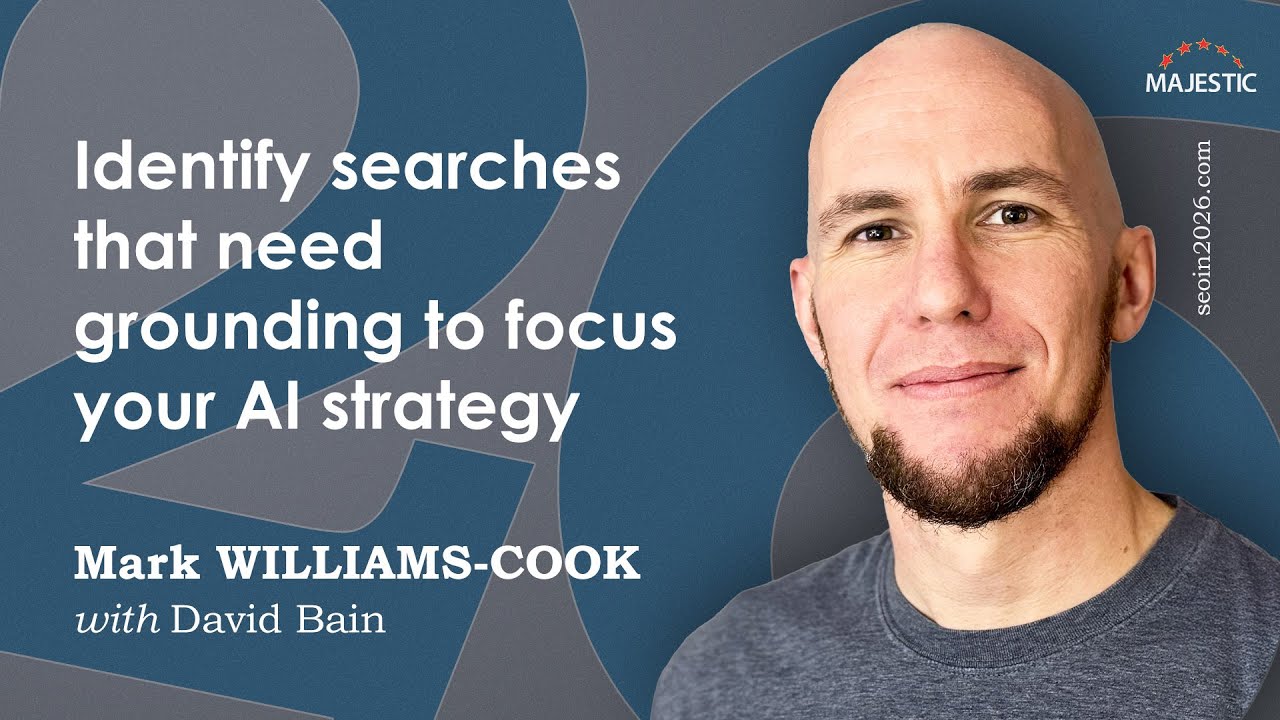
Mark Williams-Cook explains how AI search engines decide whether to search the live web for answers. Grounded queries can be influenced through content and PR, while non-grounded ones are locked in the model's training data. You can predict grounding using ChatGPT's search_prob metric or Google's Grounding API, then build SEO strategy around which queries will actually pull fresh information.
Chapters
Even if you're doing traditional SEO now, if you're thinking about AI search, it's a multi-site approach. So it's not just about getting your site to rank. It's about getting your service, your brand, your products talked about in all of those results that are coming up and making sure you've got good sentiment that describes what you're doing, because that's what the AI is going to be filtering for. I'm Mark Williams-Cook, and this is SEO in 2026.
Mark, what's your number one SEO tip for 2026?
My tip is I think everyone should be determining whether their AI searches need grounding or not.
Okay, now is this electrical, or what kind of grounding are we talking about here?
So every time you do a search on a large language model-based platform, so think about something like Google's AI mode, which is Gemini or ChatGPT by OpenAI. When you put a prompt in, a query, whatever you want to call it, one of the first things that model does nowadays is determine if the query needs grounding. And what grounding means is whether it needs to go and check its answer on the web for more recent information. So to give you an example, if you did a search for something like, what do red blood cells do? It's highly unlikely that kind of query would need grounding because the answer to that query is not likely to change and it's not likely to need up-to-date information. And the reason the large language models know this is the way they work, which is this whole token prediction thing where they look at all the content on the web and they recognize patterns of content. They'll know when they see this kind of query, this pattern, there's a very kind of sharp bell curve in terms of there's lots of consistency in the answer. It doesn't seem to change over time, so they can be fairly confident There's a good consensus and this is the correct answer. If you ask a question, to give you the other extreme example, like what happened in today's news? If you imagine a large language model looking inside for those kinds of tokens, like what happened in the news today, and then trying to figure out what comes next, it's going to look very different in terms of, from a probability point of view, there isn't a clear, well, this is what I need to say next because It's a topic that regularly changes and it needs outside information. So those kinds of things will require what we call grounding, which is it'll go off and it'll go and do web searches in the background to find information to answer that query for you.
So what does this mean practically for an SEO wondering whether or not it's likely that the SEO is likely to be able to actually get a new up-to-date answer featured quickly within AI search results? Because I would imagine that, um, you would potentially want to target queries that had more grounding required.
Yeah, absolutely. So the reason why I think this tip is important is if you are becoming focused on AI visibility, like lots of people are now, knowing which queries are being grounded is giving you the inside track on which ones you can actually change in a reasonable time period. To kind of describe it, the example I gave earlier, like about red blood cells, that's what I would define as solved knowledge. And the only way to really impact the answers there is to get into the training data of the model, which is a long process. It won't— you won't see the impact of that until there's been a model update. And because of the way it's fetching the information, it's quite a lot of work to change that answer. Whereas conversely, if you know a query has a high chance of being grounded, I've done many demonstrations where we've impacted the results the AI is generating within days. So it's really a massive time saver of, okay, we know this is a topic we're going after and here's 500 kind of questions, but we know 200 of them, for instance, are ones that aren't particularly worth focusing on, at least in the, in the near term.
So is it possible to define the probability of a phrase that requires a lot of grounding and therefore use that to assist with your deciding whether or not you're going to be targeting a particular keyword phrase and writing content for that?
Yes, bang on. So there's a few ways to actually do this. If you're kind of techie, actually, every time you do a search on ChatGPT, if you open up the developer console and go to network, you'll see in there, there's a panel for the conversation. It's called conversation. And it's got some of the kind of information that you're sending to ChatGPT and some of the things it's doing in the background. And it actually generates a thing called search_prob, which is a number 0 to 1 of the probability that query will require grounding. And there is a threshold at which it will decide, okay, I need to go and do a web search. Now that threshold depends on the model you use and even whether you're using a free or paid version of ChatGPT. So I noticed the paid versions. Will be a lot more keen to do web searches, I assume because it costs them money to go and do web searches. The probability threshold's around 0.65 for the free version of ChatGPT. So anything above that, you can be very sure that it's going to go and ground it. The other way you can do it, if you're slightly less techie, but still a bit techie, is There is actually a Google Gemini grounding API, which you can send queries to, and it will tell you whether or not it will ground that query. And really helpfully, and it's kind of the next phase of this process, is it will even tell you what web searches it's going to do in the background. So the example that they give in the Gemini documentation is. If someone asks who wins the like Euro 2024, whatever, it says, okay, I'm going to do these 3 web searches in the background to find this information. Now that does cost a little bit of money. It's about 3 cents per search. So if you are not even that technical, there are some very helpful community members. So Dan Petrovic is one of them, and he's released a couple of public models that you can use. Where you can just paste in lists of keywords and he's trained machine learning models on the output from ChatGPT and Google Gemini. And it can give you a fairly good prediction as to whether that query will be grounded or not. So if you just want a free way to do it, he's got a web interface. You just paste in your 200 keywords. It'll run for a couple of minutes and it'll say, these ones are gonna be grounded and these ones are not going to be grounded.
So the Google Gemini Grounding API certainly sounds interesting. And you can obviously take a keyword phrase, take a prompt, and determine whether or not something is going to require additional searches online for the AI to be comfortable that the information provided is most relevant for the user. And you've obviously talked about a tool there that you can put a number of keyword phrases into to get some results for this. What about uncovering phrases that you don't necessarily know about? Are there tools that you're aware of that you can actually use to uncover potential phrases that you haven't actually actively considered?
Yeah. So this is really interesting, right? So this is how the paradigm has shifted between traditional search and people using AI search, because the traditional search paradigm is you do like these one-shot searches and you use a few keywords and you go to Google and you search for one thing and then You decide what next thing you want to search for. And some people have really good Google-fu, you know, they just know what to search for to get the information they need. Whereas with, take ChatGPT for an example, people are having long old conversations. They're asking questions with 3 or 4 different aspects to it that kind of wouldn't work with a traditional search engine. So you don't need that Google-fu anymore. The LLM is sitting there in the middle and almost acting like an intent decoder. So how do we get from traditional search terms to those conversations? There's a couple of things we do to take us from traditional search to those kind of prompts that people are using. The first is we have a little personalization process. Why this is important is if you were in ChatGPT and you said, hey, I'm a vegan, give me a recipe for tonight. And then 6 hours later, you said, I'm going to start running, recommend me some running shoes. It would say, ah, because you're a vegan, here are some cruelty-free brands and running shoes that don't have leather in. So it's impacted the type of result you're getting. So the first thing we do is we use the ChatGPT API to actually pass over a description of our ideal customer profile. Along with the traditional keywords. So we might say in a prompt to ChatGPT, if I was a middle-aged guy who's just starting running and I'm health conscious and vegan, and I was looking for this information, and then I would pass over the traditional keywords that I'm interested in, you know, like running shoes, that kind of thing. What kind of things might I ask ChatGPT? Now, I've always previously told people. never use LLMs to do keyword research. This is not keyword research in terms of we're not in— this isn't, we're trying to find out what people are typing into Google. This is perfectly aligned with the training data of LLMs because they have hoovered up all of the hyper-specific forums, the Reddit threads where someone says, hey, I'm a 42-year-old guy. I'm just starting running. You know, I'm posting on the vegan subreddit. What trainers You know, might I get? So it's perfect to give you the type of queries those customer profiles might be asking for. And you can ask several. The other dimension we want is what are the next most likely questions that person is going to ask? And that's actually then when we bring in the Also Asked API, which is the Google People Also Ask data. So that's going to give us whatever question we provide, the nearest intent proximity questions. And it's so fascinating looking at these because people are so predictable. So I used this example before with running shoes, right? And then you have the question about how much does a good pair of running shoes cost? And then immediately the next most likely question is something along the lines of how much faster will good running shoes make me? Because people have seen, okay, well, there's a €50 pair and a €200 pair. How do I justify the €200 pair? How much time is it going to take off my 5K? So actually, from a list of, say you had just 100 traditional keywords, once you've pushed them through 2 or 3 different ICPs, once you've asked ChatGPT what kind of queries they're going to generate, you may get 3,000 or 4,000 prompts from that. And it's those prompts then we run through the grounding API or the grounding predictions. We can cut them right back. So then we end up with, these are sets of questions that are very likely to come up in conversations. We know that for sure, because they come from data. They're very likely to be phrased in this way because it mimics how people talk in forums and how they have real conversations with other people, which is how people interact. with those chatbots, with those AI search platforms. And then we know which ones are likely to be grounded. And of course, from the Grounding API, we can then tie each of those to— this is the list of key phrases that the AI search is going to do in the background, which will normally take place on either Google or Bing, depending which search engine you're using.
It's interesting that you talk about Google Gemini Grounding API, but you also talk about ChatGPT there as well. Are both AI search engines quite similar in terms of which types of queries they would require more grounding for?
Yes, they are. Yeah. So I think this has got to do with the initial kind of the language graph and how much consistency there is in the answer they can generate. So what I found particularly interesting is one of the tricky things with traditional keyword research was The same search term could mean 2 different things to 2 different people. And conversely, you might have 10 people wanting the same thing, but all typing in different searches. Yeah. The thing that I found interesting looking at the searches these models are doing is there's a remarkable consistency to how they perform their web searches. Because they have a fairly static, okay, this is the information I need. This is the search I need to trigger to do that. So it's more like you're dealing with one entity almost for those searches. And that gives you then a nice target to aim for because the outcome of this is essentially you have your key phrases for traditional SERP pages that you need to influence to appear in the AI search, because that's the final step, right? And it does vary a little bit from what you might call traditional SEO, because traditional SEO is, this is my website and I would like it to rank high for these queries. Whereas the goal of this is if you've identified, say, 3 or 4 key phrases that we know AI is searching for, the goal is simply to have your information present across as many of those results as possible. So if we continue with the shoe example, and you're trying to sell your brand of shoes, it might be okay, the first 2 are review websites, the 5th one is a blog, we can probably be present in all of those if we send them a sample and talk to them and do some PR with them. Because the AI, of course, is normally summarizing maybe the first 10, 20 results, it's quickly checking them all out. Unlike the human behavior of you do the search, and then a lot of the activity is in those first few results. So it's vital that you're there.
I've also heard you talking about building a pool of synthetic prompts from traditional searches. What does this exactly involve, and how reliable are these searches compared with actual data?
So the synthetic prompt process was essentially what I was describing around taking traditional search and adding this layer of personalization and then expanding the conversation. In terms of how reliable is the data? I would say it's not reliable in terms of this is precisely what someone is typing in because nobody can get that data. The only way to get that data would be to do, you know, very invasive clickstream monitoring on everyone, which just isn't gonna happen with the way privacy laws are going. What I will say though, is it is very accurate in terms of what we want to know, which is What are the actual searches being triggered in the background? Because this is what I was saying about if you have 10 questions that are worded slightly differently, but they mean the same thing, they will all generate the same searches in the background. And that's what we're interested in. So while I don't know precisely the word order that some individuals might use, it doesn't matter because the Google Foo thing is happening. through the LLM, and we have seen a remarkable consistency with them saying, okay, well, they're trying to find out this information. So a sensible thing for me to do a web search for will be these things. And that's why it's such a useful, powerful technique, because that's the thing you need to impact to actually get seen in the end answer.
I'm not sure if grounding or Google Foo gets the word of today, but both of them are pretty impressive. Mark, what's the key takeaway from the tip you shared today?
The key takeaway would be that even if you're doing traditional SEO now, if you're thinking about AI search, it's a multi-site approach. So it's not just about getting your site to rank. It's about getting your service, your brand, your products talked about in all of those results that are coming up and making sure you've got good sentiment that describes what you're doing, because that's what the AI is going to be filtering for.
Mark Williams-Cook is director at Kander and founder of AutoAsk. Find out more over at withcander.co.uk. Mark, thanks so much for being part of SEO in 2026.
Thank you for having me.
I've been your host, David Bain. Get your copy of SEO in 2026, the book, over at seoin2026.com.
More from Mark

LASTCHANCE code for 25% off SearchNorwichXL THIS Thursday! #seo #norwich #snxl


Google asking if I will keep “a monopoly” on cats.txt standard open it to then community 😂 #seo







Google adding big new AI GSC features in the UK (but not because they’re your friend) #seo
