Use AI assistance to validate long-form content that fulfills intent - with Mark Williams-Cook
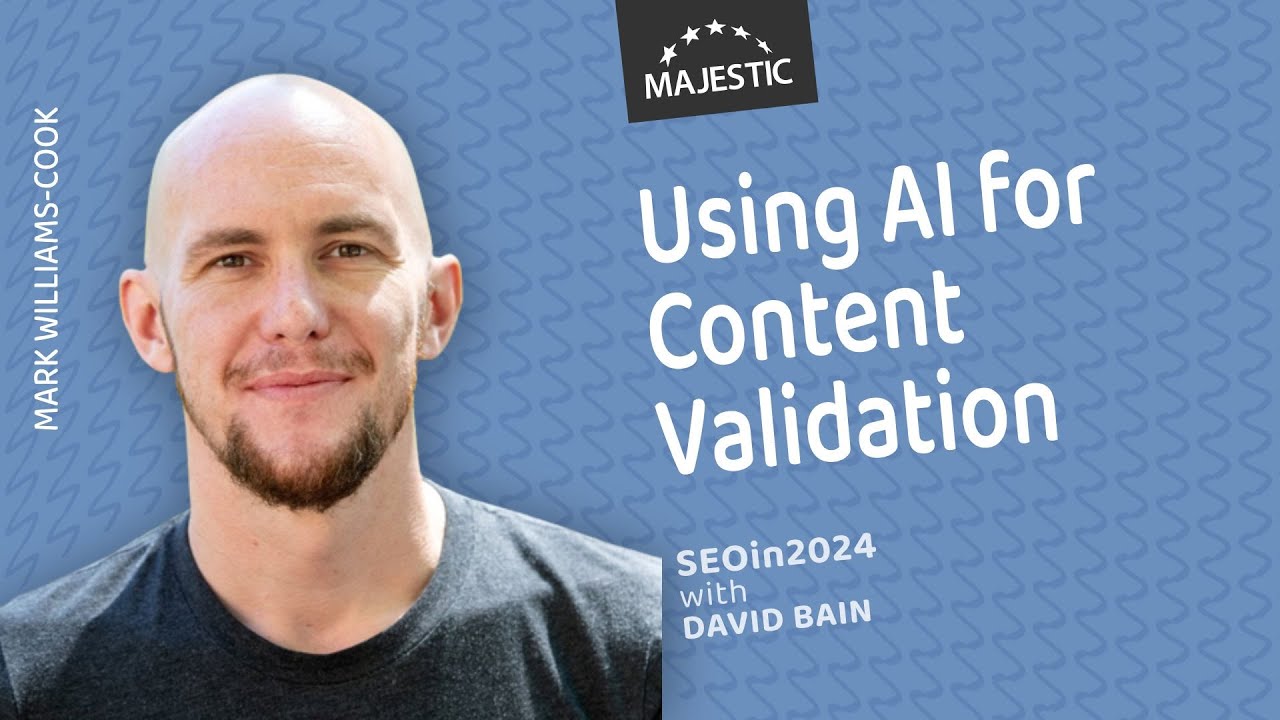
SEO expert Mark Williams-Cook shows how to use ChatGPT to audit long-form content at scale. Feed People Also Ask questions into a prompt with your URL, get back a table of gaps and fixes, then prioritize updates with Sitebulb. He warns LLMs hallucinate on strategy but excel at language analysis, and cautions that fully AI-generated content adds no value after Google's Helpful Content update.
Chapters
I'm Mark Williams-Cook, and this is SEO in 2024.
Mark, what's your number one SEO tip for 2024?
My number one SEO tip is to use AI assistance to validate your long-form content at scale to see if it's answering your users' intent.
Okay, so long-form content at scale. So I guess We should maybe dive into the specific type of content that you're talking about here as well. So do you have a specific type of content in mind?
Well, generally, when we've got companies that are investing in producing content for many, many years, we've been focusing on this kind of aspect of content quality, understanding what users are searching for. So it could be anything from buyer's guides, even actually when I'm saying long form, it can include pages with lots of of content on, even if they're like ecommerce category pages. It's essentially anywhere where we're trying to match complex user intent. So it's actually pretty much any business that's got a website.
Understood. So the validation process is to match user intent?
Yes. Yeah. So if we take a new client on, or if you are engaging with an SEO agency, one of the things that's really common they'll do is a content audit. to try and work out, is the content you've got good? You know, we've got loads of information about expertise, authority, trust, experience, and knowing what we need to look for in content. We've also got reams and reams of keyword research from all kinds of tools that give us hints as to what users are searching for. And you've got all of that wealth of experience within the company of what they know about their customer and what they kind of regularly ask. Now, It's great having all that information, but it's a very long manual task, or it has been, to try and work out if the content we've got for a particular subject answers all of those queries. So I think one of the good uses now for AI, for LLMs, which leans into the strength of how they work, especially now that they can access live, the live web, live URLs. Is using LLMs to feed in that research you've got. So a quick and dirty way we do it, obviously we've got lots of also asked data for people also ask questions. It might be we put in the article title into there and we'll get a few hundred questions out. And we can then actually load that into something like ChatGPT and say, okay, based on these questions, does this content, does this URL answer those questions? And you can very quickly get a turnaround, an idea of, of where you need to improve that content, something that would have taken a very, very long time for someone to kind of manually go through and start picking apart that content. You can do it with all different types of keyword research, whether it is People Also Ask data or suggest data, or even if you have content briefs that you're building. So you're looking to improve the content. And you've got as well opportunities with ChatGPT to use things like their API to scale it. So if you've got 1,000 pages or 5,000 pages you need to check, that's possible to make very quick strides into.
And you mentioned ChatGPT there. Is that your preferred AI?
At the moment for this particular task, yes. I've been, to be honest, very cautious about the use of AI. Because these ChatGPT is built on GPT-4, which is obviously a large language model. And the generative part of these algorithms can lead to what's commonly called hallucinations. So we have to remember how they're working, which is that they're taking tokens and they're making statistical guesses about what comes next. So I've seen people try and use LLMs for things like analyzing SEO data and forming strategies, which I don't think they're really capable of doing yet. You'll certainly get a convincing sounding answer a lot of the time. And that, that, you know, that's what LLMs do. They give you the most probable kind of sounding answer. So they're great at fooling humans. So this particular kind of language analysis task is something I've found through testing that LLMs can do with a high level of accuracy that is useful and saves a lot of time and kind of money. Other stuff, I don't think we're quite there yet.
Lovely. So I'd love to dive into this validation process in a little bit more depth. So just to clarify, so you have an intent in mind for the page, you, I guess, have your content then. So then you create prompts in order to share with ChatGPT what your intended intent is of the page, and then you share the content with it, and then it gives you I guess a list of improvements that you could make to that content.
Yeah, that's pretty much bang on. So we'll have a public URL, which has our keyword research data in. So if I take using People Also Ask as an example, because that kind of keyword data is very suited for like article-level URLs, you can literally a lot of the time, if it's an optimized title, just drop the title of the page into Google, into Also Ask to get that list of, this is the nearest intent questions around this. You can obviously amplify that with other things, like I said, that you know manually, or maybe other suggestions, even something like ChatGPT has. But you have essentially that list of questions in an accessible document online. And then you can build a, to begin with, even a very simple prompt of posting your target URL that you're trying to rank and say, Does this URL answer all of the questions posed on this URL? And then you can kind of form the prompt to say, you know, give the answers in a table, specify in the document where the answer is, where you think the answer is, and highlight any kind of gaps and maybe even suggest fixes for that. So I've seen that executed really well. I've, again, to push that even slightly further, I've seen people experimenting using the actual Search Quality Rater Guidelines PDF. And asking the LLM to evaluate the content against that. It does it well at a basic level, but again, when it comes down to things like page experience, the LLM gets a little bit confused and sort of says there isn't anything about page experience on this page because it's looking for the content rather than that user experience. So again, you have to be careful where you draw the line. But for that initial task of, you know, we've got a new client on board. They've got an existing 2,000 pages of content. We've got some quantitative data about that from analytics, you know, how many visitors it's getting, how well it ranks, what the kind of engagement metrics are. But at this stage, we've got no idea kind of what the coverage is. So this can really quickly give us a, here is an action plan for us, for the client to start moving things in the right direction.
Wow. Okay. So 2,000 pages of content. I mean, it's not the biggest website in the world, but it's still a significant volume of content. So you'd create maybe a Google Sheet with all those URLs and you'd ask ChatGPT to start going through those URLs to see what the intent was and what it was missing?
Yeah, absolutely. So an easy way to do this is normally there'll be a pattern on the website for the type of URLs you want to use. So you can use a tool like Sitebulb or Screaming Frog to get a list of those URL patterns. Tend to prioritize them because obviously you can do as many as you like. But when it comes to, again, to updating content, there's no point giving someone a kind of work list that's the next 3 years of content for them to update. So we tend to focus on maybe particular areas of the site. Because again, when it comes to testing and qualifying the results of what you're doing, it's really good to have almost like a control. So if you've got a website maybe that covers you know, several different categories, you might focus on one particular category, work on improving that content, and then you'll have a control against things you haven't worked on to see how you've impacted, you know, whether it's number of keywords ranked for, impressions, organic clicks, and separate it from, you know, maybe a Google update like the helpful content update.
Interesting. So you tend to focus on a category of content initially, rather than actually maybe trying to identify pages that were just ranking on page 2 of Google and trying to make quick improvements to get quick ranking changes?
You can't, you can't avoid the quick wins. You know, that's always a really good place to start with content. Yeah. So if you have got stuff that's ranking, like you say, on the first page, maybe that's not in the top few rankings, and it is possible to get there. Yeah, absolutely. You'd want to start there, because that's where you'll see impact. But in terms of the broader, how, how do we scale it? You know, you've just got to keep track at the end of the day of what you're working on. If you wanted to work on 50 kind of disparate URLs that fit that criteria, that's fine. As long as you still record them. There's some advantages to having a topical approach because generally what we'll find when we look at rankings, obviously this doesn't apply to every site, but generally Google will favor websites for particular kinds of categories that were inside one kind of topical theme. So normally if you did a Venn diagram, there's normally quite a lot of overlap between maybe those pages, URLs that are performing well and that are related topically.
And in terms of making those content improvements, are there any trends that you're seeing at the moment in terms of content type or format that you require to embellish an existing page?
Yeah, it's a really good question. And it's well timed because we've obviously, we're just now, what, one week out of the end of the helpful content update, which has seen some massive shifts in how websites have been ranking. You know, we've seen sites that have lost like 70, 80% of their traffic that, you know, claim they are good pages. I think it's too early for me to draw conclusions on kind of that latest sprint. The way I would look at it myself is not to focus too much on actually what the pattern of the algorithm is or what the algorithm's looking for, but to focus on that higher strategic goal of, do we have a genuine expert answering these questions? And are we posing the right questions? I think, you know, putting myself out there early on, I think there is some patterns in what I've seen in the sites that have been impacted by the latest helpful content update in terms of how they lay out the content. Maybe too much like an SEO in terms of question, answer, question, answer, question, answer. And that's the actual advantage I've found of using the LLM for precisely for this kind of task, which is that if you have a specific question and you ask the LLM, is this question answered within this page, within this document? It doesn't need to be explicitly written like that on the page. If the answer to that question is embedded within a paragraph somewhere, the LLM seems to be, you know, more than capable of finding that and saying, yes, it's answered. So I think that's a more natural way of writing. And I don't know whether that's a pattern Google's picked up on. It's certainly something that's on my mind now when we're giving content briefs. So that structure to the right people to write the content. So that, and that's something that we've always done. At least at Canda, which is we produce almost no content as an agency. We'll always try and get the kind of what we call the correct person to write about it, whether it's in-house, a client expert, or whether it's a freelance writer that's got a lot of experience in that topic.
And you started off by asking the question, do you have a genuine expert writing that content? Would you ever advise or allow ChatGPT to also write the content for you?
So I think for incredibly generic things that you need to maybe phrase in a certain way, you can use it as a starting point. The reason I don't think it's a good long-term bet though, no, for a couple of reasons. Firstly, if being a large language model, if ChatGPT can generate a suitable answer for that question, then that question is already objectively solved. somewhere else. You are just kind of rewording it. So you're not really adding any additional value. Thinking about Google's search generative experience they're working with, historically looking at Google strategy, it has been to try and keep users on the SERP because that's how they can monetize them best. So the question I would pose myself long-term is if you as an SEO or as a company have access to a large language model, that can generate an answer to a question, why would Google choose to rank your content when they could generate that answer themselves in the SERP if you're not adding any additional value? So I think you have to be very careful where you use content. Some content, you know, you may not be worried about if it ranks and it might still be helpful to users. Maybe that's a place that you can use that kind of content, but for things that we're trying to rank for. I don't think that's a good long-term strategy because essentially you are misaligning yourself or you're aligning yourself against— you're getting in the way of Google making additional revenue, which in my experience isn't a good place to be.
If an SEO is struggling for time, what should they stop doing right now so they can spend more time doing what you suggest in 2024?
Right. So my opinion on this is to stop worrying about— stop analyzing, auditing, disavowing, toxic or spammy links. Now, I've, in conversations I have with a lot of SEOs I speak to regularly, that's just taken as writ, like, it doesn't particularly come up. I found myself when I tend to share that point of view, maybe in other platforms, like LinkedIn is a good example, I have quite a number of people telling me, you know, I'm wrong. And it's really important that you look for spammy links. And you've seen LinkedIn has now started building these AI themselves collaborative articles. And they specifically say some things like toxic links can harm your website and your brand. And you need to be looking at spam scores and toxic link scores, you know, and Google has very flatly said to us, and, you know, reading between the lines here, I don't think there's a reason for them to carefully word this even, that they discount rather than kind of provide penalties for those kinds of links. And that makes perfect sense to me. Because if they had like a negative factor, if you like, a strong negative factor on what they class as bad links, then there would be a whole kind of economy for doing that to your competitors. And we've just seen Bing as well deprecate their link disavow tool because they're kind of so confident that they can identify them. So in my book, if you're spending time doing that, you could be You know, well, there's a lot of other things you could do that would get value, but I'd rather have another good link than get rid of, you know, 10 what someone says are bad links.
Mark Williams-Cook is director at Kander and founder of alsoasked.com. Mark, thanks so much for being part of SEO in 2024.
Thanks.
I've been your host, David Bain. Get your copy of SEO in 2024, the book, over Or at seoin2024.com.
More from Mark

LASTCHANCE code for 25% off SearchNorwichXL THIS Thursday! #seo #norwich #snxl


Google asking if I will keep “a monopoly” on cats.txt standard open it to then community 😂 #seo







Google adding big new AI GSC features in the UK (but not because they’re your friend) #seo
