How I Picked Up 6 Unicorns in 4 Years
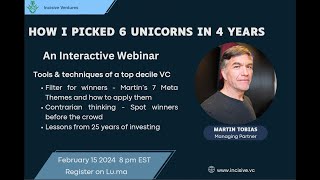
Transcript of a live webinar by Martin G. Tobias (founder & managing partner, Incisive Ventures) describing his pre-seed B2B software investment thesis and process. Tobias outlines seven meta-themes he looks for (software focus, great founders, disruptive innovation/new markets, platforms, 'laziness' value propositions, being helpful, and co-investor quality), reviews six portfolio companies that became unicorns (DocuSign example, Jeeves, Deel, Yassir, OpenSea, others), and answers audience questions about founder qualities, failure modes, sourcing, and founder outreach.
Chapters
Hello everyone. Let me get my slides going here. It. Can everyone see my slides? Hold on. Let me. Hope everyone's doing well tonight. We've got a. We've got about over a hundred people signed up so let me just admit a bunch more people here and we'll wait a just a few minutes. Hope everybody's doing well. It's snowing here for me in Spokane, Washington. See we have a good group of founders as well as lots of investors group. So I'll get going. I was going to Talk for maybe 20 or 30 minutes and then take questions. So I'm Martin Tobias. Hi. I'm the founder and managing partner of Incisive Ventures and we're a small $10 million fund precede fund out of Seattle and I named it Incisive Ventures because I have quite an analytical process about figuring out what companies to invest in and I've been investing for quite a long time and I'll go through my process today of how I picked a couple of companies that ended up being unicorns. So the kind of companies that I like to invest in and this advice about how to pick unicorns is really specific specifically designed for people that are looking for companies in my investment thesis which is B2B software. Picking unicorns in other areas like hardware or biotech or other things might have a slightly different algorithm but I look for pre seed companies that I saw I say reduce friction at scale. I've invested in about 70 companies in the last couple last four years, six of which became unicorns and they've raised over $3 billion in follow on financing. And let me just say a little bit more about me. I'm a three times venture funded CEO. I was took two companies public. I raised over $500 million for my own companies. Prior to starting Incisive Ventures I had started invested in about 250 companies and seen probably 10,000 founders and I was used to work back in the day at Microsoft and Accenture. What I found be important for unicorn. Okay, if you guys wouldn't mind going on mute. Let me see if I can mute all. What I found. You know one of the things I did when I started investing full time about four years ago is I went through all the 250 companies that I had invested in as an angel before. I'm also an LP in 17 funds and I'd seen a lot other companies or other venture capitalists invested and I went through them and I tried to identify, you know, where I had a particular thesis, where I had some particular insight where my network was particularly helpful and where I got lucky. And I think if you're going to try to pick unicorns, trying to figure out where you have unique insight, where you have a counterintuitive thesis and it turns out to be right is a big part of it. Spraying and praying and just investing in anything that sounds good is not a great way to pick unicorns. Throwing darts at a board, you're going to hit a unicorn 0.001% of the time. So what you've got to do, in my opinion, is come up with a little bit of a constrained thesis. And here is mine that I came up with about four years ago that I started investing in again, which ended up picking those six unicorns recently. And that is the seven meta themes that I'm looking for in a B2B software company. And the first one is software eats everything. So I am, like Marc Andreessen said it, I just invest in software companies. So I don't invest, despite the fact that I have invested in companies that were very successful in hardware and drug discovery and crypto and things like that, I just invest in software. The other thing is that I like to invest in great founders. And basically probably 60, 70% of the companies that I invested precede the companies ended up pivoting somehow. And the pivot is a result of a great founder listening to the market and adjusting to the market. Many of the companies that you've heard about that are unicorns started out as something different and you know, trying to figure out if a founder early, you know, is a great founder, is part of, part of it. I've Talked to over 10,000 founders and I can tell within the first 10 or 15 minutes if the founder that I'm talking to is one of the top 5% of the founders I've ever met. And part of this is having a lot of pattern matching. Venture capital and investing is very much a pattern matching game. I don't go for many of the patterns that some VCs do, but certainly having met a bunch of founders, seen a bunch of different business models is a huge advantage. The third thing is disruptive innovation creates new markets. I love investing today in markets that are underrepresented. Weird markets like construction, supply chain storage units, places where people aren't building software or thinking about how disruptive innovation can create a new market. I'd much rather be investing in a founder who's trying to create demand for a new market as opposed to one that's competing against 30 other other venture funded companies, for example, like how big was the market for ride sharing before Uber? It was zero. The ride sharing market didn't exist. How big was renting people's couches before Airbnb? It was zero. It didn't exist. So part of picking unicorns is taking a chance on found that are going to create a whole new market category. The other one is platforms win. I'll talk a little later about. I was a very early investor in DocuSign and one of the early questions why it was a little hard to raise money for docu sign in the first place was is this a feature signing things on your phone? Or could this be a platform that includes workflow and document management and stuff like that? They ended up turning it into a platform and platforms are worth much more than features. And so, you know, one of the in software anyway, if you're investing in a company that could become a platform that has a higher likelihood of being an outlier than anything else. Another thing is laziness wins. I remember when I was early, like in 2003 or something, whenever Starbucks went public, Starbucks was going public and I called a friend of mine and said should I invest? And he said, they're selling a legal addictive drug that you could make at home for 10 cents but you'll pay $3 for in the drive thru. That was really enabling laziness. Anything which makes certainly Americans able to, you know, do less work can be a great investment. I also only invest where I can be helpful to the company. That was purely obvious when I went through the 250 angel investments that I'd done before in the cases where I was investing in B2B software companies where I could help them get some customers from my contacts at Microsoft or help them introduce them to other investors through the venture funds that I'm an lpn. Those companies ended up doing better because I was actually able to help them. I know every VC says they want to be helpful and there's a lot of skepticism out there in that. But I found that the companies that I have been more engaged with have been some of the more better performing companies, companies in my portfolio. The other, the last theme that I invest behind is only to invest alongside other smart, committed people. And I've heard a lot of founders, you know, going out and telling people, hey, so and so is investing. I remember I was pitched this company one time and they said, Peter Thiel is investing. And I said, oh really? How much is he investing? A hundred thousand dollars. And I said, did you talk to Peter he said no, it was one of his guys. $100,000 for Peter Thiel is like 5 cents lost in a cushion. He probably didn't even know that the investment was being made. So that is not a committed investor. And Peter Thiel's certainly smart, but he was not really engaged in this company. So if there are other very smart people, I think a lot of venture capitalists tend to overvalue the co investor signal. Like who else is investing? I never ask who else is investing before I decide whether I'm going to invest in company, but after I decide, I want to know who else is on the team, what their superpowers are. And hopefully their superpowers are complementary to my superpowers. And I've certainly found in investing in unicorns, you got to have, it's a team effort. And so you've got to really hopefully have a good team on the investor side for you. So let me go through the six investments that I've made in the last four years. It ended up being unicorns. You see them there, Jeeves and Deal and OpenSea and some others there. I'm going to go into a couple of them specifically. But overall my portfolio in the last four years is performing about 36% IRR. And the more important thing is that 70% of my pre seed investments have received follow on financing. And certainly if you're an early investor, the trick to being more successful as an early investor is to get your companies funded in follow on financing in the seed or the series A at a higher rate than average. That 70% rate is two and a half times higher than the average pre seed company in Pitchbook. If you look up In PitchBook, only 30% of pre seed funded companies receive follow on financing. That means there's a 70% failure rate in pre seed. Maybe not 70, maybe like 65, because maybe 5% of them end up getting profitable. But the reality is if you're going to be an early investor, the trick is that those companies have to raise more money. And if you have a system and a process to help them raise more money, for example, being an LP in a bunch of funds like I am, or having some software that helps you make introductions to companies on the follow on basis, you have a higher ability to help those companies. And those companies never become unicorns if they don't raise additional financing. So I wanted to go now into just a couple of companies that I invested in early and talk about what my thesis was that at the time might have been a little counterintuitive but turned out to be correct. I already talked a little bit about DocuSign. You know, it has a couple of the themes. One is that, you know, they had a software invention that, you know, radically improved one specific business process. And the bet was that it could become a platform, not a feature. And frankly, it was hard to raise money for DocuSign in the beginning because a lot of people thought, hey, you know, Adobe could write that in like five seconds. But it turned out that they added a whole bunch of workflow around signing order and integration to real estate, form managers and other things that turned out that they were able to turn it into a platform. The other important thing, and you'll see this on everyone here, is I asked myself, could this company, if it's creating a new market, which DocuSign was, there was no nobody creating that feature yet can this company become a leader in that plat in that deal? Because the reality is companies that create new markets and our leaders in that market end up creating an order of magnitude more value than the followers. And you probably know with DocuSign there were lots of companies that ended up copying them. Ecosign, hello Sign and others. But when you look at the enterprise value that was created by DocuSign versus the other ones, it was approximately 100 times more value. And that was because they created the category and they were the leader in the category despite the fact that there was follow on competition. The leader ends up being valued at a multiple of times over the followers. And if you happen to be invested in the company that's a leader that had or that could be a leader, that ends up being a higher percentage of probability that could be a unicorn. Let's talk about the next company, Jeeves. Jeeves is a fintech in Latin America and they were basically trying to create the Brex of Latin America. And what Brex did, which was really amazing, was that they said, you know, rather than, when I'm looking at a small business, rather than underwriting the personal credit of the founder of that company, we're going to look at the cash balances in the business and underwrite the business. That had never been done in credit before. And that's why they became a unicorn very quickly, is because they changed the underwriting, they expanded credit. So my bet was, my bet was could, could Jeeves replicate this model in Latin America and could they be the leader in Latin America? It turns out that they were able to replicate it and localize it and they were able to, to be the leader in that category. The third was Deal, and some of you may know, Deal, it's an employer of record and the current employment employer of records. And I had used all of them when I was a CEO. The leader was Trinet. Trinet wrote their software in the 80s. It was in terrible software. It was had very low npss. And it was just an industry with very low, very poor software and very low npss. And so the thesis there was, hey, could create on a modern platform, better user interface. And by the way, we can start with international employees. And everybody was thinking about remote first teams at that time. And they actually got hit the timing exactly right. Just, you know, before COVID and everything. And Covid really put a supercharger underneath their business. But the bet was that they could make a better version of the software that had very low NPSS in the current market. And they were able to do that. They started internationally and then they recently, about six months ago, opened up employer of record in the United States and are competing directly with Trinet. And I use that company here and it's amazing. But again, it was software that reduced friction in that market of being an employer of record. The fourth company is Yasir, which was a super app in Latin America. You know, you can book a car, you can do grocery delivery, there's some fintech and stuff like that. And what I saw happening in Latin America at the time was that a lot of people were trying to basically replicate the individual apps that had been built in the American market for those different features. But Yasir was one of the first to come up with this idea of a super app. And the bet was, well, maybe in this other market that's very early in its adoption, rather than having five different apps, people would prefer one and you know, the localization with the languages and all of that stuff, it seemed like an interesting opportunity. They were certainly able to do that and convince people to use a super app instead of multiple apps. And that became the standard way in Latin America for people to do many of these things versus the dedicated apps. And that was counterintuitive at the time because people thought, well, Uber is going to be the Uber of Latin America. But it turned out that the consumers down there would rather have a single app than multiple apps. And that was the bet. It was counterintuitive, but it turned out to be correct. The last one I wanted to talk a little more about was opensea. Now I'm not a crypto investor, in fact, I'm pretty much a crypto skeptic. But when I met OpenSea and precede during Y Combinator. The thesis was that NFTs and crypto is basically a casino. And what do you want to be in the casino? You want to be the house. You want to be taking a rake on whatever activity happens in there. And so to me, opensea looked like a standard marketplace. And I understand marketplaces. If you're going to be in a casino, you want to be the house. Then the only question was two One, could this company, do you need a new marketplace to sell this asset? Or could these assets be sold on ebay or Amazon? And the answer was no. There were technical reasons you had to sell NFTs in a new marketplace. And then the second question, which is the same for all of these, is, could this company be the leader in this category? And they were one of the first and they ended up being the leader. Now, that company was the absolute fastest company to unicorn and in fact the fastest company to a deacorn. I invested at a $24 million valuation. Two years later, they raised at $13.8 billion. Now NFT has kind of gone off. You know, it's not the popular thing anymore. In the secondary market, they're trading around 2 billion, so it's down from the top, but it's still a unicorn and it's still a leader. And the reality is that they are a leader in their space. And my thesis of could they be a leader and do you need a different marketplace? Turned out to be correct. And it was also a little bit counterintuitive at the time. So let me talk about one more thing that VCs need to be good at. If you ask yourself, you know, and, and what, what do you need to do to support companies that could be a unicorn? VCs basically do need to be good at four things. One, they have to be good at sourcing companies. They have to attract the best founders to, to work with you. When I was an angel investor and looking at companies, I saw 20 or 25 companies a month. As a professional VC, I need, I now see over 300 companies a month. You have again, VC is a pattern matching game. So you have to see a lot of opportunities in order to make good decisions on your pattern. If you don't have enough deal flow, it's very hard to understand who's building what and to see the differences between founding teams. And it would be much harder to pick unicorns if you didn't have sufficient sourcing. The second thing a VC has to do is win the deal, convince the founder to Take my money instead of somebody else's money. From my perspective, I mean I've been a three times venture funded CEO. I've raised over $500 million. When I'm talking to companies that are in B2B software, which you know, are the kind of companies I used to run, I'm able to sit in their shoes and, and really create a lot of understanding and empathy. That's the other reason I recommend that founders, you know, search out VCs that you know, have worked in a related industry where they could hopefully understand the kind of things you're going through and could help you with business development. If you don't win a slot in a company that is potentially a unicorn, you, you, you won't pick a unicorn. The third thing VCs have to do is be supporting companies in their portfolio. And every VC has a different ability or you know, superpower to support companies. Mine is per is exactly helping companies raise follow on financing. As a pre seed investor, I already mentioned that 70% of my companies receive follow on financing. And certainly in those first one or two rounds if you don't raise the follow on financing, you never become a unicorn. So If I have 70% of my companies raising follow on financing versus 30% in a normal early stage investor, I have two and a half times more companies that could potentially become unicorns. And at the end of the day it's a numbers game. So you want to have enough companies that survive to potentially make it to that status. And the last thing VCs of course have to do is provide good returns both for their LPs as well as for their, for their founders. I'll skip that slide about value add. Let me just summarize on what I think it's important to do to pick unicorns and then I'd love to take some questions and I know we have a lot of them, so I will. You can either put them in chat or just come off mute after I do this. So to summarize what I think is important, what I have found in my personal experience picking companies and investing in six unicorns these last four years, is that as an investor you should have a constrained thesis that's based on your network, your experience and a particular business model that you're looking for that you can add value to. I think it's very hard to pick unicorns if you would be willing to invest in any company anywhere. You also need to meet thousands of founders. You have to be able to pattern match the team that's in front of you against literally thousands of other teams that you've seen. And I remember I was at a trade show one time and I was sitting at a table with Elon Musk, and I'd never met Elon before, but literally within five minutes you could tell that this is one of the smartest persons that I, that I'd ever met. And, you know, whatever he wanted to do, I would love to give him money. That's the kind of sense that you need to have if you're going to pick companies that end up being unicorns. You have to understand if this team that's in front of you is in the top 5% of teams that you've ever met. And if you've only seen 100 or 200 founders, it's really hard to have seen enough to, to, to know what the outliers could be. The third thing is you really need to understand the cycle and the current trends. I've been investing for over 25 years, and I'm what they're calling on Twitter now, a three cycle investor. So I was investing after the crash of 2000, after the crash of 2008 and 2020. And venture capital goes in cycles. You know, sectors are hot. You know, crypto was hot a little while ago. Now it's not. AI is hot now, at some point it will not be hot. And you have to understand as an investor where you are in the cycle and do you want to be investing at the top of the cycle or the bottom of the cycle? It turns out if you look historically that investors who started, who put capital to work after crashes, for example, 2001, 2002, 2009, ended up doing better. They were countercyclical investors. They're investing when people were, you know, it's like Warren Buffett said, be, you know, greedy while people are pessimistic. And the other way around, I forget exactly what it was. But what you want to be doing is you want to be investing in countercyclically. You don't want to be the guy investing in the hot category at a premium valuation. You, you want to understand where you are in the cycle and be diligent on, on that. You also need to look at, you know, current trends and understand if the trends are in your favor. I posted something on Twitter the other day. I bought a new iPhone last week. The iPhone has a terabyte of storage, you know, studio quality camera and all these apps and Internet connectivity. In 2007, I spent $100,000 for a terabyte of disk storage and $50,000 on a, on a studio quality video camera. I don't know any other industry that has had that amount of price deflation in it. You know, 100x deflation over 15 years. If you're in an industry that has that sort of deflation going on or that sort of innovation cycle going on, those trends are going to be, if they're in favor of your investment thesis, are going to be very powerful. And you have to understand what those trends are. And you need to add value to your investment beyond your capital. Capital is pretty much a commodity. And I think to be able to win allocations in very competitive companies, you have to offer, offer some unique value. The last thing you need to do to pick unicorns is to make enough investments. Angellist posted something on their data site about six months ago and they said that an individual investor has to make approximately 300 investments to pick one unicorn and on their platform. And that's very hard for normal investors to do. And I was talking to this company which is an algorithmic series B trading or pro rata investment company. They have a database of every VC and every angel investor in the country. And they said that my Track record of 6 unicorns out of 74 investments is top 10 investors in their entire database of tens of thousands of investors. You know, it's very unusual to have that percentage. I don't know if I can replicate it in the future. I've just told you what model I'm using to do it. But in order to pick something that could potentially, you know, only occurs 0.01% of the time, you have to make a lot of investments. And it's very hard for individual investors to do that. But it's easier if you're a limited partner in venture funds that are going to screen all those companies for you. But those are the best things that I have for picking unicorns. And I would. Let me stop sharing my thing here and go to questions. Sophia. Okay.
Can you.
Hi.
Hi Martin. Thank you for organizing the webinar and for the presentation. My question was about great founders. You mentioned that you can identify great founders within minutes of meeting that person. What do you think, in your opinion makes a great founder? Well, it's different for different ones. Whether you're a technical founder or a business founder. You know, if you look at the research that has been done on unicorns, the average founder of a unicorn is a, has at least 10 years of work experience and has at least two, sometimes three co founders. You know, solo founders are much Less likely to become unicorns. It's a hard job to do by yourself, and you have to have a certain amount of business experience. There actually is no technical difference between technical founders and business founders. Rough there. It's roughly 50, 50. There's no advantage to being a technical or a business founder. There's no correlation to unicorns. And where you went to school, you might have heard a lot of that around Silicon Valley. There's actually plenty of unicorn founders that dropped out of school or never didn't go to a fancy school. So I don't care about schools. I don't care about necessarily where you worked. I care about how hard you worked and if you've worked enough to understand some market or have some unique insight. In my experience, the best founders are solving some sort of a personal problem. Kind of the worst way to pitch for a founder to pitch is to say, I read this Gartner report and this one market segment is going to be big, so I'm building in that segment. The better founders are ones that are like, you know, I invested in this company called Vega Cloud. They do software which helps you, right, size your cloud and reduce your cloud expense. The founder of that company for 10 years had run a managed service provider and done the same thing, but done it all with systems engineers. And he was very frustrated in the scalability of that and the fact that it couldn't scale because it was a people business. So he said, basically, I'm going to go solve the same problem I've been trying to solve for 10 years, but I'm going to do it in software instead of people. That is an example of a great founder. He has unique insight or lots of insight into a particular market. He has a different approach to a problem he's been trying to solve before. It's his second time trying to solve it. You know, that, that, that is great. Another thing which makes a great founder in my experience is a guy or girl who can really be great at recruiting people. There's actually an algorithm that I have that can figure out what's called a talent magnet score. And if you look back historically on your LinkedIn profile, you can tell whether when a guy moves from one company to another, if a whole bunch of other smart people follow him or her. And it's been highly correlated to successful founders if other people who've worked for them before or worked in related industries will follow them to a new thing that's incredibly highly correlated to great founders is you have to be able to get, you know, people to join your party, to go along for the ride with you and hopefully you've been able to prove that in some way. Does that answer your question? Yes. Perfect. Thank you so much, Martin. Thank you Wendell. Go ahead.
Hi Martin, thanks again for the webinar as well. My question is it's great to hear about the successes. I'm curious about how you learn from failure. Most VC vets don't work out and I'm particularly interested in instances where you applied your framework perfectly and met all your criteria and it still didn't work out. What did you take from those lessons and what should we as investors learn from those?
Well, the funny thing is even with 6 unicorns out of 74, I mean not all 68 of them are going to fail, but likely 50 of them are going to fail. Right? I'm going to be wrong more than I'm right. The, the, the, the, the. And you know what tends to kill company companies? The number one thing is they run out of money. And that's why I focus on follow on financing. And as a value add is if the companies can't raise additional financing, they're going to fail early. The second thing that ends up killing companies is, you know, never finding a product market fit. You come up with an idea, you start, you know, selling that idea, but customers just don't end up pulling it in. For example, like with Deal, Deal's pricing and user interface was so much better than Trinet that anybody who saw it would just, you know, use it. It ended up having custom customer pull. Companies that you end up having to push your products tend to fail at a higher rate. If I look at the companies that failed, even companies that got to be quite successful, many times the failures were a result of something that changed in the market. For example, I invested in a company in India that was trying to create a user generated investment investor recommendations for stocks. Kind of like a public dot com for India. And when they started, they had amazing user growth. They had lots of signups, everybody loved it. And then the regulators in India changed the regulations and made it illegal for users to make user generated stock recommendations. You had to have basically a securities license in order to recommend stocks. So something changed in the regulatory environment and in those cases, you know, there's nothing you can do about that. Your original thesis was correct. The market changed around you. Most of the big failures that have happened in my portfolio were something like that, something fundamental in the market that I assumed in the beginning changed a regulatory structure, a pricing structure, something else like that. So what you need to what, what I learned on that is to maybe do a little more diligence up front on things like potential regulatory risk.
Right, okay, thank you. And just a quick follow on. You particularly talk about market pull. Do you think that's more of a diligence process and you know ask more customers from as an investor or.
Well, it's incredibly hard in pre seed to figure out if a company has market pull because they probably haven't sold very much yet. But you know, if, if the core value proposition is incredibly immediate and important, you know you, you can, you know, hope it turns out that way. For example, with Catalyst or not Catalyst, with Vega, which is the cloud configuration platform that I talked about, they pro they thought that they could save 10 or 20% on somebody's cloud bill in the first month. The average customer saves 21% and they got so confident in their ability to save money that they guarantee you a 10 savings in the first month. They, they got confident enough in their product that they were able to provide a guarantee and in fact they only charge they value priced it so they only charge people a percent of the money that they save. If you have this kind of value prop for a company for, for a customer where they don't pay you unless the product works and they see value in the first month, this is an incredibly easy thing to sell. So I look for those kind of easier selling scenarios. The other thing I like in the enterprise is potential bottoms up sales things you know like you've all heard the story of Slack. Slack was the kind of thing that one individual team could start using, get value out of it and then eventually the salespeople would call up the CIO and try to sell them a site license. If you're selling to the enterprise and you have the ab to provide value to an individual or teams and then upsell the enterprise later, that's a much faster time to market easier thing to sell to the enterprise versus having to go in top the way Microsoft or Oracle used to and convince the CIO to make a platform wide change, you know, for a startup. So I look for those kind of differences in how the company's selling to get a proxy for could this be the kind of thing that generates market pull?
Great, thank you for the insights.
All right, thanks. Does anybody else have a question or. Ali. Hey Marty, great to see you. So you've been an LP in a.
Bunch of funds and now are working as a gp.
Are there any specific things outside of like thesis but like best practices that.
You saw as an LP that you are now implementing as a GP.
Well, it's interesting as an LP I see my best performing GPS be very similar to my best performing CEOs and one of the key things there is like communication. For example, I'm sure we've all had the experience as investors. If you don't hear from a CEO for two or three months or four months, it's usually not good news. So managers or CEOs that over communicate to their stakeholders tend to be very good practice things like that. The other thing that I do quite a bit for my fund, which I didn't really get a lot when I was an LP and other funds is try to involve my LPs. Many of my LPs are operating businesses and they help me with diligence in companies and stuff like that. And I think especially for a small fund, if you have LPs who want to get involved involving your LPs in diligence or business development calls. Like for example, I have one LP that is a, that used to own the second largest Apple or in the state of Washington. I was looking at some ag tech companies that wanted to sell to Apple packing houses. I called the guy, said could you tell have a meeting with the CEO and ask him. He said yes. And you know, he helped me diligence that company. I think involving your LPs that want to get involved is a best practice that I didn't traditionally a lot of venture capitalists didn't do. But I think it is a best practice to do as a gp, especially in, in, in a small fund. Thank you. Okay, thanks Ali. Andre, why don't you. You raised your hand.
Yeah. Martin, thank you very much for this presentation. I'm sure this is really interesting for founder, for investors but even for founders this is really interesting. It's a different perspective and I got a kind of question, a two part question. What, what channels have you made available to connect with founders? What have you tried? What has worked and like in the second part would be what's like a big learning and what patterns have you seen that has led to success? When founders connect to you, whether it's like a warm or welcome or like a cold email or stuff like that.
Sure. Okay. Are you a founder, Andrew?
Okay. Yes, yes, sorry.
So you know my email is out there in tons of databases and I get tons of cold email. I'm pretty active on Twitter. I'm happy to answer DMS as well. But one of the things I've done since I get about you know, 300 companies a month now I've actually moved to asking founders to fill out a very short form for me that structures the information because one of the hardest things for a VC to do. And I know some founders don't like forms, but there are, you know, companies that are having a single form, like the common app through OpenVC and stuff like that that can reduce the number of forms. But the reason forms are better for VCs is that it gets the information in a structured format and we can understand the sector that you're building in the stage that you're at, how much money you're raising, how much is left in the round. We get, you know, things like your LinkedIn profile and I have actually written some software that goes out and, you know, scores. Your LinkedIn profile have an AI bot that reads your deck and gives me a score on the deck relative to my thesis. I'm able to do a whole bunch of analysis to see if this is potentially one of the top 10 or 20% of the companies that really fit my thesis. And, you know, if I have a structured database. So for me it's better to, to use the form and it's the reason I am quite active on Twitter as well is that I'm trying to help, you know, tell founders what is great for me. The, the key thing for you as a founder is to find invest is to do research on investors and to find investors who you have a high degree of confidence are interested in what you're investing, what you're building, whether that's a particular sector or a particular stage. For example, I'm a pre seed investor. I define pre seed as you already have a an MVP built and you're selling B2B. I tend to not invest prior to building the MVP. I consider that the angel round. So if you're still building your mvp, I tell everybody that and it's. And I'm probably not the best investor for you at that stage. It doesn't mean I don't like your company, doesn't mean I have any opinion about your business at all. I'm just telling you that for me, it's better if you have an MVP done. And you know, I can communicate that in my form and my emails and my blog and stuff like that. And I really encourage you as a founder to do a little bit of research on the investors. Are they investing at the stage that you are at? You know, what is their average check size? When did they write their last check? You know, are you the right Stage, because the number, I mean, investors and founders are both in this low probability matching game. Game. Right. I end up saying no 99% of the time. Founders end up hearing no 99% of the time. What can improve a low probability matching game? Well, if you target your communications better from both a founder and a venture capitalist perspective. Now, I know a lot of venture capitalists don't like to do that. They put on their website, hey, we love to invest in great founders. And every single founder is like, I'm a great founder. That's okay. But it doesn't really help hone down and get the right founders to talk to the right investors at the right time. And that's the trick to fundraising. You got to talk to the right investor at the right time relative to your traction and their sweet spot. Every investor, even if they say they invest in all stages, has a particular sweet spot that they like. And you need to figure that out, out as soon as possible. If they're not active on Twitter, ask them in the pitch meeting. You know about that, and hopefully you can get some of that as well.
Thank you. This is terrifically useful. Thank you very much.
Yeah. And what was the second part of your question?
Just like, what, what kind of, what kind of patterns of outreach to you have you seen? Or that was like.
It'S the best. If you use the form that's on my website or linked on my, on my, on my Twitter DM. I mean, it's harder for me to answer DMs or emails. If you send me a cold email, you're likely to get a response saying, please use the form. But I answer, I do look at every deal that I get in the form. I do respond to every company that pitches me. And there you go.
Awesome. Thank you very much.
All right, thank you. I don't know if there's anybody else that has a question. I know that. Oh, hey, Ben, why don't you answer? I'm also going through these questions in the chat here. Let me. What's your question, Ben?
So I just had a quick question around MVP versus, like, having a tremendous amount of primary market research. So, like, if a founder comes to you and they say, you know, you know, Martin, I, I haven't invested any money in building an MVP yet, but we have a solid team and we've Talked to maybe 300 of our target customers and they've all said we're good to go. And maybe some of them have thrown Lois on the table. Like, how do you look at that compared to A company with like a built mvp.
That can be enough and it tends to come around to the the co founders experience in the market. Are you a second time? Typically people who can raise money without an MVP are second time founders solving a problem in a market that they know really well. I love that you you know if you've done a couple hundred or whatever customer discovery calls that's certainly better than not. I love how people that have a wait list, you know and things like that. The only reason I tend to want to wait for an MVP is that when you're trying to figure out how much money to raise you got to have a good understanding of your development milestones and your development pipeline. And what I've seen happen is that to change materially after you have an MVP because let's say you come up with three features you think are going to be great and all your you know, customers in your discovery calls think they'll build them and then you build them and then they start to use them and two or three months into it they're like well actually we want this, that and the other thing. It's kind of hard to know how big the precede round should be until you've engaged somewhat with customers. Now obviously having done customer recovery calls is better than not having done them. Having having being an experienced team in a market that you know pretty well is very good. I would, would you know if you were a second or third time founder. I, I would potentially look at companies prior to an mvp but I just personally have found that it's better to wait until you've had some amount of customer feedback because then you can right size the the round and the, the number one reasons why pre seed companies fail is they run out of money because they raise the wrong amount of money. If you raise money before you build the MVP and you think, you think you need $750,000, you build the MVP for a couple hundred grand. You start to engage customers and they give you six months worth of work. All of a sudden you're out of money before you have enough customer traction to raise more money. That's how companies fail. Got it.
That's super helpful, thank you.
Okay, thank you. If there's anybody else who has a question I'm going through. Oh yeah. Yes. Years in North Africa. Ali. I forgot about that. People introduced in you ask Wendell. Oh, here's a question from the chat two part question. What method as a VC of you you tried successful or and failed to make yourself available to founders to reach out and then initial connections. Oh, I think I answered this, but.
Yeah, sorry, Martin, that was mine.
That was you too? Yeah. I also wanted, Let me add another part to that, Andre, and that is for me, having a warm introduction is not necessary. If I look at, I, I made seven investments in new companies last year. Two of those companies were cold outreach from Twitter. I did not get a warm introduction. Five of them were introductions from other managers that I knew. You know, I think I, I, if I Look at the 300 companies that I see every month, approximately 200 of them come to me cold through my form or email. So I get a lot of cold, I do cold deals. I, I, I am not averse to that. You do not need a warm int for me, but you do need to be in the right stage, you know, amount of fundraising and a B2B software company. Surprisingly, despite the fact that on Twitter I say I don't do crypto, I don't do hardware, I don't do drug discovery, some people still fill out my form or send me, you know, hardware deals to do this is highly unlikely for me to do it. I'm a B2B software investor.
May I ask a quick follow up on that?
Super good.
When you say crypto, do you mean all the current, like crypto focused or do you mean like leveraging the blockchain tech and B2B to surpass what a standard web cannot facilitate?
It's surprising how many pitches I'm getting today that are AI pitches that were crypto and entrepreneurs six months ago. It seems like a lot of those founders just want to pivot to whatever the next cool thing is. I'm very skeptical about that. I'm very skeptical about the value of tokens, you know, ICOs and all of this. I have not found even a single use case for, for, for coins, you know, notwithstanding the value of bitcoin. Bitcoin is a completely made up store of value that is 100% sentiment based. There's no use case for it. I'm a B2B software investor. You have to be solving a business problem. Now if that, if a business problem that you're attacking is uniquely solved with some sort of blockchain technology and you can solve it with blockchain in a way that you could not solve it before, but it doesn't require all this crazy, you know, tokenization and warrants and all this stuff potentially. Like for example, I am an AI investor, but I'm investing in AI companies that are solving previously intractable business problems, you know, problems that were too hard to solve without AI. If there's a business problem that, you know, makes a company more money or you know, saves them a significant amount of resources and it is uniquely solved by a particular technology, Even if that's blockchain technology, I would say fine, but I wouldn't call that a crypto company. I would call that at a B2B software company that's using the best, you know, software that's out there. The things that I'm incredibly skeptical of are people that are like, oh, we're going to tokenize houses or we're going to tokenize cars. Like there's a very easy way to buy houses. It's called the multiple listing service. You know, you know, it, it, you don't need all this token to buy houses. And so, you know, I, I would push back and just say you need to solve a fundamental business problem that companies will pay money for.
Thank you. Yeah, thank you very much.
Okay, the last question before we go and thank you everybody for taking your time out late on a Thursday night. Consumer tech SaaS. I'm not exactly sure what that is. Do I do it? I do not do consumer. The problem with consumer, the reason I like B2B is that businesses, if you solve a business problem that generates them more money or saves them material money, they will always have a budget to spend for that. Consumers tend to be fickle and very, you know, up and down on their spending. The other thing is that consumers are very brand conscious or trend conscious and something can be hot for a consumer for like a minute and then all of a sudden it's not the customer acquisition cost. When you're going after consumer is, is very high. You know, I, I just think that consumer is, is, is, is very hard. Not that not being notwithstanding, I have done some consumer apps that turned out to work well like Yasir, but you know, they, they were fundamentally a business app trying to get more revenue for the businesses that they were doing as and, and they had, they were lucky in being able to attract consumers at a pretty low price. I don't like to attract millions of consumers because they're incredibly expensive usually to get in the, and the lifetime value of consumers tends to be less than the lifetime value of enterprises. For example, Vega, the company that does the cloud management, they have a 120% net revenue retention. What that means is that when customers come up for renewal at the end of a year, they buy more of their software. I haven't seen too many consumer apps where the purchases go up over time, except things like Amazon that are already kind of done. So I think consumer is incredibly challenging. That doesn't mean it's not good. There's lots of VCs that focus on consumer and do very well at it. It I was just talking to a partner at Goodwater Capital and they only invest in VCS and they have billions of dollars. Or only invest in consumer. They have billions of dollar under management. They know very well how to manage that risk in consumer. If you're building something in consumer tech, go to a VC that specializes in consumer tech like Goodwater Capital. Thank you everyone for coming. I'll let you go, but if follow me on Twitter and would love to interact with any of you there. Take care.
More from Martin





Product and User Experience, how to make a cure and not a vitamin with Greg Raiz